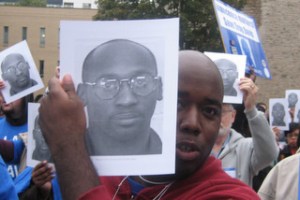
Breaking News. The Supreme Court has just called for an evidentiary hearing in the case of Troy Davis. This is a highly unusual deviation from legal business as usual. As I have explained elsewhere, American courts are remarkably adverse to re-opening cases once a jury has ruled, a defendant has been sentenced, and the appeals process has upheld the conviction. In Tulia, Texas, we didn’t get an evidentiary hearing until Bob Herbert of the New York Times had written six columns on the case, politicians like Hillary Clinton were appealing to the Department of Justice, and the Legal Defense Fund of the NAACP and a legal dream team had entered the fight. In the Troy Davis case, it took the support of folks like Jimmy Carter, Desmond Tutu and His Holiness the Pope to shift the legal balances.
Supreme Court Justice, Antonin Scalia’s reaction (see below) typifies the legal community’s default response to this sort of case. There are two concerns at war in this case. First, there is a concern for finality. Can the legal system continually re-open settled cases every time new evidence emerges? Many jurists feel this would lead to chaos. And there is a concern for justice. Do we really want to send a man to his death when there is strong evidence that, although legally convicted, he is in fact innocent?
Generally, when finality and fairness collide, finality emerges victorious. But in a high-profile case, justices start thinking about how a ruling makes them look, individually and as a group. When legal professionals start thinking this way (and they generally don’t have to) the legal game changes dramatically. (Legal eagles can find an in-depth discussion of the issues at Doug Berman’s blog).
Supreme Court Orders Hearing for Georgia Man
By THE ASSOCIATED PRESS
Published: August 17, 2009
WASHINGTON (AP) — The Supreme Court on Monday ordered a new hearing for death row inmate Troy Davis, whose supporters say is innocent and should be spared from execution for killing a police officer 20 years ago.
Davis has spent 18 years on death row for the 1989 slaying of Savannah, Ga., police officer Mark MacPhail. Davis’ attorneys insist that he is innocent and deserves a new trial because several witnesses at his trial have recanted their testimony.
The high court ordered a federal judge in Georgia to determine whether there is evidence ”that could not have been obtained at the time of trial (that) clearly establishes petitioner’s innocence.”
Defense lawyers had appealed to the Supreme Court after a federal court denied a new trial request in April.
”The substantial risk of putting an innocent man to death clearly provides an adequate justification for holding an evidentiary hearing,” said Justice John Paul Stevens, writing for the court. Justices Ruth Bader Ginsburg and Stephen Breyer concurred with Stevens.
MacPhail was slain 20 years ago while working off-duty as a security guard at a bus station. He had rushed to help a homeless man who had been pistol-whipped at a nearby parking lot, and was shot twice when he approached Davis and two other men. Witnesses identified Davis as the shooter at his 1991 trial.
But Davis’ lawyers say new evidence proves their client was a victim of mistaken identity. They say three people who did not testify at Davis’ trial have said another man confessed to the killing.
The case has attracted worldwide attention, with calls to stop Davis’ execution from former President Jimmy Carter, Pope Benedict XVI and Nobel Peace Prize-winner Desmond Tutu.
But state and federal courts have rejected Davis’ request for a new trial, and state officials have rejected calls for clemency.
Davis was scheduled to be executed on Sept. 23, but it was postponed after the Supreme Court agreed to consider whether he should get a new trial.
Justices Antonin Scalia and Clarence Thomas dissented from the decision to order an evidentiary hearing, with Scalia saying that ”every judicial and executive body that has examined petitioner’s claim has been unpersuaded.”
Davis’ ”claim is a sure loser,” Scalia said. ”Transferring his petition to the District Court is a confusing exercise that can serve no purpose except to delay the state’s execution of its lawful criminal judgment.”
Scalia said the Supreme Court was sending the District Court for the Southern District of Georgia ”on a fool’s errand.”
”That court is directed to consider evidence of actual innocence which has been reviewed and rejected at least three times,” he said.
Justice Sonia Sotomayor, who was just confirmed as a new justice earlier this month, did not take part in the consideration of Davis’ motion, the court said.
 Friends of Justice
Interesting that only the ultra-cons dissented. Not even Alito and Roberts. Don’t know what that may say for the hearings. Probably they need a different judge for the hearings than has been involved in the case. If Judge Self had presided over the Tulia hearings, the outcome would have been far different.
Absolutely, a new judge must hear this new ‘hearing.’ And the media and public light should be kept at all times on the question of police coercion tactics and a general rush to judgment. Press must do their duty to inform, i.e. the company that America keeps with the few remaining countries who advocate state killing. I may be an idealist, but I believe in innocence AND rehabilitation of the human spirit. Prayers are always with those facing inhumanity.
Would it be helpful if we wrote letters to Antonin Scalia and Clarence Thomas? We have to do everything and anything in our power to get Troy freed. What can we do?
Thank you for all you do, Alan.
I have spent this year writing/faxing/calling the people who will sit in judgment of Troy. I really think it helps. My Dad once said, “if you’re doing it, at least 1,000 others are also.” Letters(hard copies) and showing up on the front lines are the most effective voice. Hope all will try to go to rally for Troy, et.al. in D.C. and other locations in Sept. Check out amnestyusa.org for info.
Is there anyone reading this from E. Tenn, or driving through, who could take a paying rider to D.C. rally? I live in remote, inactive community and would like to hook up.
I am concerned that a the GA court will find nothing that ‘could not have been available’ at time of original trial to give unbiased review. Still lots more to do. We cannot rest. Bless all,
I don’t think letters to Scalia and Thomas would necessarily be helpful in the Troy Davis issue. SCOTUS has already dealt with it; it’s now back in the hands of a lower federal court. Writing them could let them know of your position on the matter.