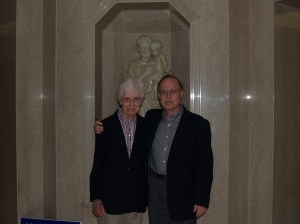
Yesterday I was honored to give a talk to the students of St. Mary-of-the-Woods College near Terre Haute, Indiana. Priscilla Hutton, an Associate with the Sisters of Providence, made sure that representatives from the local newspaper were on hand. To the left I am pictured with Sister Catherine Livers, a wonderful Christian with a sharp mind who, at the tender age of eighty-eight, can still stand on her head. I discuss my encounter with Ms. Hutton and the Sisters of Providence in the article below.
Legal activist: Justice system fails to meet ideals
By Sue Loughlin
The Tribune-Star
TERRE HAUTE — In theory, America has a wonderful criminal justice system based on great ideals.
“It’s just that it fails to meet [those ideals],” Alan Bean said in an interview Tuesday at Providence Center, where he had spoken to St. Mary-of-the-Woods College students.
He is executive director of Friends of Justice, which has brought national media attention and legal representation in what have become some high-profile cases, including a recently resolved case in Jena, La.
Among the organization’s goals are “to make mainstream white people aware that the system does not produce equal justice, and for those who are victims of that fact, we’re trying to make the system live up to” its principles.
“You get what you pay for in the criminal justice system. People who can’t pay for expensive legal representation … Nobody really tells their story very effectively,” Bean said.
For those of poorer socio-economic backgrounds, “If you are innocent or overcharged for a real crime, you can end up doing long years for something you didn’t do or you can end up spending decades in prison for something that a person with more prestige and status in society would serve a very short sentence for,” he said.
Someone once told Bean, who is white, that if you’re black and poor in America, “You live in a police world. That really struck me … It isn’t just race, it isn’t just economics. It’s the convergence of those two,” Bean said.
Bean and his wife Nancy founded the Friends of Justice, which investigates unfolding cases of police and prosecutorial misconduct that are likely to result in wrongful conviction.
Friends of Justice partners with local leadership to launch narrative-based campaigns that connect the affected community to national media, advocacy groups and excellent legal representation.
Bean has worked with the Jena 6 case in Louisiana, which has attracted national attention. In that case, Friends of Justice responded to an appeal from six families in the small Louisiana town of Jena after several days of racially tinged violence led to attempted murder and conspiracy charges being filed against six black high school students.
The case caused school boards across the nation to re-examine disciplinary procedures and several states to revamp hate crime laws. It also launched debate about inequities and systemic racism within the criminal justice system.
The Beans first starting getting involved in the issue in 1999 when a drug bust in their hometown of Tulia, Texas, led to the roundup of 46 people, 39 of them black. The town had only 5,000 people.
The arrests were made based on the false testimony of an undercover agent, according to Bean’s biography.
Bean helped build a coalition of defendants’ families and other concerned citizens who believed the defendants were being prosecuted on faulty evidence.
Because of the work of Friends of Justice, the Texas Legislature eventually passed the Tulia Corroboration bill, which led to the exoneration of dozens of innocent people by raising the evidentiary standards for undercover testimony.
In August 2003, Gov. Rick Perry pardoned the Tulia defendants.
Bean said Tuesday he believes change can, and is, happening.
“I think Americans are good-hearted people, by and large. If you can tell the story and get the facts out in a way that is compelling, you can change the climate of opinion,” he said.
Those making a difference include the Sisters of Providence. An ordained Methodist minister, Bean believes there is a religious dimension to the criminal justice system. Bad religion produces bad justice, he said, while good religion produces good justice.
“I think the Sisters of Providence are a perfect example of good religion challenging the criminal justice system and humanizing it,” Bean said. “We need more religious folks to wrestle with these issues and to get involved.”
He was invited to St. Mary-of-the Woods by Priscilla Hutton, a Sisters of Providence associate. He is on a fact-finding mission to learn more about the case of Donna Stites, who is serving time at the Indiana Women’s Prison in connection with two murders.
Stites is a diabetic on dialysis in poor health who is trying to secure her release; she has been in prison for more than 25 years. Hutton is Stites’ spiritual director, and Stites herself has become an associate Sisters of Providence.
Bean met with Stites, who told him she has changed because of her relationship with the Sisters, who cared about her and loved her. Stites told Bean she is not the same person who was once involved with drugs and who committed murder. She is now a child of God, she told him.
Bean said he might be able to get Stites legal representation to try to win her release. But the main issue, in his mind, “is to get her story out there” and the story of her relationship with the Sisters of Providence.
“Something beautiful is happening,” he said.
Sue Loughlin can be reached at (812) 231-4235 or sue.loughlin@tribstar.com.
 Friends of Justice