This brief summary of the Curtis Flowers case now introduces the extended version of the story on the Friends of Justice website.
A brief introduction to the Curtis Flowers case
On the morning of July 16, 1996, four people were brutally murdered at a furniture store in the small Mississippi town of Winona. By 11:00 am everybody had heard the news: Bertha Tardy, the proprietor of Tardy ‘s Furniture, had been killed execution style. Carmen Rigby, Tardy’s longtime bookkeeper, had suffered the same fate, as had hired hands, Bobo Stewart and Robert Golden. Golden was black, the other three victims were white. Six months later, Curtis Flowers, a young black Winona resident who had worked three days for Bertha Tardy, was arrested and charged with the brutal murder of four innocent people.
Thirteen years, $300,000 and five trials later, Mr. Flowers remains behind bars and the state has been unable to obtain a final conviction.
The first trial was held in Tupelo, MS in 1997 and the second trial was in Gulfport two years later. District Attorney Doug Evans was determined to convict Curtis Flowers four times: once for each cold-hearted murder. It was a risky strategy. To pull it off, Evans had to limit the evidence in each trial to a single victim and that was a virtual impossibility. Evans won guilty verdicts and death sentences in Tupelo and Gulfport, but both trials were overturned by the Mississippi Supreme Court.
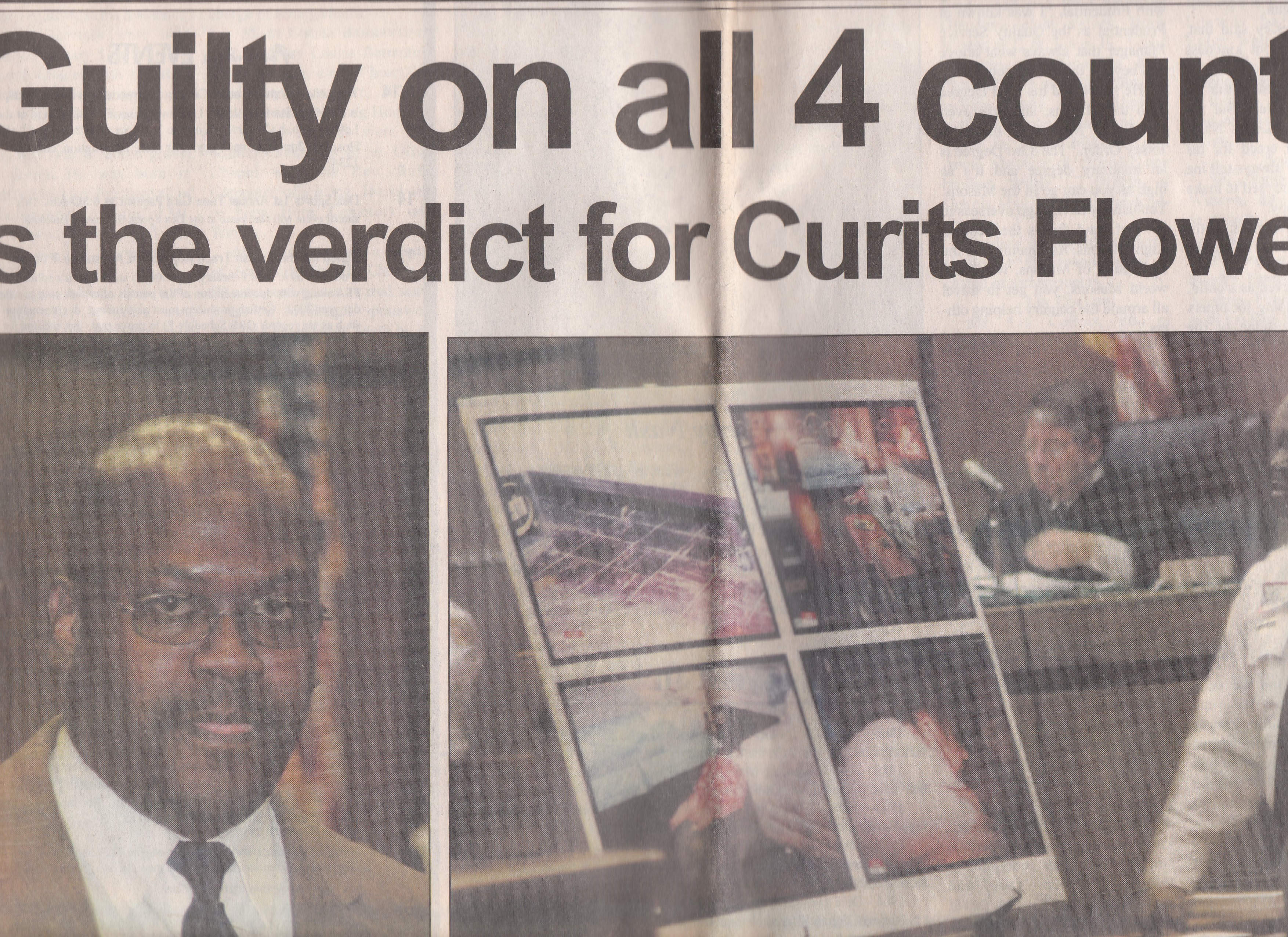
In February of 2004, Curtis Flowers was found guilty, yet again, on four murder counts. The trial was held in Winona, the county seat of Montgomery County. The Winona Times ran a special edition featuring a large head shot of Flowers beside graphic pictures from the murder scene. Victims were shown lying in their own blood. Several residents were outraged by the pictorial spread and wrote angry letters to publisher, Dale Gerstenlager. Gerstenlager responded that, apart from the photographs, readers couldn’t appreciate what a terrible deed Flowers had done.
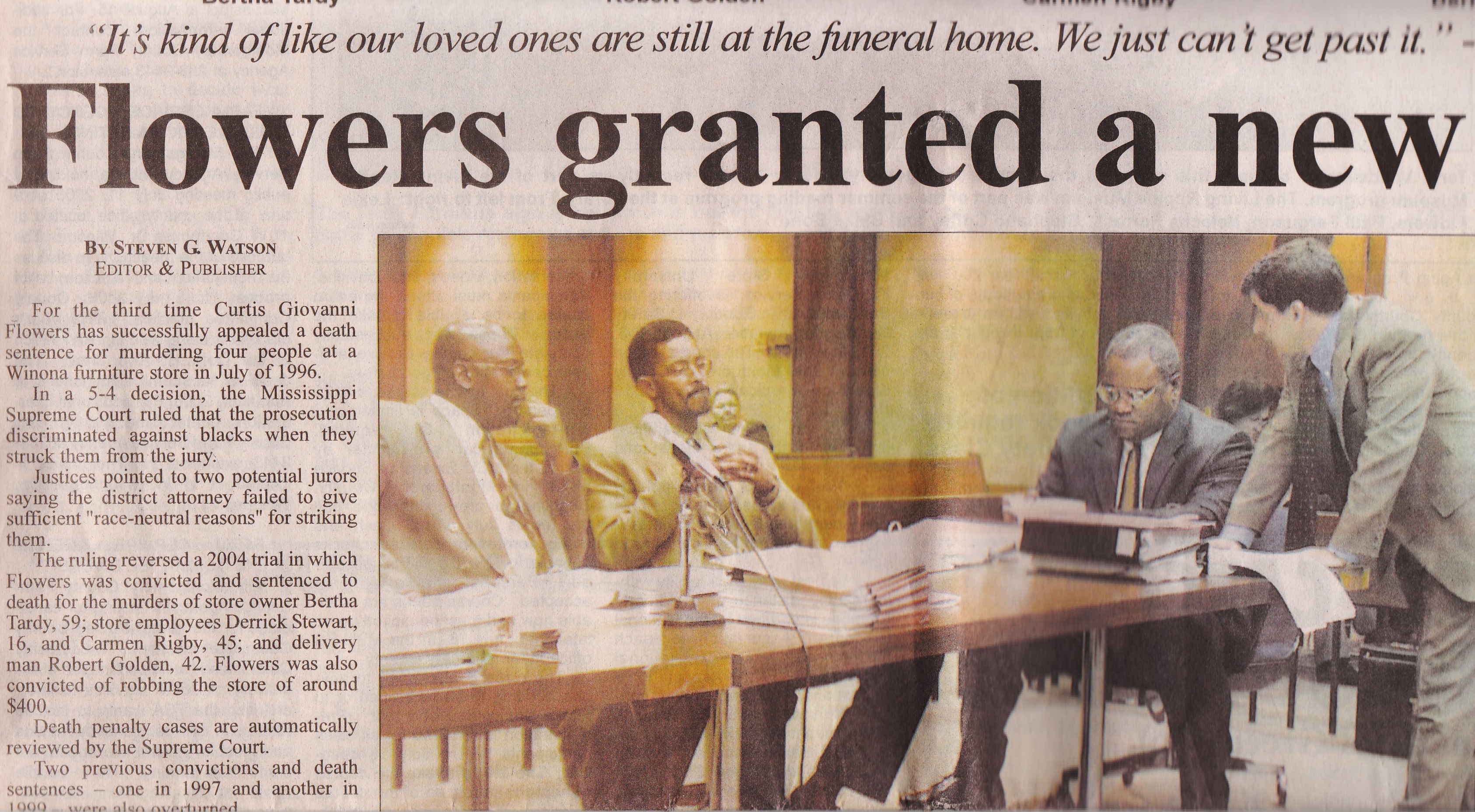
The verdict would not stand. According to former Supreme Court Justice Oliver Diaz, “We reversed because the jury selection process ended up not being fair. Every challenge the state had was used against African Americans and the only African American that was seated was when the state ran out of challenges and could not challenge anymore and one was seated.”
Doug Evans knew he would have a hard time getting a conviction in Winona if even a single African American was seated on the jury. In a county that is half black, a jury with eleven white jurors couldn’t be produced legally, so Evans broke the law.
It was an act of desperation. In Winona’s white community, Flowers’ guilt is a no-brainer–as obvious as the sun in a clear blue sky.
Black jurors have been much harder to convince.
The case against Flowers is circumstantial. He can’t produce a convincing alibi for his activities the morning of the murders. A gunshot residue test taken three hours after the murders found a single micron of residue on the web of his right thumb. But the real clincher was the bloody footprint found at the scene of the crime. Tests prove it was made by a size 10.5 Grant Hill Fila tennis shoe, and a box for precisely that shoe was found in the dresser drawer of the girlfriend Flower’s was living with. Granted, there were no shoes in the box (it was filled with hair ribbons), but the shoe box in the dresser has been the heart of the state’s case.
Doug Evans had the shoe box evidence nailed down within a few weeks of the murders, but Flowers wasn’t arrested until January of 1997, half a year later. In the interim, Evans and his invgestigator, John Johnson, cobbled together a list of witnesses who could trace Flowers’ movements on that fatal morning.
The state’s theory of the crime is relatively simple. Curtis Flowers was angry because Bertha Flowers wanted to deduct $400 worth of damaged batteries from his paycheck. Set on revenge, Flowers rose early on the morning of the crime and walked to the Angelica garment factory, five-to-ten minutes from his home. There, shortly after 7:00 am, Flowers stole a handgun from the car of his uncle, Doyle Simpson. Flowers returned home for a brief period. Then, just after 9:00 am, he walked to the Tardy’s furniture store, killed four people in cold blood, stole $400 from the cash register, ditched the gun, ran home, disposed of his clothes and the Grant Hill Filas he was wearing and stuck the $400 in the headboard of his girlfriend’s bed.
It took six months to find witnesses who could place Flowers at the Angelica factory and along the various routes the state believed he traveled on the day of the crime.
 On the surface, this looks like an airtight case, and it has generally been reported as such (to the extent it has been reported at all). But at Flowers’ fourth trial in December of 2007, all five black jurors voted to acquit while all seven white jurors voted to convict.
A frustrated Doug Evans returned to the Montgomery County courthouse in Winona less than a year later for the fifth trial. Three black jurors were selected, but they were all solidly middle class and well-connected to the white community. Two of the black jurors were willing to trade a guilty verdict for a life sentence. But James Bibbs, a retired Winona school teacher, hung the jury. Judge Joey Loper embodied the outrage of Winona’s white community. He had Bibbs dragged into the courtroom. Loper told the recalitrant juror that he had lied to get on the jury and demanded that DA Evans file perjury charges. Loper then insisted that Evans lobby other Mississippi prosecutors in support of a law that would allow the state to file motions for a change of venue (something only defense attorneys could do).
A bill giving prosecutors the right to call a jury from a multi-county district in cases that went to trial three times without a final conviction was supported by state senator Lydia Chassaniol and state representative Bobby Howell. The bill was introduced in the 2009 legislative session and sailed through the Senate without serious opposition. In the House, however, it was killed in committee by the African American chairman of the house judiciary committee.
The same bill is currently being debated in the Mississippi Legislature.
Meanwhile, Judge Loper and DA Evans were forced to recuse themselves from the case against James Bibbs. The Mississippi Attorney General’s took over the case and promptly dropped the charges due to a lack of evidence.
A sixth trial is scheduled for June 7, 2010. This time, the world will be watching.

Doyle Simpson and his 380 automatic
The gun that ended the lives of Bertha Tardy, Carmen Rigby, Bobo Stewart and Robert Golden belonged to Doyle Simpson. All are agreed on that point. Simpson made two visits to his car on the morning of the crime and reported that his gun had been stolen from a locked glove compartment shortly before the crime was committed. Catherine Snow, one of Simpson’s co-workers, claims she saw Curtis Flowers leaning against Simpson’s car at 7:30 that morning.
But is Doyle Simpson credible under oath? When first interviewed, he told investigators that he bought the weapon from his brother Robert. When that story fell apart, Simpson testified that he bought the gun from a friend named “Ike”. Simpson calls Ike a good friend but doesn’t know his last name.
The murder weapon belonged to Doyle Simpson–that much seems clear. But was the gun in the glove compartment of Simpson’s car the morning of the murders?
Doyle Simpson is no stranger to the streets. He has used drugs and has probably been involved in the drug trade. Back in the day, Simpson’s throat was slit and his body was unceremoniously deposited in a tree outside New Orleans. Miraculously, the Winona hustler survived. But whoever tried to kill him had no regard for human life and dignity. Much like the person who pulled the trigger five times in the Tardy Furniture Store.
On the witness stand, Doyle Simpson has the demeanor of a scared rabbit. Did he make his gun available to some very bad people who made him an offer he couldn’t refuse? In the most recent trial, in September, 2008, Simpson made an interesting slip. Asked to specify when he put the gun in his car, Simpson replied, “The day before they stole it.”
Who, we are left to wonder, are “they”.
More to say on this later. Stay tuned.
 Friends of Justice
I think that this is really a waist of tax payers money. I do not live in Winona, but I do know that if a man is aquitted then he is set free. I do know that if the shoe was on the other foot, and this were 3 blacks that got killed, then this case would have long been over. It is time to stop the racism. I think the investigators should put their focus in other places rather than in one place. Sometimes in life we have to realize that we are not always right, even when it comes to law enforcement. There are people sitting in jail cells and prisons today, who have been falsely accused of crimes. Then states want to compensate them with money, well that doesn’t take the place of time away from your family. I also think that Mr. Evans should be the one on trial, for trying to botch a jury. Fair is Fair. Think about it. “IF THE SHOE WERE ON THE OTHER FOOT”, it has happened for years, and noone has ever been on trial, they all stand around and watch or participate. I do hope that justice is served but, at least try and be fair. If the man isn’t guilty then he isn’t guilty, move on with your investigation, don’t you think you have wasted too much time and tax payers money on this trial.
Maybe you need to tell the same people on the Zimmerman shit
Not sure I get your drift.