 Two bizarre murder investigations raise questions about the state of the American criminal justice system.

Who dat, who dat, who dat say gonna beat dem Saints?
If I had a dollar for every time I heard the Saints famous chant during a long and involved Super Bowl night I could fund Friends of Justice in perpetuity.
I was in Slidell, LA investigating the Kelvin Kaigler story (and a host of related complaints) when I got an invitation from Will Harrell to join him in New Orleans for the big game. I met Will back in the summer of 2000 when he called me in Tulia to see if there would be any more drug trials. I told him Kareem White was up on September 7 and a few days later Will, the newly minted Executive Director of the Texas ACLU was walking into the Swisher County Courtroom.
Although Will and I have spent a lot of time together over the years (he is a very bad influence on this preacher boy) I didn’t know his personal biography very well. Turns out he hails from Yazoo City, Mississippi and lived as a boy in New Orleans. He cheered for the Saints when Archie Manning (father of Payton and Eli) quarterbacked the team. With all the other Saints fans, Will invested most of his life, boy and man, watching the pride of New Orleans slinking off the field in disgrace.
Not surprisingly, Will was captivated by the football game; brimming with hope, bristling with dread. A few former neighbors from Austin had shown up to watch the game at his house, but they met some girls in a bar and never returned. That sort of thing happens a lot in New Orleans.
So it was just me and Will. He showed me the paper mache statue of San Simon he was given during his days in Guatemala, and lit the candles he had placed on either side of the icon. Maybe the patron saint of Latin American freedom could bring the Saints a victory.
With the Colts down by seven and plenty of time on the clock, Paton Manning trotted onto the field. “He thinks he’s gonna win,” Will told me. “There is no doubt in his mind; that’s what makes him so dangerous.”
But the future hall of famer felt the heat from his left side and fired the ball into first-down territoty a second earlier than he would have liked to. Tracy Porter, New Orleans fleet defensive back, cut in front of Manning’s receiver, picked off the pass and raced for the end zone. Forty-three years of frustration had ended.
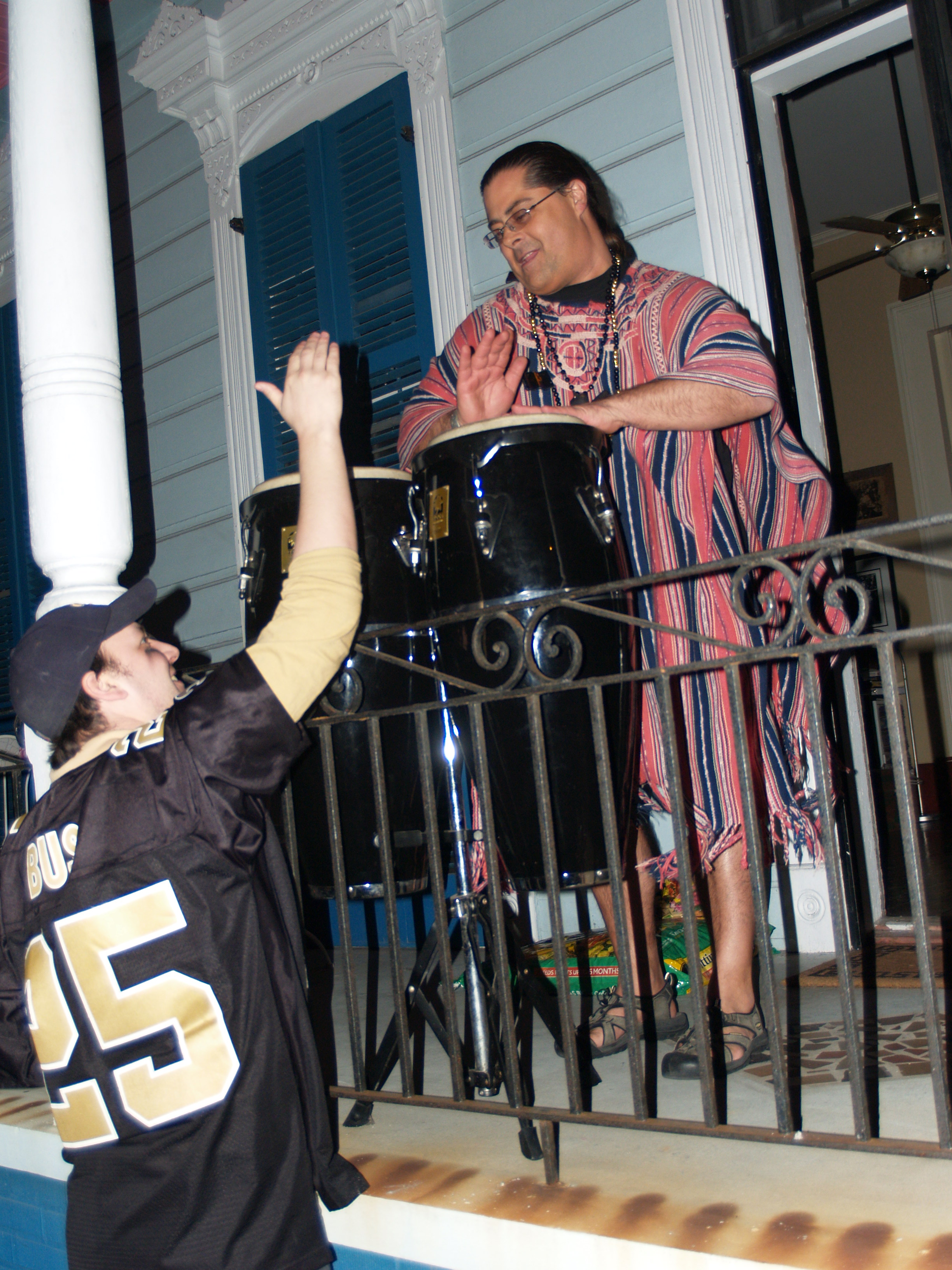 A triumphant Will Harrell, bowed to St. Simon, grabbed his double bongo drum, and headed out to the porch. A stream of jubilant humanity was already flowing down Rue Dauphine toward the French Quarter. I crossed the street to take a picture of costumed kids with “NOLA” scrawled across their foreheads in black marker. They grinned for the camera and tossed me some Mardi gras beads.
By the time I was back to Harrell’s porch he had a smaller bongo slung over his shoulder and was ready to hit the streets. It was only 10:00 pm so I figured I’d tag along for a while–this was history in the making. It never occurred to me that we wouldn’t get back to Will’s place until 5:00 am.
You don’t see real celebration up close very often. This wasn’t your run-of-the-mill championship celebration; this was Easter morning. This was redemption.
As Will and I followed the growing crowd I couldn’t stop thinking about Rodney (Jack) Strain and the anti-New Orleans rant he had delivered three years earlier, particularly the part I failed to quote in my recent Kelvin Kaigler post: “I don’t want to see temporary housing because of Katrina turn into long-term housing for a bunch of thugs and trash that don’t need to be in St. Tammany Parish. We don’t want to wake up one day and find out that New Orleans has been damn successful at running all of the trash out of the city and it end up roosting in St. Tammany.”
At a meeting earlier that day at the Holy Ghost and Fire World Outreach Center in Slidell, Prophetess Kathleen Bacon told me that the High Sheriff was likely referring to the FEMA trailers that sprouted north of Lake Ponchartrain in the wake of hurricane Katrina. Conservative white folk have been fleeing New Orleans for generations. First they fled to the suburbs of Metairie and when upwardly mobile blacks followed suit, folks started moving to the North Shore, settling in places like Covington and Slidell.
Thinking back on Sheriff Jack’s anti-New Orleans rant I was struck by the man’s confidence–it was as if he saw himself as the embodiment of a people scared to death that their righteous way of life was being contaminated from without. I had sensed the same paranoid spirit in a sermon delivered by a Baptist pastor in Jena Louisiana shortly after a white student was beaten senseless at the high school. After celebrating the glories of small town life, the pastor warned his flock that big city vice and violence had invaded their holy Zion in the piney woods. He was referring, of course, to the Jena 6.
 But Strain’s revulsion for New Orleans transcended race. Every race under the sun was on the streets of the French Quarter Super Bowl night, but white folks predominated. But these were not your Grandma’s white people. As Will and I followed the joyful throng we passed by an old-time jug band that was sitting in the doorway of a neighborhood bar. Looking for all world like Charles Manson, the guitarist was strumming his Epiphone guitar and wailing that old Louie Armstrong standard, The Saint James Infirmary Blues: “I went down to the St. James Infirmary, saw my baby there, stretched out on a cold white table, so sweet, so cold, so fair.”
I wondered if Louie Armstrong had ever performed the song in that very establishment. If not, he had sung it within a stones’ throw of the place. St. James Infirmary is a song about the tragic death of a young woman. The song hints that the singer’s “baby” was the victim of foul play. That sort of thing happened in old New Orleans. You run into death on the streets of old New Orleans. A mad waltz between life and death drives the spirit of celebration for which the town is famous. Jack Strain’s St. Tammany Parish is all about light and life (to hear Jack tell it anyway); New Orleans lives in the shadowlands between the light of life and the dark shroud of death.
 There is nothing subtle about this death dance. You see it on the walls of the little bars: skulls, skeletons and other harbingers of death. There is more than a hint of threat and intimidation in some of the costumes I saw on the street Super Bowl night. People were not trying to look pretty or sexy; they were trying to look grotesque and slightly dangerous. And they succeeded.
Still, most of the folks in the pink hair and garish costumes live relatively normal lives and are in little danger of driving over the cliff. Their regular celebrations of animal appetite are only one side of the picture; they are also parents with children to care for and employees with jobs to go to. Moreover, the rules to New Orleans Bacchanalia are solidly anchored in the history of the town–these folks know what to do and how to do it–even when dem Saints win de big game. What could be more reassuringly innocent than a sousaphone blaring out When the Saints go Marching in?
And then there is the traditional role of New Orleans religion. These sinners are also saints. Mardi gras provides one last celebration before Ash Wednesday ushers in the somber season of Lent. There is a rhythm to these things. New Orleans is far more than a party town–at least for those who live there long enough to soak in the history.
On the other hand, Sheriff Jack Strain has a point; a lot of people go off the rails in New Orleans. In fact, many were never on the rails in the first place. Take away the counterbalance of work, family and religion and big cities like New Orleans can get pretty bleak. Thousands of people are too captive to their addictions to celebrate anything. The demand for booze, marijuana and hard narcotics will always be supplied. In the booze category, a rough and ready set of local and state rules apply. For the illegal stuff, only the threat of violence keeps folks honest. When people don’t hold up their end of the contract you can’t take them to small claims court. Bones must be broken–and that’s just for starters.
Back in 1986, Clyde Simpson, a Mississippi boy, was asked to store bales of marijuana in his garage in exchange for $50,000. Clyde had a little painting business at the time and his brother Doyle had come down from Winona to help him. One day somebody broke into Clyde’s garage and stole a few bales of marijuana. That made things contractually complicated. Did the big boys still owe Doyle his $50,000, or did he now owe them? To settle the issue, the big boys decided to take out a hit on poor Clyde.
One morning in December, Doyle Simpson pulled up to Clyde’s place and waited in his car in the driveway for his brother to come out. Doyle didn’t know that a man with a knife and a gun was hiding behind the fence at the side of the house. When Clyde emerged, the man slit his throat like a watermelon and pushed him inside the house. Clyde was in shock. He rushed to the refrigerator to find ice for his throat, but two bullets put him on the floor. As a puddle of blood began to form on the kitchen floor, the man with the knife burst out the front door and caught sight of Doyle waiting in his car. Thinking on his feet, the man climbed into the car, held his gun to Doyle’s head, and told him to drive.
When Doyle had driven fifteen miles west, the man with the knife told him to stop the car. Doyle was handcuffed to a tree. His throat was cut. Two bullets were fired and both found their mark. The man went back to the car to reload his weapon, then, deciding Doyle was dead, climbed into the car and attempted to drive away. But the car was helplessly stuck in the mud, so the man ended up hitching a ride on the highway.
Doyle Simpson found a broken bottle and was able to saw off the limb that tethered him to the tree. He then staggered to the highway, collapsing on the roadway just as a trucker rounded the bend. The driver drove Doyle to the hospital just in time to save his life.
The killer, a hired thug named Horace Toppins Jr, was charged with several counts in two Louisiana parishes and eventually sentenced to 30 years. It looked for all the world like an paid hit, but the victims were low status so nobody traced the crime back to its source.
Ten years later, in 1996, Doyle was back in Winona, Mississippi when somebody sold him a gun. Two months later, four people were gunned down in Tardy’s Furniture Store in Winona, the very morning Doyle reported his gun had been stolen from the glove compartment of his car. Ballistics tests demonstated that whoever killed Bertha Tardy and three employees had used Doyle Simpson’s gun. Doyle was picked up and asked who sold him the gun. Doyle said he got the gun from his step-brother, Robert Campbell.
It was a lie.
Confronted by investigators, Doyle said he had purchased the gun from a friend named “Ike”, but Doyle didn’t know the man’s last name.
Surprisingly, no one has ever pressed Doyle on the Ike question, perhaps because everybody knows its pointless.
But Robert Campbell, Doyle’s half-brother, believes that the mystery man who placed the murder weapon in Doyle’s hands is connected to the Tardy murders. Moreover, Campbell argues that the folks that paid to have Clyde Simpson murdered in 1986 were behind the murders in Winona in 1996.
Independently, I have come to the same conclusion. I have no idea why anyone would want Bertha Tardy dead; but somebody did. Since its hard to find an experienced hitman in Montgomery County, Mississippi, it was natural to look to a big city like Memphis or New Orleans. And if you wanted access to hired killers in the Crescent City, Doyle Simpson (a man who had worked at Tardy Furniture in the past) would be the man to approach.
I am not suggesting that Doyle Simpson was the trigger man, or even that he anticipated the horrible crime. But anyone who has seen the man testify or, like me, read through the transcripts of all five trials, knows that Doyle Simpson makes a frightened witness.
Did anyone steal the murder weapon from Doyle Simpson’s car the morning of July 16, 1996? We have only Doyle’s word for it and, as we have seen, he is not a credible witness. Was the gun stolen at all, or did someone from Doyle’s New Orleans past make an offer the Winona boy couldn’t refuse?
There is little evidence that these questions have ever been asked. Certainly not by Doug Evans, the Mississippi prosecutor who decided the day Bertha Tardy died that an ex-employee named Curtis Flowers did the deed. No other options were ever considered. Evans didn’t want to ruffle feathers in Winona’s white community by suggesting that somebody held a grudge against a well-respected local merchant. Of course, prosecuting Curtis Flowers has ruffled plenty of feathers in Winona’s black community, but Mr. Evans can live with that.
As we have seen, the fabled dark side of New Orleans received national attention ten years after the Tardy murders. As in Winona, four people had been killed execution style in the North Shore town of Slidell. Investigators speculated that Roxy Agoglia, a heroin addict and heroin dealer with roots in New Orleans, had angered the kind of people that came after Clyde Simpson twenty years earlier. Jack Strain certainly thought so. St. Tammany Parish had never seen a quadruple murder. New Orleans trash, Sheriff Jack told the cameras, had invaded the fair precincts of St. Tammany Parish and somebody was going to pay. A young witness told investigators that one of the killers had a scar on one cheek, a tatoo on his arm, and wore dreadlocks. To Sheriff Jack, that description had New Orleans Trash written all over it.
This explains why the first year of the murder investigation into the quadruple murders in Slidell focused on New Orleans heroin dealers with a penchant for violence. An investigator named Scott Davis was focusing his attention on a white heroin dealer who used two black men for “muscle”, one of whom had dreads, a tatoo and a scar. This fit witness testimony perfectly: a white guy waiting in the car while two black assailants pulled off the hit.
Then Gus Bethea had a chat with a Slidell drug dealer named Frank Knight. Frank was one of those denizens of New Orleans who never had a shot at the straight life. His mother was shooting heroin and dealing on the streets when Frank was born. In fact, it was Frank’s mother who suggested that her darling boy should confess to the police.
I know this sounds odd. Why would anyone say they were party to a notoriously violent drug hit if they had nothing to do with the crime? Well, if you are looking at 60 hard years for a multitude of drug-related felonies and the nice man in the uniform is hinting that you might be on the streets in seven years if you sign a confession, you sign the paper. Then you ask what you are signing so you will know what to say on the witness stand.
The New Orleans connection disappeared and Scott Davis was busted from detective to street patrol. The DA’s office had a confession and they knew a St. Tammany jury would buy it. So what if Frank Knight was fabricating a story in exchange for a get-0ut-of-jail-free card; a difficult case would be closed.
Once again, investigators refused to ask the obvious questions. Why would a young man like Kelvin Kaigler murder Roxy Agoglia and three innocent relatives? True, in High School, Kelvin always told his friends that he was from New Orleans; Slidell sounded so uncool. He dropped out of High School, got a job on the riverfront in New Orleans, fell in with the sort of people Jack Strain rails about, and began experimenting with crack cocaine.

Then, about a year before the quadruple murders in Slidell, Kelvin Kaigler’s life underwent a dramatic reversal. He developed a love for Christian rap music and cut off all contact with his former friends in New Orleans. “Kelvin was working in New Orleans when he had a car accident,” neighbor Debbie Callens, told me. “He totalled his car and didn’t want to replace it. He was doing landscaping work aroun the neighborhood and my husband and I had him work in our yard. When that kid smiles, everything lights up. He has a very bkind spirit, very gentle. When you see Kelvin, you can see into his soul. He told me he didn’t want a car because it wanted to stay close to home.”
“We felt like he was turning the corner,” Kelvin’s brother Earl tells me. “The guys he had been hanging with in New Orleans were kind of sketchy; the kind of people that would make money and blow it. But once he settled down, every penny Kelvin made was going into his music and his CD.”
The lyrics on the CD Kelvin released prior to his arrest are an earnest testimony to the dramatic conversion playing out in his soul.

“Something’s missing inside,” he sings. “I’m tryin’ to think of what it could be. All the pain that I’m feeling, all the death that’s all around me. Lookin’ at myself up in the mirror, thinking where I went wrong.”
“No more chains holding me down,” Kelvin declares in another song, “bustin’ loose, flying free. I’m so weak, but the Lord kept me by his side, and brought me through all the rain, no more pain, and from that day, my life could never be the same. No more chains.”
Then everything fell apart. “The first week in August, Mr. John (that’s my father) closes down his barber shop in New Orleans, rents a van, and drives the whole family to Cairo, Georgia, to pick up my mother’s 90 year-old mother. Then we all drive up to Gatlinburg. It’s mostly white tourists up there, but we always have a good time. In 2007, Kelvin came along for the first time in a long time, and that’s when he was arrested. He saw them coming and told Mr. John he might want to open the door. These deputies busted into the room witht their guns drawn the second night the family was up there. One of them said he knew Kelvin didn’t do it, but they thought he might know something. But in the papers they made it look as if Kelvin was a fugitive from justice.
Kelvin Kaigler and Curtis Flowers have a lot in common. Both men love gospel music: Kelvin likes rap and Curtis (a generation older) prefers the traditional sound. Curtis leads the singing at prison church services and Kelvin continues to write rap songs behind bars. When I talked to him in the company of his attorney, Martin Regan, Kelvin was radiant. Like Curtis Flowers, Kaigler has no doubt that he will one day be exonerated. Martin Regan agrees, but knows they face a difficult legal fight.
Kelvin and Curtis share more than a love for gospel music; neither man is capable of killing four people in cold blood and neither man possesses the slightest motive for doing so. Roxy Agoglia, the woman who was murdered in Slidell in 1996, was a heroin dealer murdered because she couldn’t pay her debts. Kelvin Kaigler has no connection to the heroin trade. Neither does James Bishop, the second man Frank Knight says was with him on the fateful night.
Curtis Flowers had no reason to wish any harm to Bertha Tardy. True, Tardy and Flowers had a disagreement over some damaged batteries. “I was with Curtis more than once when Miss Bertha called him,” Robert Campbell told me today. “She was begging him to come back to work, but he wasn’t interested. He told me, ‘I don’t want a job where I deliver a piece of furniture and then, three days later, I go out and haul it back to the store.'”
Curtis Flowers held no personal animus toward Bertha Tardy. The woman gave him an $30 advance on his salary so he could enjoy the Fourth of July Holiday and begged him to return when the work week resumed. But Curtis had already decided to move in with his sister in Dallas where he could make twice the minimum wage salary he was pulling in Winona. The idea that he would kill four innocent people (two of them personal acquaintances) over a minor salary dispute is simply preposterous.
While two innocent men languish in prison the real perpetrators of mass murders in Slidell, Louisiana and Winona, Mississippi continue to ply their dangerous trade, likely on the streets of New Orleans.
 Friends of Justice
It’s a shame that those men had changed their lives and still maybe got framed. Unfortunately, there is way too much VIOLENT crime. Hopefully Horance Toppins Jr is still in jail for a long time. He should have received a death penalty as a hired hit man unless he offered up and the contractor was convicted.
I am SLOW. Please tell me how being involved in a quadruple murder would result in less time (7 years) than multiple drug offences (60)? Did I read this wrong, or ALL ya crazy down there?
I was in NO once in 1994. I got off the Bus Station at around Midnight, there was a crowed going out of the station. A black man got shot three times about 15 people ahead of me. I didn’t see anything due to the crowd. The crowd was primarily Black and NOONE seemed to care. By the time I got up to the dude to see if I could preform first aid he was splattered and DEAD. What shocked me is nobody even seem to notice, run, scream or nothin, they just moved on, like an everyday occurrence!
I then did something very stupid, since I had 8 hours to kill, I walked to the docks to pick up my car that was being shipped from Europe. I walked through the French Quarter and never saw so many passed out Drunks and Dope Addicts sleeping it off in the streets, on the sidewalks and steps to those ole French Quarter houses.
Dr. Bean, I am the man that you met in the Quarter that recited my Grandfather’s poems to you and you asked that I email you “Grandma’s House by Fred N. Scott to you . I had it copywrited in 1984.
Grandma’s House
By Fred N. Scott
At Grandma’s House when I am there
she puts butter on my bread
and sits me in her big armed chair
with a pillow behind my head
she give me coffee in Grandpa’s cup
that’s big almost as a bowl
and one time when I dropped the cup
she didn’t hardly scold
she takes me to the stawberry patch
and give me the biggest ones
to put in a bowl with sugar and such
to eat with candied buns
Grandma says I’m most a man when I put on Grandpa’s hat,
and walk with Grandpa’s walking cane she says “now who is that”?
one night when Grandpa stayed away
she put me in Grandpa’s bed
and the next morning just at day
this is what Grandma said
“Can’t you get up and make a fire for you are Grandma’s man”
I got right up and made that fire as good as Grandpa can
but when I tried to smoke Grandpa’s pipe when she had gone to the kitchen to cook
lord I could tell all about that pipe if’n i was to write a book.
I’m going back to Grandma’s too when the plums and the peaches get ripe
but there’s one thing I won’t do, I won’t smoke Grandpa’s pipe.
DON’T SMOKE
This will be a children’s book as soon as I find someone that can draw.
God bless you
Jackbenny wood should have been Cox
I would like to ask how the conclusion has been drawn that the murders in Slidell and Winona could some how be connected or the possibilty that the murderer/s could have a connection between these cities? I am not at all suggesting that this could be the case, but you certainly are leaving my critical thinking in that direction. Or is that these questions have not been explored? I am a northener with southern roots. And the cases that you post about could be anyone’s story. I follow your posts closely because I am very troubled that injustice of this kind is not national news. If it were not for Friends of Justice I would not have a clue that in the states of Mississippi, Texas, or Louisiana dole out this kind of so called justice.
Thank you so much, Jackbenny wood should have been Cox. I got one decent picture of you and would have included you in the post if I had the poem. If you could remind me about your experience with death and your current calling I’ll do a separate post just for you.
Mamad40. I apologize if I appeared to be making too strong a connection between the killings in 1986, 1996 and 2006. I wasn’t saying that Clyde Simpson, Bertha Tardy and Roxy Agoglia were killed by the same people. I am suggesting that folks in the New Orleans underworld (perhaps associated with a vestige of the Mafia family that once controlled the city) organized all three events. Moreover, I am suggesting that prosecutors are smart enough to know a hired hit when they see one but are reluctant to go after the real bad guys. If they can pressure compromised witnesses into fingering some local black guy they’ll do it. The really scary move comes next: they convince themselves that they really have the right man. It is at this point that these cases take on the kind of Alice in Wonderland quality I first observed in Tulia, Texas.
you have got to be kidding when you say bishop and kelvin are innocent!you obviously know nothing of what they were like.ask them about the others they killed.whether a forced over dose or beating with a bat to forcing people off the road while driving.any body can make someone look like an angel.i believe jesus was with kelvin when he was doing his music but after hurricane katrina people changed,alot.and those two are not innocent.more people didnt come forward because they were afraid of what would happen to them if they did.get your facts before you write.otherwise your like the rest of the media,pure fiction.
Kat:
The “rest of the media” never talks about people like Kaigler and Bishop except to announce, briefly, that they have been convicted. Reporters rarely attend trials, and if they do it’s just to hear the verdict. What you have given above is hearsay evidence. You may know something I don’t. My concern is with the “evidence” that was used to convict these men, and in my opinion that evidence is manufactured and extorted using threats and promises to manipulate weak-willed individuals. I have no idea who really shot the folks in the trailer or why they did it. My narrative simply points out the way the authorities put their case together, something “the rest of the media” rarely bothers to consider.