 Across America, violent crime rates are falling. Homicide rates for 2009 were down sharply, continuing a decade-long trend.
According to the Washington Post, “The national decrease in murder began about two decades ago. In 1991, the national homicide rate hit 9.8 per 100,000 inhabitants, prompting forecasts of permanently rising street violence — then fell to 5.7 in 1999. Many wondered whether this “Great Crime Decline” could be sustained for another 10 years. The answer would appear to be yes: By 2008, the murder rate had drifted down to 5.4 per 100,000, the lowest level since 1965. And given the preliminary figures, the rate for 2009 should be lower still. Indeed, if present trends continue, America will experience a degree of public safety not known since the 1950s.”
This is good news for opponents of the death penalty. Historically, there has been a strong correlation between the homicide rate, popular support for the death penalty and the number of executions. Consider these charts:


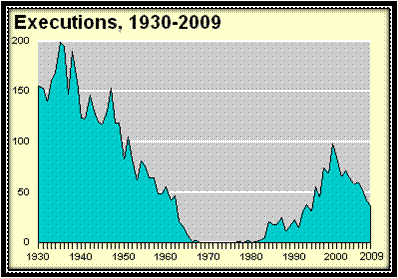
Notice that a drop in the homicide rate is followed by support for the death penalty and the number of executions. Homicide rates spiked during the 1920s and early 1930s, largely due to Prohibition-era turf battles between crime syndicates. The use of the death penalty was extremely high during the 1930s (the first decade for which we have reliable FBI stats), then began to fall.
As the charts above indicate, by the early 1960s, the homicide was comparatively low, support for the death penalty had fallen to around 42% and a virtual moratorium on capital punishment was in effect.
The frightening uptick in the homicide rate during the Reagan administration and the early Clinton years was driven in part by turf battles related to the crack epidemic.
In recent years, as homicide rates have dropped, support for the death penalty has fallen from a high of 80% during the Reagan-Clinton period to around 65% and the use of the death penalty has fallen off sharply–even in Texas.
How do we explain all of this?
Typically, law enforcement receives the credit, but this is probably wishful thinking.
 A more radical suggestion comes from Randolph Roth, a history professor at Ohio State University. This extended quote captures his thesis:
Four similar correlations emerge from an examination of homicide rates in parts of the United States and western Europe throughout the past four centuries:
The belief that government is stable and that its legal and judicial institutions are unbiased and will redress wrongs and protect lives and property.
A feeling of trust in government and the officials who run it, and a belief in their legitimacy.
Patriotism, empathy, and fellow feeling arising from racial, religious, or political solidarity.
The belief that the social hierarchy is legitimate, that one’s position in society is or can be satisfactory and that one can command the respect of others without resorting to violence.
If Roth is onto something (and I think he is), tough-on-crime tactics are counterproductive because they increase the sense of alienation that drives violent crime.
Roth puts it like this:
“It has to do with trust. If I feel empowered, if I feel included in the community, if I feel like I matter to the people around me, if I feel the government will protect me and my family, I can go about my daily life with confidence. Small slights and disagreements don’t bother me as much.
“But if I feel powerless in society, if I feel like I can’t get a fair shake from my government, and feel cut off from my neighbors, it affects how I live my life. Small disagreements and indignities that you may otherwise brush off as insignificant can enrage you, and can in some cases lead to violence and murder.”
The election of Barack Obama is one of the factors driving down the rate of violent crime. A small thing, perhaps, but the election of America’s first non-white president has had a significant impact on young people of color.
Homicide rates during the Reagan-Clinton era were particularly high among African-American youth.
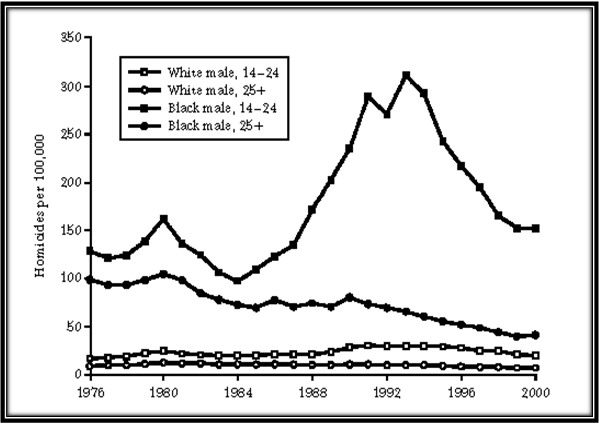
Note that homicide rates for black adults, though comparatively high, were dropping during the post-civil rights era. To get a sense of how catastrophic the homicide rate among young black males became in cities like Baltimore, check out HBO series The Wire.
Baltimore still leads the nation in murders per 100,000 population, but the numbers have been coming down, especially in the first half of 2010.
Placed in historical perspective, the national homicide rate is currently hovering around 5 per 100,000 population, half of what it was during the late 80s and early 90s, but still four times as high as in Canada and Western Europe where rates tend to fluctuate between 0ne and two per 100,000.
The traditional correlation between poverty and crime has been overstated. Crime rates fell during the great depression era and have dropped during the current recession. I also suspect that the billions of dollars we have poured into the war on drugs have had little positive effect.
Roth’s thesis makes more sense. Violent crime is generally driven by rage, despair and a profound sense of alienation. Although you won’t hear many Democratic candidates making the argument, progressive policies are the best antidote to crime.
 Friends of Justice
ABC (Australian Broadcating Commission) TV is broadcasting The Wire currently. The next episode to be broadcast will be Series 4, episode 3.
It is impossible to over-praise this drama. If I were setting up a course on the problems with American society in general and the criminal justice system in particular, I would use this drama as the text. It provides so many illustrations of the dysfunctions in policing, government, schooling and commerce.
So what should the police do?Keeping peace,detecting crimes,often require aggressive policing which may become counterproductive in the long run.
A definition of “tough on crime” might be helpful. Is is simply enforcing the law? Or is it enforcing the law with extra toughness?
Some might view a simple view of requiring personal responsibility for your actions (instead of blaming their environment) as being too tough on crime.
It’s an interesting theory, though with all the variables in criminal behavior I’m not sure that a cause to a decrease in crime can be limited to one aspect (the death penalty, self-esteem policies, etc)
Here’s some additional numbers on the subject.
http://www.homefacts.com/crime.html