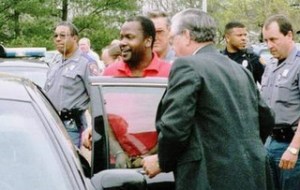
The Greenwood Commonwealth has a reasonably thorough article on the Attorney General’s decision to drop the perjury charges against James Bibbs.
Rod McDuff, Mr. Bibbs’ attorney, told the Commonwealth that “There really wasn’t any evidence to support the charge of perjury. The attorney general’s office examined this very carefully. They agreed to meet with me to discuss the evidence. They then took some additional time to thoroughly analyze the case, and they ended up making the right decision.”
One reader was incensed to learn that the fourth jury to hear the case against Curtis Flowers “divided along racial lines” and thus “could not reach a verdict”.
“What a sad commentary,” the reader exclaimed, “that people may actually be protecting a murderer for no other reason than race. Anyone who would turn a blind eye to the facts of a case, or deny justice based on race should be jailed themselves. It’s a shame that some folks are fine with having an “OJ” walking around free in Montgomery County. Those innocent people were brutally murdered, and there will come a day that God will hold not only the murderer accountable, but anyone who knowingly protected him afterward by ignoring their civic duty.”
This comment makes two logical errors that have made it possible for DA Doug Evans to sell a pathetically weak case to white jurors. First, he assumes that all the ideological bias in Winona lives on the black side of the tracks. It has never occurred to this person that the judgment of white folks might also be subjective. Secondly, he jumps from the undeniable fact that “innocent people were brutally murdered” to the conclusion that Curtis Flowers pulled the trigger.
This error in reasoning is widespread and works powerfully to the advantage of prosecutors. The more violent, senseless and repulsive the crime the more the human heart cries out of justice. Believing that the authorities nailed the right guy feels good. The thought that an innocent man may be convicted feels bad. A pro-prosecution bias emerges from the simple fact that people like feeling good and hate feeling bad.
It isn’t easy to care about due process and the sufficiency of the evidence when people are mourning a tragic loss. Every time Curtis Flowers goes to trial ancient wounds are ripped open and the desire for revenge trumps concerns about fair and impartial justice.
It is easy to argue that if Curtis Flowers must be guilty because the authorities have taken him to trial so many times. But why, if guilt has been proven beyond a reasonable doubt, has the state been unable to nail down a final conviction?
White folks think they know the answer–the niggers is just protecting one of their own.
(By the way, I have never seen the point of filling in one or more letters in nasty words with asterisks or nonesense symbols, as in n*****s, or f*ck. “Nigger” IS an ugly word, but I don’t see how plugging in a few asterisks softens the blow. Nor am I sure the blow should be softened.)
The Flowers case has divided Winona along racial lines and the division appears to be growing. Although I have accused Judge Joey Loper of pitching a hissy fit in the courtroom when he told Doug Evans to prosecute James Bibbs for perjury, there was some method to the jurist’s temporary madness. The idea was to intimidate black residents into not showing up for jury duty or stating that they couldn’t be objective jurors.
A second comment at the end of the Greenwood Commonwealth article reflects the passion this case has evoked in the black community.
Anyone who would send a person to the death chamber based on race should also be jailed. Carroll and Montgomery County jurors have sent innocent people to death chairs and chambers based on race in the past. Research the history of the criminal justice system out there if you think that I am lying. That community should exercise more caution before condemning a person to die. By the way, what do the trumped up charges against Mr. Bibbs suggest to you? The man’s life that was otherwise honorable has been wrecked by a judge who wants nothing less than another Carroll County Massacre.
The “history of the criminal justice system,” is an important issue for black people in the Mississippi Delta. It’s a history white folks are desperate to forget.
Alvin Clay will be staying in the free world while he appeals his conviction. Since his federal trial on mortgage fraud charges in the summer of 2008, the Little Rock attorney has decisively proven that the government’s star witness perjured himself repeatedly under oath.
The evidence suggests that Donny McCuien and Ray Nealy conducted a small-time real estate scam and that Alvin Clay was duped along with a list of buyers and a variety of title and mortgage companies. (When all the dust settled, the buyers in these deals were defrauded of a grand total of $16,000). Two facts are now beyond dispute: (1) the government’s case against Clay was entirely dependent upon the testimony of Donny McCuien and (2) Donny McCuien isn’t credible under oath.
The government’s vindictive motivation in this case was exposed when Donny McCuien’s credibility began to unravel. Instead of moving to vacate Clay’s conviction, the government cut a sweetheart deal with yet-to-be-prosecuted Ray Nealy even though they had mountains of damning documentary evidence against the man and no meaningful evidence at all against Clay. The government couldn’t afford to put the now-discredited Donny McCuien on the stand.
All of this has placed federal judge Leon Holmes in a sticky position. Holmes didn’t want to embarrass the US Attorneys Office; but he didn’t think anyone should go to prison on the word of a character like Donny McCuien. What to do?
Judge Holmes has done everything he could do to minimize the damage without placing himself in an adversarial position with the long list of federal prosecutors associated with this case (he’s got to work with these people, after all). First, Holmes sentenced Clay to five months of federal prison time (it could have been five years). Second, he granted Clay’s motion for release pending appeal.
But Holmes didn’t stop there. Here is the text of yesterday’s release order:
Clay presents eight issues that he believes are close issues or issues that could go either way and which, if ruled upon by the court of appeals in his favor, could result in the reversal of the conviction or a new trial. See United States v. Powell, 761 F.2d 1227, 1230-31 (8th Cir. 1985). The Court agrees that some of the issues presented by Clay are close. The Court also agrees that if decided in favor of Clay, those issues could result in the reversal of the conviction or a new trial. (my emphasis)
This wording is reminiscent of the Texas Court of Criminal Appeal’s ruling on the first round of habeas writs filed in the Tulia cases. In effect, Holmes is signalling to the federal appeals court that they should give Alvin Clay’s case very careful attention.
Alvin Clay should be congratulated for his diligent pursuit of justice. But all is not well. As a convicted felon, Clay can no longer practice law. Furthermore, he and his family have been forced to invest their scant resources in an expensive legal fight.
But if Judge Holmes had refused Clay’s motion, the Little Rock attorney would have been checking into a federal detention facility in Montgomery, Alabama early next week. Now he is free to fight for his own freedom, and that’s very good news indeed!
(This post is part of a series concerning Curtis Flowers, an innocent man convicted of a horrific crime that has divided a small Mississippi town. Information on the Flowers case can be found here.)
Perjury charges against James Bibbs have been dropped by the Mississippi Attorney General’s Office because “The State of Mississippi does not have sufficient evidence to obtain a conviction.”
In other words, this case should never have been prosecuted.
Those wanting some background to the Bibbs prosecution can find it here, but I’ll give you a brief synopsis. At the close of Curtis Flowers’ fourth murder trial, five black jurors voted for acquittal and seven white jurors voted to convict. Things went better for the prosecution in trial five. This time there were only three black jurors and the dynamics in the jury room changed considerably. Two black jurors, realizing they weren’t going to win over their white counterparts, offered to vote guilty if the other side would take the death penalty off the table.
James Bibbs was having none of that. The state hadn’t met it’s burden so Bibbs hung the jury.
Judge Joseph Loper was so incensed that he abandoned all pretence of judicial impartiality or common sense. The man threw a hissy fit in the the courtroom in front of God and everybody. First, Loper ordered DA Doug Evans to charge Bibbs with perjury. Second, Loper told Evans to change the Mississippi law that bars the prosecution from asking for a change of venue.
Like they say, you can’t make this stuff up.
The evidence against Bibbs came from a note passed to Judge Loper by a white juror. During voir dire, Bibbs claimed he didn’t know anything about the Flowers case apart from what was in the paper. In the jury room, Bibbs reported that he was in the alley behind the murder scene on the morning of the murder. This supposedly constituted inside knowledge of some kind and proved that Bibbs (in cahoots with the Flowers family) had lied his way onto the jury.
Hats off to attorney Rob McDuff for getting Loper and Evans recused from this case. Cooler heads prevailed as the Attorney General’s Office gradually backed away from a garbage case. Eventually, they stowed the garbage where it belonged.
What does this portend for Mr. Flowers’ sixth trial scheduled for June 7 of 2010? For one thing, black residents will naturally be intimidated by Mr. Bibbs’ frightening scrape with the law. This, of course, is precisely what the prosecution intended. The more black citizens in the jurors box the less likely it is that Doug Evans and friends can post a conviction. By now, they are royally sick of this case but can’t abide the political and social consequences of doing the right thing.
Hopefully, the Attorney General’s decision to punt on the Bibbs case will reassure Winona’s black residents that some folks in the great state of Mississippi aren’t still living in 1963.
(This post is part of a series concerning Curtis Flowers, an innocent man convicted of a horrific crime that has divided a small Mississippi town. Information on the Flowers case can be found here.)
Remember the Daily Kos poll showing that 47% of southerners had doubts that President Barack Obama was born in Hawaii? What would the numbers look like if the question was posed to white southerners?
Fortunately, we aren’t left to idle speculation. Del Ali of Research 2000 crunched the numbers and concluded that, if the Daily Kos figures are accurate, “the proportion of white Southern voters with doubts about their president’s citizenship may be higher than 70 percent.”
The Daily Kos study applied the “Southern” label to twelve states: Florida, North Carolina, South Carolina, Alabama, Mississippi, Georgia, Virginia, Tennessee, Kentucky, Louisiana, Arkansas, and Texas. Some of these states went blue in 2008 and others were in the swing state category. So, if the 70% figure applies to white Southerners generally, what percentage of white voters in Mississippi, Louisiana and Alabama (where Obama took between 10 and 14% of the white vote) fear the President might be a closet foreigner?
Now, move to small-town Mississippi and ask the same question. Is it possible that upwards of 85% of the white adults in Winona, MS (to choose a town at random) question the citizenship of our president?
And if this figure is inaccurate, is it too high or not high enough?
A couple of Sundays ago, Methodist pastor L. Charles Stovall and I attended a small but vital Missionary Baptist church in Winona. According to the tradition of the black church, brother Stovall and I, as visiting pastors, were ushered to the front to sit at the right and left hand of the pastor and I was asked to lead the altar prayer. Fortunately, I have attended enough traditional black worship services to know I was supposed to wait until the congregation had gathered at the front, joined hands, and sung a call-and-response hymn. I didn’t start praying until the pastor gave me a gentle nudge.
I adapted my praying style to the black idiom as much as a white preacher can without sounding ridiculous. This means breaking things up into bite-sized pieces, a few syllables at a time and waiting for the congregation to respond. Toward the end of my prayer I prayed for “our president . . . and his wife . . . and his children.”
I might not have considered praying for the president but, the previous Sunday, I had worshipped with Priscilla Hutton (a Roman Catholic) at Christ Church Cathedral in Indianapolis. Episcopalians always pray for the president using his Christian name, as in “. . . and for our president, Barack.” So, on the fly, I adapted this custom to my black Baptist prayer.
When I was done and everyone had returned to their seats, the pastor said, “thank you so much, Reverend Bean, for that prayer. You prayed for ‘our president’. And he is ‘our president’, just like George W. Bush was ‘our president’. I was so surprised to hear you use that phrase and I was really moved and touched that you did.”
Why should it be considered amazing when a white preacher prays for “our president”? Because in small town Mississippi, most white folks have a hard time embracing the idea that a black man, a black woman, and two black children are ensconced in the White House.
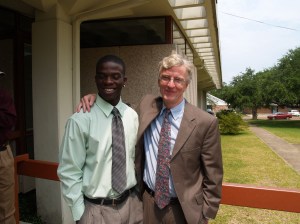
It is important that we not demonize Southern white folk. Taken as individuals, some of their views and attitudes can be troubling, and in some instances, alarming. But white people in Winona, Mississippi don’t have a lot of positive role models in the racial reconciliation department. Resentment for the civil rights movement is so widespread in this culture that any other attitude is counterintuitive. White residents of small Southern towns know it is wrong to discriminate, but the very mention of black leaders associated with the civil rights movement makes them bristle.
How do you reconcile a belief in racial equality with a deep-seated resentment for the movement that established, at least in a formal sense, that equality?
Reconciliation isn’t necessary because, as a practical matter, it is impossible. White people can’t work through their feelings on these sensitive issues without revisiting the humiliation of the 1960s when their cultural heritage was exposed and ridiculed every evening on the nightly news. White Southerners have adapted to the Civil Rights Act of 1964 and the Voting Rights Act of 1965. If the black folks want a little state money for a civil rights library here and there, prominent white politicians are willing to cooperate–within reason. But don’t ask these folks to celebrate Martin Luther King Day or to rejoice in the rich legacy of the civil rights movement. Deep wounds have yet to heal.
It is generally considered bad form to beat up on Southern whites. These people have been demeaned, stereotyped and condescended to for generations, the argument goes, so why not cut them some slack. When I question the objectivity or the racial sensitivity of people like Doug Evans (the prosecutor in the Curtis Flowers case) or State Senator Lydia Chassaniol it isn’t because I believe they are fire-breathing, old school racists. Doug and Lydia concern me because they are embedded in a deeply traumatized culture and it shows. Chassaniol admits that she belongs to the Council of Conservative Citizens (an organization with roots in the old White Citizens’ Councils) but doesn’t think that makes her racially insensitive. She isn’t being the least bit disengenuous. After attending all-white public schools during the Jim Crow era, Chassaniol went to college and returned to Winona to teach in the community’s all-white segregation academy. With all the best intentions in the world (and I firmly believe she is well-intentioned), she can’t extricate herself from her culture and it’s tortured history.
Having lived in a small, racially polarized Texas town, I know how hard it can be for folks on either side of the cultural divide to break ranks with the status quo. The journey toward racial reconciliation must be taken in the company of others–few can make this arduous pilgrimage on their own.
But where do we start and who takes the first step?
The jury system is the best system we have; but when that system collides with the racial history of the South because a low-status black man is accused of killing a high-status white woman, things fall apart. Investigators, prosecutors and potential jurors (on both sides of the color line) find it impossible to maintain the degree of objectivity our jury system demands.
The criminal justice is breaking down in cases of this nature all across the rural South, but I have never witnessed a more compelling demonstration of the phenomenon than I have encountered in Winona, Mississippi where a murder prosecution has dragged on for thirteen years, dividing a community along racial lines. How can we bring closure and resolution to this story? One thing is certain: It isn’t likely to happen in the courtroom.
Texas Governor, Rick Perry, thinks Cameron Todd Willingham intentionally burned down his house with his kids inside. Perry is sticking to this belief even if the purported fire experts who testified at Willingham’s trial used weird science to bolster the prosecution’s pet theory. Even when Craig Beyler, one of the nation’s leading fire experts, concluded that the available evidence lent no support to the prosecution’s claims Perry was unimpressed. The Governor thinks Beyler is blowing smoke because . . . well, Mr. Perry doesn’t need a reason; he’s the governor.
Yesterday, Governor Perry fired three members of the Texas Forensic Science Commission just days before Craig Beyler was scheduled to report to the group. Perry sacked solid, pro-death penalty conservatives he had earlier appointed.
Interviewed by the Fort Worth Star-Telegram, Alan Levy, one of the board members sacked by Perry, tossed off one of the best lines I’ve heard in a while: “I feel like a jilted lover, except that he’s prettier than I am.”
It gets worse when you consider who the Governor appointed to fill the vacancies on the Commission: Williamson County District Attorney John Bradley. Bradley has a reputation for prosecuting weak cases by all means necessary. He is precisely the kind of prosecutor the Texas Forensic Science Commission was supposedly designed to oversee. In other words, the proverbial fox is now guarding the hen house.
Bradley and the Governor clearly had their strategy mapped out in advance. The moment the Williamson County prosecutor was appointed to head the Commission he cancelled a scheduled meeting at which Craig Beyler was supposed to lay out his findings.
Bradley claims he intends to let Beyler report, but he won’t say when. Hopefully when the furor over the Willingham execution dies down a bit. Bradley has assured CNN that he will proceed “methodically”; a euphemism, I suspect, for “slowly”.
Perry’s move will force the commission to trashcan weeks of valuable work. “The commission had worked together for some time as a unit and we were ready to go the next step,” Alan Levy told the Star-Telegram in a follow-up interview, “and now they have to start from ground zero again because they have new people. ”
You know what really disturbs me about this incident? Perry operates in a tuff-on-crime political environment so oppressive that he thinks he can get act with complete immunity. Fortunately, most conservatives believe in basic fairness. They might not understand the mechanics of wrongful conviction, but when you slap them across the face with a power grab this transparent they can’t help but notice.
Last week I was speaking at a National Association of Criminal Defense Counsel conference in Wisconsin dedicated to racial bias in the criminal justice system. Vince Warren of the Center for Constitutional Rights talked about the futility of “a race neutral approach to a race-based problem.” White juries don’t see facts, Warren asserted, they see symbols. If no one challenges the meta-narrative (big story) within which prosecutions unfold, Warren said, present trends will continue.
Another presenter told us about a report by the National Academy of Sciences, “Strengthening Forensic Science in the United States: a Path Forward“. The report isn’t just critical of what passes for forensic in most American courtrooms, it calls for sweeping changes. The forensic scientific community, the report suggests, is incapable of reforming itself because it operates out of a prosecution bias. Therefore a new forensic science agency with no ties whatsoever to law enforcement or the prosecutorial function needs to be created.
Under the current system, our presenter suggested, most forensic “experts” are biased by a desire to please law enforcement, to conform their findings to the prosecution’s theory of the crime and to avoid conflict.
The Cameron Todd Willingham case illustrates the problem to perfection. Governor Perry’s bizarre response shows just how politicized the criminal justice system has become.
When I arrived back in Arlington I was thrilled to see that the Star-Telegram(the paper I find on my front lawn every morning) is doing a thorough, five-part investigation of the shoddy state of forensic science in Texas. A recent stream of DNA exonerations, the National Academy of Sciences’ report and the Willingham case lie at the heart of the series.
In some cases, critics say, justice may be trumped by outside influences and by speculation that goes beyond hard scientific evidence. There are even questions about how much “science” is in forensic science. In a report to Congress this year, the National Academy of Sciences said that there is a dearth of studies establishing the scientific validity of many forensic methods and that invalid interpretation of forensic evidence is a serious problem.
Question. Will Kay Bailey Hutchinson, Rick Perry’s chief opponent in the Republican gubernatorial race, make the Willingham case a campaign issue?
Answer. No. Hutchinson knows that, whatever Republicans may think of her opponent’s strong-arm tactics, they share Perry’s passion for propping up the moral integrity of the criminal justice system, in general, and the death penalty, in particular.
Death penalty opponents argue that public executions cannot be defended when innocent people are regularly convicted of murder. The only counter to this argument is the audacious claim that no innocent person has ever been executed in the state of Texas. Perry believes Willingham is guilty because, if he isn’t, critics of the death penalty win. It’s that simple.
Todd Willingham was no angel. In fact, his manifold character flaws sealed his fate. Prosecutors had no trouble convincing jurors that Todd done the crime because he fit the thug profile. Willingham was violent, abusive and sported lots of macabre tatoos–therefore, he intentionally murdered his children in the most fiendish manner imaginable. That, in brief, was the government’s case.
Thus far, Governor Perry’s bizarre move has taken lots of flack. Over at Grits for Breakfast, Scott Henson is stunned: “This really took a lot of chutzpah! But the governor can’t rewrite history by simply stopping the Commission from making official findings. That ship has sailed. More people read that New Yorker article than will ever read anything the Commission publishes, so concern about polishing the state’s image on the Willingham case is both belated and misdirected. We’ll see what happens next; the ball is in Mr. Bradley’s court.”
Lisa Falkenberg of the Houston Chronicle called up Barry Scheck of the Innocence Project to get his take. “Scheck likened the move to President Richard Nixon’s infamous attempts to oust a special prosecutor investigating Watergate. ‘It’s a Saturday night massacre, pure and simple,’ Scheck said. ‘If you don’t like the evidence, you just get rid of the judges.'”
Reform is coming, brothers and sisters, but the guardians of the status quo won’t give up without a fight. Moreover, as Rick Perry amply demonstrates, these guys fight dirty.
(This post is part of a series concerning Curtis Flowers, an innocent man convicted of a horrific crime that has divided a small Mississippi town. Information on the Flowers case can be found here.)
There is no substitute for being there. I have been researching the social history of Mississippi for several months now, but on Monday, September 21, 2009, I toured five towns in north central Mississippi that I have been writing about: Winona, Duck Hill, Grenada, Greenwood and Carrollton. The experience left me stunned.
My travelling partners were Rev. L. Charles Stovall, a United Methodist pastor from Dallas, and Lola Flowers, mother of Curtis Flowers, the man who has been tried five times for a murder he didn’t commit.
The day began in Winona. The county jail where civil rights legend Fannie Lou Hamer was beaten half to death in 1963 was demolished long ago and the Trailways depot where Hamer and her companions were arrested is now a strip mall. There isn’t much of historical value in Winona. The old courthouse where Hamer and her companions were taken after being beaten was torn down long ago, replaced by the sleek, modern structure where Curtis Flowers has been tried three separate times. (Flowers was also tried in Tupelo and Gulfport). The first Winona trial ended in a conviction but was overturned because Doug Evans, the District Attorney, illegally barred black residents from the jury. The next trial featured five (5) black jurors, all of whom voted to acquit Mr. Flowers. The final trial, held a year ago, also ended in a hung jury.
I’m not trying to convince you that Curtis Flowers is innocent–not today anyway. Today I want to talk about children and the cultural legacies they soak up by a process of osmosis.
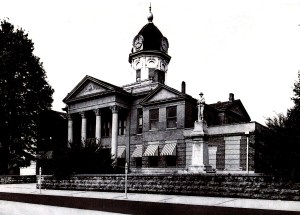
In the picture of the Old Montgomery Courthouse you will notice a monument to the fallen heroes of the Confederacy. You see these marble and limestone relics proudly displayed throughout the South. In Mississippi you find Confederate memorials on the grounds of every county courthouse, most of them erected between 1895-and 1915, the period in which the last of the confederate soldiers were shuffling off this mortal coil.
But you won’t find a lot of historical markers in Montgomery County; it’s as if the past has been intentionally stripped away. When the old courthouse was destroyed and a new building erected, the confederate memorial disappeared. It may have been transferred to a cemetary or it may be stored in somebody’s barn (if you know, leave a comment), but it wasn’t taken to the new Montgomery County courthouse.
Perhaps this represents a keen sensitivity to the sensibilities of Montgomery County’s African American residents. If so, the white people of Winona are out of step with the state of Mississippi. In 2001, Mississippi voters were asked to choose between a new-fangled flag designed by a special commission and the old 1894 flag which features the Confederate stars and bars. The result of the referendum was depressingly predictable. In excess of 85% of white residents voted to keep the stars and bars flag while 90% of black voters wanted to be rid of it. Since white voters outnumber black voters two-to-one, the old flag remained. In 1972, four years after the assassination of Martin Luther King Jr., the state of Mississippi agreed to name a new holiday in the civil rights leader’s honor. Just in case somebody might get the wrong idea, the Mississippi legislature decided to honor the blessed memory of Robert E. Lee (the White Marble Man) on the same day.
This decision didn’t sit well with Black opinion leaders. Derrick Johnson of the Mississippi NAACP explained his opposition to the King-Lee linkage this way: “It’s clearly contrary to biblical and Christian principles of loving thy neighbor. That the state would continue to allow this holiday to be celebrated is an affront to close to 40 percent of the population that is African-American. It is a remnant of Mississippi’s segregated past. Could you imagine Israel celebrating Hitler day or Nazi day?”
White Mississippians were offended by this remark. Robert E. Lee is warmly remembered as the nice Confederate who freed his slaves during the War of Northern Aggression and stood for national reconciliation when the shooting started. The fact that Lee (like Abraham Lincoln and almost every other white man of his day) considered black people to be biologically and intellectually inferior to whites, and that he was horrified by the thought of a black man casting a ballot or running for office is beside the point. It is also forgotten that the heroic general held onto his slaves as long as legally possible. The two sons of the South are linked forever (or at least for the immediate future) in Mississippi, Arkansas and Georgia. The message isn’t subtle. The January holiday can be used to honor both men or the leader of your choosing.
You won’t find that sentiment in any official documents, of course, but consider this: the state of Mississippi celebrates Confederate Memorial Day each year on the last Monday in April. All state employees, black, white or indifferent, are given the day off. This too is a sore spot with black Mississippians, but few express their views on the subject too stridently. Support for official white dominance is so institutionalized in Mississippi that anyone opposing its cruel dominion sounds like a bomb-throwing lunatic.
In Mississippi, white is the official color of normal. If you are white your culture is symbolically memorialized and regularly celebrated; if you are a person of color you live with the cynical ambiguity of King-Lee day. If you are black in Mississippi you don’t really exist, or, to put it a bit more gently, your existence is merely tolerated. The real Mississippians are the sons and daughters of the confederacy and no one lets you forget it.
On April 13, 1937, two black men, Roosevelt Townes and “Bootjack” McDaniels were in the custody of the Montgomery County Sheriff, charged with shooting George Windham, a white merchant in the small community of Duck Hill. At the conclusion of a court hearing at which the two men entered pleas of not guilty a large white mob (some reports put the number as high as 500) appeared outside the old courthouse. Sheriff’s deputies had their arms pinned behind their backs, the two defendants were bundled into a waiting school bus and driven to a field near Duck Hill.
According to a newswire report: “After they were seized the mob tortured their victims by searing their flesh with blasts from gasoline blow torches. After thus brutally burning them, the wild mob piled brush high about them, saturated the brush with gasoline, and touched a match to the pyre.” There was a lot more to the lynching, but I will spare you the gruesome details . . . for now. When this brief summary of the event was read to the House of Representatives even Southern congressmen were horrified. It was widely believed that lynching was a vestige of the past that wouldn’t survive long in the enlightened modern era. Mississippi had gone 15 months without a lynching prior to 1937. But the Duck Hill debacle were so horrifying that the House passed America’s first anti-lynching law.
The Senate version of the bill died a few weeks later, killed by a Southern filibuster. Howard Kester, a white man representing the NAACP, arrived in Duck Hill two weeks after the lynching. The charred remains of Townes and McDaniels remained chained to trees until a local pastor managed to have them taken down and buried. The savage torture-slayings had outraged the entire nation to the point that Mississippi residents were writing letters to TIME distancing themselves from the perpetrators. But Kester found that “of the scores of people with whom I talked not a single one greatly deplored the lynching. The citizens of Duck Hill seemed rather well pleased with themselves.”
I related this story to Lola Flowers and Pastor Stovall as we drove through the black end of town looking for someone who could show us the scene of the crime. No one seemed to know. The black police chief pointed us the home of the chairman of the Montgomery County NAACP, but he wasn’t home. As we drove past the town’s white cemetary a small tombstone caught my attention. The marker stands in memory of Mrs. Virginia Wells, a Duck Hill resident who died in 1937, one month after the town’s infamous lynching. Finally, we dropped in at the Duck Hill library to see if someone there might be able to assist us. A friendly woman who looked as if she might have been a young girl in 1937 asked how she could assist me. “This will sound like an odd question,” I began awkwardly, “but I have been doing research on famous lynchings and I keep running across references to what happened in Duck Hill in 1937.”
I understood none of this when I was in Grenada and it has left me eager for a return trip, this time in the company of a larger group led by a local resident who can interpret the history. I took a picture of the box-like Grenada County courthouse and Doug Evan’s office a few blocks away. Then I got back in the car and we headed southwest in the direction of Greenwood.
You know you have entered the Mississippi Delta when the Kudzu laden hills suddenly level out into a flat plain. A few miles later we arrived in the black side of Greenwood. Amazed by the poverty around me, I left the car to take a few pictures. A local resident approached me. “You interested in Robert Johnson and all them?” he asked.
“Did Robert Johnson live in Greenwood?” I asked.
“Hell, yeah,” the man replied. “Robert Johnson, Honey Boy Edwards, all them old bluesmen lived and played around here. But you need to be in Baptist Town to see all of that. Here, I’ll climb in the car with you and show you how to get there.”
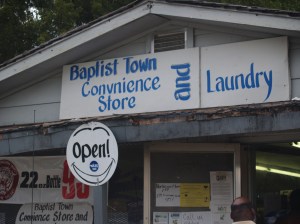
Knowing a teachable moment when I see one I complied. My new friend took us to the Baptist Town Convenience Store and introduced me to the proprietor.
Baptist Town
“You are looking at the poorest neighborhood in America,” the man told me. “We ain’t proud of it, but there it is. A few years back I brought Honey Boy Edwards back here to play. We was driving through Baptist Town and Honey Boy says, ‘Man, this place ain’t changed a lick in the past sixty years.”
I could believe it. Every building within eyesight was dilapidated to the point of collapse, but it was the look in the faces of the people wandering in and out of the store that told the story. The owner had a few fuzzy memories of the Greenwood civil rights movement but I doubted many of his younger customers had any coherent appreciation of the sacrifices their grandparent’s generation had made.
We returned to the car and drove a few blocks to the Leflore County courthouse, an impressive structure dominated by a massive Confederate memorial that had been dedicated in 1915. I circled the building looking for any acknowledgment of the civil rights movement. Although Greenwood in 65% black, no memorial counterpart to the imposing Confederate Memorial could be found.
A quick driving tour of Greenwood explained why. We drove through poor and working class neighborhoods without seeing a white face. Suddenly we were in an upscale older neighborhood dominated by two-story mansions. We had entered the world of white. Although Greenwood has elected its fair share of black leaders, the locus of raw political leverage remains unchanged.
After stopping for supper, we motored eastward toward Carroll County. A few minutes after crossing the county line, the flat road twisted into a steep climb and we were out of the Delta.
Like Montgomery County, Carroll County was sternly resistant to the civil rights onslaught. While black residents were lining up for voter registration in Greenwood, federal registrars in Carroll County waited four straight days without a single black applicant showing up. Without outside leadership it was almost impossible for black residents to make a stand against what people were still unapologetically calling “white supremacy”.
The Carroll County Courthouse
Grenada and Montgomery Counties may have abandoned their old granite courthouses, but the courthouse in Carrollton hasn’t changed significantly since it was built in 1876. A major remodel in 1992 removed the last vestiges of the bullet holes that riddled the structure back in 1886.
The Carrollton Massacre (remembered locally as the “Carrollton riot”) marked the transition from the Reconstruction period to the Jim Crow era. Ed and Charley Brown, half-Indian and half-black brothers, had an encounter with a white man named James Liddell. The molasses the Brown brothers were delivering was spilt and angry words were exchanged. A short while later, Liddell emerged from a local cafe and approached the Browns again. Asked why he was still hanging around, Ed Brown told Liddell it was none of his God damned business. Liddell slapped Brown across the face, a melee erupted and gunfire was exchanged during which Liddell was wounded in the leg.
Two days later, the Brown brothers were arraigned before a judge, accused of assaulting Liddell. Still viewing themselves as American citizens in the spirit of Reconstruction, the brothers charged Liddell with assaulting them. The brothers were taken back to a holding cell. A few days later, a white mob stormed the local lock-up and secured an inmate they took to be Ed Brown. The man was shot and hanged. Unfortunately, the lynch victim was a young man named Will McKinney.
Staircase in the Carroll County Courthouse
When a hearing was held regarding the charges filed against Liddell by the Brown brothers, the courthouse was packed with black spectators. They had been warned to stay away, but the wonder of seeing a black man filing charges against a white man generated tremendous curiosity. As the hearing proceeded, a posse of white riders from Liddell’s home in Greenwood dismounted outside the courthouse. Armed men entered the handsome building, climbing the stairs to second story courtroom and shooting every black person they encountered. When the men burst into the courtroom panic erupted. Many black residents jumped out of windows to escape the onslaught. Some died from the fall; those who survived were gunned down as they lay writhing on the ground.
A grand jury looking into the matter theorized that the armed men must have been goaded into action by gunfire from the Brown brothers. “The evidence before us goes to show that the Browns were turbulent and desperate half breeds, always ready for a conflict” the grand jury opined.
No one knows how many black people died that day (two dozen would be a modest estimate) but no white residents were injured. With the passing of time, even local historians were forced to admit that the men from Greenwood had carried out a well organized campaign of terror designed to put the black man back in his place.
You won’t find any reference to any of this on the courthouse square in Carrollton, of course. The picturesque community appears to have been frozen in time. Little has changed since that fateful day and the community would make an excellent tourist destination were it not for the incident that created bold headlines across America in 1886.
Seventeen years after the massacre for which the town is famous, a Civil War Memorial, impressive for a poor, underpopulated county, was erected on the northwest corner of courthouse grounds. As you move clockwise around the monument the dedication unfolds: “To the memory of Carroll’s Confederate soldiers who fought in defense of our constitutional rights from Bethel to Appomattox. Truth crushed to earth shall rise again.”
By 1903, the “truth” of white supremacy was standing tall again in Carroll County and throughout the South. Given this kind of history it’s not hard to see why the Mississippi NAACP objects to a flag sporting the stars and bars, a cynical marriage between the legacy of Robert E. Lee and the legacy of Martin Luther King, and an annual state holiday dedicated to the glories of the Confederacy.
The Carrollton massacre happened a very long time ago, but it helps to explain why, exactly eighty years later, federal registrars couldn’t get a single black person in Carroll County to register. In the waning days of the 20th century, Mississippi politicians were still gathering in the Carroll County town Black Hawk to curry favor with “conservative” voters and raise money for the County’s all-white private school. But that is another story.
Events have conspired to maintain white power in Mississippi and every aspect of the state culture, including the criminal justice system, has been adversely affected. White residents who were toddlers in 1886 were in the prime of middle age when two men were tortured to death with blowtorches in Duck Hill. Children attending elementary school in 1937 were in their mid-30s when Fannie Lou Hamer was beaten half to death in the Montgomery County Jail. Duck Hill is ten miles north of Winona, the town where Curtis Flowers will go to trial for the sixth time in June; Carrollton is ten miles west. Grenada is ten miles north of Duck Hill. Greenwood is ten miles west of Carrollton. The entire region would fit into a corner of the Dallas Fort Worth metroplex and it shares a common mythology.
Men like Doug Evans and women like Lydia Chassaniol are products of this culture and they behave accordingly. As white Mississippi revels in its confederate mythology innocent men like Curtis Flowers can be convicted without meaningful evidence so long as they appear to fit the “sorry nigger” profile. The criminal justice system was derailed by bigotry in 1886, in 1937, in 1963 and in 1966. In those years, the justice system was a cruel joke and people of color lived outside the law. When a thoroughly compromised legal system couldn’t adequately defend white interests, vigilante justice came into play.
By the time Curtis Flowers was arrested thirty years after the violence in Grenada the days of overt race baiting were over. But the shoddy “investigation” of the Tardy murders and the manipulation of vulnerable witnesses in this case shows how little things have changed in cases involving a socially prominent white victim and a low-status black suspect. The gaudy trappings of white supremacy have been toned down over the years and vigilante justice has all but disappeared; but inside the courtrooms of rural Mississippi the old rules still apply.
Barack Obama refuses to get sucked back into the media’s great American race war. Jimmy Carter upped the ante in the “You Lie” debacle by imputing a racist motivation to Joe Wilson’s remark. White House press secretary Robert Gibbs assured the press corp that President Obama does not share Mr. Carter’s view of the matter. When a string of reporters asked variants of the same question, Gibbs repeated his mantra.
The press doesn’t deal in the intricacies of the health care debate unless the issue can be framed as a good old he-said-she-said cat fight between ideological opposites. If Carter says Wilson is a racist the press scours the earth for a white guy willing to counter the assertion. In this case, they got Joe Wilson’s son to swear that his daddy doesn’t have a racist bone in his body.
You can’t blame Barack Obama for sitting this one out. The slightest hint that he shared Carter’s viewpoint would create several news cycles dominated by counter-assertions from the Right, demands for an apology and calls for impeachment. Thus far, the “Joe is a racist” debate has been dominated by Mr. Carter’s comment and rebutals from conservative opinion leaders like Newt Gingrich and Rush Limbaugh who accuse the left of using the “racist” label to stifle legitimate dissent.
This how-dare-you-call-me-a-racist argument plays well in Middle America, and for good reason. Millions of people voted for Hillary Clinton and John McCain in the last election cycle for entirely non-racial reasons. Logically and politically, the assertion that all opposition to Barack Obama is motivated by racial animus is a non-starter.
On the other hand, when you see folks waving rebel flags and hoisting posters featuring Mr. Obama with a bone in his nose it’s pretty clear that Jimmy Carter is on to something: a solid segment of the anti-Obama crowd can’t abide the notion of a black president.
How then do we distinguish between the racism and principled dissent?
Middle America has developed a simple metric: if you hear overtly racist rhetoric or see unambiguous and pejorative references to Africa, monkey’s and other crude racial stereotypes, you are dealing with a racist; otherwise, it is best to assume that race isn’t a factor.
A recent article on the Carter-Wilson dust-up in the New York Times was followed by the sort of partisan reader comments we have come to expect. Ironically, a Canadian reader captured the non-partisan mindset of Middle America. Here is her comment in its entirety:
There is no doubt plenty of racism in the U.S., and plenty aimed at Obama.
Still, no matter how rude, out of line, and downright wrong Rep. Joe Wilson was when he shouted “You lie!” at Obama during the latter’s recent speech, only Wilson knows what was going through his head at the time.
Jimmy Carter, no matter how well-intentioned he may have been when labeling the gibe racist, has no way of knowing whether Joe Wilson’s childish catcall was in fact “based on racism”. By stating that he believes it was, Carter did not contribute anything useful to the public forum.
Certainly, we need to combat racism, not to mention promulgate a reality-based world view in the U.S — something that seems increasingly rare here.
But unprovable accusations — no matter how tempting and possibly even correct they may be — do not promote any useful cause.
In other words, in the absence of unambiguous evidence, fair-minded citizens should avoid ascribing racist motives to political opponents.
The success of the Southern Strategy was rooted in the ubiquity of this common sense rule of thumb. So long as southerners defined themselves as small government, anti-socialist, southern heritage-affirming conservatives, Middle America welcomed them into the political mainstream. There is a certain genius to both progressive and conservative political and social philosophies and most Americans, myself included, believe that balanced, pragmatic social policy is shaped by a healthy give-and-take between sincere proponents from both camps.
President Obama is precisely the sort of bi-partisan pragmatist the American electorate has been willing to support. His race has little to do with it. John Kennedy, Lyndon Johnson, Bill Clinton and Jimmy Carter, white boys all, won elections as moderate progressives who avoided ideological extremes.
That’s one reason we have made so little progress on heath care reform (but I digress).
What American president hasn’t been denounced, renounced and vilified by partisan opponents? Regardless of political affiliation, we all find it hard to live with a president who rejects many of most deeply cherished values. So shouldn’t we be cutting the conservatives some slack here? So what if Barack Obama is being compared to Adolf Hitler–what American leader hasn’t suffered the same fate?
Similarly, what American opinion leader, black, white or indifferent, hasn’t been accused of racism? Had Martin Luther King Jr. outlived the 1960s, the epithet would surely have been applied to him. So maybe we should just bury words like “race”, “racist” and “racism” and be done with it.
Many moderate Republicans and Democrats have embraced a color-blind orthodoxy rooted in the healthy-minded belief that Jim Crow bigotry died many moons ago and is unlikely to emerge from the grave.
The combination of color-blind optimism and “if-he-doesn’t-wear-a-hood-he-can’t-be-racist” naivete has been exploited by genuine bigots for decades.
Jimmy Carter has good reason to ascribe racial motivations to Joe Wilson’s latest outburst. Although Wilson worked hard to cultivate African American support in the early stages of his political career, moderate black leaders saw through the facade years ago. When a man maintains his membership in a group like the Sons of Confederate Veterans a decade after the organization adopts an unambiguously racist agenda questions must be asked. When a man fights to the death to keep the Confederate flag flapping over the state legislature it is legitimate to wonder why.
The face of American bigotry is rapidly evolving. South Carolina has had the fastest growing Latino population in American two years running. It is not coincidental that Wilson’s outburst was in response to the president’s promise that the undocumented would not be covered under his health bill. For years, Joe Wilson has allied himself with the most extreme, and openly racist, elements of the anti-immigration movement. Racism isn’t just a black-white thing anymore.
Is Joe Wilson merely insensitive to African American opinion or is he sending a dog whistle message to white voters who despise the civil rights movement and secretly wax nostalgic about a white-power southern heritage?
When we see Joe Wilson signing autographs for people who were thrilled by his rude interjection you have to question the sincerity of his apology.
When you see Republican politicians refusing to rebuke Wilson you wonder why they encouraged their errant colleague to apologize in the first place.
Strident and unapologetic support for white supremacy was the only politically viable position for southern politicians circa 1965, the year the Voting Rights Act was signed into law. Five years later, most southern schools were integrated as school boards bowed to the inevitable. Can we conclude that hearts and minds changed dramatically in the course of five years?
Nothing changed but the law. In 1965, politicians could shout their pro-white, anti-civil rights sentiments from the house tops–and were doomed to defeat if they didn’t. Five years later, these same men quietly eschewed overt racial rhetoric. Some became Republicans, others soldiered on as Democrats, but few changed their thinking on the race issue.
After twenty years of race-neutral rhetoric, Middle America started talking about the New South. Forty years later, it was time to celebrate a Color-Blind America.
Racial attitudes have changed. Public attitudes are shaped by political rhetoric. When kids grow up hearing the public vocabulary of racial pluralism their thinking is affected. Political correctness has political consequences. When white children see tributes to Martin Luther King and Rosa Parks on television they get the message: pluralism is cool and bigotry sucks.
But political correctness is a superficial phenomenon. A political maestro like Ronald Reagan learned that by launching his 1980 presidential campaign up in Neshoba County (of Mississippi Burning infamy) and talking about “state’s rights” he could appeal to racist southerners while employing an ostensibly race-neutral political style.
Reagan mastered the art of political correctness.
There was a trade off. So long as politicians avoided incendiary racial rhetoric, the public assumed they were on the side of the color-blind angels.
White voters knew better. When a politician votes consistently for policies that damage poor communities and favor white suburbanites, overt racial references are redundant.
The Republican party is a complicated mix of New South pluralists, pro-business pragmatists, social and religious conservatives and unreconstructed racists (North and South). To tar such a diverse group as a pack of racists simply because they oppose the policies of the Obama administration is unfair, unkind and unwise.
But we dare not ignore obvious signs of bigotry and gross racial insensitivity.
The election of America’s first black president changed the political equation in profound and irreversible ways. Small government, pro-market conservatives may oppose health care reform for ideological reasons, but they stand elbow-to-elbow with mean-spirited zealots whose political vision has no place for non-whites and non-conservatives. We are witnessing a fundamentally undemocratic impulse.
Progressives may be doing most of the hair-pulling at this point, but sincere conservatives should be worrying too. If the Republican brand is defined by its least tolerant faction, the party will soon be confined to the deep South, the southern portions of Indiana, Ohio and Illinois and a few low-population Western states. You can’t win the White House with that kind of coalition.
Fortunately, there is an upside to our Summer of Hate. Realities long catalogued by groups like Hate Watch are gradually creeping into the national consciousness. The desire for a color-blind society is so strong that we risk becoming a hate-blind society. Recent developments, including Joe Wilson’s ill-tempered outburst, are a lighthouse beacon warning us away from the jagged rocks.
The Sisters of Providence of Saint Mary-of-the-Woods in Indiana are proud of Donna Stites, an Associate of the order incarcerated at the Indiana Women’s Prison in Indianapolis. Yesterday, I sat down with Publications Manager Connie McCammon who wove my rambling reflections into the article below.
Friends of Justice express interest in Donna Stites’ story
Dr. Alan Bean is the executive director of Friends of Justice.Many Providence Associates and Candidate-Associates came to know Providence Associate Donna Stites through the winter 2009 issue of HOPE in an article titled “Wanting to be seen as somebody.” This article shared Donna’s journey from a life of drugs, prostitution, murder and prison to her life as an associate of the Sisters of Providence. Walking beside her on part of her journey has been her companion, Providence Associate Priscilla Hutton of Paris, Ill., and Sisters Rita Clare Gerardot and Catherine Livers.
In March 1985, Donna was sentenced to 50 years for a Vanderburgh County, Indiana, murder to be served consecutively with an eight-year sentence for theft that she received in August of 1984 in the same county. Later in 1985, Donna received a 40-year sentence for another murder in Posey County to be served consecutively with the Vanderburgh sentences. It is this second sentence that Donna and her attorneys have argued is illegal “because the trial court had no statutory authority to order it served consecutive to any other sentence; that her guilty plea was not knowing, voluntary, or intelligent because she had been misinformed by both the trial court and counsel regarding the actual penal consequences; and that counsel was ineffective for failing to advise her that the trial court could not impose a consecutive sentence.” (Indiana Court of Appeals Web document downloaded May 22, 2008)
Priscilla has taken up the call of this injustice and has sought the assistance of Dr. Alan Bean, executive director of Friends of Justice, a criminal justice reform organization. Alan has served as a minister for Baptist and United Methodist churches. Residing in Arlington, Texas, with his wife, Alan has been ministering with the organization since 2000.
Alan and the Friends of Justice have brought the national spotlight on such cases as the Tulia, Texas, drug sting in 1999 and the Jena Six (Louisiana). Priscilla is hopeful that Alan can shine the national spotlight on the injustices of Donna’s case.
Alan made a trip to Indiana and visited with Donna and Priscilla on Monday, Sept. 14, 2009, at the Indiana Women’s Prison in Indianapolis. The following day he sat down for an interview with a staff member of the Sisters of Providence.
1.) How were you introduced to Donna Stites’ story?
I received an e-mail from Priscilla Hutton. Priscilla is her minister of record at the Indiana Women’s Prison. Priscilla had a number of concerns. With Donna, the issue was not guilt or innocence because she has never denied she was guilty. There are several things that interested me about [her] story. One is the fact that she was able to come to faith and was able to find grounding for her life in the midst of her struggles as an inmate and that she was able to move beyond her past so that she no longer identifies herself as the woman who did all those terrible things back in the day, but she sees herself as an associate of the Sisters of Providence — a Christian disciple — which is quite amazing.
Sister Rita Clare Gerardot is just one of the people who has helped Donna Stites on her journey. Pictured with Sister Rita Clare is Alan Bean. Also I’m interested in the story because it shows what can happen when people — when a community of faith — reaches out to the least of these and shows the compassion of Christ. It hasn’t just been Priscilla, but several of the sisters have gotten involved in Donna’s story and have worked not just with Donna, but her mother and her sister, who’s in the free world. [Donna’s mother died at the Indiana Women’s Prison in May 2008.]
History plays such a big role in this story. Donna’s mother was traumatized as a young girl, was exposed to things that no child should ever be exposed to. She grew up basically in a house of prostitution, had mental issues as a young woman, received shock therapy [but] was a brilliant, beautiful, charming woman but just a broken person — a person who just made absolutely terrible decisions, who had no personal boundaries, no real sense of what it meant to be a mother. Trauma is passed from generation to generation. And how do you put a stop to that? How do you intervene in intergenerational dysfunction and bring redemption to the situation?
2.) How can you help Donna?
The first thing that I can do is to tell the story — just put it into writing and hopefully get the attention of somebody in the major media who might want to pick this thing up. So that’s one thing: just tell the story. And not just tell the story of Donna, but also tell the story of the Sisters of Providence and the work they do. I’ll start blogging on it.
Donna’s legal situation is very confusing [The members of the legal system] can say that she has served enough time in prison. She has two sentences, one of which was not imposed properly so the system could decide to vacate the second sentence and release her or they could decide to uphold it and keep her inside. A lot of it depends on whether you think Donna Stites is the woman who committed the crimes or whether you think Donna Stites is a redeemed child of God. The legal system tends to answer it as if she’s still who she used to be because that’s the way the legal system thinks. Whereas the community of faith that has been working with her sees her as a redeemed child of God and feels that she has paid her debt to society and should be released. So you get these two different [views]: one group is looking through the lens of faith and the other group is looking through the lens of law.
In the case of Donna, there really isn’t that much debate about her guilt or innocence. It’s true she was not the prime mover in either of the murders and wasn’t even involved in one directly, but she implicated herself. She got involved. She helped dispose of the body. And then she took the rap as if she was the sole perpetrator. And I think the thing that really struck me about Donna when I was talking to her is that she has a very strong sense of justice. I think she was born with it. And that sense of justice when she was on the streets — stealing and prostituting and scamming people and doing anything to get drug money — she still had, it’s just that she had this warped morality. But given the constraints of that moral vision, she still felt that she wanted to do the right thing — which in that case meant lying about what happened and taking all the blame upon herself. [That] is a very noble, wrongheaded and dysfunctional thing to do, but it’s very noble in its own way.
Given the kind of moral world she lived in at the time she was trying to do the right thing. And that sounds strange because you’d think somebody who was as screwed up as she was at the time — strung out on drugs, doing all kinds of illegal and immoral and degrading things — wouldn’t have a moral compass. But she did. It’s just that it was a misguided, misinformed moral compass. And as soon as somebody from the outside was able to reach into her world and introduce her to a different moral world, then that side of her came out and started to control her life. So she moved away from a lot of the dysfunctional, self-destructive things she was doing and was able to re-orient around Roman Catholicism and Catholic morality. And you know, if that can happen with Donna, who else could it happen with?
3.) What do you think about Priscilla?
The thing about Priscilla, she’s a brilliant woman, very compassionate and has a deep commitment to her Catholic faith. She was not a Catholic by culture or by upbringing. She chose that tradition because it felt like coming home for her. She talks about the sisters all the time. I realize that without that identity, that support, being part of that community, she couldn’t do what she’s doing. She’s very much a representative of a community.
When you work in the prison system, you have to be able to think independently because society’s verdict on these people is that they are throw-away people, they aren’t worth working with. When you intentionally walk through those prison doors and open yourself to the lives of people who, in many cases, have done horrible things and people who are quite willing to scam you and manipulate you, lie to you, and you’re willing to reach out to those people with the grace of God anyway and take risks, you can’t do that as an individual. You have to have a moral vision that has been shaped by a community and is sustained by a community. And I think Priscilla sees herself as being a representative or a missionary, a disciple, somebody who is ministering as a Christian, but more specifically, out of a particular religious vision.
4.) Final thoughts, Dr. Bean?
I still don’t know if I can do anything. But I’ve learned serendipity in this work — if you’re working with a good set of facts and you’re working with committed people, good things will happen.
(Or as the Sisters of Providence would say, it’s Providence.)
Yesterday I was honored to give a talk to the students of St. Mary-of-the-Woods College near Terre Haute, Indiana. Priscilla Hutton, an Associate with the Sisters of Providence, made sure that representatives from the local newspaper were on hand. To the left I am pictured with Sister Catherine Livers, a wonderful Christian with a sharp mind who, at the tender age of eighty-eight, can still stand on her head. I discuss my encounter with Ms. Hutton and the Sisters of Providence in the article below.
TERRE HAUTE — In theory, America has a wonderful criminal justice system based on great ideals.
“It’s just that it fails to meet [those ideals],” Alan Bean said in an interview Tuesday at Providence Center, where he had spoken to St. Mary-of-the-Woods College students.
He is executive director of Friends of Justice, which has brought national media attention and legal representation in what have become some high-profile cases, including a recently resolved case in Jena, La.
Among the organization’s goals are “to make mainstream white people aware that the system does not produce equal justice, and for those who are victims of that fact, we’re trying to make the system live up to” its principles.
“You get what you pay for in the criminal justice system. People who can’t pay for expensive legal representation … Nobody really tells their story very effectively,” Bean said.
For those of poorer socio-economic backgrounds, “If you are innocent or overcharged for a real crime, you can end up doing long years for something you didn’t do or you can end up spending decades in prison for something that a person with more prestige and status in society would serve a very short sentence for,” he said.
Someone once told Bean, who is white, that if you’re black and poor in America, “You live in a police world. That really struck me … It isn’t just race, it isn’t just economics. It’s the convergence of those two,” Bean said.
Bean and his wife Nancy founded the Friends of Justice, which investigates unfolding cases of police and prosecutorial misconduct that are likely to result in wrongful conviction.
Friends of Justice partners with local leadership to launch narrative-based campaigns that connect the affected community to national media, advocacy groups and excellent legal representation.
Bean has worked with the Jena 6 case in Louisiana, which has attracted national attention. In that case, Friends of Justice responded to an appeal from six families in the small Louisiana town of Jena after several days of racially tinged violence led to attempted murder and conspiracy charges being filed against six black high school students.
The case caused school boards across the nation to re-examine disciplinary procedures and several states to revamp hate crime laws. It also launched debate about inequities and systemic racism within the criminal justice system.
The Beans first starting getting involved in the issue in 1999 when a drug bust in their hometown of Tulia, Texas, led to the roundup of 46 people, 39 of them black. The town had only 5,000 people.
The arrests were made based on the false testimony of an undercover agent, according to Bean’s biography.
Bean helped build a coalition of defendants’ families and other concerned citizens who believed the defendants were being prosecuted on faulty evidence.
Because of the work of Friends of Justice, the Texas Legislature eventually passed the Tulia Corroboration bill, which led to the exoneration of dozens of innocent people by raising the evidentiary standards for undercover testimony.
In August 2003, Gov. Rick Perry pardoned the Tulia defendants.
Bean said Tuesday he believes change can, and is, happening.
“I think Americans are good-hearted people, by and large. If you can tell the story and get the facts out in a way that is compelling, you can change the climate of opinion,” he said.
Those making a difference include the Sisters of Providence. An ordained Methodist minister, Bean believes there is a religious dimension to the criminal justice system. Bad religion produces bad justice, he said, while good religion produces good justice.
“I think the Sisters of Providence are a perfect example of good religion challenging the criminal justice system and humanizing it,” Bean said. “We need more religious folks to wrestle with these issues and to get involved.”
He was invited to St. Mary-of-the Woods by Priscilla Hutton, a Sisters of Providence associate. He is on a fact-finding mission to learn more about the case of Donna Stites, who is serving time at the Indiana Women’s Prison in connection with two murders.
Stites is a diabetic on dialysis in poor health who is trying to secure her release; she has been in prison for more than 25 years. Hutton is Stites’ spiritual director, and Stites herself has become an associate Sisters of Providence.
Bean met with Stites, who told him she has changed because of her relationship with the Sisters, who cared about her and loved her. Stites told Bean she is not the same person who was once involved with drugs and who committed murder. She is now a child of God, she told him.
Bean said he might be able to get Stites legal representation to try to win her release. But the main issue, in his mind, “is to get her story out there” and the story of her relationship with the Sisters of Providence.
“Something beautiful is happening,” he said.
Sue Loughlin can be reached at (812) 231-4235 or sue.loughlin@tribstar.com.
Donna Stites is an Associate of the Sisters of Providence, a Catholic order devoted to justice and hands-on social ministry. Donna Stites has also been an inmate at the Indiana Women’s Prison in Indianapolis. In 1984, she was involved in two horrific murders. A year later she accepted two plea agreements, one for 50 years, the other for forty.
Donna doesn’t make excuses. She could argue that she never actually killed anybody; she just helped dispose of the bodies. But she knows that, morally and legally, that’s a distinction without much of a difference.
If Donna wanted to blame her crimes on a dysfunctional childhood she could make a strong case. She could blame her violent lifestyle on the hard drugs she was taking. She could point the finger at the mother who taught her how to shoot up at the tender age of twelve.
She doesn’t go there either.
Donna knows she has broken things she cannot fix; she has created deep pain she cannot assuage.
This isn’t a story about wrongful conviction; it’s a story about God, grace and redemption.
Donna Stites didn’t turn her life around in one glorious encounter with truth and light. The path to faith has been slow and treacherous. “It was like God quietly lifted me,” Donna explained when I talked to her a couple of days ago.
“I spent the first ten years in and out of lock [solitary],” Donna says. When I asked her if she was overwhelmed by the prospect of spending her entire life in prison she shook her head. “I was twenty-one so the reality of all that wasn’t there.” She continued to live on the inside the way she had lived on the outside. For the first year or so, thanks to a corrupt prison matron, Donna even had a ready supply of drugs.
Donna’s first step down redemption road had little overt connection with religion. Ball State University was offering college courses and Donna signed up. “I had started asking questions and was beginning to realize how wrong everything was,” she says. “By that time I had made a list of six goals, and one of them was to start to college. Only after my first semester did I realize, ‘I can do this.’ I dropped out of school at fifteen, and I had never gotten an A before on a report card in my life.”
Donna was deeply impressed by Dr. Randall Calhoun, one of the professors that came to the prison. “He was always ripping my work apart, and pointing out all my logical mistakes, misspellings and bad grammar. One day he took me aside and said, ‘Do you know why I’m so hard on you? Donna, you’re like a rose in a whiskey bottle, and it’s my job to pull you out. You’ve got so much potential.”
When I asked Donna if her intellectual and spiritual quests were related her eyes lit up. “Oh yes,” she said. “After I got educated my spiritual journey really started to speed up.”
Like many offenders, Donna Stites wasn’t on good terms with organized religion. Her mother left home when Donna was a young child, leaving behind a twenty-page Dear John letter about “needing to find myself”. “My dad couldn’t read,” Donna explains, “so he had to find someone to read him the letter.”
Donna’s father was a reformed alcoholic who took his children to a fire-and-brimsone Baptist Church. “It was the kind of church where you’re thinking, ‘I can never measure up to the standard; it’s hopeless'” Donna remembers. “I never felt attracted to my dad’s religion because the way he lived had almost nothing to do with what he believed. He was physically and emotionally abusive and I didn’t want anything to do with a religion that did that to a person.”
Donna’s first meaningful contact with prison religion came in 2000 when a Roman Catholic Bible study started bringing dogs to the prison. “That sounded pretty good,” Donna says, “Dogs have always made me happy. Then they had a group that was training assistance dogs and I liked the idea that I was helping other people by working with the dogs. But the big deal with the dogs was that they loved me and didn’t even know I was a prisoner.”
I asked Donna if she had ever had contact with wholesome, stable family life growing up. “Oh yeah,” she said. “My Aunt Mildred and Uncle Buddy. I stayed with them for just a little while when I was a little girl. If ever there was a spiritual spark in my life they were it. They took us to church and Sunday school and didn’t beat us up when we got back. If there was a seed down there waiting for water they were it.”
Donna Stites and Priscilla Hutton
Donna’s life was changed forever when she met Priscilla Hutton, an educator and Catholic layperson from Paris, Illinois and an associate with the Sisters of Providence. Priscilla signed up to serve as “minister of record” for an inmate. Donna Stites turned out to be that inmate.
“Priscilla has been a lifesaver for me,” Donna says. “She can see right through me and loves me enough to tell me the truth. I can still remember telling her that when the people in here back me into a corner I’ve just got to fight back. I’ve just got to. And Priscilla said, ‘Donna, have you ever considered the option of walking out of that corner? Or, how about not getting into the corner in the first place?’ That changed my whole way of thinking because, no, I never had thought of just walking out of the corner. I didn’t know you could do that, but you can. So now, when I get all frantic about something, I know I can just pick up the phone and call Priscilla.”
I asked Donna if her personal transformation was more a new way of thinking or more about new relationships. “New relationships taught me how to think about God and life and my past,” Donna replied. “Roman Catholicism gave me a people, a family. We are a community. I feel very loved and a part of. I don’t want to mess up because I don’t want to be a bad reflection on the sisters. I believe what they believe in and I want to live that lifestyle. They are just absolutely brilliant. The perfect example of what any woman would want to be.”
I asked Donna how she lived out her new faith in the context of prison life. “I try to give fellow inmates an example of how to deal with things,” she said. “I try to talk to the young people about not spending their whole lives in and out of here. The conditions in here hinder people who might want to be rehabilitated. I don’t know how anybody could be helped under these conditions, and yet I was. I wish I could tell you what it is that would work here, but I really don’t know.”
Donna told me that if she was handed her freedom “the first thing I’d do would be to go to Holy Cross [a Catholic Church within walking distance] and I’d just sit there and give thanks.”
Donna’s future is far from certain. She is a brittle diabetic and her kidneys have virtually shut down. Recently, she has been receiving dialysis treatments three times a week. “I always knew it might come to that, and I dreaded it,” she told me. “But now that I have no choice, I find myself looking forward to the treatments. I just sit there for four hours, but I always enjoy it for some reason.”
Priscilla Hutton assures me that Donna’s color is much improved, there is a new sparkle in her eye and a new strength in her step. How long will that last? Nobody knows. Donna is taking it one day at a time.
Will Donna Stites ever re-enter the free world? (Has she ever been in the free world?) That issue is as uncertain as her physical prognosis. Like most legal stories, it’s complicated. I’ll tell you more about the crimes that put Donna in prison and the legal issues that may restore her freedom in another post.
 The Greenwood Commonwealth has a reasonably thorough article on the Attorney General’s decision to drop the perjury charges against James Bibbs.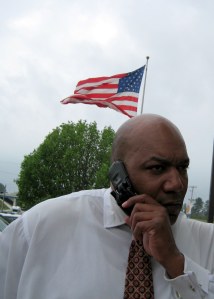


 It is important that we not demonize Southern white folk. Taken as individuals, some of their views and attitudes can be troubling, and in some instances, alarming. But white people in Winona, Mississippi don’t have a lot of positive role models in the racial reconciliation department. Resentment for the civil rights movement is so widespread in this culture that any other attitude is counterintuitive. White residents of small Southern towns know it is wrong to discriminate, but the very mention of black leaders associated with the civil rights movement makes them bristle.
 Texas Governor, Rick Perry, thinks Cameron Todd Willingham intentionally burned down his house with his kids inside. Perry is sticking to this belief even if the purported fire experts who testified at Willingham’s trial used weird science to bolster the prosecution’s pet theory. Even when Craig Beyler, one of the nation’s leading fire experts, concluded that the available evidence lent no support to the prosecution’s claims Perry was unimpressed. The Governor thinks Beyler is blowing smoke because . . . well, Mr. Perry doesn’t need a reason; he’s the governor.
 Last week I was speaking at a National Association of Criminal Defense Counsel conference in Wisconsin dedicated to racial bias in the criminal justice system. Vince Warren of the Center for Constitutional Rights talked about the futility of “a race neutral approach to a race-based problem.” White juries don’t see facts, Warren asserted, they see symbols. If no one challenges the meta-narrative (big story) within which prosecutions unfold, Warren said, present trends will continue.
 In the picture of the Old Montgomery Courthouse you will notice a monument to the fallen heroes of the Confederacy. You see these marble and limestone relics proudly displayed throughout the South. In Mississippi you find Confederate memorials on the grounds of every county courthouse, most of them erected between 1895-and 1915, the period in which the last of the confederate soldiers were shuffling off this mortal coil.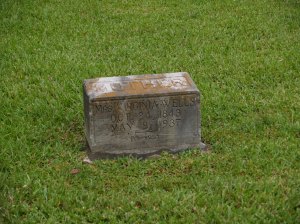

 I understood none of this when I was in Grenada and it has left me eager for a return trip, this time in the company of a larger group led by a local resident who can interpret the history. I took a picture of the box-like Grenada County courthouse and Doug Evan’s office a few blocks away. Then I got back in the car and we headed southwest in the direction of Greenwood.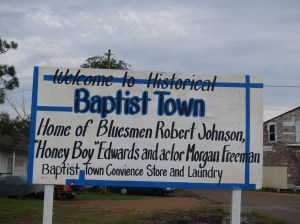
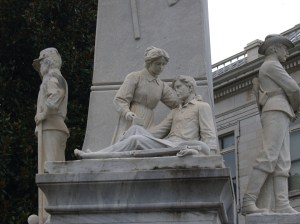


 Barack Obama refuses to get sucked back into the media’s great American race war. Jimmy Carter upped the ante in the “You Lie” debacle by imputing a racist motivation to Joe Wilson’s remark. White House press secretary Robert Gibbs assured the press corp that President Obama does not share Mr. Carter’s view of the matter. When a string of reporters asked variants of the same question, Gibbs repeated his mantra.
 The Sisters of Providence of Saint Mary-of-the-Woods in Indiana are proud of Donna Stites, an Associate of the order incarcerated at the Indiana Women’s Prison in Indianapolis. Yesterday, I sat down with Publications Manager Connie McCammon who wove my rambling reflections into
  Sister Rita Clare Gerardot is just one of the people who has helped Donna Stites on her journey. Pictured with Sister Rita Clare is Alan Bean. Also I’m interested in the story because it shows what can happen when people — when a community of faith — reaches out to the least of these and shows the compassion of Christ. It hasn’t just been Priscilla, but several of the sisters have gotten involved in Donna’s story and have worked not just with Donna, but her mother and her sister, who’s in the free world. [Donna’s mother died at the Indiana Women’s Prison in May 2008.]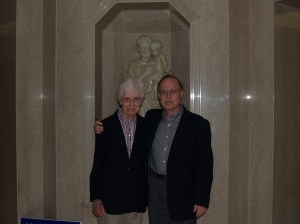
 Donna Stites is an Associate of the Sisters of Providence, a Catholic order devoted to justice and hands-on social ministry. Donna Stites has also been an inmate at the Indiana Women’s Prison in Indianapolis. In 1984, she was involved in two horrific murders. A year later she accepted two plea agreements, one for 50 years, the other for forty.
 Donna’s future is far from certain. She is a brittle diabetic and her kidneys have virtually shut down. Recently, she has been receiving dialysis treatments three times a week. “I always knew it might come to that, and I dreaded it,” she told me. “But now that I have no choice, I find myself looking forward to the treatments. I just sit there for four hours, but I always enjoy it for some reason.”
 Friends of Justice