Author: Alan Bean

Health care reform is personal

imageGordon Bean spent the last few years of his life in a Canadian hospital.  Diagnosed with Parkinson’s Disease, my dad gradually lost control of his muscles.  His mother died exactly the same way, hunched over in a wheelchair.  Whether I will suffer the same fate remains to be seen, but it’s something I think about.

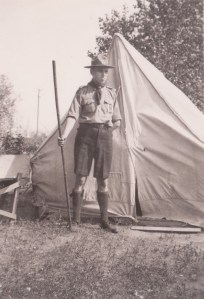
For me . . . for all of us, the health care debate is personal.  The picture at the left shows Gordon Bean as a young man; it was taken before I was born.  I like to remember dad as the guy in the picture;  it’s the way he would like to be remembered. 

We often speak of the naive and innocent as “boy scouts”.  My dad was an innocent in that sense, but he was also a genuine boy scout.  The adolescent Gordon Bean worked his way to the rank of King’s Scout (the Canadianimage-1 equivalent of an Eagle Scout).  He loved to fish, camp, canoe–all that good scout stuff and kept his scouting medals in a little cardboard box.  Loyalty, consistency, dedication; all the virtues we generally ascribe to the World War II generation apply to my father in triplicate.

Dad was a mix of diverse ideological elements.  His religion was conservative and literal, verging on fundamentalism.  His politics were liberal; some might say socialist.  He picked up the religious conservatism and the political radicalism at the same place: Calvary Baptist Church in Weyburn, Saskatchewan.  My father’s pastor, Sunday school teacher and lifelong mentor was T.C. (Tommy) Douglas, best known these days as the father of Canadian Medicare. (more…)

The Greenwood Movement

Bob Moses

(This post is part of a series concerning Curtis Flowers, an innocent man convicted of a horrific crime that has divided a small Mississippi town.  Information on the Flowers case can be found here.)

In 1962, Montgomery County, Mississippi could still boast that not a single Negro had registered to vote or paid the poll tax.  Tom Scarborough of the Mississippi Sovereignty Commission took great comfort in this statistic and checked periodically with County officials to reassure himself that it was still so.

But in the early days of 1963, neither Scarborough nor the civic leaders he interviewed in Winona were finding it easy to sleep at night.  The Freedom Rides of 1961were the first sign that Mississippi’s “massive resistance” to integration was running up against massive resistance of a different sort.  Then black college students from nearby LeFlore County started preaching civil rights from Winona pulpits and asking to be served at the segregated Stacey’s restaurant at the Winona bus station.  Winona had its Negroes under control,  but thirty miles to the west, the cotton town of Greenwood was in turmoil.

There had been a long history of civil rights agitation in the Mississippi Delta where blacks outnumbered whites three to one.  But when strange characters like the bookish Bob Moses (pictured above) and yarmulke-wearing James Bevel started speaking in Greenwood’s churches something new was afoot.  (more…)

Alvin in Wonderland

Lewis Carroll (aka Charles Dodgson) charmed the readers of Alice in Wonderland by placing logical fallacies in the mouths of bizarre characters.  Poor Alice is barraged on every side by convoluted absurdities from twisted character like the March Hare, Tweedle Dum and Tweedly Dee and the Red Queen. 

Alice in Wonderland comes to mind whenever I think of Alvin Clay.  The Little Rock attorney has spent the past seven years knocking down the government’s house of cards only to see the structure rebuilt before his eyes.   (Those who are not familiar with the story should consult this summary, written shortly before Clay’s June 2008 trial.  To put it simply, the government of the United States has been using unsustainable allegations to strike back at an uppity attorney who didn’t know his place. (more…)

Vigilante Justice in Sumner, Mississippi?

Since this post was published, the chairman of the House Homeland Security Committee says the U.S. Justice Department is investigating this incident–story pasted at bottom of this post.

Sumner, Mississippi in Tallahatchie County is best known as the town where Emmett Till was lynched for whistling at a white woman.  Now Sumner is back in the news (just barely) after County Attorney John Whitten III (the son of the attorney who successfully defended Till’s killers) organized an vigilante posse on August 20th (armed, some say, with guns and two armored tanks allegedly owned by a local survivalist group) to hunt down two young black men accused of robbing a local home.   (The courthouse in Sumner is pictured at the left.)

Thus far there  are two versions of the story: a brief article in the Jackson Clarion-Ledger (that says little apart from the fact that U.S. Rep. Bennie Sanders is asking the Attorney General to investigate) and a sensational account currently circulating in the blogosphere suggesting that little has changed in Tallahatchie County since the Emmett Till days.  An excellent blog dedicated to the Mississippi Sovereignty Commission addresses both sides of the story and suggests that an FBI probe is already underway.

As always, the comments at the end of the various stories are more entertaining than the text and raise serious questions about the current state of race relations in Mississippi.

According to the unauthorized blog version of the story, Mr. Whitten “organized a militia of what could best be described as a lynch mob. Some of these men were actual law enforcement officers while others such as the case of an unidentified white maintenance man from Tutwiler, MS, simply wore a police uniform and was given a police car along with plenty of booze, guns and ammunition. Even the K-9 unit from the Department of Corrections at the notorious Parchman State Penitentiary was alerted for this mission. In addition to the man, fire and canine power, Whitten deployed two military tanks for the purpose of hunting down Mr. Will Pittman as well.”

August 29, 2009

Feds investigating Delta incident

From staff and wire reports

The chairman of the House Homeland Security Committee says the U.S. Justice Department is investigating an incident in the Mississippi Delta in which he was told a mostly white group used weapons and “vigilante” techniques to search for a black burglary suspect.

The suspect, William Pittman, was charged Aug. 20 with breaking and entering a home in Sumner. He was released on bond the same day.

Second District U.S. Rep. Bennie Thompson, a Democrat who represents Tallahatchie County, on Thursday said he has asked the U.S. attorney general to investigate. He said his staff has received calls from concerned residents.

“Unauthorized people with guns, terrorizing citizens of this area has no place in civilized society,” Thompson said. “The fact that this community still (bears) the stains of racial tensions and is the area that Emmett Till was murdered weighs heavy on the conscience and fears of this community.”

Till, a Chicago teen who was visiting relatives in the area, was lynched in 1955.

Pittman’s father, attorney Ellis Pittman, said his son’s life was threatened by Tallahatchie County Prosecuting Attorney John Whitten.

Whitten, who is white and allegedly among the group, said the allegations are baseless.

The Justice Department says it’s aware of the case and the FBI says it’s reviewing it with other agencies.

The ACLU and the NAACP also are asking for an investigation.

Fort Worth Taser death ruled homicide

 A vigil was held for Michael Jacobs Jr. on April 21, a few days after his death in east Fort Worth. The Tarrant County medical examiner’s office has yet to rule on a cause of death in the case.   STAR-TELEGRAM/KELLEY CHINN    Since the Fort Worth Police Department started using Taser stun guns in 2001, four people have died.  One of them was Michael Patrick Jacobs Jr, a 24 year-old black man suffering from schizophrenia and bipolar disorder.  On April 18th Michael’s family called 911 after he started acting out at home.  A Fort Worth police officer arrived at the Jacob’s home, finding Michael combative, pulled out his Taser and hit the five-foot-five, 150 pound man with 50,000 volts for a full 49 seconds.

That’s a long, long time.  When 50,000 volts is coursing through your body, it’s an eternity.

It is unclear whether Jacobs was handcuffed before or after being tased.

Yesterday, Medical Examiner Nizam Peerwani declared Michael Patrick Jacob’s death a homicide.  This does not mean that the officer who held down the trigger on his Taser for almost a minute will be charged with murder or any other crime.  It simply means that Mr. Jacob’s death was caused by 50,000 volts of electricity plus nothing.

You can find the full story in the Fort Worth Star Telegram.    After the incident, Star-Telegram columnist Bob Ray Sanders had this advice for police chief Jim Halstead:

He should issue a moratorium on the use of Tasers until there is another thorough review of the department’s policies on the stun guns and until there can be more independent analyses of their effectiveness versus their danger. For the most part we’ve depended on the manufacturer’s analysis.  Since 2001, according to Amnesty International, 351 people have died after being shot with a Taser.

The newly formed Fort Worth chapter of the Southern Christian Leadership Conference, a civil-rights group founded by Dr. Martin Luther King Jr, is seeking a federal investigation into the incident.  SCLC president Rev. Kyev Tatum,  issued the following statement:

Mr. Jacobs did not have to die and no parent should have to experience the death of a child at the hands of the very officials who have sworn to protect and serve them and the entire community.  Justice should be color blind and social class should not play a role in administering it.

A news conference has been called for noon today at the Jacobs home.

Davis Case shows AEDPA went too far

Troy Davis death row inmate Supreme Court Savannah, Georgia murderTime Magizine’s David Von Drehle sheds some much-needed light on the Troy Davis story.  Von Drehle projects a world-weary and slightly cynical view of the legal world.  You don’t get the impression that he would shed a tear if Davis met his death at the hands of a Georgia executioner.  Consider this, for instance:

Like most death-penalty cases, this story is maddening and convoluted. Davis was convicted in 1991 of a tawdry and pathetic 1989 murder. On a hot Savannah night almost exactly 20 years ago, Davis and two acquaintances were hassling a homeless man at a Burger King parking lot next to the bus station. They wanted his beer, and one of the bullies — either Davis or a fellow known as Red Coles — clubbed the victim with a handgun. As it happened, an off-duty police officer, Mark MacPhail, was providing security at the restaurant. When he came running to the scene, the man with the gun shot the officer to death.

Coles pointed the finger at Davis; Davis pointed the finger back at Coles.  The state of Georgia had to side with one story and provide witnesses to back it up.

Investigators built a case from the available materials: ambiguous ballistics, jailhouse snitches, witnesses with grudges and the often unreliable observations of the sort of folks who need a burger at 1 a.m. The amalgam was enough to persuade 12 jurors that Davis was guilty, and because the dead man wore a badge, the sentence was death.

Nobody was really sure about anything in this case, but a police officer was dead and somebody had to pay the price.  Then, one by one, the trial witnesses started recanting their original stories.  Witness recantation isn’t unusual, especially when the state twists arms and brokers sweetheart deals to get people singing in harmony with the official story.  But you rarely see the kind of recantation avalanche that has transformed the Coles case into a cause celebre.

How does the state of Georgia respond?  Thanks to strict new federal laws they didn’t have to.  Five years after the McPhail killing, “Congress, exasperated by the seemingly endless nature of death-penalty appeals, passed a law intended to speed the death-row journeys of prisoners like Davis. Optimistically called the Antiterrorism and Effective Death Penalty Act (AEDPA), the new law attempted to limit death-row prisoners to one set of appeals in federal court.”

The practical result of AEDPA was that you get one bite ofthe federal apple.  Which is why Judge Antonin Scalia can’t understand why his judicial colleagues decided to send the Davis case back to a federal district court.  Davis already had one apple bite and AEDPA rules out bite number two.  Scalia isn’t arguing that Davis is guilty; he’s saying that, innocent or not, federal law has deprived Troy Davis of further appeals and that means the State of Georgia has the right to execute Troy Davis at a time of its choosing.  It may be immoral or unethical to execute an innocent man; but it’s perfectly legal.

Legal and constitutional.  There is nothing in the US Constitution barring the states from executing innocent people if that is their desire. 
If you believe that Troy Davis deserves a federal evididentiary hearing you are declaring AEDPA null and void.  Even if the hearing finds the evidence for evidence to be compelling, Scalia asserts, there are no legal provisions for doing anything about it.  That’s why he calls the hearing “a fool’s errand”.

Here’s the conclusion of the Time piece:

The court’s August eruption highlights once again the fundamental screwiness of America’s death penalty. In the marble halls of our rational humanity, we demand absolute clarity and justice. As one of the many judges who has reviewed Davis’ case puts it, “I do not believe that any member of a civilized society could disagree that executing an innocent person would be an atrocious violation of our Constitution and the principles upon which it is based.”

But most murders don’t happen in the precincts of the rational or the just. They happen on the late-night mean streets, where truth is often a figment, and memory is as slippery as the greasy pavement.

In other words, we frequently send people to death row on the basis of hopelessly muddled facts.  Nothing is nailed down.  Nothing is certain.  But a police officer is dead and somebody has to pay.  Then we pass a law (AEDPA) restricting Davis’s right, even after a recantation avalanche, to take his innocence argument to the federal level.

The Supreme Court’s decision in the Davis case is just one more indication that AEDPA went way too far and needs to be revised.

Jena 6 students get some positive publicity

P6264495Jesse Ray (Jody) Beard, best known as the youngest member of the Jena 6, is finishing High School at a private boarding school in Connecticut.  CNN recently interviewed Jesse Ray and Alan Howard, the NY attorney who has taken the young man under his wing.  You can find the text version of the story here.  I had the privilege of getting to know Mr. Howard during my last trip to Jena (in the picture at the left, he and attorney David Utter chat with Jesse Ray) and was moved by the depth of his commitment. 

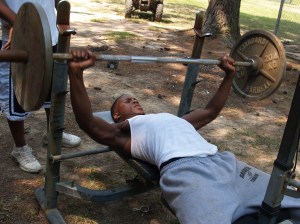
Also, the newspaper in Monroe, Louisiana did a story about Robert Bailey, Jr., another Jena 6 student who will be entering Grambling University in the fall.  Robert took a couple of summer school classes at Grambling this summer and earned a 4.0 average.  The story is unavailable online but the text is pasted below. The picture at the beginning of the article shows Robert lifting weights in June of 2009.

As the story suggests, the Bailey family has a long tradition at Grambling.   The second picture I have inserted into the news story features Robert’s grandmother during her Grambling days.  Elegant, don’t you think?  At the very end, the educational plans of all six young men are noted briefly. 

I hope Justin Barker, the victim of the December 4th, 2007 assault at Jena High, is also looking at a bright future.  Friends of Justice got involved in Jena not to pick sides but to bring some redemption to a tragic situation.  Are we better off with these young men attending college classes or locked up in a state prison? 
 P6264421

July 19, 2009

Former Jena Six student hopes to overcome past, look to future

By Stephen Largen

slargen@monroe.gannett.com

GRAMBLING — What might have sucked most people into a downward spiral only seems to have made Robert Bailey Jr. more determined to turn his life around.

Bailey, 19, is one of the Jena Six — six black Jena High School students initially charged with attempted murder in connection with a Dec. 4, 2006, assault on white student Justin Barker at the LaSalle Parish school.

The controversial case drew attention across the nation after many called the arrests and subsequent charges racially discriminatory and excessive. A massive civil rights demonstration ensued on Sept. 20, 2007, when at least 20,000 people marched through Jena to protest.

Bailey wrapped up his legal issues late last month when, along with Carwin Jones, Jesse Ray Beard, Bryant Purvis and Theo Shaw, he pleaded no contest in a Jena courtroom to misdemeanor simple battery. Bailey and the others were sentenced to seven days of unsupervised probation and a $500 fine, but were given no jail time.

They also reached a confidential settlement out of court with Barker.

The only member of the group to serve time was Mychal Bell, who pleaded guilty in December 2007 to second-degree battery and was sentenced to 18 months.

Now, after graduating in May from Shaw High School in Columbus, Ga., Bailey is taking summer classes at Grambling State University, where he plans to major in marketing. Bailey also will attempt to walk onto the football team as a wide receiver.

P6264434For Bailey, GSU was a natural choice. His grandmother, mother and several aunts went to the historically black college.

“That’s all I hear is Grambling,” Bailey said.

“In my house it was Grambling this, Grambling that — especially during football season.”

Bailey’s mother, Caseptla Bailey, who lives in Jena, is happy with her son’s decision to study at her alma mater.

“I’m very pleased with him,” Caseptla Bailey said. “I think something positive came out of all this. I think it was good he moved and got away from Jena. People here are still talking about the case. I still feel that people hold a grudge.”

Can’t go back

Robert Bailey said he has only been back to Jena for a total of three or four days since the controversy exploded.

He said he’s made the choice to keep a low profile.

“When people ask me where I’m from, I don’t like to say Jena,” Bailey said.

“People say ‘You know that’s going to stick with you for the rest of your life, right?’ I’m like, ‘For real?’ And I think about it, like, ,you’re gonna be 40 years old and people are going to look at you like you’re that Jena Six boy. I think it is going to stay with me, but it depends how you look at it. I just choose not to suck myself back into that environment where I know I’m going to get the finger pointed at me. I just choose to stay away.”

Bailey also chose to stay out of the spotlight at Shaw, where he enrolled in January 2008 and stayed with family after being kicked out of Jena High.

For his first six months at the school, Bailey didn’t even use his own name.

Instead, he went by the pseudonym “Xavier Lee,” until a local media outlet identified him as a member of the Jena Six.

“The media found out I was in Columbus,” Bailey said.

“I had people coming to me like, ‘Dang, that’s one of them boys. You seen one of those Jena Six boys?’ I was like, ‘Nah, I ain’t seen him,'” Bailey said with a laugh. “I keep to myself, I try to stay to my own business.”

Bailey was granted a final year of athletic eligibility by the Georgia High School Association.

He used that year to help lead the football team to the state playoffs.

“We did pretty good,” Bailey said.

“We made it to the state playoffs. I had 23 catches, 350 yards, four touchdowns.”

Bailey drew scholarship interest from several Division II teams but chose GSU instead.

“I just chose to come to Grambling just off of love. I want to be here,” he said.

Grambling’s alumni association has pitched in to make Bailey feel welcome.

One of the chapters has given him a textbook scholarship for his freshman year.

Bailey said he’s looking forward to catching footballs in the fall.

“I don’t plan on watching,” he said.

“I plan on being out there on the field.”

But Bailey doesn’t believe his future lies with athletics.

He plans to go law school after graduating from GSU.

“People always told me I was good at debating,” he said.

‘No choice but to succeed.’

Baton Rouge attorney Jim Boren, who served as Bailey’s lawyer, said his client has seized the opportunity to change his life.

“Robert has overcome it,” Boren said.

“He didn’t continue in a downward spiral. He picked himself up. He picked up his books and made a success of himself, and it’s just the beginning.”

Boren said Bailey is not the only member of the Jena Six to successfully move past the case.

“All the kids have left Jena and excelled,” he said.

“They haven’t gotten into any serious trouble. We’re all very proud of what they’ve done since then.”

Bailey said he still talks to all the other members of the group, and they encourage and motivate each other.

“Everybody’s started a new life,” he said.

“Everybody knows we got a second chance, and we know what we have to do. We’re grown now. You’re gonna have to be up at night studying for that final the next day. It’s what we’ve got to do. Work hard for your position in sports or whatever you choose to do.”

Bailey said the support he’s received throughout the world motivated him to continue on to GSU.

“I ain’t got no choice but to succeed in life,” he said.

“I can’t be on that negative end because I look at all the people that helped me out. They’re gonna be like, ‘Dang, we marched for nothing.'”

Additional Facts

jena six “” Where are they now?

¢ Robert Bailey Jr. is enrolled at Grambling State University and will attempt to walk on to the football team.

¢ Mychal Bell is enrolled at Southern University and will attempt to walk on to the football team.

¢ Jesse Ray Beard is finishing high school in Connecticut.

¢ Carwin Jones is planning to go to college in Texas starting in August.

¢ Bryant Purvis is enrolled at a community college in Texas and plays on the basketball team.

¢ Theo Shaw is enrolled at Louisiana Delta Community College in Monroe and was elected vice president of the school’s student government association for the 2009-2010 school year.

Former Jena 6 student Robert Bailey Jr. is taking classes at GSU and will try to make the football team in the fall.
Civil Rights tremors rumble through Montgomery County

Colored cafe

(This post is part of a series concerning Curtis Flowers, an innocent man convicted of a horrific crime that has divided a small Mississippi town.  Information on the Flowers case can be found here.)

Stacey’s Cafe in Winona, Mississippi did a roaring business back in 1961 when middle class southerners still traveled by bus.  White patrons could order a hamburger and fries while waiting for the next bus to Memphis or New Orleans.  If you were black, you had to patronize the less impressive “colored cafe” at the other end of the waiting room.  There was a big neon sign over the door at the white cafe; the colored restaurant was around at the back.

Stacey's (5)Early in 1961, Mississippi Sovereignty Commission Director, Albert Jones, sent agent Tom Scarborough to Winona on urgent business.  A Montgomery County Negro named Johnny Frazier was telling the US Attorney in Oxford Mississippi that Montgomery County Sheriff Earl Wayne Patridge and his deputies had arrested him at the bus station and “whipped” him in the County jail. (more…)

The Devil’s Logic: when innocence doesn’t matter


Is it legally acceptable for the Supreme Court of the United States to tacitly endorce the execution of an innocent man?  Antonin Scalia thinks it is.  Consider this remark from his dissenting opinion in the Troy Davis case:
“This court has never held that the Constitution forbids the execution of a convicted defendant who has had a full and fair trial but is later able to convince a habeas court that he is ‘actually’ innocent. Quite to the contrary, we have repeatedly left that question unresolved, while expressing considerable doubt that any claim based on alleged ‘actual innocence’ is constitutionally cognizable.” (more…)

Supreme Court gives Troy Davis an Evidentiary Hearing

IMG_0686-1

Breaking News.  The Supreme Court has just called for an evidentiary hearing in the case of Troy Davis.  This is a highly unusual deviation from legal business as usual.  As I have explained elsewhere, American courts are remarkably adverse to re-opening cases once a jury has ruled, a defendant has been sentenced, and the appeals process has upheld the conviction.  In Tulia, Texas, we didn’t get an evidentiary hearing until Bob Herbert of the New York Times had written six columns on the case, politicians like Hillary Clinton were appealing to the Department of Justice, and the Legal Defense Fund of the NAACP and a legal dream team had entered the fight.  In the Troy Davis case, it took the support of folks like Jimmy Carter, Desmond Tutu and His Holiness the Pope to shift the legal balances. (more…)