Over at Grits for Breakfast, Scott Henson has an excellent post contrasting racially segregated California prisons with the Texas system which has been racially integrated since federal Judge William Wayne Justice laid down the law decades ago. A riot at California’s Chico prison has drawn attention to the deep racial enmity within the California system. Although the common areas of these prisons (as opposed to the living quarters) are integrated, the various racial groups keep to themselves and any social contact across racial lines is dangerous. Within races, inmates self-segregate according to gang affiliation. Pay particular attention to the comments that follow Scott’s post–most informative.
Author: Alan Bean
The Poor Can’t Afford Diamonds
This post was submitted by Friends of Justice founding member, Dr. Charles Kiker.
 “The poor can’t afford diamonds either.”
I know it’s not polite to speak disparagingly of the dead, but that was William F. Buckley’s response a couple of decades or so ago to the plight of the poor when it comes to health care.
Mr. Buckley was right. The poor cannot afford diamonds. But he was wrong to suggest that diamonds and health care are comparable. I’m perfectly willing for the “free market” to control the availability of diamonds. Health care is in a completely different category. (more…)
The Southern Strategy Goes Down Swinging
 David Scott, a moderate black Democratic congressman from Georgia, has been getting hate mail laced with swastikas the n-word. Recently, a Swastika was painted on the sign outside of his office after a contentious public meeting in Smyrna, Georgia.
In a New York Times column, Gail Collins documents recent cases of anti-health care reform protesters packing heat at contentious town hall meetings.
While CNN personality Lou Dobbs lends credence to the idea that Barack Obama isn’t an American citizen, health-care protesters (aided and abetted by reputedly sane politicians like Chuck Grassley) have been darkly hinting that reformers, given their way, would end up euthanizing seniors. (more…)
Adding insult to injury
 On December 19, 2007, Grace Head, a 66 year-old resident of Arlington, Texas, set her Doberman Pinscher on two black neighbors, Silk Littlejohn and Broderick Gamble after telling them they had to abandon their home. Then, while Gamble was fending off the dog, Grace Head struck Ms. Littlejohn across the head with a 2-by-4. Not satisfied with this atrocity, Head jumped onto the hood of Gamble’s Toyota Camry and started stomping.
This is not your average granny.
On Tuesday, August 10, 2009, Grace Head was sentenced to 180 days in State Jail and a $4,000 fine. It was the lightest sentence allowed by law. (more…)
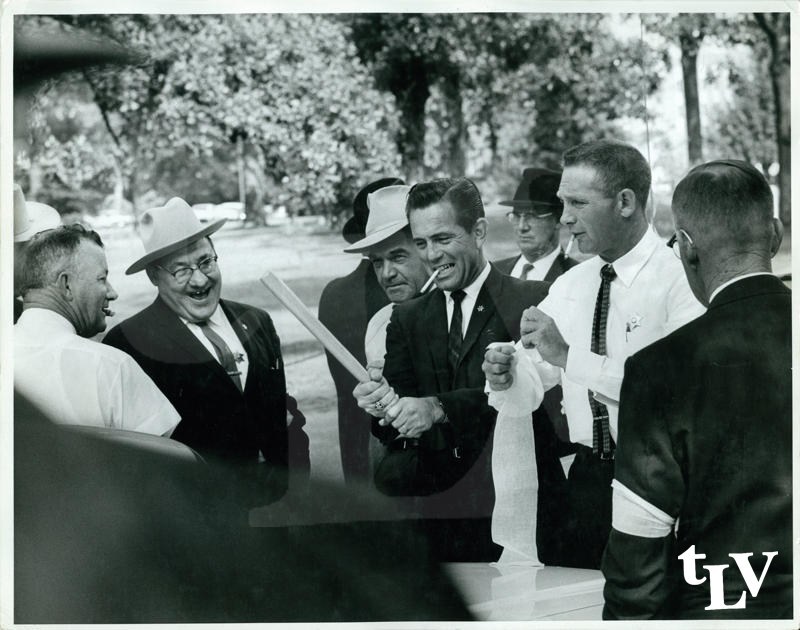
“Meddlesome Intruders”: the Freedom Riders hit Jackson, Mississippi
(This post is part of a series concerning Curtis Flowers, an innocent man convicted of a horrific crime that has divided a small Mississippi town. Information on the Flowers case can be found here.)
What happens when the state of Mississippi takes a man to trial five times and fails to obtain a final conviction?
If the defendant is Curtis Flowers you try him a sixth time. So far as I can gather, no American accused of murder has ever faced trial on the same facts six times. But if it takes ten trials to convict Flowers, the state of Mississippi, represented by District Attorney Doug Evans, is determined to do it. (more…)
Jury calls a hate crime by its proper name.
 The jury has returned a guilty verdict on a misdemeanor assault charge in the trial of Grace Head. More importantly, jurors clearly believed the crime was racially motivated whether or not Ms. Head was suffering from bi-polar disorder.
This appears to be a reasonable verdict in a difficult case. There was little ambiguity on the guilt-innocence issue, but Grace Head’s bizarre behavior revealed both racial animus and serious mental health issues. To what extent should we hold disturbed people accountable for their actions? (more…)
The Antichrist World of the Mississippi Sovereignty Commission

(This post is part of a series concerning Curtis Flowers, an innocent man convicted of a horrific crime that has divided a small Mississippi town. Information on the Flowers case can be found here.)
Why has a black man named Curtis Flowers been to trial five times on the same murder charges? When Curtis goes to trial for the sixth time he will establish a new national record for the number of times a single defendant has been tried for the same murder. A big part of the answer lies buried in the history of the town Curtis grew up in. (more…)
A hate crime raises painful questions in Arlington, Texas

A bizarre encounter on December 17, 2007 has evolved into a riveting drama in a Fort Worth, Texas courtroom. Grace Head, a 66-year old resident of nearby Arlington, stands accused of ordering her dog to attack Silk Littlejohn and her fiance Broderick Gamble. While Mr. Gamble grappled with Ms. Head’s Doberman Pinscher, the defendant struck Ms. Littlejohn across the side of the head with a two-by-four. She then jumped up and down on the couple’s Toyota Camry while smashing the vehicle with a tree limb.
Shortly after Ms. Head was arrested and bonded out, racist graffiti appeared on the Arlington couple’s garage door. Head is not accused of scrawling the hateful slogan, but many in the civil rights community hold her responsible for the act.
The charge against Grace Head is aggravated assault with a deadly weapon and criminal mischief. Prosecutors are claiming, albeit half-heartedly, that the crime was motivated by racial animus.
Silk Littlejohn is a friend of mine. Half a year after this tragic incident, Arlington Mayor, Dr.Robert Cluck, asked the Community Service Division of the Department of Justice to convene a meeting of concerned Arlington citizens. I was one of the 150 people who attended that meeting and, at the end of the day, Ms. Littlejohn and I were among a dozen or so people appointed to an “Arlington Coming Together” committee which has been meeting regularly for the past year.
Relations between the Arlington couple and Mayor Cluck have been far from cordial. When the grafitti appeared on their garage door, the City offered to have it removed, but there was no official statement of regret and outrage. When the couple refused to remove the message themselves until they saw some official expression of concern, the City had it removed without their permission. Ms. Littlejohn believes that Arlington Coming Together was a stop-gap diversion designed to create the impression that a hate crime was being taken seriously.
She may be right. Recently, Mayor Cluck and the Arlington City Council decided to disband ACT in favor of an advisory committee hand-picked by city council members.
These developments have left some ACT members with some serious questions. Fifty years ago, Arlington was a little, primarily white, community situated between Fort Worth and Dallas. Things have changed. Arlington is now a city if well over 300,000, her schools have long been majority-minority and the community has a developed a multi-ethnic flavor. But with only one non-white member on its city council, the highest level of Arlington’s city government doesn’t reflect the rapidly shifting demographics of the community.
Grace Head has entered a plea of not guilty by reason of insanity. She says she doesn’t remember the episode and claims she would never use racial epithets. Three psychiatrists have testified that the defendant is bi-polar and often doesn’t take her medicine, factors that might have sparked a psychotic episode. These witnesses have admitted that everything they know about the defendant comes directly from her–they have no way of peering into her soul and determining what motivated her vicious behavior.
One thing is certain, Silk Littlejohn and Brederick Gamble did nothing to incite violence apart from being black in a predominantly white neighborhood.
Is Grace Head Mentally ill? Most likely she is. But the prisons of Texas prisons are awash in inmates with serious mental health issues. The bar for criminal insanity is set very high and the question will eventually fall to the subjective judgment of twelve Tarrant County jurors.
Where do we go from here? The couple’s pastor, the Rev. Frederick Haynes, has rallied the people of his south Dallas Friendship West Baptist Church in support of his parishioners. Chockwe Lumumba, a civil rights attorney from Jackson, Mississippi, has been retained to represent Littlejohn and Gamble in a possible civil suit against the defendant and the City of Arlington. (Lumumba, incidentally, represented Curtis Flowers in the second of five trials he has endured in Mississippi.)
The City of Arlington has worked hard to get the victims of this crime to back away from the aggressive pursuit of legal claims. The DA’s office is prosecuting this case at the couple’s insistence but appears to have little heart for the fight. This case has been on the docket for months, but Ms. Littlejohn wasn’t asked to tell her story to prosecutors until a week before trial. The DA’s office didn’t try to find psychiatric experts to rebut claims of legal insanity and appear to be angling for a criminal insanity verdict.
Can these issues be addressed through our adversarial legal process? To some extent, yes. Actions have moral and legal consequences and that’s what the courts are for. But the criminal justice system won’t bring closure to either the victims of this assault or the City of Arlington. If they are serious about making things right, representatives of city government might want to sit down with Rev. Haynes, Silk Littlejohn and Broderick Gamble and talk things through. One session won’t accomplish much, series of meetings is needed. One way or another, the city of Arlington must reckon with the enormity of this traumatic incident and address the questions it raises. This matter must not, and will not be swept under the rug.
You can find coverage of the first day of testimony here, and coverage of the second day of trial here.
Iris Antonia Thompson Ibara is born!
 Yesterday Friends of Justice received both sad and joyous news. As we mourn the passing of our great friend, Marilyn Clement in New York, we rejoice in the birth of Iris Antonia Thompson Ibara in Cambridge Massachusetts.
Like, Marilyn Clement, Lili Ibara Thompson is one of the unsung heroes of the fight for justice in Tulia, Texas. In early 2000, Lili was working as a Vista volunteer in Plainview, Texas, twenty-five miles south of Tulia. Friends of Justice was just 16 days old when we met Lili at a Martin Luther King Day event. Hog farmer Joe Moore had been sentenced to 90 years in prison a month earlier, and a former track star named Cash Love had just received multiple 99-year sentences. When we told Lili about some of the other cases of prosecutorial misconduct we had recently witnessed she was horrified.
Lili Ibara Thompson is a practical, what-are-we-going-to-do-about-it sort of person. Her immediate thought was that we needed to get the Tulia story to the media. Retired Baptist pastor, Charles Kiker, and wheat farmer, Gary Gardner, had both written narrative accounts of the injustice we were witnessing and Lili fashioned these accounts into a pitch for the Texas Observer.
When the bundle of materials Lili sent the small but highly-respected monthly landed on the editor’s desk in Austin he handed it to Nate Blakeslee, an aspiring journalist who had just signed on with the Observer. Nate arrived in April of 2000 and his in-depth investigative piece, The Color of Justice, was published in June of that year. We were able to secure several hundred copies of Nates article and one Sunday morning, Lili helped stick copies of Blakeslee’s article under the windshield wipers as Tulia’s faithful gathered for worship.
Lili has a law degree but she is currently working as a social worker in Boston because legal work seemed too detached from a hurting world. It is fitting that Lili and Jeremy Ibara Thompson should bring a child into the world on the same day Marilyn Clement left this world. We come and we go but the work of justice goes on.
sunrise, sunset
swiftly fly the years,
one season following another,
laiden with happiness,
and tears
In Memoriam: Marilyn Clement
 “Working for the common good is a wonderful way to live – a wonderful way to spend a lifetime. I entered that work through no virtue of my own, but through the mentoring and nurture, support and inspiration of a whole community of people all over the world… A community that taught me not to be afraid, but to live with a sense of fearlessness. It included the movement for justice in my town, my country and around the world … all taught me to be unafraid.” Marilyn Clement
Marilyn Boydstun Clement, a tireless worker for civil rights and universal health care, died Monday, August 3, in New York City. She marched with Martin Luther King, Jr. She worked with the Southern Christian Leadership Conference, Women’s International League for Peace and Freedom, and the Center for Constitutional Rights. In 2004 she founded Health Care Now!, an organization devoted to single-pay, universal health care.
I knew Marilyn when we were students together at Tulia High School. I was a senior when she was a freshman. I graduated from THS in 1950, and don’t know that I saw her again until there was an all school reunion at picnic time 50 years later. I had learned that she was a social activist and sought her out to tell her the story of the Tulia Drug Sting. She provided a valuable contact to Margie Ratner of the Center for Constitutional Rights and Randy Credico and Sarah and Emily Kunstler at the Kunstler Fund for Racial Justice. Through these invaluable contacts we were able to secure nationwide media coverage and state-of-the-art legal assistance. The rest, as they say, is history.
Marilyn lived most of her adult life in New York City. In February, 2004 Patricia and I and Freddie Brookins Sr. took a trip to the Big Apple, where she provided several venues for telling the Tulia story as well as providing wall-to-wall sleeping space for us in her efficiency Village apartment.
There will be a memorial service for Marilyn sometime this fall in New York City. I probably will not attend, but I do plan to give a gift in her memory to Friends of Justice.
I hope some of you can join me in that gesture.
Charles Kiker
Charter Member of Friends of Justice
The New York Times has a brief obituary and you can find a thorough and well-written account of Marilyn’s work for racial justice and health care reform at the Health Care Now! website.
 Friends of Justice