Author: Alan Bean

Newsweek covers racial tension in Paris, Texas

You can find a rather unsavory update to this story here.

Earlier this week, the racial tension sparked by the death of Brandon McClelland was covered by Newsweek

This brief excerpt captures the tone of the piece:

In November, a courthouse protest drew representatives of the New Black Panther Party, the Nation of Islam and the NAACP on one side and white, Bible-waving hecklers and a self-identified grand titan of the Ku Klux Klan on the other. Things have reached such a nadir that the Justice Department has deployed its Community Relations Service-a sort of civil-rights SWAT team -to mediate discussions among Paris residents. “This town is being forced to look at things they never wanted to look at before,” says Brenda Cherry, who lives in Paris and cofounded Concerned Citizens for Racial Equality.

Yet it’s not at all clear that race even played a role in McClelland’s death . . .

 The details of Brandon McClelland’s tragic demise remain fuzzy (see article) and it is that very ambiguity that makes the gap between black and white perception so significant.  Like Jena, this story serves as a Rorschach inkblot–you see what you want to see.

Black radicals see a hate crime and smell a cover-up.

White residents can’t figure out what all the fuss is about.

Much of the ambiguity may stem from an initial investigation that some Paris residents deride as sloppy and half-hearted.   

Gradually, the McClelland case is being viewed through the lens of the Shaquanda Cotton story.  Some white residents assert that if the Chicago Tribune hadn’t given Paris a reputation for racism the dragging death wouldn’t be a simple tragedy without racial significance.

Black residents suggest that Paris, Texas hasn’t outlived its tragic racial history.

In short, it’s a mess; a microcosm of America’s racial divide.  Read the Newsweek account and let me know what you think.

Problems in Paris, Texas

A brutal death has caused long-simmering racial tensions to flare anew.

By Gretel C. Kovach and Arian Campo-Flores |

To his loved ones in Paris, Texas, Brandon McClelland was affectionately known as “Big Boy,” a 284-pound gentle giant. He was a devoted family man-babysitting his little cousins, caring for his mother after she suffered a stroke and a heart attack, cooking up dishes of “Mexican spaghetti” for his disabled grandmother. He had a large circle of friends and regularly invited them over to play dominoes and to barbecue in the front yard. He always looked out for them, making sure the ones who had a little too much to drink got home safely. Though he was African-American, he didn’t pay much attention to race. He had acquaintances of all colors, and, in fact, his best friend was a white girl he met at church. (more…)

Innocent man dies in prison: Wade Goodwyn tells the Tim Cole story

In 2008, Ruby Session held a photograph of her son Tim Cole after DNA testing proved that he had not committed the rape he was convicted of in 1986. He died in prison before his exoneration.Update (3/2/2010) : Texas Governor Rick Perry finally decided he had the power to issue a postmortem pardon to Timothy Cole.  I know Tim’s family were relieved, possibly even overjoyed, by this good news.  I also suspect they are still asking themselves why the justice system took so long to admit the obvious.  AGB

I was finishing up my morning stretching ritual this morning when Wade Goodwyn’s story on Tim Cole aired on NPR.  I had heard the Cole saga before, but Goodwyn has a rare gift for storytelling and his dispassionate rendition of the essential facts gave me the chills.

Dissect a case of wrongful conviction and you will find yourself at the heart of the New Jim Crow. 

The problem is spiritial and it is structural. 

Changes in the legal code can help, but the real problem lies in the hearts of men like Jim Bob Darnell, the former Lubbock County District Attorney who decided Tim Cole was guilty when all the facts pointed to another man.  Jim Bob wanted a conviction.  The rape victim thought she recognized Cole.  And when a parade of Cole’s friends testified that he was at home at the time in question an all-white jury was unconvinced.

Even now, when DNA evidence clearly proves that Cole was innocent, no court in Lubbock will grant an exoneration hearing.

Earlier this week, I was talking to a religious leader from Plainview, Texas, a town of 25,000 half-way between Lubbock and Tulia.  He rembered the day a local attorney dropped by to visit.  The earnest young man had watched yet another miscarriage of justice and needed to talk.

“You won’t get an argument from me,” the preacher told the lawyer; “the criminal justice system in this community is evil.”

The lawyer shifted forward in his chair.

“Frankly,” he said in a half-whisper, “I’m surprised to hear you say that out loud.”

“Well, I’m just calling it the way I see it,” the preacher replied.  “No one cares about the truth or the defendants; we’re just throwing lives away without remorse.”

The lawyer hesitated before speaking.  Finally he said, “If I were you I’d keep thoughts like that to myself.”

I entered this barren spiritual landscape in the summer of 1999.   Four months before an innocent Tim Cole succumbed to chronic asthma in his prison cell, forty-six people, all of them poor and most of them black, had been picked up in a single drug bust in Tulia, Texas.  (more…)

Witt Responds to Paris Critic

Before I give Howard Witt an opportunity to respond to a critic from Paris, Texas, I should clarify a couple of things: 

First, my aim is to give all sides an opportunity to share their views.  Folks from Paris who take issue with Mr. Witt’s remarks are free to respond and I promise to publish any responsible remarks.

Second, I contacted Howard Witt about the mess in Jena, Louisiana after reading his early reports on the Shaquanda Cotton story.  I was impressed with his willingness to bring an obscure but troubling case to the attention of the wider world.  Although I have only met Mr. Witt on one occasion, he is on my mailing list and frequently sends me articles he has written with some relation to racial justice. 

In short, I am not trying to put anyone in their place nor do I want to slant the conversation to the advantage of either side.  Hopefully we are all searching for the truth and this exchange will shed needed light on an important subject.

Howard Witt Responds

Thanks for the opportunity to respond to the inaccuracies and falsehoods contained in this message. I understand that many town leaders in Paris believe I have been “pushing this story for a long time,” but in fact I keep returning to Paris because important developments keep happening there that are worthy of outside attention.

Contrary to the vehement insistence of some white people in Paris that I have some sort of personal agenda–a local Methodist minister at last week’s public meeting declared that I am a “Christ killer” because of my reporting–I’m actually interested in the struggles of this east Texas town as it grapples with its troubled history of race relations. (more…)

Chicago Tribune Reporter Taken to Task

In recent years, Paris, Texas has been reluctantly entered into a competition for the uncoveted title of Most Racist Town in America.  The competition comes from towns like Jena, Louisiana and Texas communities like Tulia and Jasper.  It hasn’t been the intention of groups like Friends of Justice to encourage this silly competition, nor do reporters like Nate Blakeslee (currently with the Texas Monthly) and Howard of the Chicago Tribune set out to blacken the reputation of small southern towns.  Unfortunately, it is impossible to chronicle troubling instances of injustice without drawing unwanted attention to places like Tulia, Jena and Paris.

Recently, a community meeting in Paris degenerated into a angry free-for-all.  At least that’s the way it appeared to Chicago Tribune reporter Howard Witt.  In the wake of this debacle, a prominent resident of the North Texas community who had seen my post on Witt’s story, expressed his frustration to a Dallas resident.  I don’t know the identity of the author, but these comments were passed on to me in the interest of airing all sides of the story. 

I have been given permission to pass these comments on to my readers with the understanding that (a) the author should remain anonymous and (b) Mr. Witt would be given an opportunity to respond.  My guess is that the comments below are widely shared in Paris and I share them with you because I believe the issues in Paris should be vigorously debated from every c0nceivable angle. 

An email from Paris, Texas

The Tribune has been pushing this story for a long time. They came to Paris to write a discrimination article and they wrote one the facts not withstanding. Shaquanda Cotten had a long term history of relatively serious problems including an average of over an incident per day at school, all of which her mother chalked up to racism. The hall monitor was the last straw. She was almost 60 years old, barely five feet tall and left the school in an ambulance.

Superville went the TYC route only after offering different options if her mother would give up custody so as to stop the enabling. He, of course, did not sentence her to seven years but gave the normal “indeterminate” sentence which would have allowed for her to be released at any time after she showed any remorse and indicated she might be able to interact in society.

The Tribune knows this but continues to print misleading commentary. The local Black population not only was not “up in arms” — they were very supportive. The Black Panthers from Dallas came over and held a small demonstration — which was very helpful. Leaving alone the question of whether personal assault or the property crime of arson is more serious, the Tribune either didn’t bother to print or didn’t bother to learn that the “white” arsonist was also a victim of domestic assault and was acting out and that every psychologist and advocate that dealt with both cases recommended the sentences that Chuck handed out. They also didn’t follow up and learn that the “white” girl didn’t make her probation and went to TYC. And while no one knew what was going on at TYC at the time that girl was assaulted while under TYC jurisdiction.

The last case [Brandon McClelland]  is more troubling, but once again the Trib ignores facts and details that confuse the situation. There were two white guys and a black guy, the black guy was killed in a horrible manner, they were also friends of some duration who were out drinking together. I don’t know whether it’s a hate crime but I know it was hard for the DA to figure what to make of it so they farmed it out to the former chief prosecutor from Dallas–the guy Watkins beat–which I think was a good idea.

Don’t get me wrong there’s racism in Paris and all our communities need a lot of work, but Chuck Superville ain’t a racist and the Chicago Tribune ain’t trying to promote social justice.

Racial paralysis in Paris, Texas

If you have been thinking that the last election ushered in a post-racial America this dispatch from Paris, Texas will give you pause.  I didn’t attend the meeting described in Howard Witt’s article, but I have been in conversation with several Paris residents.  The Community Relations Service of the Department of Justice can be a useful resource when folks are ready to talk, but in towns like Paris there isn’t much that public officials like Carmelita Pope Freeman can do. 

I considered attending this event, but decided to let the Parisiennes (Parisites?) work things out in their own way.  Until the Brandon McClelland dragging death case is resolved there won’t be much common ground or shared vision in this North Texas community.

The disconnect between white and black evangelicals described in my last post springs to life in Mr. Witt’s poignant article.  White folks, arms folded defiantly across their chests, shake their heads in disbelief as black folks share personal encounters with racism.  Are the white folks racists?  Are the black folks playing the race card?  It all depends on who you ask.

One thing is certain, America remains divided by race.  You see it most clearly in places like Jena, Tulia, Bunkie and Paris; but this is a distinctly American story.

RACE IN AMERICA

Hard truth, but little reconciliation, in Paris, Texas

By Howard Witt | Tribune correspondent
1:50 PM CST, January 30, 2009
PARIS, Texas – Ten days into the new America, a hundred white and black citizens of this deeply-polarized east Texas town tried their hand at the kind of racial reconciliation heralded by the historic inauguration of President Barack Obama, gathering for a frank community dialogue on the long-taboo topic of race.

Things didn’t go so well. (more…)

Black evangelicals and racial justice

UnChristian, a book by David Kinnaman and Gabe Lyons of The Barna Group, emerged in the midst of the most recent election cycle.  Kannaman and Lyons are a couple of twenty-or-thirty-something nerds who have crunched the numbers and concluded that Christians have a serious image problem.  (In the picture above, Lyons is seated on the left; Kinnaman on the right.)

But who are these Christians?  If you read carefully you will discover that the authors are really talking about Christian evangelicals.  Although the authors suggest that only 9% of the American electorate fits a strict definition of “evangelical” (in their view you have to believe in an error-free Bible and a personal Satan to qualify), the 38% of the electorate described as “non-evangelical born-again Christians” might also make the cut.  The general tenor of the book suggest that “other self-identified Christians” (29% of voters) are guilty of false advertising; they aren’t real Christians. 

unChristian is a book written for and about evangelicals.

But is it about all evangelicals?  In a  chapter titled “Too Political”, we learn that “Christians” are commonly viewed as pro life and anti-gay.  So maybe this is a good working definition of “evangelical”: folks who oppose abortion and the gay rights movement.

Few students of American religion would be comfortable with such a definition, but it comports well with popular perception.  The term “evangelical” is commonly used to describe religious people who vote Republican, and there is little in unChristian that challenges this perception.

This suggests strongly that Kinnaman and Lyons (perhaps unwittingly) are only talking to and about white evangelicals.

Most African Americans are evangelical Christians (even in the very strict sense cited above).  The passage of Proposition 8 in California indicates that most of the black Americans who voted for Barack Obama are uncomfortable with gay marriage.  Most black Christians also have big problems with abortion.  Moreover, black Christians tend to be religiously conservative–if you like King James english drop by the nearest black church and chances are you will get an ear full of it.

Black Christians are overwhelmingly evangelical and they rarely vote for republicans.  You would be hard pressed to find a black evangelical who favored John McCain over Barack Obama.  Such people likely exist, surely, but they are lying low at the moment.

Sociologists Michael Emerson and Christian Smith addressed the striking perceptual gap between black and white evangelicals in their groundbreaking study, Divided by Faith: Evangelical Religion and the Problem of Race in AmericaWhile in solid agreement on many issues, white and black evangelicals part company on the subject of race.  (more…)

When lawmen go bad

Over at Grits for Breakfast, Scott Henson walks us through recent scandals involving Texas sheriffs.  Texas lawmen may get more negative press than their counterparts in other states, but the problem of police corruption is widespread.  I uncovered some horrendous examples of corruption in Arkansas while researching the background to the Alvin Clay case.  It isn’t that most peace officers are corrupt–they aren’t; the problem, as Henson argues, is that when a lawman goes bad we frequently discover that nobody is paying attention and few seem to care.  As Henson says, “Texas spends too few resources ferreting out public corruption and too much on law enforcement pork.”  

If you aren’t sure what Scott is driving out, make sure to check out the PBS documentary on the Tulia drug sting on February 10th.

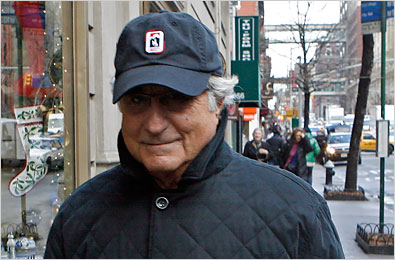
McCuien, Madoff and the arts of deception

The Talented Mr. Madoff

Bernie Madoff has friends and former associates befuddled.  How could such a nice, competent guy create so much misery?  In this New York Times article, “The Talented Mr. Madoff,” Julie Creswell and Landon Thomas portray the New York financier as a classic psychopath.

In a recent post, “Psychopaths Under Oath,” I argue that American prosecutors are vulnerable to the machinations of psycopathic witnesses.  The Madoff story is just another example. 

Creswell and Thomas are reluctant to portray Bernie Madoff as a psychopath without consulting expert opinion, beginning with an FBI profiler

“Some of the characteristics you see in psychopaths are lying, manipulation, the ability to deceive, feelings of grandiosity and callousness toward their victims,” says Gregg O. McCrary, a former special agent with the F.B.I. who spent years constructing criminal behavioral profiles.

Mr. McCrary cautions that he has never met Mr. Madoff, so he can’t make a diagnosis, but he says Mr. Madoff appears to share many of the destructive traits typically seen in a psychopath. That is why, he says, so many who came into contact with Mr. Madoff have been left reeling and in confusion about his motives.

“People like him become sort of like chameleons. They are very good at impression management,” Mr. McCrary says. “They manage the impression you receive of them. They know what people want, and they give it to them.”

I wish the FBI had consulted Mr. McCrary before they decided to believe every word proceeding from the mouth of a low-level psychopath named Donny McCuien.   But the relationship between AUSA Stephen Snyder and Mr. McCuien isn’t all that unusual.  Consider this:

Current and former S.E.C. regulators have come under fire, accused of failing to adequately supervise Mr. Madoff and being too cozy with him.  “He [Madoff] was the darling of the regulators, without question. He was doing everything the regulators wanted him to do,” says Nicholas A. Giordano, the former president of the Philadelphia Stock Exchange. “They wanted him to be a fierce competitor to the New York Stock Exchange, and he was doing it.”

Men like Mr. Snyder are entangled in the webs woven by witnesses like Donnie McCuien because they are dependent on their cooperation.  Like Bernie Madoff, Donnie McCuien listened carefully to the authority figures in his world until he learned what they wanted to hear–what they were desperate to hear.  .  Once that is established, it is simply a matter of saying the precious words in the right order and with the right emphasis. 

Gullibility is driven by prosecutorial desperation.

Psychopaths are successful because they are completely unconcerned with the feelings of others–they have no empathy.  Because they are only concerned about their own interests, psychopaths are unencumbered by ethical and moral niceties.  Which brings us to the second expert cited in the New York Times article.

Mr. Madoff’s confidence reminds J. Reid Meloy, a forensic psychologist, of criminals he has studied.

“Typically, people with psychopathic personalities don’t fear getting caught,” explains Dr. Meloy, author of a 1988 textbook, “The Psychopathic Mind.” “They tend to be very narcissistic with a strong sense of entitlement.”

All of which has led some forensic psychologists to see some similarities between him and serial killers like Ted Bundy. They say that whereas Mr. Bundy murdered people, Mr. Madoff murdered wallets, bank accounts and people’s sense of financial trust and security.

Like Mr. Bundy, Mr. Madoff used a sharp mind and an affable demeanor to create a persona that didn’t exist, according to this view, and lulled his victims into a false sense of security. And when publicly accused, he seemed to show no remorse.

Like Bernie Madoff, Donny McCuien never worried about getting caught.  He was so confident in his ability to deceive federal authorities like Stephen Snyder that he continued to run real estate scams while he was telling the government that he knew nothing about the world of real estate. 

Because Alvin Clay was willing to do the government’s work after the fact, it has recently come to light that Donny McCuien was enthusiastically scamming buyers, sellers and lenders when he took the stand to speak the words Mr. Snyder longed to hear. 

True, McCuien is to Madoff as a minnow is to a whale, but the same principles hold. 

Ultimately, McCuien and Madoff were undone because neither man could conceive of personal failure.  The technical term is “grandiosity”.

The media can’t be expected to unmask the likes of Madoff and McCuien.  Until Madoff admitted (without a shadow of remorse) to pocketing fifty billion dollars of other peoples’ money, journalists had no reason to suspect the man.  The New York Times didn’t commission a major investigative article until after the Wall Street magnate had fallen from grace. 

Similarly, I haven’t been able to interest the media in the plight of Alvin Clay. 

Prosecutors, investigators and S.E.C. enforcers who fear the wrath of a just God must develop a keen nose for psychopaths like Madoff and McCuien.  We should probably be paying more psychologists and profilers to check out potential witnesses.  The signs of deception are easily spotted once you know what to look for and it is so much easier to clean up the mess before another wrongful conviction or Ponzi scheme goes into the books.

No excuses?

The race issue is incredibly sticky and prone to over-simplification.  When I stumble over a word of wisdom on the subject I intend to pass it on.  In this piece, New York Times columnist Charles Blow has some important things to say about children and the limits of positive thinking.  Let me know what you think.

Alan Bean, Friends of Justice