
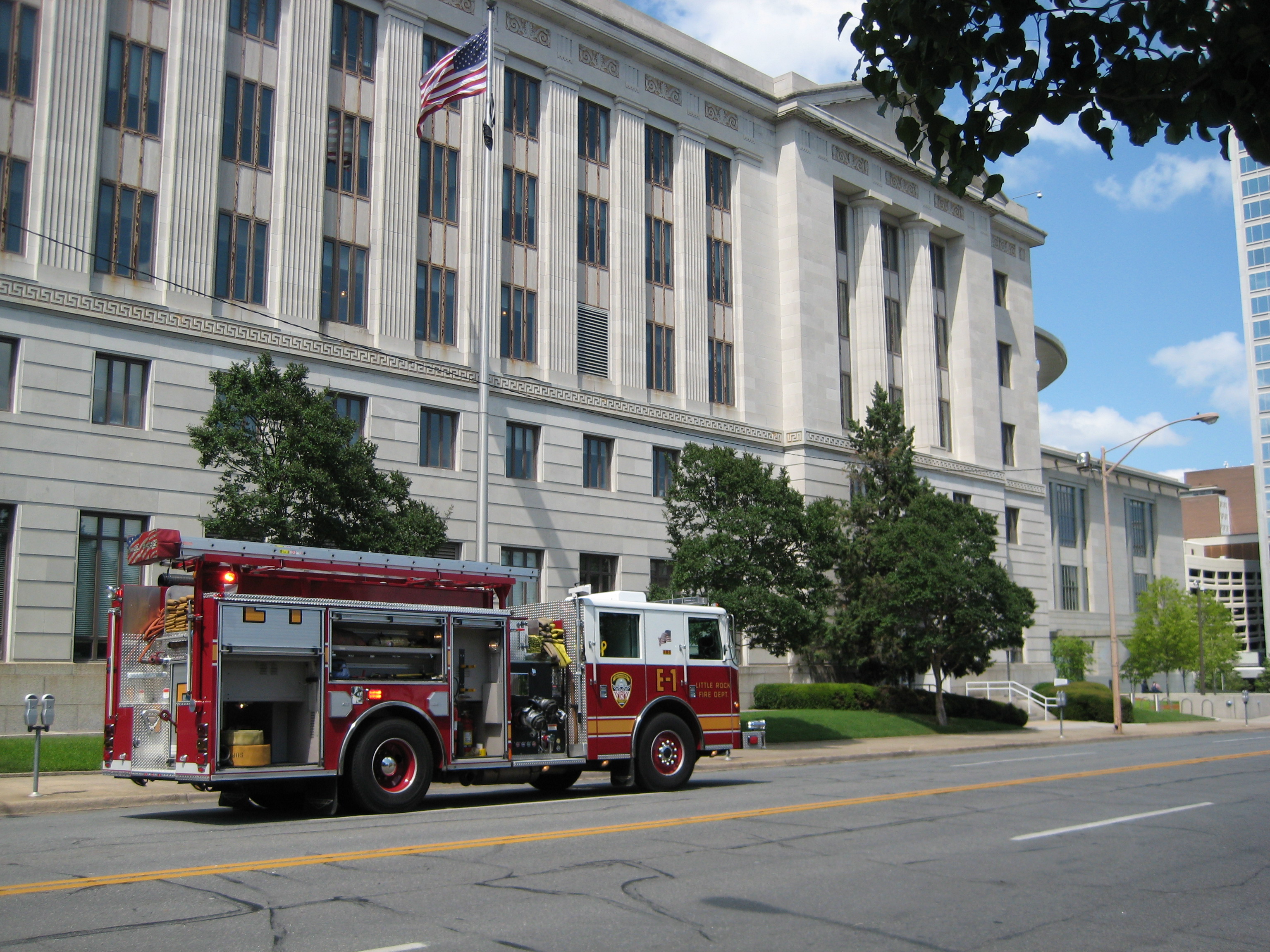
On the first day of Alvin Clay’s trial in late May, I walked from Little Rock’s Central High School to the federal courthouse. I wanted to feel the shift from the Old Jim Crow segregration of 1957 to the New Jim Crow regime on display at Mr. Clay’s trial. As I walked, I remembered sitting in courtrooms in Texas and Louisiana. I remembered the helpless feeling of watching a wrongful conviction unfold before your eyes and being powerless to stop it.
A week later, with the Clay trial more than half over, I was feeling upbeat. I saw the coming verdict as a coin toss. The government’s case was remarkably weak; but I knew it didn’t have to be strong.
When the closing arguments were over I knew Alvin was going down on all counts. Steven Snyder, the assistant US attorney was afire with indignation, his arguments precisely tailored to the fears and loyalties of his audience. Defense attorney George Hairston was badly off his game.
Perhaps it was the fact that somebody had broken into Mr. Hairston’s hotel room the night before and stolen his closing argument along with the rest of his laptop computer. Perhaps the aging attorney was showing early signs of senility. Whatever the explanation, only a stellar performance would have removed the governments trump cards from the table, and Hairston hadn’t come close.
Friends of Justice intervenes in cases with a high potential for wrongful conviction. Kareem Abdul Jabbar White was convicted in September of 2000, the last of nine drug defendants tried in the Swisher County courtroom. We had spent nine months watching one defendant after another convicted on the uncorroborated word of a remarkably corrupt undercover officer named Tom Coleman. Ultimately, Coleman implicated three-quarters of the young black males in Tulia.
A month after Kareem was convicted; the Tulia story was featured in the New York Times. But three years would pass before the defendants were pardoned by Governor Rick Perry and released from prison. Everyone associated with the Friends of Justice became personae non grata. The ordeal was particularly draining for people like Nancy Bean, a school teacher who had to face the angry glares of the respectable folk every work day.
When you think your phones are tapped, and you know someone just disabled the brakes on your car, time moves slowly.
I spent the four months after Mr. White’s conviction pouring over Joe “Booty Wooty” Moore’s trial transcript. None of the lawyers involved in the legal fight had considered filing a writ of habeas corpus on Joe’s behalf, so we decided to write one ourselves. I soon realized that I was studying the mechanics of wrongful conviction.
Moore had been convicted in December of 1999 and sentenced to 90 years (another defendant received multiple 99-year sentences).

Joe Moore
Joe Moore had been convicted on drug charges a decade earlier and, with his knees bad and his diabetes worse, he lived in fear of returning to prison. On two separate occasions, Tom Coleman had attempted to lure Joe into selling drugs. Both times, the hulking hog farmer ran the skinny cop off his property.
Joe’s jury didn’t know about Coleman’s checkered past. And Joe’s court-appointed attorney provided what must be the most counterproductive defense in the annals of jurisprudence. Still, I kept wondering how the uncorroborated testimony of a stranger could overcome the presumption of innocence?
Alvin Clay’s trial inspires similar questions.
The convictions of Joe Moore and Alvin Clay trials followed the same narrative arc: A low-status black defendant, one documentable “prior bad act”, a fiery close from the prosecution, a placid performance from the defense attorney, a lying witness, and an all-white jury.
Actually, there was a single African American on Joe Moore’s jury, the daughter of a Baptist preacher. She knew Joe just well enough to question the government’s case, but her doubts were no match for the certainty shining in the eyes of eleven white jurors. These people didn’t think Joe was guilty; they knew it. The man had been a bootlegger, a notorious gambler and a womanizer back in the day; so he had to be guilty of this one too.
None of the early members of Friends of Justice had much prior experience with the law. We were preachers, slaughter house managers, wheat farmers, school teachers and juke-joint proprietors. When we heard that forty-six drug kingpins were peddling poison to school children in tiny Tulia, Texas, we didn’t believe it.
I can never forget the headline in the local paper: “City streets cleared of garbage”. A few days after reading these words I shared my concern with the Sunday school class at the Baptist Church. I was particularly bothered by the repeated use of the term “scumbag” in reference to defendants the newspaper editor didn’t know personally. “I had always believed that defendants are to be considered innocent until proven guilty,” I said.
A red-faced man told me that the defendants were guilty, all forty-six of them. Moreover, they were all going to jail. A few months later, this man served as chairman for a jury that sentenced a young first-offender to forty-five years for selling drugs to Tom Coleman.
When the Sunday school class ended, a local businessman took me aside. “It’s these black athletes,” he confided. “They score a few touchdowns and they think they’re gods. They think they can smoke their dope and mess around with our girls, and, well, something had to be done.”
All of the original Friends of Justice expected to get out of the criminal justice reform business the moment our fight in Tulia was over. Most of us did. But the phone calls didn’t stop. At first the anguished voices on the other end of the phone came from Tulia; then from surrounding counties.

Never Again Rally, 2001
Simply by publishing a factual narrative of these cases in independent newspapers we found we repeatedly embarrassed the state into doing the right thing. Before the drug sting defendants got some justice, Friends of Justice had overturned three smaller cases in the Texas panhandle.
Then the calls started arriving from further afield. Ann Colomb, a housewife from Church Point, Louisiana, told us that the federal government was using convicted drug dealers to accuse her family of running a multi-million dollar drug ring out of their modest FHA bungalo.
I could imagine a small town sheriff and a dim-witted gypsy cop cooking up a bogus drug bust in the Texas panhandle; it never expected to see the federal government following suit. There is no parole in the federal system, inmates were facing multi-decade sentences, and they could win time cuts of five years or more by providing “substantial assistance” to the US attorney’s office.
It was obvious from the outset that astute inmates were hosting perjury parties behind bars. The government had to provide defense counsel with summaries of each contact they have with inmates. By placing these reports in chronological order, I could see the Colomb family name spreading from inmate to inmate and from prison to prison. Letters started arriving at the US Attorney’s office offering information about “the Culone’s” or “the Colognes”.
Ann hadn’t taken the Colomb name until she remarried her current husband, and none of her sons went by the name. Common sense suggested that the letter writers were willing to implicate total strangers if that’s what it took to lop half a decade of their sentences. One inmate eventually admitted that he paid over $2000 to a cellmate for identifying information on Ann Colomb and her sons.l
After interviewing almost every important person in the Colomb’s social world I knew the government’s vast cocaine enterprise was a complete fantasy.

Ann Colomb
I still believe that most federal prosecutors wouldn’t have gone after the Colomb family on such shoddy evidence; but if a rogue prosecutor decides to prosecute, there is little recourse. There are few limits to prosecutorial discretion.
Innocence projects are springing up across America in the wake of a horrifying string of exonerations. Are wrongful convictions confined to the relatively small number of cases involving DNA evidence, or is the problem just as serious in narcotics and conspiracy cases?
DNA evidence had no bearing on the Joe Moore case, it didn’t help Ann Colomb and, when I first arrived in Jena, Louisiana, I knew it wasn’t going to help Mychal Bell either.
Could it be that established civil rights organizations are attaching the shopworn categories of the 1950s and 1960s to a social landscape they no longer fit? What if the civil rights abuses of the 20th century are mutating into exotic strains as a new century unfolds? And what if the pills and potions that vanquished the Old Jim Crow are no longer effective?
The Old Jim Crow regime maintained social distance between white people and black people. The New Jim Crow uses mass incarceration to maintain social distance between the beneficiaries of our Brave New economy and those who have been left behind.
America hasn’t always locked up six to ten times as many of her citizens as other western democracies. The shift from Old Jim Crow segregation to New Jim Crow incarceration began in the early 1980s and continues apace. Our prisons are overflowing with drug addicts, nickel-and-dime drug dealers, the mentally ill, the mentally retarded, and the adult children of dysfunctional parents. Some of these people belong behind bars. Others can’t cope on the streets, but don’t belong in prison. Thousands, we believe, are innocent of the charges that placed them behind bars.
Friends of Justice argues that mass incarceration multiplies the social problems it is designed to relieve. In the process, the potential for wrongful conviction has risen dramatically.
Our Common Peace Initiative encourages a shared quest for viable alternatives to mass incarceration. A second program, Operation Blind Justice, uses narrative intervention to expose the mechanics of wrongful conviction.
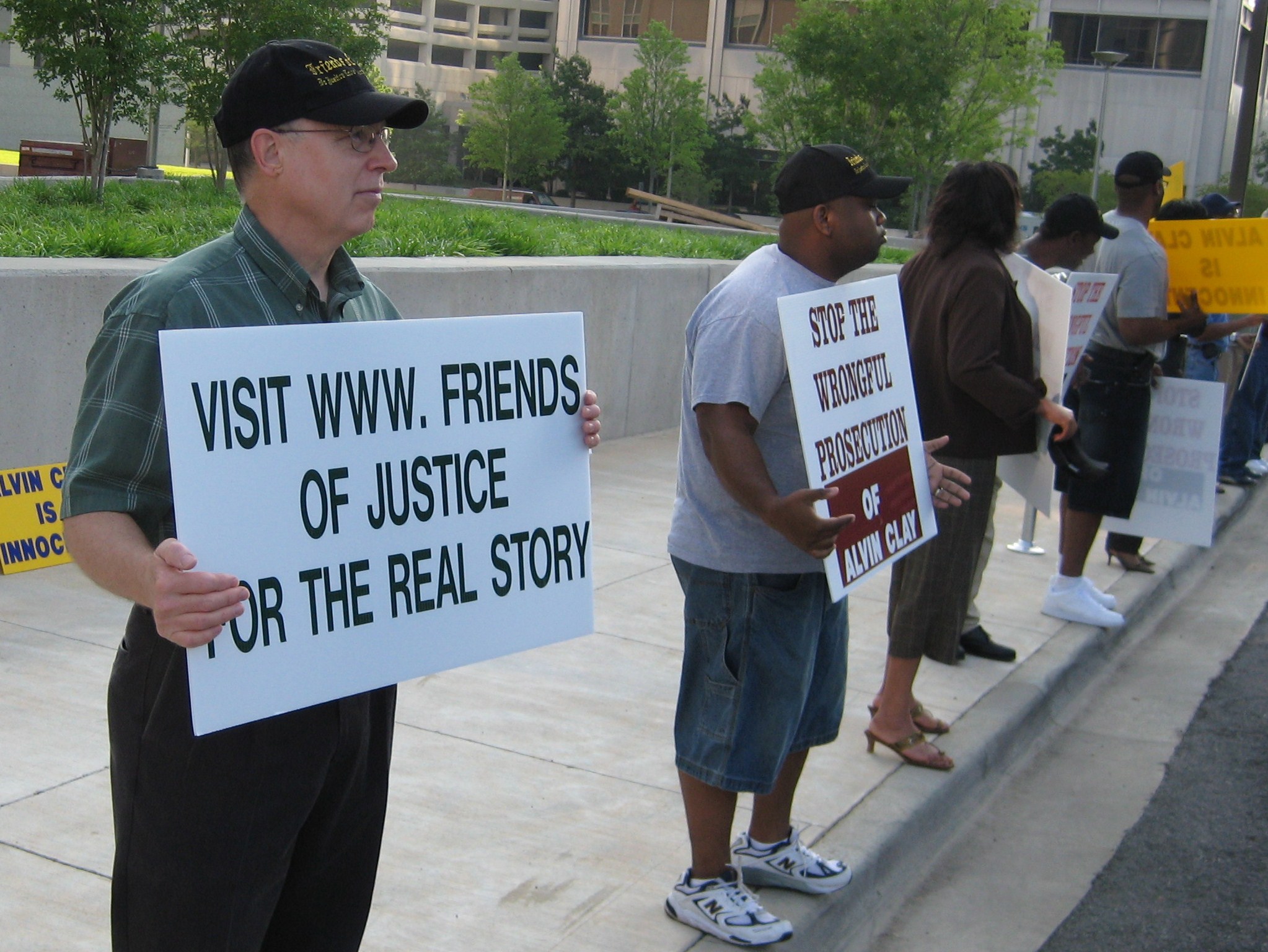
This explains our interest in the plight of Alvin Clay. The Little Rock attorney outraged the US attorney’s office by exposing an undercover sting operation that made Tulia’s Tom Coleman look like Andy Griffith. All fifty of the people targeted by the Arkansas operation were African American.
By sponsoring the perjured testimony of a corrupt officer, Alvin Clay argued, the federal government had forfeited the national trust.
When a confidential informant told his handlers that thirty-four of the fifty defendants indicted in the wake of Operation Wholesale were innocent, no one believed him. Roy Lee Russell was charged with perjury and a rookie attorney was assigned to his defense.
When Alvin Clay showed that he was willing to go to the wall for low-status defendants, the FBI was called in to investigate the Little Rock attorney. No evidence of wrongdoing had surfaced, but the government knew that if they looked hard enough they would come up with something.
All they needed was evidence of one bad act and a witness willing to point the finger.
Civil Rights activists have spent the past half century searching for another Rosa Parks story.
The New Jim Crow regime has been kind to Rosa parks and her spiritual heirs. The great divide is no longer between black people and white people; but between those who have adapted to the rules of the new economy and those who either cannot or will not adapt.
A civil rights story illuminating current problems will almost always feature compromised defendants. The futile search for unsullied subjects injects Old Jim Crow assumptions into a New Jim Crow reality.
The judicious use of perjured testimony is the critical cog in the machinery of wrongful conviction. In Tulia, Tom Coleman pointed the finger and the rules of evidence kept Coleman’s crazy quilt past out of the courtroom. In the Colomb case, the federal government paraded a dozen convicted drug dealers before the jury. With all that smoke there had to be some fire somewhere. In the Clay trial, the government sponsored the testimony of a pathological liar. It may be legal, but it’s morally abhorrent.
Getting a witness to point the finger at an innocent defendant is not easy. Even drug addicts and drug dealers will dig in their heels when asked to send an innocent man to prison.
Donny McCuien knew Alvin Clay was innocent; that’s why he was seen weeping in the witness room. Two of the inmates who came to Lafayette prepared to testify that they had purchased drugs from the Colombs blew the whistle on a perjury scam once they met the convicted defendants and realized they didn’t fit the dealer profile. In Tulia, a compromised informant named Eliga “Man” Kelly refused to lie for the government.
It takes a crude cocktail of threats and promises to shape perjured testimony.
Once witnesses have testified, however, it is almost impossible to get them to recant. Witnesses who admit to perjury will be convicted of perjury. Prosecutors and police officers insist they were acting in good faith and no one prove otherwise? Proving malicious intent is virtually impossible.
When all the mechanics of wrongful conviction are considered together it is hardly surprising that only 5% of cases make it to a jury? In most cases, this is because defendants are guilty as charged. But innocent people will frequently take a plea bargain if they don’t think they stand a chance with a jury.
America can’t retreat from its dysfunctional love affair with mass incarceration unless we concede that the war on drugs is unwinnable, that prison is no place for addicts, the mentally ill or the mentally retarded and that our prisons have devolved into crime schools.
Friends of Justice is not satisfied with snatching the occasional brand from the burning. Our narrative interventions highlight egregious examples of business as usual. Unlike legal professionals, we are free to critique the justice system on moral grounds.
Narrative interventions produce teachable moments. By documenting cases of wrongful conviction as they unfold we demonstrate how that the normal functioning of the criminal justice system regularly produces unjust outcomes.
The real culprit is the system itself. Machinery is designed to replicate a predictable outcome. When high demand pushes the assembly line to the breaking point all attempts at quality control are abandoned.
In theory, the appeals process culls the bad cases from the criminal justice production line. But so long as the moving parts of the judicial process are working properly, appeals courts express satisfaction with the final result. So long as the losers in this process appear to low-status thugs, no one is concerned.
After three decades of mass incarceration there is a growing hunger for a better way. Friends of Justice wants to get people talking about viable alternatives to a failed status quo. We invite you to join the conversation.
Alan Bean
Friends of Justice





 Friends of Justice
