By Pierre Berastain
As I heard Marco Rubio’s speech at the Republican National Convention, I was shocked by his words of hypocrisy. I recently came out as an undocumented student in the United States, and for me–a fellow Hispanic–Marco Rubio’s words were insulting. Senator Rubio’s message portrays an America of inclusivity, where dreams are possible. We are a land of endless opportunity that cares not about the color of the skin, but about the tenacity of the spirit.
Senator Rubio, American is just that, which is why I am convinced your party–the Republican Party–is fundamentally anti-American. Your party claims endless opportunity for all. Where is my opportunity to participate in my community? Are two Harvard degrees and a promise of a life in public service not enough for you? What else must I do to prove myself to your party?
I would like to take a look at a few excerpts from Senator Rubio’s speech at the RNC: (more…)
As the Democrats converge on North Carolina, I can’t help thinking of the 1964 Democratic Convention in Atlantic City when Fannie Lou Hamer shocked America and roused the fury of an American president. They don’t make political conventions like this anymore.
Why were individuals and organizations as diverse as Jerry Falwell’s Liberty University, Tim “Left Behind” LaHaye, George H.W. Bush, Gerald Ford, Ronald Reagan, the Washington Times, James “Four Spiritual Laws” Kennedy, Rex Humbard, Hal “Late Great Planet Earth” Lindsey, Oliver “Iran-Contra” North, Strom Thurmond, Jesse Helms, and a long list of Congressmen willing to associate their names and reputations with the Rev. Sun Myung Moon. It’s simple, the good Rev. made the drop, he greased the wheel, he put his money where his mouth was.
And what a strange mouth it was. Moon claimed to have been in communication with luminaries such as Joseph Stalin and Adolph Hitler (both of whom he personally “saved”), the founders of the five great world religions, and, of course, Jesus Christ himself. He led crusades in the United States dedicated to ripping down the crosses from Christian churches (he didn’t like the competition), and claimed repeatedly to be the Son of God, the king of the world etc. etc.
It wasn’t just the money, of course. Rev. Moon was a passionate anti-communist who believed strongly in free market capitalism (a system he worked with great success). He was also virulently anti-homosexual, claiming that gays should be eliminated in the way Stalin disposed of his enemies. In short, his politics, if not his theology, lined up with that of the Christian Right on a number of hot-button issues.
And then there was the tax evasion issue. Moon did 13 months for the crime and Christian televangelists like Jerry Falwell and Tim LaHaye, realizing their own legal vulnerability, rallied to his support. It didn’t hurt that Moon had donated hundreds of thousands of dollars to prop up Falwell’s faltering Liberty University.
In short, the Rev. Sun Myung Moon was an insane rich man. While most mainstream religionists wrote him off early and often, it is surprising to witness the degree of support he received from American religious leaders long after his heretical (and downright bizarre) beliefs had become public knowledge.
Politics does indeed make strange bedfellows.
By the way, the Washington Times has been very kind to Moon because he bought the paper (he also owned United Press International at his death). The Times has published a laudatory obituary for their owner which tells you all the good stuff while cleaning up the weirdness. Sort of what FOX news does for the religious right.
An earlier post, Immigration and the Heart of God, was written for the event described in this article. The goal was to place the immigration issue on the agenda of the faith community. Friends of Justice has been part of this work for several months now and, in cooperation with like-minded groups and individuals, we plan to expand the scope of the Immigration and the People of God program described below. Lydia Bean’s comment captures the spirit of this work: “It is very clear this is something God cares about. Politicians always have their finger in the wind to see how it blows. Rather than trying to change the politicians, we’re trying to change the wind.”
Local activists are encouraging Waco churches to join a nationwide effort that seeks to move the discussion about immigration policy from the political arena to church pews.
The effort kicked off this summer with a symposium that explored what the Bible says about immigrants and how Christians should respond. Held at First Spanish Assembly of God Church in Waco, it drew representatives from 27 organizations, most of them churches, organizer Manuel Sustaita said.
Now, the fledging group is encouraging pastors to follow through on pledges they made at the event, said Lydia Bean, another organizer.
Nine said they would preach sermons this fall related to God’s heart for immigrants. Others vowed to hold voter registration drives or host guest speakers to educate members about immigration issues, she said.
The group plans to meet later this month to talk about possibly hosting a broader community event, Bean said. But for now, the focus is on encouraging congregations to discuss immigration issues. That sort of grass-roots effort is the best bet for prompting meaningful immigration reform, she said.
“I think it is very clear this is something God cares about . . . Politicians always have their finger in the wind and see how it blows,” said Bean, an assistant sociology professor at Baylor University. “Rather than trying to change the politicians, we’re trying to change the wind.”
Bean and Sustaita — who is known to many in the community because of his role as founder of the Waco Vietnam Veterans Memorial — declined to publicly list the churches involved. They said they are sensitive to the fact that immigration policy is a politically touchy issue and want to let pastors approach it in their own time and own way.
But most of the churches involved are evangelical, they said.
The Catholic Church has long advocated immigration reform, Bean and Suistaita noted. So parishes here are already involved in the issue.
But the topic is only recently gaining traction in evangelical circles, Bean said. (more…)
The “They Take our Jobs” lobby would have you believe that the presence of undocumented residents is driving the United States to the poor house. Not so, says the Center for American Progress. In fact, if only 15% of the undocumented population in states like Texas and New Mexico was suddenly deported, the economic impact would be ruinous.
This research indicates that the prevailing policy of mass deportation isn’t just draining the American treasury of your tax dollars at an alarming rate, it is undermining economic stability. If you doubt this is so, please check out the charts below. I have copied the information for Texas and New Mexico, but you can find information on Arizona, Colorado, Florida, Nevada and Virginia as well.
As the report argues:
There is ample reason to suspect that at least a portion of these jobs would not be readily taken by other workers. Immigrants tend to live clustered in certain communities, where there may not be a ready supply of other workers to fill the openings they would leave behind. Additionally, undocumented workers tend to have skill sets that are specific to the industries they work in (for example, construction, home health services, etc.) that often do not match those of the nativeborn unemployed.
Debates about the economic and fiscal benefits and drawbacks of immigrants typically oversimplify the role that immigrants play in our economy. When one looks more closely, they will find that the impact that immigrants (or any group for that matter) have on the economy is multifaceted and complex.
Immigrants are not just workers; they are also consumers and taxpayers. The effects of their labor and consumption on economic growth and fiscal health must be factored in as we consider how to address the situation of a large undocumented workforce.
In this report we describe the direct impacts of either deporting or legalizing undocumented workers in Texas. In reality, the effects would be much larger. Mass deportation, for example, would result in an indirect negative impact on local businesses because there would be less money circulating in the local economy, which would lead to further job losses. The estimates reported here should thus be considered conservative rather than exhaustive.
Texas
We estimate the economic contributions of immigrants, both documented and undocumented, for Texas. The state has one of the largest populations of unauthorized immigrants, and it has played and will continue to play a pivotal role in elections as a swing state. We then report the negative fiscal impact of four different deportation scenarios—namely what would happen if 15, 30, 50, or 100 percent of undocumented immigrants were removed from the state. Finally, we explore the positive economic outcomes that would result from legalizing undocumented immigrants. (For a detailed explanation of the methodology used, please see the appendix on page 9.)
New Mexico
Dr. Raúl Hinojosa-Ojeda is the founding director of the North American Integration and Development Center.
Seven years after Hurricane Katrina, New Orleans has become a national laboratory for government reforms. But the process through which those experiments have been carried out rarely has been transparent or democratic. The results have been divisive, pitting new residents against those who grew up here, rich against poor, and white against Black.
Education, housing, criminal justice, health care, urban planning, even our media; systemic changes have touched every aspect life in New Orleans, often creating a template used in other cities. A few examples:
– In the weeks after Hurricane Katrina, more than 7,500 employees in city’s public school system were fired, despite the protection of union membership and a contract. Thousands of young teachers, many affiliated with programs like Teach For America, filled the empty slots. As charters took over from traditional public schools, the city became what then-superintendent Paul Vallas called the first 100% free market public school system in the US. A judge recently found that the mass firings were illegal, but any resolution will likely be tied up in appeals for years. (more…)
Texas Republicans received a second straight setback today when a three-judge federal panel blocked the state’s voter ID law because the state had failed to demonstrate that the law was not prejudicial to minorities. Earlier this week, a federal court tossed out a Republican-inspired redistricting plan for largely the same reason.
You can’t blame the GOP for trying. With Barack Obama leading Mitt Romney by 12 percentage points among women voters, ninety points among African and Americans and forty points among Hispanics, Republicans are running scared. As Lindsey Graham told a Washington Post reporter this week, “The demographics race we’re losing badly. We’re not generating enough angry white guys to stay in business for the long term.”
What’s the solution. Either you court minority voters or you reach out to “angry white guys” by bragging that if the women, blacks and Mexicans hate us, we must be right.
Of course, you could do both at the same time. The Republican Convention in Tampa has featured its fair share of minority speakers, but a series of racial incidents have marred the proceedings. Convention delegates aren’t just overwhelmingly white, no serious attempt has been made to address issues minority voters care about: job creation, unemployment, immigration reform, health care and racial profiling.
All the evidence suggests that the GOP strategy, to the extent there is one, has been to double down on their efforts to tap into white male resentment, minimize the number of minority voters who make it to the polls, and generating redistricting maps that give Republican candidates a leg up.
The GOP’s barrage of racially coded messages has attracted media attention. In a celebrated incident, Chris Matthews of MSNBC accused RNC chairman Reince Priebus of covering for the covert racism at work in the 2012 election. Matthews’ assault was so intense (see below) that Priebus called him “a jerk”. Matthews was being a jerk. But he was also sincerely pissed off, which was kind of refreshing.
It is interesting to watch Tom Brokaw try to calm the waters by suggesting that politicians on both sides of the ideological divide should dial back the rhetoric. That is no doubt true, but it avoided the issue at hand. Brokaw couldn’t address the race-baiting question for fear it would blow his hard-won reputation for impartiality. Chris Matthews doesn’t win a lot of style points, but I appreciate his passion.
The ill-famed Willie Horton ad in 1988 was effective largely because it didn’t initially appear to be racial. Support for George H.W. Bush plummeted when the thinly disguised racial manipulation in Horton ad was decoded. Suddenly the racial motivation was obvious to any objective observer. You will not be surprised to learn that the creator of the Horton ad, Larry McCarthy, has been hired by a pro-Romney super-PAC to inject racially coded messages into Republican attack ads.
Are voter ID laws racially motivated? Republicans insist they are simply trying to bring integrity to the process. According to the article in the Washington Post,
Republican lawmakers have argued that the voter ID law is needed to clean up voter rolls, which they say are filled with the names of illegal immigrants, ineligible felons and the deceased. Texas, they argue, is asking for no more identification than people need to board an airplane, get a library card or enter many government buildings.
It is possible that the names of illegal immigrants and ineligible felons appear on the voter rolls, but the chances of folks in either category jobbing the system are remote. Felons and the undocumented have a lot to lose and little to gain from casting an illegal vote. Republicans have no evidence that voter fraud is widespread (all the evidence points in the other direction), but they know voter ID laws suppress the minority vote and, if you’re with the White team, that can only be good.
HBO’s new Aaron Sorkin series The Newsroom has conservative bloggers beside themselves. In the clip below, fictional news anchor Bill McAvoy, played by Jeff Daniels, launches into an extended rant in which he compares the Tea Party to the Taliban. Both groups, McAvoy suggests, trade in “Ideological purity, compromise as weakness, a fundamentalist belief in scriptural literalism, denying science, unmoved by facts, undeterred by new information, a hostile fear of progress.”
Here’s the entire clip:
No thanks. The Tea Party is a mishmash of often contradictory complaints and enthusiasms. Many, perhaps most, Tea Party folk merely tolerate the brand of fundamentalist obscurantism The Newsroom excoriates. A lot of Americans enlist in the Tea Party because they are pro-business but anti-Wall Street. The bailout of the financial “industry” had more to do with growing the Tea Party than religion fanaticism. In fact, if Occupy Wall Street and Tea Party people were ever able to sit down for a beer they would agree on a lot of things.
I see Sorkin’s screed as an attempt to define a sensible political middle occupied by moderate Republicans and centrist Democrats. In the middle of McAvoy’s rant, this middle ground is identified as true Republicanism, but the speech has generally been denounced by Republicans and hailed by Democrats. According to McAvoy, real Republicans believe in “a prohibitive military” and “common sense government”. They believe there are “social programs enacted in the last half century that work, but there are way too many costing way too much that don’t.”
Moreover, real Republicans believe in free market capitalism, and law and order.
In other words, we’re talking about Reagan Republicans shorn of the small government libertarians and evangelical theocrats . . . in short, the people known today as Democrats.
It is not accidental that most Democrats have no problem with Sorkin-McAvoy’s “real Republicanism” while the real real Republicans hate it. Reagan style Republicanism is the new political middle; the turf currently defended by politicians like Bill Clinton and Barack Obama.
Politicians to the right and the left of this safe middle ground, Sorkin implies, should be thrown under the bus. The real Republicans should come over to the blue side and the Tea Party and progressive Democrats can just go to hell.
Yet it is precisely this combination of global military imperialism and unrestricted free market bubble building that has brought our economy to its knees.
Ron Paul libertarians say we can’t afford to be the world’s policeman, and they are dead right. We currently spend more on our military than all the other children of earth combined.
International corporations get fat shipping American manufacturing jobs to the Third World while feeding off one speculative bubble after another. The anti-Wall street wing of the Tea Party calls this madness, and they are right. Ross Perot said much the same thing back in the Bill Clinton era and, come to think of it, he was right too. You really can hear that “giant sucking sound”.
The “centrist” politics of Sorkin’s Will McAvoy is a creation of the Wall Street gamblers that drove us into a deep recession. These people feed American militarism, anti-immigrant sentiment and the demons of mass incarceration because they hope to grow fat off the private contracts associated with such ungodly madness. Over half the military personnel in Afghanistan at the moment are private contractors. The war on drugs and the war on migrants is fueling a private prison boom of spectacular proportions.
Here’s the sad truth. You can’t get elected to either the Senate or the US presidency (or survive in much of the academic and religious world) without kissing the ring of Wall Street and what Eisenhower, had he survived into the twenty-first century, would be calling the military-prison-industrial complex. The folks pulling the puppet strings are the real masters of America. Unrestrained militarism and capitalism abide genuine democracy. Sorkin’s “common sense government” exists at the pleasure of men (and a smattering of women) who control the wealth of America while producing little of value.
We get nowhere demonizing the radicals on the conservative and liberal fringes of American society. These people are confused about a lot of things, but most of them are honest. Fundamentalists have wandered into an intellectual cul de sac, but American evangelicalism, for all its weird excesses, remains the beating heart of American spirituality. Casting conservative religionists into the outer darkness isn’t American, it isn’t Christian, and it isn’t wise. We need these people and, though they scarcely realize it, they need us.
I am not suggesting, as frustrated radicals often do, that there is no real difference between Republicans and Democrats or that elections are meaningless. Barack Obama and Mitt Romney will not pursue the same policy goals if elected. But whoever comes out on top in November (this year and in the foreseeable future) must convince Wall Street and the military establishment that they are dependable guarantors of the status quo. So long as this is the case, politicians cannot treat what ails us.
When I say that Ayn Rand was a wanna be Antichrist who inspired The Satanist Bible, I am not suggesting that Paul Ryan, a huge Ayn Rand fan, shares that distinction. Ryan is struggling to be a good Catholic Christian and a devotee of a woman who turned the teaching of Jesus on its head.
Fortunately, a long list of conservative politicians and Christians has no illusions about Ayn Rand. The late Charles Colson, shortly before his death, made a last ditch attempt to warn fellow conservatives that Ayn Rand and Jesus are antithetical. “Atlas shrugged,” Colson said, “and so should you.”
Colson wasn’t alone.
In a biting article in First Things, a conservative Christian journal founded by Richard John Neuhaus, Joe Carter addressed the link between the Satanism of Anton LeVey (the author of The Satanic Bible) and Ayn Rand’s Objectivist philosophy.
. . . to be a follower of both Rand and Christ is not possible. The original Objectivist was a type of self-professed anti-Christ who hated Christianity and the self-sacrificial love of its founder. She recognized that those Christians who claimed to share her views didn’t seem to understand what she was saying.
Many conservatives admire Rand because she was anti-collectivist. But that is like admiring Stalin because he opposed Nazism. Stalin was against the Nazis because he wanted to make the world safe for Communism. Likewise, Rand stands against collectivism because she wants the freedom to abolish Judeo-Christian morality. Conservative Christians who embrace her as the “enemy-of-my-enemy” seem to forget that she considered us the enemy.
Even if this were not the case, though, what would warrant the current influence of her thought within the conservative movement? Rand was a third-rate writer who was too arrogant to recognize her own ignorance (she believed she was the third greatest philosopher in history, behind only Aristotle and Aquinas). She misunderstood almost every concept she engaged with—from capitalism to freedom—and wrote nothing that had not been treated before by better thinkers. We don’t need her any more than we need LeVay.
Few conservatives will fall completely under Rand’s diabolic sway. But we are sustaining a climate in which not a few gullible souls believe she is worth taking seriously. Are we willing to be held responsible for pushing them to adopt an anti-Christian worldview? If so, perhaps instead of recommending Atlas Shrugged, we should simply hand out copies of The Satanic Bible. If they’re going to align with a satanic cult, they might as well join the one that has the better holidays.
Faux historian David Barton wasn’t publicly unmasked until conservative Christian scholars, embarrassed by being associated with blatant lies and distortions, went into full revolt. I am hoping the same dynamic plays out in connection with Paul Ryan’s boyish infatuation with a woman who hated his Jesus with the darkest passion.
This debate transcends partisanship. The big problem is that Ayn Rand’s Antichrist philosophy drives a business culture where, by design, only the strong survive. Unless you argue that Christian ethics have nothing to do with the teaching of Jesus, or that the teaching of Jesus should be dissociated from business ethics, this is a problem. Paul Ryan like Ayn Rand because, like most American politicians, red and blue, he shares her take-no-prisoners, profit-driven outlook. The only people exempted from this survival of the fittest social Darwinism are your family of origin, your spouse and your children. Everyone else is on their own.
That is the philosophy of Antichrist.
If you find it hard to believe that Ayn Rand was (a) the inspiration for popular Satanism, or (b) philosophically opposed to the empathy and compassion of Jesus, you should peruse this extensive list of telling quotations compiled by Bruce Wilson of Talk to Action. You will notice that virtually every Rand critic quoted is a card carrying conservative.
But before you scroll down the list, check out this video Bruce Wilson put together:
Anton LaVey, founder of the Church of Satan (to Kim Klein of the Washington Post, 1970), as cited on page 2 of Contemporary Religious Satanism: A Critical Anthology, by Jesper Aagaard Peterson (Ashgate Publishing Limited, 2009)
“Ayn Rand, more than anyone else, did a fantastic job of explaining the morality of capitalism, the morality of individualism.”
Congressman Paul Ryan, 2009 official Ryan For Congress video ad.
Mike Wallace: “You are out to destroy almost every edifice of the contemporary American way of life, our Judeo-Christian religion, our modified government regulated capitalism, our rule by majority will. Other reviews have said you scorn churches and the concept of God. Are these accurate criticisms?”
Ayn Rand: “Yes. I am the creator of a new code of morality.”
Mike Wallace 1959 CBS interview with Ayn Rand
“Objectivism, the philosophy of Ayn Rand, is an acknowledged source for some of the Satanic philosophy as outlined in The Satanic Bible by Anton LaVey… Satanism has far more in common with Objectivism than with any other religion or philosophy. Objectivists endorse reason, selfishness, greed and atheism. Objectivism sees Christianity, Islam and Judaism as anti-human and evil. The writings of Ayn Rand are inspiring and powerful.”
from the essay Satanism and Objectivism, republished on the website of the Church of Satan
“My great friend, the late Bill Buckley – one of his greatest contributions to modern conservatism was his effort to purge it of cranks and crypto-cultists and for Buckley, Ayn Rand and her followers certainly fit that description… [Ayn Rand’s] patently anti-Christian ideas seem to be gaining steam… powerful committee chairmen on Capital Hill make their staffers read her tracts.”
former Nixon Administration member Charles Colson, May 2011 installment of his “Two Minute Warning” video series, titled Atlas Shrugged and So Should You
“I just want to speak to you a little bit about Ayn Rand and what she meant to me in my life and [in] the fight we’re engaged here in Congress. I grew up on Ayn Rand, that’s what I tell people..you know everybody does their soul-searching, and trying to find out who they are and what they believe, and you learn about yourself.
I grew up reading Ayn Rand and it taught me quite a bit about who I am and what my value systems are, and what my beliefs are. It’s inspired me so much that it’s required reading in my office for all my interns and my staff. We start with Atlas Shrugged.”
U.S. Congressional Representative Paul Ryan (R-WI), 2005 keynote speech in honor of Ayn Rand’s birthday, held by the Atlas Society.
“As for his ‘religion,’ he called it ‘just Ayn Rand’s philosophy with ceremony and rituals added’ ”
Bill Ellis, quoting Anton LaVey on the intellectual source of his form of satanism, from page 180, Raising the Devil: Satanism, New Religions and The Media (2000, the University Press of Kentucky)
“To imply or state that the Church of Satan was the first to clearly state the Satanic ethic is to ignore the continuing impact of Ayn Rand…
To illustrate this historical precedent, let us examine the Nine Satanic Statements [from The Satanic Bible] in view of the Rand work Atlas Shrugged. In Galt’s speech (pages #936-993) is the written source of most of the philosophical ideas expressed in the Satanic Bible… Note that the sequential order of these Atlas Shrugged quotations parallels the order of the Nine Satanic Statements.”
Essay by George C. Smith, “The Hidden Source of the Satanic Philosophy”, republished in The Satanic Bible (link to PDF file of Anton LaVey’s book)
“[T]he reason I got involved in public service, by and large, if I had to credit one thinker, one person, it would be Ayn Rand. And the fight we are in here, make no mistake about it, is a fight of individualism versus collectivism…
…you can’t find another thinker or writer who did a better job of describing and laying out the moral case for capitalism than Ayn Rand.
It’s so important that we go back to our roots to look at Ayn Rand’s vision, her writings, to see what our girding, under-grounding [sic] principles are. I always go back to, you know, Francisco d’Anconia’s speech (at Bill Taggart’s wedding) on money when I think about monetary policy. And then I go to the 64-page John Galt speech”
Paul Ryan, 2005 speech to the Atlas Society
“What I am fighting is the idea that charity is a moral duty and a primary virtue.”
Ayn Rand, 1964 interview with Playboy magazine
“Today you’re supposed apologize to every naked savage anywhere on the globe because you are more prosperous.”
Ayn Rand, 1980 interview with Tom Snyder
“1. Blessed are the strong, for they shall possess the earth – Cursed are the weak, for they shall inherit the yoke!
2. Blessed are the powerful, for they shall be reverenced among men – Cursed are the feeble, for they shall be blotted out!
3. Blessed are the bold, for they shall be masters of the world – Cursed are the righteously humble, for they shall be trodden under cloven hoofs!”
from The Book of Satan, part V, in The Satanic Bible
“I am not attacking Rand for the overlap of her views with LaVey’s; I am saying that, at their core, they are the same philosophy. LaVey was able to recognize what many conservatives fail to see: Rand’s doctrines are satanic…
“[P]erhaps instead of recommending Atlas Shrugged, we should simply hand out copies of The Satanic Bible. If they’re going to align with a satanic cult, they might as well join the one that has the better holidays.”
from The Fountainhead of Satanism, by Joe Carter, published June 8, 2011 in the Neoconservative Catholic-affiliated monthly journal First Things
“[I]f a man smite thee on one cheek, SMASH him on the other!” — Anton LaVey, from The Satanic Bible (Section III, paragraph 7)
“It’s hard for me to imagine a worldview more antithetical to Christianity – also difficult to imagine a more juvenile one”
the late Charles Colson, May 2011 installment of his “Two Minute Warning” video series.
“Rand’s novels are vehicles for a system of thought known as Objectivism. Rand developed this philosophy at the length of Tolstoy, with the intellectual pretensions of Hegel, but it can be summarized on a napkin. Reason is everything. Religion is a fraud. Selfishness is a virtue. Altruism is a crime against human excellence. Self-sacrifice is weakness. Weakness is contemptible…
If Objectivism seems familiar, it is because most people know it under another name: adolescence.
Michael Gerson, Former Assistant to the President for Policy and Strategic Planning, and Deputy Assistant to the President and Director of Presidential Speechwriting, under President George W. Bush, April 21, 2011 column in The Washington Post, Ayn Rand’s adult-onset adolescence
“I read Atlas Shrugged recently and respected its support for innovators… I also was amazed at the viciousness of Rand’s view of Christianity, leading up to its conclusion, where the book’s hero traces in the air the Sign of the Dollar, a replacement for the Sign of the Cross…
[…]
And this, sadly, is the book that a budget expert I admire, Rep. Paul Ryan, R-Wis., recommends–apparently without caveat–and tells his staffers to read. Sen. Ron Johnson, R-Wis., is also a Rand fan…
…Ryan and others, if they want support from Christians, cannot merely react to the left’s criticism with a shrug: They should show what in Rand they agree with and what they spurn. The GOP’s big tent should include both libertarians and Christians, but not anti-Christians.”
Marvin Olasky, intellectual father of “compassionate conservatism”, July 16, 2011, Take a stand against Rand, published in World Magazine
“I am afraid that Chairman Ryan’s budget reflects the values of his favorite philosopher Ayn Rand rather than the gospel of Jesus Christ. Survival of the fittest may be OK for social Darwinists but not for followers of the gospel of compassion and love.”
Jesuit Father Thomas J. Reese, as quoted April 24, 2012 in the Washington Times
“There are two novels that can change a bookish 14-year-old’s life: The Lord of the Rings and Atlas Shrugged. One is a childish fantasy that often engenders a lifelong obsession with its unbelievable heroes, leading to an emotionally stunted, socially crippled adulthood, unable to deal with the real world. The other, of course, involves orcs.”
John Rogers, screenwriter and comic
“I hope you picked it [Atlas Shrugged] up off the floor of the subway and threw it in the nearest garbage pail.”
Fred Clark’s Slacktivist blog is aimed at recovering evangelicals; particularly ex-devotees of the commercially marketed Christianity that hit its stride in the early years of the Reagan revolution.
I always know when Fred links to one of my blog posts, the usual number of hits increases by a factor of five. Slacktivist posts regularly garner hundreds of comments. Few mainstream website generate that kind of interest.
There are three reasons for Fred Clark’s success. First, he writes extremely well. Second, his work is carefully researched and edited, he approaches blogging like a full-time job). Finally, there are a whole lot of recovering evangelicals out there.
Some of these folks remain in the big-tent evangelical camp but are looking for authentic alternatives to a narrow and increasingly irrational tribalism. Fred Clark also ministers to a large cadre of atheists and secularists who grew up addicted to with-God-on-our-side religion.
When you grow up born again you never really get over it. A certain subset of the atheist-agnostic community appreciates Fred Clark’s blog even though he remains a committed Christian. He has deep insight into a slice of their experience that genuine secularists can never understand. The Slacktivist is a form of therapy, an opportunity to work through painful memories and thorny issues.
In a recent post, Clark uses a music video from the 1980s to examine the toxic world of “evangelical tribalism”, the “us-against-them” mindset that has characterized commercial Christianity for the past quarter century. The video features Carman, a smooth-talking white rapper who always reminded me of the post-Vegas Wayne Newton and Petra, a Christian 80s band that transformed the power chords and vocal hooks of early metal music (think softcore AC/DC) into a highly marketable form of “Christian contemporary” entertainment.
Here’s the video version of “Our Turn Now”
And here’s Clark’s summary of the contents:
The lyrics begin by lamenting the 1962 Supreme Court decision ending state-sponsored establishment prayers in public schools. Carman, rapping like MC Neil Diamond, offers a litany of post-hoc argumentation, blaming everything he considers bad on the court’s ruling. He calls it “religious apartheid.”
“It’s our turn now” proclaims the chorus — a rallying cry for the tribal rule of sectarian religion. And everyone else, everything outside the tribe, is on the side of the “devil.”
I was introduced to Carman by a member of the ecumenical (nominally American Baptist) congregation I pastored in the early 80s. The young man who played the song for me (assuming I’d be thrilled) was in his early 20s, a highly intelligent high school band teacher.
The basic idea was that Jesus and Satan are starring in a WWF-style Smack Down main event. Satan (like every good wrestling heel from that era) enters the ring full of strutting, ranting bravado, but after the Savior gives him the thrashing of his life, Satan’s bold baritone devolves into a whining, emasculated falsetto.
Carman ended the song, as I recall, with an oblique reference to the book of Revelation. Message: our side wins.
The message of “Our Turn Now” is much the same. In professional wrestling, “the face” (or crowd favorite) gets slapped, kicked, gouged and mangled for a good twenty minutes before he shakes off the cobwebs and turns the tables to the appreciative roar of the crowd. “It’s our turn now.” Carman’s message never transcended the crass world of wrasslin’ melodrama.
But who, in this us-against-them world, is “us” and who is “them”? In Our Turn Now, the heels, the bad guys, the spawn of Satan, were the justices of the Supreme Court who tossed God out of the classroom, the Kennedy and Johnson administrations, liberal “Christians” (who generally supported the court’s decision), secularists, atheists like Marilyn Murray O’Hair, secularists of every stripe; in short, everyone who is not a card-carrying, washed in the blood evangelical Christian.
As Clark suggests, the mindset was binary, Manichean, darkness and light . They took the reins of government and did their worst; well, now it’s our turn now. Soon evangelical Christians who love Jesus and Carman in equal measure will control Congress and the White House. Godly laws will be passed. The glory of Jehovah God will return to the classroom, drugs and sexual promiscuity will be abolished by statute, and national righteousness will be restored.
If you pay careful attention to the Carman video (yes, I know that means having to watch it twice–suck it up, this is important) you will note that although all the primary performers are as white as heavy metal, all kinds of black kids are shaking it to the music, witnessing to white kids, and giving their ultra hip stamp of approval to the ascendancy of Christian America.
In other words, when we talk about “us” we’re not just talking about white people.
Why then, are nine out of ten registered Republicans, by a recent estimate, non-Hispanic whites?
At the 2008 Republican Convention, 92% of the delegates were white while it sometimes appeared that half the folks on stage were people of color. Why are white people so much more excited about Carman’s vision of Christian America than the non-white minority?
Because the “us” celebrated in the video were really the folks who were humiliated by the 1960s–white, primarily southern, evangelicals.
The marketing magic behind Carman was the linking of popular culture (heavy metal rock, professional wrestling, Ramboesque violence) with Southern Baptist piety. In the 1950s, Elvis was Satan; by 1980 he has joined the choir triumphal. Young people were free to celebrate the values of the American entertainment machine as long as they were down with a Jesus who palled around with marines, corporate moguls, chamber of commerce presidents and was comfortable in the smoke filled rooms of the Grand Old Party.
Rock and roll, pro wrestling, and romantic violence got a pass because the Right needed a really big army to fight liberalism, particularly the brand of liberalism shaped by the civil rights movement. In the South and the great American heartland, white evangelicals had grown accustomed to being in control, calling the shots and dictating moral standards. Suddenly, and quite without warning, white evangelicals were being pilloried as nasty Jim Crow racists determined to deprive the Negroes of their civil and constitutional rights.
Evangelicals still haven’t recovered from the shock. In the South, evangelicals (with Southern Baptists leading the way) climbed out onto the segregation limb until the civil rights movement, to the surprise of everyone, sawed it off.
The routine popular association of conservative religion and blatant racism was deeply humiliating. By the mid-1970s it was no longer possible to defend the old Jim Crow system, but white hot racial resentment was creating rich opportunities for a resurgence of some kind.
The key was to rebrand the 1960s. The big issues weren’t civil rights and Vietnam, the new argument went, it was all about two Supreme Court decisions: driving God out of the schools (1962) and Roe v. Wade (1973). These two liberal decisions, the argument went, paved the way for violence in the streets, the drug culture, sexual promiscuity, perversion and every other evil imaginable.
But it’s Our Turn Now.
Why have African Americans and Hispanics been reluctant to jump on the bandwagon? Because it’s too awkward. The GOP is the unofficial Party of White and the Christian Right, though officially Neapolitan, is vanilla clear through. Check out the crowd at the next Romney rally and see if you can find any people of color in the crowd. If you got $5 for every one you couldn’t gain admission to a ticket to a $100 a plate fundraiser.
This didn’t happen overnight. In 1973, most prominent southern evangelicals were big supporters of the separation of church and state and evangelical views on abortion tracked national opinion. The big opportunity was raging white resentment, but neither leading evangelicals nor GOP strategists couldn’t admit as much.
Abortion was, and remains, a legitimate moral issue, but a particularly thorny one. As the current tug-of-war between supporters and detractors of Todd (“shut that thing down”) Akin suggests, banning abortion for rape and incest survivors is about as popular as back alley abortions. Hence, most Americans are unwilling to go all the way with the pro-life movement.
This is precisely why true believers, as defined by opinion leaders within the Religious Right, can tolerate no compassionate exceptions to pro-life orthodoxy. Go down that road very far and pretty soon most Democrats will be agreeing with you. The goal has never been to make abortion safe, legal and rare. From a culture war perspective, the more abortions the better. The tragic statistics feed an effective wedge issue.
The goal was to get rank and file evangelicals (mad as hell about being branded as racists but lukewarm on abortion) to stop talking race and start screaming about abortion, abortionists and the horrors of the sexual revolution.
At the same time, the Religious Right launched a campaign to convince southern preachers that the separation of church and state was a liberal abomination.
W.A. Criswell was pastor of First Baptist Church Dallas, in its heyday the largest congregation in Protestant America. In 1960, Criswell used traditional southern support for the separation of church and state to argue that John F. Kennedy, a Roman Catholic who was sure to take his marching orders from the Vatican, was unworthy to be president:
It is written in our country’s constitution that church and state must be, in this nation, forever separate and free. In the very nature of the case, there can be no proper union of church and state.
But in 1980, with the nuptials between Southern Baptists and Reagan’s GOP a done deal, Criswell opined thus:
I believe this notion of the separation of church and state was the figment of some infidel’s imagination.
How do we account for this amazing transformation? Criswell got the memo.
By 2012 David Barton was arguing that Thomas Jefferson, the father of church-state separation, was an orthodox evangelical who dreamed of Christian theocracy. Only when a holy host of conservative historians cried foul did Barton’s publisher pull the Jefferson book. Not surprisingly, Barton’s good buddy Glenn Beck has agreed to publish the Jefferson manuscript.
As the Barton episode demonstrates, it has become painfully difficult for thinking conservatives to stick with the Religious Right or the GOP. For the moment, few malcontents will leap into the reluctant arms of either the Democrats or liberal Christianity.
When Bill Clinton threw the unions under the bus in the 1990s he knew they would stay loyal. “Where would they go?” he asked. The same applies to conservative evangelicals who can’t abide the irrational excesses of their coreligionists. They will stay with the GOP and the Christian Right because they have nowhere else to go.
The culture war has advanced to the point where the tiny strip of middle ground separating conservatives from liberals has become a barbed wire infested minefield. The corporate interests that funded Carman and Petra like it that way. So long as the American melodrama is conceived as a pay-per-view Smackdown between Christ and Antichrist nobody has the luxury of genuine thought. As the secular left screams in protest (“You can’t do that! You can’t believe that! You can’t say that!”) the easier it becomes for the Christian Right to define itself as a tiny island of godliness in a vast Satanic sea.

 By Alan Bean
 By Alan Bean
 By Alan Bean


 By Alan Bean
 By Alan Bean
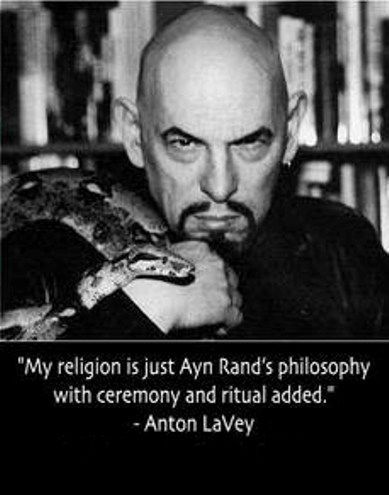 When I say that Ayn Rand was a wanna be Antichrist who inspired The Satanist Bible, I am not suggesting that Paul Ryan, a huge Ayn Rand fan, shares that distinction. Ryan is struggling to be a good Catholic Christian and a devotee of a woman who turned the teaching of Jesus on its head.
 By Alan Bean
 Friends of Justice