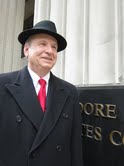
Author: Alan Bean

Tom Berry: “Ten Years of Waste, Immigrant Crackdowns and New Drug Wars”

If you want to know why America’s immigration policy is so badly broken, this article by Tom Berry is a great starting place.  “Continuing down the same course of border security buildups, drug wars and immigration crackdowns will do nothing to increase security or safety,” Berry says.  “It will only keep border policy on the edge – teetering without direction or strategy.”

This article, originally published in Truthout, is an edited excerpt of the policy report Berry produced for the Center for International Policy.   Berry appeared on NPR’s Fresh Air in 2009 and the horrors he discussed with Terry Gross have only worsened in the ensuing three years.  AGB

Border Security After 9/11: Ten Years of Waste, Immigrant Crackdowns and New Drug Wars

Prior to the September 11 terrorist attacks, the term “border security” was rarely used. Today, however, it is both a fundamental goal of US domestic security and the defining paradigm for border operations. Despite the federal government’s routine declarations of its commitment to securing the border, neither Congress

nor the executive branch has ever clearly defined the term “border security.”

Border security constitutes the single largest line item in the Department of Homeland Security (DHS) budget. Nonetheless, DHS has failed to develop a border security strategy that complements US domestic and national security objectives. DHS has not even attempted to delineate benchmarks that would measure the security of the border or specify exactly how the massive border security buildup has increased homeland security.

In its strategic plan, DHS does promise: “We will reduce the likelihood that terrorists can enter the United States. We will strengthen our border security and gain effective control of our borders.” And DHS Secretary Janet Napolitano assured us last year that, as a result of new border security spending by the Obama administration, “the Southwest border is more secure than ever before.”

Since 2003, Homeland Security and the Justice Department have opened spigots of funding for an array of border security operations. These include commitments for 18-foot steel fencing, high-tech surveillance, unmanned aerial vehicles (UAVs), increased prosecutions of illegal border crossers and new deployments of the Border Patrol and National Guard.

Yet the federal government’s continued expressions of its commitment to border security only serve to highlight the shortcomings of this commitment and to spark opposition to long- overdue immigration reform. “Secure the border” – a political demand echoed by immigration restrictionists, grassroots anti-immigrant activists and a chorus of politicians – now resounds as a battle cry against the federal government and liberal immigration reformers. These border security hawks charge that the federal government is failing to meet its responsibility to secure the border, pointing to continued illegal crossings by immigrants and drug traffickers. Border sheriffs, militant activists and state legislatures have even started taking border security into their own hands.

The post-9/11 imperative of securing “the homeland” set off a widely played game of one-upmanship that has had Washington, border politicians and sheriffs, political activists and vigilantes competing to be regarded as the most serious and hawkish on border security. The emotions and concerns unleashed by the 9/11 attacks exacerbated the long-running practice of using the border security issue to further an array of political agendas – immigration crackdowns, border pork-barrel projects, drug wars, states’ rights and even liberal immigration reform. Yet these new commitments to control the border have been largely expressions of public diplomacy rather than manifestations of new thinking about the border. (more…)


Denton County to Pay Over Half Million Dollars in Discrimination Suit

Image
Cary Piel

By Pierre R. Berastain

“I understand why people hung people from trees…[I] want to go home and put on my white pointy hat.”  Those are the alleged words Denton County felony Prosecutor Cary Piel told his black co-worker Nadiya Williams-Boldware who sued in federal court and was awarded over half million dollars for the discriminatory incident.

After being called a troublemaker by a co-worker, dismissed by her boss—the supervisor happened to be Cary Piel’s wife— and turned away by the Texas Workforce Commission Civil Rights Division, Boldware took her complaints to the U.S. District Court for the Eastern District of Texas.  The story can be found here.

Image
Susan Piel

After the verdict—on Monday, June 22, 2012—Denton County District Attorney Paul Johnson fired the four prosecutors who cost the county the hefty $510,000 penalty: Susan Peil, Cary Peil, John Renz, and Ryan Calvert.  Calvert is Cary Peil’s brother-in-law, and Renza was Peil’s partner in court.  Read more about the firings here.

A Snitch’s Dilemma

By Alan Bean

A Snitch’s Dilemma” takes us inside the world of a typical Atlanta street hustler.  His name is Alex White.  It’ a long piece, but this isn’t the kind of story you can tell in 700 words.  White made his living as a drug dealer and a snitch.  Narcotics officers knew he was dealing but didn’t care; the men who supplied him with drugs may have known he was a snitch but looked the other way so long as he only set up “nobodys”. 

Then a gang of Atlanta narcotics cops killed an innocent old woman in a botched drug raid and Alex White’s neat world came apart.

Ted Conover wrote this piece for the NYT Magazine.  He doesn’t glamorize his subject or his life on the streets.  Instead, he gives us a portrait of a man trapped by the streets.  When federal authorities urge him to get out-of-town for his own safety, White is terrified by the thought of leaving his familiar streets.  He can’t survive anywhere else.

Alex White is smart.  Smart enough to have excelled in school had he been so inclined.  But, in the words of his on-again-off-again girlfriend, he was too “hoodish” for the straight life.  But did he choose to be that way or was there are a certain inevitability about it?

A Snitch’s dilemma takes us inside the world Alexandra Natapoff describes in “Snitch,” the best book I have seen on the subject of criminal informants.  But this isn’t really a story about a snitch; it’s about the neighborhood that shaped Alex White and the social and economic conditions that shaped that neighborhood. 

This is also a story about the futility of a drug war that perpetuates the evils it was ostensibly created to eliminate.  Highly recommended.

Is “evangelical” a white word?

Molly Worthen

By Alan Bean

Molly Worthen’s NYT essay on the social cleavage between white and black evangelicals is a statement of the obvious and a work of art.

Worthen teaches history at the University of North Carolina, Chapel Hill and her writing reflects a deep understanding of evangelicals black and white.

The term “evangelical”, in its common usage, refers exclusively to white folks.  This may be the best explanation for a curious fact: only 35% of Americans in a recent Barna poll correctly identified Barack Obama’s religious faith as Christian.  Ask African-Americans about Obama’s religion and I suspect over 95% would get it right.  So I can’t help but wonder about the results from Caucasian respondents.  My guess is that fewer than 25% of white people know that Obama is a Christian.

If we use political affiliation as a rough proxy for race (which, tragically, it is) the figures are interesting.  52% of Democrats know that Obama is a Christian (African-American respondents likely skewed this figure upward); but only 29% of Independents and 24% of Republicans believe that Obama is a Christian (with 18% believing he is a Muslim). (more…)

Walker: A Cocaine Conspiracy Untangles a Web of Lies

Attorney David Moffitt

By Clarence Walker

Assistant District Attorney Karen Plants was head of the narcotics unit of the Wayne County District Attorney Office in Detroit Michigan when the Inkster Police Department scored a major narcotic bust in 2005. Acting on a reliable tip, officers collected 47 kilos of cocaine, the largest haul the Inkster authorities ever had in its history.

This was the epitome of the American way to carry out “the war on drugs”: A swift take down of Alexander Aceval, Ricardo “Richard” Pena, Chad Povish and Brian Hill along with the seizure of the cocaine worth millions of dollars.

While the community celebrated the bust, the subsequent investigation blew the lid off an egregious case of corruption in Michigan’s Jurisprudence.  The drug bust included lies orchestrated by the prosecutor, the judge, the informant and the police.  The string of charges ranged from “obstruction of justice” to perjury.

Circuit Judge Mary Waterstone, in charge of the trials against Aceval and Pena, was complicit in the perjury scheme. She told a Michigan Attorney General investigator that prosecutor Plants expressed concern for the safety of Chad Povish who set up the men to be arrested. (more…)

The Hunger Games: children are always on the front lines

By Nancy Bean

So far my summer “to do” list has served only as a bookmark in the Hunger Games Trilogy.

Set in a dystopian North America, the isolated and impoverished provinces serve the rich and powerful Capital. The Capital sponsors the annual Hunger Games with tributes drawn from the provinces. Two 16 year olds from each province are set down in a highly rigged and orchestrated arena of fighting to the death for the entertainment of the bored folks in the Capital and to maintain the power of fear and grief over the provinces.

The children are trained to view each other as the enemy as they vie with bloody competition for the limited resources and protections available in the arena.

Don’t think Tea Party disrespect for government; rather think Corporate Capital becoming the only person with a vote.

Think for profit prisons and schools and healthcare and security forces.

Think the imminent defunding of WIC and Headstart and Public schools.

Think dissolution of safety and health regulations.

Globally think of our unquenchable thirst for cheap goods and corporation’s ravishing pursuit of cheap labor pursued by any means necessary and always at the expense of the world’s peace and security, with starvation and homelessness of children as predictable first casualty.

On Sunday morning our pastor preached on David and Goliath. Although his sermon and the text was about how the battle belongs to the Lord and is not won with weaponry but with faith, I could only think about how every war is waged with children and “the least of these” on the front lines of harm’s way.

Suzanne Collins has crafted a story full of violence and adventure for her audience of young adults which has left this 57 year old reeling with the dark realities it reveals.

Supreme Court addresses Juvenile Life without Parole issue

Matthew Bentley was fourteen when he shot an killed the owner of a home he thought was unoccupied

It appears I was misled by some of the early AP reporting on the Court’s ruling.  Here is law professor Mark Osler’s clarification as it appeared on his blog.  AGB

Yesterday, the Supreme Court struck down part (but not all) of the Arizona immigration law. That gobbled up a lot of the news cycle.

Buried beneath that story was another dramatic decision. The Supreme Court also issued its opinion in Miller v. Alabama, ruling that it is unconstitutional for a state to use a mandatory sentencing scheme which mandates life without parole sentences where the defendant was a juvenile at the time of the crime. This affects a lot of cases– 29 states and the federal government have such sentencing schemes.

Unfortunately, initial reports (over the AP wire and elsewhere) said that all JLWOP sentences were struck down, but that is not true. Sentences where the judge or jury had other options available (such as life with parole) seem to survive this decision.

My commentary on this important can be found over at the motherlode of sentencing info, Doug Berman’s Sentencing Law and Policy blog.

Bryan Stephenson of the Equal Justice Institute summed up today’s ruling by the Supreme Court nicely,

“The court took a significant step forward by recognizing the fundamental unfairness of mandatory death-in-prison sentences that don’t allow sentencers to consider the unique status of children and their potential for change.  The court has recognized that children need additional attention and protection in the criminal justice system.” (more…)

Supreme Court rejects key portions of Arizona immigration law

By Alan Bean

The Supreme Court handed the Obama administration a big win by striking down the most egregious portions of Arizona’s controversial immigration law.  Stat law enforcement can determine the immigration status of detained individuals, but cannot stop and question a person on the street simply because they suspect that person may be undocumented.

Although state police officers have a greenlight to determine the immigration status of detained persons, this merely transfers this common practice from ICE, a federal agency, to state and local law enforcement.  From the standpoint of the detained individual, it hardly matters whether your status is being checked by ICE officials or by a state official–the result is the same. 

Arizona won some state’s rights points, in other words, but the plight of undocumented persons (and those who merely look, by virtue of language, accent and skin-hair color, as if they might be documented) hasn’t changed on iota.  Under the all-but-universal Secure Communities program, local law enforcement officials are already required to place an ICE hold on any person they detain for whatever reason.  The feds will then run a check and determine whether the individual is subject to deportation. 

Secure Communities is well understood in the Latino community, but Anglos hardly know the program exists because, well, they don’t have to worry about it.  As a result, some Anglo reporters may interpret today’s ruling as a step toward more stringent immigration practices.  It isn’t.

Few understand that few of the supposedly dangerous criminals we deport every year have ever been convicted of a violence-related crime.  In the federal system, any conviction stands proxy for future dangerousness. 

The good news from today’s ruling is that local and state police officers will not have the right (or the obligation) to stop and question a person suspected of being Latino.   This policy, if upheld, would have been a wholesale validation of racial profiling, regardless of what Arizona governor Jan Brewer has to say to the contrary.  In the absence of criminal behavior, physical appearance, accent, and the use of non-standard English would have been the only cues that could lead an officer to suspect undocumented status.  In other words, Arizona wanted to legalize George Zimmerman-style hunches rooted in ethnic and racial factors and the Supreme Court said no.  America just dodged a bullet.

Supreme Court upholds key part of Arizona for now; strikes down other provisions

By , Updated: Monday, June 25, 1:26 PM

The Washington Post

The Supreme Court on Monday said states may play a limited role in enforcing laws on illegal immigration, upholding part of Arizona’s controversial law but striking other portions it said intruded on the federal government’s powers.The justices let stand for now the part of the law that requires police to check the immigration status of anyone they detain or arrest if they have “reasonable suspicion” that the person is in the country illegally. Arizona Gov. Jan Brewer (R) declared that decision, on the part of the law that had generated the most controversy, a victory.

But the ruling also in part vindicated the Obama administration, with the court rejecting three provisions that the federal government opposed.

The court ruled that Arizona cannot make it a misdemeanor for immigrants to fail to carry identification that says whether they are in the United States legally; cannot make it a crime for undocumented immigrants to apply for a job; and cannot arrest someone based solely on the suspicion that the person is in this country illegally.

The court also said the part of the law it upheld — requiring officers to check the immigration status of those they detain and reasonably believe to be illegal immigrants — could be subject to additional legal challenges once it is implemented.

The other major decision of the court’s term — the constitutionality of President Obama’s health-care law — will come Thursday, on the final day of the term.

In a statement Monday, Obama said he was “pleased that the Supreme Court has struck down key provisions of Arizona’s immigration law.” He added that the decision makes clear “that Congress must act on comprehensive immigration reform,” since a “patchwork of state laws is not a solution to our broken immigration system.” At the same time, Obama said, he remains “concerned about the practical impact” of the part of the law that was allowed to stand.

“No American should ever live under a cloud of suspicion just because of what they look like,” Obama said. “Going forward, we must ensure that Arizona law enforcement officials do not enforce this law in a manner that undermines the civil rights of Americans, as the Court’s decision recognizes.”

Republican presidential candidate Mitt Romney, for his part, issued a statement that did not comment on the specifics of the ruling but instead said the decision “underscores the need for a President who will lead on this critical issue and work in a bipartisan fashion to pursue a national immigration strategy.”

Obama “has failed to provide any leadership on immigration,” the former Massachusetts governor said.

Romney did not speak to reporters accompanying him Monday on a campaign trip to Arizona, and aides refused to say whether he agrees with the Supreme Court’s ruling or even whether he supports Arizona’s immigration policy.

“The governor supports the states’ rights to craft immigration laws when the federal government has failed to do so,” spokesman Rick Gorka said. “That’s all we’re going to say on this issue.”

Keep reading . . .

Capehart: Zimmerman’s story doesn’t add up

George Zimmerman has given a series of statements describing the night the shot Trayvon Martin dead.  In this WP column, Jonathan Capehart compares the recently released tapes of Zimmerman’s various statements and arrives at a simple conclusion: none of this makes sense.  AGB

Zimmerman caught on tape: ‘It sounds like you’re looking for him’

George Zimmerman’s version of events the night he killed Trayvon Martin have never really made sense. And thanks to the release of a treasure trove of audio files last week by his attorney, we get to hear Zimmerman tell police what happened that rainy Feb. 26 night in his own voice. But what you’ll immediately notice is that what he tells the Sanford Police Department while in custody and in subsequent interviews doesn’t exactly match what he said during his infamous call to the non-emergency line at the SPD. You’ll also understand why investigator Christopher Serino, who had problems with Zimmerman’s account from the beginning, sought to arrest him for manslaughter two weeks later.

To refresh your memory, click here to listen to the phone call Zimmerman placed to the SPD. There have been break-ins in the neighborhood and “there’s a real suspicious guy” who “looks like he’s up to no good,” he told the dispatcher. “These [expletive], they always get away,” Zimmerman said before getting out of his car to pursue Martin. When he confirmed he was following the unarmed 17-year-old, the dispatcher said, “We don’t need you to do that.” They discuss where he would meet the police when they arrived.

Now, click here to listen to the Feb. 29 interview Zimmerman had with Serino and investigator Doris Singleton as they probe the inconsistencies in what Zimmerman said in the unredacted version of that non-emergency call and what he told Singleton hours after the shooting. A word of caution: There’s raw language in this conversation. The questions asked by the two detectives are what you would expect from seasoned homicide investigators. But they find Zimmerman’s responses unsatisfactory.


This combo made from file photos shows Trayvon Martin, left, and George Zimmerman. (AP Photo)

Serino and Singleton peppered Zimmerman with questions as they replayed Zimmerman’s four minute and 12 second call to the SPD’s non-emergency line. Why did he think Martin was suspicious? What did he think Martin was on drugs? Zimmerman would tell them he was afraid. But they focused a lot of attention on why the neighborhood watch captain would pursue Martin , “a good kid,” a “mild-mannered kid,” as Serino would describe him but who Zimmerman said made him fearful because he stared at him and walked around his car.

At one point in the call, Zimmerman says, “Oh [expletive], he’s running.” Serino asked Zimmerman to describe how Martin was running. “I don’t remember ’cause I was on the phone,” he answered. “It happened so quickly.” That was unsatisfactory to Serino. “It sounds like he’s running as to get away from you,” the detective said as he pressed Zimmerman to describe how Martin was running. “I don’t know why,” Zimmerman said in response.

On the call, the dispatcher asked him which way Martin was running. You can hear Zimmerman get out of his car and the detectives asked to confirm if he was getting out to see where Martin was going. “So, you basically jumped out of the car to see where he was going,” Serino inquired. When Zimmerman replied, “Yes, sir,” the investigator replied bluntly, “Okay, that’s not fear, all right. That’s one of the problems I have with the whole thing.”

Another area of contention was when the dispatcher asked Zimmerman, “Are you following him?” Serino asked him, “What went through your mind?” Zimmerman replied, “He’s right.” When Serino said, “You should have went back to your vehicle,” Zimmerman said, “But I still wanted to give [the dispatcher] an address.”

Martin was running in the direction of his father’s fiance’s apartment, where he was staying while on suspension from school. Serino said, “At this point, he’s gotta be hiding from you” because Martin could not have made it home and then come back to attack Zimmerman. Singleton challenged Zimmerman’s entire account for why he got out of his car. “You’re trying to catch up to him,” she said. “You’re looking for him,” Serino added. “It sounds like you’re looking for him.”

“Did you pursue this kid? Did you want to catch him,” Serino asked.

“No,” Zimmerman said, sounding exasperated.

“That’s not you,” Serino said. ‘That’s not what you’re about.”

“No,” Zimmerman said again.

Singleton questioned why at the end of the call, Zimmerman told the dispatcher to have the police call him upon their arrival and he would tell them where he was. “You’re going to be back at your car in less than 15 or 20 seconds from that distance,” she asked, “so why would they need to call you?” Zimmerman said he said this because he was frustrated he didn’t “give an adequate description” of where he was from community clubhouse. “You know what the impression would be,” Singleton said, “is that you’re going to continue to look and when they get here you’ll tell them where you’re at at that point.”

The call would end. Zimmerman and Martin would encounter each other. And Martin would be shot dead at point-blank range. Nothing about this case has made sense, nothing. What the Serino and Singleton interviews on Feb. 29 show is that the detectives didn’t think it made sense either