Author: Alan Bean

How a Mexican Cartel Makes its Millions

Introduction by Pierre R. Berastaín

The Mexican cartels are known for their sanguinary wars and inexhaustible supply of narcotics.  Yet, behind the bloodshed and multi-billion dollar industry exist a complex network of power, an innovative machinery for narcotic transport, and mechanisms of survival and protection that ensure the longevity of the cartel and drug production.  In this article, The New Yorker’s Patrick Radden Keefe pays a detailed look at the operations of one of the richest, deadliest, and most powerful organizations in the world—The Sinaloa Cartel of Mexico.  The Cartel’s operations reach not only the United States and Latin America, but also Europe and Asia, and its influence ranges everywhere from top national officials to city cab drivers.  As a Drug Enforcement Administration official indicates, “They have eyes and ears everywhere.”  This astonishing account of the cartel’s operations sheds light on underground tunnels, dynastic marriages, systems of bribery, and even insurance for seized drugs.

Cocaine Incorporated
By: Patrick Radden Keefe

One afternoon last August, at a hospital on the outskirts of Los Angeles, a former beauty queen named Emma Coronel gave birth to a pair of heiresses. The twins, who were delivered at 3:50 and 3:51, respectively, stand to inherit some share of a fortune that Forbes estimates is worth a billion dollars. Coronel’s husband, who was not present for the birth, is a legendary tycoon who overcame a penurious rural childhood to establish a wildly successful multinational business. If Coronel elected to leave the entry for “Father” on the birth certificates blank, it was not because of any dispute over patrimony. More likely, she was just skittish about the fact that her husband, Joaquín Guzmán, is the C.E.O. of Mexico’s Sinaloa cartel, a man the Treasury Department recently described as the world’s most powerful drug trafficker. Guzmán’s organization is responsible for as much as half of the illegal narcotics imported into the United States from Mexico each year; he may well be the most-wanted criminal in this post-Bin Laden world. But his bride is a U.S. citizen with no charges against her. So authorities could only watch as she bundled up her daughters and slipped back across the border to introduce them to their dad.

Known as El Chapo for his short, stocky frame, Guzmán is 55, which in narco-years is about 150. He is a quasi-mythical figure in Mexico, the subject of countless ballads, who has outlived enemies and accomplices alike, defying the implicit bargain of a life in the drug trade: that careers are glittering but brief and always terminate in prison or the grave. When Pablo Escobar was Chapo’s age, he had been dead for more than a decade. In fact, according to the Drug Enforcement Administration, Chapo sells more drugs today than Escobar did at the height of his career. To some extent, this success is easily explained: as Hillary Clinton acknowledged several years ago, America’s “insatiable demand for illegal drugs” is what drives the clandestine industry. It’s no accident that the world’s biggest supplier of narcotics and the world’s biggest consumer of narcotics just happen to be neighbors. “Poor Mexico,” its former president Porfirio Díaz is said to have remarked. “So far from God and so close to the United States.”

The Sinaloa cartel can buy a kilo of cocaine in the highlands of Colombia or Peru for around $2,000, then watch it accrue value as it makes its way to market. In Mexico, that kilo fetches more than $10,000. Jump the border to the United States, and it could sell wholesale for $30,000. Break it down into grams to distribute retail, and that same kilo sells for upward of $100,000 — more than its weight in gold. And that’s just cocaine. Alone among the Mexican cartels, Sinaloa is both diversified and vertically integrated, producing and exporting marijuana, heroin and methamphetamine as well.

Estimating the precise scale of Chapo’s empire is tricky, however. Statistics on underground economies are inherently speculative: cartels don’t make annual disclosures, and no auditor examines their books. Instead, we’re left with back-of-the-envelope extrapolations based on conjectural data, much of it supplied by government agencies that may have bureaucratic incentives to overplay the problem.

So in a spirit of empirical humility, we shouldn’t accept as gospel the estimate, from the Justice Department, that Colombian and Mexican cartels reap $18 billion to $39 billion from drug sales in the United States each year. (That range alone should give you pause.) Still, even if you take the lowest available numbers, Sinaloa emerges as a titanic player in the global black market. In the sober reckoning of the RAND Corporation, for instance, the gross revenue that all Mexican cartels derive from exporting drugs to the United States amounts to only $6.6 billion. By most estimates, though, Sinaloa has achieved a market share of at least 40 percent and perhaps as much as 60 percent, which means that Chapo Guzmán’s organization would appear to enjoy annual revenues of some $3 billion — comparable in terms of earnings to Netflix or, for that matter, to Facebook.

Continue reading

The Cooperative Baptist Fellowship: a candle in search of darkness

By Alan Bean

Leaders insist that the Cooperative Baptist Fellowship is not a denomination, and there is some truth to the claim.  The CBF doesn’t pass resolutions, has no statement of faith, and delegates to this week’s convention in Fort Worth weren’t delegates selected by individual churches.  If you wanted to attend, you could register for free on the CBF website, and over 1500 people did.

On the other hand, if you attend a church like Broadway Baptist in Fort Worth, the Cooperative Baptist Fellowship clearly fills the role of a denomination.  Broadway, largely due to its stance (or lack of stance) on the gay rights issue, is no longer affiliated with the Southern Baptist Convention or the Baptist General Convention of Texas.  For us, the CBF serves as a denomination.

I attended as much of this weeks CBF gathering in Fort Worth as time would allow, serving as a greeter, attending work shops, chatting with the folks hawking wares and services at the Gathering Place and participating in evening worship.  Still, I missed all of the business sessions and most of the workshops and my conversations were largely limited to  the scattered handful of leaders and participants I know from the distant past.  This was the first CBF event I have ever attended, so I don’t have a large fund of actual experience to draw from.

I was a graduate student at the Southern Baptist Theological Seminary in Louisville when the CBF was founded in 1991.  I was vaguely aware that Daniel Vestal, a conservative but not fundamentalist pastor, lost a close fight for the presidency of the Southern Baptist Convention in 1989.  In those days, as many as 45,000 “messengers” from across the nation would flock to the annual conventions as both moderates and fundamentalist factions tried to turn out the vote.  By contrast, this year’s SBC gathering was attended by fewer that 8,000 people.  Vestal lost that fight and it soon became obvious that the conservative faction had taken control of the denominational apparatus.

Although SBC presidents have little formal control, they do make critical nominations to the all-powerful “Committee on Committees” (a tribute to “organization man” bureaucracy if ever there was one).  Since the Committee on Committees nominates people (usually male people) to the boards of various powerful institutions throughout the denomination, including six theological seminaries, ten years of fundamentalist presidents starting in 1980 represented a complete transfer of power.

The Cooperative Baptist Fellowship came to existence as a protest movement within the SBC that functioned primarily at the state level.  The fundamentalists held sway at the denominational level, but most of the money on which the denomination depended flowed through powerful state conventions.  In influential states like Texas and Virginia, CBF influence was so strong at the state level that pro-SBC conventions were formed so the denomination could relate directly to the more conservative churches.

As a moderate SBC leader told me back in the day, the power struggle in Baptist land was about sociology more than anything else.  The men and women of the CBF are high culture Baptists.  That may sound like a contradiction in terms, and in a sense it is.  How high culture can you be and still call yourself a Baptist?  CBF folks like beautiful art, semi-classical music and a well-turned phrase.  Well, some CBF churches use vestments, pipe organs and are slowly falling in love with the liturgical traditions of historic Christianity.  The quasi-denomination is built on the institutional foundation of churches, Baptist universities like Mercer and Baylor, and the long list of seminaries and theological schools spawned by the exodus of moderates from the SBC.  CBF people may be the most theologically and biblically literate Christians in America.  For all that, they retain a fondness for “the old songs” like Just as I am, and I Love to Tell the Story, they talk about missions, missionaries and “the mission field” a lot, and they take the Bible very seriously.

It’s complicated.

Gradually, the CBF has surrendered the dream of retaking control of the mother ship and has developed a separate identity.  The initial generation of CBF leaders is now old enough for retirement.  Last night, Daniel Vestal was feted and celebrated in a two-and-a-half-hour worship service that, though deeply meaningful to old timers, seemed a tad excessive to first-timers like me.

Old guard CBF leaders like Vestal came of age in the old Southern Baptist Convention and it shows.  Even during the strife of the 1980s, men like Vestal presented themselves as the true defenders of Baptist “distinctives” like world missions and evangelism. “We first lost our focus on evangelism,” Vestal lamented in 1989. “Then we lost our trust for each other. Now, we’re losing our viability as a denomination for world evangelization.”

I doubt this kind of rhetoric resonates with the scores of seminary and college students who attended the CBF gathering in Fort Worth, especially if evangelism means “saving souls” and “world evangelization” means disparaging other religions.  As the CBF and the SBC have drifted apart, both groups have redefined themselves.  The SBC has embraced the old “heaven and hell” Christianity so characteristic of frontier revivalism.  The evangelistic mission of the SBC may have been interpreted in softer terms by moderate SBC leaders between 1950 and 1975,  but the kinder, gentler evangelism had been thoroughly eradicated by 1990.  Since then, preachers who believe in a literal hell, a real heaven, and a sure-’nuff Satan have had the stage to themselves.

“The light shines in the darkness,” John’s Gospel tells us, and confident Christians have always been clear about their darkness and their light.  In the SBC, sinners are lost, they are going to hell, and nothing short of faith in the saving blood of Jesus will save them.  That message has always been popular in the South, especially in Bible Belt states like Texas, Mississippi and Alabama.

I left Southern Baptist life in 1994, shortly after the formation of the CBF, and this week’s conference was my first opportunity to witness the semi-denomination up close and personal.

If the sermon on the glory of God Vestal preached last night is anything to go by, the CBF loves the light but would rather not talk about the darkness.  Using every rhetorical tool in the preacher’s tool kit, Vestal tried to get his audience fired up about the glory of God.  He was only partially successful.

The CBF has always been unsure about the darkness.  Do they believe in a real Satan and a real hell? Some may and some may not; but it hardly matters since hardly anyone affiliated with the group is comfortable with these dark concepts.  Every good story needs an antagonist, a villain, and the CBF story doesn’t have one.  The Light of the world will be swallowed by the neon glitter of secular America unless we splash some tangible darkness onto the canvas, and I didn’t see much of that.

For too long, the unacknowledged Satan of the CBF has been the Grand Inquisitor fundamentalists who sent a generation of SBC moderates into exile (not quite an auto-da-fe, but close enough).  The CBF needs to do better than that.  The glory of God will have an ersatz feel until it is juxtaposed with truly dark evils like poverty, mass incarceration, global warming, anti-immigrant bigotry and the demonization of the gay rights movement.  There’s lots of material out there, but a sort-of-denomination spawned in conflict and controversy naturally wants to keep the lid on Pandora’s box.  Until recently, issues with any potential for controversy have been studiously avoided.

The younger generation of CBF people hunger and thirst for deep theological conversation about things like sex, the ecological crisis, justice, crime and punishment, immigration and all the other broken pieces of America.  Plenty of CBF people want the light to shine into genuine darkness.  Darkness-light issues found their way into some of the workshops I attended, but were addressed in the most general of terms and seldom mentioned in worship nor, I suspect, in business meetings.

This will need to change.  The trauma of being rejected by Mother Church takes a decade or two to get past, but the CBF is divided into folks older than me (who have a hard time letting go of past indignities), and people younger than me (who have little living memory of these events and long to move on).  Who will lead the CBF now that the beloved Rev. Vestal has retired?  That is the question of the hour.  For better or worse, they don’t make preachers like Vestal any more.

During a meeting of Texas Baptists, Bill Leonard, the dean of liberal Baptist historians, took us on a whirlwind tour of the state of Christian America.  In a day in which denominationalism is losing its meaning, he said, Baptists need to be tell the world who we are and who we are not.  I asked old church history prof if a generation of seminary students with no living memory of our Baptist holocaust might open the door to new things.

The Wake Forest professor didn’t give the yes-or-no answer I had expected.  It is a great blessing, he admitted, to live without the burden of history.  But the churches these students will enter are still living with these painful memories and pastors who don’t understand the historical context of their churches don’t always anticipate the trauma they can evoke with a single misplaced sentence.

I see his point.  And yet I long for leaders who are free to apply the light of God to the all-too-real darkness of current events.  The day is coming.  The younger generation of denominational leaders longs for social justice, isn’t the least bit hung up on social evils like cussing, drinking and gambling, and takes a compassionate view of issues like gay rights, immigration rights and the criminal justice system.  In time, these young women and men will be at the helm of the Cooperative Baptist Fellowship and the self-definition Leonard calls for will begin.

Judge tosses record jury award in libel case

Judge Dana Womack

By Alan Bean

Judges are generally hesitant to take matters out of the hands of a jury, but Tarrant County District Judge Dana Womack seems downright eager.   The record award of $13.7 million is gone like smoke and now it is the plaintiffs who must fork over court costs.

In other words, Womack didn’t just call for a do over; she arbitrarily inserted her personal judgment for that of the jury.

If the article below is anything to go by, the case seems to turn on the judge’s doubt that statement’s allegedly made by the defendants, Shannon Coyel, Gerald Coyel, Charlie Doescher and Pat Doescher, could actually be traced to these individuals.  I doubt we have heard the last of this story.

Judge throws out $14 million jury award in online libel case

BY DARREN BARBEE

dbarbee@star-telegram.com

A Tarrant County judge has thrown out a jury’s nearly $14 million Internet libel verdict in a case that garnered national attention and was called the largest such award involving online defamation.

With her ruling, state District Judge Dana Womack sided with the defendants who argued that the jury’s verdict was not supported by the evidence. The judgment, signed late last week, does not explain her reasoning. Womack declined through a court official to comment.

One of the defendants said he understood that the jury had wanted to send a message with its decision.

“But if you’re going to penalize somebody for doing it, make sure you get the people who did it,” said the defendant, Charlie Doescher, who lives in Kennedale.

The case originated after a woman employed by Mark and Rhonda Lesher accused them of sexually assaulting her. They were indicted but acquitted at trial.

The Leshers later sued, saying the woman and her husband, along with their employees, smeared them in blog postings to ruin the Leshers’ reputations. The case took years to get to the jury. In April, a Tarrant County jury voted 10-2 to award the couple $13.78 million. Defendants Shannon and Gerald Coyel and Doescher, who worked for the Coyels, were ordered to pay varying amounts of the award.

In a motion filed last month, the defendants’ attorneys argued that no evidence presented to the court tied them to the posts. A review “will show the IP address allegedly tied to Gerald and Shannon Coyel’s home is nowhere to be found,” the court document said. The motion also argued that no evidence supported an award of mental anguish for the Leshers, nor was there evidence that their reputations were injured and Rhonda Lesher’s beauty salon lost profits.

Rhonda Lesher, who said she moved after the online posts wrecked her business, said Tuesday that the verdict’s reversal was a “slap in the face.” She said the couple plan to appeal.

Many of the blog posts were vile — Lesher said there were more than 25,000 entries — including that her customers engaged in sexual perversions and molestations, drug dealing and other criminal activity. Among the posts, one stated “…they got ‘HERPIES’ and ‘AIDS’!” Another read, “These are the ‘SLIMEST’ ‘LYING’ ‘PERVERTED’ ‘CHILD MOLESTING’ ‘HELPLESS WOMAN RAPING’ ‘SCUM’ I have ever heard of!”

Lesher said she and her husband had asked for $5 million in damages, but the jury went far beyond that. Though she still feels she has been vindicated, the judge’s ruling “took my breath way.”

“I just felt gut shot,” she said. “Don’t get me wrong, I had not spent any [of the award] money in my mind. I wasn’t counting my chickens before the eggs hatched. … We have worked for four years and have spent as much as we’ve spent to get to bottom of it to get some vindication.”

Lesher said the couple sold their ranch to pay for attorneys and have paid civil and criminal trial costs of more than $1 million. The couple still have a suit pending in Collin County against district attorney prosecutors for malicious prosecution, she said.

“The amount of torment and pain we have endured it’s really hard to put into words,” she said.

According to the lawsuit, Shannon Coyel, a former client of Mark Lesher, an attorney, accused the Leshers and one of their employees of sexually assaulting her. The criminal trial was moved to Collin County because of pre-trial publicity, and the jury acquitted all three in January 2009.

Coyel said the trial was “humiliating” and that she saw a counselor for more than two years to deal with her experiences, including the ordeal with the blog posts.

She said she copes through “My faith in God. I go to bed every night and I pray God takes my worries away,” she said.

Media reports about the jury’s verdict angered her, she said, because they came before the case was closed. Coyel said she was never worried about the money that she was supposed to pay — roughly $2 million.

“They would never get a dime from me because I don’t have a dime to give them,” she said.

She also said that the blog posts disgusted her and that her husband barely uses a computer. “Just to even read [the posts], there’s got to be something mentally wrong with you,” she said.

The judge, she said, did an excellent job and followed the law in her ruling.

“This is how the judicial system is supposed to work,” she said. “The judge … could see through all the smoke and mirrors.”

Doescher, who also had been ordered to pay money, said he did not know the Leshers and had never seen them until he walked into the courtroom.

“They were out for revenge,” he said.

Being dragged into the lawsuit was an ordeal for him, he said. “It hurt my life so much.”

In her ruling, Womack orders the Leschers to pay the defendants’ court costs.

Judge Joe Spurlock II, a law professor at Texas Wesleyan University School of Law, said judges have the ability to disregard jury verdicts, dismiss the case and have it retried or allow a person who wins to agree to reduce the award.

Judges in U.S. courts can set aside a verdict when they believe that it was somehow unjust, biased, prejudiced or otherwise compromised, said Spurlock, formerly a district judge in Fort Worth who also served on the appellate court.

“Judges hate to do this,” Spurlock said, noting that jury decisions are held in high regard as a foundational institution. “We only do it on those rare occasions that it’s not proper justice, it was just not properly served.”

Darren Barbee, 817-390-7126

Why Obama changed course on immigration

Facing SouthBy Alan Bean

Kung Li’s latest article in Facing South underscores the foolishness of believing that comprehensive immigration reform would be realized as soon as Obama and the Democrats proved they were serious about securing the border.  

Getting tough simply created an appetite on the right for yet more bodies on the border, ever greater deportation stats, and an ever-expanding role for local law enforcement.  

No matter how far to the right Obama moved on the immigration issue, his conservative opponents had no choice but to raise the ante.

The only way to produce credible and comprehensive immigration reform is to humanize the problem.  Obama’s “we’re only deporting the worst of the worst” stance was wrongheaded and counterproductive from the drop.

First, we aren’t deporting the worst of the worst.  

The federal court system uses any past felony violation as a proxy for “dangerousness” whether or not the offense involved violence or the threat of violence.  Instead, federal officials are examining the immigration status of every person apprehended by local law enforcement for any reason.  The assumption is that undocumented residents who have a criminal record of any kind are a threat to public safety.  In most cases, the government has no good reason to believe the folks we are shipping back to Mexico are dangerous criminals.

The Obama administration was simply jacking up its deportation statistics in the unfounded hope that a show of toughness at the border would induce Republicans to embrace genuine immigration reform.  When ill-informed voters hear that 400,000 dangerous criminals have been deported, they view all undocumented persons with fear and suspicion.

Republicans will oppose any measure proposed by the Obama administration unless it has overwhelming bipartisan support.  The president extended an olive branch to the DREAM Act  community because he realized, finally, that his original tactic could do nothing but fail.

On immigration, cutting the ties between enforcement and legalization

Kung Li

Facing South

June 22, 2012

The cover of Time Magazine released on June 14 featured Pulitzer Prize winning journalist Jose Antonio Vargas and 35 other undocumented immigrants. The next day, Secretary of Homeland Security Janet Napolitano issued a memorandum that will, when implemented, grant deferred status and possibly work authorization to between 800,000 and 1.4 million undocumented people who meet age, education, and criminal history criteria. President Obama stepped out later that afternoon into the Rose Garden to add some Presidential love — if not an executive order — to the policy. It was a significant shift for someone who had, a year earlier, insisted it would be inappropriate for him to do exactly what he is now doing. (more…)

Southern Baptists poised to elect a black president; is this significant?

The Rev. Fred Luter is running unopposed for the presidency of the Southern Baptist Convention. Here, he delivers a sermon during Sunday services at Franklin Avenue Baptist Church in New Orleans.
The Rev. Fred Luter

The Southern Baptist Convention is poised to elect its first African-American president.  Is this a big deal, or a cynical ploy?

Neither, really.

As this Morning Edition article makes clear, Fred Luter isn’t just a prominent African-American preacher; he’s a transformational figure who stuck with his New Orleans congregation when the sanctuary washed away with Hurricane Katrina.  Luter is that rarest of preachers, a man who rose from the streets, understands poverty, and spikes his call to conversion with a strong dose of compassion.

In other words, the Southern Baptist Convention isn’t just placing a token black man in an honorary position to deflect attention from the denomination’s racist past; Luter rose to prominence the hard way and deserves all the accolades he is receiving.

But there is another side to the story embodied in the passionate minority report filed by Dwight McKissic, pastor of Cornerstone Baptist Church in Arlington, Texas.  McKissic is as theologically conservative as a Southern Baptist can be.  He preaches against “the gay lifestyle” with notorious gusto, but he is even more passionate about racial injustice. 

Fred Luter notwithstanding, Rev. McKissic sees little evidence that the moral fervor of the overwhelmingly white SBC “messengers” who will attend this year’s convention extends to civil rights.  

This impression was reinforced in a particularly painful way when Richard Land, head of the SBC’s Ethics and Religious Liberty Commission, launched into a racially tinged radio rant that made him sound like the reincarnation of George Wallace circa 1962. 

Land lost his radio program over his diatribe (largely because his racist comments turned out to be an unacknowledged quote from an obscure right-wing zealot), but he kept his post with the Ethics and Religious Liberty Commission.  Land has apologized for dismissing prominent civil rights preachers as “race hustlers” and suggesting that Barack Obama only addressed the Trayvon Martin case in a desperate attempt to improve his standing with black voters. 

Is Richard Land truly repentant?  McKissic is hedging his bets.  And for good reason.

As law professor Michelle Alexander points out, New Jim Crow racism differs markedly from Old Jim Crow bigotry.  Richard Land has renounced his denomination’s support for Old Jim Crow segregation and the overt commitment to white supremacy that was part of that package.  But when it comes to the New Jim Crow realities associated with mass incarceration and the creation of a black male undercaste, the high-profile Baptist preacher is essentially clueless. 

As Michelle Alexander points out, you can’t understand the dynamics of the New Jim Crow unless you are willing to sympathize with the plight of poor young black men who are making all the mistakes Fred Luter made as a young man on the mean streets of New Orleans.  Luter loves these guys, even as he laments key features of their lifestyle.  So does Dwight McKissic.  White Baptists like Richard Land has come to terms with a long-dead Martin Luther King Jr., but isn’t ready to acknowledge the full human dignity of the pre-conversion Fred Luter.

For savvy black Baptists in the SBC like Dwight McKissic, that’s a big problem.

Southern Baptists See Their Future In A Black Pastor

NPR

June 19, 2012

The Southern Baptist Convention is expected to elect its first black president on Tuesday: Fred Luter, a former street preacher who turned a dying New Orleans church into a powerhouse. His election is a milestone for the 167-year-old denomination at a time when minorities make up a growing share of a shrinking membership.

Luter, who is running unopposed for president of the nation’s largest Protestant body, is a departure from his predecessors. He was the middle child of a divorced mother, and until a motorcycle accident landed him in the hospital at age 20, he had little interest in God.

Then God changed him, he told NPR earlier this year.

“I grew up in the ‘hood, and my mom worked two or three jobs. So I hung out with a lot of bad guys, did a lot of crazy things I should not have done,” Luter said. “And so, when I gave my life to the Lord and saw what God did in my life, then I wanted all those guys I ran the street with to experience what I was experiencing.”

Soon, Luter was preaching on the streets in New Orleans. In 1986, he was invited to take over Franklin Avenue Baptist Church. Under him, its congregation grew from a couple of dozen people to 7,000 — the largest Southern Baptist church in Louisiana. Then Hurricane Katrina struck in 2005, destroying the sanctuary.

“It would have been easy for Fred Luter to have said, ‘I think God’s calling me elsewhere,’ ” says Russell Moore, dean of the Southern Baptist Theological Seminary in Louisville, Ky. “And he could have gone to a very comfortable pastorate anywhere in the country.

“And yet, he stayed,” Moore says. “And he stood with the people of New Orleans and said, ‘We’ll be back, we’ll rebuild’ — and became a spiritual anchor.”

‘The Future Of The Country Is Urban’

Luter’s decision to stay, and his personal charisma, propelled him to national prominence in the Southern Baptist Convention, says pastor David Crosby.

Crosby leads First Baptist of New Orleans, which shared its space with Luter’s congregation while they rebuilt. He adds that Luter brings something else desperately needed to this denomination, which has seen its numbers drop: He understands how to reach the only growth area of religion.

“The future of the country is urban; the future of the Southern Baptist Convention is also urban,” Crosby says. “We’ve got to learn how to operate and do our mission and thrive in the urban environment. And Fred brings that. He knows it instinctively.”

The SBC has made some progress in that area. Two decades ago, the denomination was “as white as a tractor pull,” as one critic put it. Now it’s 20 percent minority. Richard Land, who heads the SBC’s Ethics and Religious Liberty Commission, says Luter’s election shows how far the Southern Baptists have come from the days when they supported slavery.

“It’s as historic a moment as Southern Baptists have had,” Land says, “because the president of SBC is not just an honorific — it is a position of real power.”

Maybe — and maybe not, says Dwight McKissic, senior pastor of the largely African-American Cornerstone Baptist Church in Arlington, Texas.

‘A Historic Moment’

“This is a great job, but it’s somewhat symbolic and ceremonial,” he says.

McKissic says the two-year presidency is a good first step. But he says African-Americans are absent from all the real positions of power.

Some say there’s a latent racism in the denomination. And many were troubled by a recent broadcast on Land’s radio program in which he said President Obama and black leaders were using the death of Trayvon Martin for political purposes.

“This is being done to try to gin up the black vote for an African-American president who is in deep, deep, deep trouble for re-election,” Land said on the air.

“It was like someone took a knife and stuck it in my heart,” McKissic says. “It validated suspicions that many black Baptists have had all along, that this is how a good number, if not the majority, of Southern Baptists felt.”

Land has apologized and asked for forgiveness.

“I don’t want anything I’ve said, or any mistakes I’ve made, to detract from — in any way — from what is going to be a truly historic moment — a historic moment in which I rejoice,” he says.

Luter has forgiven Land; he says it’s time to look forward. He notes that if he’s elected, it will be because white Baptists voted for him.

“It won’t be because of the handful of black folk that’s going to be there,” Luter says. “So, it will say something to the country and to the world — that the Southern Baptist Convention is not just talking this thing, we’re actually walking this thing.”

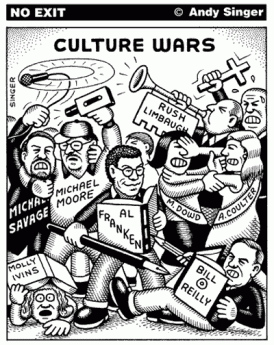
At war over the culture war: Dionne and Gerson go toe-to-toe

By Alan Bean

When two columnists working for the same newspaper address the same subject (the culture war and the contraception debate) you can learn a lot.  Michael Gerson accuses Barack Obama of sustaining our endless American culture war by forcing a conservative Roman Catholic Church to conform to “the liberal values of equality and choice.”  In Gerson’s view, the Catholic Church is an inherently conservative, indeed ‘illiberal’, institution.  Gerson endorses a pluralistic view of America in which a variety of civic organizations, some liberal and progressive, others illiberal and traditional, co-exist in a free society.  But this dream of a pluralistic America is being thwarted by an inherently intolerant “liberal” view of American life in which every individual and institution is expected to conform to the liberal values of equality and choice.  By forcing illiberal Catholic medical providers to provide free contraceptive services to their clients, Gerson alleges, the Obama administration is rejecting the pluralistic vision of America and stoking the fires of culture war.

Gerson believes it is a mistake to antagonize conservative institutions because, unlike their liberal counterparts, they encourage 

The habits of good citizens — attributes such as self-control, cooperation and respect for the law — don’t emerge spontaneously. They are cultivated in families and religious congregations. The health of liberal political institutions is strengthened by the success of traditional institutions, which often teach values that prepare individuals for the responsible exercise of freedom.

In Gerson’s view, Obama moved to the left on immigration and gay rights because he is an ardent culture warrior who disrespects the views of American conservatives.

Then comes E J Dionne, a progressive columnist who, unlike the evangelical Gerson, happens to be a living, breathing Roman Catholic in good standing.  Dionne agrees that Obama’s initial handling of the contraception issue was ham-handed and out of character.  Dionne’s Obama is no champion of the liberal view of America.  At his core, the president is an even-handed pragmatist who is generally eager to negotiate with his ideological opponents.

In fact, Dionne reminds us, six years ago Obama complained that

There are some liberals who dismiss religion in the public square as inherently irrational or intolerant, insisting on a caricature of religious Americans that paints them as fanatical, or thinking that the very word ‘Christian’ describes one’s political opponents, not people of faith.

Sounds a lot like Michael Gerson, doesn’t it.  Obama dropped the ball on the contraception issue, Dionne admits, but was able to self-correct by offering a compromise that was joyfully embraced by Catholic medical care providers.   

Unlike Gerson, Dionne refuses to define the Roman Catholic Church as an inherently traditional or illiberal institution.  The Catholic Church is a pragmatic and pluralistic blending of conservative and progressive impulses.  Dionne says he remains in the fold largely because

When it comes to lifting up the poor, healing the sick, assisting immigrants and refugees, educating the young (especially in inner cities), comforting orphaned and abandoned children, and organizing the needy to act in their own interest, the church has been there with resources and an astoundingly committed band of sisters, priests, brothers and lay people. Organizations such as Catholic Charities, the Catholic Health Association, the Catholic Campaign for Human Development and Catholic Relief Services make the words of Jesus come alive every day.

Moderate Catholics appreciate the president’s willingness to meet the Church half way on contraception and Dionne hopes the conservative wing will tone down its opposition to abortion rights and gay marriage because the American Catholic community is as divided on these issues as the rest of society.

Two views of the Roman Catholic Church; two views of the sitting president.  Who wins?

Dionne gets the best of this dust-up.  The culture war doesn’t separate illiberal traditionalists like a monolithic Catholicism from liberal, pluralism denying, culture warriors like Obama.  Obama has been deeply influenced by both secular liberalism and the traditional values sustained by the Christian Church.  Roman Catholics, like most Christian denominations, are split down the middle over culture war issues like gay marriage, abortion and, now, contraception.  Gerson’s neat divisions don’t fit either Obama or American Catholicism.

If the president has moved off the fence on gay marriage and immigration it’s because he sees no point in placating ideological opponents for whom the word ‘compromise’ has become the vilest of profanities.  Any politician on the right willing to meet the president half way on any contentious issue gets his or her (usually his) mouth washed out with soap in full view of the cameras.

Nice try, Michael, but you didn’t nail it this time.

Will demographic trends doom the GOP?

By Alan Bean

No matter how depressing present political realities may be, Democrats look to the future with confidence.  By mid-century, they say, America will be a majority-minority nation and that can only help the left. 

Jamelle Bouie questions this reasoning on two counts: Republicans could win back the most prosperous sector of the Latino community by returning to the moderate immigration policies of George W. Bush; and, as minorities are absorbed into the affluent mainstream, their resistance to conservative politics will diminish.

In other words, future trends can never be predicted with confidence, especially when we’re gazing 37 years down the road. 

This “the future is ours” rhetoric should make genuine reformers cringe.  We can’t get locked into the culture war categories of the present hour.  Between 1950 and 1970, Democrats and Republicans switched sides on civil rights.  It is hard to believe that the Republican Party on display during the primary election season could move to the left on anything; but stranger things have happened in American politics.  If public sentiment shifts (as it always does) politicians will shift along with it. Reformers should be trying to nudge both parties in the direction of compassion and common sense, even when it feels silly.  Life is full of surprises.

The worst thing that could happen would be for Democrats to eschew the hard work of rethinking the entire progressive narrative because “we are bound to start winning sooner or later”.  Democrats have been on the wrong side of plenty of issues in recent memory (think the war on drugs, mass incarceration and the deregulation of the financial sector), and the blue team will continue to get things wrong if they misread the writing on the wall. 

The tepid politics of triangulation has been weighed in the balance and found wanting.

Nothing in public life is inevitable.  Change is always hard work.  Justice demands courage.  Patience is a virtue; complacency is not.

The Democrats’ Demographic Dreams

Jamelle Bouie

June 14, 2012

If Democrats agree on anything, it’s that they will eventually be on the winning side. The white Americans who tend to vote Republican are shrinking as a percentage of the population while the number of those who lean Democratic—African Americans and other minorities—is rapidly growing. Slightly more than half of American infants are now nonwhite. By 2050, the U.S. population is expected to increase by 117 million people, and the vast majority—82 percent of the 117 million—will be immigrants or the children of immigrants. In a little more than 30 years, the U.S. will be a “majority-minority” country. By 2050, white Americans will no longer be a solid majority but the largest plurality, at 46 percent. African Americans will drop to 12 percent, while Asian Americans will make up 8 percent of the population. The number of Latinos will rise to nearly a third of all Americans. (more…)

Five ‘Stand Your Ground’ cases you should know about

By Alan Bean

The Trayvon Martin case is important because it exposed the flawed, and potentially deadly, reasoning behind Florida’s Stand Your Ground law.  It doesn’t matter whether the victim was, or wasn’t, a marijuana user or whether the Zimmerman’s lied about their finances at a bail hearing.  None of that has any bearing on the tragic elements of this case.  In the end, it doesn’t even matter whether or not Trayvon Martin lashed out at the stranger who stalked and harassed him. 

The story is important because a really awful state statute made George Zimmerman think he could pursue and confront an unarmed private citizen and shoot him dead if he decided to defend himself.

In other words, this isn’t just about Trayvon, and it isn’t just about Florida–twenty-four states have passed some version of Stand Your Ground legislation.  You haven’t heard most of the horror stories because they haven’t been in the news.  You wouldn’t have heard about Trayvon Martin either if he didn’t have unusually determined parents.

Thanks to Pro Publica for understanding why the Trayvon Martin case is important and investigating the nationwide consequences of Stand Your Ground legislation.

Five ‘Stand Your Ground’ Cases You Should Know About

by Suevon Lee
ProPublica, June 8, 2012

The Stand Your Ground law is most widely associated with the Feb. 26 shooting death of Trayvon Martin, an unarmed 17-year-old killed in Florida by George Zimmerman, a neighborhood watch captain who claimed he was acting in self-defense.

But as a recent Tampa Bay Times investigation  indicates, the Martin incident is far from the only example of the law’s reach in Florida. The paper identified nearly 200 instances  since 2005 where the state’s Stand Your Ground law has played a factor in prosecutors’ decisions, jury acquittals or a judge’s call to throw out the charges. (Not all the cases involved killings. Some involved assaults where the person didn’t die.) (more…)

Obama says no to mass deportation

By Alan Bean

In a major development, the Obama administration has decided to enforce key provisions of the failed DREAM Act essentially by presidential fiat.   Young people who came to the United States as children, who have graduated from high school and have a clean criminal record, will be allowed to remain in the United States.  The plan does not include a pathway to citizenship, but qualifying applicants will receive two-year work visas that can be renewed indefinitely.

Although this plan does not give the immigrant rights movement everything it wants (this is no substitute for comprehensive reform), it means that 800,000 young people are no longer targeted for deportation.

President Obama is calculating that, like his recent support for marriage equality, his softened position on deportation will help him more than it hurts.  It will certainly raise his prospects with Latino voters who are far more likely to show up on election day now that the administration has addressed the mass deportation issue. 

In the process, Obama has handed Mitt Romney a potential campaign issue.  But Republicans will have to think carefully before accusing the administration of introducing  de facto “amnesty” contrary to the express wishes of Congress.  Demonizing “illegal aliens” has worked well for the conservative movement, but public opinion could shift in a more progressive direction simply because somebody, finally, is making the case for compassion and common sense. 

An update to the article below can be found here.

Administration plan could spare hundreds of thousands of illegal immigrants from deportation

By Associated Press, 

 Friday, June 15,

WASHINGTON —

WASHINGTON — The Obama administration will stop deporting and begin granting work permits to younger illegal immigrants who came to the U.S. as children and have since led law-abiding lives. The election-year initiative addresses a top priority of an influential Latino electorate that has been vocal in its opposition to administration deportation policies. (more…)

Burl Cain and the ACLU agree

Burl Cain

What do Angola prison warden Burl Cain (a champion of faith-based prison ministries) and Marjorie Esman of the Louisiana ACLU have in common?  They both think locking up thousands of old folks who couldn’t re-offend if they wanted to is an expensive outrage.

This video is part of the ACLU’s “Elderly in Prison” and summarizes that report’s big talking points.  This blurb that accompanies the video boils the argument down to two brief sentences:

Our extreme sentencing policies and a growing number of life sentences have effectively turned many of our correctional facilities into veritable nursing homes — and taxpayers are paying for it. A new ACLU report supplies detailed and practical solutions that states and the federal government can implement to address the dramatic and costly growth in the number of elderly prisoners without putting communities at risk.

Marjorie Esman had lots of good reasons NOT to call up Burl Cain.  When mass incarceration is presented with a racial justice frame (think Angola 3) the warden of Louisiana’s most notorious prison comes off sounding like the reincarnation of Bull Conner.  But when the focus narrows to a reform issue Cain supports, a surprising outlook overlap appears. 

The warden of America’s largest prison believes in rehabilitation.  If we took all the money we’re spending to keep elderly prisoners alive and invested it in education programs for young offenders, he says, we could lower recidivism rates and improve public safety.

Makes sense to me.

Hats off to Marjorie Esman for making the call, and to the ACLU for exhibiting the kind of pragmatic compassion it takes to get a reform message in front of a mainstream audience.