In a three-month period shortly after World War II, 751 home fires killed fo urteen people in the city of Chicago. The deadliest of these fires broke out in filthy, overcrowded tenement buildings in the city’s black district. Joe Allen’s People Wasn’t Made to Burntells the story of a fire on 1733 West Washburne Street that claimed the lives of four children and eventually placed the victim’s father on trial for murder.
Like scores of other Mississippi sharecroppers, James and Annie Hickman had migrated north in search of a better life. In segregated Chicago, housing options were strictly limited for Black families like the Hickmans. They were “forced to live in ‘kitchenettes’: dilapidated one-room apartments that in many cases had no heat, electricity, or running water.” The kitchenette the Hickman family moved into was owned by Mary Porter Adams, a Black woman desperate to maximize her monthly profit, and managed by David Coleman, a white man determined to spend as little as possible on maintenance and repair work.
James Hickman paid Coleman a $100 deposit and moved into a 25 by 15 foot attic apartment on the understanding that more suitable accommodations on the second floor would soon be available. “The Hickmans had to go down to the floor below them to get water from a neighbor to cook and clean with” Joe Allen tells us. “They cooked on a Kenmore two-burner stove a few footsteps from their beds. At a local store James bought two lamps to light the room, both fueled by kerosene.”
When James Hickman asked Coleman when the second-floor apartment would be ready, the manager initially put him off. Hickman kept pressing the issue. Finally, Coleman told Hickman he wasn’t going to rent him the better apartment and wouldn’t return the deposit money. Moreover, Coleman said “he had a man on the East Side ready to burn the place up” if Hickman took him to court. (more…)
Bloggers quickly learn that most readers snap up posts on the hot stories of the day, so by now I should have written something on the Occupy Wall Street movement. Thus far, the OWS people haven’t addressed the issue of mass incarceration, and I don’t expect that to change. The big issue that has drawn thousands of people into the streets is economic inequality. Some OWS protesters want to do away with free market capitalism; others simply resent living in a plutocracy where the politicians function as lap dogs for the wealthy and only well-financed opinions receive a public airing.
This resentment has been hanging in the air for decades, of course, but the economic meltdown of 2008 built a roaring fire under the winter of our discontent. Everything is melting. We see the very people responsible for the current fiasco assigned to key positions in Barack Obama’s cabinet and we are outraged. These people signed off on the housing bubble and turned a blind eye to the massive fraud in the economic sector that kept the bubble afloat for so long. They have been tainted by ubiquitous iniquity and they have demonstrated their incompetence, so why are they still calling the shots? Why are they shaping public policy? Why is the Tea Party intent on cutting their taxes and catering to their every whim? (more…)
“Social justice outside the church is not biblical justice or kingdom work. It is social work. Fine, that’s a good thing. But let’s not call this kingdom work.”
McKnight believes in justice, especially the kind of justice that mattered to Jesus. But that’s just the problem, few churches share his passion. Take the issue of mass incarceration, for instance. Over the past four decades, churches have adopted a law-n-order, lock-’em-up stance. We wanted to be on the side of the angels, and that meant supporting law enforcement force the bad people (particularly drug dealers) off the streets. (more…)
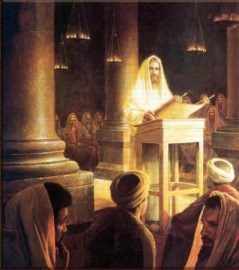
This week the Mustard Seed Conspiracy study is examining Jesus’ brief ministry in Capernaum as described in the Gospels of Mark and Luke. In Luke, this material follows immediately on the heels of Jesus’ rejection in his hometown of Nazareth. This is important for two reasons. In Nazareth Jesus announced his agenda using the ancient words of Isaiah 61: “The Spirit of the Lord is upon me, because he has anointed me to preach good news to the poor; he has sent me to proclaim release to the captives.” Now, in Capernaum, he makes good on his promise.
Luke also uses the Nazareth-Capernaum contrast to make a second point: a prophet may be without honor in his own town, but the strangers down the road get it immediately.
The recurring theme of the Capernaum passages is authority. Jesus takes authority over Shakespeare’s “slings and arrows of outrageous fortune”: the “unclean spirits of disease and disability (physical and mental).
And Jesus takes authority over his audience–he has no interest in keeping the customers satisfied.
Let’s start with the unclean spirits. On 23 occasions in the Synoptic Gospels, Jesus casts out unclean spirits (also referred to as demons). There is something unseemly about these unclean spirits. They twist their victims into grotesque shapes and exit the body with horrifying shrieks. Why, we ask, couldn’t Jesus quietly heal people? (more…)
I just returned from a nine-day trip to Edmonton, Alberta. Whether I was attending my 40th high school reunion or visiting with friends and relatives, the nature of my work brought the conversation around to Bill C-10, “The Safer Streets, Safer Communities Act,” sponsored by the reigning conservative government. In essence, the plan calls for lots and lots of prison construction.
Consider the facts. The United States currently incarcerates 743 people per 100,000 population; Canada incarcerates 117 per 100,000. If the Canadian crime rate was on the rise there might be some rationale for prison construction but, as in America, the crime rate north of the 49th parallel has been dropping like the anvil in a road runner cartoon for years.
Is Prime Minister Steven Harper trying to shore up his political dynasty by playing the tough-on-crime card that worked so well for so long in the US of A? Should we be talking about a “Northern strategy”?
This morning the Grits for Breakfast blog referenced an august gathering in which a number of guests from the lock-’em-up state of Texas explained to Canadian officials why massive spending on prisons is an economic and public safety disaster. You can find the full article from the Canadian Broadcasting Corporation site here.
Then Jesus said to Simon, “Do not be afraid; from now on you will be catching people.” (Luke 5:10)
By Alan Bean
This week we consider Jesus’ calling of the first disciples. In Mark’s gospel, the subject is covered in five short verses; Luke’s account is twice as long and doubly detailed. The evangelists (a fancy word for the men who write the four gospels) inherited scores of traditional stories about the life and work of Jesus and used this material with great freedom.
In Mark’s gospel, Jesus appears to two groups of fisherman busy casting their nets into the sea. “Follow me,” he says, “and I will make you fish for people.” Without a word, the men drop their nets and follow.
In Luke, the action if far more complex. Right at the end of John’s gospel, we find a story about a miraculous catch of fish. Luke gives us the same story, but he places it in a very different setting. In John, the risen Christ appears to his disheartened disciples and asks them to let down their nets for a catch. In Luke, this request is extended right at the beginning of Jesus’ teaching ministry.
As a teenager growing up in McLaurin Baptist Church in Edmonton, Canada, I discussed Mark’s story with Sadie Beggs, an Irish Baptist. “Jesus just walks up and tells these guys to follow, and they do,” I said. “I wonder what was going through their heads.”
Sadie told me she had always been mystified by the disciples’ willingness to follow a perfect stranger. “It must have been a miracle,” she said.
In Luke, the decision to follow Jesus is more understandable. Jesus heals the mother-in-law of a soon-to-be disciple named Simon just shortly before the two men meet by the sea of Galilee. The call to discipleship doesn’t come from a complete stranger, in other words, Simon has already seen Jesus at work. (more…)
A war of words has erupted on the web featuring self-described “secular liberal” Mark Pinsky and progressive evangelical Jim Wallis, on one side, and the consortium of scholars and columnists who write for Talk to Action on the other.
Pinsky believes that critics of Dominionism and the New Apostolic Reformation have created the false impression that most evangelicals are dangerous theocrats.
Next, Jim Wallis poured gasoline on the fire by claiming in a HuffPost piece, that “some liberal writers seem hell-bent on portraying religious people as intellectually-flawed right-wing crazies with dangerous plans for the country.”
Are Pinsky and Wallis making legitimate claims, or is something more sinister afoot?
Anyone familiar with the good folks at Talk to Action knows how carefully they distinguish Dominionism and mainstream evangelicalism. Rachel Tabachnick, the most high-profile critic of the New Apostolic Reformation, grew up Southern Baptist and is well acquainted with the wild diversity within evangelicalism. She is all about nuance. She is saying that Dominionism has a long history (see my piece on the evolution and meaning of the movement), that it is a minority movement within evangelicalism that is growing rapidly and, most importantly, gaining the support of prominent politicians like Michelle Bachmann, Sarah Palin and Rick Perry.
Pinsky and Wallis refuse to engage this argument, preferring to publicly cudgel a silly straw man into submission.
How do we explain this unseemly assault on the Talk to Action people? (more…)
“He was the soul and heart of the Birmingham movement. Fred Shuttlesworth had the vision, the determination never to give up, never to give in. He led an unbelievable children’s crusade. It was the children who faced dogs, fire hoses, police billy clubs that moved and shook the nation.” John Lewis
Fred Shuttlesworth is dead at 89. He never thought he would survive the civil rights struggle in Birmingham. Far less protective of his personal safety than men like Martin Luther King and Medgar Evers, Shuttlesworth attributed his survival to the grace of God. He couldn’t think of any other explanation.
Frankly, neither can I.
It was Shuttlesworth that convinced MLK to come to Birmingham in 1956, the year his home was fire-bombed by the Ku Klux Klan, and it was Shuttleworth’s courage that sustained the movement. As the quote above suggests, the Birmingham preacher drafted children into the movement when most of the able-bodied adults were already in prison. In 1961, when a mob of white segregationists surrounded his Birmingham church, it was Shuttlesworth who calmed the crowd.
Shuttlesworth had been sparring with Police Chief Bull Conner for seven years before the Birmingham campaign reached its peak. It was during these years of relative anonymity that Shuttlesworth was the most vulnerable. Not nearly as erudite as the silver-tongued Martin Luther King, Shuttlesworth was an old-time “hooping” preacher. While King struggled to win the support of progressive and moderate whites, Shuttlesworth inspired the foot soldiers.
When he came to preach at the Southern Baptist Theological Seminary in October of 1978, I had never heard of Fred Shuttlesworth. The civil rights narrative trumpeted in the mainstream media had ony a few hero slots available, and Rev. Fred never made the cut. Shuttlesworth had been invited to speak at Southern by Andrew Manis, then an M.Div student. A decade later, Manis would write the acclaimed biography, A Fire You Can’t Put Out: The Civil Rights Life of Birmingham’s Reverend Fred Shuttlesworth.
Old School black preachers are often unnerved by predominantly white audiences. There is a interactive cadence to black preaching that washes back and forth between the preacher and the congregation. Preaching to an unresponsive audience, it’s hard to get your rhythm. So it was for Shuttlesworth at Southern. His voice was almost inaudible at first, and his delivery seemed forced.
But something he said struck a chord with my wife, Nancy. “Amen,” she shouted, as loudly as she dared.
“I’ll take that amen!” Shuttlesworth roared back, and suddenly, he was a man transformed. When the sermon ended, we were all on our feet whooping and hollering.
You had to look hard to find a mention of Shuttlesworth’s death in America’s flagship newspapers. The death of Steve Jobs and Sarah Palins’ political career grabbed the headlines. But no one did more to kill Jim Crow than the Rev. Fred Shuttlesworth. (more…)
Unless, that is, you are open to shocking new ideas about God, a counter-intuitive take on the created order, and a topsy-turvy understanding of the human condition.
When Jesus arrived in his hometown of Nazareth, everybody wanted to be impressed. When a local boy makes good, small towns announce their association with the local-boy-made-good for the edification of passing motorists. “We might look like just another hick town,” the sign suggests, “but Bob Wills grew up here.”
Even if you’ve never heard of Bob Wills, you can’t help being a little bit impressed.
Immediately after his wilderness encounter with the devil, Matthew tells us, Jesus took up residence in the little fishing village of Capernaum, on the northern shore of the Sea of Galilee, (or the Sea of Tiberias as Herod Antipas insisted on calling it). From there, he moved into the surrounding communities, eventually arriving at his home town of Nazareth.
By this time, Jesus had acquired a reputation as a teacher with, it was widely rumored, the power to heal. Nobody was thinking “Messiah” or “Son of God” at this point; but Rabbi was a distinct possibility. Which explains why, when the hometown boy showed up for Sabbath worship, he was handed the scroll of the prophet Isaiah and asked to read a passage of his choosing.
Turning to what we call the 61st Chapter (there were no chapters or verses in his day), Jesus intoned a startling message that, like the Lord’s Prayer, had been domesticated by frequent repetition.
The Spirit of the Lord is upon me,
because he has anointed me to bring good news to the poor.
He has sent me to proclaim release to the captives
and recovery of sight to the blind,
to let the oppressed go free,
to proclaim the year of the Lord’s favor.
Then he handed the scroll back to the attendant and sat down.
Folks were impressed. “He reads very well for a kid from Nazareth,” some thought. “Good intonation, not too fast or too slow, and he fills the synagogue with his voice without appearing to shout. Not bad for a rookie.” (more…)
How refreshing to read a piece about the Christian Right written by someone who once inhabited this world and retains an ear for nuance. According the The Guardian website, “Karl Giberson is a science and religion scholar, speaker and writer. He is also a fellow of the American Scientific Affiliation.”
Giberson came of age in the world of egghead evangelicalism.
So did I. Well, sort of. As far as I can recall, I never heard sermons about creationism or any of the “alternative universe” constructions Giberson details below. That stuff wasn’t as prevalent in my native country of Canada as it was in the American heartland. Still, to the extent that Canadians take their intellectual cues from Great Britain or the United States, I couldn’t avoid the likes of Francis Schaeffer when I got to university.
I wasn’t impressed.
When I arrived at Southern Baptist Theological Seminary in 1975, Schaeffer was regarded as a theological lightweight posing as an evangelical Renaissance Man. As Giberson realizes (mercifully), not all evangelicals live in a tightly woven “alternative universe”.
But millions do, and these are the folks Rick Perry and Michelle Bachmann are currently courting. In this parallel world, “scientists” preach an innerant Bible and assure the faithful that the world was created by the God of the Bible very, very recently. Evolution is a myth, homosexuality is a disease and Christians are God’s chosen people.
So long as you never stray outside the carefully patrolled borders of this parallel universe, you are never forced to wrestle with opposing arguments or to consider alternative views. But ishould you ever venture outside the fold, you will find yourself intellectually defenseless and intimidated.
Which is why hardcore evangelicalism works so hard to construct a social world offering cradle-to-grave protection from the demons of the secular world.
The word “demons” in the previous sentence is not metaphorical–folks like C. Peter Wagner inhabit a demon (and angel) filled universe. If old-school fundamentalists like J. Gresham Machen and William Bell Riley were steeped in the rationalistic canons of the modernism they opposed, this new breed of Christian soldiers are distinctly pre-modern. In fact, they’re downright medieval, and proud of it.
Thinking evangelicals are an endangered species, but there are plenty of them still out there. In 1994, evangelical historian Mark Knoll wrote The Scandal of the Evangelical Mind. It has all been downhill since then.
Millions of evangelicals, including GOP candidates, are trapped in an alternative ‘parallel culture’ with its own standards of truth
Michele Bachmann and I grew up in the same evangelical world. We heard similar sermons, read similar books – most importantly the Bible – and we followed the same anointed leaders.
By the time we were in college our generation of evangelicals had been educated into a profoundly different worldview than that of the secular, anti-Christian, Satan-following Ivy League elites we had been taught to fear. We understood the world to be a spiritual battleground with forces of good pitted against forces of evil. Real angels and real demons hovered about us as we prepared to wage these wars. We sang songs like Onward, Christian Soldiers in our churches. At summer camps and vacation Bible schools we stamped our feet, and waved our arms as we sang with good Christian gusto I’m in the Lord’s Army. We knew which side we were on.
Our religious literature was filled with the ideas of people like Francis Schaeffer, a fundamentalist Pennsylvania pastor who transformed himself into a guru by moving to the Swiss Alps, making himself look like Heidi‘s grandfather, and turning his home into a refuge for troubled pilgrims called “L’Abri“. Schaeffer, the intellectual architect of the religious right in America, helped a generation of young evangelicals understand that the corrosive forces of secular humanism were eating away at the foundations of the Christian west. We were heartened that such an impressive intellectual – a fundamentalist counter to Jacob Bronowski or Carl Sagan – was on our side.
Schaeffer’s 1976 bestseller, How Should We Then Live?, chronicled the decline of the Christian west, which had flourished with God’s blessing for centuries, but was now in decline. With broad brushstrokes, our alpine sage showed us how the west had sold its soul for a mess of secular pottage and sham materialism. Schaeffer’s million-selling manifesto was made into an impressive film series, narrated by Schaeffer. Clad in his iconic Swiss leggings, with a flowing mane of white hair and trademark goatee, Schaffer took viewers to all the great cultural spots in the west to help us understand what had gone wrong. The book and film series were widely used at evangelical colleges and universities across the country.
Michele Bachmann told the New Yorker recently that Schaeffer had a “profound influence” on her developing worldview as a young person. Millions of evangelicals would murmur “amen” to that. I read Schaeffer and watched his film series at Eastern Nazarene College in Massachusetts in 1979 as part of a capstone general education course required of all students.
Schaeffer was the most charismatic of the evangelical experts that shaped the world views of believers in the 1970s. There were many more with different specialities. We learned that evolution had no scientific support from young-Earth creationists like Henry Morris and Ken Ham. When Bachmann says that “evolution has never been proven” she is simply repeating what our generation has heard from evangelical leaders as we were growing. I enrolled at Eastern Nazarene College seeking credentials that would enable me to join the creationists in their fight against evolution.
We learned that homosexuality is a choice made by people to live in sin, under Satan’s influence. The reparative therapy – “pray away the gay” – used at the clinic run by Bachmann’s husband was something we all endorsed, under the influence of evangelical social scientists like James Dobson, who had a PhD in child development and thus knew what he was talking about. We grew up hearing about the “gay agenda” and how it was being used by Satan to destroy traditional morality and faith in the Bible.
Christian “historians” like Peter Marshall and David Barton helped us understand that America was a “Christian nation” and that recent travails, like the social upheaval of the 1960s that gave us drug abuse, promiscuity, and the homosexual agenda, were the result of abandoning America’s religious roots.
Many evangelicals, myself included, were fortunate enough to study under Christian scholars, like my professors at Eastern Nazarene College in the 1970s or my colleagues today at Gordon College, who see through the nonsensical claims of people like James Dobson, David Barton, Francis Schaeffer, and Ken Ham – who runs the preposterous Creation Museum in Kentucky. Even as a college student I recall Schaeffer being examined rather critically and young-Earth creationism dismissed out of hand.
There are, fortunately, many evangelical scholars – National Institutes of Health (NIH) director Francis Collins and historian Mark Noll come to mind – who are quietly raising alarms about all this dangerous anti-intellectualism, warning us about populist gurus who are marketing a “Christianised” version of knowledge that, on closer examination, turns out to be neither Christian nor knowledge.
Unfortunately, millions of evangelicals – and this would include much of the political base being courted by the GOP presidential candidates as well as the candidates themselves – are trapped in an alternative “parallel culture” with its own standards of truth. The intellectual authorities mentioned above – with the exception of Schaeffer who died in 1984 – all have media empires that spread their particular version of the gospel. Millions of dollars every year support the production of books, DVDs, radio shows, school curricula, and other educational materials. Very few evangelicals grow up without hearing some trusted authority – perhaps even with a PhD – tell them that the age of the Earth is an “open question”. Or that scientists are questioning evolution. Or that gays are getting spiritual help and becoming straight. Or that secular historians are taking religion out of US history.
Historian Randall Stephens and I have been interested in this alternative knowledge world for years. We grew up in it and emerged from it unscathed – as near as we can tell – but many of our evangelical students over the years have arrived at college with “truths” from this alternative knowledge world written on their hearts. Harvard University Press has just published our sympathetic insiders’ analysis of the parallel culture of American evangelicalism. Titled The Anointed: Evangelical Truth in a Secular Age, we look at how evangelical knowledge structures are exploited by media savvy authorities like those mentioned above.
And, as we watch the GOP candidates enthusiastically promote discredited ideas from this alternative knowledge world, we worry.
 By Alan Bean
 By Alan Bean
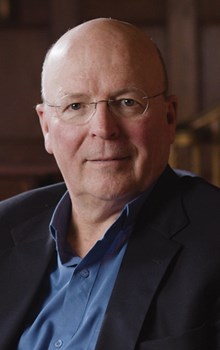 “Social justice outside the church is not biblical justice or kingdom work. It is social work. Fine, that’s a good thing. But let’s not call this kingdom work.”
 By Alan Bean
 By Alan Bean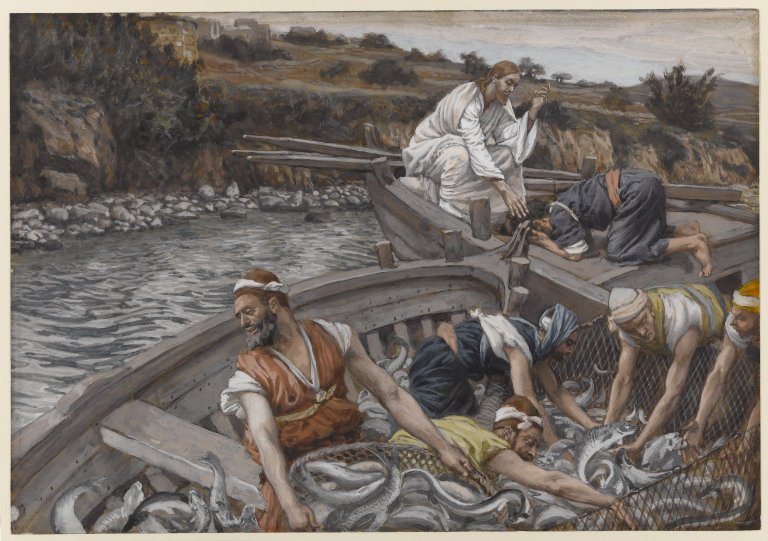


 Shuttlesworth had been sparring with Police Chief Bull Conner for seven years before the Birmingham campaign reached its peak. It was during these years of relative anonymity that Shuttlesworth was the most vulnerable. Not nearly as erudite as the silver-tongued Martin Luther King, Shuttlesworth was an old-time “hooping” preacher. While King struggled to win the support of progressive and moderate whites, Shuttlesworth inspired the foot soldiers.
 By Alan Bean
 Friends of Justice