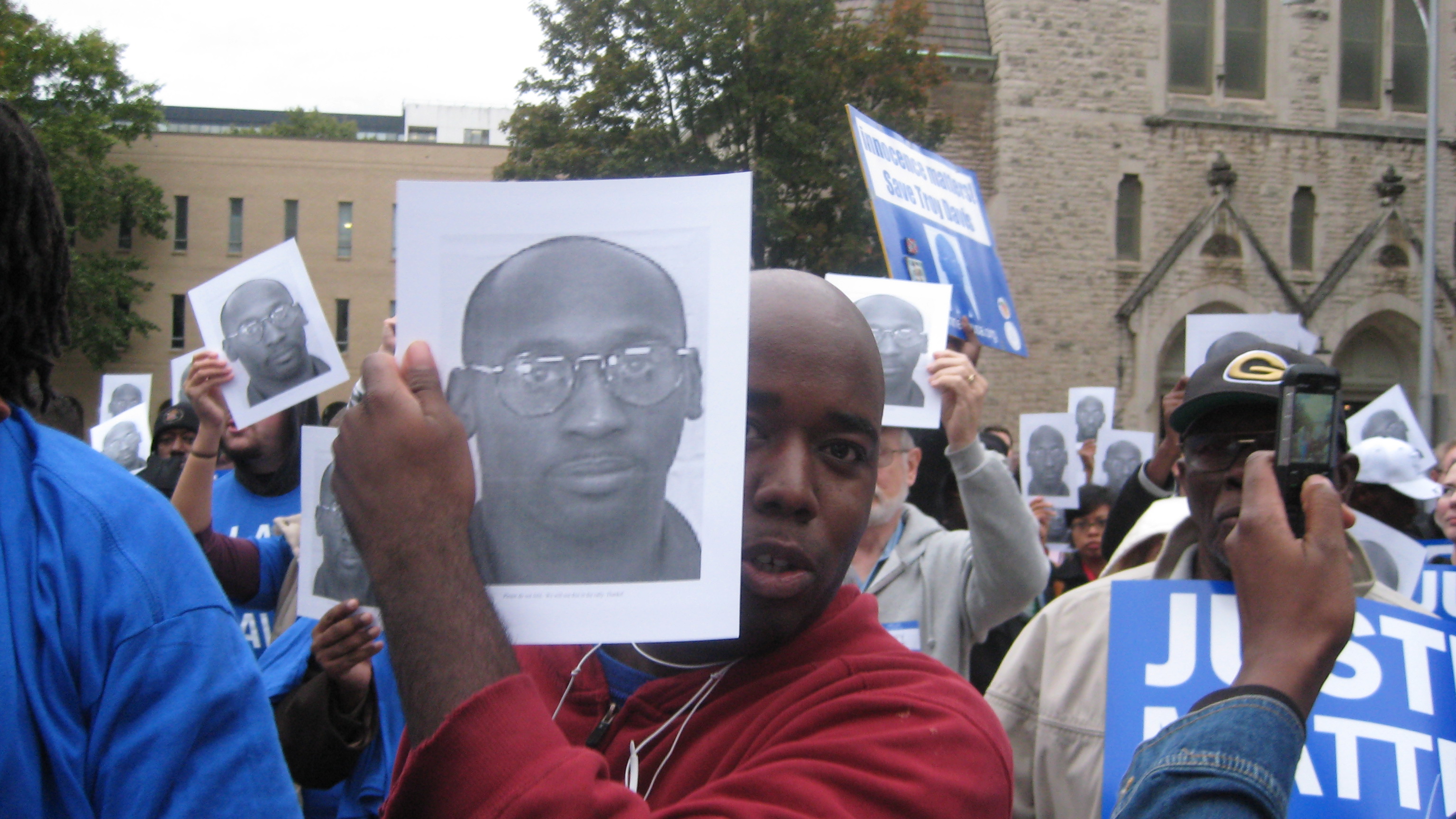
Three ways to help Troy Davis

If you’re wondering how to respond to Georgia’s scheduled September 21st execution of Troy Davis you’ve come to the right place.  Thanks to Courtney-Rose Harris of the NAACP for providing this information.  AGB

Three ways to help Troy Davis and his family

The Georgia Board of Pardons & Paroles will determine Troy Davis’ fate on September 19 during a final clemency hearing.  As NAACP President & CEO Benjamin Jealous said, “Time is running out, and this is truly Troy’s last chance for life.”

Now is the time for action!  The NAACP (in partnership with Amnesty International) began the TooMuchDoubt campaign Tuesday.  There are three easy ways that people can support Troy Davis.

1. Sign the petition to the Board of Pardons and pass this on to your friends and family. Each name means a more united front for justice:

2. Send a message of support to Troy as he fights for justice on what may be the final days of his life.

3. Make sure everyone knows about this injustice. Spread the word on Facebook and Twitter (hashtag #TooMuchDoubt) so that Troy Davis’ story can be heard. We still have a chance to save his life, but only if people are willing to speak out against injustice.

The NAACP will also be on the ground mobilizing our members and allies in the state of Georgia as Davis’ hearing date approaches.   On September 15 we will hold a rally at the historic Ebenezer Baptist Church in Atlanta, GA.

It’s clear that there is no justice in executing a man when there is just too much doubt. We are certain that with this information your readers and supporters will be more than compelled to support Troy Davis.  Feel free to reach out to me at 443/676-7503 or crharris@naacpnet.org with any questions.

Courtney-Rose Harris

NAACP Connect Project Specialist

New Media Department
1156 15th Street NW, Suite 915
Washington, DC 20005
(202) 463-2940 (O)
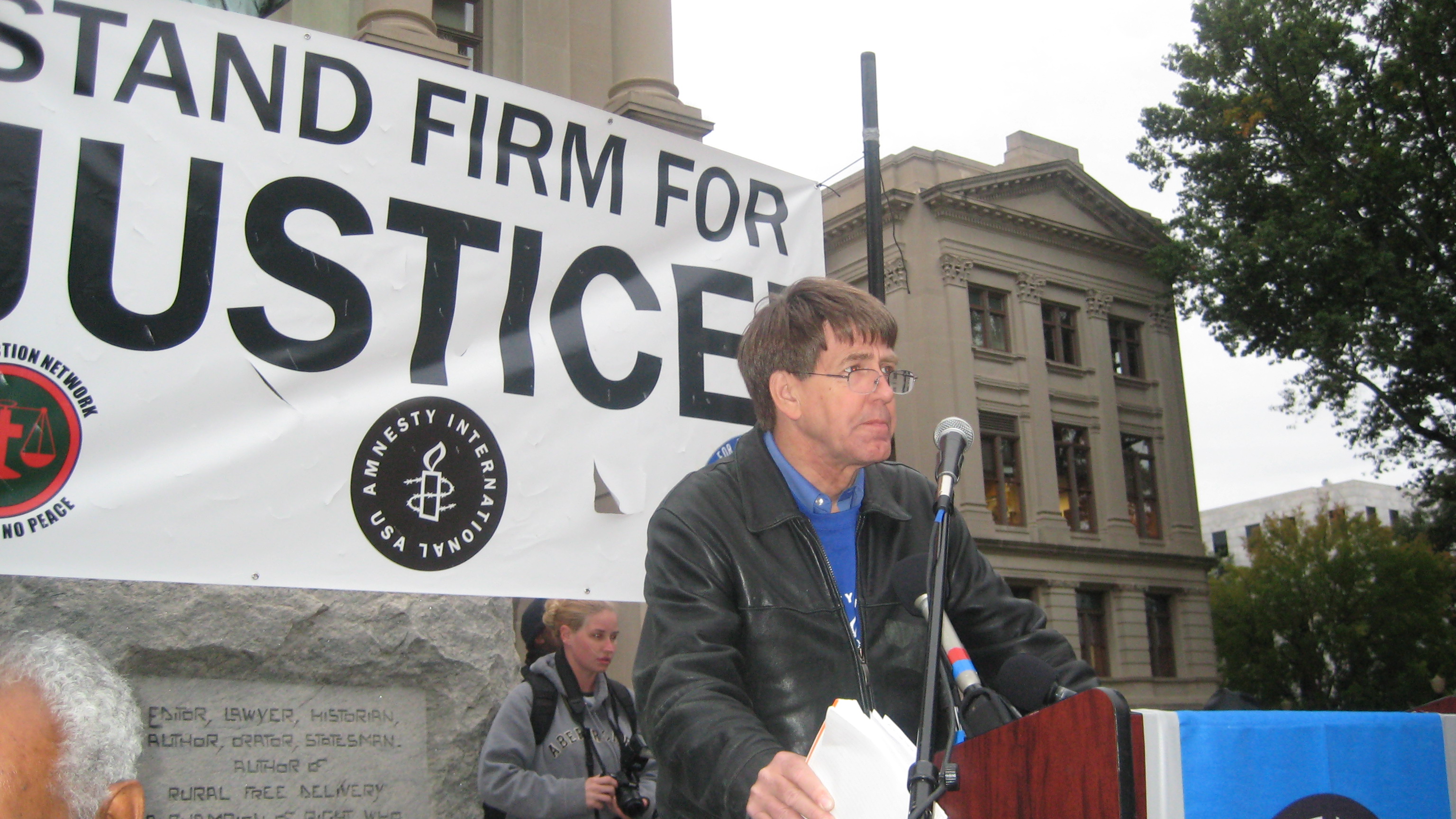
Execution date set for Troy Davis

Larry Cox addresses Troy Davis rally in Atlanta

By Alan Bean

Now that the state of Georgia has established a September 21-28 window for the execution of Troy Davis, organized support for the Georgia defendant will ramp into high gear.  Amnesty International, the organization most closely associated with the Davis case, will be coordinating the opposition.  Executive Director Larry Cox has issued a brief statement which includes this important piece of historical context:

The Board stayed Davis’ execution in 2007, stating that capital punishment was not an option when doubts about guilt remained.  Since then two more execution dates have come and gone, and there is still little clarity, much less proof, that Davis committed any crime. Amnesty International respectfully asks the Board to commute Davis’ sentence to life and prevent Georgia from making a catastrophic mistake.

Laura Moye, the AIUSA attorney closest to the Davis case, released this statement:

It is because of cases like Troy Davis’ that support for the death penalty has dropped significantly in this country. The possibility of human error is far too high, and the chances of executing the innocent are far too real.


Order signed for Sept. execution of Troy Davis

By GREG BLUESTEIN, Associated Press

ATLANTA (AP) — Georgia is scheduling the execution later this month of an inmate who has won widespread support for his claims of innocence in the 1989 slaying of a Savannah police officer, his attorney said Tuesday. (more…)

Deinstitutionalization and the criminalization of mental illness

By Melanie Wilmoth

A recent NPR story sheds light on the growing number of people with mental illnesses residing in America’s prisons and jails. Rather than treating mental illness with therapy and treatment programs, the government uses the criminal justice system as a warehouse for people with mental health issues. With little capacity to provide mental health services, US prisons and jails struggle to treat these individuals.

The increasing “criminalization of mental illness” dates back to the 1950’s when the federal government first began its push for deinstitutionalizing individuals with mental illnesses. There were two main aspects of deinstitutionalization: individuals would be taken out of state-run mental institutions (many of which had a reputation for inhumane treatment) and then treatment would be provided through community mental health programs. In theory, deinstitutionalization sounded promising. People would be moved out of restrictive state institutions and moved into community-run programs. However, deinstitutionalization backfired when community mental health services lacked funding. Thus, people were removed from institutions and received no support services or treatment for their mental illness. As a result, those who were deinstitutionalized ended up homeless or in prison. (more…)

When the prison boom goes bust

By Alan Bean

Scott Henson’s Grits for Breakfast blog offered a couple of terrific posts over the weekend.  “Private prisons and faux privatization” was inspired by a Forbes piece in which E. D. Kain asserts that running prisons is a government responsibility even if the work is subcontracted to a private prison company.

Thus any ‘privatization’ that occurs is simply the transfer of the provision of a government service (in this case, incarceration) to a private contractor. The contractor still operates with the full force of the law. In other words, it’s still government, just government-for-hire or for-profit government.

If there is any saving to the tax payer it is only because private prisons pay their workers less than state-run prisons.  Since this translates into less capable workers nothing of value is gained and much is lost.

“Texas prison  boom going bust” argues that county commissioners in small Texas towns can no longer build lock-ups far exceeding local needs on the assumption that a steadily growing prison population will fill the excess beds.

Jail-bed supply significantly exceeds demand statewide. With the exception of immigration detention, the bubble has burst. As has, hopefully, the “jail as profit center” myth among Texas county commissioners.

Prison privatization and the proliferation of the The Texas Gulag are two of the primary symptoms of America’s failed attempt to make crime pay.  Public officials have believed for years that everybody wins when we lock up more people this year than we did last year. Small towns get jobs; private prison companies slash wages and rake in profits, politicians get campaign contributions from the private prison industry and jobs in that sector when they leave politics.  Who could ask for anything more? (more…)

What was really behind Rick Perry’s push for privatized prisoner care?

By Melanie Wilmoth

Earlier this year, Texas Governor Rick Perry proposed privatizing prisoner healthcare. Perry claimed that privatization would save Texas millions of dollars, something which was sorely needed in light of the state’s $27 billion budget deficit. There was much argument over whether or not this proposal would actually save the state money, but the proposal was ultimately shot down when it faced bipartisan resistance.

In a recent article, Tim Murphy sheds light on why Perry was so eager to privatize prisoner care, a move that would have greatly benefitted the private-prison industry. According to Murphy, Perry’s privatization proposal “coincided with an influx of campaign contributions from private-prison executives and lobbyists, among them his former top aide, Michael Toomey, a political powerbroker who represents the nation’s largest private corrections contractor, Corrections Corporation of America.” Overall, representatives from the private-prison industry donated over $100,000 to Perry’s reelection campaigns. (more…)

Mustard seed conspiracy?

By Charles Kiker

Matthew 13:31-32: “The kingdom of heaven is like a grain of mustard seed which a man took and sowed in his field; it is the smallest of all seeds but when it is grown it becomes the greatest of shrubs and becomes a tree, so that the birds of the air come and make nests in its branches.”

One necessary preliminary observation regarding “the kingdom of heaven” in this—and other—parables of the kingdom: this same parable as reported in Mark 4:30-32 and Luke 13:18-19 has “kingdom of God” rather than “kingdom of heaven.” It is customary for Matthew to refer to the kingdom of heaven and for Mark and Luke to refer to the kingdom of God. At any rate, Jesus in this parable and other parables is not referring to heaven as a place where good people go when they die (or people who have prayed the right prayer and/or believed the right things). It is about the kingdom of God which is coming on earth. “Thy kingdom come, thy will be done, on earth as it is in heaven.” It is about the kingdom coming on earth, and the will of God being done on earth where the will and ways of humankind have sway, as well as in the heavens where God and only God has sway. (more…)

The most influential civil rights champion you’ve never heard of

If you’ve never heard of Stetson Kennedy, you’ll feel as if you’ve known the man all your life after reading this wonderful eulogy by University of Florida professor Paul Ortiz.  Kennedy is generally remembered as a thorn in the side of the Ku Klux Klan, but as Professor Ortiz makes clear, his significance is much deeper and broader than that.  Until this morning, I had never heard Stetson Kennedy’s name mentioned in connection with racism, segregation, white supremacy or the civil rights movement.  How can that be?  AGB 

stetson_kennedy_typing.pngBy Paul OrtizStetson Kennedy passed away on Saturday, Aug. 27. He was 94 years old. Stetson died peacefully in the presence of his beloved wife, Sandra Parks, at Baptist Medical Center South in St. Augustine, Florida.

Stetson Kennedy spent the better part of the 20th century doing battle with racism, class oppression, corporate domination, and environmental degradation in the American South. By mid-century Stetson had become our country’s fiercest tribune of hard truths; vilified by the powerful, Stetson did not have the capacity to look away from injustice. His belief in the dignity of the South’s battered sharecroppers, migrant laborers, and turpentine workers made him the region’s most sensitive and effective folklorist.

Stetson was so relentless, so full of life, that some of us thought that he would trick death the way that he had once fooled the Ku Klux Klan into exposing their lurid secrets to the listeners of the Adventures of Superman radio program in 1947. As recently as April, Stetson gave a fiery speech to hundreds of farm workers and their supporters at a rally in support of the Coalition of Immokalee Workers in Tampa. Standing in solidarity with Latina/o and Haitian agricultural workers affirmed Stetson’s ironclad belief in the intersections between labor organizing, racial justice, and economic equity. (more…)

How to join the conspiracy

By Alan Bean

When I tell people about Friends of Justice they sometimes ask how they can get involved.  I tell them that all donations are gratefully received, but that’s rarely what they have in mind. They want to know how they can get involved in the work of Friends of Justice.

And here’s my answer: If you want to help Friends of Justice you need to understand the spirituality that drives our work; you need to get involved with the Mustard Seed Conspiracy. If you live within reasonable driving distance of Arlington, Texas you are invited to attend our weekly study which will begin on Wednesday, September 7.  A few days prior to each gathering you will find that week’s reading assignment and a brief commentary on the Mustard Seed Conspiracy blog. (more…)

“Stop-and-frisk” tactics and racial profiling in New York

By Melanie Wilmoth

Although New York City is 29 percent Latino and 25 percent Black, Al Baker reports that a shocking 85 percent of individuals stopped by New York City police are Latino or Black. In 2008, the New York Police Department’s “stop-and-frisk” tactics and the racial disparities associated with them, prompted the Center for Constitutional Rights to file a suit alleging the use of racial profiling by city police. Recently, lawyers representing the city attempted to dismiss the case. Yesterday, however, Judge Shira Scheindlin rejected the lawyers’ efforts, ruling that there was enough substantial evidence to carry on with a trial.

In her book, The New Jim Crow: Mass Incarceration in the Age of Colorblindness, Michelle Alexander describes the development of stop-and-frisk policies:

Once upon a time, it was generally understood that the police could not stop and search someone without a warrant unless there was probable cause to believe that the individual was engaged in criminal activity. That was a basic Fourth Amendment principle. In Terry v. Ohio, decided in 1968, the Supreme Court modified that understanding, but only modestly, by ruling that if and when a police officer observes unusual conduct by someone the officer reasonably believes to be dangerous and engaged in criminal activity, the officer “is entitled for the protection of himself and others in the area” to conduct a limited search to “discover weapons that might be used against the officer.” Known as the stop-and-frisk rule, the Terry decision stands for the proposition that, so long as a police officer has “reasonable articulable suspicion” that someone is engaged in criminal activity and dangerous, it is constitutionally permissible to stop, question, and frisk him or her — even in the absence of probable cause.

…In the years since Terry, stops, interrogations, and searches of ordinary people driving down the street, walking home from the bus stop, or riding the train, have become commonplace — at least for people of color.

As Alexander points out, the Supreme Court’s decision in Terry v. Ohio set a legal precedent, making it permissible for police to search individuals without probable cause. (more…)

An informed conversation about the religious right, politics and dominionism

By Alan Bean

Sarah Posner and Anthea Butler understand the religious right because they attend actual religious gatherings and talk to people.  When they sit down for a conversation about dominionism, the New Apostolic Reformation and politicians like Rick Perry and Michelle Bachmann you get the straight goods.

Dominionists aren’t poised to take over America.  The religious right is an exceedingly complex social phenomenon.  Most of the folks in Houston’s Reliant Stadium for Rick Perry’s The Response had never heard of dominionism.  All of this is true, but that doesn’t mean something big isn’t afoot in the world of conservative evangelicalism.  Something big is afoot and it is already impacting the political process and the way social issues are debated in the public arena.

When I was attending university in the mid-1970s, my parents, Gordon and Muriel Bean, were suddenly wrapped up in the charismatic movement.  They continued to attend McLaurin Baptist Church (then a very non-demonstrative congregation), but they were much more excited about groups like the Full Gospel Business Men International and Women Aglow (of which my mother eventually became Alberta president).  Like the dutiful son I am, I attended these meetings but was never tempted to get involved.  I saw the usual “signs and wonders”:  folks speak in tongues as if it was the most natural thing in the world, worshipers healed of chronic ailments (usually having one leg longer than the other), worshippers  “slain in the spirit” (that is, lying in ecstasy on the floor as their bodies twitched with Holy Spirit electricity).

Like I say, it wasn’t my cup of tea.  But I learned that this kind of religion can be extraordinarily powerful for those on the inside.  As Posner and Butler point out below, it is the ordinary people who attend religious conferences and buy books and DVDs that drive the movement.  The names of the preachers change from generation to generation; the spiritual hunger driving the movement abides forever.

The GOP has learned to tap into that hunger; Democrats lose elections, especially in the South, because they haven’t.

This is a long piece, but I offer this little clip as an indication of the fresh insight you will discover throughout a fascinating conversation.  This is Anthea Butler:

For the last 30 years, journalists have had an easy time reporting on the religious right, because all they did was pay attention to to white male leaders of big organizations like Focus on the Family, National Association of Evangelicals, or Family Research Council. The days when a nice soundbite from Jerry Falwell, James Dobson, or Ted Haggard would suffice are over. If journalists and others want to understand the last 10 years of the religious right movement, they will need to pay attention to the theological, religious, and ethnic diversity among evangelicals, Pentecostals, and non-denominational churches. They will at least need to recognize the old and new leaders of the religious right, and the complex network of leaders, conferences, and teachings if they want a reductionist argument they can spin out in 800 words. As someone who has studied and written about Pentecostalism for over 15 years, their lack of basic knowledge is staggering, and although I don’t expect people to get it like I do, I do expect reporters and journalists to do their homework! (more…)