Misconceptions About Famous Trials

By Allison Gamble

America loves a good court case. You have only to look at the recent coverage of the Casey Anthony trial for proof that Americans are obsessed with high-profile criminal proceedings. The OJ Simpson murder trial is another example that kept America captivated through 41 days of trial. Yet the public perception of these cases varied widely. Casey Anthony was largely presumed guilty of killing her daughter, and outrage followed her acquittal. When OJ Simpson was acquitted of murdering his ex-wife and her lover, however, public opinion as to why he was or was not guilty was divided, often along racial lines. It’s easy to get swept away by the tidal wave of public opinion, but far more difficult is understanding why these cases resulted in the verdicts that they did and how they have affected the American court system. (more…)

Texas and the “school-to-prison pipeline”

By Melanie Wilmoth

A recent Washington Post article by Donna St. George sheds light on the increasing criminalization of student discipline in the US and the effect it has on Texas children.

As a result of zero-tolerance policies, schools have been funneling kids from the classroom to the cell-room through what some are calling the “school-to-prison pipeline.” Schools have increasingly turned to ticketing to deal with behavior issues that, in the past, were handled by school administration. It is not uncommon for students to receive school-based tickets for disruptive behavior such as cursing in class, tardiness, truancy, and fighting. Shockingly, a 2010 report by Texas Appleseed indicated that children as young as 6 have received tickets.

St. George points to some equally alarming facts:

[Texas] stands out for opening up millions of student records to a landmark study of discipline, released in July . The study shows that 6 in 10 students were suspended or expelled at least once from seventh grade on. After their first suspension, they were nearly three times more likely to be involved in the juvenile justice system the next year, compared with students with no such disciplinary referrals…Students who have been arrested or appeared in court are more likely to drop out of high school…Dropouts, in turn, are more likely than graduates to be incarcerated or unemployed.

The criminalization of student disciple has become such a prominent problem in the US, that national organizations such as the American Civil Liberties Union have made challenging the “school-to-prison pipeline” one of their key issue areas.

Texas students sent from classroom to courtroom

By Donna St. George

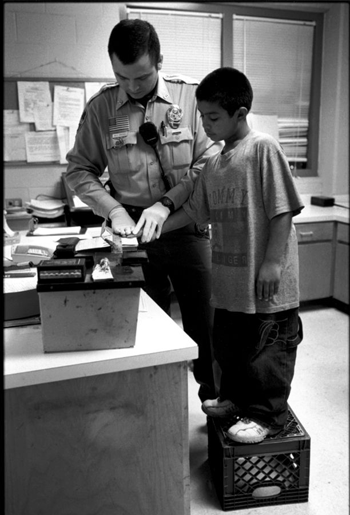
SPRING, TEX. — In a small courtroom north of Houston, a fourth-grader walked up to the bench with his mother. Too short to see the judge, he stood on a stool. He was dressed in a polo shirt and dark slacks on a sweltering summer morning.

“Guilty,” the boy’s mother heard him say. (more…)

Faith as an Engine of Criminal Justice Reform

By Harinder Singh

With all attention currently on the debt ceiling in the US, the faith community is calling on leadership to save money through addressing the wasteful costs of incarcerating 2.3 million Americans.

On June 16, 2011, I joined a cadre of 23 interfaith religious leaders from throughout the US in support of the National Criminal Justice Commission Act in visiting our congressional representatives and the White House.  I met with representatives from Texas and California in their offices on Capitol Hill as part of a fly-in organized by the Faith in Action Working Group of the Justice Roundtable. I participated in this critical action because correcting injustices in our prison systems needs to be a state and national priority, fueled especially by all who claim to be driven by religious convictions. An avenue for this type of reform lies in the proposed creation of the National Criminal Justice Commission Act of 2011 (S. 306) (NCJCA), which was introduced with bipartisan support in 2011 by Senator Jim Webb. Members of the Commission would be appointed by the legislative and executive branch and would be charged with undertaking comprehensive critical examination of America’s criminal justice system.

The portion of the bill I would like to focus on today– Section 5(b) — reads as follows: “The Commission shall make findings… and recommendations for changes in oversight, policies, practices, and laws designed to prevent, deter, and reduce crime and violence, reduce recidivism, improve cost-effectiveness, and ensure the interests of justice at every step of the criminal justice system.”

This Commission represents a real chance to address a statistic that won’t go away: The US accounts for 5% of the world’s population, yet locks up 25% of the world’s prisoners. Existing practices too often incarcerate people whose rehabilitation would be best served by access to recovery programs—not imprisonment, and rob resources from addressing high-risk, violent offenders who pose the real threat to our communities.  (more…)

My Kind of Patriotic Sermon

Brent Beasley
Brent Beasley

I didn’t go to church this July 4th weekend.  I couldn’t bear the thought of singing odes to American Exceptionalism.   America is exceptional, of course, but our national history is such a mix of glory and gloom, triumph and tragedy, that flag waving triumphalism is rarely appropriate–especially in a Christian sanctuary.

Mercifully, not all patriotic sermons are created equal.  Brent Beasley, pastor of Fort Worth’s Broadway Baptist Church, loves America.  He doesn’t love everything the American people have done or everything we presently represent in the eyes of the world; but he loves our better angels; he loves our dreams.  

In this sermon, Dr. Beasley contemplates the familiar words “Give me your tired, your poor, Your huddled masses yearning to breathe free”, and is reminded of the words of our Savior, “Come unto me, all ye who are weary and are heavy laden, and I will give you rest.”

It doesn’t always get ugly when patriotic longing and religious aspiration join hands; sometimes it can be beautiful.

The political implications of this message are obvious and unstated–that too is a splendid combination. AGB (more…)

“Perrymandered” electoral map could backfire

By Alan Bean

Once upon a time, the red-red state of Texas was Dixiecrat Blue.  That changed at the federal level a long time ago, but as late as 2004, the State House was still controlled by Democrats.  Recent elections have changed that in a big way–Republicans are now firmly in control of the Texas Legislature.  Texas has always been a politically conservative state; it just took a few decades for the Southern strategy to kick in.

One quick glance at the Texas Legislature’s “face-book” and the racial implications of this political re-orientation is immediately obvious: most Democrats are black and brown and the delegation boasts a large number of women; flip over to the Republican delegation and you see lots of white males, a few white females and the occasional conservative Latino who was elected with Anglo votes.

Meanwhile, the complexion of the Texas electorate has been rapidly changing.  The state population has been exploding in recent years and almost all the growth has come from the Latino segment of the population.  Thanks to this growth, Texas was recently awarded four additional congressional seats.  Here’s the problem; the Republican dominated Legislature is responsible for drawing up a new electoral map, but the folks responsible for creating four new seats rarely pull the red lever in the voting booth.

As this article in the National Journal indicates, the GOP initially looked to Rep. Lamar Smith for guidance.   Smith suggested that they create two strong Republican districts (to ensure continued GOP hegemony) while cobbling together two heavily Latino districts a to avoid questions about fairness and possible legal challenges.

Led by Joe Barton and Rick Perry, Texas Republicans decided to ignore Smith’s advice and play for all the marbles.  They controlled the Legislature, so they ought to be able to reconfigure the electoral lines in their favor.  This kind of thinking produced a “Perrymandered” map designed to give the Republicans four new seats while doing absolutely nothing to increase Latino political influence.  In fact, the new map was designed to frustrate Hispanic voters.  The snub was obvious and intentional.

Texas Democrats have only themselves to blame for these developments.  The party’s best bet (morally and politically) is to embrace ethnic diversity and market itself as “the party that looks like Texas.”  Unfortunately, many older Democrats are still mired in the bad old days when Jim Crow values dominated Texas politics.  What’s the use of fielding an inclusive mix of black, brown and white candidates, they reason, if conservative white voters rally around The Party of White?  The idea that white voters might reconsider their biased ways if presented with a compelling new vision is beyond the comprehension for most Anglo Democrats in Texas.

Latino Texans are frustrated.  For decades they have been exploited by Democrats and ignored by Republicans.  Texas Latinos have a hard time getting excited about the Democratic Party (why should they), but they do want their growing numbers to translate into real political influence (why shouldn’t they).   (more…)

Should we be afraid of evangelicals?

article imageBy Alan Bean

Lisa Miller is right to be concerned about anti-evangelical bigotry.  Most evangelical Christians, she notes, aren’t “dominionists” and very know anything about the New Apostolic Reformation, a movement with close ties to presidential hopeful Rick Perry.

Even if Rick Perry or Michelle Bachmann make it to the White House, they won’t be trying to replace the US Constitution with the Bible or setting up the 10 Commandments in the courthouses of America.  The separation of church and state isn’t going to disappear simply because America elects a president who doesn’t care for the concept.

But why, if it is such an esoteric and eccentric philosophy, are Rick and Michelle hitching their wagons to the dominionist star? (more…)

UK Seeks Bill Bratton’s Policing Advice

By Melanie Wilmoth

Jamilah King gives her take on the UK’s plan to contract with former Los Angeles police chief, Bill Bratton.

Having served in the New York, Los Angeles, and Boston Police Departments, Bratton certainly has a significant amount of experience. He is well-known for his “zero-tolerance” policing and his belief that punishing smaller, nonviolent offenses such as loitering, vandalism, and drug possession will prevent more serious offenses from being committed in the future. However, this type of policing tends to significantly increase prison populations. As King points out, “in Bratton’s first year as police commissioner in New York, juvenile arrests jumped to over 98,000 from just over 20,000 the previous year.”

Rather than addressing the systemic factors that contribute to high crime rates such as unemployment, low-quality public education, and poverty, we rely on punishment to “solve” our social problems. It is this punitive consensus that contributes to prison overpopulation and stymies the development of alternatives to mass incarceration.

Here is what King has to say:

The U.S. Is Still Recovering from ‘Supercop’ Bill Bratton’s Policing

By Jamilah King

When British Prime Minister David Cameron announced plans to contract former LAPD chief Bill Bratton to help sort through the ashes of that country’s worst urban rebellion in recent memory, the connection seemed obvious. Los Angeles is the U.S. city perhaps most synonymous with urban rage, and many credit Bratton for the city’s drop in violent crime that began in 2002. Never mind, say critics, that the the city’s response to its rioting was deeply flawed, or that Bratton himself was nearly a decade removed from its most recent uprising, which happened in 1992. (more…)

Where are the personal apologies for the freedom riders?

Kung Li with Facing South wonders why so few white Southerners have ever apologized for their behavior during the Freedom Rides.  The same question applies to the civil rights and Jim Crow eras: why have so few white Southerners (or southern legislatures) acknowledged being part of an organized “massive resistance” movement dedicated to keeping African-Americans in a subordinate caste?  Is it because few good opportunities for face to face apology present themselves; or could it be that the generation described in Mr. Li’s column feel their actions were justified?  The young people graduating from southern high schools and colleges are certainly less bigoted than their parents and grandparents, but there has never been a day of reckoning in the South.  AGB

Freedom_Riders.jpgBy Kung LiThe 50th anniversary of the Freedom Rides generated a burst — however brief — of remembrance. There was Oprah Winfrey’s gala show on May 4, commemorating the day the southbound Greyhound and Trailways buses pulled out of Washington, D.C. A few weeks later, a large group of Freedom Riders gathered in Jackson, Miss. at the invitation of Gov. Haley Barbour, surrounded by reporters eager to watch the interaction between the Freedom Riders and a man who had a few months earlier said about segregation, “I just don’t remember it being that bad.” (more…)

Burl Cain and the Trans-Mississippi God

By Alan Bean

Liliana Segura’s article on Louisiana’s Angola prison provides a guided tour of the punitive consensus that, with states like Louisiana, Mississippi and Texas leading the way, now controls America.  Consider this:

“Lifers in Louisiana were once eligible for parole in as little as five years. In 1926 the state legislature installed the “10-6 rule”: prisoners sentenced to life were eligible for release after 10 years and six months. This held true until the 1970s, which saw a precipitous decline in parole recommendations and the rise of “tough on crime” reforms that would soon dominate nationwide.

After the U.S. Supreme Court’s 1972 ruling in Furman v. Georgia, which briefly suspended the death penalty, Louisiana abolished parole for a range of violent crimes. “Within less than a decade Louisiana went from turning all lifers loose in ten-and-a-half years or less to keeping virtually all of them in prison for their natural lives,” writes historian Burk Foster. As former head of the Louisiana Department of Corrections C. Paul Phelps once warned, “the State of Louisiana is posturing itself to run probably the largest male old-folks home in the country.”

 Like most journalists who write about Angola, Segura is fascinated, perplexed, and a little creeped-out by warden Burl Cain, a man with a gift for baptizing the brutal.  On the one hand, Angola inmates were much less likely to die a violent death before Mr. Cain assumed the reins.  But America’s most famous warden presides over one of the least forgiving corrections regimes in the world.  His easy willingness to identify American meanness with the immutable will of God is disturbing.  (more…)

Rick Perry’s Texas miracle…or not.

By Melanie Wilmoth

In the wake of his recent presidential candidacy announcement, Governor Rick Perry hasn’t been shy in reporting that, despite the ongoing economic crisis, Texas continues to create more new jobs than any other state in the nation. It’s a “Texas Miracle” as Perry calls it.

Perry attributes this job growth to his successful implementation of conservative principles such as low taxes and minimal government regulation. However, as Harold Meyerson points out, Perry neglects to mention the quality of the jobs created in Texas. According to the Bureau of Labor Statistics, Texas ties with Mississippi for the highest percentage of workers in minimum wage jobs.

Although low-wage jobs may bring more businesses to Texas (greater access to cheap labor will often do that), this type of job creation does little to break the cycle of poverty. It comes as no surprise that Texas ranks 4th highest in the percentage of individuals living below the federal poverty line. That’s some “miracle.”

Take a look at what Meyerson has to say:

The sad facts behind Rick Perry’s Texas miracle

By Harold Meyerson

Rick Perry’s Texas is Ross Perot’s Mexico come north. Through a range of enticements we more commonly associate with Third World nations — low wages, no benefits, high rates of poverty, scant taxes, few regulations and generous corporate subsidies — the state has produced its own “giant sucking sound,” attracting businesses from other states to a place where workers come cheap. (more…)