Truth Crushed to Earth Shall Rise Again: a Mississippi town mirrors the soul of a nation

By Alan Bean

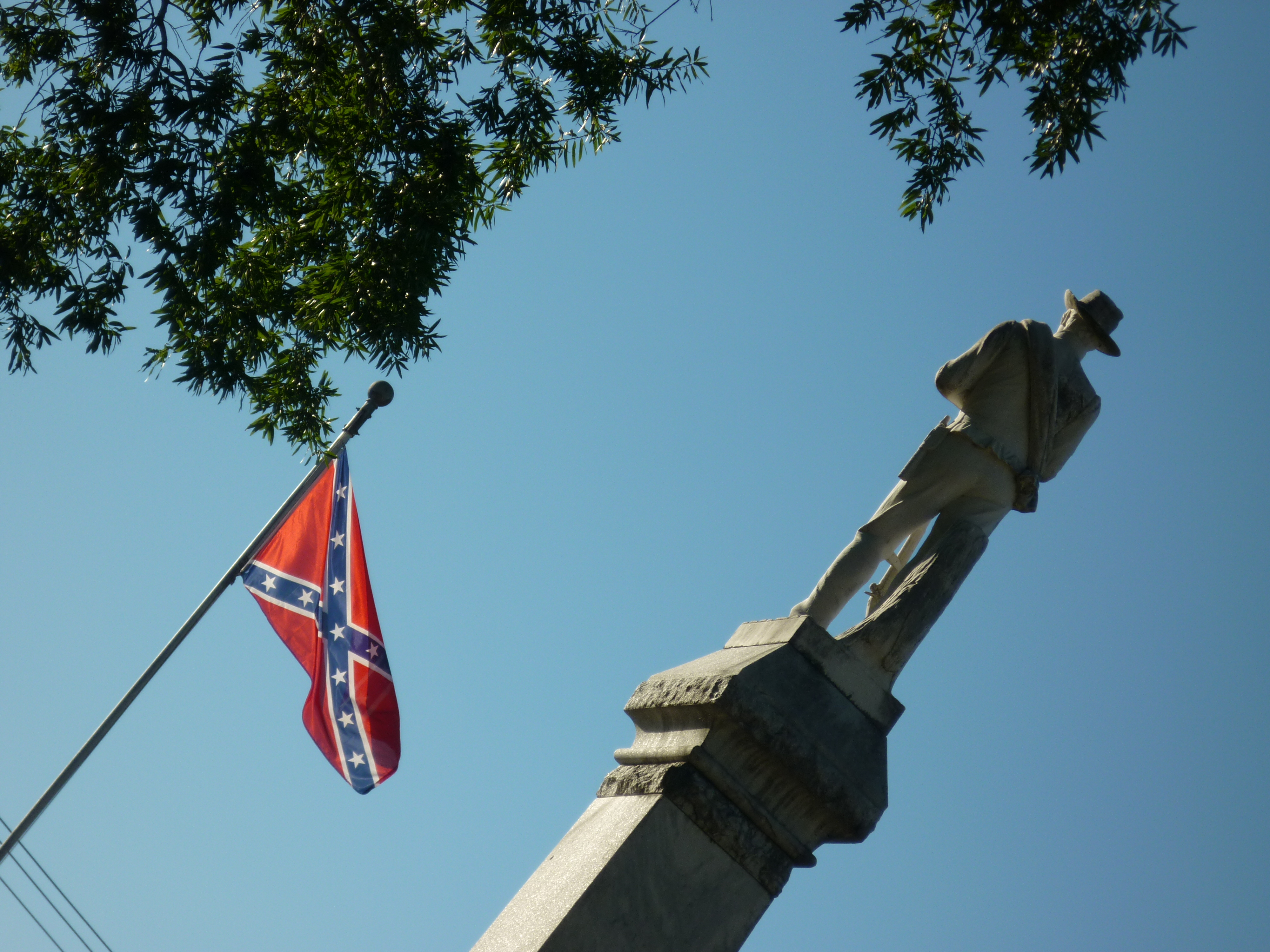
A monument to “The memory of Carroll’s Confederate Soldiers who fought in defense of our constitutional rights from Bethel to Appomattox” stands in front of the Carroll County courthouse in Carrollton Mississippi.  No surprise there; virtually every county courthouse in Mississippi constructed before 1920 sports a civil war memorial.  But few of these monuments are accompanied by the Confederate flag.  We’re not talking about the Mississippi state flag that incorporates the stars and bars–this is the genuine article. (more…)

A place like Mississippi

Magnolia blossom at the Leflore County Courthouse

By Alan Bean

Ever since Friends of Justice was asked to look into the case of Curtis Flowers, we have been intrigued with Mississippi.  The most intense confrontations between civil rights and states rights took place in the Magnolia state.  Most educated Americans are vaguely aware that hundreds of freedom riders were arrested in Jackson, Mississippi in 1961.  The Emmett Till story, for very good reason, has received a lot of attention. The Freedom Summer of 1964, culminating in the murder of James Chaney, Michael Schwerner and Andrew Goodman, has entered the American historical lexicon.

But so much has been forgotten.  Who today remembers the voter registration struggles in places like Greenwood, Cleveland and Grenada?  How many are aware of the intimate link between the Emmett Till case and the Montgomery bus boycott?  How many educated Americans are familiar with the heroic work of Sam Block, Diane Nash, Amzie Moore and Aaron Henry (to name just a few)?

Amazing stories have been forgotten because in Mississippi nobody won.  The civil rights people won a few battles, but the states rights people won the war.  Jim Crow may be dead, but civil rights backlash has controlled American politics for decades.

The Friends of Justice civil rights tour devoted nine intense days to these stories.  “To understand the world,” William Faulkner said, “you must first understand a place like Mississippi.”  Over the next few days I will be writing a series of posts dedicated to a parallel proposition: To understand America in 2011 you must first understand the Mississippi Delta in 1963.  Some of these stories will be familiar, some will not.  But this series of posts isn’t driven by an antquarian interest in days long past; in June of 2011, Friends of Justice went to Mississippi in search of America.

Awash in Mississippi history

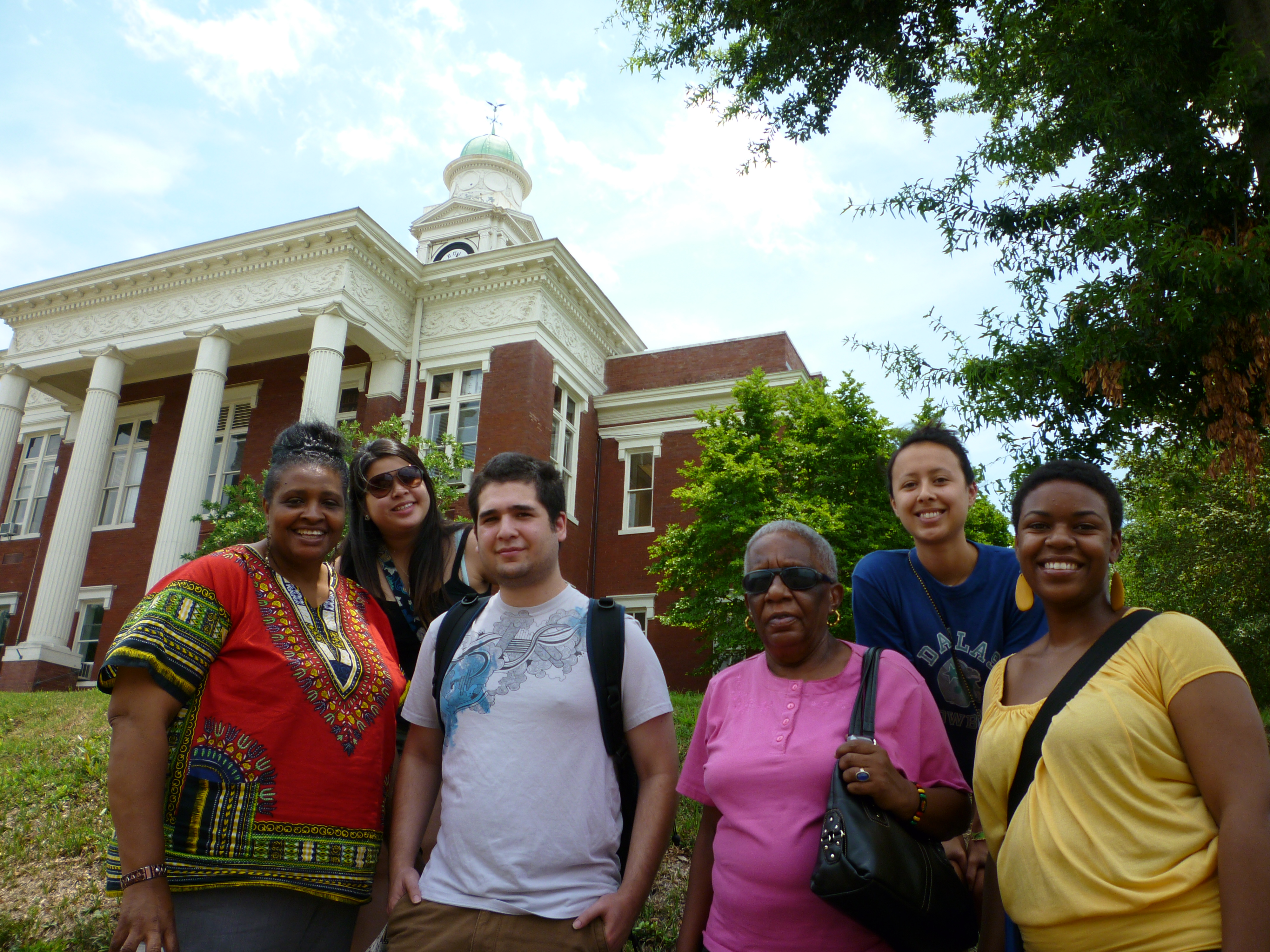
Linda White, Chelsea Zamora, Alec Goodwin, Margaret Block, Victoria Frayre and Chaka Holley

By Alan Bean

The Friends of Justice Mississippi civil rights tour is almost at an end.  We won’t have time for a full report until we are back in Texas, but I wanted to give you a quick highlight reel from the first day or two.

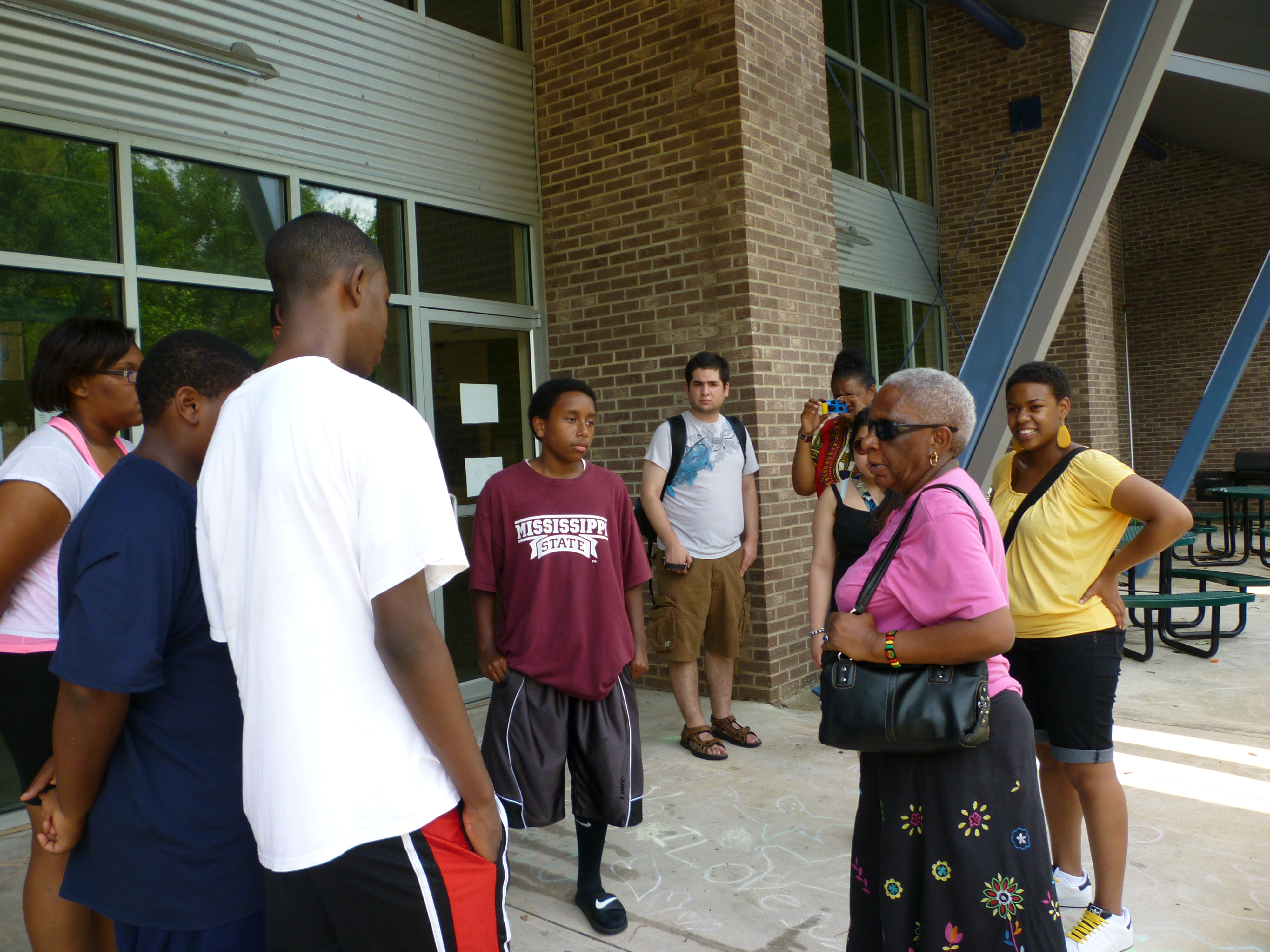
Margaret Block recites poem to young men

After driving from Arlington to Cleveland, MS, we picked up civil rights veteran Margaret Block and headed for the 47th Annual Mississippi Civil Rights Memorial in Meridian and Philadelphia.  On the way down we stopped at the Boys and Girls Club in Kosciusko.  Most Boys and Girls Clubs struggle with inadequate funding, but Oprah Winfrey has seen to it that the club in her home town is state of the art.  It makes a difference.

When we visited, 250 children were dancing, working on computers, dancing, playing ping pong and dancing.  Every activity seemed to involve intense physical activity and the children were loving it.  Several groups put on impromptu dance performances for our group.  Margaret Block responded in kind by reciting one of her trenchant poems to a group of teenage boys.

Little Mississippi towns like Kosciusko are changing, but at a glacial pace.  The community is 53% white, but all but two of the children at the town’s beautiful and fully equipped Boys and Girls Club were black.  “This is the kind of facility most little towns can only dream of,” Margaret Block explained, “but the white parents still won’t allow their kids to attend.”

I don’t have time to tell you about the tense exchange between civil rights activist Diane Nash and the mayor of Meridian, MS, our troubling encounter with white supremacy in Carrellton, MS, my heart warming (and rending) visit with Curtis Flowers in Parchman, MS or the amazing woman we met in Doddsville, MS.  I’ll tell these stories (and many others) when we are safely back in Texas and I have a little time on my hands.  Today we’re visiting the all black town of Mound Bayou, Aaron Henry’s drug store in Clarksdale, the site where Emmett Till’s murderers were acquitted in Sumner, and Parchman prison where hundreds of freedom riders were incarcerated in 1961.

Jimmy Carter: Call Off the Global Drug War

This op-ed in the NY Times from President Jimmy Carter speaks for itself.  Now, if we can just get Bill Clinton to admit that he extended Ronald
Reagan’s militaristic solution to the drug probelm, we might be getting somewhere.  AGB

Call Off the Global Drug War

By JIMMY CARTER
Published: June 16, 2011

//

Atlanta

IN an extraordinary new initiative announced earlier this month, the Global Commission on Drug Policy has made some courageous and profoundly important recommendations in a report on how to bring more effective control over the illicit drug trade. The commission includes the former presidents or prime ministers of five countries, a former secretary general of the United Nations, human rights leaders, and business and government leaders, including Richard Branson, George P. Shultz and Paul A. Volcker.

The report describes the total failure of the present global antidrug effort, and in particular America’s “war on drugs,” which was declared 40 years ago today. It notes that the global consumption of opiates has increased 34.5 percent, cocaine 27 percent and cannabis 8.5 percent from 1998 to 2008. Its primary recommendations are to substitute treatment for imprisonment for people who use drugs but do no harm to others, and to concentrate more coordinated international effort on combating violent criminal organizations rather than nonviolent, low-level offenders.

These recommendations are compatible with United States drug policy from three decades ago. In a message to Congress in 1977, I said the country should decriminalize the possession of less than an ounce of marijuana, with a full program of treatment for addicts. I also cautioned against filling our prisons with young people who were no threat to society, and summarized by saying: “Penalties against possession of a drug should not be more damaging to an individual than the use of the drug itself.”

These ideas were widely accepted at the time. But in the 1980s President Ronald Reagan and Congress began to shift from balanced drug policies, including the treatment and rehabilitation of addicts, toward futile efforts to control drug imports from foreign countries.

This approach entailed an enormous expenditure of resources and the dependence on police and military forces to reduce the foreign cultivation of marijuana, coca and opium poppy and the production of cocaine and heroin. One result has been a terrible escalation in drug-related violence, corruption and gross violations of human rights in a growing number of Latin American countries.

The commission’s facts and arguments are persuasive. It recommends that governments be encouraged to experiment “with models of legal regulation of drugs … that are designed to undermine the power of organized crime and safeguard the health and security of their citizens.” For effective examples, they can look to policies that have shown promising results in Europe, Australia and other places.

But they probably won’t turn to the United States for advice. Drug policies here are more punitive and counterproductive than in other democracies, and have brought about an explosion in prison populations. At the end of 1980, just before I left office, 500,000 people were incarcerated in America; at the end of 2009 the number was nearly 2.3 million. There are 743 people in prison for every 100,000 Americans, a higher portion than in any other country and seven times as great as in Europe. Some 7.2 million people are either in prison or on probation or parole — more than 3 percent of all American adults!

Some of this increase has been caused by mandatory minimum sentencing and “three strikes you’re out” laws. But about three-quarters of new admissions to state prisons are for nonviolent crimes. And the single greatest cause of prison population growth has been the war on drugs, with the number of people incarcerated for nonviolent drug offenses increasing more than twelvefold since 1980.

Not only has this excessive punishment destroyed the lives of millions of young people and their families (disproportionately minorities), but it is wreaking havoc on state and local budgets. Former California Gov. Arnold Schwarzenegger pointed out that, in 1980, 10 percent of his state’s budget went to higher education and 3 percent to prisons; in 2010, almost 11 percent went to prisons and only 7.5 percent to higher education.

Maybe the increased tax burden on wealthy citizens necessary to pay for the war on drugs will help to bring about a reform of America’s drug policies. At least the recommendations of the Global Commission will give some cover to political leaders who wish to do what is right.

A few years ago I worked side by side for four months with a group of prison inmates, who were learning the building trade, to renovate some public buildings in my hometown of Plains, Ga. They were intelligent and dedicated young men, each preparing for a productive life after the completion of his sentence. More than half of them were in prison for drug-related crimes, and would have been better off in college or trade school.

To help such men remain valuable members of society, and to make drug policies more humane and more effective, the American government should support and enact the reforms laid out by the Global Commission on Drug Policy.

Jimmy Carter, the 39th president, is the founder of the Carter Center and the winner of the 2002 Nobel Peace Prize.
Tina Dupuy: We Get the Media we Want

Tina Dupuy

By Alan Bean

Tina Dupuy is a Los Angeles-based comedian and freelance writer.  She thinks we get the kind of media we want.

“If we wanted a somber and serious Edward R. Murrow to deliver the important news of the day – we’d all tune in and the ratings would be gangbusters. But we don’t. Most media criticism comes from the assumption that we want Murrow but we get TMZ – instead of the empirical (and slightly embarrassing) fact: We want TMZ.”

The rest of her column is pasted below. (more…)

When Will the U.S. Stop Taking the Easy Route on Immigration?

By Victoria Frayre*

Newly released statistics by the U.S. Sentencing Commission reveal that almost half of all people sentenced for federal felony crimes are Latino. Why is this so? Although most Latino federal offenders are being imprisoned for immigration offenses (about 48% in 2007) does it really make sense to throw illegal immigrants in prison? With prisons already busting at the seams it is absolutely mind-boggling to me why anyone would think that adding to the overwhelming prison population is a good idea. Ironically, this is exactly what is happening. (more…)

David Simon offers to make a new season of ‘The Wire’ if the feds end their drug war

Eric Holder and stars of 'The Wire' discuss endangered children.Attorney General Eric Holder recently appeared with several actors from the HBO series ‘The Wire’ to discuss the plight of children exposed to the drug culture.  It seems the program, co-produced by David Simon and Ed Burns, is a real hit at the Justice Department.  President Obama is also a big fan.  In fact, AG Holder is so impressed with The Wire he ordered Simon and Burns to produce at least one additional season.

“I want to speak directly to Mr. Burns and Mr. Simon. Do another season of ‘The Wire.’ That’s actually at a minimum….if you don’t do a season, do a movie. We’ve done HBO movies; this is a series that deserves a movie. I want another season or I want a movie. I have a lot of power Mr. Burns and Mr. Simon.” (more…)

Rick Perry’s Jesus politics

By Alan Bean

A couple of years ago, Rick Perry made headlines by hinting that, if the Obama administration didn’t change its low-down ways, Texans might start thinking about secession.  Now the Texas governor is raising eyebrows nationwide by calling America to a day of prayer and fasting he calls “The Response”.

According to the event’s promotional video, a plethora of plagues has driven the nation to its knees: economic collapse, violence, perversion, division, abuse, natural disaster, terrorism, depression, addiction and fear. (more…)

Spotlight on Medgar Evers

By Chelsea Zamora

As Friends of Justice prepares for our Civil Rights Tour in the Mississippi Delta, we are spotlighting some of the civil rights activists that have helped change the future for African Americans and minorities across the United States. Medgar Evers, Mississippi NAACP field secretary and civil rights martyr, heads the list.

Medgar Evers was born on July 2, 1925 in Decatur Mississippi. He grew up on a small farm with his parents and five siblings. While Evers was still young, several of his close friends were lynched, a devastating experience for the local black community. Yet this tragedy made Evers even more determined to finish school, a rare achievement for African Americans in Mississippi. (more…)

Tough on crime; tougher on education

By Chelsea Zamora

High school graduates have recently been walking across the stage, receiving their diplomas, and preparing to leave home for the first time. While this is true for some, a good number of students are staying at home and receiving their education from local community colleges.

While many factors play into why one chooses community college, cost plays a major role, especially in low income families. According to the Texas Higher Education Coordinating Board, community college is less than half the cost of attending a regular university, with students saving money on things like tuition and housing expenses. Between the years 2000-2007, there was a 31% increase in students attending a two year college, compared to a 19.9% increase in students attending public universities in Texas. This shows how rapidly the community college system has been expanding. (more…)