
Google “all white jury” and Mychal Bell of the Jena 6 will be at the top of the list. According to Jena 6 attorney David Utter, not a single African American has been seated in the Jena courtroom since 1994 (that’s not a typo).
I didn’t say much about the racial composition of Alvin Clay’s jury during the trial; they deserved a chance to show their shine. If any of the jurors in Clay’s case wish to respond to my harsh assessment I will be happy to discuss the issues in private, or to publish your views without comment.
Alvin Clay’s jury filed out of the court room at the lunch hour. The first order of business had to be polishing off the boxed lunches provided by the court. Then they had to pick a foreman. To get a verdict decided in an hour, the foreman only had time to take an initial poll of the jury. There couldn’t have been the slightest hint of disagreement.
In short, a one-hour verdict is really a ten-minute verdict.
This case boiled down to a swearing match between Alvin Clay and Donny McCuien. Judge Leon Holmes admitted as much when he denied a defense motion for acquittal. Only one witness suggested that Alvin Clay was in on the conspiracy: Donny McCuien. To convict Clay on all counts, you had to believe McCuien.
Judge Holmes ruled (correctly) that he was not allowed to assess the credibility of witnesses; that was a job for the jury.
McCuien testified in exchange for lenient treatment. He quickly learned that the federal government had no interest in Donny and Ray; they wanted Alvin.
Donny and Ray would have pulled off their scheme without detection if the government hadn’t been trying to nail a black Little Rock attorney who had embarrassed them once too often. Even if the feds had stumbled upon their real estate scam, they would have tossed it to state officials. It’s a simple slam dunk document case that would never have gone to trial.
McCuien originally told the government he had no association with the Nealy scam until late in the game. In reality, McCuien was instrumental in linking both buyers and sellers with Nealy. The buyers were contacted at Burger King and most of the sellers lived in McCuien’s neighborhood.
When FBI agent Rodney Hays learned he had been scammed by McCuien he made no attempt to alert the grand jury to the fact that they had been scammed. Hays knew what the US attorney’s office was looking for and he gave it to them, even if he had to suborn perjury to do it. So long as Hays delivered the goods, all sins would be forgiven.
McCuien was all too cooperative. He told Hays that Nealy and Clay had cashed in big-time by selling a home to a woman named April Flowers. Unfortunatgely for McCuien, when the feds raided Nealy’s office they found no reference to the phantom transaction. You can’t work with a lending agency and a title company without creating a paper trail. Donny McCuien was scamming the federal government and they knew it.
So long as McCuien was feeding the feds what they wanted, they proved to be remarkably forgiving. He could lie to them as long as he was also willing to lie for them.
McCuien and Nealy assured Alvin Clay that rehab work was being completed and he believed them. This was also the testimony of the sellers, lenders and title agents involved in this case. Jurors were asked to evaluate the truthfulness of this testimony. If they believed Clay they had to acquit. If they thought he was lying, they had to convict.
Jurors were assured that, although Donny McCuien had a history of lying to the federal government, he was now telling the truth.
Steven Snyder made this assertion forcefully and earnestly. There wasn’t a shadow of equivocation in his voice or in his manner. He was a preacher on fire with the very truth of God.
In reality, Steven Snyder is just a guy who chose to believe a witness he knew was lying to him because that’s what it took to convict the defendant du jour. Unlike men like Bob Govar and George Vena, Steven Snyder didn’t have a personal dog in this fight. He couldn’t drop the charges against Clay without making his colleagues in the Eastern District look suspect, so he packaged a notorious liar as the voice of truth.
Snyder didn’t enjoy the task that had been dumped into his lap. Throughout the trial he looked like a man on the verge of a nervous collapse. But when he got in front of the jury he was a man on a mission. Everything was simple; the case was unassailable; Clay was guilty. Period!
That’s what prosecutors are paid to do. Defense attorneys are paid to do the reverse.
But how could the jury be so thoroughly convinced by Donny McCuien that they reached a verdict in less time than it took to bolt down a box lunch?
In theory, the government had to prove that Alvin Clay was guilty, and they had to prove it beyond a reasonable doubt. And they had to do all of that with nothing to work with but the word of a notorious liar who lied to the jury just as he had lied to buyers, sellers, Alvin Clay and the federal government. In theory, selling McCuien as a credible witness should have been a tall order, but it wasn’t.
I doubt jurors spent a lot of time assessing Donny McCuien’s credibility. McCuien was believed because he was singing in harmony with the Federal Bureau of Investigation and the US Attorney’s Office. A liar was believed because he was standing on the side of the Eagle.
The Alvin Clay trial was a marketing scam. Most middle class white jurors are like the guy who would rather push a Ford than buy a Chevy. They believed McCuien because he was sponsored by the Eagle. They pulled for the scruffy hustler in the ill-fitting suit for the same reason they will pull for TEAM USA at the Olympics. It’s their brand, their team, their product of choice.
They would have believed Alvin Clay if he was allied with the Eagle brand.
Black jurors, as a group, are a much harder sell than white jurors. Black Americans were only half as likely to back the invasion of Iraq. They wanted more assurance than the simple fact that the Eagle was in a warlike mood.
Black Americans are half as likely as their white counterparts to express confidence in the criminal justice system.
Jurors want to believe they have sacrificed two weeks of their lives to some noble purpose. Putting a bad guy behind bars makes them feel good. Acquitting a man who may or may not be guilty leaves them feeling uneasy and dissatisfied. Give them clear evidence of innocence and they will acquit; otherwise, they will convict. Every time.
Judge Holmes once said that pregnancies resulting from rape are as rare as snowflakes in Miami. So are acquittals in federal trials. (In fairness to Holmes, he has since admitted that the “snowflakes in Miami” remark was over-the-top and inaccurate).
A fascinating study conducted by Tufts Unversity shows that white jurors are far more willing to consider the racial dynamics of a trial, are more attentive to detail, and are more concerned with due process issues when they are working shoulder-to-shoulder with minority jurors. (More on this groundbreaking study can be found here.)
The Alvin Clay trial shows what happens when white jurors hold the fate of a black man in their hands. Few white jurors aren’t consciously aware of their own prejudices. But the Tufts study found that white jurors think and behave differently when they work with black jurors. The effect is so strong, in fact, that simply knowing they are going to be working in a diverse setting impacts the pre-deliberation attitudes of white jurors.
Black jurors would have asked why it had taken the federal government five years to bring this black attorney to trial, and why the feds were in bed with a proven liar.
White jurors easily convince themselves that a case has nothing to do with race, even if the judge, the prosecutors, the FBI agents, and all twelve jurors are white.
Black jurors would have written off Donny McCuien as just another Uncle Tom snitch selling his soul to the man.
That’s precisely who Donny McCuien is; that’s why he was weeping in the witness room.
Steven Snyder didn’t lose any sleep last night. He convinced himself that Alvin Clay was guilty long ago. With that issue settled, the federal functionary was willing to climb under the covers with McCuien.
But Steven Snyder doesn’t have a clue what transpired between Clay, Nealy and McCuien. Only two men who graced Leon Holmes’ courtroom know the truth–Alvin Clay and Donny McCuien. On the stand, Clay was respectful, calm, reasonable, and revealing. The government didn’t catch him in a single contradiction.
McCuien’s testimony was bizarre, desperate and demonstrably false. He had memorized a few catch lines, but was utterly flummoxed when defense questions wandered off the subjects on which he had been carefully prepped by the FBI. Every claim he made was impeached by credible witnesses.
For instance, McCuien claims that, following the FBI raid, Clay told him to lie to the authorities. Jeron Marshall was testifying for the government under full immunity, but she testified that McCuien told her that Clay told him to “tell the truth”.
A jury with three of more African Americans would never convict a man like Alvin Clay on the basis of such shoddy “evidence”. White jurors wouldn’t have done it either if anyone had been in the room to pose the hard questions.
I have been asked if it is possible to appeal a conviction on the basis of jury composition. Not unless it can be demonstrated that the selection process was flawed in some way. I will leave it up to the lawyers to address that issue.
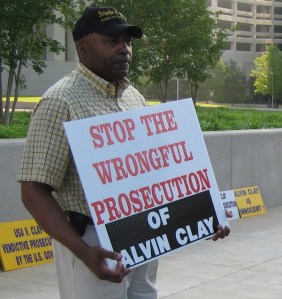
The deeper question is how seriously we take the right of every American citizen to be tried by a jury of peers? If Alvin Clay possessed that right, it would have taken his jury longer than ten minutes to send him down the river.





 Friends of Justice


