Alvin Clay Part 2: “Everybody’s Got Standards”

Part 1 of this series can be found here.

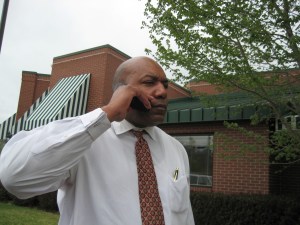
Roy Lee Russell in Dumas, Arkansas

By Alan Bean

Alvin Clay Part 2: “Everybody’s Got Standards”

Why did the federal government investigate Little Rock Attorney Alvin Clay when there was no evidence of wrongdoing? 

 Why has the FBI unleashed a campaign of dirty tricks against Clay? 

 Why is the Department of Justice trying to link the black attorney to illegal drugs? 

 Why have FBI agents and federal prosecutors repeatedly lied to magistrates, judges and grand juries in order to obtain search warrants and indictments?

Why did the government withhold evidence from Clay’s defense team?

Why have a federal prosecutor and an FBI agent committed perjury in this case; and why did a federal judge give them a pass?

 Why is Assistant US Attorney Bob Govar so desperate to distance himself from the Clay case?

 It all began with Operation Wholesale, a spectacularly corrupt undercover drug bust that should have become a national scandal, but didn’t.  I may appear off topic here, I admit.  But you can’t understand what’s happening to Alvin Clay in May of 2008 until you understand what happened to Roy Lee Russell in March of 1999.

Operation Wholesale got rolling when Russell, a black farm worker who had done time on drug charges, ran into a black Arkansas State Trooper named Lloyd Franklin at the Exxon station in Dumas, Arkansas.

 “Roy Lee, you remember how we kicked ass down in Pine Bluff?” Franklin asked.  “Well, we’re doing another undercover operation and we need a good informant.”  Franklin told Russell to drop by his office if he was interested.

 Russell was interested.  He had enjoyed the few months he had spent working under cover with Franklin ten years earlier.  “Lloyd Franklin is a straight up kind of guy that does everything by the book,” Russell told me when I spoke to him in Little Rock.  “He’d take forever writing out his police reports; he wanted to get every little detail right.” 

Franklin had been a stabilizing influence in Russell’s often chaotic life.  During the few months the men spent making cases together in Pine Bluff, Russell took pride in being part of a class act–something straight and good.

 Operation Wholesale didn’t work that way.  This time, Russell was paired with a black State Trooper named Clayton Richardson, Lloyd Franklin’s opposite number–a pathetic character driven by greed, fear and appetite.

 “After we made a few buys,” Russell told me, “the FBI come in and said they wanted to prosecute the cases.  The feds said they could get me $900 a month on top of the $250 per case the state was already paying me.”

 It is hardly surprising that the Arkansas State Police and the FBI used a black cop and a black confidential informant (CI) to run a drug sting–the operation was aimed at poor black males and nobody else.  Roy Lee Russell’s job was to introduce Clayton Richardson to the poor side of the hardscrabble Arkansas farming towns he knew so well.

 Operation Wholesale wasn’t racist in the overt sense.  Drug warriors, state and federal, are judged by the statistics they accumulate (and by little else).  You get one point for bringing down a major drug supplier.  You get one point for nailing a crack addict who sells for buy money.  Kingpins rarely touch the dope they sell, they are protected by a small army of underlings, and they can afford high dollar lawyers.  Crack addicts and mentally challenged street hustlers are easy to nail and even easier to prosecute.  As one narcotics agent put it to me, “It’s like shooting fish in a barrel.”

 Young black males are disproportionately impacted by the drug war because they are disproportionately targeted.  As the prisons fill up with black guys, the public is taught to associate drug dealing with black skin. 

But that’s just the beginning.  Precisely because the targets of the typical drug bust fit the dealer profile (young, poor and black) and can’t afford good lawyers, it doesn’t take real evidence to secure a conviction.  Defendants frequently go down on the uncorroborated word of an undercover police officer or confidential informant.

 Narcotics operations, no matter how shoddy or corrupt, pass unnoticed by the public unless somebody raises a fuss.  The system is adept at rewarding those who embrace the status quo and punishing those who ask too many questions. 

The three most corrupt narcotics operations on record all happened in Texas.  In Tulia, it was a white undercover cop making uncorroborated cases on poor blacks.  In Hearne, it was a black informant making uncorroborated cases on his friends.  In Dallas, it was a couple of Hispanic cops teaming up with Hispanic informants to make cases on Mexican nationals. 

The Tulia drug sting, though the least egregious case, garnered by far the most publicity.  It was widely assumed that Tom Coleman, the white cop, faked cases on black defendants because he was a racist.  The Coleman operation came to grief because Tom Coleman was given the motive and the opportunity to line his own pockets by defrauding the government.

The Tulia sting unraveled because Friends of Justice stood up and said no.  The Hearne case fell apart because local residents, inspired by the stand we were making in Tulia, stood up to a corrupt prosecutor.  The Dallas scam was exposed because the Texas Legislature passed a Tulia-Hearne bill granting defense attorneys the right to ask for corroboration in drug cases made by confidential informants.

Operation Wholesale combined the worst elements of Tulia, Hearne, and Dallas.  A rookie cop with no experience in narcotics work was placed on the street with a convicted felon.   Had an advocacy group like Friends of Justice been paying attention, Operation Wholesale would have become another Tulia. 

When you give money to unsupervised individuals and ask for no corroboration you are courting disaster.    

Although Clayton Richardson was unfamiliar with narcotics work, he quickly learned that the more drugs you buy, the lower the price.  By breaking a large drug buy (purchased at wholesale prices) into several smaller units you could make a healthy profit every time you drove to Little Rock to turn in “evidence”.

“You could pay $450 for the drugs and tell the feds you paid $600 or even $650 and nobody asked any questions,” Russell told me.  “That’s $150 or $200 straight profit every time you make a case.”

As we drove through rural Arkansas, Roy Lee Russell pointed to a mileage sign.  “Things really started to come apart when we made a buy in McGehee,” he said.  “Some of my old friends figured Clayton for a cop and told me I shouldn’t be hanging with him.  When I told that to Richardson he completely freaked out, like somebody was gonna kill him or something.  From that day on, he wouldn’t stay at the apartment the state police rented for us in Monticello.  And he wouldn’t go out on the streets with me to make buys.”

 Instead, Russell claims, Trooper Richardson shacked up with a woman he met at Wal Mart and spent most of his weekends gambling in Greenville, Mississippi.  “Clayton was playing the slot machines and drinking, and he’d be giving the women a little money to gamble with.  He was married at the time-had a wife and kids back in Camden.”

 “When it came time to prosecute these cases Donnie Robinson and Stephen Pinkstone of the FBI started showing me pictures,” Roy Lee remembers.  “They’d be asking, ‘Who is this?’ and ‘Who is that?’  They never asked me specifically if me and Clayton Richardson made a buy from these people.  You see, I never looked at Clayton’s reports so I had no idea who he was making cases on.”

The first defendant, Steve Block, went to trial in January.  “They put me in a room with Clayton Richardson,” Russell says.  “Now, I been knowin’ Steve Block since I was a kid, so I told Clayton Richardson, ‘We didn’t make no case on Steve Block'”.

According to Russell, Richardson asked him why he was ****ing up the operation.  Unsure what to do, Russell perjured himself by claiming that Mr. Block sold them drugs.  When the case ended in a mistrial, Russell knew he couldn’t provide the government with a repeat performance. 

“I didn’t have no trouble putting dope dealers away,” Russell told me.  “We did that ten years earlier with Lloyd Franklin and I never lost a minute’s sleep over it.  And even in this deal here, we made some good cases now and then and, if a deal really happened, I had no problem getting up on that stand and telling the truth.  But to go along with Clayton Richardson’s lies was too much.  I couldn’t do it.  I ain’t no angel, but everybody’s got standards.”

Roy Lee Russell figured the feds would be relieved to learn that they were in the process of sending innocent people to prison.  Not so!

“Some of these cases they just wouldn’t drop,” Russell told me.  “Pinkstone kept coming to my house asking me to testify.  But I said, ‘I ain’t goin’ down there [to the federal courthouse in Little Rock].’  Pinkstone told me, ‘We can lock you up and hold you for contempt if we want to.’ And I told him, “You just do what you gotta do!”

In the end, Steven Block was convicted on the uncorroborated testimony of Clayton Richardson.  Cases dependent on Russell’s testimony were dropped, but if the field report had Richardson on the scene, the federal government, under the direction of Assistant US Attorney Bob Govar, continued to prosecute.

In March of 1999, a defendant named Johnny Patrick proved that he was locked up in the state prison in Dermott, Arkansas when Clayton Richardson said Patrick was selling drugs in the parking lot of Church’s Chicken in Eudora.

“Maybe if he were at a church meeting and had 50 nuns to verify his story it might be a better alibi,” Patrick’s lawyer told the Arkansas Democrat Gazette.  “But this is about as good as it gets.”

Defendants unable to prove innocence beyond a reasonable doubt weren’t so lucky.

Michael James Evans was convicted even though Roy Lee Russell signed an affidavit stating that the narcotics transaction described in Clayton Richardson’s police report was pure fantasy.  In addition, Richardson’s report had the deal going down in front of a house trailer.  Sales receipts proved that the trailer wasn’t moved to that site until long after the alleged crime.  (In the photograph at the top of this post, Roy Lee Russell is standing in front of the trailer.)

Trooper Richardson’s uncorroborated testimony was enough to rob an innocent man of seven years of freedom.  When the trial was over, a confused juror asked the presiding judge to change her verdict to ‘not guilty’.  She had voted to convict, she said, because Evans didn’t have an airtight alibi and his attorney never produced any character witnesses. 

This is typical juror reasoning.  In narcotics cases the presumption of innocence is replaced by a presumption of guilt.  If the defendant fits the dealer profile (young, poor and black) innocence must be demonstrated beyond a reasonable doubt.  Johnny Patrick could meet the standard; Michael Evans could not.

The US Eighth Circuit Court of Appeals upheld the verdict, reasoning that Richardson might have witnessed the buy in front of another house trailer.  The jurors’ recantation, the court ruled, came too late.

Roy Lee Russell was arrested in March of 1999 and charged with perjury and obstruction of justice.  By that time he had signed affidavits for a long list of defendants claiming that neither he nor Richardson had purchased drugs from them.  “I never said none of these cases didn’t happen-just that most of them didn’t,” Roy says.

Assistant US Attorney, Bob Govar, cooked up a bizarre explanation for Russell’s recantation.  The confidential informant, he said, was angered when his monthly stipend dropped from $900 to $700 a month.  According to Govar’s curious theory, Russell decided to supplement his flagging salary by writing affidavits in exchange for cash. 

The media gobbled up this story without asking a single defense attorney if it was true.  If they had asked the question, they would have learned that Russell wrote his affidavits without discussing remuneration with a single attorney. 

Not only did Roy Lee Russell have nothing to gain by testifying that Operation Wholesale was a fraud against the government, he had everything to lose.  From the moment he refused to sign off on Clayton Richardson’s narrative, Russell was threatened with prison time.   Instead of forfeiting $200 a month in salary, Russell surrendered every nickel of the $700 monthly stipend the feds were paying him to provide testimony in Little Rock.  The only upside for Mr. Russell was a clean conscience.

Clayton Richardson was rewarded handsomely for defrauding the American tax payer. 

The media swallowed the government’s suggestion that the State Trooper’s field reports were the gospel truth.  Bob Govar, the federal prosecutor, was a trusted source; Roy Lee Russell, the convicted felon, was not.  In the media, Russell was derided as a “turncoat”.

Government officials like Bob Govar and Steve Pinkstone lied to themselves, then they lied to one another, and finally they lied to the press.  How do we account for such unconscionable behavior? 

Once you understand the Alice in Wonderland world men like Govar and Pinkstone inhabit, their strange reasoning begins to make a weird sort of sense.  The government knew that Russell was telling the truth-it was as elementary and obvious as 1+1=2.  Unfortunately, if you couldn’t trust Operation Wholesale, you couldn’t trust any narcotics operation based on uncorroborated testimony.  Ergo, the public had to trust Operation Wholesale.

Roy Lee Russell was Toto pulling back the curtain on the Wizard of Oz.  He was the little boy declaiming that the Emperor has no clothes.

The best analogy I have come up with is from “The Third Man,” a 1948 movie based on a Graham Greene story.  The hero, a bumbling investigator named Holly Martins, learns that the villainous Harry Lime has stolen a vast supply of penicillin, drastically diluted it, then sold it back to medical practitioners.  As a result, dozens of innocent people have died.

In the climactic scene, Martins and Lime are at the apex of a giant Farris Wheel, looking down on the Vienna fairground below.  From that great height, people are reduced to the size of tiny ants.

“Have you ever seen any of your victims?” Martins asked.

“You know, I never feel comfortable on these sort of things,” Lime answered with a sardonic shrug.  “Victims?  Don’t be melodramatic.  Look down there.  Tell me.  Would you really feel any pity if one of those dots stopped moving forever?  If I offered you twenty thousand pounds for every dot that stopped, would you really, old man, tell me to keep my money, or would you calculate how many dots you could afford to spare?”

Holly Martins confronts Harry Lime

That’s the way men like Bob Govar and Steven Pinkstone have been forced to think.  From the lofty perch of a federal prosecutor or an FBI enclave, men like Steve Block, Michael Evans and Roy Lee Russell look more like tiny dots than real, flesh and blood people.  The only question is how many of these guys must be sacrificed to preserve the illusion.

The Third Man analogy isn’t a perfect fit, of course.  Maybe the testimony Bob Govar gets from narcotics cops and confidential informants is legitimate — there are officers out there like Lloyd Franklin, after all.  True, these guys have a motive and an opportunity to lie to the government, but that doesn’t mean they all take advantage.  And if some of them lie, a few dots like Michael Evans stop moving. 

But it’s not forever.  It’s only seven years, or perhaps twenty-five or thirty years, tops.  

Besides, most of them are guilty, right?  If they didn’t do this one, they probably did something just as bad, or worse.

So the rationalizing goes.

Into this sordid world stepped a young black attorney with shoulders so broad he couldn’t buy his suits off the rack.  His name was Alvin Clay and he had been tapped to defend Roy Lee Russell.  It was Clay’s first federal case.


Alvin Clay Part 1: Guilt by Association

The Alvin Clay case is eye-opening and jaw dropping, but it sure ain’t simple.  Friends of Justice begins each new intervention with a narrative.  In this case, the story will unfold in a series of posts designed to place a deeply flawed prosecution in its full and natural context.  This is the first installment.

On May 27th, Alvin Clay goes to trial at the federal courthouse in Little Rock, Arkansas, a small city made famous by two incidents: the turbulent integration of Central High School in the fall of 1957, and the tumultuous events surrounding the presidency of Bill Clinton, in particular the Whitewater Scandal.


Both Central High School and the Rose Law Firm lie just over a mile from the federal courthouse where Alvin Clay will be tried on mortgage fraud charges.  The Clinton Presidential Library is within quick walking distance of the Rose Law Firm. These intimate geographical relationships are fitting; the Alvin Clay story has much in common with the two staggering events that made Little Rock famous.


In September of 2007, just a day or two after the historic march on Jena, Louisiana, I was on a Canadian radio program  with Billie Jean Brown Trickey, a member of the Little Rock Nine.  We were discussing the changing face of the civil rights movement.  In 1957, if you were looking for the cutting edge of the civil rights movement, you wanted to be at Central High School.  In the wake of Brown vs. Board of Education, the integration of public education was the hot button issue.

But fifty years after Billie Jean Brown and her black classmates completed their first year at Central High School, the primary locus of the civil rights movement has shifted from the schoolroom to the courtroom.  If you are trying to find the pulse of the civil rights movement today, you need to be at the Federal Courthouse in Little Rock at the end of May.

Alvin Clay stands accused of real estate fraud-charges strikingly similar to the allegations dogging Bill and Hillary Clinton for over two decades.  No one could make a direct connection between the Clintons and a specific criminal act.  But with all that smoke, there had to be some fire.  Or did there?

 There was certainly plenty of smoke.  Before the Whitewater saga ground to its exhausted conclusion, fourteen former associates of the Clintons (most of them high-ranking officials) had been convicted of a laundry list of crimes ranging from embezzlement to mortgage fraud. 

Whitewater was a case of guilt by association.  Republican partisans said the Clintons were getting away with murder.  Democratic partisans dismissed the entire affair as a baseless witch hunt.  The vast majority of Americans listened to Whitewater commentary on the evening news and said, “Huh?”   The mortgage deals at issue were so tangled and murky that normal people had no idea what it was all about.

The government is hoping the Alvin Clay case has that effect on you. The Devil hides in the details knowing that few have the patience for the kind of mind-numbing minutiae a mortgage fraud case entails. As a result, injustice flows like the waters and nobody knows.

We like simple pictures: nooses swinging from trees, grim-faced black students walking through the doors of a schoolhouse with their clothes drenched in spit, or a determined Rosa Parks refusing to give up her seat on the bus.  But the contemporary civil rights movement, if there is one, must learn to deal with Alvin Clay complexity. 

The federal government accuses Clay of sending fraudulent mortgage applications to lending companies.  That’s the primary contention.  He also stands accused of having accepted money for rehab work that was never performed. 

The government hasn’t got a single witness able to connect Mr. Clay with the mortgage fraud.  Moreover, Clay argues that he subbed out the rehab to a second party and was repeatedly assured that the work was being completed.  In other words we’ve got an old fashioned, he-said-she-said standoff.  My money’s with Alvin Clay.  To learn why, just keep reading.

What Alvin Clay knew and didn’t know is impossible to prove beyond a reasonable doubt.  But the record clearly shows that the federal government, represented by federal prosecutors and FBI agents, repeatedly and knowingly lied to grand jurors in order to secure an indictment. 

It got so bad, in fact, that assistant US attorneys with the Eastern Division of Arkansas recused themselves rather than face questioning from defense counsel. 

Evidence abounds that government officials have been engaged in a dirty-tricks harassment campaign against Alvin Clay and several of his close friends and business associates (more on that later).  In fact, realizing that their guilt-by-association case may not impress a jury, federal officials have been pressuring every drug client Mr. Clay ever represented in a desperate search for a cheap and easy path to conviction. 

 Thus far, no one has responded to the government’s crude attempts to suborn perjury; but it is just a matter of time before some pathetic soul gives federal agents what they are looking for.

 This tawdry quest for a narcotics case, though morally indefensible, is strangely appropriate.  As unlikely as it may appear at first glance, the government’s prosecution of Mr. Clay is a product of our nation’s counterproductive war on drugs.

For three decades, Alvin Clay was a poster child for the success of the civil rights movement.  Growing up in Blytheville, a predominantly African American community of 18,000 in northeastern Arkansas, Clay led a charmed life.  His mother was a schoolteacher and his father was a high school vice principal.  Alvin was always big, athletic, friendly, academically gifted and popular. 

“Everybody always loved Derrel (Alvin’s family name),” his father told me on the ride from the airport.  “He kind of grew up with the idea that you could trust people; that folks would look out for him.  I guess that’s why he bought himself so much trouble.”

An outstanding student, Clay was student body president in his Senior year.  No one was surprised when he won a football scholarship to Austin Peay University in Clarkesville, Tennessee.  Alvin weighed 245 pounds and could bench press almost twice his weight when he graduated in 1990.  He had also been a member of the university debating team, earned an advanced commission with ROTC and lettered in football four years running.  After giving brief consideration to an NFL career, Clay opted for law school, enrolling in the University of Arkansas in 1991.

“Football is a rough game, and an injury can end everything in a heartbeat,” Alvin told me when I sat down with him over a beer in Little Rock last month.  “My parents had always wanted me to be a doctor or a lawyer-something like that.  Academics came natural to me, so I decided I’d be an attorney.”

Clay passed the Arkansas bar in 1995 and was licensed a year later.  “But I never wanted to limit myself,” he says.  “I got a real estate license while I was still in law school, then I became a broker.  Finally, just to keep all my options open, I picked up a contractor’s license in 2000.” 

The government can make one valid claim,” Clay admits.  “To get a contractor’s license you needed to pass a test (which I passed easily), but you also needed to document some experience.  If you were new to the business, the experience of people in your company could be imputed to you.  But I wasn’t working for a company.  I was told that the experience of people I intended to employ could be credited to me, as well, and I used that as a way to get around the requirement.”

“At the time, I was serious about starting a construction company,” Clay explains.  “I used the experience of a gentleman that agreed to assist me with construction projects.  We had talked to several individuals about building homes.  And I used the experience of a gentleman that I intended to hire once I actually had work for him to do.  But at the time I filled out the application I didn’t have anyone working for Clay Construction.  The application was completed a year and a half before I met Nealy and over two years before the first real estate transaction.  So the government can’t link that application to the furtherance of a conspiracy.”

“If I had just stuck to my law practice I’d be a millionaire by now, for sure,” Clay says.  “But I wouldn’t settle for base hits; I was always going for the grand slam.  High reward come with high risk; I understand that now.”

In 2001, Clay promoted a fight featuring a promising Arkansas middle weight, Jermain “Bad Intentions” Taylor  at the Alltel Arena in Little Rock.  “It was supposed to bring me a big payday, but it ended up destroying me financially,” Clay says.  “For a while there I let my law practice go-all my energy went into the fight.”

That’s when Clay met the man who would change his life dramatically.  “Kevin Howard, one of my real estate agents, introduced me to Ray Nealy because we needed an investor for the fight,” Clay recalls.  “HBO required us to have a $150,000 escrow account that would only be used if debts weren’t covered.  At the conclusion of the fight we were short $9,000 and Nealy had to cover that because it was his escrow account.”

In the late 1990s, Ray Nealy made good money riding the bench as a little-utilized running back with the Miami Dolphins.  When an injury ended his football career, Nealy launched a more promising career as a show-me-the-money entrepreneur. 

“Ray didn’t come up like I did, with all the advantages,” Alvin remembers.  “He was street smart and kind of rough around the edges, but he was full of business ideas and he helped me out a lot, giving me the money for the fight.  From the outside, the Jermain Taylor fight was a big success.  It played on HBO and everybody got paid.  But, financially, it set off a downward spiral that cost me my home and both my cars.  I was using public transportation and living with friends-it was a hard time.”

Clay was eager to revive his law practice and his real estate business.  He had six realtors working under him when Ray Nealy asked him if he’d like to put his contractor’s license to work.  As Nealy explained it, little real work would be required.  He had a few houses that needed some rehab work.  Clay would be the official contractor, but the actual labor would be subbed out to a former Burger King Manager named Donny McCuien.

Between August 2nd of 2002 and February of 2003, Alvin Clay received five separate checks from title companies.  “Ray and I worked it so that I got most of my portion of the money on the first deal and small amounts after that.  Ray wanted to put some money in my pocket so I could pay him back. After I got that first check I cut a business check to Donny McQuien, I cut a check to Clay Construction, I bought a car, and I repaid the money I owed Ray.”

Alvin was a little surprised when he was asked to make the checks payable to Nealy’s mother, but he figured his friend knew what he was doing.  “It was a debt I owed,” Alvin explains.  “If he had asked for the money in nickels, I would have paid it in nickels.  It was his call.”

By this time, Clay’s law practice was picking back up and he was having a hard time keeping up with six real estate agents.  “I delegate too much,” he admits.  “I’m a big picture guy who leaves the details to other people.  No one had ever violated my trust before and that made me naïve.  Ray would stick his head in the door and say, ‘another house closed.’  I’d say, ‘great,’ and that was that.”

Clay was careful to have his accountant file a 1099 with the IRS after each transaction.  “I’m a working attorney and I know that what you put on paper is forever.  There is no way I would knowingly stipulate to something that wasn’t true.  It’s not just wrong, it’s stupid.  I thought I would be covered with the government if I made a full disclosure of every transaction.”

Ray Nealy had no such scruples.  He was working in the midst of a sub-prime bubble and lax oversight was the order of the day.  Lending institutions were accepting applications from sketchy applicants, then bundling several mortgages together and selling them to the highest bidder.   The buyer bought the risk along with the mortgage.  The system encouraged fraud and Ray Nealy, like thousands of other real estate hustlers across the nation, couldn’t resist cashing in.

Nealy worked the lowest rungs of the real estate ladder, hooking up buyers with bad credit and sellers with homes that only people with bad credit would want to buy.  Buyers knew how much they wanted to pay and sellers knew how much cash they wanted out of the deal–apart from that, neither party had much interest in the details. 

This scheme, though unscrupulous, was legal as far as it went.  Buyers, sellers and lenders all signed off on the particulars.  Apart from allowing Nealy and McCuien to use his contractors license, Clay had no involvement in the real estate deals.  He had no time for anything beyond law and his own real estate enterprise.  

“I honestly believed that the work was being done,” Clay insists.  “I had a guy coming into my office with his overalls covered with paint and grass stains assuring me that everything was fine.  Ray Nealy and Donny McCuien both told me everything was above board.”

From a strictly legal perspective, it didn’t matter.  The loans were all made on an as-is basis–the lending institutions never heard about Clay Construction.  Nealy was working with sellers eager to sell; buyers eager to buy and lenders eager to lend-nobody was asking questions.

Unbeknown to Alvin Clay, none of the loan applicants came close to qualifying for a mortgage. Nealy was doing whatever it took to overcome the buyers’ deficiencies: placing money in applicant bank accounts and withdrawing it the same day, inflating incomes, entering fake Social Security numbers and, on at least one occasion, forging signatures. 

“You accuse me of being a bad businessman, I’ll have to plead guilty,” Clay says.  “I have been very naïve in my dealings with other people.  I have made very bad decisions in business and in my personal relationships, and I have lived to regret my mistakes.  But the government’s charges against me simply aren’t true; I didn’t break any laws, and that’s a fact.”

Like Bill and Hillary Clinton, Alvin Clay finds himself in the crosshairs of a guilt-by-association inquisition.  How likely is it, the government will ask at trial, that Alvin Clay didn’t know what Ray Nealy and Donny McCuien were up to?  After all, prosecutors will point out, Nealy and Clay worked on the same floor of the same office building.

Bill and Hillary Clinton were never indicted by the federal government.  It takes real, hard evidence to convict a former governor or a sitting president.  Smoke alone doesn’t cut it; you need real fire.

But Alvin Clay isn’t Hillary Clinton.  He has no friends in high places.  If he did, the government’s illegal actions against him would be the stuff of raw scandal. 

It is difficult to know if the Department of Justice asked the FBI to investigate Clay, or whether it worked the other way around.  But one thing is certain: the investigation was launched without any evidence that the Little Rock attorney had broken the law. 

The case against Alvin Clay began as a fishing expedition.

Why was the United States Government so desperate to dig up dirt on a relatively obscure defense attorney?

 When you learn the answer you will understand why I want a standing-room-only crowd in the federal courtroom in Little Rock for Alvin Clay’s trial, and why I am calling for a solemn march from Central High School to the federal court house on morning of May 27th.

Go to Alvin Clay, Part 2: “Everybody’s Got Standards”


In Memoriam

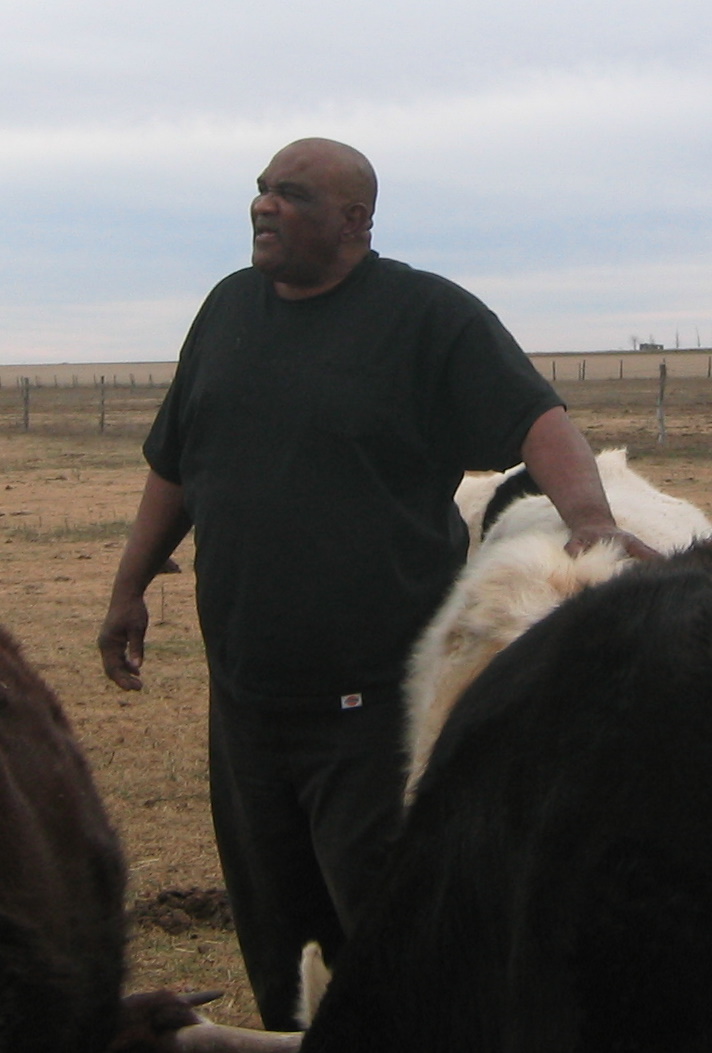
Joe Moore on the farm

 Joe Welton Moore of Tulia, Texas is dead at sixty-five. 

Known as “Bootie Wootie” (or just “Bootie”) by his friends, Mr. Moore was a longtime fixture in Tulia’s black community.  Joe came to Tulia in the early 1950s when his father, an east Texas share cropper, decided to relocate to the Texas panhandle after the advent of irrigation made the semi-desert of Swisher County bloom like a rose.  The family settled into the Sunset Addition, a segregation-era shantytown across the tracks from the white folks in Tulia.

Joe Moore was a man of many talents.  During the high points of the agricultural calendar, Joe would organize hay hauling and cotton picking crews.  As the unofficial mayor of Sunset, the big man ran a bootleg bar in dry Swisher County and served as an unoffical bank, loaning money at interest.  People would gather in Funz-a-Poppin’ in the evening to shoot pool, play dominoes and poker, and drink beer. 

The authorities knew what Joe was up to but they learned to look the other way.  Joe tells me that he was pulled over now and then just for show.   A Tulia cop once said, “Joe, you gotta start moving a better brand of whiskey.  That rot gut we took off you last time tasted like horse piss.”

“I always felt like Joe was performing a public service,” a former Tulia mayor once told me.  “Tulia was officially dry, but everybody knew where to go for a drink if they wanted one.”

Joe Moore will be remembered as the big hog farmer who received 90 years after being accused of selling dope to Tom Coleman, a white undercover officer.  Joe was the first of 47 defendants to go to trial and his conviction at the end of a lightning-fast trial sent a cold wave of dread shuddering through Tulia’s black community.  Before long, younger defendants were lining up to accept plea agreements.  Only a few defendants were willing to roll the dice with Tulia juries.  They were all found guilty in day-long trials and sentenced to between 20 and 99 years. 

Friends of Justice was organized as an alliance of sting defendants, their families and a small group of white residents who didn’t think a dog should be convicted on Tom Coleman’s uncorroborated testimony.

About the time the Tulia story first made the pages of the New York Times and the Washington Post, a white farmer named Gary Gardner decided he wanted to write a writ of habeas corpus for Joe Moore.  Gary and Joe had little in common beyond the fact that both men were well over three hundred pounds and the stout wheat farmer had used the Mayor of Sunset on his farm a time or two.  But Gary was convinced that if all the pertinent facts surrounding Tulia’s notorious drug bust could be gathered into a single document the dominoes would begin to fall.

Gary Gardiner was no lawyer, but he had written dozens of cartoonish legal briefs in the course of a long fight with the Tulia school board.  I offered to proof read Gary’s writ, offering the occasional suggestions as the document progressed.  Generally, however, I didn’t mess with Gary’s legal arguments and he didn’t question my radical modifications of his prose.  By the time we set to work, the Tulia drug bust had faded from public attention.

Joe Moore was thrilled to learn that somebody on the outside was trying to help.  By this time, Friends of Justice was corresponding with two dozen inmates locked up on Tom Coleman’s word, but the only legal action in the works was a futile attempt to make lawyers a quick buck through civil law suits.  I kept getting letters from prisoners wondering what was being done to help them.  The answer, unfortunately, was nothing . . . apart from our Quixotic writ written on Joe Moore’s behalf.

Even though Gary and I were the only real legal game in town, the real lawyers of the world were horrified by our amateur writ.  “Do you want Joe Moore to die in prison?” one attorney asked me. 

Frankly, I didn’t think our massive document would convince a Texas appeals court.  But by forging all the damning facts about Tom Coleman and his employers into one extended arguement, our writ served as an excellent foundation for genuine attorneys to build on.

Joe Moore wasn’t deterred by our critics.  When I visited him with his old friend, Thelma Johnson, he told me that he would take any help that was offered.  “You couldn’t do worse for me than the lawyer I had at trial,” he said.  “At least you’re on my side.”

Just when the drama between Friends of Justice and the legal community had reached a crisis point, a young attorney from New York named Vanita Gupta arrived in Tulia.  Although she was warned to avoid Bean and Gardner, Vanita was willing to accept help from any quarter.  Returning to New York with her suitcase crammed with legal documents (including a copy of our 200-page writ) Vanita flogged the Tulia story to the Legal Defense Fund and some of the best silk-tie law firms in New York and Washington DC.

For Joe Moore, the involvement of Yankee lawyers came not a moment too soon.  Transferred from one Abilene, Texas prison to another, Joe found himself under the care of an underpaid quack who thought he might save the Texas treasury a few bucks by taking Joe off his insulin.  Joe was blind, delerious and on the point of death when the prison warden got a call from Elaine Jones, Lead Counsel for the Legal Defense and Joe’s New York legal team. 

In a panic, the warden had Joe transferred to a real hospital in Abilene where his problem was quickly diagnosed and dealt with.  Joe’s health had recovered considerably when the good news arrived three years after his 1999 conviction–the Texas Court of Criminal Appeals had called for an evidentiary hearing into the first four Tulia cases to go to trial.

No one was expecting much.  Judge Ed Self had presided over most of the Tulia drug trials and he was still in charge of the evidentiary process and he was requesting legal briefs from both sides instead of an actual hearing.  Fortunately, the daughter of the Swisher County Sheriff wrote a letter to the Tulia Herald pointing out that Charles Kiker and Alan Bean of the hated Friends of Justice had contributed money to the campaign of Mr. Self’s opponent. 

I responded with a letter arguing that the sheriff’s daughter had it right: a vote for Ed Self was a vote for the ethically challenged Tom Coleman.

Judge Self rose to the bait.  Alan Bean and Gary Gardner, as non-lawyers, were incapable of commenting intelligently on the Tulia cases, he wrote to the Tulia Herald.  Besides, the legal process in the Coleman cases had been immaculate from first to last.

Self had pre-judged the issue at bar.  Within days of writing his fateful letter he was forced to recuse himself.  In the spring of 2003, Joe Moore and three youthful co-defendants were on their way back to the Swisher County courtroom where they had been tried and convicted.  An army of top-drawer legal talent under the generalship of Vanita Gupta was also headed to Tulia.  Coleman’s erstwhile supporters were in panic mode.

One of Joe Moore’s attorneys later told me that writing Joe’s writ had been relatively simple.  “You and Gary laid out all the facts,” he said, “we just had to put your arguments into standard legal form.”

Joe Moore and his young friends sat in the jury box during the week long evidentiary hearing that exposed Tom Coleman as a lying, racist fool.  “I really enjoyed myself in there,” Joe told me at the time.  “Just watching old Tom Coleman get all tangled up in his lies was a real treat.”

Joe Moore could have been released a few days after the hearing if he had insisted.  But for the eventual deal to have universal application Joe and his friends had to remain behind bars a few more months.  Joe desperately desired his freedom–but he wanted justice more.

By June of 2003, Joe Moore was back in the free world after spending three-and-a-half years behind bars.  His diabetes was still bad, his knees were shot, and he was suffering from the heart disease that would eventually take him down; but he was alive and he was free. 

A year later, at the conclusion of a mammoth civil rights suit, Joe received over a quarter million dollars from the people who had put him in prison.  He bought a used Ford Expedition that has carried dozens of black children to Friends of Justice sponsored events all over the panhandle.  Then, with the kind assistance of friend of justice Charles Kiker, a retired preacher and former real estate man, Joe bought a little hog farm (see picture above).

Joe Moore was in and out of the hospital for the last couple of years as his heart gradually gave out.  He had lived a long and good life that veered off into tragedy and ended in triumph.  Bootie will be remembered fondly by all who knew him.

Jena 6 Lawyers demand that the DA and the Judge step aside

Last Friday I participated in a panel discussion of race and the legal system at a legal conference in New Orleans.  Two of the Jena 6 attorneys, Jim Boren (representing Robert Bailey) and John Digiulio (representing Carwin Jones) were part of the panel, and they graciously brought me up to speed on legal developments. 

Not much has been accomplished in recent months, largely because District Attorney Reed Walters has been trying to decide whether to run for Judge or to stay on as DA.  Walters has many detractors in LaSalle Parish, but his defense of Jena’s honor last year has redounded to his glory (as he knew it would).  The community wagons have circled around Walters and he has apparently decided to stay on as DA.

As a result, the legal plight of the five remaining Jena defendants can now be addressed.

Walters’ first shot across the bow was an attempt to revoke the probation of Jesse Ray Beard.  Jesse Ray had been placed on juvenile probation for minor offenses prior to the Justin Barker incident.  Walters doesn’t want to step into the courtroom against the host of skilled attorneys now representing the Jena 6 defendants.  So he decided to send Jesse Ray to juvenile prison for a couple of years without having to mess with Mr. Beard’s legal team.

Jesse Ray’s attorneys (led by David Utter, an authority in juvenile law) responded by filing motions to recuse both DA Reed Walters and Judge JP Mauffray.  In non-legal terms, that means Jesse Ray is demanding, through his attorneys, that Walters and Mauffray have no further dealings with these cases because they have surrendered every vestige of objectivity.

I have posted the relevant portions of the motion to recuse Reed Walters below (minus footnotes and arcane legal discussions). 

The motion will give you a good feel for the arguments that will be made in the courtroom if any of the remaining defendants go to trial. 

Walters’ defenders, led by the redoubtable editors of the Jena Times, have done an excellent job of presenting their version of the facts.  With the assistance of the Christian Science Monitor and the editorial page of the New York Times, a carefully crafted myth has been spun for an audience (including many white progressives) desperate to believe that Jena was no big deal.

This tapestry of half-truth and outright fabrication will stand until it is rebutted in open court.  Mauffray, Walters and the good people of Jena are hoping to avoid a legal showdown.  They know their cherished mythology is indefensible, so they are waiting for America to forget about the Jena 6 so LaSalle Parish law can proceed without interference. 

That ain’t gonna happen.

The motion posted below has been denied by Judge Mauffray.  A motion to reconsider that decision, however, has been granted.  David Utter is driving to Jena as I write in an attempt to negotiate a hearing in which Mr. Beard’s attorneys can argue for a full recusal hearing.  Walters and Mauffray don’t want to see that happen because an independent judge would preside.  So long as the DA and the judge are playing on home court they will win every time. 

If you want to know how Jena 6 attorneys will argue in court, read on:

MOTION TO RECUSE THE DISTRICT ATTORNEY

             NOW INTO COURT, through undersigned counsel, comes JESSE RAY BEARD, a juvenile, who moves the Court as follows:

1.

           Jesse Ray Beard (Jesse Ray) has been charged with a delinquent act.

2.

The District Attorney prosecuting the case is J. Reed Walters (“Walters”).

3.

Walters has shown on numerous occasions that he is so prejudiced and harbors such personal bias against Jesse Ray and the other five African American youths now known as the Jena 6, that he is incapable of fairly and impartially performing his duties as the district attorney.

4.

            During the relevant time period, Walters also served as attorney for the LaSalle Parish School Board.  In this capacity, Walters provided counsel to the School Board of a nature which created an irreparable conflict of interest with his duties as the district attorney, thereby impairing his ability to perform his duties as the district attorney fairly and impartially.

5.

A district attorney must be recused when his bias, prejudice, or personal interest in a case impairs his ability to fairly and impartially perform his duties.

WHEREFORE, JESSE RAY BEARD PRAYS that after due proceedings, District Attorney J. Reed Walters be recused from this and all other matters involving Jesse Ray. 

 MEMORANDUM IN SUPPORT OF

MOTION TO RECUSE THE DISTRICT ATTORNEY

JESSE RAY BEARD, by and through counsel, respectfully moves this Court to recuse District Attorney J. Reed Walters and his office from prosecuting this case.[1]  Jesse Ray Beard (“Jesse Ray”) submits this motion to recuse pursuant to Louisiana Code of Criminal Procedure Article 680, Article I Section 2 of the Louisiana Constitution (Due Process), Article I Section 3 of the Louisiana Constitution (Right to Individual Dignity), and the 5th and the 14th Amendments to the United States Constitution.  See La. C. Cr. P. art. 680; La. const. art. I §2; La. const. art. I §3; U.S. const. amend. V; U.S. const. amend. XIV.

As grounds, Jesse Ray states the following:

INTRODUCTION

            On August 31, 2006 African-American students arrived at school to find “two hangman’s nooses hanging from the tree that sits in the center of the Jena High School square tree . . . where most students assemble during recess and lunch breaks.”[2]  “Incident More Hype than Reality”, Jena Times, p. 1A (Sept. 13, 2006).  Disregarding the 4,863 recorded lynchings over the past 125 years, almost all in the Deep South and almost all hangings of African-Americans, officials reported to the local media that “most of the ‘racial tensions’ were more media hype than reality.”  “In reality, the nooses had nothing to do with racial bigotry, but rather an ignorant prank taken from the mini-series, ‘Lonesome Dove.'”  Id.  In spite of a recommendation by the school principal that the 3 noose hangers be expelled, the expulsion hearing committee of the LaSalle Parish School Board voted to suspend the students instead.  Id.  The attorney representing the school board (both in the noose-hangers’ cases and also with regard to the expulsions of six African-American students including Jesse Ray) was, and remains, District Attorney J. Reed Walters (Walters): the very person who refused to prosecute these white students but charged Jessie Ray with attempted murder for allegedly hitting a fellow student.[3]

On December 4, 2006, after 3 months of racial tension at the school, including but not limited to: 1) protests and a sit-in by African-American students; 2) a meeting of African-American parents and students in response to the nooses; 3) African-American parents’ efforts to discuss their opposition to the light punishment of the noose-hangers with the School Board; 4) numerous fights between African-American and white youth that spilled off school grounds; 5) at least one day of the entire school being placed on “lockdown;”[4]and 6) an arsonist’s fire that destroyed the main school building, Justin Barker (Justin), a white student, was injured in a battery, allegedly by six African-American students.[5]   Shortly after the incident, sheriff’s deputies arrested the young men, now known as the Jena 6, and charged them with aggravated second degree battery.  Even though Justin was well enough to attend a school function hours later, Mr. Walters increased the charges against the Jena 6 to attempted second degree murder, and conspiracy to commit attempted second degree murder, and transferred one of the young men – Mychal Bell – to adult court.[6] 

Since that fateful day when three white students placed hangman’s nooses on a tree in the center of the square at Jena High School, Mr. Walters has repeatedly demonstrated his bias and inability to fairly and impartially perform his duties as the prosecutor in the Jena 6 cases.  As will be shown at a hearing on this motion, his personal bias in this case and conflict of interests as prosecutor and school board attorney make him unfit to proceed as prosecutor herein.

Our nation’s ugly history of lynching African-Americans and the symbol of the noose as a deadly threat to African-Americans made the hanging of those nooses from the school yard tree an undeniable crime in the circumstances of this case.  Mr. Walter’s manifest unwillingness to prosecute this crime is the clearest sign of his bias and his inability to fairly and impartially prosecute Jesse Ray.  This impartiality is further highlighted when one compares the leniency with which Mr. Walters treated the white noose hangers juxtaposed against his treatment of the Jena 6.  Finally, Mr. Walters’ behavior in this and other cases involving Jesse Ray show a willingness to abuse his power as the chief law enforcement officer in LaSalle Parish to secure convictions, disregarding his primary duty to justice.    

•I.                   The Law of Recusal

District attorneys are given broad power and discretion in prosecuting cases.  However, the United States Constitution and the Louisiana Constitution require that prosecutors’ broad discretion and power is limited to ensure that prosecutors are always seeking justice and that every prosecution is conducted fairly and impartially.  If a prosecutor cannot conduct a prosecution fairly and impartially, he must be recused.

Louisiana Code of Criminal Procedure Article 680(1) (“Article 680”) limits prosecutors’ power by providing that a district attorney shall be recused when he “[h]as a personal interest in the cause or grand jury proceeding which is in conflict with the fair and impartial administration of justice.”  Article 680’s recusal provision is not only provided for but is required by constitutional guarantees of the fair and impartial administration of justice.  Plaquemines Parish Comm’n Council v. Perez, 379 So.2d 1373, 1377 (La. 1980).  Article 1 § 2 of the Louisiana Constitution provides that “no person shall be deprived of life, liberty, or property, except by due process of law.”  The Louisiana Supreme Court has defined the essence of due process as “protection from arbitrary and unreasonable action.”  Plaquemines, 379 So.2d at 1377.  Furthermore, due process itself requires impartiality.  See Id.  Additionally, Article I Section 3 of the Louisiana Constitution commands that: “No person shall be denied the equal protection of the laws.  No law shall discriminate against a person because of race or religious ideas, beliefs, or affiliations.”[7] 

The Louisiana Supreme Court has interpreted Article 680 (1) to require courts to recuse a district attorney “when the situation presented raises questions as to whether the district attorney’s ability to fairly and impartially perform his duties has been impaired.”  State v. King, 956 So.2d 562, 567 (La. 2007).  Recusal is required even where the district attorney is not aware of his partiality and despite his earnest assertions that he is impartial.  Id.  Furthermore, a defendant need not prove that a district attorney will benefit personally or economically from prosecuting the defendant.  The Louisiana Legislature and courts in Louisiana have made clear that a district attorney must be recused if he is involved or interested in any extrinsic matters which might, consciously or unconsciously, impair or destroy his power to conduct the accused’s trial fairly and impartially.  Id.; State v. Tate, 171 So. 108 (La. 1936).  In fact, when the Louisiana Legislature passed Article 680, it changed the grounds for recusal from requiring a showing of a “personal interest adverse to that of the prosecution” to any “personal interest in the cause which is in conflict with fair and impartial administration of justice.”  See, State v. Bailey, NO. 2007-KK-1922 (La. 2007) (writ denied) (dissent) (discussing change in language and requirements for recusal); See also La. C. Cr. P. art. 680.

The proponent of recusal must prove by a preponderance of the evidence that the district attorney has a personal interest which conflicts with the fair and impartial administration of justice.  King, 956 So. 2d 562 at 566; State v. Snyder, 237 So.2d 392, 395 (La. 1970).  However, courts must apply an objective standard in making its recusal determination.  That is, the proponent of recusal needs only to produce evidence that would lead a reasonable person to question whether the district attorney can conduct the trial fairly and impartially.  King, 956 So. 2d at 570. 

What is more, if there is a “close” case, courts must err on the side of recusal to promote the fair and impartial administration of justice.  Id., at 570.  Furthermore, courts have found that district attorneys had personal interests in cases and ordered their recusal based on broad and varied factual situations.•II.                The Grounds for Recusal

Because of his bias and conflict, Mr. Walters fails to see what any fair and unbiased individual would see:  A “hangman’s noose” hung in a tree previously utilized by whites only is not, and can never be, a prank.[9]  This failure, shown in his actions both as counsel to the school board and as District Attorney, indicate a bias and conflict of interest that, while shared with influential parts of the white community, make it impossible to fairly and impartially prosecute Jessie Ray.  As legal counsel to the LaSalle Parish School Board, Mr. Walters was ultimately responsible for the legal opinion to his clients that ensured that the noose-hangers’ school term was only interrupted with suspension and weekend detentions, while guiding the system to a full academic year expulsion for the Jena 6.  After African-American students reacted in protest and outrage to the noose-hanging and racial unrest engulfed the school, Mr. Walters threatened the African-American students with ruining their lives with a “stroke of his pen” if they did not behave, while ignoring any responsibility the white students had in the unrest. 

As District Attorney, Mr. Walters refused to consider charging the three white students who admitted to hanging the nooses, even though he could have proceeded under not one, but  four possible statutes: i.e. terrorizing, institutional vandalism, violating Louisiana’s hate crime statute, and assault.  After refusing to prosecute the white noose-hangers, Mr. Walters then made good on his threat to African-Americans, in particular the Jena 6 and Jesse Ray, by overcharging the Jena 6, and arguing for high bonds (thus guaranteeing that they all spent time incarcerated before trial).  Based on the facts alleged herein, in addition to what will be adduced at a hearing on the matter, it is clear that Mr. Walters has a personal interest and bias in the cause which is in conflict with the fair and impartial administration of justice.

Pursuant to the standards set forth in Article 680 of the Louisiana Code of Criminal Procedure, State v. Tate, 171 So. 108, and other Louisiana case law, the office of the LaSalle Parish District Attorney, J. Reed Walters, must be recused from this case. 

•A.                            Mr. Walters in His Capacity as School Board Counsel: Slapping the Wrists of White Students and Hammering African-Americans.

More than any other image from African-American history, a hangman’s noose is a tangible, visual, silent and deliberate threat intended to instill fear and intimidation.  African-Americans suffered death at the hands of white vigilantes for all of their history in our nation, but nothing like the spectacle associated with public lynching.[10]  Lynching was a prominent component of the late 19th and 20th century American political landscape, and was utilized as a tool for the systematic intimidation of African-Americans.[11]  Between 1882 (when reliable statistics are first available) and 1968, the vast majority of the 4,863 recorded people lynched in the United States were southern, African-American men.[12]

“Lynch mobs” enforced extralegal and barbarous death sentences of hanging and mutilation on thousands of African-Americans in the southern United States.[13]  From the 1890’s through the early decades of the 20th century, state and federal lawmakers effectively sanctioned the violence by allowing it to go unchecked and consistently turned a blind eye to the thousands of lynchings.[14]  “Lynchings were concentrated in a swath running through Georgia, Alabama, Mississippi and Louisiana.”[15]  It is inconceivable that an experienced Louisiana prosecutor would be unaware of this history.  Community institutions were also complicit in condoning lynching and in protecting perpetrators.  Some local newspapers refused to report lynchings in their communities, and others wrote stories advertising coming lynchings and guaranteeing huge crowds.  Local law enforcement, prosecutors, and even judges often abdicated their obligation to find and punish lynchers.  For example, police directed traffic at the 1931 lynching of Matthew Williams in Salisbury, Maryland.  The conspiracy of silence extended to the white townspeople as well.  Whites often closed ranks to protect their friends and neighbors while fear kept most African-Americans silent.  Some elderly African-Americans are still unwilling to talk openly about lynching today, even within their own families.[16]

            Mr. Walters’ bias became clear when he ignored this history[17] and either supported or failed to intervene when the LaSalle Parish School Board expulsion hearing committee overrode school Principal Scott Windham’s recommendation that the noose-hangers be expelled.  Instead, the students received suspensions.[18]  The obvious nature and significance of this history was highlighted when CNN recently aired “The Noose – An American Nightmare.”  The program also showed how important it is for unbiased prosecutors to quell potential violence by prosecuting such crimes before they lead to a spiral of violence.  Yet, bias can prevent a prosecutor from carrying out his most basic duties.

            Principal Windham knew and was willing to act on what the expulsion hearing committee and Mr. Walters failed to recognize because of an overriding bias.  The nooses were an overt, racist threat to the African-American students who dared ask school officials if they could sit with white students at lunch under a tree that had long been associated as a gathering place exclusively for white students.  We cannot assume Mr. Walters is ignorant of this background.  Were Mr. Walters not biased, he would recognize that in the context described and considering the history of race, racism, and lynchings in the United States (especially in the South), nooses hanging from a tree are a threat to the entire African-American community.  They are a powerful, unequivocal statement to any African-American that he dare not upset the dominant social order.  Rather than acknowledge the noose-hanging as the assault and/or hate crime that it was, Mr. Walters’ bias allowed him to accept the dominant view, seemingly held by some white citizens in Jena, that the act was merely an “ignorant prank” and thus he supported his client’s (the school board’s) minor disciplining of the three perpetrators of this racist act.[19] 

His treatment of the noose-hangers is in stark contrast with the swift expulsions of the Jena 6.[20]  All six were arrested and locked in jails – four in the squalid LaSalle Parish Jail and two in juvenile detention – immediately after the Dec. 4, 2006 battery on Justin Barker.  By January 29, 2007, the LaSalle Parish School Board upheld the year-long expulsions of four of the students, with a fifth student apparently not appealing his expulsion.  Jena Times, p. 1A (Jan. 31, 2007).  As counsel to the school board, Mr. Walters ensured that the underlying facts of the incidents and possible racial bias were not explored as part of the process, admonishing the school board members that “[w]e’re not here to discuss the investigation or any other students, we’re here to make sure the expulsion process was conducted in accordance to Louisiana Statutes.”  Id., at p. 3A.  The vote to uphold the expulsions was seven-one, with the lone dissent coming from the Board’s sole African-American member.  Id. 

Having acted as counsel to the school board with the result he directed, Mr. Walters could not then turn around and prosecute the noose cases in an unbiased way.  Furthermore, he put himself in the untenable position, through his conflict of interest in representing the school board, of being seen as unfairly acting to expel the Jena 6 and not those who hung the nooses.  He cannot now deny his bias and his personal stake in prosecuting Jesse Ray.  Mr. Walters’ bias and his interest in validating his advice to the school board is a basis for this Court to recuse him.  Contrary to the trial judge’s decision in Bailey, a defendant moving for recusal is not required to prove that the district attorney would receive some personal benefit from prosecuting the defendant.  The proper standard, as announced in Tate, only requires that a defendant show that the district attorney is involved or is interested in an extrinsic matter which might consciously or unconsciously impair or destroy his power to fairly and impartially conduct the defendant’s prosecution.  Furthermore, even if the standard was as the Bailey court suggested (i.e., that a defendant must show that the district attorney received some personal benefit), the facts in this case would still require a court to recuse Mr. Walters.  The benefit that Mr. Walters receives from prosecuting Jesse Ray is a professional benefit.  By prosecuting Jesse Ray, Mr. Walters validates his advice to the school board to expel Jesse Ray and his co-defendants.  Concomitantly by not prosecuting the noose hangers he validates his advice to the school board not to expel the noose-hangers.  It would be professionally embarrassing to Mr. Walters to take any other course.  Clearly this “conflict” made it impossible for Mr. Walters to be objective in his duties as prosecutor.

In addition, a further conflict of interest for Mr. Walters arises out of the civil litigation filed by the Barkers against the Jena 6 defendants and the school board.  It is very likely that Mr. Walters will be a witness in that litigation since he was counsel for the school board at the time of the incident and remains its counsel today.  It would be highly improper for him to continue as the prosecutor of the individual Jena 6 defendants in such circumstances.  Criminal convictions of the Jena 6 would be advantageous to Walters’ client the school board because a civil jury would be more likely to allocate more of the blame and damages to the Jena 6 defendants if they have been convicted of a crime.  The school board could also argue that they cannot be expected to prevent criminal behavior.  Alternatively, if the remaining Jena 6 defendants are acquitted (or if Walters would drop the charges — as may well be mandated by the lack of credible evidence against at least some of the defendants), the school board would be left as the primary focus of blame in the civil case.  Finally, should there be a claim against the Jena 6 by the school board (or even a defense grounded in alleged untoward action of the Jena 6) Mr. Walters could be seen as using his position as District Attorney to augment and support the interests of his client, the school board.  Such a conflict of interest is simply inappropriate.


•B.                            Mr. Walters’ Bias Allows Him to Make Good on his Threat to African-Americans Students and to Abuse his Prosecutorial Power by Refusing to Charge the White Students and Improperly Charging the African-American Students.

Days after the nooses were hung, Mr. Walters was called to Jena High School by Detective Paul Smith[21] to address the students at a hastily called assembly.  In a recent “chronology” of events disseminated by the Jena Times, Mr. Smith claims the precipitating incident was a fight involving one of the Jena 6.  There is no way the fight stemmed from racial tension and the nooses, the Jena Times assures us, because according to them, from Sept. 9 (the day after Jena High was on “lockdown” after someone reported a gun on campus) to Nov. 30, 2006 (the night an arson’s fire burned the school’s main building down) “there were no such reports of any violence or destruction during this time period.”  “Disruptions at school were only those of typical disruptions, nothing related to any racial divide, thus, putting to rest any speculation that there was true racial tensions [sic] in town.”  See Appendix D, p.7  (“Chronological Order of Events Concerning the `Jena 6′”). 

            As with most versions of events surrounding the Jena 6, Jena’s African-Americans recall things differently.  Indeed, even the Jena Times’ “Chronology”, which contains lengthy narratives editorializing on facts critical to the events and questions whether the nooses were “racial”, notes an impassioned speech by an African-American mother about the nooses at a school board meeting on Sept. 18, 2006 – nine days after the time of supposed racial “peace” noted above.  Id., at pp. 6-7.  It was Det. Smith, the lead detective in the Jena 6 case, not the school principal who called the assembly.  Id., at p. 8.  African-American students remember Mr. Walters harshly admonishing students to behave and obey school rules, saying, “I can be your best friend or your worst enemy.  I could take your lives away with the stroke of my pen.”[22]

Unfortunately, this is precisely what Mr. Walters proceeded to do to the Jena 6.  After Det. Smith’s investigation of the battery on Justin, which included a statement by one of the admitted noose-hangers implicating three of the Jena 6 in the attack, all six African-American students were arrested and incarcerated.  Bonds were set between $70,000 and $138,000, much too high for most to secure bail and release.  Although the Jena 6 were charged with second degree battery at the time of their arrest, Mr. Walters increased the charges to attempted second degree murder and conspiracy to commit attempted second degree murder. 

In an unusually public comment on a criminal case, especially one with an on-going investigation, Mr. Walters noted in the front page of the local paper that he “will do whatever is in my authority and power to bring justice to those charged with criminal actions and help restore the schools to a place where the teachers can teach and the children can learn free from the threat of criminals.”  See Jena Times 12/13/2007, p. 1A.  In fact, in the only conviction to date, Mr. Walters was found by a reviewing court to have exceeded his authority.  As noted earlier, this included overcharging 16 year old Mychal Bell in order to transfer the case to adult court and incarcerate him with grown men in a squalid jail for 10 months, only to drop the charges to aggravated second degree battery (a charge not transferable to adult court) after the selection of an all-white jury, and securing a conviction forthwith.  An appellate court determined Mr. Walters’ actions exceeded his authority, reversed Mychal’s conviction, and remanded the case back to juvenile court.[23]  See, e.g., Appendix C (State v. Bell opinion).

In contrast, Mr. Walters was unable to identify a crime committed by the three white students who admitted to hanging the nooses on schools grounds the day after African-American students asked to sit with white students at lunch under a tree long noted as a gathering place for whites.  On September 19, 2007, in a statement to the press, Mr. Walters claimed that he “researched state law and came to the conclusion that there is no state criminal statute prohibiting the conduct [of hanging nooses on school grounds].”  Jena Times, p. 2A (Sept. 19, 2007).  Undersigned counsel’s research found a number of possible criminal statutes applicable to the crimes committed by the white students.

First, Mr. Walters had grounds to initiate criminal proceedings against the individual(s) that hung the nooses on the grounds of Jena’s high school under Louisiana’s terrorizing or institutional vandalism statutes.  In light of the facts surrounding the noose hanging, Mr. Walters also could have prosecuted such individual(s) for violation of Louisiana’s hate crimes statute.  Louisiana’s hate crime statute provides:

It shall be unlawful for any person to select the victim of the following offenses against person and property because of actual or perceived race, age, gender, religion, color, creed disability, sexual orientation, national origin, or ancestry of that person or the owner or occupant of that property or because of actual or perceived membership or service in, or employment with, an organization: first or second degree murder; manslaughter; battery; aggravated battery; second degree battery; aggravated assault with a firearm; terrorizing; mingling harmful substances; simple, forcible, or aggravated rape; sexual battery, second degree sexual battery; oral sexual battery; carnal knowledge of a juvenile; indecent behavior with juveniles; molestation of a juvenile; simple, second degree, or aggravated kidnapping; simple or aggravated arson; placing combustible materials; communicating of false information of planned arson; simple or aggravated criminal damage to property; contamination of water supplies; simple or aggravated burglary; criminal trespass; simple, first degree, or armed robbery; purse snatching; extortion; theft; desecration of graves; institutional vandalism; or assault by drive-by shooting.

La. Rev. Stat. ann. § 14:107.2(A).  In order to be guilty of violating Louisiana’s hate crime statute, a defendant must be guilty of one of the underlying offenses set forth in section 14:107.2(A).  Hanging a noose constitutes not one but two of the specified underlying offenses: terrorizing[24] and institutional vandalism.”[25]  Terrorizing was one of the goals of lynchings in the American South.  “Lynchings …had three intertwined functions.  [The] first goal, [was] to maintain social order over the black population through terrorism…”[26]   Those nooses hanging from a tree (perceived by many as a white only tree) represent that terrorism.

In addition, Mr. Walters could have prosecuted such individual(s) for assault[27] if he had simply overcome his bias and recognized that a hanging noose, in light of the facts herein and its historical meaning in Louisiana, conveys a substantially similar message as that of a burning cross, and then relied on precedent establishing that a burning cross causes the person to whom it is directed to be in reasonable apprehension of receiving violence to his or her person.  See, e.g., Virginia v. Black, 538 U.S. 343 (U.S. 2002) (Supreme Court held that a state may prohibit intimidating cross-burning without violating the First Amendment’s prohibition on regulating free speech because burning a cross falls under the “true threat” exception to free speech.); Florida v. T.B.D., 656 So.2d 479, 481 (Fl. 1995) (Supreme Court of Florida held that a statute prohibiting cross burnings on another’s property without written permission is constitutional, and holds that burning a cross is a threat. The Court stated that “an unauthorized cross-burning by intruders constitutes a direct affront to one’s privacy and security and has been inextricably linked in the state’s history, to sudden and precipitous violence – lynchings, shootings, whippings, mutilations, and home-burnings. The connection between a flaming cross in the yard and forthcoming violence is clear and direct.”).  Additionally, in T.B.D., the dissenting opinion noted that the state could have prosecuted the cross-burner for assault: “the issue in this case is not whether the state can prohibit the contemptible act of cross-burning.  Clearly, it can. . . . The defendant in T.B.D. could have been charged with any number of offenses other than the one at issue, including assault.”  Id. at 483. 

Although he was unable to find a law to prosecute the noose-hangers, Mr. Walters’ creativity knew no bounds when it came to charging and prosecuting the Jena 6.  He charged the African-American youth with attempted murder, even though Justin walked out of the hospital and attended a school party hours after the incident.  He convinced the all-white Mychal Bell jury that a tennis shoe was a dangerous weapon in order to qualify for aggravated second degree battery.[28]  But he could not find a law to prosecute the white boys who hung nooses from a tree on public school grounds.  As will be made clear at a hearing on the matter, his failure to do so had little to do with the Louisiana criminal code’s shortcomings and everything to do with his personal bias and interest in the case. 

•C.                            Mr. Walters Has Abused His Authority in Other, Confidential Matters  

At a hearing on this motion, Jesse Ray will seek a public trial on matters that have heretofore been confidential, juvenile proceedings.  Under our state’s juvenile code he apparently is not free to discuss the proceedings or release documents related to those proceedings.  Jesse Ray will waive the confidentiality and protection it was supposed to provide and seek a full and open discussion of prosecutorial misconduct that occurred therein and in this proceeding that prove that Mr. Walters is unable to fairly and impartially perform his duties in this case. 

As will be shown at a hearing on this matter, it is clear that Mr. Walters’ behavior in this and other cases involving Jesse Ray is not about justice, but instead has been about securing convictions in a patently unfair and abusive manner.

Conclusion

Mr. Walters is incapable of fairly and impartially prosecuting Jesse Ray Beard.  His bias and conflict of interest in this matter is made clear by his disparate treatment of the students at both the school board level and as prosecutor.  In addition, his actions at the school board created a conflict of interest and made it impossible for him to fairly and impartially act as a prosecutor herein.  Finally, Mr. Walters’ actions in this and other cases abused his authority as a prosecutor and prove his bias and prejudice toward Jesse Ray.  Therefore, this Court should recuse Mr. Walters and his office from this prosecution.

Adam Liptak on Mass Incarceration

I write this afternoon from Tulia, Texas, the panhandle community that gave a healthy bump to a number of journalists.  I met Adam Liptak of the New York Times in the Swisher County courthouse in Tulia in the course of the weeklong evidentiary hearing in 2003 that exposed undercover agent Tom Coleman as a racist idiot.  Liptak works the legal beat for the Times and has recently taken an interest in the uniquely American problem of mass incarceration.

Liptak’s “Inmate Count in U.S. Dwarfs Other Nations'” touches all the bases in three pages of tight prose.  Foreign criminologists, Liptak observes, stand aghast at the American proclivity for long prison sentences.   The war on drugs is the chief culprit: we locked up 40,000 people for drug crime in 1980, a number that has risen to a staggering 500,000.

Liptak observes that, unlike other developed nations, America elects its judges, prosecutors, sheriffs and police chiefs.  In other countries, criminal justice functionaries are trained professionals who are relatively immune from the popular appetite for tough on crime policies.

Liptak remains convinced that mass incarceration has made Americans safer.  This is an open question among criminologists, and Liptak’s own statistics demonstrate why.  In recent years the British crime rate rose while America’s rate was falling, a fact that many use as proof that our tough criminal justice system is working.  On the other hand, Canada’s crime rate has generally risen and fallen with America’s.  Both Canada and Great Britain incarcerate only a fraction of the people locked up in America.  Statistics, as always, can be used by folks who think mass incarceration enhances public safety and by those, like me, who believe mass incarceration makes us all less safe by undermining our most dysfunctional families and communities.

Liptak is right, democracy is the big culprit.  I am an ardent democrat, but some matters are best left to the experts: medical diagnosis is one of them, the criminal justice system is another.

The average person believes that locking up drug dealers lowers the demand for illegal drugs thereby enhancing public health and public safety.  It ain’t so, and every working cop knows it. 

Unfortunately, our leading criminal justice people (US Attorneys and the federal Attorney General) are appointed by politicians who are frequently (almost universally) guilty of tough-on-crime pandering of the crudest sort.   Mass incarceration is no answer to the drug plague, but few elected politicians have the guts to say so. 

This isn’t Mr. Liptak’s last word on a critically important subject.  He notes, in passing, that America’s fragile social safety net is part of the problem.  This piece of the puzzle deserves more careful attention than it generally receives.  Hopefully, the Times’ legal editor will have more to say on the subject down the road.

The Alvin Clay story

For several weeks now I have been hinting that Friends of Justice is working on a new case that exposes drug war corruption.  The story features the plight of Alvin Clay, a Black Arkansas attorney who is built like a linebacker.  There is far more to the story than this brief column in the Arkansas Leader suggests, but it is a good beginning.  Alvin’s trial is scheduled for May 27th and we need your help.  Stay posted for the rest of the story.

Alan Bean

Tuesday, April 15, 2008

Garrick Feldman, Publisher

Little Rock lawyer caught in subprime meltdown

Before there was a subprime meltdown, thousands of homes were sold to buyers who couldn’t afford the mortgages that went with them and middlemen lined their pockets with hundreds of millions of dollars in fees and fraudulent expenses.

Now financial institutions are owed at least a trillion dollars on homes that are almost worthless. The value of these homes was supposed to go up, instead of down, and the lenders couldn’t possibly lose on these deals, but their losses have helped push the U.S. into a recession.

An upcoming federal trial in Little Rock will shed some light on how these homes were sold back and forth as if they were McMansions, when, in fact, many of them were in the poorest inner cities and whose values were overinflated while the realtors and remodelers who sold them made huge profits before the real estate bubble burst.

One such case involves a Little Rock attorney named Alvin Clay, who is built like a defensive tackle — in fact, he is a former football player — but federal prosecutors think they’ll crush him for making fraudulent mortgage applications that made him and his partners more than $100,000 in profit.

He says he’s never seen those profits and he’s a victim of prosecutorial misconduct because he defended drug dealers the feds wanted to send to prison.

A multi-count indictment accuses Clay and his partners of keeping at least half the money they obtained from mortgage companies. If a home was worth just $35,000, they would finance it for $57,000 and sell it to buyers who had almost no income, the prosecution alleges.

A faith-based organization that exposed prosecutorial misconduct in Texas and Louisiana has sent a representative to Arkansas to help Clay fight the charges. They agree he may be the victim of prosecutorial overzealousness because of people he has represented.

Dr. Alan G. Bean, the executive director of Friends of Justice in Arlington, Texas, believes federal prosecutors have indicted Clay because he defended a Pine Bluff man who reneged on a deal with the government to testify against more than 50 alleged drug dealers in Jefferson County.

The man served time for perjury, but prosecutors had to drop charges against some 30 defendants.

Bean, a white Baptist minister, is convinced the feds were furious with Clay, who is black, for defending the former drug informant and for having another client “who was putting the government through unnecessary grief,” as Bean puts it.

Bean points out that thousands of mortgage companies that prepared loan documents for unqualified borrowers have not been prosecuted.

He calls the Clay case “selective prosecution.” The original prosecutor in the case was Robert Govar, who once headed the U.S. attorney’s criminal division in Little Rock. He no longer handles the Clay case.

Govar was demoted last year after making threats to this columnist for suggesting that Govar must have known he was illegally using prison labor on his property in Lonoke.

The prison labor, you recall, was provided by Jay Campbell, the former Lonoke police chief who was sentenced to 40 years in prison on corruption charges. (His wife received a 20-year sentence.)

Govar testified at the Campbells trial that he didn’t know he was breaking the law when he used prison labor, which will probably be Clay’s defense when he goes to trial on May 27.

Govar was taken off the Clay case for allegedly withholding exculpatory evidence from the Little Rock attorney, who faces disbarment if convicted.

Bean has helped free dozens of innocent people accused of selling drugs and committing other crimes.

Bean had a key role in two high-profile drug cases and the protests in Jena, La., over what civil-rights groups considered harsh treatment of black students following a brawl with white students who were accused of displaying a noose in front of their school.

His most famous drug case unfolded in Tulia, Texas, where a rogue undercover agent had falsely accused 46 people of selling him drugs. Charges were dropped after the case against the defendants fell apart, and Gov. Rick Perry later pardoned the defendants – the only pardons he has issued while in office.

Bean also helped free a family in Church Point, La., that was convicted on drug charges with tainted testimony.

“This stuff is happening all over the place,” Bean said. “There’s a real need for what I do. I try to look at it from a moral perspective so people can see connections different from the government, so it’s no longer the government’s narrative.”

Bean has strong words for the U.S. attorney’s office in Little Rock and Fort Smith. It will be the western district that will prosecute Clay, who should not have been indicted, Bean says.

“The case against Alvin is ill-considered,” the minister says. “They didn’t want him to be a thorn in their side.”

If he’s convicted, Clay faces five years in prison for each count, or up to 25 years, and $250,000, or double the money he allegedly made on the real estate deals.

Sitting Down in the Middle of History in Bunkie, Louisiana

All the hot button issues were on the table in Bunkie, Louisiana last week. 

At seven in the morning I hooked up with a couple of French journalists and headed down to Church Point to pick up Ann Colomb, the central actor in Radley Balko’s excellent feature article.  The journalists were interested in doing a Jena story (of course), but I talked them into considering the Colomb and Bunkie sagas as well.  After picking up Ann Colomb, we headed north to Jena where we had lunch with Caseptla Bailey.  Finally, we all drove down to Bunkie, a little community about an hour south of Jena.

None of this made any sense from a logistical standpoint; but in my mind all these stories are rooted in a common problem: small town authority figures who view poor people of color with thinly disguised disdain. 

The march to the Bunkie police station is well covered by Abbey Brown’s informative article in the Alexandria Town Talk.   The real action took place later that day in a little private club by the railroad tracks featuring a bar, a dance floor and a pool table.  As usual, local church leaders were distancing themselves from anything controversial.

“You know what side of town you on?” a middle-aged Bunkie resident asked me.

“I’m guessing, the black side,” I replied.

“You got that right,” he said.  “Everything on this side of them tracks is on the black side; all the money’s on the white side.  That’s all you gotta know about Bunkie, Louisiana.”

At about 6:30, the celebrities from Lafayette, Alexandria, Dallas and Baton Rouge arrived in black SUVs.  There were a couple of FBI agents, two Assistant US Attorneys from Lafayette, two representatives of the DOJ’s Community Relations Service, and Donald Washington, United States Attorney for the Western Division of Louisiana.

Mr. Washington informed me that he reads my blog.  “I thought you might,” I replied. 

Bunkie is the third Friends of Justice case that has tested the mettle of the US Attorney: the Colomb case, Jena, and now Bunkie. 

Washington got off to a rough start in the Colomb case by suggesting that Ms. Colomb and her three sons were guilty even though the DOJ had decided to drop all charges against them.  Fortunately, there are signs that Washington is reconsidering that hasty assessment.

The United States Attorney didn’t fare much better in Jena.  Entering the story before a tidal wave of international media attention broke over the community, Washington informed the media that (a) the official response to the noose incident and the prosecution of the Jena 6 was untainted by racial bias of any kind, and (b) there was no meaningful association between the hanging of the nooses and the assault on Justin Barker three months later. 

It wasn’t long before Donald Washington found himself in the nation’s capital face-to-face with Maxine Waters and Sheila Jackson Lee.  The black politicians were outraged by his characterization of the Jena affair and demanded an explanation.  The US Attorney kept his wits about him while those around him were losing theirs and impressed observers with his thoughtful answers to vitriolic questions.

Now, in a weird juke joint in Bunkie, Louisiana, Donald Washington looked like a seasoned politician who had learned to parse his remarks for the wider world.  By the time the meeting was twenty minutes old it was standing room only and the little air conditioning unit in the wall was struggling to compete with the body heat.

It was difficult to know what to talk about.  Local residents facing pending charges were cautioned by representatives on both sides to avoid discussing legal particulars.  “If you are represented by counsel,” Donald Washington told the gathering, “you probably shouldn’t be talking to me.”

The issues in Bunkie revolve around charges of excessive force, the alleged falsification of evidence, and warantless searches.  One woman informed the meeting that the Bunkie Police Department (usually represented by Detective Chad Jeansonne) had searched her home eight or nine times, always without a warrant.  Jeansonne had informed her that he could search her place anytime he wanted without a warrant.

Technically, this is partly true.  Officers facing “exigent circumstances” are allowed to search a dwelling without taking the time to get permission from a local magistrate.  The operative term is “exigent”.  An officer must believe that something dreadful will happen if he waits even a few moments to enter a residence. 

For instance, if there is reason to believe that death or serious physical harm may be averted by a warrantless search, officers are permitted to proceed. 

But it didn’t sound as if the searches in question qualified.  If the woman was telling the truth (and there was no reason to believe she wasn’t) the Bunkie Police Department has some serious explaining to do.  If the woman’s experience is an egregious cased of normal practice, the protest staged earlier in the day was fully justified.

Many of the out-of-town activists were convinced that the issues in Bunkie are being understated.  “What we’ve got here is a house on fire,” one outspoken speaker from Lafayette told the assembled officials, “and we’re hearing from you that you’re going to get to it.”

Mr. Washington wasn’t sure how to respond to the accusations being lodged against local law enforcement.  On the one hand, he didn’t want to discuss criminal cases; on the other hand, he seemed frustrated by the general, non-specific nature of some of the complaints.  He had just come from a meeting of respectable Bunkie African American residents who had assailed him concerns about “loud music, sagging pants and drugs.”  Whom was he to believe?

Bunkie Police Chief, Mary Fanara had received 68% of the vote in the most recent election, Mr. Washington reminded the crowd.  If her police force was out of control, he seemed to ask, why was she so popular?

It was quickly obvious that many aggrieved Bunkie residents didn’t know where to go with their concerns.  “You go to Marksville [site of the Parish courthouse] and ask who to call, and they won’t tell you,” one resident complained.  “Then you bring a complaint to the police chief and she just laughs in your face.  A complaint goes from your mouth to the police chief, to the District Attorney, to the judge and into the garbage.”

“Sometimes, there are bona fide reasons that a person is reluctant to make a report,” Washington acknowledged; “but at the end of the day, you’ve got to make a report.  If you say, ‘I can’t report it,’ we’ve got a stalemate that can never be addressed.  The state police is an option; but you can also go to the FBI.”

This was the opening Jerriel Bazile had been waiting for.  Mr. Bazile’s brother, Larry, had been accused of selling drugs to an FBI agent . . . or to an FBI agent accompanied by a confidential informant . . . or to the agent and a second defendant . . . Chad Jeansonne’s incident reports reflect all three conspiracy theories. 

“I myself tried to contact the FBI in Alexandria,” the burly Dallas businessman said.  “Larry Lambert would not listen to me.  So I called the FBI in New Orleans.  They told me I had a legitimate case, but they didn’t want to cross jurisdictional lines.  So I called the FBI in Lafayette, and got the same message.  So I was forced back to Alexandria where I know Larry Lambert isn’t going to listen to me.”

That said, Mr. Bazile admitted that local residents needed to do a better job of documenting their complaints.  The woman who has endured repeated warrantless searches was immediately on her feet brandishing a sheaf of paper work.  “You want documentation?” she asked.  “I’ll show you documentation!”

Now it was time for King Downing of the national ACLU to ask a pointed question.  “What threshold of stories of this sort would warrant an investigation?” he asked.  “There’s another form of litigation called pattern and practice.”  Downing seemed to be suggesting that people like Donald Washington don’t need the kind of hard facts that would convince a jury if the volume and nature of complaint is sufficiently high.

One of the prosecutors told the group that the Department of Justice had prosecuted one pattern and practice case that he could recall.  He thought it was in New Iberia but, “I don’t want to mistake it because it happened so long ago.”

Finally, Donald Washington addressed the elephant in the room.  “We’ve heard Detective Jeansonne’s name a lot,” he said, “but detective Jeansonne has been involved in three drug roundups in the past year and we need to establish if we are dealing with backlash.”

This was essentially a restatement of Mary Fanara’s oft-published argument that the only folks complaining in Bunkie are drug defendants and their kinfolks. 

King Downing countered with a question about the Bunkie Police Department’s association with federal narcotics task forces.  He seemed to be suggesting that the feds may be reluctant to investigate the Bunkie Police Department because the FBI and the ATF (Alcohol, Tabacco and Firearms) are complicit in much of the trouble.

The Larry Bazile case suggests that this might occasionally be true.  When, according to Chad Jeansonne’s various reports, a single FBI agent is associated with three mutually exclusive versions of a single drug deal you wonder how that agent feels about it.  In fact, you wonder if the agent even exists.  How can you ask hard questions about Mr. Jeansonne without embarrassing the FBI?

Finally, King Downing asked the question the meeting had been circling for at least two hours.  Turning to the line of public officials seated on stools, Downing said, “What are you going to do when a citizen complaint is contradicted by a police statement?  How do you adjudicate between the two; or is it just a wash?”

“It’s not a wash,” Assistant US Attorney Stephanie Fielding assured Downing.  “But you have to ask some questions.  Was there a witness?  Does the report seem unusual?  Does this fit what a cop would normally do?  It is a process of analyzing the whole situation.”

Todd Cox, an FBI agent from New Orleans, brought the meeting to a close with his first comment of the evening.  “I don’t think a case like this could be built on one complaint,” he said.  “It’s a building process.”  If so, the process appears to be building in Bunkie.

Donald Washington was pointing to his watch.  It was well after nine o’clock and the meeting was well into it’s third hour.  There appeared to be a consensus that we had covered as much ground as we could cover in one meeting.

I was elated.  Donald Washington had brought an impressive array of high-ranking officials to a little two-bit town in Central Louisiana to talk to the local police department, an organization of respectable church people concerned about sagging pants and, finally, a roomful of aggrieved residents and concerned advocates from Louisiana, Texas and New York. 

I asked the French journalists for their take on the meeting.

“It was wonderful,” the photographer told me.  “It’s just like sitting down in the middle of history.”


“Guilty Before Proven Innocent”: The Colomb Story

I have been working for almost two years to get this amazing story into print.  When the government uses a snitch parade to convict an innocent family you would think the media would snap to attention.  Journalists find the story compelling; but this has proven to be a tough story to get past an editorial board.  We like to think well of our government and its now-ancient drug war and the Colomb saga makes that impossible.

A little over a year ago, I brought Ann Colomb to Atlanta for a summit on the use and abuse of informants.  Moments after my presentation, a young man was standing in front of me with his hand extended.  “Hi, I’m Radley Balko,” he said, “and I’d really like to do this story.”

Reason magazine isn’t Time or Newsweek; it’s a modest publication with a strongly libertarian bent.  When I brought Radley Balko to the Lafayette area to begin his research, we had plenty of political conversations, especially when we had to sit in a restaurant for four hours waiting for somebody to pick up his lifeless rental car.  We didn’t agree on everything; but we shared a disdain for the war on drugs.

Perhaps you’re asking what could possibly be wrong with a war on drugs.  Read Mr. Balko’s article on the Colomb family and you will begin to understand.

Friends of Justice began advocating for Ann Colomb and her three sons in the fall of 2004.  Nancy and I were attending a conference in New Orleans and Ann and her daughter Jennifer drove three hours to hand us three massive binders full of discovery materials. 

“Don’t worry,” I told Ann after I had spent two full weeks digesting the pertinent facts, “there’s no way the federal government is going to take a case this weak to trial.” 

Nonetheless, I made several fact-finding trips to Church Point to figure out why the government would even consider paying convicted drug dealers to lie.  The payments were in time, not money; but when you’re locked up, minutes and hours mean far more than dollars and cents.

In the spring of 2006, Nancy and I were heading off on a vacation to Colorado when Ann called.  “Mr. Bean,” she said, her voice trembling, “I really think they are going to take us to trial.”

A couple of weeks later I was sitting in a federal courtroom in Lafayette watching a bizarre legal spectacle unfold.  Every day, after the trial recessed for the day, I drove to the library down the street from the courthouse and tapped out a summary of the day’s events.  Every media outlet between New Orleans and Houston (and a thousand people on my email list) received these dispatches and by the second week of trial a reporter from the local paper was in the courtroom and my dispatches were being featured in the paper’s blog.  

By the end of the trial, the entire community was debating the legitimacy of uncorroborated snitch testimony. 

When the jury convicted Ann Colomb and her three sons, a loud wail rose from the two dozen family members huddled at the back of the courtroom.  Never in my life have I witnessed such abject despair.  As the verdict was read, children lost fathers, wives lost husbands, and an extended family surrendered its matriarch.  That night I left off being a criminal justice reformer and became a pastor to a broken family.

When the family was released from captivity at the conclusion of a day-long hearing, we all waited in the heat for three hours while the prisoners were processed.  Nancy Bean took all the children to McDonald’s for ice cream when it looked like some of them where on the verge of passing out.  When the prison doors finally swung open, we all joined hands as one of the alleged drug kingpins led us in the Lord’s prayer. 

That’s when I decided that, whatever the cost, I was going to get this story to the world.  I have now made two dozen trips to Church Point and the Colombs have become a second family.

Federal Judge Tucker Melancon’s denunciation of uncorroborated snitch testimony is stunning. I never thought I would hear a man in his position speak so frankly. Melancon knew that the “evidence” used to convict the Colomb family was completely lacking in credibility, but I believe my running critique of the government’s case validated and bolstered his personal conviction.

This is a long and complex story and Radley Balko tells it well.  Please give his ten-page article the attention it deserves.

Alan Bean, Friends of Justice


Obama’s cardinal sin

Barack Obama didn’t realize he was breaking one of the cardinal rules of American political life–never speak honestly about guns, the military or religion.  Hillary Clinton knows this rule because she watched her husband live by it through several tempestuous decades of political life in Arkansas and Washington. 

Mr. Obama was asked why his campaign was having trouble gaining traction with working people.  The Illinois senator was in a relatively intimate setting and he decided, unwisely, to answer an honest question honestly.  Working people feel shut out of the political life of the nation, he said.  They work hard, but have little to show for it.  Factories close, jobs disappear and nobody in Washington seems to be paying attention.  “It’s not surprising, then, they get bitter, they cling to guns or religion or antipathy to people who aren’t like them or anti-immigrant sentiment or anti-trade sentiment as a way to explain their frustrations.”

Obama wasn’t suggesting that people go hunting when they get frustrated, or that folks turn to God in their hour of need.  He was suggesting that when people feel their backs pressed against the wall they separate the world into two camps: the familiar and the dangerous; us and them.  They lash out at the immigrants (legal and illegal) who are snapping up jobs that should be reserved for native Americans.  Just as they want a few guns in the home to repel intruders, they favor the use of force against America’s enemies. 

Most significantly, beleguered people typically embrace a dualistic, us-against-them religious vision.  The world is divided into the saints and the sinners; the saved and the damned; the children of light and the children of darkness.  America becomes the New Israel, and God protects her because she is the quintessential Christian nation.  

Thoroughgoing advocates of this worldview comprise a distinct minority; but in blue collar and lower middle class congregations, this defensive posture dominates, albeit in a somewhat diluted form.  Few pastors could survive more than a month or two if they were to denounce this worldview from the pulpit. Republicans get elected by merely hinting that they resonate with this us-against-them religious vision.  Preachers and politicians who disagree learn to keep their dirty little secret to themselves.

Hillary Clinton is making the most of her opponent’s faux pas.  She was raised with God and guns, she says, and is on good terms with both.  Obama is guilty of liberal elitism; he is talking down to the masses. 

In 1932, John D. Rockefeller asked Harvard’s William Earnest Hocking to head up a “Rethinking Missions” investigative study.  People like Pearl Buck were becoming increasingly uncomfortable with the traditional missionary model.  They didn’t want to convert people away from their inherited religions; they wanted to encourage creative dialogue between communities of faith.  Hocking envisioned a Christianity so big and comprehensive that the citizens of the world could call themselves Christians without rejecting their inherited religious beliefs. 

The idea didn’t play well in Peoria.  In fact, it created chaos within the mainline Christian denominations that participated in the Hocking-Rockefeller study.  From that day to this, every major Christian denomination has had a conservative wing constantly threatening to break away in protest.  Some have done it.  More evangelical denominations, like the Southern Baptists, have essentially excommunicated all those uncomfortable with the us-against-them religious vision. 

This helps explain why most Protestant pastors rarely speak honestly about religion unless the people in the pews are of a common mind.  They rarely are.  The United Churches of Christ, the liberal denomination to which Barack Obama belongs, endorses an inclusive religious outlook.  By contrast, Hillary Clinton’s United Methodists are deeply divided.  Seminary professors and denominational leaders generally favor gun control, a liberal immigration policy, urge extreme caution in the use of military force, and favor inter-religious dialogue over the traditional conversionist model of missions.  My guess is that Hillary Clinton (and her Baptist husband) share these convictions.  But wise Methodist pastors and Methodist politicians avoid these subjects.

When a small group of black and white residents stood up to a bogus drug bust in Tulia, Texas, we quickly learned that the criminal justice system is the ultimate expression of the us-against-them vision.  The defendants in Tulia were convicted without meaningful evidence because they were already outcasts, pariahs, “those people”, them.  Prison is the temporal equivalent of hell. 

The cancerous growth of prisons over the past quarter century cannot be explained by crime rates or public safety concerns alone; there is something deeper and more sinister at work.  Prison is now reserved for the portion of the population that cannot or will not adapt to the rigors of a highly competitive marketplace in which unskilled jobs have become an endangered species.  Our prisons are filled with the mentally retarded, the mentally ill, the drug and alcohol addicted, and high school drop outs.  The Children’s Defense Fund talks about a “Cradle to Prison Pipeline” specifically designed for children born into poor and socially chaotic environments. 

Ironically, those most deeply affected by the collapse of the old industrial economy who are most likely to favor prison expansion.

Hillary Clinton’s new status as a gun-toting, flag-waving, Bible-thumping American may win her a few votes on April 22nd, but it isn’t likely to convince genuine us-against-them enthusiasts if she is still around for the general election.  Bill Clinton dealt with an upsurge of us-against-themism in the 1990s by building prisons and pouring billions of dollars into the war on drugs.  The abject failure of these policies has created a backlash and Hillary Clinton now favors a more temperate approach.  In both cases, I fear, policy has been driven by political expediency.

By gently and compassionately critiquing the us-against-them mentality, Senator Obama has committed the cardinal sin of American politics.  Can he survive?  This is a serious question.  Ms. Clinton clearly tastes blood in the water and is moving in for the kill.  Much depends on whether Mr. Obama can reframe the debate.  In America, his options are limited, but I hope he gives it a shot.

Alan Bean


Summer Internship with Friends of Justice

Do you want to help lead a multiracial movement to build a justice system that truly serves all Americans? Friends of Justice is looking for a Summer Intern. Give us three months, and we’ll give you leadership experience that will last a lifetime.

Friends of Justice is a faith-based, multiracial movement working for democratic accountability in our criminal justice system. We’re concerned that mass incarceration is corrupting our democracy, compromising the equal citizenship of poor people, and aggravating social problems in local communities. Our solution is to rally the American public behind the “Common Peace agenda,” a new moral consensus that public safety must be built on a foundation of democratic problem-solving and equal justice under the law. We achieve dramatic impact with our innovative model of “narrative-based intervention.” We investigate cases of injustice, organize the affected community to tell their story, and generate national coverage about these unfolding cases that that dramatize the need for democratic accountability in our criminal justice system.

As a Friends of Justice Intern, you will travel with our Executive Director in Texas and Louisiana to investigate cases of injustice and to organize through churches in low-income Black and Hispanic communities. You would also gain experience in new media, investigating and writing stories for our nationally recognized blog. This internship would be excellent preparation for careers in law, public policy, ministry, and civil rights leadership. (more…)