Sexual Assault: From Central America to the Halls of Family Detention Centers

By Pierre Berastain

Pierre Berastain
Pierre Berastain

When President Barack Obama declared the surge of unaccompanied minors a “humanitarian crisis,” immigration activists were hopeful the President would help thousands of women and children fleeing violence. However, the administration responded to the crisis with a policy far from appropriate or humane. President Obama and Secretary of Homeland Security Jeh Johnson looked on as families and children were locked in detention centers. Though these centers are supposed to be less harsh than prisons, they instead operate as institutions that worsen the trauma migrant women and children experience in their dangerous countries and journeys. The lack of mental health services, alleged abuses by officers, and the general conditions render family detention centers unlivable and dangerous for many seeking refuge.

Detained women and children are constantly reminded of the traumas they’ve experienced. Migrant women are leaving countries that have the highest rates of femicide and violence against women according to United Nations estimates. There, the journey to and from school could lead to death. Gangs brutally murder women to show their dominance. No matter how much money these families give to gang members to leave them alone, or how many times the families relocate, they continue to be persecuted. After much brutality, they flee their countries to protect themselves from these crimes.

But their journey to the United States is just as dangerous. Women and girls prepare themselves for the journey by taking contraceptives so, if they are raped, they will not become pregnant. On their long journey to the United States, 80% of women and girls are raped. Despite the very likely possibility that they will be assaulted, women and children continue to make the journey north.

Unfortunately, making it on to US soil doesn’t mean problems end for these women and children. In the hands of ICE officers and detention center guards, the women and their children see their traumas exacerbated. According to The Human Rights Watch, indefinite detention is traumatic and has profound psychological effects. Many of the detained women and children who they interviewed suffered from depression and suicidal thinking. In a letter to President Obama, mothers at the Karnes detention center described the constant headaches they suffer from because of the stress of being held in the detention center. Jailing children (most of whom are on average six years old, according to the Lutheran Immigration and Refugee Service) and their mothers does not ensure that they will make it to their court appointments; it does ensure their traumas will worsen.

One of the most widespread criticisms of family detention centers is the lack of mental health resources for survivors of sexual assault. Both women and children walk through the halls of family detention centers carrying the burden of the sexual assault they witnessed or experienced. Though the Department of Homeland Security and ICE claim they provide adequate resources for their detainees, in reality their resources are not only very limited, but also not sensitive to the culture and genders of those they claim to help. For example, the Artesia Family Detention Center offers no onsite mental health providers; women and children were able to talk to a psychiatrist only through a video feed, making it very difficult for any relationship to form. To make matters worse, women could only speak to a male psychiatrist. Women who had suffered sexual abuse at the hands of men were expected to speak about the trauma to other men. For many Latinas, being asked– and often times forced–to talk about rape to a man is unthinkable. Women often leave important details out of their narratives, and the experience further prevents them from healing. Despite the closing of the Artesia Center, malpractice of mental health services is still prevalent among the newer, much larger detention centers.

The trauma is also worsened by sexual assault that occurs to these women while detained. In 2009, a guard at the infamous Hutto Detention Center was caught crawling out of a woman’s cell in the middle of the night. Though there was substantial evidence indicating that the woman had been raped, the guard never faced charges. The woman and her child, however, were later deported.

Six years after the sexual assault case at Hutto, the prevalence of sexual assault and ICE’s attempts to hide them are still a major issue. Less than a year ago, the Mexican American Legal Defense and Education Fund (MALDEF) and other advocacy groups sent a letter to Secretary Johnson demanding the investigation of allegations of sexual assault committed by guards and personnel at the Karnes Detention Center. The women represented by MALDEF made disturbing allegations: guards had promised desperate mothers money, shelter, and help with immigration proceedings in exchange for sexual favors. The guards removed women from their cells in the middle of the night or early in the morning for the purpose of engaging in sexual acts. Even worse, the guards allegedly touched the women inappropriately in front of others, including children.

But as in the Hutto case, no one faced charges. Though ICE conducted an investigation, they found the claims to be false. Their evidence, however, was taken solely from the testimonies of guards themselves and women who were terrified of deportation. The results of this biased investigation fails to address serious concerns of sexual assault in detention centers and perpetuates the belief that the victims, not the perpetrators, will face repercussions for speaking out, whether that’s leaving their family and countries or being deported back to those same countries. These women flee the sexual violence that exists in their countries only to realize they haven’t escaped the nightmare while under the responsibility of the US government.

Despite being subjected to incarceration and abuse, the women detained at the centers have tried to resist the injustices perpetrated against them. In late April, more than 70 mothers held a hunger strike, a work strike, or stood in solidarity to demand their freedom and to protest the conditions and abuses they experience in the detention center. Though ICE reacted by putting the leaders and their families in dark, isolated rooms, the strike sparked a movement among the different detention centers. Within weeks of the first strike at Karnes, there was another strike at the center to get the attention of ICE Director, Sarah Saldaña. Then, ten mothers at the Berks detention center in Pennsylvania launched a work strike demanding their release and the closing of the center. At a men’s Arizona detention facility, more than 200 men participated in a hunger strike after the death of José de Jesús Deniz-Sahagún, who at the time was under ICE custody.

The resilience of these women, men and children in fighting to protect their human rights must not go unnoticed. We must continue to challenge the existence of these centers and force the President to acknowledge that detention worsens the trauma migrants have to live with and to recognize that detention is far from a humane response. On July 24, Secretary Jeh Johnson announced a number of policy reformsto address some concerns with detention centers. These reforms are far from sufficient. It is time we also acknowledge the incarceration of innocent people fleeing from violence is simply unacceptable. The Department of Homeland Security, and our government at large, ought to look at the abusive practices happening in detention centers and close them down.

This piece was written with Jessica Manzano-Valdez, Public Policy and Communications Intern at the National Latin@ Network for Healthy Families and Communities.

(more…)

Reimagining the Bible Belt: Faith-based organizers in Texas are still battling ghosts of the Old South

This article by Lydia Bean (my daughter) and Danielle Ayers dominates the cover of this month’s Sojourner’s Magazine.  

By Danielle Ayers , Lydia Bean July 2015

IF YOU’RE A Christian who cares about social justice, you can’t afford to ignore Texas.

In his book Rough Country, Princeton sociologist Robert Wuthnow puts it bluntly: “Texas is America’s most powerful Bible-Belt state.” Texas has the second largest population in the country, home to more than 26 million people. In 2014, Texans led six out of 21 congressional committees. And more than half of Texans attend church at least twice monthly.

No other state has more evangelical Christians than Texas. Many national Christian media companies, parachurch ministries, and influential megachurches are based in Texas. That’s why Texas is called the Buckle of the Bible Belt: It’s the most populous, wealthy, and politically powerful part of the country where evangelical churchgoing is still a dominant force.

But what if we reimagine the Bible Belt? In 2005, Texas officially became a “majority-minority” state, where traditional minority racial or ethnic groups represent more than half of the population. A majority of Texans under 40 in the pews are people of color. This creates an opportunity: Demographic change could lead to cultural change. What if we cast a new vision for faith in Texas public life that puts working families and people of color at the center?

But demographic change will not translate automatically into cultural change. The dominant historical Bible Belt narrative has influenced and shaped the identities of all Texas Christians, including in the African-American and Latino faith communities.

Christians and white supremacy
In Texas and most of the South, the dominant form of evangelical Christianity has been deeply complicit with white supremacy. During the ascendency of the Ku Klux Klan, many white Christians acted as if lynching was a legitimate defense of their white Christian civilization. In the 1920s, J. Frank Norris, pastor of a 10,000-member fundamentalist megachurch in Fort Worth, kept close ties with the Klan, according to author David R. Stokes. Norris, a powerful fundamentalist leader, even invited the Texas Klan’s Grand Dragon to lead prayer from the church’s pulpit one Sunday morning and later hired him to teach at the church.

In the 1950s and ’60s, the most powerful leaders in the Southern Baptist Convention—including W.A. Criswell, pastor of First Baptist Church of Dallas, the nation’s largest Southern Baptist church at the time—opposed the civil rights movement. In 1956, Criswell denounced the Supreme Court’s Brown vs. Board of Education decision that ruled racial segregation unconstitutional. “Let them integrate,” Criswell shouted before the South Carolina legislature, according to historian Andrew M. Manis. “Let them sit up there in their dirty shirts and make all their fine speeches. But they are all a bunch of infidels, dying from the neck up.”

Read more here

Forgiveness Breaks the Devil’s Back

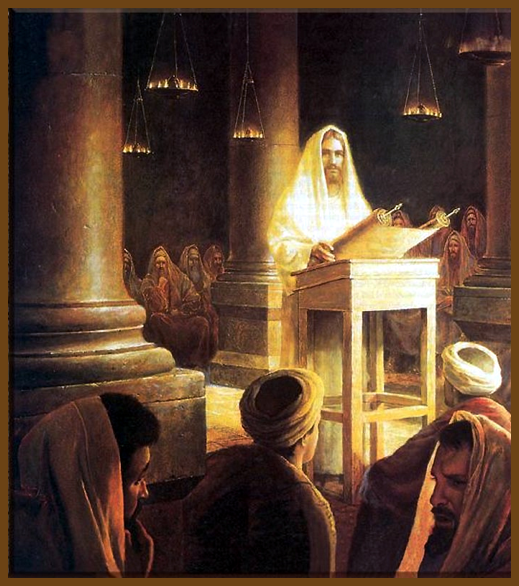
Jesus at Nazareth

By Alan Bean

This sermon was originally preached at Springcreek Community Church in Garland, Texas.

Fresh from wrestling with the Devil through forty days and forty nights, Jesus shows up in his home church of Nazareth and uses the ancient words of the prophet Isaiah to lay down his manifesto:

The Spirit of the Lord is upon me
because he has anointed me
to preach good news to the poor.
He has sent me to proclaim release to the captives
and recovery of sight to the blind;
to set at liberty those that are oppressed,
to proclaim the Lord’s jubilee when all debts are cancelled
and all the slaves go free.

The Spirit of the Lord is upon me, because he has anointed me . . .” What does that mean?

The word “Messiah” means “the anointed one”.  Anointing was a big deal in ancient Israel: somebody took a hollowed out horn filled with oil and poured it over your head.  Psalm 133 gives us a graphic portrait of an anointing:

How good and pleasant it is
when brothers and sisters live together in unity!
It is like the precious oil on the head,
running down upon the beard,
on the beard of Aaron,
running down over the collar of his robes.

“Isaiah was talking about me,” Jesus is saying, “The Holy Spirit of God has anointed me to preach good news to the poor.”

In ancient Israel the thrill of anointing was reserved for prophets, priests and kings.

Which is why, from the fourth century on, theologians have talked about the “three-fold office of Jesus”: prophet, priest and king.

You don’t find this talk in the Gospels, however, and that’s largely because the priests and princes in Jesus’ world were always trying to kill him.  In the Gospel narratives, Jesus appears as a prophet.  Not just any prophet, mind you.  Jesus is THE prophet who completes, fulfills and perfects the prophetic task.

As the gospel story unfolds, the prophetic work of Jesus puts him in continual conflict with priests and princes.  Finally, in the fullness of time, Jesus heads south to the Holy City:

Jerusalem, Jerusalem, the city that kills the prophets and stones those who are sent to it!  How often have I desired to gather your children together as a hen gathers her brood under her wings, and you were not willing!”

Days later, Jesus rides into Jerusalem, “humble and riding on the foal of a donkey.” (That’s Zechariah).  He enters the temple, overturns the tables of the money changers and cries,

‘My house shall be called a house of prayer’ (that’s Isaiah)
but you are making it a den of robbers. (that’s Jeremiah).

Jesus begins his public ministry by preaching good news to the poor; he ends his public ministry on the same note.

Verily, verily I say unto thee, when you won’t feed the hungry, provide water for the thirsty, clothe the naked, care for the sick, visit the prisoner or welcome the stranger, you are leaving me out in the cold, alone and hungry.

Having said that, Jesus takes his disciples aside and says, “You know that after two days the Passover is coming, and the Son of Man will be handed over to be crucified.”

Then, as if on cue, we find “the chief priests and the elders of the law” retreating to the palace of Caiaphas the high priest where they “conspired to arrest Jesus by stealth and kill him.”

Annointing in BethanyMeanwhile, Jesus is in Bethany, reclining at supper in the home of Simon the leper.  A woman bursts onto the scene with an alabaster jar of expensive perfume.  In seconds, the sweet ointment is running down his face, dripping onto his robes and puddling on the floor.

Apart from Jesus himself, this woman is the only person in Jerusalem who understands what’s going on.  She isn’t just anointing his body for burial; she is anointing “the anointed one” for spiritual warfare; she is commissioning him for the cross.

Jesus always knew his life story would end on a Roman cross, and he repeatedly said so.  But the death of the Anointed One was not random, it was carefully orchestrated.  Jesus arrived in Jerusalem at Passover for many reasons, theological and practical.  The big practical reason was that, during Passover, the population of Jerusalem swelled to four times its normal size and everybody would be there, including princes like Pilate and Herod Antipas, and priests like Caiaphas.

Herod the prince and Caiaphas the priest plot his downfall, but Jesus drives the action, declaring the good news of the kingdom with parable and prophetic action until his enemies are driven to a murderous frenzy.

All the hatred, fear, confusion, greed, envy and rage festering in the hearts of priests and princes rises to the surface in one dreadful moment.  Jesus is falsely accused, he is spat upon; he is beaten, he is whipped, he is humiliated and, finally, he is nailed to a Roman cross outside the walls of Jerusalem.

Then comes the miracle.  Gazing down on a mob of sneering, sarcastic, mockers, Jesus raises his eyes to heaven and utters the words that broke the devil’s back:

Father, forgive them, for they know not what they do.

And with these words everything changed.

The curtain in the temple, walling off the holy of holies from everyone but the High Priest, was torn from top to bottom.

A Roman centurion, standing guard for Caesar, hears these words and says, “Surely, this man was the Son of God.”  “Jesus is Lord; and Caesar is not.”

Finally, and this is only in Matthew, an earthquake shakes the countryside, and the tombs of the saints are opened.  This relates to Luke 11 where Jesus says

You build tombs for the prophets whom your ancestors killed . . . so this generation may be charged with the blood of all the prophets shed since the foundation of the world.

When you kill me, Jesus was saying, you slay the prophets all over again.  And then Matthew gives us the flip side, when Jesus is raised, all the prophets come back to life.

Jesus forgave the priests and the princes who put him on the cross.  He forgave the disciples who left him to die alone. He forgave the devil himself.  The Cruel Spirit can withstand any weapon formed against him—except forgiveness.

Roof, forgivenessIn recent days, we have seen demonic rage snuff out the lives of nine good people; and we have seen the miracle of forgiveness wring unity and reconciliation out of a senseless and tragic act.

Forgiveness is hard.  Miracles don’t come easy.  But because the Anointed One forgave; so can we.  We are called to the work of prophets, and prophetic action invites backlash.  Always. Sneering back at the haters is easy; forgiving the hate is hard.

I learned how hard forgiveness can be in Tulia, Texas, a Panhandle community halfway between Amarillo and Lubbock.

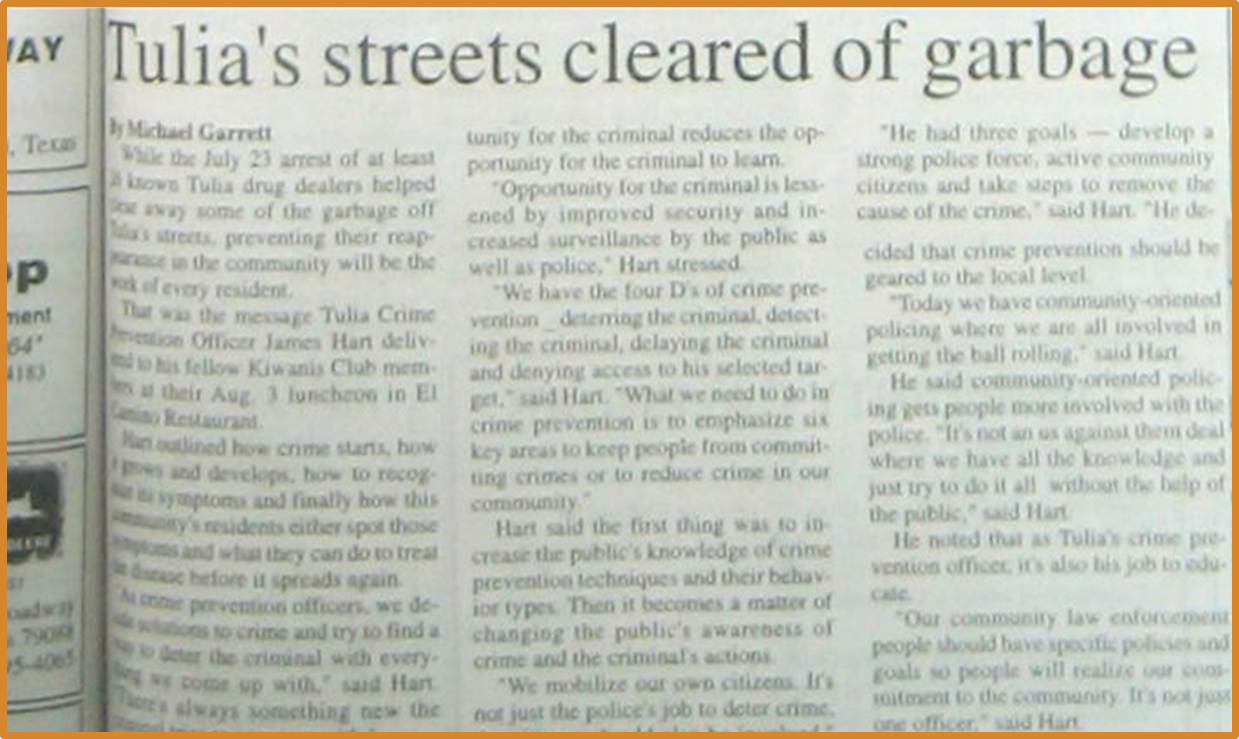
City streets cleared of garbageIn the early morning hours of July 23rd, 1999, 47 alleged drug kingpins were arrested on the poor side of Tulia and paraded in front of waiting television cameras in their underwear.

The defendants were all from the poorest echelons of Tulia’s black community or married to someone who was.

These people were all charged with selling little baggies of powdered cocaine to a single undercover agent.

Tom Coleman, had no evidence to corroborate his stories; you either trusted him, or you didn’t.

Everybody did.  The churches of Tulia backed the Coleman operation to the hilt.  They didn’t know anything about the officer, but they trusted the Sheriff who hired him.

The headline in the local paper summed up the general attitude: “Tulia’s streets cleared of garbage.”

When I told my Sunday school class how disturbed I was by this headline, I was told that the defendants “are all guilty, and they’re all going to jail.”

The sting robbed at least fifty young children of the only parents they knew.  Nancy and I ended up taking three of these children into our home.

When the first cases went to trial, local juries handed down the stiffest sentences allowed by law: 45 years.  Sixty years.  Ninety years.  One young man received six 99-year sentences, to be served consecutively.

Then we learned that Tom Coleman had been arrested on theft charges in the middle of the eighteen-month undercover operation.  Before taking the Tulia job, Coleman worked as a deputy in another West Texas town, leaving in the dead of night owing local merchants $10,000.

That was Coleman’s MO.

I called another West Texas Sheriff who hired Coleman even further back.  “If I had people in my jail on that man’s uncorroborated word,” the man told me, “I wouldn’t be able to sleep at night.”

Nancy and I stood at a crossroads.  We could pretend nothing was happening and get on with our lives; or we could take a prophet’s stand.  With a choice that stark, the decision made itself.  We started holding Sunday night meetings in our living room where the children, parents and loved ones of the sting defendants gathered to sing gospel songs, dance, read letters from prison and plot strategy.

We packaged the story for journalists.  We reached out to advocacy groups across the nation.  We got in touch with the governor’s office and made repeated trips to Austin to visit with legislators, handing out brochures that read: Moses, the Apostle Paul and Jesus agree: no one should be convicted on the word of a single witness.

Gradually, our efforts were rewarded.

Two sisters from New York produced a documentary on the story.

Two international law firms saw the documentary and signed on to represent the defendants on a pro bono basis.

A recent journalism graduate wrote a 16-page story for a Texas magazine.

ABC’s 20-20 sent a team to investigate.

Bill O’Reilly covered the story on Fox.

Then the backlash began . . . at least for those of us who lived in Tulia.

A congregation refused membership to our family.

Nancy was shunned at work by her fellow teachers.

Denominational officials told me I was too radical to recommend to their churches.

The brake lines on our Oldsmobile Silhouette were cut.

Our phones were tapped.

Then, as the story gained national traction, we started taking flak from our allies:

Lawyers who had once shunned the defendants as small-town losers were now queuing up to join the fight.

Some attorneys complained about our public singing and praying.

Defendants were told not to associate with “the local white people” because we couldn’t be trusted.   Not everyone listened; but many did.

A local black Baptist mission asked us to work with their young people, but dropped the idea when the white mother church complained.

Finally, after four years of struggle, a judge ruled that Tom Coleman lacked credibility under oath.

All charges were dropped, prisoners were released from prison and eventually pardoned by Governor Perry.

Tom Coleman was found guilty of aggravated perjury and the defendants (and their lawyers) received millions of dollars in reparation payments.

A law was passed by the Texas legislature demanding corroboration for single-witness testimony.

The Department of Public Safety took replaced unaccountable, and often corrupt, narcotics task forces.

But Nancy and I were too beaten up and betrayed to celebrate.

Here’s the saving grace: we knew our Bibles well enough to realize that our experience in Tulia followed a familiar pattern, a gospel pattern.

We had taken a prophet’s stand so the blowback from the priests and princes came as no surprise.  Even the opposition and betrayal of friends and allies followed the biblical story line.  Take up the cross of the Anointed One and these things happen.

Forgiveness kept us in the Tulia fight and has sustained us through fifteen years of ministry with the group we formed in Tulia, Friends of Justice.

I have written a book, “Taking out the Trash in Tulia, Texas.”

Recently, we have produced a six-week Bible study we call Breaking the Silence.

Forgiveness doesn’t come quickly, and it doesn’t come easily, but we knew the Old, Old Story of Jesus and his love, so we mouth the words, “Father, forgive them” until we meant it.

And every now and then, in the heart of the struggle, we feel the amazing grace of God welling up and we know we have chosen the right path.

We see it in the Bible.

We have seen it in Charleston, South Carolina.

And as we follow Jesus through the Valley of the Shadow of Death, we feel it in the deep places of the soul.

Forgiveness makes the difference.  Forgiveness breaks the devil’s back.

Truth Crushed to Earth Shall Rise Again: a Mississippi town mirrors the soul of a nation

This old post has been getting a lot of attention (for obvious reasons ), so I thought I’d throw it up again.

Friends of Justice

By Alan Bean

A monument to “The memory of Carroll’s Confederate Soldiers who fought in defense of our constitutional rights from Bethel to Appomattox” stands in front of the Carroll County courthouse in Carrollton Mississippi.  No surprise there; virtually every county courthouse in Mississippi constructed before 1920 sports a civil war memorial.  But few of these monuments are accompanied by the Confederate flag.  We’re not talking about the Mississippi state flag that incorporates the stars and bars–this is the genuine article.

View original post 1,239 more words

Was Dylann Roof wrong about America?

By Alan Bean
Nine Dead After Church Shooting In Charleston
The slaughter of nine innocent people gathered for prayer at a historic Black church in Charleston, South Carolina was horrific, deplorable, sickening, cruel and heartless.  It was not senseless.

In the mind of Dylann Storm Roof the act made perfect sense.  He was trying to spark a race war and he thought killing innocent people in a place of worship linked to the civil rights movement and an ancient slave revolt was a good way, a sensible way, to light the fuse.

If you think like Dylann Roof, his brazen act made perfect sense.

The carnage looks senseless because we don’t think like Dylann Roof.  Hardly any of us do.

Perhaps the young man is crazy.  But why did his craziness veer in this particular direction? (more…)

If Eric Casebolt is your hero, we need to talk

CaseboltNow that Eric Casebolt has resigned from the McKinney police department his bizarre actions will gradually fade from the headlines. We can all be thankful that police chief Greg Conley got out in front of the story (and not a moment too soon) by admitting that his officer was “out of control” when he climbed out of his police car and remained out of control throughout the entire episode.

The back-and-forth about what brought police officers to the scene will continue, but I’m not really interested. Suffice it to say that some of the African American kids at the pool party were from the neighborhood and had pool passes while others did not. White parents, seeing all the Black children as equally alien, made racist comments like “go back to your section 8 neighborhood” or “go back to the plantation”.  Some Black kids grew incensed and an altercation ensued.

But, whether or not you agree with this summary, none of that really matters. If the McKinney police department had handled this incident professionally we wouldn’t know that things got a bit out of hand on the rich side of McKinney, Texas last Friday. If the officers had calmly taken statements from all parties at the scene, and calmly encouraged the combatants to calm down, this would have gone into the books as just another minor incident unworthy of media attention.

And, for the most part, that is exactly what was happening before Eric Casebolt arrived on the scene. The chief had it right–the man was out of control. Moreover, as the senior officer, it was difficult for his fellow officers to shut him down. Pushing, shoving, cursing like a drunken sailor, waving his gun in the direction of horrified young people, and finally sexually assaulting a young girl less than half his size, Casebolt’s performance was a jaw-dropper.

I am troubled by the conservative white folks who used social media to honor and valorize Casebolt, suggesting his actions were justified, professional and necessary.

How could any sane person view the viral video and draw that conclusion?

Eric Casebolt is a troubled man, but we can only guess at the source of his trouble.

After ten years of military service, was he the victim of a delayed PTSD reaction?

Was Casebolt driven by the kind of insane racial animus that leads otherwise sensible people to curse whenever our president appears on television without being able to articulate what inspires their hate?

Was the ex-officer high on drugs?

I have no idea.  But his behavior cries out for some kind of explanation.

And that’s why the momentary adulation the man received is so troubling. I fear that even if Casebolt had actually gunned down two or three of the young black men he threatened with his firearm, thousands of white people in North Texas would have backed him to the hilt. The simple fact that young black children (and, yes, they are legally children) refused to satisfy the man’s appetite for submission, in the eyes of far too many people, would have justified any action designed to break their will.

And that’s just flat scary.

The Casebolt saga reminds me of the Gadarene demoniac in the Bible. Asked for his name, the broken man replied “legion”, suggesting that more than one kind of demon was oppressing him.

But the word “legion” would have had a second meaning in first century Palestine that no one could miss. Was the man saying that his madness channeled the crazed cruelty of the Roman Empire? Had the man served as a Roman soldier and seen things no one should see? Or had he been so brutalized by the forces of empire that his mind coped by splintering into a thousand pieces?

The Bible suggests these questions but provides no answer save the healing touch of the Master.

But the same questions must be asked with reference to Mr. Casebolt. This is NOT a story about one bad apple spoiling the reputation of an otherwise pristine community. Whatever infected this rogue McKinney police officer is rampant within our society.  His name is legion.

The madness must be named before it can be healed. Once again, the touch of the Master is needed. I leave you with the words of Archbishop Oscar Romero:

No one wants to have a sore spot touched, and therefore a society with so many sores twitches when someone has the courage to touch it and say: ‘You have to treat that. You have to get rid of that. Believe in Christ. Be converted.’

Mississippi family indicted for cheering at graduation ceremony

image

A family in Senatobia Mississippi has been indicted after cheering as a proud graduate crossed the stage at a high
school commencement ceremony. 

Three members of the graduate’s family were forcibly removed from the auditorium after shouting “you did it, girl”. 

A few days later, the celebrants were charged with disturbing the peace.  They face a $500 fine and possibly six months in jail.

Superintendent Jay Foster defends the decision to prosecute.  Graduation is a solemn occasion, he says, and families have a right to hear their child’s name announced in a stone-quiet auditorium.

For the middle class white men who preside over graduation ceremonies in towns like Senatobia, graduation may be a solemn affair.  They went to college (a much bigger deal than high school) and their children are expected to follow suit.  High School graduation, for these people, is the first step down a long road of gradual advancement.

But for the children of field hands, Wal Mart employees and truck drivers, high school graduation is whoopin’ and shoutin’ time; there’s nothing solemn about it.  There is no pomp in this world. The circumstance is bleak.

In many cases,  the graduate crossing the stage is the first person in the family to get a degree of any kind.  It’s a triumph for the entire clan–a watershed moment.

I understand this respectable – working class divide very well.  During our family’s nine years in Tulia, Texas we watched the social drama unfolf year after year. 

The vice principal would tell the audience that applause should wait until all graduates had received their degrees and that unseemly  outbursts would not be tolerated.  

This rule held until the first Black, redneck or Latino graduate  was announced.  After that each family outdid the last in voicing its pride.  Hell, if they didn’t cheer real loud, how would the town know how proud the family was? 

More importantly,  how would the graduate know?

Sure, there was an element of “take your pomp and shove it” class warfare involved in this annual drama.  The Hoi Poloi knew the ruling cadre of respectable professionals was asserting its authority and they rose to the challenge with gusto.

In the end, no harm was done.  The principal waited for the brief burst of celebration to pass before announcing the next graduate.  Everybody heard the name of their child announced loud and clear.

The authorities in Tulia knew that white professionals had become a tiny minority in the community.  Apparently, the ruling white class in Senatobia, Mississippi isn’t ready to throw in the towel.  Having laid down the law, they are going to make it stick even if it transforms their community into a national laughing stock.

Jay Foster thinks like the folks who gave us the Tulia drug sting and the Jena 6 fiasco.  Make no mistake, this is all about enforcing white privilege by all means necessary.

Christians lead opposition to the death penalty in Nebraska

Nebraska legislators just abolished the death penalty in their state then overrode a governor’s veto.  It takes a movement to effect this kind of change, and in Nebraska, as this article in Christianity Today makes clear, the movement originated in the religious community.  More signicantly, mainline, evangelical and Roman Catholic leaders joined hands.  When the Christian community speaks with a unified voice people listen.

Ted Cruz like you’ve never seen him before

Friends of Justice

I bet you didn’t know Ted Cruz was a criminal justice reformer, but it’s true. It rarely benefits his partisan agenda to beat the reform drum, but in this essay written for the Brennan Center for Justice, he lays out some excellent policy suggestions.

How do we account for such enlightened prose from a man who is normally dismissed as a narrow-minded bigot?

First, Cruz is smart. They don’t let dummies on the Princeton debate team. Secondly, the junior senator from Texas understands that the deep flaws in our criminal justice system could be turned on conservative Christians if anyone had a mind to do so. I doubt this is likely, but when you live on the losing side of the culture war a measure of paranoia comes with the territory.

Here’s Ted’s critique of the demise of the jury trial. I encourage you to read the entire essay.

The…

View original post 559 more words