Kennedy: If at first you can’t secede . . .


G45L0JRM.5
Micah Hurd

Bud Kennedy sent me the link to this troubling column featuring Micah Hurd, an ex-Marine who thinks Texas ought to Secede from the Union and create a new nation based on a literal reading of Old Testament Law.  AGB

In Texas, if at first you can’t secede, try — joining a militia?

BY BUD KENNEDY
bud@star-telegram.com

A determined Marine reservist made national headlines last year when he petitioned the White House for Texas secession.

Now, after more than 125,000 Americans signed his petition, Micah Hurd has sort of seceded.

Hurd, 24 and now a Plano resident, left college at UT-Arlington and quit the Texas State Guard.

Frustrated with the Guard, the state’s civil disaster-relief corps, he instead has joined a militia.

The Guard doesn’t have a “productive vision,” Hurd said, adding that he thinks Texas needs a “military force.”

He joined a Weatherford-based militia to resist “if we get attacked by our government.”

Hurd, the son of a Weatherford pastor, landed in The Washington Post in November when he petitioned President Barack Obama to let Texas “withdraw” and keep its “standard of living … [under] the original ideas and beliefs of the Founding Fathers.”

Hurd said Friday, “I adamantly believe Texas should secede.”

And if the rest of America doesn’t see it that way?

“I do not believe at this point we should enact a revolution,” he said.

“But in 50 years — who knows?”

The White House sent a brief response to Hurd’s petition and others from eight states, saying America’s founders meant to create a “perpetual union” as described in the Articles of Confederation.

“I can’t find that anyplace in the Constitution,” Hurd said.

He said he bases his views in part on his faith as a follower of Christian Reconstructionism and dominionism, a libertarian strain of Christianity.

To Reconstructionists, liberty and human rights are Bible-based and the only righteous government is a theocracy under “God’s law.”

“Nowhere in God’s law does it say I must continue to be subject to a tyranny,” Hurd said.

“We can remove ourselves from our fiscally irresponsible government.”

Hurd’s departure from the Texas State Guard was not without controversy.

When his White House petition made the news, 4th Regiment Col. Howard Palmer of Denton emailed volunteers not to discuss secession in any government capacity.

Palmer’s email called the idea “ignorant talk” and told any secessionists to “make it go away.”

Hurd said he was not petitioning as a Guard member. (He remains a Marine reservist after five years in the North Carolina-based 2nd Marine Aircraft Wing.)

Now living in Plano with his family and studying to become a fiber engineer, Hurd said he will commute to drills in Weatherford and hopes to counter stereotypes of a “Billy Bob militia.”

He fears the federal goverment “stepping in and mandating a sweeping change of laws to limit our rights,” he said.

“Those rights are God-given.”

In all the nostalgia for Texas independence — just last week Railroad Commission Chairman Barry Smitherman speculated that the rest of the U.S. might collapse — there has been little discussion of the religious overtones.

Writing on “secession theology” for Religion News Service last fall, Massachusetts scholar G. Jeffrey MacDonald compared the petitions to a reformation and church splits over purity.

Hurd said converting Texas or America to a religious theocracy is a “long-term goal — it might take 1,000, 2,000, 3,000 years.”

He is not the only secessionist thinking that way.


Good people saying good things

Scott Henson

Too busy to bloviate this morning; but here’s is the stuff I would be talking about if I had the time:

Scott (Grits) Henson had a couple of terrific blog posts over the weekend:

Elysium at the airport: TSA groping now only for poor people suggests that limiting TSA screenings to less affluent travelers is “a tacit admission that such screenings were really pointless security theater.”  The phrase “security theater” captures the sad reality beautifully.

And then there’s this: The free jail myth: County pols must stop pretending incarceration pays for itself.  The “free jail myth” has been refuted so many times you’d think small town public officials would have caught on by now; but they never do.  Promises of free jails are driving the proliferation of private prisons.

On Syria:  Jon Huckins has a terrific post over at Red Letter ChristiansSyria: The Stuff No One Wants To Talk About.  Proponents and critics of a military response have one thing in common: they aren’t thinking about the ordinary people affected by this tragedy.  Huckins captures the ethical complexity of this issue beautifully:  “On one hand, we can’t simply launch missiles into this region that kills innocent civilians (which they will) and then go eat a burrito and talk about our fantasy football teams. On the other hand, we can’t simply stand idle as tens of thousands of innocent civilians are being killed by a regime that devalues life.”

Finally, the excellent-and-always-improving Associated Baptist Press has two great articles:

In Working Poor a Ministry Focus, Baylor journalism student Daniel Wallace reminds us that poor folks aren’t all unemployed or homeless; most of them are working dead-end jobs that don’t pay enough to feed, clothe and house a family.  Are churches set up to respond?

Emily Hull McGee
Emily Hull McGee

Then, in Does Your Church Need Millennials, pastor Emily Hull McGee shares this sobering advice: “before you buy better church coffee or even hire someone to create a ministry with young adults, know this: Your church must be ready and willing to be transformed and forever changed by the passions of 20- and 30-somethings if you intentionally invite them in.”

If you wonder what she means by that, Emily spells it out in startling detail.  Her thoughts run parallel to the Common Peace Community Friends of Justice is putting together in DFW.


Balko shares the sad conclusion to the Ann Colomb story

OLYMPUS DIGITAL CAMERA
Ann Colomb

By Alan Bean

I emailed Radley Balko a couple of months ago to fill him in on the sad conclusion to a story he has been following.

I encouraged Ann Colomb to pursue a suit against the men responsible for wrongfully convicting Ann and three of her sons.  I knew the deck was stacked against her, but she needed to know she had done everything in her power to win a public acknowledgment of wrongdoing and some financial compensation for her suffering.

No mainstream attorney with standing in the legal community would take the case because these matters are handled on a contingency basis and the chances of winning were too small to justify the time and expense.

Radley Balko is the only journalist with national reach who has looked into this case.  You have to understand the criminal justice system to handle the complexities of this case and few journalists do.  Friends of Justice worked this case from 2004 through 2006 when Ann and her boys walked out of prison.  That was the most satisfying moment I have experienced in fifteen years of advocacy work.  Too bad the system intentionally shields wrongdoers from the consequences of their actions.

An Update In The Story Of Ann Colomb

By Radley Balko

Back in 2008, I wrote a long piece for Reason magazine about the Colombs, a black, working class family in Church Point, Louisiana. The Colombs’ story goes back 15 years, and is pretty complex, but here are the highlights:

— The family says they had been routinely harassed for years by local law enforcement. This harassment seemed to begin when the light-skinned Colomb boys began dating white girls, including the daughter of a local deputy. The harassment included the boys and their white girlfriends regularly getting pulled over, and on several occasions arrested on charges that never stuck (except on one occasion).

— Church Point is largely segregated (in fact, if not in law), or at least it was when I wrote the story. (more…)

Joe Phelps: Jesus’ Rejection of Violence is the Long-term Answer

Pastor Joe Phelps

By Alan Bean

I attended Southern Baptist Theological Seminary with Joe Phelps between 1975 and 1978.  Joe is now pastor of Highland Baptist Church in Louisville.  My wife and I were members at Highland in the early 1990s while I was finishing up a doctorate at Southern.  There is a good article in the Washington Post describing my alma mater’s messy descent into what former Southern Seminary professor Frank Stagg called “obscurantism”.

In this opinion piece written for the Louisville Courier-Journal, pastor Phelps talks about being invited back to Southern Seminary shortly before the invasion of Iraq to talk war and peace from a Christian perspective.  He quickly realized that he was the token pacifist on a panel of five Baptists.

It was five against one. In the midst of the interchanges I drew the evening’s biggest laugh when I expressed surprise at being more conservative than the seminary’s president because “I take Jesus’ words on war and violence more seriously than he does.”

The laughter was loud and long. It wasn’t a disrespectful laugh. It was, rather, a spontaneous reaction to something that sounded to them too preposterous to be serious.

Here in an auditorium filled with young men being equipped to go out and lead churches across the land in the ways of Jesus, not one of them expressed concern that our country was forming its response to the 2001 attacks based on the visceral reactions of the dominant culture more than from a faithful following of the one they’d pledged allegiance to.

If you are a Christian who thinks pacifism is a laughable position, I urge you to hear Joe out.

Jesus’ rejection of violence is the long-term answer

Joe Phelps

I visited yesterday with a young man who is part of a crew remodeling our house. When I learned that he is an Army reservist who is home for a while from the Middle East and will soon be redeployed there in the coming weeks, I thanked him for his service to our country and spoke of the current dilemma in Syria. (more…)

Why Cato was so wrong about welfare

By Alan Bean

Researchers at the Libertarian Cato Institute made headlines last month by claiming that welfare recipients are a lot better off than minimum wage workers.  A lot of people want to work, the study suggested, but when you can make the equivalent of $35,000 in benefits, you’d be crazy to take a job on the lower rungs of the wage ladder.

Ergo, government largess has made poor people dependent on the dole.

It took several weeks for cooler heads to realize that Cato’s “research” started with a conclusion and went looking for facts to back it up.   (To see just how flawed the Cato study was read Josh Barro’s post in the Business Insider below.)

By the time Archie-and-the-debunkers fire up, of course, no one is paying attention, so the study’s authors won’t have to face the music and dance.  People who work in ‘Think tanks’ are rarely paid to think; they are reimbursed for providing facts to match the prejudices of whoever pays the piper.

Josh Barro has been called a libertarian, a conservative and a liberal, but he’s actually a center-right thinker who doesn’t buy anyone’s orthodoxy.  That’s the hopeful thing about blogs; in theory at least they free opinion from the constraints of moneyed interests . . . assuming that anyone is listening.

I have never understood the appeal of libertarian thought.

Sure, applying simple market principles to the war on drugs can be highly instructive.  And the libertarian suspicion of our costly imperial-military machinery resonates with me.

But the idea that government intervention inevitably makes things worse is horribly simplistic. (more…)

The real reason Republicans boycotted the March

“80% of life is showing up”

By Alan Bean

Why did every single Republican official who was invited to speak at the 50th anniversary of the March on Washington decline?

The easy answer is that they aren’t big on the civil rights movement, but that’s not true.  When push comes to shove, Republican leaders are willing to admit that Jim Crow laws were a bad idea and that equal access to the American dream is a good thing.  They might not have anything good to say about the civil rights leaders of 2013, but they are capable of honoring Martin Luther King when the occasion calls for it.  In fact, they even held their own quiet, unpublicized commemoration featuring the handful of black congressional Republicans earlier in the week.  Associating with conservative Blacks is always a winner for Republicans.

Attending an event organized by mainstream Black America is another question entirely.

The Republican Party may be embarrassed by the fact that not a single member of the red team accepted an invitation to climb the steps of the Lincoln Memorial last Wednesday and say some nice things about civil rights.

But here’s the problem, the snub didn’t look good to Black people (of every political persuasion) not did it impress white liberals.  But, the culture war being what it is, these people won’t vote Republican under any circumstances.

The simple truth is that snubbing civil rights leaders doesn’t hurt Republicans politically and it might even help.  No one wanted to be the only representative of the Republican brand associated with last weeks commemoration.  It wouldn’t send the right message to the only voters that count to most politicians–primary voters.  That’s where the real election takes place in most districts.

True, snubbing the organizers of the event reinforced the Republican reputation as the Party of White; but how many conservative white voters care enough about that to switch their votes.  Five?  None?  Somewhere in between?

On the other hand, being associated with an event this public–especially if you are the only Republican on the podium–could lose you the votes of the Tea Party types who vote disproportionately in Republican primaries.  It might not be a big effect.  You might only lose a few hundred votes.  But when you know that appearing at the event won’t gain you a single vote it doesn’t take a math whiz to work the equation.  Speaking would have been a net loser for most Republicans and they have the political sophistication to know it.

Woody Allen once remarked that 80% of life is showing up.  That’s certainly true for congressional Democrats.  All they have to do to look good in the eyes of Black America is to make an appearance.  The expectation bar has been set that low.

John Kennedy and Lyndon Johnson had to sacrifice a major element of their political base (the Solid South) to do the right thing.

Democrats like Barack Obama and the Clintons win the support of Black America simply by showing up.  Nice work if you can get it.

Brumley: Moderates seek exit from ‘messy middle’

By Alan Bean

I stole the term “messy middle” from my daughter, Dr. Lydia Bean, who coined the phrase for a recent study of evangelicals and same sex marriage.  Since I am briefly quoted in the article below, I thought I should elaborate a bit.  The messy middle churches I describe aren’t moderate in the sense of being poised midway between liberals and conservatives.  Unlike homogeneous congregations in which the majority of congregants hold similar views on theological, political and economic issues, messy middle churches minister to people who are all over the ideological map.

Some are economic conservatives but quite liberal theologically and progressive on social issues.  Others are theological and social conservatives but skew to the left on economic issues (you see this a lot in African American and Latino churches).

Because the culture war fault line runs right down the middle of messy middle congregations, pastors and other opinion leaders within the church are reluctant to tackle issues that highlight the lack of message unity within the congregation or, worse yet, spark controversy within the body.

This explains the strange silence in most messy middle congregations on issues that affect poor people: employment policy, mass incarceration, immigration and homelessness.  Generally, we just don’t talk about this stuff.

That makes sense if the goal is maintaining institutional stability.

But if we’re trying to follow a Christ who preached good news to the poor, we’ve got a problem.

And recent studies suggest that millennials (roughly folks between 18 and 32 as of this writing) are looking for a faith that makes sense of the real world while transcending the weary divisions promoted by the culture war.  Millennials tend to be much more socially progressive than their parents, particularly on the issue of same sex marriage.

Below, a number of Christian leaders, including author Brian McLaren, Suziee Paynter of the Cooperative Baptist Fellowship, and Curtis Freeman of Duke Divinity School, share their views.

Moderates seek exit from ‘messy middle’

Individuals and institutions are beginning to seek ways to help moderate churches find their prophetic voice in an age when Millennials demand social-action churches.

By Jeff Brumley

Many are convinced that beyond addressing material and spiritual needs, moderate Baptist churches must become more vocal advocates for “the least of these” in society.

Some are forming congregational programs, while institutions like the Cooperative Baptist Fellowship are studying initiatives to help churches find their prophetic voices as Millennials moving into leadership voice dissatisfaction with congregations that remain silent on the burning social issues of the day.

In Texas, Alan Bean recently launched the Common Peace Community, a congregational initiative he hopes will inspire Baptist and other churches to move out of what he calls the “messy middle.” (more…)

Kiker: Random Reflections on War and Peace

By Charles Kiker

I’m writing this on the 85th anniversary of the signing of the Kellogg-Briand pact on August 27, 1928. Kellogg-Briand made war on war, declaring that the only legal war in international relations was a war of self-defense. The United States Senate, by a vote of 85-1, ratified that treaty, entered into and agreed upon by the world’s major powers. The United States has never officially abrogated that treaty.

In at least 50 of the 85 years since that pact was signed there have been major conflicts involving one or more of the world’s major powers. In a very, very few of those years could one say the world was without some sort of armed conflict.

So much for international law!

The President has promised that the United States will withdraw from Afghanistan in 2014, bringing to a close this country’s longest war.

But it seems likely that before that war ends, our country will be involved in another, a very messy situation in Syria. (more…)

Why is Black America still fixated on Trayvon Martin?

George Zimmerman and his lawyer Mark O'MaraBy Alan Bean

If you were hoping the big fuss over Trayvon Martin was going away, this weekend’s March on Washington 2 was a rude wake-up call.  Speaker after speaker pointed to the Zimmerman-Martin saga as an example of why Dr. King’s dream is yet unfulfilled.

A host of white opinion leaders have argued, with some justification, that the Zimmerman trial devolved into an unsightly media circus.  Sure, the media exploited this story, the way they exploited  the carefully orchestrated outrage perpetrated by Miley Cyrus a couple of days ago, but they didn’t create it.

The media flocked to this story because millions of African Americans see Trayvon Martin as the new Emmett Till.

In 1955 the issue was lynching; in 2013 it’s racial profiling and stand your ground laws.

If you’re thinking the issue would be settled by a jury verdict, remember that Till’s murderers were also acquitted by a jury of their peers.

But wasn’t Trayvon Martin a little thug?  Didn’t he initiate the fight?  Didn’t he have the well-intentioned Zimmerman fearing for his life?  Didn’t Trayvon’s pot-smoking past justify Zimmerman’s profiling?  Isn’t this whole story a saga invented by race-baiters like Al Sharpton and Barack Obama?  Haven’t there been a series of black-on-white crimes much worse than anything Zimmerman did that have been ignored by the race-baiters?  Aren’t black people just trying to change the subject from their high drop out rates and single-parent family problem?

If you are asking these questions (and, Lord knows, some of you are) please read this post from Craig Watts that recently appeared on the excellent RedLetter Christians blog.

Beyond Trayvon Martin and Racism

Posted AUG 14 2013

by CRAIG M. WATTS 

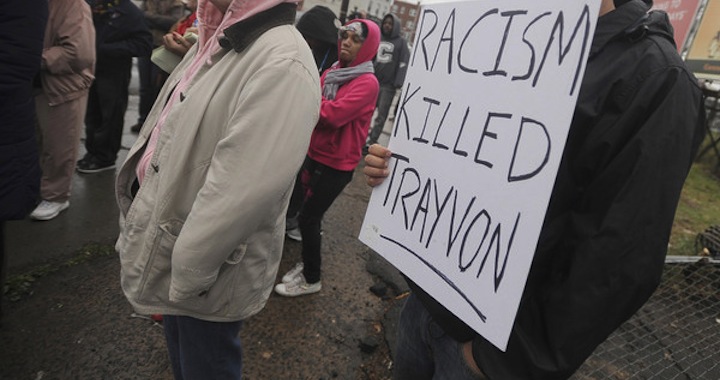
Racism Killed Trayvon Martin
It continues even now. The group emails and facebook posts spotlighting incidents of black on white violence and the cries, “Where’s the outrage now like there was over Trayvon Martin’s death at the hands of George Zimmerman! Why isn’t the President speaking out now?” And each time the comparison offered shows a total lack of understanding about why Martin’s killing was different.

No doubt there have been acts of violence more horrible than Trayvon Martin’s case. And no doubt there is black on white violence as well as white on black violence, though most killings by far involve people of the same race. And certainly innocent people of all races have been killed.

Still there are differences in Zimmerman’s killing of Martin, differences that rightly led to the national attention.

The day after the court decision I was in Orlando, Florida where I was visiting with two men –one of them a minister- who were attending the NAACP national meeting. “It wouldn’t have gone down this way if Zimmerman was black and Trayvon was white,” remarked one of them.  “The police wouldn’t have failed to arrest an armed black man who tracked down an innocent white kid, caused a fight with him and then pulled out a gun and killed him. The police would likely shot the black man right there.”

No one can know for sure what the police would have done. But the scenario the man described is not at all farfetched. And it wouldn’t have made national news. Unfortunately, many white people –like those who make the questionable comparisons- have not even considered the matter from the perspective of a black man. (1) A young black man had done nothing wrong. (2) He was tracked down by an armed man of another race for no other reason than that the young man was black and therefore viewed with suspicion as a white young man would not normally have been. (3) The armed man provoked an unnecessary confrontation. (4) In the midst of a fight the armed man pulled out his weapon and killed the innocent black young man. (5) Police did not arrest the killer until there was a public outcry. (6) When the killer when to trial, he was declared “Not Guilty.”

Those who object to the attention given to the killing of Trayvon Martin and who continue to post stories of doubtful similarity to Martin’s case on Facebook or send them in emails fail to see that those six characteristics are essential to the whole issue.  Too many people the attention given to Zimmerman’s killing are simply in denial about enduring and still pervasive problem woven into the nation’s social fabric: racism.

I’m hesitant to simply label all these people as racists who point to other incidents of violence and make questionable comparisons. But I do believe a certain kind of moral myopia is at work, hindering their ability to see what’s going on. What appears as racism is often an expression of a broader problem: the failure to have sufficient empathy and compassion for people outside of one’s own circle, not only of race, but of class, nationality, sexual orientation and others crucial aspects of identity. This failure accounts for the apparent inability of some to even begin grasp the real issues at stake when discrimination and inequality come into play and even to blame the victims who are not like him or herself.

Sadly, this failure is far too prevalent among American Christians. Love, kindness, and compassionate understanding are present in them. But they don’t extend it in fullness to those who are not like them. Jesus sought to address this problem in the parable of the Good Samaritan (Luke 10:25-37). Loving our neighbors involves more than care for people who are like us. The circle of care and understanding must extend even to people who have been perceived as at odds with “our kind” of people. Suspicion must be put aside.

This matter is beyond racism. The failure to have sufficient empathy and compassion for people outside of one’s own circle, not only of race, but of class, nationality, and sexual orientation is a failure of moral imagination. We can’t “weep with those who weep and rejoice with those who rejoice” (Romans 12:15 ) if we can’t or won’t get out of our own shoes and imagine ourselves in their place. More likely we will minimize their suffering and troubles or attribute the misfortune to the people’s own personal flaws. We will insensitively judge and tend to be self-righteous.

Attitudes toward the poor among many people in the United States display this same lack of empathy and compassion. Too many blame the poor for their plight and assume their problems are the result of laziness or moral failings. In other words, they blame the victims rather than seek to sympathetically understand the struggles and suffering of those who are disadvantaged.  Self-righteous judgmentalism overshadows merciful traits found in the way Jesus dealt with the poor.

Christians will not be agents of reconciliation and healing as long as they see the world from the perspective of the privileged or fail to even attempt to see from the viewpoints for those who are unlike themselves in important ways.  We have a higher calling than simply to be representative of our race, class, nationality or whatever else defines us in this world. “As God’s chosen ones, holy and beloved, clothe yourselves with compassion, kindness, humility, meekness, and patience” (Colossians 3:12).

Was the Apostle Paul a woman-hater, or what?

evans_projectmatzoh_post.jpg
Rachel Held Evans having a bit of fun

By Alan Bean

The title of this blog post from Rachel Held Evans reads like a dusty treatise cribbed from a little-read theological journal, but it is well worth reading.  Before long there will be four posts in this series on the domestic codes of the New Testament and I urge you to read them all. (For more on the author, check out this piece from the Atlantic.)

At issue here are all those passages where Paul and a few other New Testament luminaries, make disparaging remarks about women; or at least that is how these passages are commonly read.  Rachel Held Evans doesn’t mind sharing her problems with the Bible, but she believes the domestic codes are only problematic when we rip them from their original context.  Fully contextualized, these passages are alive with life and blessing.

Four Interpretive Pitfalls Around the New Testament Household Codes

Rachel Held Evans

This is the first post in a weeklong series entitled  “Submit One To Another: Christ and the Household Codes,” which will focus on those frequently-cited passages of Scripture that instruct wives to submit to their husbands, slaves to obey their masters, children to obey their parents, and Christians to submit to one another (Ephesians 5:21-6:9, Colossians 3:12-4:6; 1 Peter 2:11-3:22). You are welcome to join in the conversation via the comment section or by contributing to our Synchroblog. Use #onetoanother on Twitter. 

***

Ever heard this before? 

“The Bible says wives are to submit to their husbands, so clearly, Christian men are supposed to be the heard of the household and Christian wives are supposed to defer to the wishes of their husbands when making family decisions.” 

Or this? 

“The Bible teaches husbands to love their wives and wives to respect their husbands because men need respect more than they need love and women need love more than they need respect.”  (more…)