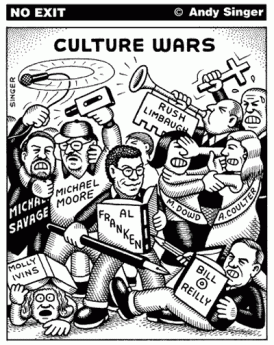
At war over the culture war: Dionne and Gerson go toe-to-toe

By Alan Bean

When two columnists working for the same newspaper address the same subject (the culture war and the contraception debate) you can learn a lot.  Michael Gerson accuses Barack Obama of sustaining our endless American culture war by forcing a conservative Roman Catholic Church to conform to “the liberal values of equality and choice.”  In Gerson’s view, the Catholic Church is an inherently conservative, indeed ‘illiberal’, institution.  Gerson endorses a pluralistic view of America in which a variety of civic organizations, some liberal and progressive, others illiberal and traditional, co-exist in a free society.  But this dream of a pluralistic America is being thwarted by an inherently intolerant “liberal” view of American life in which every individual and institution is expected to conform to the liberal values of equality and choice.  By forcing illiberal Catholic medical providers to provide free contraceptive services to their clients, Gerson alleges, the Obama administration is rejecting the pluralistic vision of America and stoking the fires of culture war.

Gerson believes it is a mistake to antagonize conservative institutions because, unlike their liberal counterparts, they encourage 

The habits of good citizens — attributes such as self-control, cooperation and respect for the law — don’t emerge spontaneously. They are cultivated in families and religious congregations. The health of liberal political institutions is strengthened by the success of traditional institutions, which often teach values that prepare individuals for the responsible exercise of freedom.

In Gerson’s view, Obama moved to the left on immigration and gay rights because he is an ardent culture warrior who disrespects the views of American conservatives.

Then comes E J Dionne, a progressive columnist who, unlike the evangelical Gerson, happens to be a living, breathing Roman Catholic in good standing.  Dionne agrees that Obama’s initial handling of the contraception issue was ham-handed and out of character.  Dionne’s Obama is no champion of the liberal view of America.  At his core, the president is an even-handed pragmatist who is generally eager to negotiate with his ideological opponents.

In fact, Dionne reminds us, six years ago Obama complained that

There are some liberals who dismiss religion in the public square as inherently irrational or intolerant, insisting on a caricature of religious Americans that paints them as fanatical, or thinking that the very word ‘Christian’ describes one’s political opponents, not people of faith.

Sounds a lot like Michael Gerson, doesn’t it.  Obama dropped the ball on the contraception issue, Dionne admits, but was able to self-correct by offering a compromise that was joyfully embraced by Catholic medical care providers.   

Unlike Gerson, Dionne refuses to define the Roman Catholic Church as an inherently traditional or illiberal institution.  The Catholic Church is a pragmatic and pluralistic blending of conservative and progressive impulses.  Dionne says he remains in the fold largely because

When it comes to lifting up the poor, healing the sick, assisting immigrants and refugees, educating the young (especially in inner cities), comforting orphaned and abandoned children, and organizing the needy to act in their own interest, the church has been there with resources and an astoundingly committed band of sisters, priests, brothers and lay people. Organizations such as Catholic Charities, the Catholic Health Association, the Catholic Campaign for Human Development and Catholic Relief Services make the words of Jesus come alive every day.

Moderate Catholics appreciate the president’s willingness to meet the Church half way on contraception and Dionne hopes the conservative wing will tone down its opposition to abortion rights and gay marriage because the American Catholic community is as divided on these issues as the rest of society.

Two views of the Roman Catholic Church; two views of the sitting president.  Who wins?

Dionne gets the best of this dust-up.  The culture war doesn’t separate illiberal traditionalists like a monolithic Catholicism from liberal, pluralism denying, culture warriors like Obama.  Obama has been deeply influenced by both secular liberalism and the traditional values sustained by the Christian Church.  Roman Catholics, like most Christian denominations, are split down the middle over culture war issues like gay marriage, abortion and, now, contraception.  Gerson’s neat divisions don’t fit either Obama or American Catholicism.

If the president has moved off the fence on gay marriage and immigration it’s because he sees no point in placating ideological opponents for whom the word ‘compromise’ has become the vilest of profanities.  Any politician on the right willing to meet the president half way on any contentious issue gets his or her (usually his) mouth washed out with soap in full view of the cameras.

Nice try, Michael, but you didn’t nail it this time.

Will demographic trends doom the GOP?

By Alan Bean

No matter how depressing present political realities may be, Democrats look to the future with confidence.  By mid-century, they say, America will be a majority-minority nation and that can only help the left. 

Jamelle Bouie questions this reasoning on two counts: Republicans could win back the most prosperous sector of the Latino community by returning to the moderate immigration policies of George W. Bush; and, as minorities are absorbed into the affluent mainstream, their resistance to conservative politics will diminish.

In other words, future trends can never be predicted with confidence, especially when we’re gazing 37 years down the road. 

This “the future is ours” rhetoric should make genuine reformers cringe.  We can’t get locked into the culture war categories of the present hour.  Between 1950 and 1970, Democrats and Republicans switched sides on civil rights.  It is hard to believe that the Republican Party on display during the primary election season could move to the left on anything; but stranger things have happened in American politics.  If public sentiment shifts (as it always does) politicians will shift along with it. Reformers should be trying to nudge both parties in the direction of compassion and common sense, even when it feels silly.  Life is full of surprises.

The worst thing that could happen would be for Democrats to eschew the hard work of rethinking the entire progressive narrative because “we are bound to start winning sooner or later”.  Democrats have been on the wrong side of plenty of issues in recent memory (think the war on drugs, mass incarceration and the deregulation of the financial sector), and the blue team will continue to get things wrong if they misread the writing on the wall. 

The tepid politics of triangulation has been weighed in the balance and found wanting.

Nothing in public life is inevitable.  Change is always hard work.  Justice demands courage.  Patience is a virtue; complacency is not.

The Democrats’ Demographic Dreams

Jamelle Bouie

June 14, 2012

If Democrats agree on anything, it’s that they will eventually be on the winning side. The white Americans who tend to vote Republican are shrinking as a percentage of the population while the number of those who lean Democratic—African Americans and other minorities—is rapidly growing. Slightly more than half of American infants are now nonwhite. By 2050, the U.S. population is expected to increase by 117 million people, and the vast majority—82 percent of the 117 million—will be immigrants or the children of immigrants. In a little more than 30 years, the U.S. will be a “majority-minority” country. By 2050, white Americans will no longer be a solid majority but the largest plurality, at 46 percent. African Americans will drop to 12 percent, while Asian Americans will make up 8 percent of the population. The number of Latinos will rise to nearly a third of all Americans. (more…)

Five ‘Stand Your Ground’ cases you should know about

By Alan Bean

The Trayvon Martin case is important because it exposed the flawed, and potentially deadly, reasoning behind Florida’s Stand Your Ground law.  It doesn’t matter whether the victim was, or wasn’t, a marijuana user or whether the Zimmerman’s lied about their finances at a bail hearing.  None of that has any bearing on the tragic elements of this case.  In the end, it doesn’t even matter whether or not Trayvon Martin lashed out at the stranger who stalked and harassed him. 

The story is important because a really awful state statute made George Zimmerman think he could pursue and confront an unarmed private citizen and shoot him dead if he decided to defend himself.

In other words, this isn’t just about Trayvon, and it isn’t just about Florida–twenty-four states have passed some version of Stand Your Ground legislation.  You haven’t heard most of the horror stories because they haven’t been in the news.  You wouldn’t have heard about Trayvon Martin either if he didn’t have unusually determined parents.

Thanks to Pro Publica for understanding why the Trayvon Martin case is important and investigating the nationwide consequences of Stand Your Ground legislation.

Five ‘Stand Your Ground’ Cases You Should Know About

by Suevon Lee
ProPublica, June 8, 2012

The Stand Your Ground law is most widely associated with the Feb. 26 shooting death of Trayvon Martin, an unarmed 17-year-old killed in Florida by George Zimmerman, a neighborhood watch captain who claimed he was acting in self-defense.

But as a recent Tampa Bay Times investigation  indicates, the Martin incident is far from the only example of the law’s reach in Florida. The paper identified nearly 200 instances  since 2005 where the state’s Stand Your Ground law has played a factor in prosecutors’ decisions, jury acquittals or a judge’s call to throw out the charges. (Not all the cases involved killings. Some involved assaults where the person didn’t die.) (more…)

Obama says no to mass deportation

By Alan Bean

In a major development, the Obama administration has decided to enforce key provisions of the failed DREAM Act essentially by presidential fiat.   Young people who came to the United States as children, who have graduated from high school and have a clean criminal record, will be allowed to remain in the United States.  The plan does not include a pathway to citizenship, but qualifying applicants will receive two-year work visas that can be renewed indefinitely.

Although this plan does not give the immigrant rights movement everything it wants (this is no substitute for comprehensive reform), it means that 800,000 young people are no longer targeted for deportation.

President Obama is calculating that, like his recent support for marriage equality, his softened position on deportation will help him more than it hurts.  It will certainly raise his prospects with Latino voters who are far more likely to show up on election day now that the administration has addressed the mass deportation issue. 

In the process, Obama has handed Mitt Romney a potential campaign issue.  But Republicans will have to think carefully before accusing the administration of introducing  de facto “amnesty” contrary to the express wishes of Congress.  Demonizing “illegal aliens” has worked well for the conservative movement, but public opinion could shift in a more progressive direction simply because somebody, finally, is making the case for compassion and common sense. 

An update to the article below can be found here.

Administration plan could spare hundreds of thousands of illegal immigrants from deportation

By Associated Press, 

 Friday, June 15,

WASHINGTON —

WASHINGTON — The Obama administration will stop deporting and begin granting work permits to younger illegal immigrants who came to the U.S. as children and have since led law-abiding lives. The election-year initiative addresses a top priority of an influential Latino electorate that has been vocal in its opposition to administration deportation policies. (more…)

Burl Cain and the ACLU agree

Burl Cain

What do Angola prison warden Burl Cain (a champion of faith-based prison ministries) and Marjorie Esman of the Louisiana ACLU have in common?  They both think locking up thousands of old folks who couldn’t re-offend if they wanted to is an expensive outrage.

This video is part of the ACLU’s “Elderly in Prison” and summarizes that report’s big talking points.  This blurb that accompanies the video boils the argument down to two brief sentences:

Our extreme sentencing policies and a growing number of life sentences have effectively turned many of our correctional facilities into veritable nursing homes — and taxpayers are paying for it. A new ACLU report supplies detailed and practical solutions that states and the federal government can implement to address the dramatic and costly growth in the number of elderly prisoners without putting communities at risk.

Marjorie Esman had lots of good reasons NOT to call up Burl Cain.  When mass incarceration is presented with a racial justice frame (think Angola 3) the warden of Louisiana’s most notorious prison comes off sounding like the reincarnation of Bull Conner.  But when the focus narrows to a reform issue Cain supports, a surprising outlook overlap appears. 

The warden of America’s largest prison believes in rehabilitation.  If we took all the money we’re spending to keep elderly prisoners alive and invested it in education programs for young offenders, he says, we could lower recidivism rates and improve public safety.

Makes sense to me.

Hats off to Marjorie Esman for making the call, and to the ACLU for exhibiting the kind of pragmatic compassion it takes to get a reform message in front of a mainstream audience.

Evangelicals call for immigration reform

By Alan Bean

Evangelical organizations from the left-leaning Sojourners to the right-leaning Focus on the Family, have joined in a plea for immigration system.  If you’re curious, you can find a list of all the signatories here (scroll to the bottom of the page).

Critics will note that there are few concrete policy proposals mentioned in the brief list of principles released by the Evangelical Immigration Table.  But the fact that conservative religious leaders are calling on political leaders to “welcome the stranger” is noteworthy.  Here’s the statement: (more…)

Mississippi can’t kick the private prison habit

By Alan Bean

Geo Group, the private prison firm that lost three prison contracts in Mississippi earlier this year because of gross violations that turned facilities like the juvenile prison at Walnut Grove into hell holes, has been disciplined again.  This time, Geo is accused of failing to protect the safety of corrections workers at its prison near Lost Gap MS.

You would think that Mississippi officials might be getting the idea that private prisons aren’t such a good idea.  Not so.  Christopher Epps, Commissioner of the MS Dept. of Corrections, immediately announced that all the three private prisons previously run by Geo Corp would be turned over to the Management & Training Corporation of Centerville, Utah.

According to the Associated Press, Epps is hoping for a better result.

“The Mississippi Department of Corrections is looking forward to a great partnership with MTC,” Epps said in a statement Thursday. “There is a need for different types of prisons, including state and regional as well as private facilities in Mississippi. MTC will be held to the same high standards as set by MDOC and I feel extremely confident that MTC will do a great job.”

Epps told reporters he thought Mississippi would get better terms if the three prisons were sold as a package deal.  In other words, Mississippi is trying to do corrections on the cheap, and that’s the problem.  The only way private prisons can turn a profit is by cutting corners.  If they were really held to the same standards as state prisons they would have to hire as many corrections officers as MDOC and pay them comparable salaries.  The private prison industry would also have to invest in a safe working environment for their employees, something that Geo Corp clearly failed to do. (more…)

When God changes the rules

By Alan Bean

In a recent post, I responded to a Curtis Knapp, a Baptist pastor in Kansas who believes the federal government ought to be executing homosexuals in accordance with the twentieth chapter of Leviticus.  I suggested that when the Bible is read through a Christological lens, the admonitions of Leviticus can be taken seriously, but not literally.  They are still in the Bible, but they are trumped by the higher vision of God revealed in Jesus (and in many parts of the Hebrew scriptures as well).

I gave a single example from the Sermon on the Mount in which Jesus clearly distinguishes his message from the “eye-for-an-eye” demands of the Mosaic law.  But there are plenty of other examples.

In a captivating post called “When the atheists are right” law professor (and Friends of Justice board member) Mark Osler, points to the story of the Prodigal Son.  Responding to a Christian father who thought it was his duty to consign his dead son to hell, Osler introduces an alternative take on grace and the character of God.

And there, in the Book of Luke, is the story of the prodigal son — the younger of two, who demanded his inheritance and then squandered it through “dissolute living.” He hits bottom, having run through the money, and resolves to return to his father and repent. However, before he has a chance to say anything, his father runs to him, puts his arms around him and kisses him. There is love there, before repentance, even in the apparent absence of repentance. There is love before all; that is what Christ directs us to do.

The Elder Brother’s rejection of the Prodigal was solidly rooted in precept and principal, but it couldn’t be squared with the gracious heart of God.

Fred Clark’s Slacktivist blog uses Peter’s vision in Acts 10 in which a sheet containing animals which were “unclean” according to Levitical law accompanied by the spoken command: “arise, Peter, kill and eat.”

And what he understood was that his vision was not about dietary laws regarding “all kinds of four-footed creatures and reptiles and birds of the air.” What Peter understood about Peter’s vision was that it was about Gentiles — about outsiders, about those people whom the laws of Moses said were law-breakers, unclean, an abomination.

Here is what Peter himself said about his own vision:

You yourselves know that it is unlawful for a Jew to associate with or to visit a Gentile; but God has shown me that I should not call anyone profane or unclean.

In Acts 10, God changed the rules.  Peter wasn’t informed that his interpretation of the dietary rules was wrong or that the ancient wall between Jew and Gentile was based on a misunderstanding; he was informed that a new vision of faith in action had burst upon the world.  If Peter interpreted his vision in light of the Jew-Gentile divide, we should apply it to the current antagonism between gay and straight Christians.

The Sunday after Barack Obama came out for marriage equality, Dallas pastor Freddie Haynes made a bold stand in the pulpit of Friendship-West Baptist Church in which he asked why Christians are so eager to major in areas that Jesus minored in.  Jesus majored in deliverance and compassion; judgment was a minor issue (unless he was talking about preachers).

This morning, my wife and I encountered these familiar words from Luke 13.  The setting is the healing of a woman who had been crippled for eighteen years.  Jesus’ religious critics are appalled that a Rabbi would heal on the sabbath, a clear violation of biblical teaching and rabbinic tradition.

Jesus replies,

You hypocrites!  Does not each of you on the sabbath untie his ox or his donkey from the manger, and lead it away to give it water?  And ought not this woman, a daughter of Abraham whom Satan bound for eighteen long years, be set free from this bondage on the sabbath day?

In other words, the cold word of the law melts when brought into contact with the compassionate heart of God.  The lesson: whenever we find a disconnect between the clear word of scripture and the grace of God revealed in Jesus; we go with Jesus.  Every time.  All the way.

David Barton’s therapeutic history

This isn’t really about Thomas Jefferson

Faux historian David Barton has written a book about Thomas Jefferson that portrays the deist slave holder as a Christian patriot who espoused enlightened views on slavery and race.  But Barton’s primary aim is to expose a cynical liberal academy that lies to the American people.  This quote from the book’s blurb is typical:

America, in so many ways, has forgotten. Its roots, its purpose, its identity―all have become shrouded behind a veil of political correctness bent on twisting the nation’s founding, and its founders, to fit within a misshapen modern world.

The time has come to remember again.

Evangelical historians Warren Throckmorton and Michael Coulter learned about David Barton’s book from their students at Grove City College.  What they were hearing sounded strange enough to warrant a careful reading of Barton’s book.  (more…)

Anti-immigrant sentiment on the decline nationwide

By Alan Bean

As the summer heats up, anti-immigrant rhetoric has been cooling considerably.  Or, to be more precise, mainstream politicians are beginning to understand the downside of siding with the haters. 

In an interview in which he was predictably critical of Barack Obama, Jeb Bush, the former Florida governor, tried to pull his party back from the brink on the immigration issue:

“It’s the one thing that separates us from the rest of the world is to say embrace our values, learn our language and work hard and dream big and create what you want to create because it helps all of us.  You have to deal with this issue, you can’t ignore it and so either a path to citizenship which I would support and that does put me probably out of the mainstream of most conservatives or … a path to residency of some kind.”

In Vermont, Massachusetts, New York and the District of Columbia, public officials are in full-scale revolt against the now-mandatory Safe Communities program.

California legislators are close to passing a TRUST Act which would “require police to continue to detain only those immigrants for deportation purposes who have a serious or violent felony conviction under state law”.  TRUST is a somewhat desperate acronym for “Transparency and Responsibility Using State Tools”.

TRUST is hardly a radical piece of legislation; it simply means that, in California, the kinder, gentler version of Safe Communities will be enforced instead of the “deport everybody” approach that has been in vogue in many jurisdictions over the past couple of years.

In Texas, the state Republican Party dropped much of the mean-spirited, anti-immigrant language from its platform in the course of its state convention in Fort Worth.  According to the Fort Worth Star-Telegram, the new statement begins like this:

 “Because of decades-long failure of the federal government to secure our borders and address the immigration issue, there are now upwards of 11 million undocumented individuals in the United States today, each of whom entered and remain here under different circumstances,” the document states. “Mass deportation of these individuals would neither be equitable nor practical.We seek common ground to develop and advance a conservative, market-and law-based approach to our nation’s immigration issues.”

This “Texas Solution” calls for a temporary worker program “to bring skilled and unskilled workers into the United States for temporary periods of time when no U.S. workers are currently available.”

In addition, “the program would require participants to pay fees and fines, pass a criminal background check, prove they can afford private health insurance and waive rights to apply for public financial assistance.”

This new immigration policy is hardly a panacea for proponents of comprehensive immigration reform, but it’s a vast improvement over the  “what part of illegal do you not understand?” approach that has dominated conservative politics since the advent of the Tea Party revolution.

According to Bud Kennedy, a Star-Telegram columnist who attended the Republican Convention, the new GOP platform is driven by demographic reality.

“I’d start telling Hispanic voters about Republicans, and they’d say, ‘I’m pro-life, too, but you want to deport my grandma,'” said Norman Adams of Houston, celebrating the Texas party’s 180-degree turn away from its position of removing all illegal immigrants and slowing legal immigration.

“They can’t say that anymore.”

Texas has always been a one-party state.  It was once impossible to win statewide office if you ran as a Republican, and the same is now true for Democrats.  But with the Hispanic slice of the electorate growing by 2% with every new election cycle in Texas, the GOP mainstream is beginning to read the writing on the wall.
 
Tea Party reaction to the state GOP’s softened stance on immigration was predictable–they think the new policy represents a de facto amnesty for “illegals”.
 
It doesn’t, of course.  The presence of non-citizens would merely be tolerated under the proposed policy, there would be no fast track to citizenship, and beneficiaries of the new regime would have to relinquish their right to public assistance.  In short, we are talking about a permanent class of second-class citizens.  But, as Kennedy suggests, people who live in fear that Grandma could be deported at any moment may be happy with half a loaf.
 
If Texas Democrats want the enthusiastic support of Texas Latinos, they need to move to the left of state Republicans on immigration, something they have been reluctant to do.  Democrats know white conservatives will control Texas politics for at least another decade, so they are reluctant to sell themselves as the party of inclusion and diversity.  The blue party was hoping it could win Latino support by largely ignoring the immigration issue and allowing the GOP’s nativist and xenophobic platform to drive Latino voters into the democratic party by default. 
 
The Texas GOP may just have taken that option off the table.