“The real CSI”: Forensic science in the courtroom

If you tune into any popular television crime drama these days, you are likely to find a familiar formula — a murder occurs, an investigation ensues, the perpetrator is identified using some forensic evidence, and justice is served.  In the end, everything is wrapped up in a neat little bow.  

Although this popular plot format may make for good ratings, it isn’t rooted in reality.  In the real world, most cases aren’t clean-cut, investigations can drag on for years, and forensic science tools can be unreliable.  In some cases, questionable forensic evidence can lead to wrongful convictions, leaving innocent people behind bars.

In “The Real CSI,” which airs Tuesday, April 17, 2012, at 10 P.M. ET on PBS (check your local listings), FRONTLINE and ProPublica take an in-depth look at the use of forensic science in the courtroom.  Check out the press release below for more information.  MWN

FRONTLINE AND PROPUBLICA EXAMINE FORENSIC SCIENCE IN THE COURTROOM

FRONTLINE Presents
“THE REAL CSI”
Tuesday, April 17, 2012, at 10 P.M. ET on PBS

www.pbs.org/frontline/real-csi
www.facebook.com/frontlinepbs
Twitter: @frontlinepbs


Evidence collected at crime scenes—everything from fingerprints to bite marks—is routinely called upon in the courtroom to prosecute the most difficult crimes and put the guilty behind bars. And though glamorized on commercial television, in the real world, it’s not so cut-and-dried. A joint investigation by FRONTLINE, ProPublica and the Investigative Reporting Program at UC Berkeley examines the reliability of the science behind forensics in “The Real CSI,” airing Tuesday, April 17, 2012, at 10 P.M. ET on PBS (check local listings).

FRONTLINE correspondent Lowell Bergman finds serious flaws in some of the best known tools of forensic science and wide inconsistencies in how forensic evidence is presented in the courtroom. From the sensational murder trial of Casey Anthony to the credentialing of forensic experts, Bergman documents how a field with few uniform standards and unproven science can undermine the search for justice.  (more…)

Requiem for the culture war

By Alan Bean

Like me, Jonathan Merritt has been engaged in a prolonged love-hate relationship with both ends of the moral spectrum.  Young Christians look at both political parties, Merritt says, and find themselves longing for a third option. 

“Christians are rejecting the polemical, power-hungry and partisan politics of the culture wars.   We need to be involved in politics, but in an independent, civil, embodied way.”

After reading Bob Allen’s excellent review of Merritt’s new book,A Faith of our Own: Following Jesus Beyond the Culture Wars, I found myself thinking that it isn’t just “young Christians” who feel this way. 

There is a lot to like in both the conservative and liberal traditions.  Hard work, sexual fidelity, commitment to family, entrepreneurial spirit, economic realism–hooray for the conservatives!  Inclusion, respect for diversity, compassion, non-violence, equality, fairness–thank God for liberalism!

But there’s a lot to dislike in both camps too, and partisan zealots have constructed a cottage industry out of exploiting the weakness in the other sides’ vision.  These fish-in-a-barrel massacres are easily arranged: Liberal and conservative virtues, considered in isolation from one another, are equally unsustainable. 

Liberals and conservatives need one another and America needs both kinds of people.  Robbed of the insights at the heart of the parallel virtue, zealots on both sides succumb to moral malnutrition.

The culture war is understandable, possibly even inevitable, but that don’t make it pretty.  A focus on hard work and responsibility with no place for compassion and fairness is a recipe for despair.   Focusing on diversity and fairness apart from personal responsibility is a one-way ticket to nowhere. 

Duh!  What could be more obvious?

Tragically, liberal and conservative partisans are consigned to cultural hell by their refusal to recognize the glories of the opposing creed. 

Maybe its only those who lived through the tumult of the 1960s (the kind of folks currently running the show) who feel called to subsist on an impoverished and unbalanced moral diet.  If so, the kids can’t take over soon enough!

Merritt’s book will be available May 6.  In the meantime, I commend Bob Allen’s review.

Were the Tulsa shootings racially motivated?

By Melanie Wilmoth Navarro

As of yesterday, two suspects have confessed to the Tulsa, Oklahoma shootings that left two injured and three dead over the Easter weekend.  The two suspects — Jacob England, 19, and Alvin Watts, 32 — were arrested Sunday morning and confessed shortly after their arrest.

Late Thursday, According to the New York Times, England wrote an angry post on his Facebook page about the deaths of his father and fiancée:

Mr. England’s father, Carl, was shot on April 5, 2010, at an apartment complex…and the man who was a person of interest in the case, Pernell Jefferson, is serving time at an Oklahoma state prison.

Mr. England is a Native American who has also described himself as white.  Mr. Jefferson is black.

“Today is two years that my dad has been gone,” Mr. England wrote, and then used a racial epithet to describe Mr. Jefferson. “It’s hard not to go off between that and sheran I’m gone in the head,” he added, referring to the recent suicide of his 24-year-old fiancée, Sheran Hart Wilde. “RIP. Dad and sheran I Love and miss u I think about both of u every second of the day.”

Hours later, England and his roommate, Watts, drove a pickup through a predominately black neighborhood in Tulsa and started to randomly shoot pedestrians.  Mr. England admitted to shooting three of the victims and Mr. Watts admitted to shooting the other two.

Many within the Tulsa community believe the actions of England and Watts were racially motivated.

The city of Tulsa has a history of racial tension.  In 1921, the city was the site of one of the deadliest race riots in U.S. history.  The riots began when a young black man was arrested after he was accused of sexually harassing a white woman.  His arrest sparked a violent confrontation between the black and white communities.  According to documents from the Tulsa Historical Society:

In the early morning hours of June 1, 1921, Black Tulsa was looted and burned by white rioters.  Governor Robertson declared martial law, and National Guard troops arrived in Tulsa.  Guardsmen assisted firemen in putting out fires, took imprisoned blacks out of the hands of vigilantes and imprisoned all black Tulsans not already interned.  Over 6,000 people were held at the Convention Hall and the Fairgrounds, some for as long as eight days.

Twenty-four hours after the violence erupted, it ceased.  In the wake of the violence, 35 city blocks lay in charred ruins.

Historians estimate that over 300 people were killed in the riot and more than 8,000 were left homeless.

Now, 91 years after the deadly riot, race relations in Tulsa remain rocky.  Many, including the Tulsa NAACP chapter and Tulsa City Council member Jack Henderson, want the gunmen to be prosecuted for a hate crime.

“Somebody that committed these crimes were very upset with black people,” said Jack Henderson, “That person happened to be a white person. The people that they happened to kill and shoot were black people — that fits the bill for me.”

Police officials and prosecutors, however, say it is still too early in the investigation to call the shooting rampage a hate crime.

“The undignified don’t deserve dignity”: Mississippi’s first hate criminal goes to prison

Two weeks ago, a white high school student named Deryl Dedmon pled guilty to the murder of James Anderson, a black man.  Dedmon dodged the death penalty by admitting that the crime was racially motivated.  In so doing, he became Mississippi’s first hate criminal.

Two accomplices, John Aaron Rice and Dylan Butler, also admitted their involvement in the racially-motivated murder.

Newsweeks Tony Dokoupil traveled to Mississippi to find out what Deryl Dedmon, the young man behind the wheel of the Jeep Cherokee, meant when he admitted to being “young and dumb, ignorant and full of hatred.”

“What I discovered,” Dokoupil reports, “was deeper, scarier, and more complex than a single country boy gone bad or even simple, pre-civil-rights-era racism.”

Dedmon’s friends don’t see him as a racist and don’t think the murder should be classified as a hate crime.  Even more disturbing, from the writer’s perspective, many of their black friends seemed to agree.

The kids in Dedmon’s social circle don’t think they’re racist at all. Sure, many use the N word, sometimes even in anger. But they say they don’t mean it in a racist way, any more than the town’s monument to the Confederate dead is meant as a call to arms. “It’s heritage, not hate,” says Trevor, echoing a common defense of Southern pride. The trips to west Jackson, he and others believe, were driven by social status—reveling in the lawlessness of poor neighborhoods—not skin color.

The article published in Newsweek and on the web in The DailyBeast, represents the most in-depth analysis of this tortured tale to appear thus far.  It will come as no surprise that the murder of James Anderson was the culmination of a long series of trips from predominantly white Rankin County to the poor black neighborhoods of nearby Jackson.  Unlike the black friends the white defendants knew from school, the denizens of West Jackson were regarded by Dedmon and his friends as the semi-human citizens of a Third World country.  It was okay to threaten, attack, beat and eventually kill people in poor black neighborhoods because, well, they’re niggers.

But our black friends back in Rankin County, well, they’re okay.

 In the version told by Dedmon’s social circle, racial hatred did not bring them to Jackson so much as boredom and drunken teenage aggression, mingled with a kind of moral outrage at the shabbiness of life in the Metro Inn area. Yes, the people there are almost all black, and the white teens call them “niggers.” But that has more to do with their status than their skin; the undignified don’t deserve dignity, they say. “White, black, red, or yellow,” says the Bunyanesque friend from the car wash, who did not go to Jackson that night, “what I’m prejudiced against is stupidity. I don’t like stupid people.”

If you hate black people because of their color, you’re racist; if you hate poor, inebriated black people because you have contempt for their lifestyle, that’s just being a decent American.

This is what happens when centuries of slavery and Jim Crow oppression empty into half a century of silence.  Until the early 1970s, the official position in the state of Mississippi was pure, unfiltered white supremacy.  By the late 70s the subject of race was off the table.  You could spout the old line behind closed doors, but in the public arena the past wasn’t mentioned.  Until recently, Mississippi school children weren’t even taught that there was a civil rights movement.

Confused white males like Deryl Dedmon were left to figure things out for themselves.  Dedmon’s behavior was unusual, to be sure, but the sentiments voiced by his friends, black and white, are standard issue.

That’s why I call my book, Taking out the Trash in Tulia, Texas.  So long as the defendants in the Texas Panhandle town I called home for nine years were sufficiently “trashy”, constitutional protections and the canons of common sense didn’t apply.  The war on drugs is rooted in the same principle.

Tony Dokoupil’s five-page article can be found here.  Highly recommended.

The American vigilante myth

By Alan Bean

In an illuminating weekend piece, Washington Post film critic Ann Hornaday addresses America’s love affair with the lone wolf vigilante.  “Of the countless stories we tell ourselves,” she writes, “the American myth of the solitary enforcer of justice may be the most tenacious, beloved and — as the story of George Zimmerman and Trayvon Martin has so grievously demonstrated — distorting.”

In the movies, the vigilante takes the law into his (occasionally her)  own hands because “the system” has dropped the ball.  If they can’t get me some justice, the vigilante thinks, I’ll make my own.  This stark sentiment drives the narrative arc of dozens of blockbuster Hollywood films every year.  “Do you feel lucky, punk?” Dirty Harry asked forty years ago, and thousands of films are resolved in similar fashion.

For every lone wolf hero there must be a corresponding villain, a punk, a thug, a gang of thugs, or the favorite of prime time television dramas, the pathological serial killer.  In this sense, Hornaday writes,  “the fatal encounter” in a gated community in Florida, “played out like an all-too-real clash of iconographies: Zimmerman’s idea of the property-defending hero Standing His Ground vs. the hoodie-wearing youth who has symbolized menace and urban violence in everything from “The Wire” to last year’s comic teen-thugs-battle-aliens satire “Attack the Block.”

The racial dynamics shift from plot to plot, but the man who takes the law into his own hands is normally white and middle class while the punks and thugs, regardless of race, are heartless incarnations of evil.   We can’t know if Zimmerman’s pursuit of Martin was racially motivated, Hornaday says, but he clearly saw himself as a stand your ground vigilante protecting his neighborhood from the forces of evil.

The American gun culture is inspired by a similar iconography.  Charlton Heston’s “I’ll give you my gun when you pry it from my cold, dead hands!” applause line worked because his audience identified with the man-against-the-world hero trapped between human evil and an unresponsive and bureaucratic system.  This may explain why Zimmerman ignored the request to remain in his vehicle.  “If you want the job done right . . .”

But, as Hornaday points out, the real world never adapts to the cathartic demands of a Hollywood script:

It’s easy to understand the enduring appeal of the vigilante archetype, whose hard-charging moral certainty jibes perfectly with this country’s sense of exceptionalism, not to mention the narrative constraints of a 90-minute action movie. It’s far more difficult to reconcile complicated reality with the simplistic, comforting fictions we crave.

Here’s the big problem.  American’s on both sides of the black-white color line are traumatized.  A sober reading of American racial history does little to enhance the self-esteem of white people, and this is particularly true of the civil rights narrative.  White Americans can face the simple facts of our national history, or we can feel good about ourselves.  There’s no third alternative. 

Maybe that’s why Hollywood has a hard time telling civil rights stories that don’t involve white protagonists.  White people want to feel good about themselves, but history keeps getting in the way.

At the same time, it’s hard for black Americans to reckon with history and come away feeling good about their country.  Whether we’re talking about the era of slavery or the Jim Crow period, the same question arises: Do I want to be part of this country?  An affirmative answer is possible, but only with conditions attached.  At the very least, the truth of the historical record must be acknowledged. 

So here’s the problem.  Black America has a therapeutic need to tell a story that white America needs to ignore.  That was then, white folks say.  “That is now,” black Americans reply.

Which explains why the Trayvon Martin case divides public opinion along racial lines.

Hollywood’s vigilante myth gives white Americans (the majority of movie goers) a therapeutic myth they can live with.   If we can’t talk about us, let’s talk about me.  How we explain the dramatic spike in gun sales following the election of Barack Obama.  Why did a black man who avoids the race issue whenever possible stir such profound emotion in so many white people?  “I stand here today as hopeful as ever that the United States of America will endure,” our black president says, “that it will prevail, that the dream of our founders will live on in our time.”  What could possibly be threatening about that?

America is a nation with two foundational dreams.  There is the Manifest Destiny dream of steadily expanding white hegemony, and there is the Nation of Immigrants and Opportunity dream of radical inclusion.   From the beginning, these two conflicting narratives have been fighting for the upper hand.  The Civil War was simply the most bloody encounter in an ongoing war. 

Even when the president talks about American greatness, everybody knows he’s evoking the Nation of Immigrants narrative.  Obama doesn’t denigrate the myth of white hegemony; he doesn’t have to.  His mere existence constitutes a ringing denial of an old, old story that dare not speak its name.

We are drawn to the Americam vigilante myth because we can’t talk about who we are as a nation.

The demands of the 90-minute movie plot and the therapeutic needs of the majority of movie fans combine to give us a narrative that celebrates radical individualism.  We can’t talk about who we are as a people without making everybody uncomfortable.  So Dirty Harry singlehandedly rids Los Angeles of punks and Mr. Heston dares the government to pry his firearm from his cold, dead hands.

George Zimmerman is the product and the victim of the American vigilante myth.  We can’t escape his fate unless we decide what makes America exceptional.  Is it the ability of white patriots to enforce their will on inferior races; or is it our ability to move from apartheid to radical inclusion?  So long as we avoid the “us” question, the lone wolf vigilante will fill the void.

Western: we can cut crime and prisons at the same time

chart

Crime and Punishment

Public Safety Doesn’t Require More Inmates

By Bruce Western

This article orginally appeared in the Boston Review.

By the end of the 1990s, policymakers and police were celebrating the great American crime decline. Rates of murder, robbery, and rape had fallen across cities and suburbs, among rich and poor.

Less appreciated perhaps is the continuing decline in crime in the 2000s. In every state fewer incidences of serious violence and property crime were reported to police in 2010 than in 2000. The murder rate is now the lowest it has been since the early 1960s.

Research on the 1990s traces the crime drop to better policing; to a subsiding crack trade, which, at its height in the late 1980s, unleashed a wave of murderous violence; and to increasing prison populations.

However, some researchers find the apparently large effect of imprisonment controversial. Driven by tough-on-crime policy and intensified drug enforcement, prison populations grew unchecked from the early 1970s until the last decade, but crime rates fluctuated without any clear trend. By the early 2000s incarceration rates had grown to extraordinary levels in poor communities. Whole generations of young, mostly minority and poorly educated men were being locked up, leading to the United States’s current status as the world’s largest jailer, in both absolute and relative terms.

Prisons may have reduced crime a little in the short run, but at the current scale the negative effects of incarceration are likely to outweigh the positive. Commonplace incarceration among poor young men fuels cynicism about the legal system, destabilizes families, and reduces economic opportunities.

Over the last few years, the rate of prison population growth in the states finally began to slow. (The growth in federal prisons has continued unabated.) As the political salience of crime declined and the cost of prisons ballooned, policymakers and the courts turned to alternatives to incarceration.

Twelve states reduced imprisonment in the last decade. These states diverted more drug offenders to probation and community programs, and parolees were less likely to return to the penitentiary.

All the states that reduced imprisonment also recorded reductions in crime. For instance, between 2000 and 2010, New York cut imprisonment by about a fifth, and the crime rate fell by about 25 percent.

States that raised their imprisonment rates averaged similar reductions in crime, though the declines show a lot of variation. Where prisons grew by more than 20 percent, crime fell by a little less than the national average. And in some places—such as Maine, Arkansas, and West Virginia—crime barely fell at all.

It seems clear, then, that ever-increasing rates of incarceration are not necessary to reduce crime. Although it’s difficult to say precisely how much the growing scale of punishment reduced crime in the 1990s, the crime decline has been sustained even as imprisonment fell in many states through the 2000s.

These data are good news for governors who want to cut prison budgets. But cuts alone may not work. Policymakers should study cases such as New York and New Jersey. These states cut imprisonment while building new strategies for sentencing, parole and after-prison programs.

The era of mass incarceration is not over, but there are signs of reversal. Given the social costs of incarceration—concentrated in poor neighborhoods—these are heartening trends. The last decade shows that public safety can flourish, even as punishment is curtailed.

Bruce Western, Professor of Sociology at Harvard University, is author of Punishment and Inequality in America.

Boycotts of ‘Stand Your Ground’ group

by Melanie Wilmoth Navarro

(Note: This article was updated on 4/10/12.)

In the wake of Trayvon Martin’s killing, groups are boycotting the American Legislative Exchange Council (ALEC).

ALEC is the well-funded conservative organization behind the controversial “stand your ground” gun laws.  Organizations like Color of Change have pressured groups to stop funding ALEC, and NPR reports that major U.S. companies like Coca-Cola and PepsiCo have recently dropped their ALEC memberships:

“Two of America’s best-known companies, Coca-Cola and PepsiCo, have dropped their memberships in the American Legislative Exchange Council, a low-profile conservative organization behind the national proliferation of “stand your ground” gun laws.

ALEC promotes business-friendly legislation in state capitols and drafts model bills for state legislatures to adopt. They range from little-noticed pro-business bills to more controversial measures, including voter-identification laws and stand your ground laws based on the Florida statute. About two-dozen states now have such laws.

Florida’s stand your ground law has been cited in the slaying of Trayvon Martin, an unarmed teen who was shot and killed by neighborhood watch volunteer George Zimmerman on Feb. 26.”

In addition to stand your ground and voter ID laws, ALEC supports a number of disturbing initiatives, including prison privatization, anti-labor union bills, and Arizona-style immigration policies.  Other major companies that fund ALEC include Walmart, Kraft Foods, AT&T, Johnson & Johnson, UPS, and ExxonMobil.

Let’s continue to put pressure on these organizations to divest from ALEC.  Hopefully, they will follow in the footsteps of Coca-Cola and Pepsi-Co.

UPDATE (4/10/12):

Several more groups, including Kraft Foods, Intuit (the maker of Turbo Tax), the Bill and Melinda Gates Foundation, and McDonalds, have decided to withdraw support for ALEC.


Did Kenneth Chamberlain have to die?

By Alan Bean

While the Trayvon Martin case dominates the headlines, this story hasn’t received the attention it deserves.  As usual, the facts are messy.  Police officers, accompanying a medical team responding to a medical alert, end up shooting a 68 year-old ex-marine to death.  The New York Times story below is over a month old.  More recently, Democracy Now devoted a segment to the tragedy.  Apart from that, the mainstream and alternative media have shown little interest.

The similarities between the Kenneth Chamberlain and Trayvon Martin stories are striking.  In both cases, men with guns manufactured crisis conditions that could have been easily avoided.  In both cases, an innocent man died.

It is difficult to assess how race played into either narrative.  George Zimmerman thought Trayvon Martin was suspicious.  Maybe it was the way he was walking or the way it was dressed.  It now appears that the 9-1-1 operator introduced the race issue, but Zimmerman was responding to visual cues of some kind.  I’m not sure how suspicious a skinny kid with iced tea and skittles can look.  But Zimmerman wasn’t seeing a kid with iced tea and skittles; he saw someone who didn’t belong in his neighborhood–an alien element.

One obvious difference between these tragic tales is that one involved police officers while the other involved an armed civilian.  The difference is more apparent than real.  Zimmerman, for reasons that are not yet clear, saw himself as a kind of reserve police officer.  If officers can pull over and question suspicious people, George thought he ought to be able to do it too.  Legally, he might have been on solid ground–that’s the scary thing about the Trayvon Martin case.

When it becomes necessary to question suspects, there are good reasons why we call police officers.  They have the training, experience, and procedures to handle potentially volatile confrontations with disciplined grace and professionalism.

At least that’s the theory.  Although the facts remain a bit unclear, it appears that the police officers responsible for Kenneth Chamberlain’s shooting intentionally and foolishly escalated the tension in the room.  This happens all too often.  Sometimes its an innocent civilian who takes the bullet; sometimes its the police officer.  But when fear overrides common sense, bad decisions are made. (more…)

A near miss . . . but we’re okay!

By Alan Bean

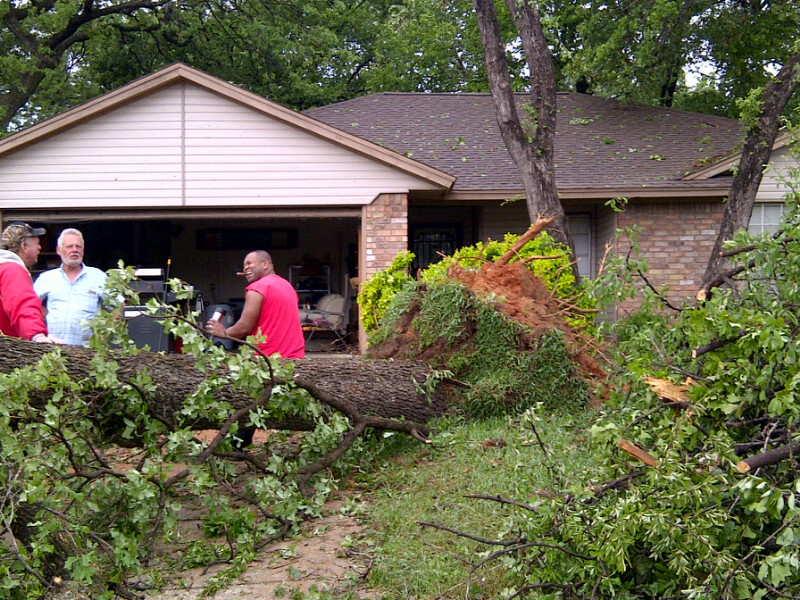
So many people have contacted Friends of Justice asking if we’re okay, that I thought I’d let you know that we are.  The picture to the left was taken about four blocks from the Bean home, so it was a close call.  This is the second time in five years that we have been three blocks from a devastating tornado (the other one was in Tulia, Texas).

Melanie Wilmoth Navarro, our Director of Outreach, got a good shot of the twister that hovered nearby for over an hour as large hunks of tar paper and insulation mixed with tree limbs rained from the sky  All the damage portrayed in this post was caused by this single tornado.

Several homes in a neighborhood located just north of the Friends of Justice office (and a bit south of the Bean home) were destroyed, and dozens of others sustained major damage.  A wing of a nursing home just up the road was completely destroyed.  A good report on the storm damage can be found here.

Friends of Justice staff took refuge in the meat locker of a Braum’s restaurant across the street from our office.  The chances of any particular property getting hit by a tornado are generally remote, but this one was far too close for comfort.  Power was restored at 2:00 am this morning and life is returning to normal.  Here are a few more pictures I took on the way to work this morning.