United Methodist Church divests from private prisons

by Melanie Wilmoth

Until last week, the United Methodist Church (UMC) owned stock in two private prison companies, GEO Group and Corrections Corporation of America (CCA). According to Bill Mefford, Director for Civil and Human Rights for the UMC’s General Board of Church and Society (GBCS), the denomination held about $736,000 in CCA and $215,500 in GEO Group.

Months ago, Mefford, the GBCS, and UMC churches started a petition on Change.org:

The private prison industry is a fast growing industry and extraordinary profits are made from such investments, with these two companies posting profits of 2.9 billion by the end of 2010. These profits are at the expense of people of color. Private prison corporations, such as GEO Group and CCA, lobby hard for anti-immigrant legislation, such as seen in Arizona with SB 1070 and Georgia with SB 87. Private prisons are also responsible for neglect and abuse in prisons. Such legislation and examples of abuse and neglect directly contradict United Methodist stances and biblical teaching.

We, as United Methodists, believe that profiting from private prisons and owning stock in private prison corporations like GEO Group and Corrections Corporation of America is incompatible with biblical teaching. Therefore, we call for The United Methodist Church to:

1. Immediately divest from all investment in private prison corporations, including Corrections Corporation of America and GEO Group, and

2. Take all money earned to date of divestment from ownership of the stock in GEO Group and CCA, and give it to organizations dedicated to helping those coming out of prison to reenter society.

It was a great victory for the GBCS and other advocates when the UMC announced this week that it is divesting from GEO Group and CCA. According to Laura Markle Downton, Criminal Justice Grassroots Coordinator at the GBCS:

“As of last week, the United Methodist Church has divested from both CCA and GEO Group, and UMC’s Board of Pensions, which controls the investments of our church, has permanently put into place a screen that will not allow us to invest in any corporation in the future that has gross revenues of 10% or more from private prisons.” (more…)

Immigrant detention in the U.S.: Tales from within

by Melanie Wilmoth

In a recent report published at Colorlines.com, Seth Freed Wessler describes his experiences visiting the Baker County Jail and several other immigrant detention centers throughout Florida and Texas.

Since 2009, the rapid expansion of immigrant detention in the U.S. has led Immigration and Customs Enforcement (ICE) to create or expand at least 10 detention centers. In addition, immigrant detention accounts for over $2 billion in the 2012 federal appropriations bill. The private prison industry, which grosses about $5 billion annually, is contracted to operate most of these detention facilities.

Despite the Obama administration’s plan to reform immigration laws and prioritize alternatives to mass detention, “ICE under Obama has moved to build more facilities, which it says will be ‘humane.’”

But, in reality, how “humane” are these facilities?  (more…)

Coerced confessions: One way wrongful convictions happen

by Lisa D’Souza

It seems impossible to imagine confessing to a serious crime that you know you did not commit.  That’s why confessions make such great evidence.  Juries almost always believe them.  And yet, false confessions happen.  They usually happen in serious felony cases; 80% of coerced confessions uncovered in one study were obtained in murder investigations.  A significant number of the convictions overturned by DNA evidence were based on coerced confessions.  Others remain in jail on cases in which DNA evidence exonerates them but based on their confession judges and prosecutors refuse to consider the conviction wrongful.

Young people or people with mental retardation are more susceptible to making a false confessions.  Another study found that 63% of false confessors were under the age of 25, and 32% were under 18; yet of all persons arrested for murder and rape, only 8 and 16%, respectively, are juveniles.   In a 2005 study at Williams College, students gave false confessions when confronted with manufactured evidence.

Police are trained to interrogate suspects using psychological methods.  These interrogation techniques are powerfully coercive and are designed to destroy the suspect’s hope and confidence.  Police often lie to suspects about the evidence against them and make false promises about what will happen if they provide a confession.  The police, convinced before the interrogation that the suspect is guilty, go to great lengths to obtain a confession.  The prosecution is then convinced by the confession that the suspect is guilty.

And that is how many wrongful convictions happen.

Nga Truong spent her 17th, 18th and 19th birthdays in jail after being coerced into confessing that she murdered her infant son.  Why would she say she killed her baby when she hadn’t?  Read more about Nga Truong at: http://www.npr.org/2012/01/02/144489360/how-a-teens-coerced-confession-set-her-free?sc=fb&cc=fp

Learn more about coerced confessions at: http://falseconfessions.org/false-confessions-happenand at: http://www.truthaboutfalseconfessions.com/

Beyond DNA

Dallas DA, Craig Watkins

By Alan Bean

The Dallas Observer recently published Leslie Minora’s extensive piece on the shift to non-DNA exonerations in Dallas County.  DA Craig Watkins has been accused of grandstanding, Minora says, but his ideological opponents usually overlook the unusual context in which the Maverick prosecutor works:

What his critics ignore is Dallas County’s reputation as a place where prosecutors aimed to convict at all costs. Changing that culture in a conservative, law-and-order minded place like Dallas is difficult. What his critics see as media whoring could just as easily be considered the sort of necessary publicity to change the political culture and — not coincidentally — keep Watkins in office. Watkins, a former criminal defense lawyer, Texas’ first black district attorney and the first Democrat to win the Dallas office since 1986, took a political gamble in establishing the unit. As non-DNA cases increasingly become the unit’s focus, the stakes grow higher as the cases lose the protective hedge of objective, science-based evidence. “I’m sure the day will come when there will be political fallout as the result of a decision we make to exonerate someone with no science. That’s inevitable. That will happen,” Watkins says. But as Duke and others can attest, it’s a risk Watkins is willing to take.

The article notes that Watkins’ Conviction Integrity Unit dealt with the easy, smoking-gun DNA cases first.  But what about the 85% of criminal cases that involve no meaningful DNA evidence?

. . . the sheer number of DNA exonerations — and the efforts to uncover how the courts failed so miserably — have revealed troubling gaps in the criminal justice system: Eyewitnesses are more fallible than jurors might think; forensic evidence isn’t always reliable or interpreted correctly; the way police run lineups can lead to wrongful convictions. The trouble is, those problems may just as easily plague cases in which no DNA exists. Modern science has shown the justice system the tip of the iceberg, but how many innocent men and women are suffering in prison and likely to stay there because they have no evidence to test? Where do law enforcement and innocence advocates, faced with sorting out the guilty and innocent, go from here?

The move to non-DNA exonerations will be difficult, Minora predicts.  Recanting witnesses, ambiguous evidence and gross prosecutorial misconduct may raise concerns about the legitimacy of a conviction; but there is no real substitute for the slam dunk certainty DNA evidence can provide.  How will the public respond to cases that, although riddled with issues that undermine confidence in a conviction, fall short of the sure-fire proof of actual innocence to which residents of Dallas County have grown accustomed?   

Beyond DNA, Difficult Tests for the Justice System is highly recommended.  In an entertaining and revealing section, Minora puts Craig Watkins (the most progressive prosecutor in Texas) against Williamson County’s John Bradley, arguably the most law-n-order DA in the Lone Star State.  Grits for Breakfast reported this morning that the Texas Bar Association has dismissed the grievance filed against Bradley in connection with the Michael Morton case.  This suggests that, here in Texas anyway, Bradley’s insistence that the guilty remain behind bars still trumps Watkins’ fears about wrongful conviction.

There’s hope for reconciliation between religious right, progressives

This ground-breaking op-ed by Mark Osler and Randy Potts appeared in the Christmas Eve edition of the Dallas Morning News.  Historically, opinion leaders in the Christian conservative and social progressive camps have viewed one another as ideological opposites and, regrettably, frequently bolster their fundraising efforts by attacking the other side of the culture war stand-off.  Having worked with folks from both sides on both sides, Osler and Potts see more similarities than differences.

Law professor, Mark Osler, will be familiar to our readers.  Randy Roberts Potts, a former social worker and middle school English teacher, is a freelance writer who wrote about his coming out experience as the grandson of televangelist Oral Roberts in the recent book, It Gets Better.

There’s hope for reconciliation between religious right, progressives

The holiday season is a time to rejoice, a time to eat and be merry, a time to reflect on what unites us. Especially at this time of year, it seems that too much of our political landscape has been covered with battles between conservative Christians and social progressives.

Some people see the occupy Wall Street and tea party movements as a manifestation of that divide, but such an analysis (though true in part) obscures the fact that that both sides of the culture wars now feel ignored by a power structure that most values the rich and large institutions. Within this truth lies an opportunity for reconciliation between two groups that in many ways are natural allies. Like estranged relatives who find themselves welcome again at Christmas dinner, we need to drop our guard and open our hearts.

Why should we have hope that such reconciliation is possible? (more…)

Is ending the drug war enough?

By Alan Bean

It is good to see book reviews like this popping up in conservative papers like the Amarillo Globe-News.  Ernest Drucker’s A Plague of Prisons covers ground that will be familiar to readers of this blog.  If his numbers are accurate, the State of Texas was locking up almost as many people in 2009 as the entire state prison system in the United States was incarcerating in 1970.  Grasp that fact and you get a feel for the extent of mass incarceration.

According to Ronald Fraser’s review, Ernest Drucker compares the growth of prisons to a contagion sparked by a futile war on drugs.  The solution?  According to Fraser and Drucker its simple: “Simply by not incarcerating new cases involving nonviolent, small-time drug offenders would, Drucker said, immediately cut prison admissions by 30 percent.”

The problem here is obvious.  Like most liberal and libertarian analysts, Fraser (and possibly Drucker–I haven’t read the book) refuse to grapple with the obscene spike in violent crime that gripped America from the late 1960s to the early 1990s.

Bill Stuntz saw the war on drugs as a proxy war on violent crime.  Thanks to a plethora of state and federal laws, it became much easier for prosecutors to put a gangsta away on drug charges than to make a murder or assault rap stick.  That may be a bit of an exaggeration, but there can be no doubt that the penalties for drug offenses have become grossly disproportional.

There can also be little doubt that the war on drugs was enthusiastically embraced by almost everybody, including the poor residents of most high crime neighborhoods and the politicians who represented them.  This wasn’t because people living in hot neighborhoods liked or trusted the police (they didn’t); but they liked the open air drug markets and gun violence even less. (more…)

Pastor W.G. Daniels waged peace in Fort Worth, Texas

PASTOR 4By Alan Bean

No one can account for the dramatic drop in violent crime.  According to the Washington Post, in 2011 the DC homicide rate reached its lowest point since 1963.  But just across the county line, the homicide rate is experiencing an upswing.  When violent crime drops there is always a reason.  When gang-related violence plunged in Fort Worth, TX, a big part of the reason was the Rev. W.G. Daniels. 

Daniels died this week.  Marty Sabota’s obituary shows that Daniels grasped many of the principles criminologist  David Kennedy outlines in his excellent book Don’t Shoot:

America has four inextricably linked problems that converge in its most troubled communities.   There’s the violence that terrorizes many of its, especially, black and minority communities. There’s the chaos that comes with, especially, public drug markets.  There’s the devastation being wrought on, especially, troubled black and minority communities by our criminal justice in response to the first two problems.  And there’ the worsening racial divide that’s causing.

In Fort Worth, Pastor W.G. Daniels stopped the violence by forging a creative dialogue between law enforcement and the communities most affected by violent crime.  A former police officer who understood the law enforcement mindset, Daniels made the perfect peacemaker.  He knew why his neighbors didn’t want to talk to the police, but he also understood why law enforcement will always concentrate on high crime communities.  Daniels didn’t want the police to ignore the hot neighborhoods; he just wanted them to show more respect and professionalism.  

Getting gang members, community members and the police on the same page isn’t easy, but it can be done.  As Daniels once told the Star-Telegram:

You had gangs like the Crips and the Bloods fighting against each other, but after we conducted a survey, we found that there just needed to be somebody to bring a truce to stop the madness and no better people to do it than pastors who meet every Sunday. We needed to send a message that it would not be tolerated, and by the help of God and Christ we were able to bring about peace.

When people are talking to one another behavior changes.  Open air drug markets move underground, police officers feel more appreciated and behave with a higher level of professionalism, residents of high crime neighborhoods gain a new sense of confidence and self-respect.  Criminologist David Kennedy and pastor W.G. Daniels heal communities because they understand the spiritual nature of the war they are fighting.  (more…)

Michael Morton case raises questions about prosecutorial accountability

By Alan Bean

This New York Times editorial touches on a case that will be familiar to readers of Scott Henson’s excellent Grits for Breakfast blog.  A few days ago, Scott provided this helpful summary of the Michael Morton imbroglio and its singular significance:

Grits recently named the Michael Morton exoneration out of Williamson County the biggest Texas criminal justice story of 2011. Morton spent a quarter-century in prison for allegedly murdering his wife before he was exonerated by DNA and a team of won’t-quit attorneys who fought Williamson County DA John Bradley over testing the evidence for six long years (prevailing only after the Legislature changed the law to remove Bradley’s grounds for objection). It turned out prosecutors 25 years ago had failed to release exculpatory evidence to the defense, and the man who apparently did so, then-elected DA Ken Anderson, is today a sitting Williamson County District Judge. You really can’t make this stuff up!

John Bradley is currently locked in a tight election race that will tell us how the good people of Williamson County (reputedly the most tuff-on-crime county in one of America’s most tuff-on-crime states) feel about the gross injustice perpetrated in their name.

But, as the NYT editorial below correctly observes, this isn’t just a story about a single county or a single state; the Michael Morton case is an egregious example of business as usual in our legal system.  It isn’t that all prosecutors routinely withhold exculpatory evidence from defense counsel (most do not); but if they do, the crime is rarely uncovered, and even when the truth is exposed there is little anyone can, or will, do about it.

In a few weeks I will be telling you how the DEA and the DOJ conspired to convict Ramsey Muniz of a crime he could not possibly have committed.  It all began with an investigative report riddled with baldfaced lies.  A DEA agent reported that her attention was drawn to Muniz by Ramada Inn employees who called to report suspicious behavior.  This report became the foundation for a widely circulated Houston Chronicle story (Muniz once ran for governor, so his legal woes attracted considerable attention) and the basis of the government’s case.  

This story was accepted as bedrock truth until attorney Dick DeGuerin decided to chat with the employees at the Ramada Inn.  They hadn’t been suspicious of Muniz at all, they told the Houston attorney, in fact, the polite businessman had been a model guest.  Furthermore, the Ramada Inn hadn’t contacted the DEA, the DEA contacted the motel. 

When it became clear that a DEA agent had repeatedly perjured herself, the government simply adjusted its story on the fly as the presiding Judge pretended not to notice.

That’s the real problem with prosecutorial misconduct–nobody cares–at least nobody with the power to do anything about it.   If you don’t believe me, read on.     (more…)

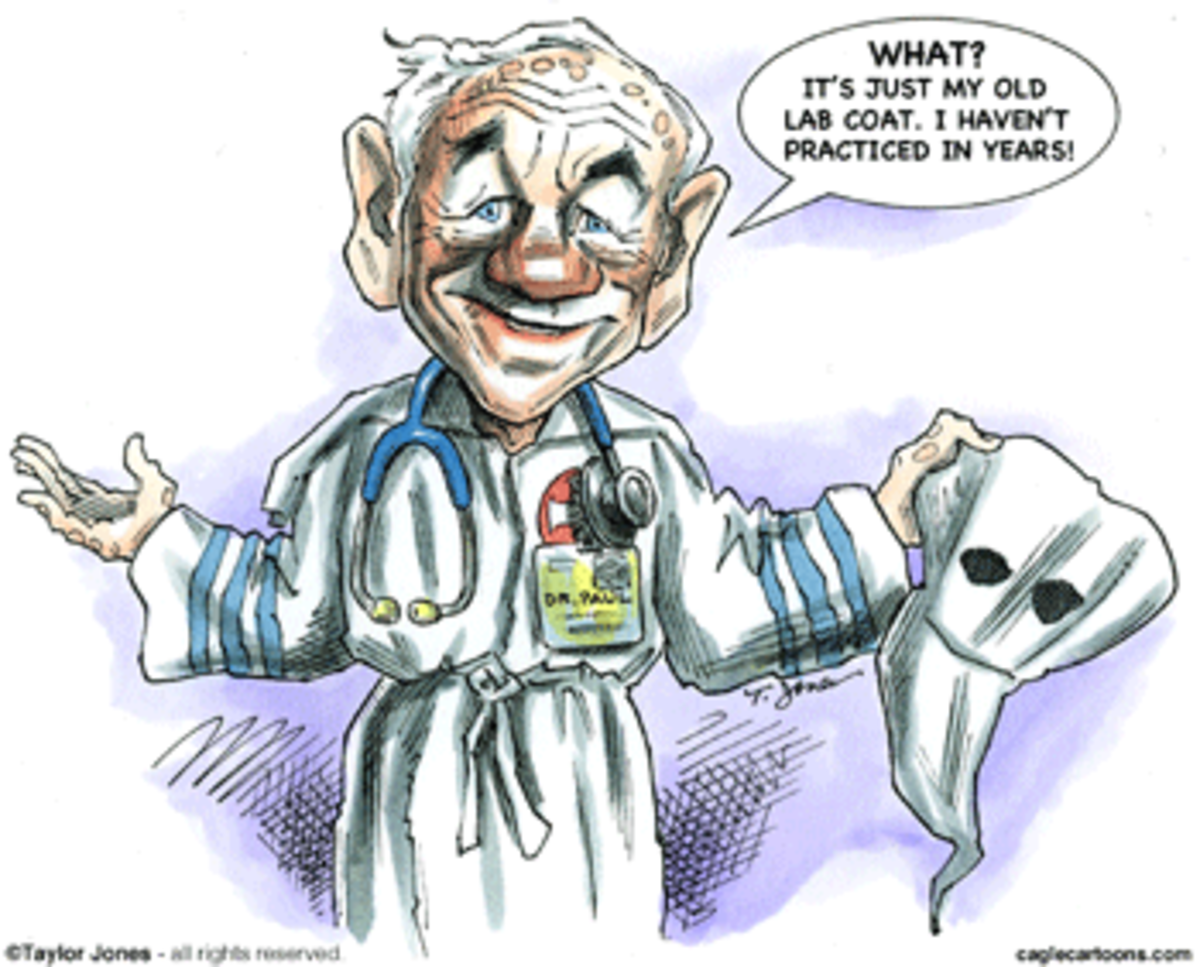
Progressives should be wary of Ron Paul

There is a lot to like about Ron Paul.  He opposes the war on drugs; he is anti-war, and he doesn’t like the Patriot Act.  Who could ask for anything more?

If you believe Adele M. Stan, progressives should be asking for much, much more.  Ron Paul’s libertarianism may overlap with the progressive agenda at important points, but it flows from a entirely different source.  Stan associates Paul with the anti-civil rights John Birch Society as well as the modern Reconstruction movement.  My research has reached similar conclusions.

Progressives contend that we’re all in this thing together; Libertarians say we’re all on our own.   Progressivism is consistent with religious altruism; libertarianism logically tends toward the moral nihilism of Ayn Rand. A philosophical difference that great can’t be mended with duct tape and baling wire.  Friends of Justice endorses a Common Peace Agenda that embraces the legitimate rights and needs of all people.  We aren’t satisfied with simply ending the war on drugs or reducing the size of the prison population; we seek what Martin Luther King Jr. called The Beloved Community. 

Those in search of the common good must choose their coalition partners with great care.  We don’t have to agree on every point, but we must be working toward the same broad goal.  What kind of America are we trying to create?  AGB (more…)

Challenging Ron Paul’s Followers on Racism

A sane, reasoned analysis of Ron Paul’s newsletter problem.  AGB 

Originally published in LA PROGRESSIVE.

December 27, 2011

By

Paul Ron kkk Challenging Ron Pauls Followers on RacismI can’t say that I am surprised by the content of recently unearthed Ron Paul newsletters from the 1990’s that talk about a coming “race war,” or about Congressman Paul’s continuing connection to the John Birch society. Neo-Confederates, white supremacists, and those who hate immigrants and gays have been vocal supporters of the conservative wing of the Republican Party for the last 40 years, so it is not surprising that Rep. Paul would count people with such views among his most loyal supporters.

Nor he is alone in such a posture. During her run for the Vice-Presidency, Sarah Palin attracted more than a few such people to the rallies she organized, to the great embarrassment of John McCain​, while racist imagery was a fixture at early rallies of the Tea Party before leaders of that movement were able to persuade, or force, individuals with such views to go into deep cover.

But Ron Paul is not your ordinary conservative Republican. The success of his current run for the Republican nomination depends on him persuading Democrats attracted to his anti-war, pro-civil liberties policies to register as Republican. Moreover, his presidential run, either as a Republican or an independent, cannot gain traction without gaining support from at least some people of color, leftists and liberals.
 
If these people are like me — a white leftist who lives in an heavily immigrant city, works in a predominantly black workplace, and is part of a multiracial family — they will have something close to zero tolerance for racism, sexism and homophobia. They are not only going to look closely at how Congressman Paul responds to these latest revelations, but how his most impassioned white followers act when he is raked over the coals in the media because of suggestion that his campaign is tainted by such prejudices In my own way, I have been very closely observing how the libertarians to whom I have been connected by social media have dealt with the new revelations about Ron Paul’s past. Have they responded by calmly pointing out that the Ron Paul campaign, and the libertarian movement generally, is a big tent that welcomes blacks, immigrants and gays, or have they attacked those who demand that Paul respond forthrightly and quickly to the new revelations as enemies of liberty whose motives are suspect?

The informal results of my little survey may surprise my friends on the left. The majority of the libertarians I work or correspond with have pointed out that the sentiments in those newsletters do not represent what Rep Paul, or the vast majority of his followers stand for and insist that the movement they are a part of will remain inclusive and multiracial. I don’t necessarily agree with all their conclusions, but the manner in which they have responded has been reassuring. In defending Paul, they have not allowed themselves to become the very people they were accused of apologizing for or protecting.

However, a few of the Ron Paul supporters in my networks have completely flipped out over the new accusations and have struck out at anyone and everyone who raises questions about the Paul campaign with injured innocence and a torrent of abuse.

Implicitly and sometimes explicitly, they have said that racism is no longer an issue in American society, and that critics of Paul are “playing the race card” to undermine the campaign of a great patriot and a great American

This argument is not only unconvincing, it is counterproductive. It suggests that supporters of Ron Paul have something to hide, most probably the very attitudes that critics accuse the movement of harboring

Let me conclude with the following suggestion. If supporters of Ron Paul want to continue to attract a multiracial following, they will have to deal in a serious and principled way with accusations of racism, homophobia, and anti-immigrant prejudice, not move into a posture of denial

mark naison Challenging Ron Pauls Followers on RacismIn our very NON post racial society, denying racism’s existence is a posture that arouses, rather than defuses, suspicion among racism’s long time victims.

Healing America’s racial wounds requires open discussion and debate. Those who call for a cover up when real issues arise contribute to the continuation and intensification of the very divisions they claim to abhor.

Mark Naison
With a Brooklyn Accent