(This post is part of a series concerning Curtis Flowers, an innocent man convicted of a horrific crime that has divided a small Mississippi town. Information on the Flowers case can be found here.)
Seven years after Fannie Lou Hamer was beaten by the minions of Earl Wayne Patridge, a young woman gave birth to a baby boy in Winona, Mississippi. She named the baby Curtis Giovanni Flowers. Twenty-six years later, Lola Flowers’ baby was charged with murdering Bertha Tardy, Carmen Rigby, Derrick “Bobo” Stewart and Robert Golden in a Winona furniture store.
How much had changed in Winona during Curtis Flowers’ quarter century in the free world?
Winona is the county seat of Montgomery County, once the boldest bastion of white supremacy in the state of Mississippi. Little civil rights brush fires sprang up in Montgomery County in the early 1960s, but men like Sheriff Earl Wayne Patridge and Tom Scarborough of the Mississippi Sovereignty Commission made sure they were stomped out before they could spread. Sometimes that meant issuing an extrajudicial beating to uppity black males in the dead of night. When a black school teacher who thought he could register to vote just because he held a masters degree, it was necessary to denounce the man as a communist agitation and have him fired. If a young black preacher encouraged his flock to vote, he had to be relieved of his pulpit.
From a distance, it appeared that Fannie Lou Hamer’s team had scored a smashing victory at the expense of Earl Wayne Patridge and his ilk. In a sense, they had. Now black residents could register to vote without placing their jobs in jeopardy or risking a brutal beat-down. And just as little Curtis Giovanni Flowers was drawing his first breath, the doors of Winona’s public schools swung open to black students. (more…)
“If the freedom Democratic Party is not seated now, I question America. Is this America, the land of the free and the home of the brave, where we have to sleep with our telephones off of the hooks because our lives be threatened daily because we want to live as decent human beings, in America?” Fannie Lou Hamer
The summer of 1964 was a watershed moment for the civil right movement and for America. Never before had black and white Americans worked together with such common purpose. And yet, by the end of August, black civil rights leaders were vowing never to work with white people again. Meanwhile, white civil rights activists realized they didn’t have a home in either of the major political parties.
The voting rights movement had been building momentum in Mississippi since the Freedom Rides of 1961. The work was dangerous, beatings were commonplace and martyrs were plentiful. What better way to win protection and attention than to issue a call to idealistic young white people from across America to come to Mississippi for the summer of 1964? John Kennedy had been assassinated half a year earlier and a still-grieving nation was desperate for healing.
Across the southern states, only 40% of eligible African Americans were registered to vote; in Mississippi it was 6.4%. As we have seen, civic leaders in the Magnolia State were determined to keep Negroes out of the courthouse. For the most part, they were successful. To outsiders this looked like blatant injustice, but the good people of Mississippi felt they were simply preserving a cherished way of life. Throughout the spring and early summer the young people kept coming, just as they had at the high water mark of the Freedom Ride movement. They were young, idealistic, dedicated and often remarkably naive. Fannie Lou Hamer had to take the white girls aside and explain why it was a bad idea to be seen in public with a young black male–no matter how good looking and entertaining he might be.
The big idea was a mock election for the purpose of choosing delegates to the 1964 Democratic Convention in Atlantic City. Since African Americans were excluded from participating in the formal election process, they formed their own party, the Mississippi Freedom Democratic Party (MFDP) and conducted parallel elections that were open to all. The MFDP was prepared to argue that they should be seated in Atlantic City in preference to Mississippi’s all white “regular” democratic contingent. The official election was unconstitutional and undemocratic, it was argued, because black voters had been excluded. Furthermore, it was common knowledge that the Mississippi delegation to the Democratic Convention would be supporting the Republican Barry Goldwater in the fall election.
Throughout the summer, Freedom Schools designed to introduce children to the civil rights movement and the American Constitution popped up across Mississippi. White Mississippians correctly interpreted the Freedom Schools as the threat to the established order. In early June a church in the Neshoba County town of Philadelphia was burned to the ground for opening its doors to a Freedom School. Two young white civil rights workers from New York City, Andrew Goodman and Michael Schwerner, traveled to Philadelphia with James Earl Chaney, a black activist from Meridian Mississippi to investigate. Arriving in town, they were arrested, held for several hours, then released, re-arrested and delivered into the custody of the local Ku Klux Klan. While search teams were still scouring the area for the missing men, Mississippi Senator, James Eastland, speculated that the entire affair was a publicity stunt designed to make his beloved Mississippi look bad.
When the bodies were finally found buried in a Neshoba County dam, the bodies of all three men were riddled with bullets and Chaney’s body had been horribly mutilated. During that summer, 35 shooting incidents were reported, six activists were murders, 80 were beaten and 65 houses or churches were burned.
On August 21, 1964, short days before the beginning of the Democratic Convention, seven buses carrying Freedom Democrats from Mississippi rolled up to a modest motel in Atlantic City. President Lyndon Johnson had been hoping the MDFP would back down; he now realized that wasn’t going to happen. Everyone knew Johnson was on the verge of naming Minnisota Senator Hubert Humphrey as his running mate, but the formal announcement hadn’t been made. Humphrey was told that if the credentials of the MDFP deligates were recognized he could forget about being VP.
Lyndon Johnson famously predicted that the 1964 Civil Rights Act would lose him a sizable slice of the South, but his lead in the polls over Goldwater was large and growing. Still, he was worried. What if the sight of white delegates storming out of the convention while black delegates took their places sparked an anti-civil rights backlash across the nation. Besides, Johnson had a good working relationship with Mississippi Senators Jim Eastland and John Stennis and didn’t want to lose their behind-the-scenes support.
Photographers approached the MFDP delegation with a mix of trepidation and curiosity. One reporter said they had the look of prison escapees who feared they would be re-arrested the minute they re-crossed the Mississippi line. At the heart of the group stood the indefatigable Fannie Lou Hamer of Ruleville. Short and squat in her store-bought dress she was leading the group through a medley of spirituals and freedom songs.
Ed King at the Jackson Woolworth sit-in
The MFDP contingent also had a smattering of white delegates like Ed King, the chaplain of Tougaloo College in Jackson. King, a veteran of the sit-in movement, had nearly lost his life in a non-accidental highway accident. The family of slain activist Micheal Schwerner could frequently be seen with the MFDP delegates. Despite the disapproval of the Democratic hierarchy, MFDP attorney, Joseph Rauh, was able to arrange for a hearing in front of the credentials committee. Ed King, Martin Luther King, Rita Schwerner (the widow of the slain activist) and Fannie Lou Hamer were selected to address the committee.
While Lyndon Johnson watched in amazement, Fannie Lou Hamer sat down before a jam-packed auditorium and peered, unblinking, into the camera. “Mr. Chairman and the Credentials Committee,” she said, “my name is Mrs. Fanny Lou Hamer, and I live at 626 East Lafayette Street, Ruleville, Mississippi, Sunflower County, the home of Senator James O. Eastland, and Senator Stennis.”
The president was livid. This ignorant woman (as Johnson called her) was about to set the world on fire. Hurriedly, Johnson called a press conference to tell reporters nothing they didn’t already know. It worked. Network coverage shifted away from the ignorant woman from Ruleville to the most powerful man in the world.
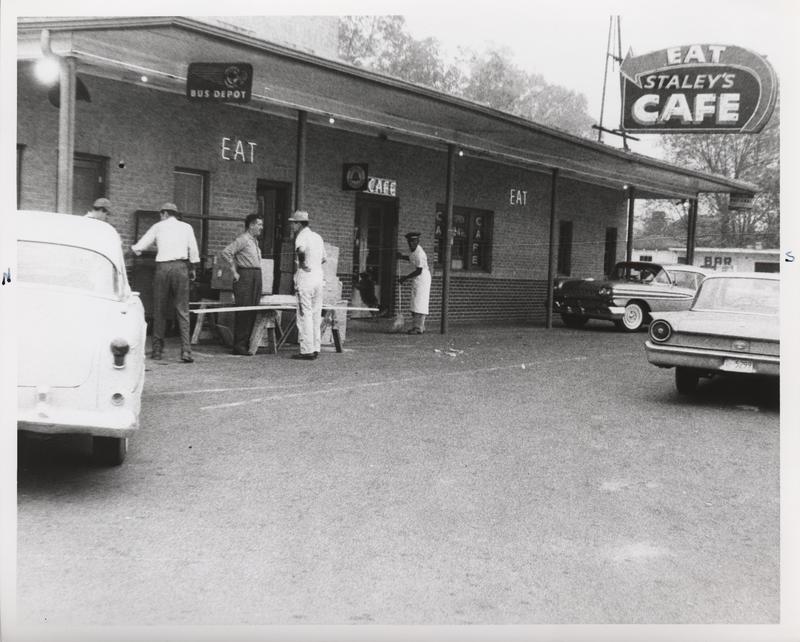
Fannie Lou Hamer talks about Winona justice
Johnson’s reprieve was only temporary. Hamer’s testimony was so rivetting that the networks replayed her remarks in their entirety later that evening. Fannie Lou talked about losing her job on the plantation because she had registered to vote in Indianola. Then she talked about her encounter with Mississippi Justice in the little town of Winona.
“And in June the 9th, 1963, I had attended a voter registration workshop, was returning back to Mississippi. Ten of us was traveling by the Continental Trailway bus. When we got to Winona, Mississippi, which is in Montgomery County, four of the people got off to use the washroom, and two of the people—to use the restaurant—two of the people wanted to use the washroom.
“The four people that had gone in to use the restaurant was ordered out. During this time I was on the bus. But when I looked through the window and saw they had rushed out I got off of the bus to see what had happened, and one of the ladies said, “It was a State Highway Patrolman and a Chief of Police ordered us out.”
“I got back on the bus and one of the persons had used the washroom got back on the bus, too.
Trailways Depot in Winona
“As soon as I was seated on the bus, I saw when they began to get the four people in a highway patrolman’s car, I stepped off of the bus to see what was happening and somebody screamed from the car that the four workers was in and said, “Get that one there,” and when I went to get in the car, when the man told me I was under arrest, he kicked me.
“I was carried to the county jail, and put in the booking room. They left some of the people in the booking room and began to place us in cells. I was placed in a cell with a young woman called Miss Ivesta Simpson. After I was placed in the cell I began to hear the sound of kicks and horrible screams, and I could hear somebody say, “Can you say, yes, sir, nigger? Can you say yes, sir?”
“And they would say other horrible names.
“She would say, “Yes, I can say yes, sir.”
“So say it.”
“She says, “I don’t know you well enough.”
“They beat her, I don’t know how long, and after a while she began to pray, and asked God to have mercy on those people.
“And it wasn’t too long before three white men came to my cell. One of these men was a State Highway Patrolman and he asked me where I was from, and I told him Ruleville, he said, “We are going to check this.”
“And they left my cell and it wasn’t too long before they came back. He said, “You are from Ruleville all right,” and he used a curse work, and he said, “We are going to make you wish you was dead.”
“I was carried out of that cell into another cell where they had two Negro prisoners. The State Highway Patrolmen ordered the first Negro to take the blackjack.
“The first Negro prisoner ordered me, by orders from the State Highway Patrolman for me, to lay down on a bunk bed on my face, and I laid on my face.
“The first Negro began to beat, and I was beat by the first Negro until he was exhausted, and I was holding my hands behind me at that time on my left side because I suffered from polio when I was six years old.
“After the first Negro had beat until he was exhausted the State Highway Patrolman ordered the second Negro to take the blackjack.
“The second Negro began to beat and I began to work my feet, and the State Highway Patrolman ordered the first Negro who had beat me to sit upon my feet to keep me from working my feet. I began to scream and one white man got up and began to beat me my head and told me to hush.
“One white man—since my dress had worked up high, walked over and pulled my dress down and he pulled my dress back, back up.
“I was in jail when Medgar Evers was murdered.
“All of this is on account of us wanting to register, to become first-class citizens, and if the freedom Democratic Party is not seated now, I question America, is this America, the land of the free and the home of the brave where we have to sleep with our telephones off of the hooks because our lives be threatened daily because we want to live as decent human beings, in America?
“Thank you.”
In moments, Democratic Party officials were deluged with phone calls and telegrams from outraged Americans demanding that the MFDP be seated immediately.
Lyndon Johnson was adamant that this must not happen. A compromise was proposed. Ed King and Aaron Henry would be seated as representatives of the MFDP and the white Mississippi delegation would be seated in its entirety. Fannie Lou Hamer decided the issue when she informed her contingent that she didn’t come all the way to Atlantic City “for no two votes.”
The issue was decided by a rushed vote–the white Mississippi regulars would be seated along with King and Henry. It was too late. Most of the regulars walked out of the convention in protest. When MFDP delegates took their places they were ushered out of the building by security personnel. The second night, every seat in the building was taken so the MFDP contingent marched to the convention floor where Fannie Lou Hamer led them in spirited song.
Stokely Charmichael
The white Mississippi regulars, as expected, abandoned the Democrats for the Republican Goldwater. They have controlled American politics ever since. It was no accident that Ronald Reagan launched his 1980 presidential campaign at the Neshoba County Fair.
Fannie Lou Hamer was disillusioned but undaunted. When a reporter asked her if she was seeking equality with the white man she peered at him imperiously. “No,” she said. “What would I look like fighting for equality with the white man? I don’t want to go down that low. I want the true democracy that’ll raise me and that white man up . . . raise America up.”
Are we there yet? Forty-six years after Ms. Hamer told America the truth about Winona, Mississippi the town remains deeply divided. The wrongful prosecution of Curtis Flowers has revealed a deep perception gap between Winona’s black and white residents. In the fourth of five trials, all five black jurors saw through the state’s paper thin evidence while all seven white jurors voted to convict. When legislation was introduced in a desperate attempt to expand the jury pool only one black senator supported the bill. It passed anyway thanks to overwhelming support from white senators.
The fact that Mississippi has a handful of black senators shows how much has changed. But the inability of white residents to call a wrongful prosecution by its proper name demonstrates just how far we have to go.
Two bizarre murder investigations raise questions about the state of the American criminal justice system.
Who dat, who dat, who dat say gonna beat dem Saints?
If I had a dollar for every time I heard the Saints famous chant during a long and involved Super Bowl night I could fund Friends of Justice in perpetuity.
I was in Slidell, LA investigating the Kelvin Kaigler story (and a host of related complaints) when I got an invitation from Will Harrell to join him in New Orleans for the big game. I met Will back in the summer of 2000 when he called me in Tulia to see if there would be any more drug trials. I told him Kareem White was up on September 7 and a few days later Will, the newly minted Executive Director of the Texas ACLU was walking into the Swisher County Courtroom.
Although Will and I have spent a lot of time together over the years (he is a very bad influence on this preacher boy) I didn’t know his personal biography very well. Turns out he hails from Yazoo City, Mississippi and lived as a boy in New Orleans. He cheered for the Saints when Archie Manning (father of Payton and Eli) quarterbacked the team. With all the other Saints fans, Will invested most of his life, boy and man, watching the pride of New Orleans slinking off the field in disgrace.
Not surprisingly, Will was captivated by the football game; brimming with hope, bristling with dread. A few former neighbors from Austin had shown up to watch the game at his house, but they met some girls in a bar and never returned. That sort of thing happens a lot in New Orleans.
So it was just me and Will. He showed me the paper mache statue of San Simon he was given during his days in Guatemala, and lit the candles he had placed on either side of the icon. Maybe the patron saint of Latin American freedom could bring the Saints a victory.
With the Colts down by seven and plenty of time on the clock, Paton Manning trotted onto the field. “He thinks he’s gonna win,” Will told me. “There is no doubt in his mind; that’s what makes him so dangerous.”
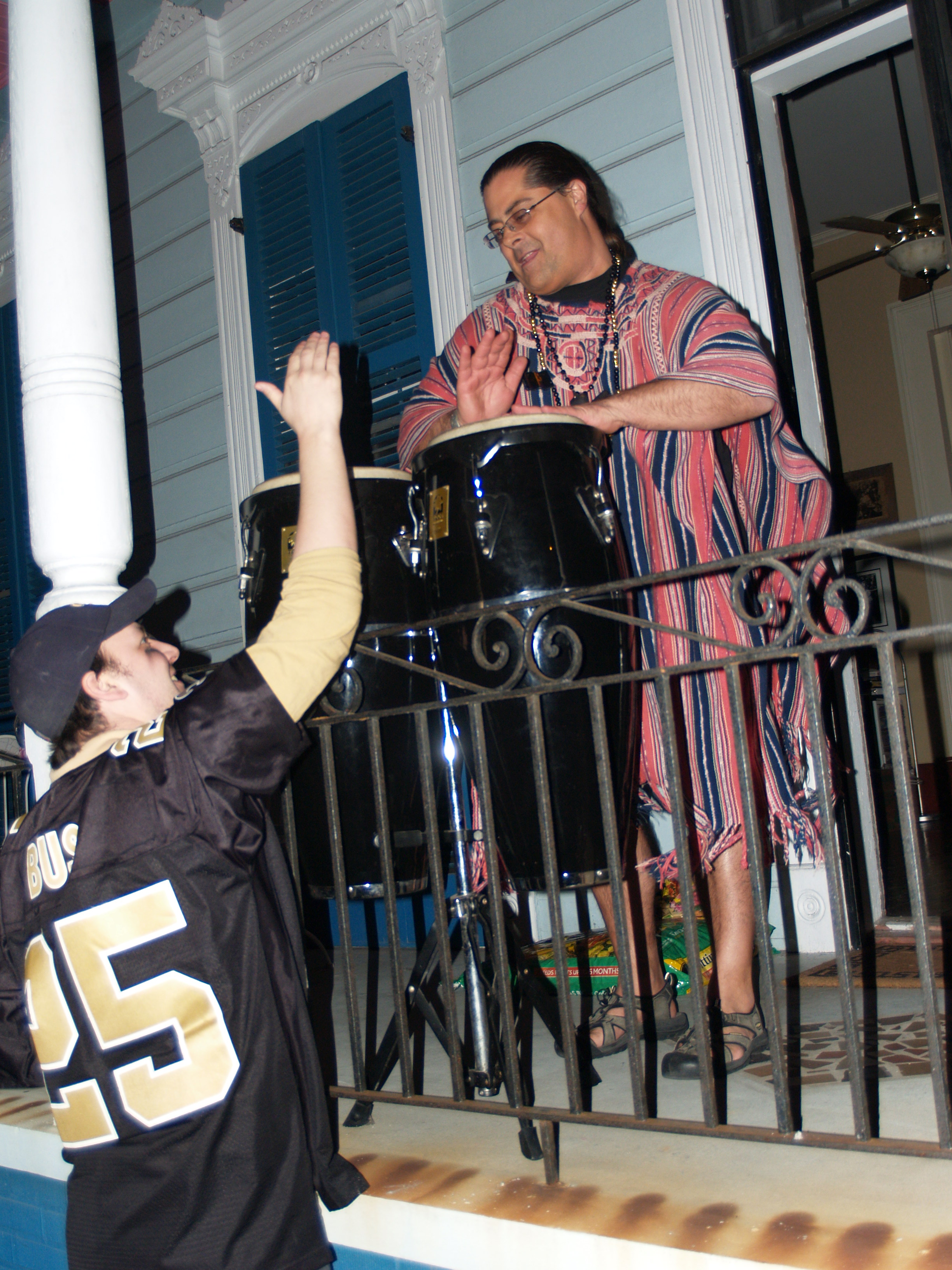
But the future hall of famer felt the heat from his left side and fired the ball into first-down territoty a second earlier than he would have liked to. Tracy Porter, New Orleans fleet defensive back, cut in front of Manning’s receiver, picked off the pass and raced for the end zone. Forty-three years of frustration had ended. A triumphant Will Harrell, bowed to St. Simon, grabbed his double bongo drum, and headed out to the porch. A stream of jubilant humanity was already flowing down Rue Dauphine toward the French Quarter. I crossed the street to take a picture of costumed kids with “NOLA” scrawled across their foreheads in black marker. They grinned for the camera and tossed me some Mardi gras beads.
By the time I was back to Harrell’s porch he had a smaller bongo slung over his shoulder and was ready to hit the streets. It was only 10:00 pm so I figured I’d tag along for a while–this was history in the making. It never occurred to me that we wouldn’t get back to Will’s place until 5:00 am.
You don’t see real celebration up close very often. This wasn’t your run-of-the-mill championship celebration; this was Easter morning. This was redemption.
As Will and I followed the growing crowd I couldn’t stop thinking about Rodney (Jack) Strain and the anti-New Orleans rant he had delivered three years earlier, particularly the part I failed to quote in my recent Kelvin Kaigler post: “I don’t want to see temporary housing because of Katrina turn into long-term housing for a bunch of thugs and trash that don’t need to be in St. Tammany Parish. We don’t want to wake up one day and find out that New Orleans has been damn successful at running all of the trash out of the city and it end up roosting in St. Tammany.”
At a meeting earlier that day at the Holy Ghost and Fire World Outreach Center in Slidell, Prophetess Kathleen Bacon told me that the High Sheriff was likely referring to the FEMA trailers that sprouted north of Lake Ponchartrain in the wake of hurricane Katrina. Conservative white folk have been fleeing New Orleans for generations. First they fled to the suburbs of Metairie and when upwardly mobile blacks followed suit, folks started moving to the North Shore, settling in places like Covington and Slidell.
Thinking back on Sheriff Jack’s anti-New Orleans rant I was struck by the man’s confidence–it was as if he saw himself as the embodiment of a people scared to death that their righteous way of life was being contaminated from without. I had sensed the same paranoid spirit in a sermon delivered by a Baptist pastor in Jena Louisiana shortly after a white student was beaten senseless at the high school. After celebrating the glories of small town life, the pastor warned his flock that big city vice and violence had invaded their holy Zion in the piney woods. He was referring, of course, to the Jena 6.
But Strain’s revulsion for New Orleans transcended race. Every race under the sun was on the streets of the French Quarter Super Bowl night, but white folks predominated. But these were not your Grandma’s white people. As Will and I followed the joyful throng we passed by an old-time jug band that was sitting in the doorway of a neighborhood bar. Looking for all world like Charles Manson, the guitarist was strumming his Epiphone guitar and wailing that old Louie Armstrong standard, The Saint James Infirmary Blues: “I went down to the St. James Infirmary, saw my baby there, stretched out on a cold white table, so sweet, so cold, so fair.”
I wondered if Louie Armstrong had ever performed the song in that very establishment. If not, he had sung it within a stones’ throw of the place. St. James Infirmary is a song about the tragic death of a young woman. The song hints that the singer’s “baby” was the victim of foul play. That sort of thing happened in old New Orleans. You run into death on the streets of old New Orleans. A mad waltz between life and death drives the spirit of celebration for which the town is famous. Jack Strain’s St. Tammany Parish is all about light and life (to hear Jack tell it anyway); New Orleans lives in the shadowlands between the light of life and the dark shroud of death.
There is nothing subtle about this death dance. You see it on the walls of the little bars: skulls, skeletons and other harbingers of death. There is more than a hint of threat and intimidation in some of the costumes I saw on the street Super Bowl night. People were not trying to look pretty or sexy; they were trying to look grotesque and slightly dangerous. And they succeeded.
Still, most of the folks in the pink hair and garish costumes live relatively normal lives and are in little danger of driving over the cliff. Their regular celebrations of animal appetite are only one side of the picture; they are also parents with children to care for and employees with jobs to go to. Moreover, the rules to New Orleans Bacchanalia are solidly anchored in the history of the town–these folks know what to do and how to do it–even when dem Saints win de big game. What could be more reassuringly innocent than a sousaphone blaring out When the Saints go Marching in?
And then there is the traditional role of New Orleans religion. These sinners are also saints. Mardi gras provides one last celebration before Ash Wednesday ushers in the somber season of Lent. There is a rhythm to these things. New Orleans is far more than a party town–at least for those who live there long enough to soak in the history.
On the other hand, Sheriff Jack Strain has a point; a lot of people go off the rails in New Orleans. In fact, many were never on the rails in the first place. Take away the counterbalance of work, family and religion and big cities like New Orleans can get pretty bleak. Thousands of people are too captive to their addictions to celebrate anything. The demand for booze, marijuana and hard narcotics will always be supplied. In the booze category, a rough and ready set of local and state rules apply. For the illegal stuff, only the threat of violence keeps folks honest. When people don’t hold up their end of the contract you can’t take them to small claims court. Bones must be broken–and that’s just for starters.
Back in 1986, Clyde Simpson, a Mississippi boy, was asked to store bales of marijuana in his garage in exchange for $50,000. Clyde had a little painting business at the time and his brother Doyle had come down from Winona to help him. One day somebody broke into Clyde’s garage and stole a few bales of marijuana. That made things contractually complicated. Did the big boys still owe Doyle his $50,000, or did he now owe them? To settle the issue, the big boys decided to take out a hit on poor Clyde.
One morning in December, Doyle Simpson pulled up to Clyde’s place and waited in his car in the driveway for his brother to come out. Doyle didn’t know that a man with a knife and a gun was hiding behind the fence at the side of the house. When Clyde emerged, the man slit his throat like a watermelon and pushed him inside the house. Clyde was in shock. He rushed to the refrigerator to find ice for his throat, but two bullets put him on the floor. As a puddle of blood began to form on the kitchen floor, the man with the knife burst out the front door and caught sight of Doyle waiting in his car. Thinking on his feet, the man climbed into the car, held his gun to Doyle’s head, and told him to drive.
When Doyle had driven fifteen miles west, the man with the knife told him to stop the car. Doyle was handcuffed to a tree. His throat was cut. Two bullets were fired and both found their mark. The man went back to the car to reload his weapon, then, deciding Doyle was dead, climbed into the car and attempted to drive away. But the car was helplessly stuck in the mud, so the man ended up hitching a ride on the highway.
Doyle Simpson found a broken bottle and was able to saw off the limb that tethered him to the tree. He then staggered to the highway, collapsing on the roadway just as a trucker rounded the bend. The driver drove Doyle to the hospital just in time to save his life.
The killer, a hired thug named Horace Toppins Jr, was charged with several counts in two Louisiana parishes and eventually sentenced to 30 years. It looked for all the world like an paid hit, but the victims were low status so nobody traced the crime back to its source.
Ten years later, in 1996, Doyle was back in Winona, Mississippi when somebody sold him a gun. Two months later, four people were gunned down in Tardy’s Furniture Store in Winona, the very morning Doyle reported his gun had been stolen from the glove compartment of his car. Ballistics tests demonstated that whoever killed Bertha Tardy and three employees had used Doyle Simpson’s gun. Doyle was picked up and asked who sold him the gun. Doyle said he got the gun from his step-brother, Robert Campbell.
It was a lie.
Confronted by investigators, Doyle said he had purchased the gun from a friend named “Ike”, but Doyle didn’t know the man’s last name.
Surprisingly, no one has ever pressed Doyle on the Ike question, perhaps because everybody knows its pointless.
But Robert Campbell, Doyle’s half-brother, believes that the mystery man who placed the murder weapon in Doyle’s hands is connected to the Tardy murders. Moreover, Campbell argues that the folks that paid to have Clyde Simpson murdered in 1986 were behind the murders in Winona in 1996.
Independently, I have come to the same conclusion. I have no idea why anyone would want Bertha Tardy dead; but somebody did. Since its hard to find an experienced hitman in Montgomery County, Mississippi, it was natural to look to a big city like Memphis or New Orleans. And if you wanted access to hired killers in the Crescent City, Doyle Simpson (a man who had worked at Tardy Furniture in the past) would be the man to approach.
I am not suggesting that Doyle Simpson was the trigger man, or even that he anticipated the horrible crime. But anyone who has seen the man testify or, like me, read through the transcripts of all five trials, knows that Doyle Simpson makes a frightened witness.
Did anyone steal the murder weapon from Doyle Simpson’s car the morning of July 16, 1996? We have only Doyle’s word for it and, as we have seen, he is not a credible witness. Was the gun stolen at all, or did someone from Doyle’s New Orleans past make an offer the Winona boy couldn’t refuse?
There is little evidence that these questions have ever been asked. Certainly not by Doug Evans, the Mississippi prosecutor who decided the day Bertha Tardy died that an ex-employee named Curtis Flowers did the deed. No other options were ever considered. Evans didn’t want to ruffle feathers in Winona’s white community by suggesting that somebody held a grudge against a well-respected local merchant. Of course, prosecuting Curtis Flowers has ruffled plenty of feathers in Winona’s black community, but Mr. Evans can live with that.
As we have seen, the fabled dark side of New Orleans received national attention ten years after the Tardy murders. As in Winona, four people had been killed execution style in the North Shore town of Slidell. Investigators speculated that Roxy Agoglia, a heroin addict and heroin dealer with roots in New Orleans, had angered the kind of people that came after Clyde Simpson twenty years earlier. Jack Strain certainly thought so. St. Tammany Parish had never seen a quadruple murder. New Orleans trash, Sheriff Jack told the cameras, had invaded the fair precincts of St. Tammany Parish and somebody was going to pay. A young witness told investigators that one of the killers had a scar on one cheek, a tatoo on his arm, and wore dreadlocks. To Sheriff Jack, that description had New Orleans Trash written all over it.
This explains why the first year of the murder investigation into the quadruple murders in Slidell focused on New Orleans heroin dealers with a penchant for violence. An investigator named Scott Davis was focusing his attention on a white heroin dealer who used two black men for “muscle”, one of whom had dreads, a tatoo and a scar. This fit witness testimony perfectly: a white guy waiting in the car while two black assailants pulled off the hit.
Then Gus Bethea had a chat with a Slidell drug dealer named Frank Knight. Frank was one of those denizens of New Orleans who never had a shot at the straight life. His mother was shooting heroin and dealing on the streets when Frank was born. In fact, it was Frank’s mother who suggested that her darling boy should confess to the police.
I know this sounds odd. Why would anyone say they were party to a notoriously violent drug hit if they had nothing to do with the crime? Well, if you are looking at 60 hard years for a multitude of drug-related felonies and the nice man in the uniform is hinting that you might be on the streets in seven years if you sign a confession, you sign the paper. Then you ask what you are signing so you will know what to say on the witness stand.
The New Orleans connection disappeared and Scott Davis was busted from detective to street patrol. The DA’s office had a confession and they knew a St. Tammany jury would buy it. So what if Frank Knight was fabricating a story in exchange for a get-0ut-of-jail-free card; a difficult case would be closed.
Once again, investigators refused to ask the obvious questions. Why would a young man like Kelvin Kaigler murder Roxy Agoglia and three innocent relatives? True, in High School, Kelvin always told his friends that he was from New Orleans; Slidell sounded so uncool. He dropped out of High School, got a job on the riverfront in New Orleans, fell in with the sort of people Jack Strain rails about, and began experimenting with crack cocaine.
Debbie Callens and Gloria Kaigler
Then, about a year before the quadruple murders in Slidell, Kelvin Kaigler’s life underwent a dramatic reversal. He developed a love for Christian rap music and cut off all contact with his former friends in New Orleans. “Kelvin was working in New Orleans when he had a car accident,” neighbor Debbie Callens, told me. “He totalled his car and didn’t want to replace it. He was doing landscaping work aroun the neighborhood and my husband and I had him work in our yard. When that kid smiles, everything lights up. He has a very bkind spirit, very gentle. When you see Kelvin, you can see into his soul. He told me he didn’t want a car because it wanted to stay close to home.”
“We felt like he was turning the corner,” Kelvin’s brother Earl tells me. “The guys he had been hanging with in New Orleans were kind of sketchy; the kind of people that would make money and blow it. But once he settled down, every penny Kelvin made was going into his music and his CD.”
The lyrics on the CD Kelvin released prior to his arrest are an earnest testimony to the dramatic conversion playing out in his soul.
Kelvin Kaigler
“Something’s missing inside,” he sings. “I’m tryin’ to think of what it could be. All the pain that I’m feeling, all the death that’s all around me. Lookin’ at myself up in the mirror, thinking where I went wrong.”
“No more chains holding me down,” Kelvin declares in another song, “bustin’ loose, flying free. I’m so weak, but the Lord kept me by his side, and brought me through all the rain, no more pain, and from that day, my life could never be the same. No more chains.”
Then everything fell apart. “The first week in August, Mr. John (that’s my father) closes down his barber shop in New Orleans, rents a van, and drives the whole family to Cairo, Georgia, to pick up my mother’s 90 year-old mother. Then we all drive up to Gatlinburg. It’s mostly white tourists up there, but we always have a good time. In 2007, Kelvin came along for the first time in a long time, and that’s when he was arrested. He saw them coming and told Mr. John he might want to open the door. These deputies busted into the room witht their guns drawn the second night the family was up there. One of them said he knew Kelvin didn’t do it, but they thought he might know something. But in the papers they made it look as if Kelvin was a fugitive from justice.
Kelvin Kaigler and Curtis Flowers have a lot in common. Both men love gospel music: Kelvin likes rap and Curtis (a generation older) prefers the traditional sound. Curtis leads the singing at prison church services and Kelvin continues to write rap songs behind bars. When I talked to him in the company of his attorney, Martin Regan, Kelvin was radiant. Like Curtis Flowers, Kaigler has no doubt that he will one day be exonerated. Martin Regan agrees, but knows they face a difficult legal fight.
Kelvin and Curtis share more than a love for gospel music; neither man is capable of killing four people in cold blood and neither man possesses the slightest motive for doing so. Roxy Agoglia, the woman who was murdered in Slidell in 1996, was a heroin dealer murdered because she couldn’t pay her debts. Kelvin Kaigler has no connection to the heroin trade. Neither does James Bishop, the second man Frank Knight says was with him on the fateful night.
Curtis Flowers had no reason to wish any harm to Bertha Tardy. True, Tardy and Flowers had a disagreement over some damaged batteries. “I was with Curtis more than once when Miss Bertha called him,” Robert Campbell told me today. “She was begging him to come back to work, but he wasn’t interested. He told me, ‘I don’t want a job where I deliver a piece of furniture and then, three days later, I go out and haul it back to the store.'”
Curtis Flowers held no personal animus toward Bertha Tardy. The woman gave him an $30 advance on his salary so he could enjoy the Fourth of July Holiday and begged him to return when the work week resumed. But Curtis had already decided to move in with his sister in Dallas where he could make twice the minimum wage salary he was pulling in Winona. The idea that he would kill four innocent people (two of them personal acquaintances) over a minor salary dispute is simply preposterous.
While two innocent men languish in prison the real perpetrators of mass murders in Slidell, Louisiana and Winona, Mississippi continue to ply their dangerous trade, likely on the streets of New Orleans.
Donald Washington, Louisiana’s first African-American US Attorney, is stepping down. Among his greatest achievements, he says, is his handling of the controversial Jena 6 case in 2007.
If you think Mr. Washington is proud of bringing a serious racial incident to the American public’s attention, think again. Quite the reverse. Louisiana owes Mr. Washington a vote of thanks for effectively debunking bogus claims made by people like me.
“There’s a huge story that one day may be told,” Washington said. “To sum up our involvement, the Department of Justice did a great job of ensuring that controversies that happen on school campuses don’t become federal cases unless the facts in evidence lead us in that direction.”
Mr. Washington was under heavy pressure to prosecute the young men who hung nooses from a tree at Jena High School as hate criminals. I have always supported his restraint in that regard.
But there’s more.
“As far as the kids are concerned, it is more than abundantly apparent that they never intended for what happened in two disparate and separate events to be linked together and become the focus of a national controversy. And to this day, all of those groups that intended to ferret out any kind of nefarious conduct on behalf of the citizens of the Jena community still have failed to do so.”
If you find that hard to follow, here’s a rough translation: “There was never the slightest relationship between the nooses hung at the High School in September and the schoolyard assault on Justin Barker three months later.”
Since I am the first person to link the nooses and the beat-down, I take Mr. Washington’s comments personally. That doesn’t mean I disagree with his assessment in every particular. I never argued that the black football players who assaulted Mr. Barker were consciously avenging the noose provocation. On September 20th, 2007 I enjoyed a series of conversations with the men and women who rode the buses to Jena from all over the nation. Most of the folks I talked to believed the assault on Barker followed hard on the heels of the noose hanging.
Not so. It’s true that black students were deeply provoked by the noose incident. The nooses appeared the morning after a black freshman asked if it was okay for black students to sit under the tree at the white end of the school courtyard. Although black kids were free to visit the tree whenever they chose, everybody in Jena understood that one side of the courtyard was reserved for white kids and the other end was for the black students. It had been that way ever since Jena schools integrated in compliance with federal law in 1970. The kid who asked the question was challenging the tradition of a segregated school courtyard. That was the issue and folks on both sides knew it.
Black kids were angry in the wake of the noose incident; but they weren’t fighting mad.
The Jena equation doesn’t balance until you factor in the behavior of adults.
First, the school superintendent announced that the noose hanging was completely unrelated to racism. Is Mr. Washington, the outgoing US Attorney from the Western Louisiana Division of the Department of Justice, signing off on this bizarre sentiment?
So it seems.
It was the refusal of school officials to acknowledge that Jena High School had a racial problem that sparked the anger of black students. Now they were fighting mad. Pushing matches flared up on campus. Nothing serious, but tension was escalating. It got so serious that police officers placed the campus on full lockdown.
That’s when the second bull-headed act by a white public official took place. The principal called all the students to the school auditorium for a special assembly. True to tradition, the white kids sat on one side of the aisle, the black kids on the other. Every uniformed police officer in town was in the room. District Attorney Reed Walters walked to the podium and told the kids to settle down and get a grip. Then he turned to the kids on the black side of the aisle, pulled out his Parker Jotter and said, “I want you to know that I can end your lives with a stroke of my pen.”
Walters has admitted making this remark. He says he thought the white and black students should have been able to work things out among themselves.
One thing was certain, the student body wasn’t going to get any guidance from adults.
DA Reed Walters and Superintendent Roy Breithaupt weren’t acting on their own initiative. They were desperate men doing what they had to do. They couldn’t address the racial history of Jena without throwing their community into an uproar. Besides, Reed and Roy were raised in the segregated South. Their behavior suggests they have never backed away from the racist assumptions at the heart of the Jim Crow regime. These men weren’t going to tolerate overt racism. If the white kids had donned sheets and burned a cross on the black end of the school yard, school officials would have taken action. But anything more subtle than that would be ignored or interpreted as innocent juvenile horseplay.
Justin Barker was best friends with the boys who hung the nooses. These were country kids who grew up in all-white schools. When they hit high school, they were bused to the semi-integrated high school in Jena. It was only natural that these kids were intimidated by black students–especially football players. But it would be a tragic mistake to single out the kids who hung the nooses for special attention– as Walters and Breithaupt’s bizarre behavior suggests, the noose hangers were reflecting the values of the culture that shaped them.
Tension between the white “noose boys” and the black football players rose steadily during the fall semester–but the altercations were always off campus. Then somebody set fire to the high school campus–a detail rarely mentioned in media accounts. Robert Bailey was assaulted at a Friday night dance and this led to a related altercation at a convenience store the following morning. When school opened on Monday morning, angry confrontations erupted during the lunch hour. Kids were rehashing the Bailey beat-down and Justin Barker was at the heart of the action.
So, although there is no direct connection between the noose incident and the assault on Justin Barker, it doesn’t take a genius to connect the dots.
Unless, as folks like Donald Washington would have you believe, the Friends of Justice narrative is largely fictional.
Which brings us to June of 2009 when the five Jena defendants still awaiting trial pled guilty to simple battery and were sentenced to a week of unsupervised probation. When the week was over, the charges were expunged from their records.
Why did Reed Walters allow a dedicated team of lawyers to bargain him down from attempted murder to simple assault?
Because the Friends of Justice narrative was accurate in every detail. In fact, the carefully-researched truth was far worse. If Reed Walters had taken a single defendant to trial, the whole sordid story would have come out and crowds of indignant protestors would have returned to Jena.
Walters yielded to the inevitable. Simple as that.
Donald Washington has another story. “All in all,” he says, “the federal agencies involved — from the U.S. Attorney’s Office to the FBI to the Department of Community Relations — performed their duties admirably, professionally and thoroughly.”
I won’t quibble. I was contacted by Carmelita Pope Freeman of the Community Relations Service of the Department of Justice shortly after the Jena story first broke in the national media. Carmelita wanted to sit down with folks on both sides of the issue and work toward an amicable resolution. I told her she needed to wait until the legal process was over. In a recent conversation, Ms. Freeman told me her work in Jena is finally winding up. I hope she was able to make solid progress. I hope lessons were learned. But my fear is that Donald Washington’s take on the situation received the imprimatur of the federal government and everyone moved on.
The last time I spoke to Donald Washington was at a townhall meeting in Bunkie, Louisiana in the summer of 2008. “I read everything you write,” he told me, “and I’ve got no problem with what you’re trying to do. Just one word of caution: Be fair.”
I assured the US Attorney that I would be heed his advice. As I turned away, Mr. Washington’s eyes lit on the diminutive Ann Colomb, a housewife from nearby Church Point, Louisiana.
“I’m sorry ma’am,” Washington said, “but you look awfully familiar. Have we met?”
The US Attorney’s face fell. “Oh, Mrs. Colomb,” he said, “I am so sorry about what happened to you and your family. And I want you to know that the men who lied about you and your sons are being punished to the full extent of the law.”
When Ann Colomb told me this story later she wasn’t impressed. “All they did was give more time to the snitches that had the courage to admit what they done,” Ann told me. “I don’t blame those poor souls for lying on us; the folks I blame is Don Washington, Brett Grayson and the rest of the those DOJ boys that paid the snitches to lie on innocent people.”
You will be discouraged to learn that federal cases built almost entirely on the uncorroborated testimony of convicted drug dealers are still being prosecuted in the Western District of Louisiana. Next week, five defendants the feds know as “the Sunnyside Organization” will go to trial in the federal courtroom in Lafayette. I have been monitoring this prosecution for three years and it looks like a replay of the Colomb fiasco. More on that when the trial is over.
US Attorneys like Donald Washington serve at the whim of presidents. Washington was appointed by George W. Bush and Barack Obama wants to move in a different direction. How different, I wonder? Does the president know how the Jena situation was resolved? Does he know what happened to Ann Colomb and her sons? Does he know what is happening to the Sunnyside defendants even as we speak? Probably not–he’s a busy man. But I will do everything in my power to keep him, and you, informed.
The US Supreme Court agreed to dismiss a suit against two Iowa prosecutors after Pottawattamie County, Iowa signed off on a $12 million settlement with Terry Harrington and Curtis W. McGhee, two men who were wrongfully convicted on the basis of coerced testimony. Former prosecutors Dave Richter and his assistant Joseph Hrvol had claimed immunity from prosecution but, when the Supreme Court agreed to hear the case, support for this position quickly eroded.
Accroding to the New York Times, “McGhee and Harrington sued, saying that as prosecutors Richter and Hrvol had them arrested without probable cause, coerced and coached witnesses, fabricated evidence against them and concealed evidence that could have cleared them. They claimed authorities were eager to charge someone and that they were targeted because they are black.”
Harrington and McGhee were convicted of killing retired police officer John Schweer at a Council Bluffs car dealership in 1977. The two men were sentenced to life in prison in 1978.
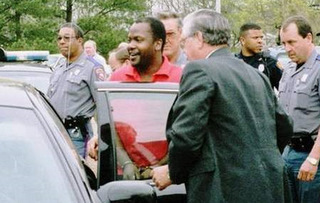
The picture above shows Terry Herrington with his family after being released from prison.
(This post is part of a series concerning Curtis Flowers, an innocent man convicted of a horrific crime that has divided a small Mississippi town. Information on the Flowers case can be found here.)
Mississippi State Representative Bobby Howell will be re-introducing a bill designed to convict Curtis Flowers of Winona. A recent article in the Greenwood Commonwealth lays out the basic facts surrounding the case: “Curtis Giovanni Flowers has been tried five times for murder in a 1996 quadruple homicide at Tardy Furniture in Winona with every trial being overturned on appeal or ending in a hung jury. Howell said he doesn’t think Montgomery County — with a population of about 12,000 — can field a jury of people who don’t already know about the case.”
This is nonsense and Howell knows it. The challenge isn’t to seat a jury; that can be done with no difficulty at all. The trick is to seat a jury with lots of white people and few black jurors. The Mississippi Supreme Court has already rebuked the Grenada DA for attempting, illegally, to keep blacks off the jury in the third Flowers trial. Interviewed by Tom Mangold of the British Broadcasting Corporation, former Supreme Court Judge Oliver Diaz put it this way: “We reversed because the jury selection process ended up not being fair. Every challenge the state had was used against African Americans and the only African American that was seated was when the state ran out of challenges and could not challenge anymore and one was seated.” (more…)
Stanley Fish is a law professor who writes a column for the New York Times. In his latest offering, Fish describes the revenge-vengeance film genre. According to Fish, Iam Neeson’s lines from “Taken” summarize the plotline we have come to expect from this sort of film:
“If you’re looking for ransom, I don’t have any money. But what I do have are a very particular set of skills, skills I have acquired over a very long career, skills that make me a nightmare for people like you. If you let my daughter go now, that will be the end of it I will not look for you, I will not pursue you. But if you don’t, I will look for you. I will find you. And I will kill you.”
According to Dr. Fish, “The formula’s popularity stems from the permission it gives viewers to experience the rush violence provides without feeling guilty about it. The plot gives the hero the same permission when a wife or daughter or brother or girlfriend . . . is abducted, injured or killed.”
The revenge-vengeance only works, of course, if the carnage depicted on-screen is a response to some despicable act perpetrated by a genuinely nasty villain or, better yet, group of villains. “Once the atrocity has occurred,” Fish says, “the hero acquires an unquestioned justification for whatever he or she then does; and as the hero’s proxy, the audience enjoys the same justification for vicariously participating in murder, mayhem and mutilation. In fact, the audience is really the main character in many of these films. You can almost see the director calculating the point at which identification with the hero or heroine will be so great that the desire to see vengeance done will overwhelm any moral qualms viewers might otherwise have.” (more…)
Harvard sociologist Orlando Patterson makes two major claims in this stimulating op-ed piece in the New York Times. First, he suggests that racism has changed its shape without losing its power. This means that a black president must never address the race issue directly.
Patterson understands the historical roots of American racism as well as any living American scholar. Here’s his mini-lecture on the subject:
We became this way because of the peculiar tragedies and triumphs of our past. Race and racism scar all advanced nations, but America is peculiar because slavery thrived internally and race became a defining feature of personal identity.
Slavery was quintessentially an institution of exclusion: the slave first and foremost was someone who did not belong to and had no claims on the public order, nor any legitimate private existence, since both were appropriated by the slaveholder. The Act of Emancipation abolished only the first part of slavery, the master’s ownership; far from removing the concept of the ex-slave as someone who did not belong, it reinforced it. The nightmare of the Jim Crow era then extended and reinforced the public slavery of black Americans right up through the middle of the 20th century.
At the same time, the status of blacks as permanent outsiders made whiteness a treasured personal attribute in a manner inconceivable to Europeans. Whiteness had no real meaning to pre-immigration Swedes or Irishmen because they were all white. But it became meaningful the moment they landed in America, where it was eagerly embraced as a free cultural resource in assimilating to the white republic. In America race had the same significance as gender and age as defining qualities of personhood.
The civil rights movement opened up new opportunities for educated people of color by abolishing “the lingering public culture of slavery”, but while black people have made great strides in the entertainment, athletic and political fields, the social segregation in America has actually deepened. African Americans are still perceived to be “culturally different”, Patterson writes, and “In the disciplined cultural spaces of marriages, homes, neighborhoods, schools and churches, these same differences become the source of Apollonian dread.”
Social isolation means that white Americans have a hard time grasping the individuality of black Americans. As a result, the pathologies of the few are attributed to the many. Although the relationship between social pathology and bad public policy is simply assumed in the academic community, a black president must never appear to be making excuses for absentee dads and street-hardened thugs if he wants white votes.
I’m not sure if Patterson is trying to describe the president’s thinking in this op-ed, or if he is telling Obama how he ought to think. Maybe he’s doing both. Obama, Patterson suggests, must never lecture white America about race. In the wake of the Jeremiah Wright controversy, Obama had to speak out to keep the race issue from derailing his candidacy. But since entering the White House, he has made only one foray into racial politics (his remarks about the Gates-Crowley affair) and Patterson sees that as an unmitigated disaster.
Therefore, the professor says, America’s first black president “will not be leading any national conversations on race, convinced as he must be that they exacerbate rather than illuminate.”
Patterson seems to agree with this stark assessment.
Are white Americans so ignorant and reflexively defensive that they can’t engage in an intelligent give-and-take on the subject of race?
So progressive analysts seem to believe. So it has always been. The NAACP was horrified by Martin Luther King’s practice of non-violent direct action because the strategy invited a violent white backlash. King persisted because he knew the sheer pathology of the typical white reaction to marches, buoycotts and sit-ins exposed the irrational hatred at the heart of racist public policy.
Similarly, the Freedom Rides of 1961 received negative reviews from the mainstream press. It was generally assumed that anyone foolish enough to sit in the front section of a bus in Alabama or Mississippi had only themselves to blame if they received a brutal beating. But every Freedom Rider sent from Jackson to the notorious Parchman prison in the Mississippi Delta weakened the position of Southern politicians. Ultimately, Attorney General Bobby Kennedy pressured the Interstate Commerce Commission into changing the law.
Only after non-violent and inter-racial strategies were abandoned did a conservative backlash against civil rights take hold in America. For an entire decade, the conflict between civil rights and states rights shaped the way Americans thought about the past and the present. The living narratives unleashed by non-violent direct action seized white America by the throat. The strategy was daring, dangerous and uniquely effective. Civil rights activists created a social crisis in America and waited for the truth to surface.
The narrative strategy Friends of Justice employs is rooted in the early civil rights movement. By taking hold of the narrative surrounding actual criminal cases we spark an intense conversation about race and justice. Initially, public officials ignore us. When that doesn’t work they attempt try to spin the story in their own favor. In the resulting clash of narratives the truth ultimately rises to the surface. Not everybody sees it, of course. Some folks remain convinced that Tom Coleman made good cases in Tulia or that the nooses hanging from a tree in Jena held no racial significance. But Jena changed the way school administrators think across America, Tulia led to widespread reforms and the Colomb case (though it gained less publicity than Jena and Tulia) exposed fundamental flaws in federal conspiracy law.
Orlando Patterson hopes Barack Obama can “quietly” reform the criminal justice system. Not by himself, he can’t. Our punitive justice system was shaped by tough-on-crime politicians exploiting and feeding public fears at the top of their lungs. There was nothing subtle or “quiet” about this process. Divisive and damaging narratives about crack babies and inner city thugs built the present system and only healing justice narratives can take it apart.
Conservative politicians could afford to be speak loudly because they reflected the zeitgeist. White people were angry, afraid and in the majority. Progressive leaders must wait for somebody else to change the tenor of the conversation, but if everyone is quiet nothing will change.
White skin is no barrier to reflection and repentance. Given the right environment, all people can learn. But there will be nothing quiet about the process. “You shall know the truth,” Jesus tells us, “and the truth shall set you free.” Politically nuanced fudge phrases are good for winning elections but they will never reveal truth or expose lies.
Orlando Patterson is right about one thing: a sitting president can’t be the standard-bearer for a twenty-first century civil rights movement. Barack Obama shouldn’t take the lead in the conversation about race and justice–but he has already changed the context in which that conversation unfolds. It’s up to the rest of us to speak the loud truth without apology.
Susan Klopfer, the leading authority on the historiy of the Mississippi civil rights movement is intrigued by the Curtis Flowers story. “Dr. Bean’s group believes that the state’s theory of the murder “… doesn’t fit the actual evidence, and the state manufactured phoney evidence by manipulating, badgering and bribing witnesses,” she writes.
Klopfer’s interest in the Flowers case flows from her fascination with Mississippi history. In a recent interview the journalist and civil rights historian notes that, “In Mississippi, it’s said ‘the past is the present.’ And it was and still is.”
Klopfer is blogging on Friends of Justice and the Flowers case on her Mississippi Sovereignty Commission blog and on a blog inspired by a book she is writing on Emmett Till. Thirty-three years separate the brutal beating of gospel-singing activist Fannie Lou Hamer and the arrest of another gospel-singing native of Montgomery County, Curtis Flowers. Hamer created a national sensation at the 1964 Democratic national convention in Atlantic City by relating the horrific details of her cruel encounter with Winona law enforcement. Lyndon Johnson scheduled an impromptu press conference at the time Hamer was scheduled to speak because he didn’t want “that illiterate woman” antagonizing southern Democrats. But Hamer’s revelations were sp appalling and her delivery so intense that all three major networks carried her remarks in their entirety on the evening news.
I will be writing more about the links between Fannie Lou Hamer and the Flowers story in coming weeks. If you would like a sneak preview check out Ms. Klopfer’s blogging.
Like me, Susan Klopfer is amazed by the culture of silence that persists in Mississippi.
“I was most surprised when discovering the Mississippi Sovereignty Commission,” she recently told a reporter. “It was a spy agency funded by the state from 1955 to 1972 to halt integration. Former military intelligence and FBI agents were hired and they, in turn, used the services of the Klan as enforcers. I was able to go through these papers and trace a money trail to an East Coast foundation that gave money to Mississippi to fight the Civil Rights Act and to fund private, segregated academies in Mississippi. Even today, few Mississippians know this history. I feel very obligated to tell these stories, of true civil rights heroes who have lost their lives.”
The Iowa historian’s master work, Where Rebel’s Roost: Mississippi Civil Rights Revisited demonstrates how opposition to the Massive Resistance movement in Mississippi during the 1950s and 60s led inevitably to harassment and, in most cases, financial ruin. One blessed exception to this rule was the publisher of the Petal Paper in Forest County, Mississippi. When the Citizens’ Council tried to run him out of business, P.D. East published an article with the charming title: “Go to Hell in a Bucket!” A 1958 spoof ad began: “Yes, You too can be Superior. Join the Glorious Citizens Clans.”
According to Klopfer, “The ad went on to list various ‘freedoms’ that would accrue to members: ‘Freedom to yell ‘Nigger’ as much as you please without your conscience bothering you! Freedom to wonder who is pocketing the five dollars you join to pay! Freedom to take a profitable part in the South’s fastest growing business: Bigotry! Freedom to be Superior Without a Brain, Character or Principle!’ . . . This Wonderful Offer Open to White Folk Only.'”
P.D. East survived because he had an ardent following outside Mississippi. Few were so fortunate.
Klopfer has a particular interest in the funding behind the Massive Resistance movement. Much of the money driving the Sovereignty Commission and the Citizens’ Councils, she discovered, came from Wycliffe Draper, a wealthy New York racist and anti-Semite. Draper contributed copiously to Mississippi racist from politicians like Theodore G. Bilbo, the notoriously racist Mississippi governor and senator, his successor, Senator James Eastland to organizers like Robert Patterson, the twisted genius behind the Citizens’ Council movement (and, more recently, the Council of Conservative Citizens).
Klopfer’s 2004 interview with Robert Patterson suggests that the Citizens’ Councils didn’t die out when overt racism became unfashionable, they simply went underground.
Mississippi can’t say “no” to racism without saying “no” to its past. There is no operation that would allow a surgeon to cut away the cancer of officially endorsed public racism without killing the patient. Mississippi wasn’t just a state with a lot of racists; Mississippi’s identity was inextricably tied to racism. Opposition to integration was so widespread and entrenched that for generations it was impossible for Mississippians to stand against the juggernaut without courting financial ruin, physical injury, or even death. The legacy is ghastly and has never been renounced, either formally or informally. No Mississippi politician to this day could publicly confront the enormity of the state’s anti-civil rights record without committing political suicide.
In fact, state senator Lydia Chassaniol did no damage to her electoral prospects by openly revealing her membership in a neo-Nazi group like the Council of Conservative Citizens. Until very recently, the groups’ annual event in Black Hawk, Mississippi was considered so mainstream and uncontroversial that leading politicians from both major parties were regular participants. It has even been suggested that Chassaniol’s address to the CCC last summer was a test balloon designed to see if it was safe to get back in the racist water. Apparently it is. Among Mississippi newspapers, only the Greenwood Commonwealth even acknowledged the Senator’s address. Outside Mississippi, the speech failed to stir a ripple of interest.
Thank God for enterprising historians like Susan Klopfer who have the courage to state the obvious.
Is it legally acceptable for the Supreme Court of the United States to tacitly endorce the execution of an innocent man? Antonin Scalia thinks it is. Consider this remark from his dissenting opinion in the Troy Davis case:
“This court has never held that the Constitution forbids the execution of a convicted defendant who has had a full and fair trial but is later able to convince a habeas court that he is ‘actually’ innocent. Quite to the contrary, we have repeatedly left that question unresolved, while expressing considerable doubt that any claim based on alleged ‘actual innocence’ is constitutionally cognizable.” (more…)
 The summer of 1964 was a watershed moment for the civil right movement and for America. Never before had black and white Americans worked together with such common purpose. And yet, by the end of August, black civil rights leaders were vowing never to work with white people again. Meanwhile, white civil rights activists realized they didn’t have a home in either of the major political parties.







 Donald Washington, Louisiana’s first African-American US Attorney,
  The US Supreme Court agreed to dismiss a suit against two Iowa prosecutors after Pottawattamie County, Iowa signed off on a $12 million settlement with Terry Harrington and Curtis W. McGhee, two men who were
 Stanley Fish is a law professor who writes a column for the New York Times. In
  Harvard sociologist Orlando Patterson makes two major claims in
  The narrative strategy Friends of Justice employs is rooted in the early civil rights movement. By taking hold of the narrative surrounding actual criminal cases we spark an intense conversation about race and justice. Initially, public officials ignore us. When that doesn’t work they attempt try to spin the story in their own favor. In the resulting clash of narratives the truth ultimately rises to the surface. Not everybody sees it, of course. Some folks remain convinced that Tom Coleman made good cases in Tulia or that the nooses hanging from a tree in Jena held no racial significance. But Jena changed the way school administrators think across America, Tulia led to widespread reforms and
  Susan Klopfer, the leading authority on the historiy of the Mississippi civil rights movement is intrigued by the Curtis Flowers story. “Dr. Bean’s group believes that the state’s theory of the murder “… doesn’t fit the actual evidence, and the state manufactured phoney evidence by manipulating, badgering and bribing witnesses,” she writes.
  Is it legally acceptable for the Supreme Court of the United States to tacitly endorce the execution of an innocent man? Antonin Scalia thinks it is. Consider this remark from his dissenting opinion in the Troy Davis case:
 Friends of Justice