Category: “civil rights”

What ‘The Help’ says about Hollywood

By Alan Bean

The Hollywood adaptation of Kathryn Stockett’s The Help, opens in theaters this Wednesday.  Critics have been kind.  Evaluated as a good story, The Help is engaging and emotionally satisfying.  But isn’t this another Hollywood racial melodrama in which a noble white person intercedes on behalf of helpless Negroes?

Yes and no.  Civil Rights activists were deeply offended by the 1988 potboiler Mississippi Burning, a civil rights era drama that gave the FBI credit for staring down the KKK in Philadelphia, MS.  Why, critics ask, can’t Hollywood do a civil rights story about black people standing up for black people?  The answer is simple: Hollywood makes movies for a mass audience, and that means creating narratives that appeal to white people.  Sure, you always want to toss in a black guy so black viewers can relate to the story in a modest fashion; but that’s generally as far as it goes. (more…)

Marlowe’s Mississippi

By Alan Bean

Lara Marlowe generally writes for an Irish audience, but when she turns her attention to the American South it is wise to take notice.  American journalists are generally reluctant to address our nation’s racial history honestly and openly; aggrieved southerners wail and lament when they feel mistreated and misunderstood.  Nowhere is this more true than in Mississippi.  But Marlowe’s carefully crafted piece on the Magnolia state draws on the insights of those who know the region best.

Most of the sobering facts cited below will come as no surprise to readers of this blog.  But how many Americans know that the public schools of Mississippi lost half a million white students when the feds finally got serious about school integration in the South?   A recent article in The Christian Century, notes that “only 2 percent of high school seniors could name the social problem that the Supreme Court addressed in Brown v. Board of Education.” (more…)

A mayor and a prophet lock horns in a Southern town

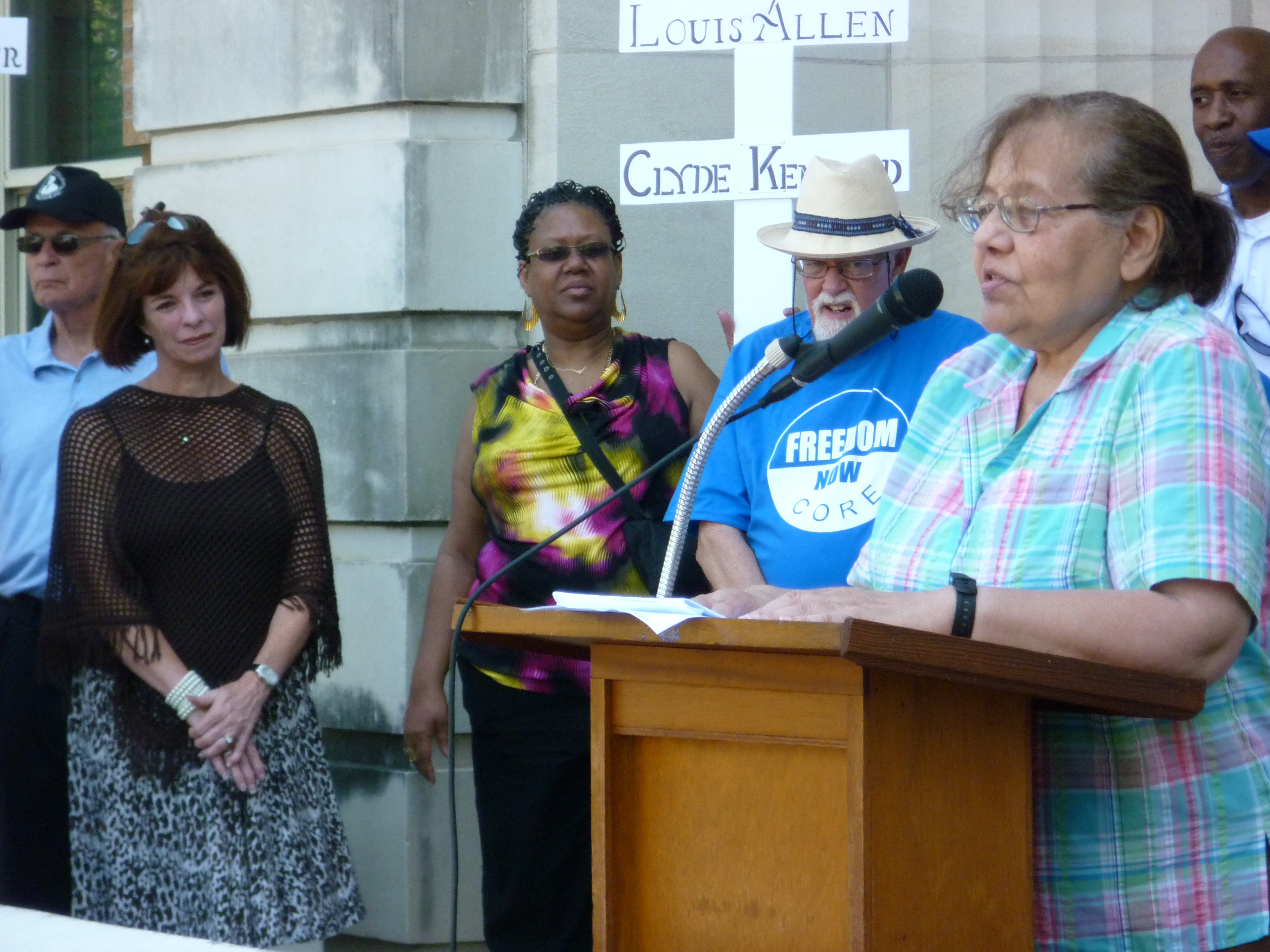
Diane Nash addresses crowd as Mayor Cheri Barry looks on

By Alan Bean

On Saturday, June 18th, Friends of Justice joined dozens of civil rights veterans in honoring the memory of James Earl Chaney, Andrew Goodman, and Michael Schwerner.  For those who worked in Mississippi during the 1960s, the cruel and cowardly murder of three civil rights workers epitomizes a painful period.

The Mississippi phase of the civil rights movement doesn’t get nearly as much attention as corresponding events in nearby Alabama.  There was plenty of terror in Alabama as well; but it was offset by triumph.  Apart from the freedom rides of 1961, Mississippi didn’t produce a lot of victories.  Passionate support for segregation was almost universal among white folks.  In many counties, not a single black voter was registered when the Voting Rights Act was signed into law in 1965.  In Mississippi, two armies, one dedicated to “state’s rights” (full-blown Jim Crow segregation), the other dedicated to Civil Rights (racial equality reinforced by racial justice) fought to a bitter standstill.  (more…)

A place like Mississippi

Magnolia blossom at the Leflore County Courthouse

By Alan Bean

Ever since Friends of Justice was asked to look into the case of Curtis Flowers, we have been intrigued with Mississippi.  The most intense confrontations between civil rights and states rights took place in the Magnolia state.  Most educated Americans are vaguely aware that hundreds of freedom riders were arrested in Jackson, Mississippi in 1961.  The Emmett Till story, for very good reason, has received a lot of attention. The Freedom Summer of 1964, culminating in the murder of James Chaney, Michael Schwerner and Andrew Goodman, has entered the American historical lexicon.

But so much has been forgotten.  Who today remembers the voter registration struggles in places like Greenwood, Cleveland and Grenada?  How many are aware of the intimate link between the Emmett Till case and the Montgomery bus boycott?  How many educated Americans are familiar with the heroic work of Sam Block, Diane Nash, Amzie Moore and Aaron Henry (to name just a few)?

Amazing stories have been forgotten because in Mississippi nobody won.  The civil rights people won a few battles, but the states rights people won the war.  Jim Crow may be dead, but civil rights backlash has controlled American politics for decades.

The Friends of Justice civil rights tour devoted nine intense days to these stories.  “To understand the world,” William Faulkner said, “you must first understand a place like Mississippi.”  Over the next few days I will be writing a series of posts dedicated to a parallel proposition: To understand America in 2011 you must first understand the Mississippi Delta in 1963.  Some of these stories will be familiar, some will not.  But this series of posts isn’t driven by an antquarian interest in days long past; in June of 2011, Friends of Justice went to Mississippi in search of America.

When Will the U.S. Stop Taking the Easy Route on Immigration?

By Victoria Frayre*

Newly released statistics by the U.S. Sentencing Commission reveal that almost half of all people sentenced for federal felony crimes are Latino. Why is this so? Although most Latino federal offenders are being imprisoned for immigration offenses (about 48% in 2007) does it really make sense to throw illegal immigrants in prison? With prisons already busting at the seams it is absolutely mind-boggling to me why anyone would think that adding to the overwhelming prison population is a good idea. Ironically, this is exactly what is happening. (more…)

Spotlight on Medgar Evers

By Chelsea Zamora

As Friends of Justice prepares for our Civil Rights Tour in the Mississippi Delta, we are spotlighting some of the civil rights activists that have helped change the future for African Americans and minorities across the United States. Medgar Evers, Mississippi NAACP field secretary and civil rights martyr, heads the list.

Medgar Evers was born on July 2, 1925 in Decatur Mississippi. He grew up on a small farm with his parents and five siblings. While Evers was still young, several of his close friends were lynched, a devastating experience for the local black community. Yet this tragedy made Evers even more determined to finish school, a rare achievement for African Americans in Mississippi. (more…)

Banning Books in Prison

By Chaka Holley

Many were shocked when Gary Indiana, a decaying city with a population of 100,000, announced the closing of the city’s main library. Due to budget cuts, the library board voted 4-3 to close the bankrupted city’s main branch. The public response was not in favor of this decision.  For many, the public library was their only access to books and other resources.

Gary is not alone; prisons are also limiting access to reading materials. These limits are not due to budget cuts however, but to prohibition.  The American Civil Liberties Union (ACLU) is suing South Carolina’s Berkeley County Jail for prohibiting all books outside of the Bible. In Connecticut, the department of corrections is following suit. Similarly, other prisons around the country are also under scrutiny for banning books. (more…)

Pastor to Black Panthers ministers to white Baptist University in North Carolina

J. Alfred Smith

I first met the Reverend Dr. J. Alfred Smith when he “preached a revival” at First Baptist Church, Kansas City, KS.  Charles Kiker, my father-in-law, was pastor at FBC in the mid-1990s and I was invited as the guest singer.  A few years later, when Friends of Justice was created in response to a big drug bust in a little Texas town, Pastor Smith and members of his congregation provided welcome support.  Dr. Smith, pastor emeritus at Allen Temple Baptist Church in Oakland, CA, is now 80 years old, but his commitment to prophetic witness still burns white-hot.  The article below first appeared in the Religious Herald. AGB


J. Alfred Smith finds Gardner-Webb University open to diversity

By Norman Jameson

Thursday, May 12, 2011

BOILING SPRINGS, N.C. (ABP) — A predominantly white Baptist college in rural North Carolina might seem an unlikely place to find an urban African-American pastor from California known for an agenda of prophetic justice, but Gardner-Webb University just said goodbye to J. Alfred Smith, pastor emeritus of Allen Temple Baptist Church in Oakland, Calif., who served as the school’s first scholar-in-residence this spring. (more…)

The slow death of the 14th amendment

Richard Beeman

On May 4, amateur historian David Barton appeared on Jon Stewart’s Daily Show.  Barton’s central argument was that, constitutionally, the first amendment applies to the federal government but not to the states.  Therefore, if individual states and municipalities see fit to make the Bible the sole standard for criminal and civil law, to reinstate chattel slavery or to make Christianity an official and protected religion, the federal government can do nothing about it.

Barton didn’t suggest that non-federal governments should do these things, merely that they can if they want to.

On May 14th, Jon Stewart invited Richard Beeman, an actual constitutional scholar at the University of Pennsylvania, to respond to Barton’s theory. (more…)

The Drug War’s Latest Victim

By Alec Goodwin

The War on Drugs has claimed yet another victim: the California prison system.

The United States Supreme Court has ruled in a narrow 5-4 decision that the prisons in California are so overcrowded that it violates the constitutional right against cruel and unusual punishment, and that at least 33,000 prisoners must be put somewhere else.

Medical conditions were so bad that an inmate died every week. Mental health services were so poor that suicide was frequent. Quarantines due to virus outbreaks, moldy walls, broken pipes, and human waste smeared over the walls have also been frequent problems. Nowhere else in the entire country are conditions this poor. (more…)