Category: immigrant rights

Berastain: Coming out at Harvard

Pierre Berastain

By Pierre Berastain

My family immigrated to the United States on December 18, 1998 after years of socioeconomic hardships. In Dallas, my father found employment in a moving company, often working over sixteen hours every day of the week while my sister and I attended school and our mother helped the family settle. Eventually, my mother found employment as a babysitter. In Peru, my father owned a company and my mother worked as a television producer, for the Department of Education, and for Defensa Civil, the equivalent of FEMA in the United States. Both were successful individuals, but thanks to the instability of the Fujimori regime, my parents lost everything. Both of them held university degrees, but as is the case with many professional immigrants, Mom and Dad saw themselves relegated to unfulfilling work once settled in America.

On the day of our arrival, my sister and I spoke no English, and over the next several months, we would learn how to ask permission to go to the bathroom, how to tell a stranger where we had come from, and how to ask for directions so that we would not get lost. From the beginning, Mom and Dad placed significant emphasis on our education, and we quickly learned that the quality of schools depended on the geographical area where we lived. Armed with this knowledge, my father asked me to research better school districts in the Dallas area so that we could relocate.

Years passed and I excelled in my studies, got accepted to the Academy of Biomedical Professions at R.L. Turner High School in Carrollton, TX, and, in 2006, I enrolled at Harvard College where I graduated with honors after completing my major in Social Anthropology, a minor in Ethnic Studies, and a Certificate of Language Proficiency in Portuguese. On the day of my graduation in 2011, I began to feel — truly feel — that I would no longer have to dance to obtain an avocado or peach, that my mother would no longer have to cry, wondering whether I would have to sell candy in the streets, that my father would never again be abducted at gunpoint while on his rounds as a taxi driver in the streets of Lima. I no longer wondered whether ever again my family would have to choose between rice and toilet paper. On that day — May 26, 2011 — I knew my future was a little more secure than it had been the day before. (more…)

Can I get a little sympathy for Joe Arpaio?

Sheriff Joe Arpaio

By Alan Bean

There is an Alice in Wonderland quality about the civil trial of Arizona Sheriff Joe Arpaio.     Racial profiling is illegal and Sheriff Joe insists that his boys would never target a resident of Maricopa County on the basis of national origin or skin color.  On the other hand, it is widely considered to be okay to keep non-white Mexican nationals out of the United States because, well, they’re not like us and, if we let too many of them in, we won’t be like us for much longer.

The cries for help that Joe Arpaio’s office received from white residents clearly reflect “keep America white” sentiments, and “America’s toughest Sheriff” enthusiastically responded to these messages, but, he insists, without committing the dreaded sin of racial profiling.

It isn’t just the ALCU and MALDEF that have problems with Sheriff Joe; the Department of Justice is also concerned about his tactics.

Let’s get this straight.  The federal government, represented by the Department of Homeland Security, entered into a 287(g) agreement according to which 160 deputies, working for a man widely deplored as an insufferable racist, were deputized as immigration agents with the authority to sweep into the heavily Latino sections of town and arrest people who looked like they might be undocumented.

Now the federal government, represented by the Department of Justice, is upset because Joe and his posse were overstepping their mandate.  Please explain how deputized border cops (racist or otherwise) can locate people who are in the country illegally without resorting to the crudest kind of racial profiling?

We aren’t talking about routine traffic stops here; we’re talking about white people complaining about “wetbacks”; we’re talking about dozens of immigration agents (paid by the sheriff’s department) sweeping into a suspicious neighborhood and arresting everybody brown person in sight.  The government says you can do this as long as you don’t resort to racially profiling.

I’m sorry, but I can understand why Sheriff Arpaio might get a little confused.  One branch of the federal government is begging him to flush out the Mexicans while another posse of federales takes him to task for racial profiling.

When we say that America’s immigration policy is broken, this is precisely what we are talking about.  Our Jekyll and Hyde government reflects the fractured contradictions within the national psyche.  Heaven help the poor journalists and jurists charged with making sense of of this mess; it’s beyond my feeble powers.

Arpaio Takes the Stand in Racial Profiling Lawsuit

New America Media, News Report, Valeria Fernández

PHOENIX, Ariz. – Word spread like wildfire in the North Phoenix neighborhood: Sheriff Joe Arpaio was coming to do an immigration sweep. His agency had received a letter circulated by a member of an immigration restrictionist group that was signed by eight businesses complaining about day laborers in the area.  (more…)

Immigration and the Heart of God

This presentation was part of a People of Faith and Immigration gathering, July 24, 2012 at the First Spanish Assembly of God in Waco, Texas.

Immigration and the Heart of God

By Alan Bean

Why are our churches so silent on the immigration issue?    Is it because a range of opinion exists within our congregations on the immigration issue and pastors fear they might spark a civil war if they touch on the subject?

Or do we fear that if we approached the immigration issue from a biblical perspective, or viewed the subject through the lens of Jesus Christ, we might arrive at mushy, impractical conclusions that don’t wear well in the real world?

The biblical narrative begins as Adam and Eve are exiled from the garden.  Next we meet Abraham, Sarah and their descendants.  These people are sojourners, undocumented aliens.  They wander the Promised Land as exiles, never finding a true home.  Eventually, the sons of Jacob show up in Egypt with a message for Pharaoh: “We have come to reside as aliens in the land; for there is no pasture for your servants’ flocks because the famine is severe in the land of Canaan.”

God’s children move from being undocumented aliens in Canaan to being undocumented aliens in Egypt.  They were driven by hardship, by the need for food, work and the means of survival.  They have come to be reunited with their brother Joseph.

Which is why the oldest confession of faith in the Bible begins:

A wandering Aramean was my father; he went down into Egypt and lived there as an alien, few in number, and there he became a great nation, mighty and populous.  When the Egyptians treated us harshly and afflicted us, by imposing hard labor on us, we cried to the LORD, the God of our fathers; the LORD heard our voice and saw our affliction, our toil and our oppression.  (more…)

Children of undocumented parents face foster care, adoption

By Pierre R. Berastain

What happens to children of parents who are caught in the process of deportation?  According to a judge in Missouri, those children go to foster care.  The logic couldn’t make more sense: the parents abandon their children, so the state is in its right to take over.  It is estimated that over 5,100 children are in foster care while their parents face deportation.  It doesn’t matter the parents provided a home for the children, or that the children enjoyed a bed every night and a meal every day.  All that matters is that the parents committed the civil offense of remaining in the country without papers.  It is one thing to enforce the law; it is another to separate families that have done nothing wrong besides seek a better future for themselves, a more comfortable lifestyle for their children, a safer place to call home.

Judge Terminates Detained Mom’s Rights, Allows  Missouri Couple to Adopt
By Jorge Rivas

On Wednesday a Missouri juvenile court judge terminated a Guatemalan woman’s rights to her 5-year-son because they believe she abandoned her child when she was imprisoned after a 2007 immigration sting at a poultry processing plant.

Encarnacion Romero, the mother of the child, cried as she was leaving the courtroom, according to the Joplin Globe. Romero’s attorney say they will appeal the decision.

The case garnered National attention when ABC’s “Nightline” covered the story in February 2012. (more…)

How Immigration Reform Got Caught in the Deportation Dragnet

Shahed Hossain Photo: Erin Hollaway

Things have only gotten worse since Seth Wessler published this piece in Colorlines almost two years ago.  From Bill Clinton to Barack Obama, proponents of comprehensive immigration reform (CIR) have believed that tough deportation policies provided the quid pro quo concession that would bring immigration hawks to the bargaining table.  It hasn’t worked.  This misbegotten strategy has simply ensured that hardliners provided the harsh narrative driving the immigration debate.  Minor tweaks to American immigration policy (like president Obama’s recent announcement that undocumented adolescents would no longer be targeted for deportation) aren’t sufficient.  We need a thoroughgoing critique of existing policy and an alternative vision rooted in compassion and common sense.  The status quo has got to go.  AGB

How Immigration Reform Got Caught in the Deportation Dragnet

by Seth Freed Wessler

Thursday, October 7 2010,

On the night that Shahed Hossain left his family’s house in a Haltom City, Texas, to drive to Laredo, his mother, Habiba Hossain, cooked dinner—chicken and rice and okra picked from the garden. She piled her son’s plate high and watched him eat. Then, she took his Bangladeshi passport from a drawer and handed it to him, leaving his green card safely stored away. The 21-year-old had a penchant for losing things and a green card is not a thing to lose. She hurried him out the door and into the white utility van in the driveway where his boss waited.

“I’ll see him in a week,” she thought. Like every other time he’d set off for work trips all over Texas, she figured, her younger son would return to that house where he grew up with his brother and his parents and the dog.

But that night was the last time Shahed Hossain’s mother would see him free in United States, the last time she’d have a chance to worry he’d lose anything. Six days later, Hossain was locked up in a privately run immigration detention center near the U.S.-Mexico border. He spent more than a year there, a period he’s tried to forget, before he was shackled, loaded onto a plane and flown to Dhaka, Bangladesh. (more…)

An Innocent Question

Federal courthouse, McAllen, Texas

By Alan Bean

“Is there any way that I could get a permit that would let me stay in this country?”

The question came from a young man who, the day before, had been nabbed by Border Patrol officers as he waded the Rio Grande River.  Like most of the men in the courtroom, the questioner was short, thin and young.  I guessed his weight at 120 pounds, but it could have been less.

Like the thirty-five men and women standing with him in the magistrate court on the fourth floor of the federal courthouse in McAllen, Texas, the man asking the question was pleading guilty to a charge of entering the United States illegally.  Most of the defendants had been deported on multiple occasions, but this young man was apprehended by Border Patrol on his first attempt to enter the country illegally.

And yet he asked an innocent question; innocent in the sense that children are innocent.  He meant no one any harm.  He was just looking for a chance to earn a decent living.  He was ready to work long and hard.  He was eager to contribute to the greater good.  He entered the United States for the purest of motives, and yet he was being prosecuted as a criminal. (more…)

Tom Berry: “Ten Years of Waste, Immigrant Crackdowns and New Drug Wars”

If you want to know why America’s immigration policy is so badly broken, this article by Tom Berry is a great starting place.  “Continuing down the same course of border security buildups, drug wars and immigration crackdowns will do nothing to increase security or safety,” Berry says.  “It will only keep border policy on the edge – teetering without direction or strategy.”

This article, originally published in Truthout, is an edited excerpt of the policy report Berry produced for the Center for International Policy.   Berry appeared on NPR’s Fresh Air in 2009 and the horrors he discussed with Terry Gross have only worsened in the ensuing three years.  AGB

Border Security After 9/11: Ten Years of Waste, Immigrant Crackdowns and New Drug Wars

Prior to the September 11 terrorist attacks, the term “border security” was rarely used. Today, however, it is both a fundamental goal of US domestic security and the defining paradigm for border operations. Despite the federal government’s routine declarations of its commitment to securing the border, neither Congress

nor the executive branch has ever clearly defined the term “border security.”

Border security constitutes the single largest line item in the Department of Homeland Security (DHS) budget. Nonetheless, DHS has failed to develop a border security strategy that complements US domestic and national security objectives. DHS has not even attempted to delineate benchmarks that would measure the security of the border or specify exactly how the massive border security buildup has increased homeland security.

In its strategic plan, DHS does promise: “We will reduce the likelihood that terrorists can enter the United States. We will strengthen our border security and gain effective control of our borders.” And DHS Secretary Janet Napolitano assured us last year that, as a result of new border security spending by the Obama administration, “the Southwest border is more secure than ever before.”

Since 2003, Homeland Security and the Justice Department have opened spigots of funding for an array of border security operations. These include commitments for 18-foot steel fencing, high-tech surveillance, unmanned aerial vehicles (UAVs), increased prosecutions of illegal border crossers and new deployments of the Border Patrol and National Guard.

Yet the federal government’s continued expressions of its commitment to border security only serve to highlight the shortcomings of this commitment and to spark opposition to long- overdue immigration reform. “Secure the border” – a political demand echoed by immigration restrictionists, grassroots anti-immigrant activists and a chorus of politicians – now resounds as a battle cry against the federal government and liberal immigration reformers. These border security hawks charge that the federal government is failing to meet its responsibility to secure the border, pointing to continued illegal crossings by immigrants and drug traffickers. Border sheriffs, militant activists and state legislatures have even started taking border security into their own hands.

The post-9/11 imperative of securing “the homeland” set off a widely played game of one-upmanship that has had Washington, border politicians and sheriffs, political activists and vigilantes competing to be regarded as the most serious and hawkish on border security. The emotions and concerns unleashed by the 9/11 attacks exacerbated the long-running practice of using the border security issue to further an array of political agendas – immigration crackdowns, border pork-barrel projects, drug wars, states’ rights and even liberal immigration reform. Yet these new commitments to control the border have been largely expressions of public diplomacy rather than manifestations of new thinking about the border. (more…)

Supreme Court rejects key portions of Arizona immigration law

By Alan Bean

The Supreme Court handed the Obama administration a big win by striking down the most egregious portions of Arizona’s controversial immigration law.  Stat law enforcement can determine the immigration status of detained individuals, but cannot stop and question a person on the street simply because they suspect that person may be undocumented.

Although state police officers have a greenlight to determine the immigration status of detained persons, this merely transfers this common practice from ICE, a federal agency, to state and local law enforcement.  From the standpoint of the detained individual, it hardly matters whether your status is being checked by ICE officials or by a state official–the result is the same. 

Arizona won some state’s rights points, in other words, but the plight of undocumented persons (and those who merely look, by virtue of language, accent and skin-hair color, as if they might be documented) hasn’t changed on iota.  Under the all-but-universal Secure Communities program, local law enforcement officials are already required to place an ICE hold on any person they detain for whatever reason.  The feds will then run a check and determine whether the individual is subject to deportation. 

Secure Communities is well understood in the Latino community, but Anglos hardly know the program exists because, well, they don’t have to worry about it.  As a result, some Anglo reporters may interpret today’s ruling as a step toward more stringent immigration practices.  It isn’t.

Few understand that few of the supposedly dangerous criminals we deport every year have ever been convicted of a violence-related crime.  In the federal system, any conviction stands proxy for future dangerousness. 

The good news from today’s ruling is that local and state police officers will not have the right (or the obligation) to stop and question a person suspected of being Latino.   This policy, if upheld, would have been a wholesale validation of racial profiling, regardless of what Arizona governor Jan Brewer has to say to the contrary.  In the absence of criminal behavior, physical appearance, accent, and the use of non-standard English would have been the only cues that could lead an officer to suspect undocumented status.  In other words, Arizona wanted to legalize George Zimmerman-style hunches rooted in ethnic and racial factors and the Supreme Court said no.  America just dodged a bullet.

Supreme Court upholds key part of Arizona for now; strikes down other provisions

By , Updated: Monday, June 25, 1:26 PM

The Washington Post

The Supreme Court on Monday said states may play a limited role in enforcing laws on illegal immigration, upholding part of Arizona’s controversial law but striking other portions it said intruded on the federal government’s powers.The justices let stand for now the part of the law that requires police to check the immigration status of anyone they detain or arrest if they have “reasonable suspicion” that the person is in the country illegally. Arizona Gov. Jan Brewer (R) declared that decision, on the part of the law that had generated the most controversy, a victory.

But the ruling also in part vindicated the Obama administration, with the court rejecting three provisions that the federal government opposed.

The court ruled that Arizona cannot make it a misdemeanor for immigrants to fail to carry identification that says whether they are in the United States legally; cannot make it a crime for undocumented immigrants to apply for a job; and cannot arrest someone based solely on the suspicion that the person is in this country illegally.

The court also said the part of the law it upheld — requiring officers to check the immigration status of those they detain and reasonably believe to be illegal immigrants — could be subject to additional legal challenges once it is implemented.

The other major decision of the court’s term — the constitutionality of President Obama’s health-care law — will come Thursday, on the final day of the term.

In a statement Monday, Obama said he was “pleased that the Supreme Court has struck down key provisions of Arizona’s immigration law.” He added that the decision makes clear “that Congress must act on comprehensive immigration reform,” since a “patchwork of state laws is not a solution to our broken immigration system.” At the same time, Obama said, he remains “concerned about the practical impact” of the part of the law that was allowed to stand.

“No American should ever live under a cloud of suspicion just because of what they look like,” Obama said. “Going forward, we must ensure that Arizona law enforcement officials do not enforce this law in a manner that undermines the civil rights of Americans, as the Court’s decision recognizes.”

Republican presidential candidate Mitt Romney, for his part, issued a statement that did not comment on the specifics of the ruling but instead said the decision “underscores the need for a President who will lead on this critical issue and work in a bipartisan fashion to pursue a national immigration strategy.”

Obama “has failed to provide any leadership on immigration,” the former Massachusetts governor said.

Romney did not speak to reporters accompanying him Monday on a campaign trip to Arizona, and aides refused to say whether he agrees with the Supreme Court’s ruling or even whether he supports Arizona’s immigration policy.

“The governor supports the states’ rights to craft immigration laws when the federal government has failed to do so,” spokesman Rick Gorka said. “That’s all we’re going to say on this issue.”

Keep reading . . .

Why Obama changed course on immigration

Facing SouthBy Alan Bean

Kung Li’s latest article in Facing South underscores the foolishness of believing that comprehensive immigration reform would be realized as soon as Obama and the Democrats proved they were serious about securing the border.  

Getting tough simply created an appetite on the right for yet more bodies on the border, ever greater deportation stats, and an ever-expanding role for local law enforcement.  

No matter how far to the right Obama moved on the immigration issue, his conservative opponents had no choice but to raise the ante.

The only way to produce credible and comprehensive immigration reform is to humanize the problem.  Obama’s “we’re only deporting the worst of the worst” stance was wrongheaded and counterproductive from the drop.

First, we aren’t deporting the worst of the worst.  

The federal court system uses any past felony violation as a proxy for “dangerousness” whether or not the offense involved violence or the threat of violence.  Instead, federal officials are examining the immigration status of every person apprehended by local law enforcement for any reason.  The assumption is that undocumented residents who have a criminal record of any kind are a threat to public safety.  In most cases, the government has no good reason to believe the folks we are shipping back to Mexico are dangerous criminals.

The Obama administration was simply jacking up its deportation statistics in the unfounded hope that a show of toughness at the border would induce Republicans to embrace genuine immigration reform.  When ill-informed voters hear that 400,000 dangerous criminals have been deported, they view all undocumented persons with fear and suspicion.

Republicans will oppose any measure proposed by the Obama administration unless it has overwhelming bipartisan support.  The president extended an olive branch to the DREAM Act  community because he realized, finally, that his original tactic could do nothing but fail.

On immigration, cutting the ties between enforcement and legalization

Kung Li

Facing South

June 22, 2012

The cover of Time Magazine released on June 14 featured Pulitzer Prize winning journalist Jose Antonio Vargas and 35 other undocumented immigrants. The next day, Secretary of Homeland Security Janet Napolitano issued a memorandum that will, when implemented, grant deferred status and possibly work authorization to between 800,000 and 1.4 million undocumented people who meet age, education, and criminal history criteria. President Obama stepped out later that afternoon into the Rose Garden to add some Presidential love — if not an executive order — to the policy. It was a significant shift for someone who had, a year earlier, insisted it would be inappropriate for him to do exactly what he is now doing. (more…)

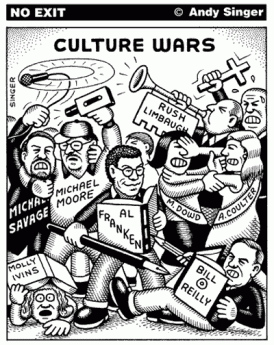
At war over the culture war: Dionne and Gerson go toe-to-toe

By Alan Bean

When two columnists working for the same newspaper address the same subject (the culture war and the contraception debate) you can learn a lot.  Michael Gerson accuses Barack Obama of sustaining our endless American culture war by forcing a conservative Roman Catholic Church to conform to “the liberal values of equality and choice.”  In Gerson’s view, the Catholic Church is an inherently conservative, indeed ‘illiberal’, institution.  Gerson endorses a pluralistic view of America in which a variety of civic organizations, some liberal and progressive, others illiberal and traditional, co-exist in a free society.  But this dream of a pluralistic America is being thwarted by an inherently intolerant “liberal” view of American life in which every individual and institution is expected to conform to the liberal values of equality and choice.  By forcing illiberal Catholic medical providers to provide free contraceptive services to their clients, Gerson alleges, the Obama administration is rejecting the pluralistic vision of America and stoking the fires of culture war.

Gerson believes it is a mistake to antagonize conservative institutions because, unlike their liberal counterparts, they encourage 

The habits of good citizens — attributes such as self-control, cooperation and respect for the law — don’t emerge spontaneously. They are cultivated in families and religious congregations. The health of liberal political institutions is strengthened by the success of traditional institutions, which often teach values that prepare individuals for the responsible exercise of freedom.

In Gerson’s view, Obama moved to the left on immigration and gay rights because he is an ardent culture warrior who disrespects the views of American conservatives.

Then comes E J Dionne, a progressive columnist who, unlike the evangelical Gerson, happens to be a living, breathing Roman Catholic in good standing.  Dionne agrees that Obama’s initial handling of the contraception issue was ham-handed and out of character.  Dionne’s Obama is no champion of the liberal view of America.  At his core, the president is an even-handed pragmatist who is generally eager to negotiate with his ideological opponents.

In fact, Dionne reminds us, six years ago Obama complained that

There are some liberals who dismiss religion in the public square as inherently irrational or intolerant, insisting on a caricature of religious Americans that paints them as fanatical, or thinking that the very word ‘Christian’ describes one’s political opponents, not people of faith.

Sounds a lot like Michael Gerson, doesn’t it.  Obama dropped the ball on the contraception issue, Dionne admits, but was able to self-correct by offering a compromise that was joyfully embraced by Catholic medical care providers.   

Unlike Gerson, Dionne refuses to define the Roman Catholic Church as an inherently traditional or illiberal institution.  The Catholic Church is a pragmatic and pluralistic blending of conservative and progressive impulses.  Dionne says he remains in the fold largely because

When it comes to lifting up the poor, healing the sick, assisting immigrants and refugees, educating the young (especially in inner cities), comforting orphaned and abandoned children, and organizing the needy to act in their own interest, the church has been there with resources and an astoundingly committed band of sisters, priests, brothers and lay people. Organizations such as Catholic Charities, the Catholic Health Association, the Catholic Campaign for Human Development and Catholic Relief Services make the words of Jesus come alive every day.

Moderate Catholics appreciate the president’s willingness to meet the Church half way on contraception and Dionne hopes the conservative wing will tone down its opposition to abortion rights and gay marriage because the American Catholic community is as divided on these issues as the rest of society.

Two views of the Roman Catholic Church; two views of the sitting president.  Who wins?

Dionne gets the best of this dust-up.  The culture war doesn’t separate illiberal traditionalists like a monolithic Catholicism from liberal, pluralism denying, culture warriors like Obama.  Obama has been deeply influenced by both secular liberalism and the traditional values sustained by the Christian Church.  Roman Catholics, like most Christian denominations, are split down the middle over culture war issues like gay marriage, abortion and, now, contraception.  Gerson’s neat divisions don’t fit either Obama or American Catholicism.

If the president has moved off the fence on gay marriage and immigration it’s because he sees no point in placating ideological opponents for whom the word ‘compromise’ has become the vilest of profanities.  Any politician on the right willing to meet the president half way on any contentious issue gets his or her (usually his) mouth washed out with soap in full view of the cameras.

Nice try, Michael, but you didn’t nail it this time.