Category: mass incarceration

ACLU report focuses on Mississippi drug war


For years now, Mississippi, Louisiana and Texas have been competing for the dubious distinction of having the highest incarceration rate in America.  A new report commissioned by the ACLU of Mississippi asks why the Magnolia state’s prison population has exploded in recent years.  According to the report:

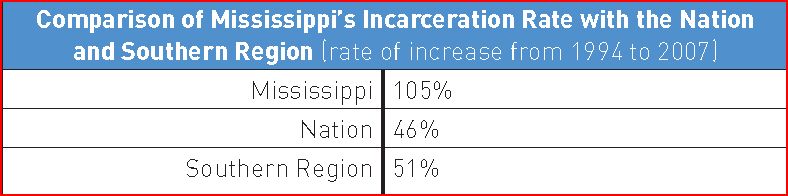
Mississippi has the second highest incarceration rate in the nation, at 749 prisoners per 100,000 residents. Between 1994 and 2007 the state’s incarceration rate ballooned by 105 percent, compared to just 46 percent for the nation as a whole and 51 percent for the Southern region. During that same period, prison expenditures by the state of Mississippi grew by 155 percent. By mid year 2008, Mississippi’s prison population had reached a record high of 22,764. (more…)

Tulia and the spell of mass incarceration

Gary Gardner, moments before heading down to a protest at the state capital with Friends of Justice and a bus full of Tulia residents, September 2000

By Alan Bean

This is the text of a speech delivered at a Friends Committee on Legislation of California banquet in Whittier, California, March 26, 2011.

When I arrived in Tulia in the summer of 1998, I didn’t know very much about mass incarceration and the war on drugs. I had no idea that Texas, the state we had just moved to, had almost quadrupled its prison population between 1988 and 1998, or that the number of prisons had grown from 16 in 1980 to 108 in 2000.

Nor did I realize that the average family income of America’s poorest 20 percent increased 116% between 1947 and 1979 and had given back half of those gains between 1983 and 1998.

I didn’t realize that the American incarceration rate once mirrored western democracies like Canada, Great Britain and Germany, but had recently grown to six times the size of other nations.

For twenty years our family had been shuffling around the United States and Canada, and Nancy wanted our children to experience the love and support of family. Everything was going according to plan until we saw the headline in the local newspaper, “Tulia streets cleared of garbage.” (more…)

Tulia-style drug bust draws suspicion in Wichita Falls

Alleged Tulia kingpin, Joe Welton Moore

The good folks in Wichita Falls, Texas are celebrating the arrest of 44 drug kingpins, with four or five additional arrests waiting in the wings. 

“It’s a good number of arrests, but the reality is there are probably still five-times as many of these types of criminals out there,” Sheriff David Duke told the Wichita Falls Times Record News. “It’s a scary thing to think that this stuff is being sold in our neighborhoods, near our children. A lot of these dealers are armed because of competition with other dealers. And many will steal, rob and commit financial crimes to facilitate their operations.”

No one associated with the infamous Tulia drug sting of 1999 can read these words without recalling the proud pronouncements of Swisher County Sheriff Larry Stewart and his undercover man, Tom Coleman. (more…)

The drug war is a long way from over

When the Wall Street Journal endorses the growing shift from mass incarceration to rehabilitation and diversion programs, something is in the wind.  But let’s not pop the champagne corks too quickly.  Politicians are beginning to understand that long prison terms for drug offenses have failed to deter drug abuse or the illegal drug trade.  Furthermore, prisons, even if run on the cheap, are unspeakably expensive.  All of this is good.

Mass incarceration is primarily a function of the war on drugs, a slash and burn campaign that–its own propaganda notwithstanding–was never about getting drugs and drug dealers off the streets.  The drug war is about social control.  When a nation turns its back on its poorest citizens (as American did in late 197os) bad things are bound to happen.  Desperate people take desperate measures.  Those with little access to legitimate work will turn to illegitimate work–like selling drugs.  Middle class addicts can fund their habits, but poor addicts sling drugs and commit property crime to keep the supply flowing.  Entire neighborhoods become economically dependent on the trade in illegal drugs even as they are afflicted by unbearably high crime rates.  (more…)

They built it, but nobody came: private prisons face bleak future

Prison outside Jena, Louisiana

For decades now, private prisons have been thrown up across America, often at the expense of the taxpayer, on the assumption that the policy of mass incarceration would eventually supply the needed bodies. 

As I relate in Taking out the Trash in Tulia, Texas, the prison west of Tulia was built on this basis.  One scam offered to Swisher County residents was so flimsy it disintegrated before construction could begin.  The second wave of con artists used junk bonds to finance a building that sat empty for years before being picked by the state for half of its original construction cost. 

The prison outside Jena, Louisiana was built on the same basis, this time with the larcenous cooperation of then-Louisiana Governor Edwin Edwards.  The same Houston outfit was responsible for the speculative private prisons built in Tulia, Jena and a dozen other little towns.

If we built it, folks reasoned, they will come.  And come they did.  For a time.

The Tulia prison was eventually filled to capacity.  The Jena prison filled up tool, but was closed on two separate occasions in response to racially-tinged allegations of inmate abuse (it now serves as a massive ICE lock-up). 

But as the rate of incarceration has slowed in response to low crime rates and the financial crisis currently afflicting state and federal governments, more and more communities are paying the bills for superfluous prisons.  (more…)

Is prison a down payment on hell?

By Alan Bean

Megachurch pastor, Rob Bell has a new book coming out that claims hell is freezing over.  “Eternal life doesn’t start when we die;” Rev. Bell asserts, “it starts right now. And ultimately, Love Wins.”

Not surprisingly, Pastor Bell is being trashed by the evangelical establishment . . . and the book hasn’t even come out.

Have you ever noticed the strong correlation between a stout belief in hell and support for mass incarceration? I doubt anyone has done any polling on this, but there is a powerful narrative connection between hell and prison.  If God plans to toss the miscreant into the lake of fire at judgment day, why should we be concerned about rehabilitation here below?  God gives up on people; why shouldn’t we? (more…)

Stories we believe in: learning from Walter Fisher’s narrative paradigm

By Alan Bean

American liberals can’t fathom the appeal of the Tea Party phenomenon.  Here we are, struggling to recover from a recession created by massive tax cuts, military adventurism, and an under-regulated financial sector and what are they asking for: more tax cuts, even less government regulation, and more military spending.

Moreover, this message sells in the heartland, big-time.

By every standard of rationality, progressive politics should be enjoying a renaissance.  The alternative has been weighed in the balance and found wanting.  And yet politicians aligned with Tea Party rhetoric are winning elections and shaping the political agenda.  How can these things be? (more…)

McWhorter: end the drug war and racial tension evaporates

John McWhorter

John McWhorter is a conservative African-American who enjoys needling white liberals and the “racism-is-still-real” brand of civil rights advocacy.  For over a year now McWhorter’s take on race has taken on a decidedly libertarian tone.  He’s for legalizing drugs; all of them.

The Cato Institute’s current newsletter contains a PDF version of McWhorter’s new message.  The version I have pasted below appeared last year in The New Republic.

If you are a fan of HBO’s The Wire (the best television of all time in my opinion), the essential features of McWhorter’s argument will come as no surprise.  African-American youth have little incentive to look for conventional work because drug money comes so easy.  As a result, hundreds of thousands of black males are doing time on drug charges, inner city street gangs slaughter one another in turf battles, black children have no fathers, black women give up on finding a marriage partner, and everything goes to hell. (more…)

North Carolina poised to repeal Racial Justice Act

By Alan Bean

In the dwindling days of the 2009 legislative session, lawmakers in North Carolina, voting along party lines, passed a Racial Justice Act that allows death row defendants to use statistics to corroborate claims of racial bias in the criminal justice system. Then came the 2010 election. With the Republicans now in control of the state legislature, prosecutors from across the state are calling for the repeal of the Racial Justice Act.

The controversy centers in a study by the Michigan State University Law School finding that qualified black jurors in North Carolina are more than twice as likely to be excluded from juries as qualified white jurors.

Of the 154 inmates currently on death row in North Carolina, 33 were tried by all-white juries and 40 had juries with only one person of color. The state is approximately 70% white and 25% African-American. (more…)

Was the Moynihan Report racist?

By Alan Bean

A recent post touched on Daniel Patrick Moynihan’s 1965 report, “The Negro Family: The Case for National Action.”  (You can read Moynihan’s report here.)  A New York Times article celebrating the political incorrectness of Jonathan Haidt suggested that many prominent sociologists now agreed with Moynihan’s controversial ideas.  Below I have pasted two examples of this phenomenon, one by Harvard’s William Julius Wilson, the other by James T. Patterson, a Brown University history professor.

First, let me share a few of my own thoughts.  We must distinguish between Moynihan’s actual report and the version of that report reflected in contemporary media accounts.  Moynihan, a trained sociologist, touched on a wide variety of issues, but the media chose to focus on his “tangle of pathology” in the black family.  In Moynihan’s defense, he didn’t actually say that all black families were disintegrating.  Middle class blacks were doing just fine, he acknowledged; it was the folks in the urban slums he worried about.  (more…)