Category: mass incarceration

Rachel Tabachnick talks dominionism on Fresh Air (and why you should be paying attention)

By Alan Bean

Are Rick Perry and Michelle Bachmann part of a movement determined to forcibly Christianize every aspect of American culture?

If so, why does a blog dedicated to ending mass incarceration care one way or the other?

If Rachel Tabachnick is anything to go by, the answer to the first question is ‘yes’.  Tabachnick knows more about the dominionist strain within contemporary evangelicalism than just about anybody and you simply must check out her recent interview with Terry Gross of Fresh Air.)

I am still thinking through my answer to the “so what” question (and will have more to say on the subject as my thinking clarifies); but the rough outline of an answer came to me yesterday when a reporter asked me why Louisiana (unlike Texas and Mississippi) has done nothing to reform its criminal justice system.

The avuncular visage of Burl Cain sprang to mind.  Cain is slowly transforming the Angola prison plantation into a spiritual rehabilitation center.  Inmates (90% of them in for life) are repeatedly invited to get right with Jesus.  Life becomes a whole lot easier if they take the offer.

Then I thought of Ann Richards, the progressive Texas Governor who, during her ill-fated re-election campaign against George W. Bush, told the voters that she wanted to build more prisons so folks with addiction issues could get rehabilitated.

Burl Cain and his Louisiana fan club want to lock up more people every year so earnest evangelists can have a captive audience.

Friends of Justice works in Texas, Louisiana and Mississippi, three states that are gradually backing away from the punitive consensus that has controlled the American judicial system for more than three decades.  Texas was embarrassed into rethinking mass incarceration through a series of scandals: Tulia (the bizarre drug bust that gave birth to Friends of Justice), Hearne (the American Violet story), the Dallas Sheetrock scandal, the Houston crime lab, the Texas Youth Commission fiasco, an incredible string of DNA exonerations in Dallas County and Governor Perry’s botched attempt to silence the Texas Forensic Science Commission.  Thanks to a series of modest reforms, the Texas prison population has now plateaued in the 160,000 range (it was 40,000 in 1980) and will likely stay there for the foreseeable future.

Mississippi experienced a 3.5% drop in its prison population in a single year by deciding that inmates must only serve 25% of sentences before being eligible for parole (it had been 85%).

The old “lock ’em up” mentality is beginning to soften even in the state that boasts the highest incarceration rate in the free world.  Folks in Louisiana want to lock up as many people as possible out of a misdirected sense of compassion.  After all, isn’t it better to find Jesus in jail than to live an unregenerate life in the free world?  We don’t hate criminals in Louisiana; we just want what’s best for them.

This is precisely the kind of theocratic logic that politicians like Rick Perry and Michelle Bachmann have embraced.  They want to Christianize the nation (by force if necessary) the way Burl Cain has Christianized the Angola plantation.  And if the liberals presently controlling Hollywood, the recording industry, the public school system, the evening news and the political life of the nation don’t want to be Christianized, that’s just too bad.  Michelle, Sarah, Rick et al are God’s anointed apostles.  At Angola, to oppose Burl Cain is to oppose God; the New Apostolic Reformation wants to extend this kind of thinking to every aspect of our national life.

Do the politicians currently feeding at the trough of radical religion really believe that the eclectic vitality of a diverse nation can be homogenized by the blood of the Lamb?  Maybe not.  But they want to push the political envelope as far in that direction as the public will allow.  In these strange times, it’s smart politics.

If you think I’m overstating the case, please read Ms. Tabachnick’s conversation with Terry Gross.

The Evangelicals Engaged In Spiritual Warfare

August 24, 2011 – TERRY GROSS, host:

This is FRESH AIR. I’m Terry Gross. (more…)

UK Seeks Bill Bratton’s Policing Advice

By Melanie Wilmoth

Jamilah King gives her take on the UK’s plan to contract with former Los Angeles police chief, Bill Bratton.

Having served in the New York, Los Angeles, and Boston Police Departments, Bratton certainly has a significant amount of experience. He is well-known for his “zero-tolerance” policing and his belief that punishing smaller, nonviolent offenses such as loitering, vandalism, and drug possession will prevent more serious offenses from being committed in the future. However, this type of policing tends to significantly increase prison populations. As King points out, “in Bratton’s first year as police commissioner in New York, juvenile arrests jumped to over 98,000 from just over 20,000 the previous year.”

Rather than addressing the systemic factors that contribute to high crime rates such as unemployment, low-quality public education, and poverty, we rely on punishment to “solve” our social problems. It is this punitive consensus that contributes to prison overpopulation and stymies the development of alternatives to mass incarceration.

Here is what King has to say:

The U.S. Is Still Recovering from ‘Supercop’ Bill Bratton’s Policing

By Jamilah King

When British Prime Minister David Cameron announced plans to contract former LAPD chief Bill Bratton to help sort through the ashes of that country’s worst urban rebellion in recent memory, the connection seemed obvious. Los Angeles is the U.S. city perhaps most synonymous with urban rage, and many credit Bratton for the city’s drop in violent crime that began in 2002. Never mind, say critics, that the the city’s response to its rioting was deeply flawed, or that Bratton himself was nearly a decade removed from its most recent uprising, which happened in 1992. (more…)

Burl Cain and the Trans-Mississippi God

By Alan Bean

Liliana Segura’s article on Louisiana’s Angola prison provides a guided tour of the punitive consensus that, with states like Louisiana, Mississippi and Texas leading the way, now controls America.  Consider this:

“Lifers in Louisiana were once eligible for parole in as little as five years. In 1926 the state legislature installed the “10-6 rule”: prisoners sentenced to life were eligible for release after 10 years and six months. This held true until the 1970s, which saw a precipitous decline in parole recommendations and the rise of “tough on crime” reforms that would soon dominate nationwide.

After the U.S. Supreme Court’s 1972 ruling in Furman v. Georgia, which briefly suspended the death penalty, Louisiana abolished parole for a range of violent crimes. “Within less than a decade Louisiana went from turning all lifers loose in ten-and-a-half years or less to keeping virtually all of them in prison for their natural lives,” writes historian Burk Foster. As former head of the Louisiana Department of Corrections C. Paul Phelps once warned, “the State of Louisiana is posturing itself to run probably the largest male old-folks home in the country.”

 Like most journalists who write about Angola, Segura is fascinated, perplexed, and a little creeped-out by warden Burl Cain, a man with a gift for baptizing the brutal.  On the one hand, Angola inmates were much less likely to die a violent death before Mr. Cain assumed the reins.  But America’s most famous warden presides over one of the least forgiving corrections regimes in the world.  His easy willingness to identify American meanness with the immutable will of God is disturbing.  (more…)

The Savior of Angola

Aerial view of Angola prison, January 10, 1998.: USGSBy Alan Bean

You don’t work in the criminal justice reform world very long without running up against Burl Cain.  The man is larger than life and, like the hero of the old Kris Kristofferson song, “he’s a walking contradiction; partly truth, partly fiction.”

According to legend, Burl Cain tamed the most corrupt and violent prison in the world with the love of Jesus.  But as James Ridgeway argues in this compelling piece for Mother Jones, the story has been greatly enhanced in the telling.

Many of those who have embraced Cain’s religious regime really have turned their lives around; but what of those who maintain their independence?  That’s the story you never hear, and Ridgeway is here to tell it.

This story is personal for me.  Friends of Justice is working, individually or as part of larger coalitions, on behalf of at least six Angola prisoners who we believe to be innocent.  Burl Cain knows a lot of the folks in his prison didn’t do the crime.  He also knows the death penalty (which he personally administers) is in serious tension with Christian non-violence.  But all of that pales to insignificance compared to his primary task of claiming souls for eternity.

James Ridgeway came to Angola to talk to warden Cain, but spent his time in the company of PR whiz, Cathy Fontenot.  Cain, he learned at the end, was in Atlanta that day.  The warden was wise to decline an interview.

I have pasted a few choice highlights below, just to whet your appetite, but I encourage you to read the entire article. (more…)

Movement building in an age of scarcity

By Alan Bean

How do we organize in a world of steadily declining resources?  It isn’t just that non-profit organizations are struggling to stay afloat; the economy of the United States has entered a period of decline that will not end in your lifetime or mine.  Dissidents are good at critiquing what is; we aren’t always adept at anticipating what will be.  We can no longer proscribe solutions rooted in the assumption of ever-expanding national wealth.  Storm clouds are gathering on the economic horizon. (more…)

A mayor and a prophet lock horns in a Southern town

Diane Nash addresses crowd as Mayor Cheri Barry looks on

By Alan Bean

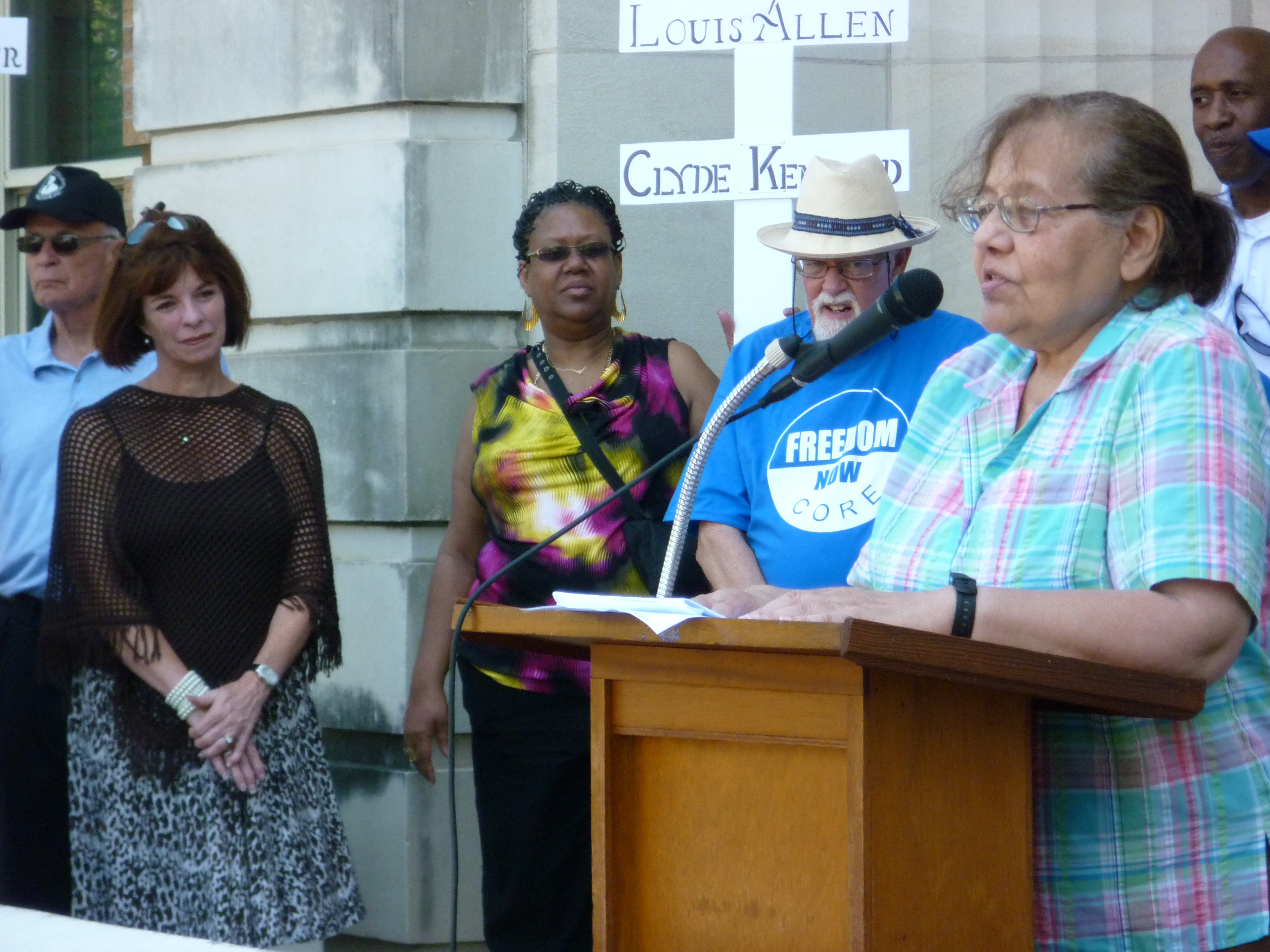
On Saturday, June 18th, Friends of Justice joined dozens of civil rights veterans in honoring the memory of James Earl Chaney, Andrew Goodman, and Michael Schwerner.  For those who worked in Mississippi during the 1960s, the cruel and cowardly murder of three civil rights workers epitomizes a painful period.

The Mississippi phase of the civil rights movement doesn’t get nearly as much attention as corresponding events in nearby Alabama.  There was plenty of terror in Alabama as well; but it was offset by triumph.  Apart from the freedom rides of 1961, Mississippi didn’t produce a lot of victories.  Passionate support for segregation was almost universal among white folks.  In many counties, not a single black voter was registered when the Voting Rights Act was signed into law in 1965.  In Mississippi, two armies, one dedicated to “state’s rights” (full-blown Jim Crow segregation), the other dedicated to Civil Rights (racial equality reinforced by racial justice) fought to a bitter standstill.  (more…)

Royal visit has me longing for home

PHOTO: Prince William, Duke of Cambridge and Catherine, Duchess of Cambridge visit the Somba K'e Civic Plaza on day 6 of the Royal Couple's North American Tour, July 5 2011 in Yellowknife, Canada.By Alan Bean

I have been too busy to blog this week, but I couldn’t resist this story. You may ask what a royal tour has to do with criminal justice reform. Very little, I expect, although I am clever enough to come up with something if I had a mind to.

I am blogging about Kate and William’s royal tour because it pleases me.

For one thing, Queen Elizabeth ascended to the throne a few years before I was born and, though I am 58 years old, she has been the only British monarch I have known. When you grow up singing "God save our gracious Queen, long live our noble Queen, God save the Queen(to the tune of My Country ‘Tis of Thee) it gets into your bones (whether you like it or not).

This lovely photographic essay from the Washington Post shows the royal couple taking in a little calf roping at the Calgary Stampede and attending the Dene Games in Yellowknife, in the Northwest Territories. I was born in Calgary in 1953 and the Bean family moved to Yellowknife three years later. I remember my dad taking my sister and I to the Calgary Stampede during a summer vacation when I was a little kid. He wouldn’t spring for cowboy boots, but I did get a cowboy hat, and I wore it to bed that night.

I remember William’s grandfather, Prince Phillip, the Duke of Edinburgh, creating quite a stir a generation ago when he was presented with the inevitable cowboy hat during a visit to Calgary. “Thank you very much," said the Prince. “I think I have six or seven of these now. Perhaps I’ll use this one for a planter.”

That didn’t go down well in Cow Town.

There is another story about Prince Phillip dining at Calgary’s glorious Palicer Hotel back in the mid fifties (when he was about the age William is now). According to legend, a hotel waitress, while removing Phillip’s dinner plate, whispered, “Keep your fork, Prince, we’re havin’ pie.”

I don’t get back to Canada much these days.  My parents are both long dead and my sister, Carol, spends half the year in Texas.  But everyone needs a sense of home, and places like Calgary, Edmonton and Yellowknife are about as close as I can get.  A return visit to Yellowknife after almost fifty years is high on my bucket list.

Calgary's Bow River Valley

Last year, while in Calgary for the funeral of my aunt, Iris Garner, I stopped by the old home of the now defunct Baptist Leadership Training School, an institution I attended in 1971.   It had been fully forty years since I last walked to the nearby park overlooking the gorgeous Bow River valley.  The view of the river hadn’t changed a bit, but I hardly resembled the callow youth who once looked out over the scene.  I have rarely felt more orphaned and adrift.

So I guess, in the end, these rambling thoughts do relate to this blog’s primary theme.  Everybody needs a sense of place, everybody needs to belong to a people.  Friends of Justice works in the American South, a region occupied by rooted people with a strong sense of belonging.  What happens when a proud people is made synonymous with bigotry and hate?  Issues of culpability aside, how deep does the fear, loss and resentment go?

The spirit and spirituality of mass incarceration is a plant native to the southland that has been nourished for decades by the deepest kind of alienation and outrage.  People felt as if the glorious narrative that had given them a sense of people and place had been desecrated.  The sense of loss was palpable.  This is why Ronald Reagan launched his election campaign in 1980 in Neshoba County, the place where, 16 years earlier, three civil rights leaders had been murdered.  Reagan was opposed to the civil rights movement, but he was hardly a son of the South.  His advisers knew, however, that a rich deposit of racial resentment was waiting to be mined in places like Neshoba County.  People had lost their story and they desperately wanted it back.  Reagan promised to deliver.  The promise was kept.

Sign announcing the 2011 Neshoba County Fair

I understand these emotions.  I grew up in one country and I live in another.  Calgary, Alberta and Fort Worth Texas have a lot in common, but I never really feel at home in Texas.  Nor would I feel at home if I returned to my native Canada.  Like Thomas Wolfe said, “You can’t go home again.”

When Tea Partiers say they want their country back they are longing for an old, old story.  They want to feel part of an exceptional, virtuous and boot-leather-tough nation where everyone shares the same values and pursues the same goals.  That kind of America never existed in reality; but it lives in memory nonetheless.  The nation people want to regain exists in the form of narrative mythology, and this story about restoring a noble, resolute and unified America is the most potent force in contemporary politics.

There is no sense decrying or endlessly deconstructing the narrative that animates our ideological opposites.  We need a narrative of our own.  We don’t need a story about the nation we once were; we need a story about the nation the better angels of our national nature have always aspired to be.  We need to start talking about a country where there is no us and them; a nation where there are no surplus, throw-away people.
We need to start talking about a nation of broken people where broken people can be redeemed.
According to reporter Jeremy van Loon, Prince William characterized Canada as that kind of country.

Prince William praised Canada’s “extraordinary potential” and the nation’s values of “freedom and compassion” at the end of a nine-day tour of the country with his wife, the Duchess of Cambridge.  “Canada is not just a great union of provinces and territories, it is a great union of peoples from many different backgrounds who have come together to make this a model — and a magnet — for those who value freedom, enterprise, tolerance and compassion,” he said today in Calgary.

 I’m not sure Canada, or any other country, deserves such high praise.  The prince was being complimentary.  But don’t we want to live in that kind of country?  When we tap into that desire, the movement to end mass incarceration will begin.

When Will the U.S. Stop Taking the Easy Route on Immigration?

By Victoria Frayre*

Newly released statistics by the U.S. Sentencing Commission reveal that almost half of all people sentenced for federal felony crimes are Latino. Why is this so? Although most Latino federal offenders are being imprisoned for immigration offenses (about 48% in 2007) does it really make sense to throw illegal immigrants in prison? With prisons already busting at the seams it is absolutely mind-boggling to me why anyone would think that adding to the overwhelming prison population is a good idea. Ironically, this is exactly what is happening. (more…)

David Simon offers to make a new season of ‘The Wire’ if the feds end their drug war

Eric Holder and stars of 'The Wire' discuss endangered children.Attorney General Eric Holder recently appeared with several actors from the HBO series ‘The Wire’ to discuss the plight of children exposed to the drug culture.  It seems the program, co-produced by David Simon and Ed Burns, is a real hit at the Justice Department.  President Obama is also a big fan.  In fact, AG Holder is so impressed with The Wire he ordered Simon and Burns to produce at least one additional season.

“I want to speak directly to Mr. Burns and Mr. Simon. Do another season of ‘The Wire.’ That’s actually at a minimum….if you don’t do a season, do a movie. We’ve done HBO movies; this is a series that deserves a movie. I want another season or I want a movie. I have a lot of power Mr. Burns and Mr. Simon.” (more…)

Tough on crime; tougher on education

By Chelsea Zamora

High school graduates have recently been walking across the stage, receiving their diplomas, and preparing to leave home for the first time. While this is true for some, a good number of students are staying at home and receiving their education from local community colleges.

While many factors play into why one chooses community college, cost plays a major role, especially in low income families. According to the Texas Higher Education Coordinating Board, community college is less than half the cost of attending a regular university, with students saving money on things like tuition and housing expenses. Between the years 2000-2007, there was a 31% increase in students attending a two year college, compared to a 19.9% increase in students attending public universities in Texas. This shows how rapidly the community college system has been expanding. (more…)