Category: racial politics

Newt plays the race card

By Alan Bean

When Newt Gingrich calls Barack Obama the “food stamp president,” is he making a crude appeal to white racial resentment, or is he taking a race-neutral stand on economic policy?

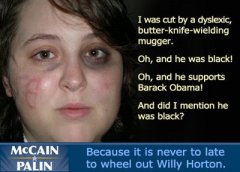
To put the question another way, are we witnessing a return to the racially coded Willy Horton ads that brought George H. W. Bush back from the political grave? 

The NPR story below gives both sides of the debate but, like most news coverage, substitutes he-said-she-said quotations for a nuanced discussion of the issue.  Tali Mendelberg’s The Race Card is the definitive work on racial coding.  Mendelberg notes that American politicians are no longer able to use race in an overt fashion.  Since the civil rights era, he says, the idea of equality is too firmly established in American social life for overt appeals to white supremacy to work.  This creates the impression that racism has no meaningful place in the political game, but such is not the case.  White Americans are racially biased, but they also embrace the ideal of full racial equality.  This is why racial coding can be highly effective. (more…)

Texas redistricting case: A challenge to the Voting Rights Act?

The redistricting saga in Texas is causing concern throughout the nation. Not only could the redistricting case severely diminish the impact of minority voters in the 2012 elections, but it will also likely determine which party will take the four additional Congressional seats that Texas gained as a result of population growth.

The Republican-dominated state legislature drew the highly disputed district maps. “At least three of the four new congressional districts were drawn in a way that seemed likely to favor Anglo Republican candidates,” ProPublica reports,” — Even though Latinos and African-Americans accounted for most of the state’s population growth.”

The case is currently being heard by the Supreme Court and Texas is desperately seeking a resolution before the 2012 elections.

The ProPublica report below, offers an excellent overview of the ongoing legal battle and the potential effects that redistricting could have on parts of the Voting Rights Act. MW

Will the Supreme Court strike down part of the Voting Rights Act?

By Lois Beckett, ProPublica

Yesterday afternoon, the Supreme Court heard arguments in a Texas redistricting case that could have major implications for minority voters — as well as determine which party is likely to control Congress after the 2012 elections.

Here’s our guide to why the case matters, why it could pose a challenge to part of the Voting Rights Act, and what impact the Court’s ruling could have on voters across the country.

How did this case end up in front of the Supreme Court?

At its most basic, the case is contesting which district maps Texas will use in the 2012 elections.

This seems like a dry question, but it’s not. Thanks to population growth, Texas is gaining four seats in Congress, and how the district lines are drawn is likely to determine whether those additional seats will be won by Democrats or Republicans — and how big an impact minority voters will have in deciding who the new representatives will be.

Because those four seats could help determine which party controls the House of Representatives, the Texas case is being closely watched across the country.

As it has done before, the Republican-dominated state legislature drew maps that heavily favor Republicans.

At least three of the four new congressional districts were drawn in a way that seemed likely to favor Anglo Republican candidates — even though Latinos and African-Americans accounted for most of the state’s population growth. (more…)

Pat Buchanan may be finished at MSNBC

Conservative icon Pat Buchanan may be losing his pulpit at left-leaning MSNBC.  Reports in the Washington Post, Slate, and the HuffPost indicate that MSNBC president Pat Griffin is on the verge of cutting his network’s ties to Buchanan.  Color of Change has been insisting that the conservative pundit be fired since the publication of Buchanan’s Suicide of a Superpower: Will America Survive to 2025.  The book contains a chapter called “The end of white America” in which it is argued that the loss of a shared European culture and a common Christian heritage is robbing the nation of its traditional character.

This quote, recently aired on NPR’s The Diane Rehm Show, provides a good synopsis of Buchanan’s position

For what is a nation?

Is it not a people of a common ancestry, culture, and language who worship the same God, revere the same heroes, cherish the same history, celebrate the same holidays, share the same music, poetry, art, literature, held together, in Lincoln’s words, by “bonds of affection … mystic chords of memory, stretching from every battle-field, and patriot grave, to every living heart and hearth-stone”?

If that is what a nation is, can we truly say America is still a nation? The European and Christian core of our country is shrinking. The birth rate of our native born has been below replacement level for decades. By 2020, deaths among white Americans will exceed births, while mass immigration is altering forever the face of America.

Buchanan says he took the controversial chapter title from an article in the Atlantic written by Vassar professor Hua Hsu.  Hsu’s lengthy piece traces a perceived white identity crisis through the 1990s and the first decade of the twenty-first century.  The article features the work of Temple sociologist Matt Wray who is paying close attention to the impact the academy’s critique of white supremacy is having on his students. (more…)

Is Ron Paul a racist?

By Alan Bean

James Kirchick’s article in the Weekly Standard throws fuel on the “is Ron Paul a racist?” fire.  In the 1980s, Paul sponsored a newsletter that regularly spewed racist and anti-semitic venom while endorsing every conspiracy theory coming down the pike.  Paul says he didn’t write the articles and never edited the newsletter.  He also claims that the racist views that were a regular feature of the publication he financed never reflected his true feelings

An extended version of Kirchick’s take on Ron Paul has been published in the New Republic and now appears on the CBS site.  In this piece, Kirchick argues that Paul’s racism is consistent with his libertarianism.   

Paul’s indulgence of bigotry . . . isn’t an incidental departure from his libertarianism, but a tidy expression of its priorities: First principles of market economics gain credence over all considerations of social empathy and historical acuity. His fans are guilty of donning the same ideological blinders, giving their support to a political candidate on account of the theories he declaims, rather than the judgment he shows in applying those theories, or the character he has evinced in living them. Voters for Ron Paul are privileging logical consistency at the expense of moral fitness.

As proof that he can’t be a racist, Paul notes that “the blacks” are beginning to rally to his libertarian banner.

Kirchick can’t understand why Paul’s racist associations haven’t attracted public scrutiny.  The lack of interest is probably explained by the simple fact that, until very recently, Paul wasn’t viewed as a serious candidate.  If, like Newt Gingrich, Paul suddenly roared to the front of the pack, his background would get a lot more attention.

Is Ron Paul a hater?

Let’s begin with what we know for sure: the Republican candidate had a lot of racist and anti-semitic friends back in the day.   And as Kirchick points out below, Paul’s regular appearances on the Alex Jones program suggests he is comfortable with nutty conspiracy theorists. 

Full disclosure: I once appeared on the Jones program in connection with the ill-starred Tulia drug sting.  (But Paul is a regular guest who appears to have endorsed, for instance, the idea that 9-11 was produced and directed by the American government.)  I have also been the victim of a Weekly Standard hatchet job, so I am willing to cut a little slack.

I like Ron Paul.  He is generally right about drugs and militarism, although I find his Austrian school economics hard to stomach.  It is refreshing to hear a presidential candidate espousing unpopular opinions–something you rarely hear from Democrats or Republicans these days. (more…)

Are undocumented immigrants ‘persons’?

By Chris Kromm

This column originally appeared in Facing South

When the U.S. Census counts the population of the country every 10 years, who qualifies as a person? This week, the state of Louisiana filed a lawsuit which challenges the Census’ long-standing policy of counting all residents — citizens and non-citizens — and using those results to divide up seats in the U.S. Congress.

The lawsuit, which has broad implications for the political role of immigrants, comes after Louisiana lost a Congressional seat following the 2010 Census count. Thanks to the massive displacement after Hurricane Katrina — the city of New Orleans lost 30% of its population between 2000 and 2010 — Louisiana’s delegation fell from seven seats to six.

During the last 10 years, every other Southern state saw growth — in many cases fueled by new immigrants. Texas, for example, gained four Congressional seats thanks to its burgeoning population; the Census estimates two-thirds of the growth came in the Latino/Hispanic community.

New immigrants were also key to increases in size, and added Congressional seats, in Florida, Georgia and South Carolina. Nationally, about 22% of voting-age Latinos are not citizens.

In the lawsuit filed directly to the Supreme Court, Louisiana v. Bryson [pdf], Louisiana argues that the Census policy of counting non-citizens allows other states to gain clout “at the expense of states containing relatively few” undocumented immigrants, like Louisiana. Leave out the undocumented residents, Louisiana says, and it would still have seven Congressional seats.

Louisiana Attorney General Buddy Caldwell innocently says that “Louisiana’s complaint simply asks the court to require the federal government to re-calculate the 2010 apportionment of U.S. House of Representatives seats based on legal residents.”

If the Supreme Court ruled in Louisiana’s favor, the fallout would be anything but simple. Aside from forcing 17 states to scrap their political maps on the eve of the 2012 elections, the law would fundamentally change how the Census works and immigrants are recognized in the country.

The U.S. Constitution originally said the Census should involve “counting the whole number of free persons,” which the 14th Amendment changed to “counting the whole number of persons,” including non-citizens.

Changing that mandate would be felt at every level of government and the economy. States and localities, which provide services like police, fire and medical treatment to undocumented residents, depend on billions in federal aid based on whole-person counts. Undocumented residents also paid $11.2 billion in taxes in 2010.

If the Supreme Court sided with Louisiana in saying that undocumented residents shouldn’t count in divvying up Congresional districts, they may be cornered into saying the Census can’t count them for other policy matters as well.

This isn’t the first time Louisiana leaders have dragged the Census into the immigration debates roiling the South and country. In 2009, U.S. Sen. David Vitter (R-LA) introduced an amendment to the bill funding the 2010 Census that would have required Census workers to ask residents if they were U.S. Citizens; the senate voted down the measure.

Redistricting advocate Justin Levitt, who runs the website All About Redistricting, said on Twitter that the Louisiana suit “will lose, and lose badly, for several reasons.” Rick Hasen at the University of California-Irvine agrees on the Election Law Blog:

How appealing will be an argument to a bunch of originalists/textualists that the term “persons” in the Constitution does not include all people, and in fact excludes non-legal residents?
Pat Buchanan appears on white supremacist radio show

MSNBC commentator, Pat Buchanan, recently appeared on a white supremacist radio show to promote his new book, “Suicide of a Superpower.” In protest, the advocacy group ColorOfChange.org organized a petition, calling on MSNBC to fire Mr. Buchanan for his “long record of bigotry.”  For more details and to sign the petition, see the below message from ColorOfChange.org. MW

Did you hear about MSNBC’s white supremacist commentator?

For years, Pat Buchanan has passed off white supremacist ideology as legitimate mainstream political commentary. And MSNBC continues to pay him and give him a platform on national TV to do it.

Buchanan has just published a book which says that increasing racial diversity is a threat to this country and will mean the “End of White America.”1  This weekend, to promote his book, he went on a white supremacist radio show whose host has said things like “MLK’s dream is our nightmare,” and “interracial sex is white genocide.”2

Buchanan has the right to express his views, but he’s not entitled to a platform that lets him broadcast bigotry and hate to millions. If MSNBC wants to be seen as a trusted, mainstream source of news and commentary, it needs to fire Buchanan now.

Please join us in calling on MSNBC to fire Pat Buchanan:

http://act.colorofchange.org/sign/buchanan/

Here are a few examples of what Buchanan has said in the past: (more…)

The most influential civil rights champion you’ve never heard of

If you’ve never heard of Stetson Kennedy, you’ll feel as if you’ve known the man all your life after reading this wonderful eulogy by University of Florida professor Paul Ortiz.  Kennedy is generally remembered as a thorn in the side of the Ku Klux Klan, but as Professor Ortiz makes clear, his significance is much deeper and broader than that.  Until this morning, I had never heard Stetson Kennedy’s name mentioned in connection with racism, segregation, white supremacy or the civil rights movement.  How can that be?  AGB 

stetson_kennedy_typing.pngBy Paul OrtizStetson Kennedy passed away on Saturday, Aug. 27. He was 94 years old. Stetson died peacefully in the presence of his beloved wife, Sandra Parks, at Baptist Medical Center South in St. Augustine, Florida.

Stetson Kennedy spent the better part of the 20th century doing battle with racism, class oppression, corporate domination, and environmental degradation in the American South. By mid-century Stetson had become our country’s fiercest tribune of hard truths; vilified by the powerful, Stetson did not have the capacity to look away from injustice. His belief in the dignity of the South’s battered sharecroppers, migrant laborers, and turpentine workers made him the region’s most sensitive and effective folklorist.

Stetson was so relentless, so full of life, that some of us thought that he would trick death the way that he had once fooled the Ku Klux Klan into exposing their lurid secrets to the listeners of the Adventures of Superman radio program in 1947. As recently as April, Stetson gave a fiery speech to hundreds of farm workers and their supporters at a rally in support of the Coalition of Immokalee Workers in Tampa. Standing in solidarity with Latina/o and Haitian agricultural workers affirmed Stetson’s ironclad belief in the intersections between labor organizing, racial justice, and economic equity. (more…)

Asked about the civil rights movement, Perry changes the subject

By Alan Bean

The post below comes from Chris Kromm at The Institute for Southern Studies.  Asked to comment on the contribution of the “Friendship Nine”, Perry made the obligatory tip of the hat to racial equality and then launched into a standard (and off-topic) defense of small government politics.  Perry didn’t comment on the groundbreaking heroism of nine civil rights pioneers because his audience of choice gets angry at the very mention of the civil rights movement.  They don’t hate black people, and they aren’t calling for a return to the days of racial segregation; but the civil rights movement is a touchy topic because it makes white Southerners and conservative politicians looks really, really bad.  So Mr. Perry, fearful of alienating his base, changed the subject.

Gov. Rick Perry flunks civil rights lesson in South Carolina campaign stop

FriendshipNineJail.jpgEach presidential election, Republicans declare that this could be the year they might win over African-American voters, or at least enough to tip the balance in key battleground states.But if surging White House hopeful Gov. Rick Perry of Texas ends up clinching the GOP nomination, he may have irreparably hurt his chances of luring black voters — already a challenge when facing President Obama — this past weekend at a campaign stop and fundraisernear Rock Hill, South Carolina.During the media presser, a TV reporter noted that Perry was visiting a “very important place in Rock Hill’s and the nation’s civil rights history,” it being the 50th anniversary of a historic sit-inby a group of students from nearby Friendship College, known as the “Friendship Nine.” (more…)

“Perrymandered” electoral map could backfire

By Alan Bean

Once upon a time, the red-red state of Texas was Dixiecrat Blue.  That changed at the federal level a long time ago, but as late as 2004, the State House was still controlled by Democrats.  Recent elections have changed that in a big way–Republicans are now firmly in control of the Texas Legislature.  Texas has always been a politically conservative state; it just took a few decades for the Southern strategy to kick in.

One quick glance at the Texas Legislature’s “face-book” and the racial implications of this political re-orientation is immediately obvious: most Democrats are black and brown and the delegation boasts a large number of women; flip over to the Republican delegation and you see lots of white males, a few white females and the occasional conservative Latino who was elected with Anglo votes.

Meanwhile, the complexion of the Texas electorate has been rapidly changing.  The state population has been exploding in recent years and almost all the growth has come from the Latino segment of the population.  Thanks to this growth, Texas was recently awarded four additional congressional seats.  Here’s the problem; the Republican dominated Legislature is responsible for drawing up a new electoral map, but the folks responsible for creating four new seats rarely pull the red lever in the voting booth.

As this article in the National Journal indicates, the GOP initially looked to Rep. Lamar Smith for guidance.   Smith suggested that they create two strong Republican districts (to ensure continued GOP hegemony) while cobbling together two heavily Latino districts a to avoid questions about fairness and possible legal challenges.

Led by Joe Barton and Rick Perry, Texas Republicans decided to ignore Smith’s advice and play for all the marbles.  They controlled the Legislature, so they ought to be able to reconfigure the electoral lines in their favor.  This kind of thinking produced a “Perrymandered” map designed to give the Republicans four new seats while doing absolutely nothing to increase Latino political influence.  In fact, the new map was designed to frustrate Hispanic voters.  The snub was obvious and intentional.

Texas Democrats have only themselves to blame for these developments.  The party’s best bet (morally and politically) is to embrace ethnic diversity and market itself as “the party that looks like Texas.”  Unfortunately, many older Democrats are still mired in the bad old days when Jim Crow values dominated Texas politics.  What’s the use of fielding an inclusive mix of black, brown and white candidates, they reason, if conservative white voters rally around The Party of White?  The idea that white voters might reconsider their biased ways if presented with a compelling new vision is beyond the comprehension for most Anglo Democrats in Texas.

Latino Texans are frustrated.  For decades they have been exploited by Democrats and ignored by Republicans.  Texas Latinos have a hard time getting excited about the Democratic Party (why should they), but they do want their growing numbers to translate into real political influence (why shouldn’t they).   (more…)

Rick Perry’s Big Gamble

By Alan Bean

It no longer matters whether Rick Perry’s The Response extravaganza draws 8,000 or 80,000 ardent Christians to Houston’s Reliant Stadium; the event will be remembered (if it is remembered at all) as a cynical attempt to build a base by driving another wedge into an already fractured religious community.

Perry’s big event would have been inconceivable during the nation’s formative years, and it is hard to imagine any 20th century presidential candidate thinking he could enhance his political stature by consorting with fringe elements on the religious right.  True, George W. Bush and Ronald Reagan courted these same people, but always behind closed doors.

The take-away from The Response is that a Republican presidential aspirant believes an event of this sort is in his political interest.  Rick Perry’s personal religion is irrelevant here; tomorrow’s event is pure politics.

Will the gamble pay off? (more…)