Category: Racial reconciliation

A hate crime unites Jackson Mississippi

By Alan Bean

While The Help transported America back to Jackson, MS circa 1963,  a young white Jackson man named Daryl Dedmon was determined to prove that nothing has changed in Jackson.

It could be argued, in fact, that Dedmon’s decision to run over a man he and his friends had already beaten to a bloody pulp was far more senseless than hate crimes perpetrated against black Mississippians during the Jim Crow and civil rights eras.  Violence back then had a clear purpose: maintaining Jim Crow and white supremacy.  Perpetrators weren’t necessarily seething with hatred, they were simply making a point (the lives of black people are worthless) and inspiring an emotion (terror).  That was the message whenever hapless black men were lynched by smiling crowds throughout the South.

What kind of message were Mr. Dedmon and his friends sending?  The only silver lining clinging to the edges of this story is the response of Jackson residents, black and white.  Dedmon et al didn’t mean to unite their community, but that’s what they did.

Normally, I wouldn’t assume the guilt of the defendants, but these guys were caught by a surveillance camera.

James Craig Anderson

HUNDREDS MARCH AGAINST RACIST KILLING IN MISSISSIPPI

Vigil for James Craig Anderson is held in Jackson parking lot where White teens are suspected of intentionally targeting Black victim for brutal attack caught on videotape

Religious and community leaders in Jackson, Miss. led a march and vigil on Sunday for James Craig Anderson, the Black man who authorities say was killed in June by a White teenager who shouted racial slurs after running the 49-year-old over with his car on June 26.

 The Clarion-Ledger reported that a diverse crowd gathered at the Metro Inn to remember Anderson, as Daryl Dedmon remains jailed on a murder charge under an$800,000 bond.

Escorted by police and singing “We Shall Overcome,” marchers walked down Ellis Avenue to the site of the hit-and-run killing, as faith leaders decried a killing that shocked a community and has drawn international headlines. When they arrived, a wreath and candles were laid down as demonstrators joined hands in solidarity. (more…)
A mayor and a prophet lock horns in a Southern town

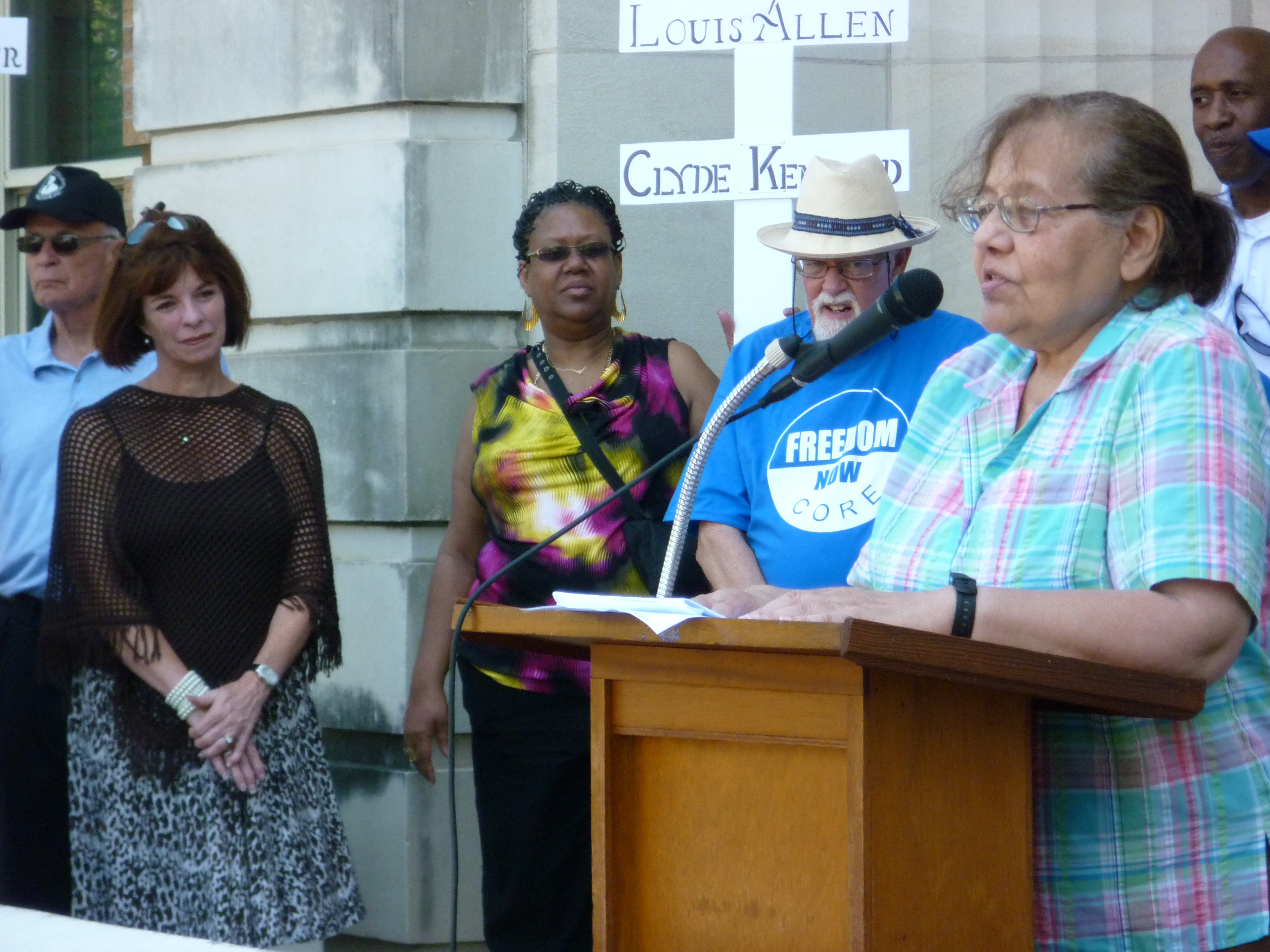
Diane Nash addresses crowd as Mayor Cheri Barry looks on

By Alan Bean

On Saturday, June 18th, Friends of Justice joined dozens of civil rights veterans in honoring the memory of James Earl Chaney, Andrew Goodman, and Michael Schwerner.  For those who worked in Mississippi during the 1960s, the cruel and cowardly murder of three civil rights workers epitomizes a painful period.

The Mississippi phase of the civil rights movement doesn’t get nearly as much attention as corresponding events in nearby Alabama.  There was plenty of terror in Alabama as well; but it was offset by triumph.  Apart from the freedom rides of 1961, Mississippi didn’t produce a lot of victories.  Passionate support for segregation was almost universal among white folks.  In many counties, not a single black voter was registered when the Voting Rights Act was signed into law in 1965.  In Mississippi, two armies, one dedicated to “state’s rights” (full-blown Jim Crow segregation), the other dedicated to Civil Rights (racial equality reinforced by racial justice) fought to a bitter standstill.  (more…)

Pastor to Black Panthers ministers to white Baptist University in North Carolina

J. Alfred Smith

I first met the Reverend Dr. J. Alfred Smith when he “preached a revival” at First Baptist Church, Kansas City, KS.  Charles Kiker, my father-in-law, was pastor at FBC in the mid-1990s and I was invited as the guest singer.  A few years later, when Friends of Justice was created in response to a big drug bust in a little Texas town, Pastor Smith and members of his congregation provided welcome support.  Dr. Smith, pastor emeritus at Allen Temple Baptist Church in Oakland, CA, is now 80 years old, but his commitment to prophetic witness still burns white-hot.  The article below first appeared in the Religious Herald. AGB


J. Alfred Smith finds Gardner-Webb University open to diversity

By Norman Jameson

Thursday, May 12, 2011

BOILING SPRINGS, N.C. (ABP) — A predominantly white Baptist college in rural North Carolina might seem an unlikely place to find an urban African-American pastor from California known for an agenda of prophetic justice, but Gardner-Webb University just said goodbye to J. Alfred Smith, pastor emeritus of Allen Temple Baptist Church in Oakland, Calif., who served as the school’s first scholar-in-residence this spring. (more…)

Alexander v. McWhorter: who’s got the winning formula?

By Alan Bean

John McWhorter and Michelle Alexander agree that the war on drugs should be abandoned.  They also agree that far too many young black males are languishing in American prisons.  But McWhorter thinks Alexander’s call for a consensus-shifting movement is wrong-headed.  It’s wrong-headed because it’s impractical.  It’s impractical because white people are sick and tired of being demonized.  As McWhorter sees it, we simply will not listen to a social analysis that identifies white racism at the heart of the problem.

McWhorter isn’t saying that Alexander is wrong when she associates the war on drugs with a “Southern strategy” rooted in white resentment; he just feels that, as a practical matter, that argument can’t be sold in the white-dominated American marketplace.

This is an important issue.  For criminal justice reformers, it is THE issue.  Should we embrace the “only a movement” philosophy of Michelle Alexander, or the “end the drug war and white guilt is gone” idea John McWhorter has been championing?  Alexander is asking for the second phase of the civil rights movement; McWhorter is looking for an argument that works in an incurably cynical world.

One thing is certain: at some point we must connect with white moderates; if we don’t, the political fight cannot be won.  But how do we win over white moderates?  Do we conform our arguments to their fears, anxieties and preferences, or do we challenge them to embrace a revolutionary vision grounded in love, mercy and justice?

Whether Michelle Alexander knows it or not (and I suspect she does) she is calling for nothing less than a full-blown religious revival.  The values she espouses are biblical values; they won’t work in the political arena, and they aren’t that welcome in most white churches either (if the preacher gets concrete and specific).  Martin Luther King knew that mainstream white America wasn’t ready for integration, so he launched a movement fired by a religious revival.  Mainstream white America isn’t ready to end the drug war; it could even be argued that white folks need the drug war because it reinforces our most cherished prejudices.  Can anything short of a spiritual revival alter this social landscape? (more…)

Is anti-white bias on the rise?

By Alan Bean

The title of this Wall Street Journal article is a bit understated.  Not only do white Americans see anti-white bias on the rise, they believe that bias against whites is a greater problem than bias against blacks.  If this study is accurate (and I suspect it is) it is hardly surprising that references to systemic or structural racism hook so much resentment in white audiences–they think they are the ones getting whooped on!

In one sense, this observation is accurate.  White Americans are generally held responsible for past injustice–a catalogue of grievances ranging from the virtual extermination of Native Americans to slavery, Jim Crow and the “Southern Strategy”.  White people keep insisting that neither they nor their parents owned slaves and they have never personally exterminated a Native American.  Therefore, their hands are clean and the fact that these outrages keep coming up for discussion is an indication of anti-white bias.  This justifies the odd belief that white people encounter more social bias in the course of an average day than black people. (more…)

Kellogg challenges the colorblind consensus

By Alan Bean

The W.K. Kellogg Foundation recently launched a $75 million grant-making program dedicated to racial healing.  “We believe that all children should have equal access to opportunity,” the foundation’s website reads.  “To make this vision a reality, we direct our grants and resources to support racial healing and to remove systemic barriers that hold some children back. We invest in community and national organizations whose innovative and effective programs foster racial healing. And through action-oriented research and public policy work, we are helping translate insights into new strategies and sustainable solutions.”

In an article written for the National Committee for Responsive Philanthropy, Dr. Gail Christopher, Kellogg’s vice president for program strategy, addressed the issue squarely:

The vision that guides the work of the W.K. Kellogg Foundation is clear: we envision a nation that marshals its resources to assure that all children thrive.  What may be less self-evident to some is the pernicious and self-perpetuating way in which racism impedes many children’s opportunities to do so. (more…)

Obama’s problem with white folks

By Alan Bean

A new Pew Poll shows that Barack Obama isn’t connecting with white voters.  This is hardly big news: Obama won just 43% of the white vote in the 2008 election.  But his popularity rating with white voters now rests at 38%.  Even more chilling, if you’re a Democrat, a full 60% of the white electorate backed Republican candidates in the 2010 midterm election.

What’s going on here?  Two things. 

First, as we commemorate the 43rd anniversary of Martin Luther King’s assassination, the Republican Party is still advertising itself (surreptitiously, of course) as the Party of White.  

In the short run, this makes a lot of political sense.  Baby boomers, the demographic currently controlling American politics, are 75% white.  But the “Party of White” strategy will shortly run out of gas.   From the earliest days of European colonization, America has been a majority white nation.  Not for long.  A slight majority of Americans 18 and younger are people of color.  These rapidly shifting demographic patterns have injected a strong dose of cognitive dissonance into the hearts and minds of white folk.  We feel we are losing control.  We pull the red lever because we hope it will preserve the white-dominated world we were born into. (more…)

Adapting reality to the white viewer

The New York Times recently ran an article lamenting the all-white list of nominees for this year’s Oscars.  Randy Shaw (see below) points out that it ain’t just the movies; television offers few characters or programs aimed at the non-white audience. 

Shaw references David Simon’s The Wire as a blessed exception to the rule and wonders why such a critical success hasn’t been emulated (except by HBO’s Treme, and that show is also produced by David Simon).

It’s simple; The Wire was always more popular with critics than with viewers.  It held its own; but Simon’s programs received only a fraction of the audience that followed The Sopranos, for instance.  Why is that?  

The answer isn’t pleasant.  White audiences don’t relate well to non-white protagonists.

Early on in the Tulia fight, several producers showed a tentative interest in bringing the story to the silver screen.  I didn’t pay much attention to the let’s-make-a-movie phenomenon because we were years away from resolution.  Secondly, I figured the story was too morally ambiguous for Hollywood.  I remember being asked if my family would be interested in playing the starring role in a film.  When I protested that the affected community should be at the center of the movie I was assured that the American viewing public would have little interest in poor black people living in an isolated Texas town. (more…)

McWhorter: end the drug war and racial tension evaporates

John McWhorter

John McWhorter is a conservative African-American who enjoys needling white liberals and the “racism-is-still-real” brand of civil rights advocacy.  For over a year now McWhorter’s take on race has taken on a decidedly libertarian tone.  He’s for legalizing drugs; all of them.

The Cato Institute’s current newsletter contains a PDF version of McWhorter’s new message.  The version I have pasted below appeared last year in The New Republic.

If you are a fan of HBO’s The Wire (the best television of all time in my opinion), the essential features of McWhorter’s argument will come as no surprise.  African-American youth have little incentive to look for conventional work because drug money comes so easy.  As a result, hundreds of thousands of black males are doing time on drug charges, inner city street gangs slaughter one another in turf battles, black children have no fathers, black women give up on finding a marriage partner, and everything goes to hell. (more…)

Can we end mass incarceration without mentioning race?

By Alan Bean

The criminal justice reform movement has two distinct branches that may have trouble sharing a common message or strategy.

The first branch of reformers is best represented by Michelle Alexander’s “New Jim Crow” thesis.  Alexander sees the war on drugs as primarily an assault on poor people of color.  Reformers, she argues, have either avoided racial arguments altogether, or have focused on Rosa Parks-type defendants who transcend racial stereotypes.  Consider this quote from her book, The New Jim Crow: Mass Incarceration in the Age of Colorblindness:

Challenging mass incarceration requires something civil rights advocates have long been reluctant to do: advocacy on behalf of criminals. Even at the height of Jim Crow segregation—when black men were more likely to be lynched than to receive a fair trial in the South—NAACP lawyers were reluctant to advocate on behalf of blacks accused of crimes unless the lawyers were convinced of the men’s innocence . . . outside of the death penalty arena, civil rights advocates have long been reluctant to leap to the defense of accused criminals. Advocates have found they are most successful when they draw attention to certain types of black people (those who are easily understood by mainstream whites as ‘good’ and ‘respectable’) and tell certain types of stories about them. Since the days when abolitionists struggled to eradicate slavery, racial justice advocates have gone to great lengths to identify black people who defy racial stereotypes, and they have exercised considerable message discipline, telling only those stories of racial injustice that will evoke sympathy among whites. (more…)