Category: “Social Justice”

Prosecutors held to account

The US Supreme Court agreed to dismiss a suit against two Iowa prosecutors after Pottawattamie County, Iowa signed off on a $12 million settlement with Terry Harrington and Curtis W. McGhee, two men who were wrongfully convicted on the basis of coerced testimony.  Former prosecutors Dave Richter and his assistant Joseph Hrvol had claimed immunity from prosecution but, when the Supreme Court agreed to hear the case, support for this position quickly eroded.

Accroding to the New York Times, “McGhee and Harrington sued, saying that as prosecutors Richter and Hrvol had them arrested without probable cause, coerced and coached witnesses, fabricated evidence against them and concealed evidence that could have cleared them. They claimed authorities were eager to charge someone and that they were targeted because they are black.”

Harrington and McGhee were convicted of killing retired police officer John Schweer at a Council Bluffs car dealership in 1977.  The two men were sentenced to life in prison in 1978.

The picture above shows Terry Herrington with his family after being released from prison.

Orlando Patterson’s quiet revolution

Harvard sociologist Orlando Patterson makes two major claims in this stimulating op-ed piece in the New York Times. First, he suggests that racism has changed its shape without losing its power.  This means that a black president must never address the race issue directly.

Patterson understands the historical roots of American racism as well as any living American scholar.  Here’s his mini-lecture on the subject:

We became this way because of the peculiar tragedies and triumphs of our past. Race and racism scar all advanced nations, but America is peculiar because slavery thrived internally and race became a defining feature of personal identity.

Slavery was quintessentially an institution of exclusion: the slave first and foremost was someone who did not belong to and had no claims on the public order, nor any legitimate private existence, since both were appropriated by the slaveholder. The Act of Emancipation abolished only the first part of slavery, the master’s ownership; far from removing the concept of the ex-slave as someone who did not belong, it reinforced it. The nightmare of the Jim Crow era then extended and reinforced the public slavery of black Americans right up through the middle of the 20th century.

At the same time, the status of blacks as permanent outsiders made whiteness a treasured personal attribute in a manner inconceivable to Europeans. Whiteness had no real meaning to pre-immigration Swedes or Irishmen because they were all white. But it became meaningful the moment they landed in America, where it was eagerly embraced as a free cultural resource in assimilating to the white republic. In America race had the same significance as gender and age as defining qualities of personhood.

The civil rights movement opened up new opportunities for educated people of color by abolishing “the lingering public culture of slavery”, but while black people have made great strides in the entertainment, athletic and political fields, the social segregation in America has actually deepened.  African Americans are still perceived to be “culturally different”, Patterson writes, and “In the disciplined cultural spaces of marriages, homes, neighborhoods, schools and churches, these same differences become the source of Apollonian dread.”

Social isolation means that white Americans have a hard time grasping the individuality of black Americans.  As a result, the pathologies of the few are attributed to the many.  Although the relationship between social pathology and bad public policy is simply assumed in the academic community, a black president must never appear to be making excuses for absentee dads and street-hardened thugs if he wants white votes.

I’m not sure if Patterson is trying to describe the president’s thinking in this op-ed, or if he is telling Obama how he ought to think.  Maybe he’s doing both.  Obama, Patterson suggests, must never lecture white America about race.  In the wake of the Jeremiah Wright controversy, Obama had to speak out to keep the race issue from derailing his candidacy.  But since entering the White House, he has made only one foray into racial politics (his remarks about the Gates-Crowley affair) and Patterson sees that as an unmitigated disaster. 

Therefore, the professor says, America’s first black president “will not be leading any national conversations on race, convinced as he must be that they exacerbate rather than illuminate.” 

Patterson seems to agree with this stark assessment.

Are white Americans so ignorant and reflexively defensive that they can’t engage in an intelligent give-and-take on the subject of race?

So progressive analysts seem to believe.  So it has always been.  The NAACP was horrified by Martin Luther King’s practice of non-violent direct action because the strategy invited a violent white backlash.  King persisted because he knew the sheer pathology of the typical white reaction to marches, buoycotts and sit-ins exposed the irrational hatred at the heart of racist public policy. 

Similarly, the Freedom Rides of 1961 received negative reviews from the mainstream press.  It was generally assumed that anyone foolish enough to sit in the front section of a bus in Alabama or Mississippi had only themselves to blame if they received a brutal beating.  But every Freedom Rider sent from Jackson to the notorious Parchman prison in the Mississippi Delta weakened the position of Southern politicians.  Ultimately, Attorney General Bobby Kennedy pressured the Interstate Commerce Commission into changing the law.

Only after non-violent and inter-racial strategies were abandoned did a conservative backlash against civil rights take hold in America.   For an entire decade, the conflict between civil rights and states rights shaped the way Americans thought about the past and the present.  The living narratives unleashed by non-violent direct action seized white America by the throat.  The strategy was daring, dangerous and uniquely effective.  Civil rights activists created a social crisis in America and waited for the truth to surface.

The narrative strategy Friends of Justice employs is rooted in the early civil rights movement.  By taking hold of the narrative surrounding actual criminal cases we spark an intense conversation about race and justice.  Initially, public officials ignore us.  When that doesn’t work they attempt try to spin the story in their own favor.  In the resulting clash of narratives the truth ultimately rises to the surface.  Not everybody sees it, of course.  Some folks remain convinced that Tom Coleman made good cases in Tulia or that the nooses hanging from a tree in Jena held no racial significance.  But Jena changed the way school administrators think across America, Tulia led to widespread reforms and the Colomb case (though it gained less publicity than Jena and Tulia) exposed fundamental flaws in federal conspiracy law

Orlando Patterson hopes Barack Obama can “quietly” reform the criminal justice system.  Not by himself, he can’t.  Our punitive justice system was shaped by tough-on-crime politicians exploiting and feeding public fears at the top of their lungs.  There was nothing subtle or “quiet” about this process.  Divisive and damaging narratives about crack babies and inner city thugs built the present system and only healing justice narratives can take it apart.  

Conservative politicians could afford to be speak loudly because they reflected the zeitgeist.  White people were angry, afraid and in the majority.  Progressive leaders must wait for somebody else to change the tenor of the conversation, but if everyone is quiet nothing will change.

White skin is no barrier to reflection and repentance.  Given the right environment, all people can learn.  But there will be nothing quiet about the process.  “You shall know the truth,” Jesus tells us, “and the truth shall set you free.”  Politically nuanced fudge phrases are good for winning elections but they will never reveal truth or expose lies. 

Orlando Patterson is right about one thing: a sitting president can’t be the standard-bearer for a twenty-first century civil rights movement.  Barack Obama shouldn’t take the lead in the conversation about race and justice–but he has already changed the context in which that conversation unfolds.  It’s up to the rest of us to speak the loud truth without apology.

Jena 6 students get some positive publicity

P6264495Jesse Ray (Jody) Beard, best known as the youngest member of the Jena 6, is finishing High School at a private boarding school in Connecticut.  CNN recently interviewed Jesse Ray and Alan Howard, the NY attorney who has taken the young man under his wing.  You can find the text version of the story here.  I had the privilege of getting to know Mr. Howard during my last trip to Jena (in the picture at the left, he and attorney David Utter chat with Jesse Ray) and was moved by the depth of his commitment. 

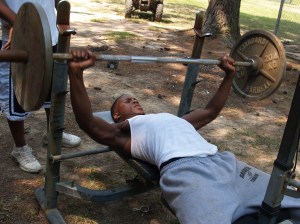
Also, the newspaper in Monroe, Louisiana did a story about Robert Bailey, Jr., another Jena 6 student who will be entering Grambling University in the fall.  Robert took a couple of summer school classes at Grambling this summer and earned a 4.0 average.  The story is unavailable online but the text is pasted below. The picture at the beginning of the article shows Robert lifting weights in June of 2009.

As the story suggests, the Bailey family has a long tradition at Grambling.   The second picture I have inserted into the news story features Robert’s grandmother during her Grambling days.  Elegant, don’t you think?  At the very end, the educational plans of all six young men are noted briefly. 

I hope Justin Barker, the victim of the December 4th, 2007 assault at Jena High, is also looking at a bright future.  Friends of Justice got involved in Jena not to pick sides but to bring some redemption to a tragic situation.  Are we better off with these young men attending college classes or locked up in a state prison? 
 P6264421

July 19, 2009

Former Jena Six student hopes to overcome past, look to future

By Stephen Largen

slargen@monroe.gannett.com

GRAMBLING — What might have sucked most people into a downward spiral only seems to have made Robert Bailey Jr. more determined to turn his life around.

Bailey, 19, is one of the Jena Six — six black Jena High School students initially charged with attempted murder in connection with a Dec. 4, 2006, assault on white student Justin Barker at the LaSalle Parish school.

The controversial case drew attention across the nation after many called the arrests and subsequent charges racially discriminatory and excessive. A massive civil rights demonstration ensued on Sept. 20, 2007, when at least 20,000 people marched through Jena to protest.

Bailey wrapped up his legal issues late last month when, along with Carwin Jones, Jesse Ray Beard, Bryant Purvis and Theo Shaw, he pleaded no contest in a Jena courtroom to misdemeanor simple battery. Bailey and the others were sentenced to seven days of unsupervised probation and a $500 fine, but were given no jail time.

They also reached a confidential settlement out of court with Barker.

The only member of the group to serve time was Mychal Bell, who pleaded guilty in December 2007 to second-degree battery and was sentenced to 18 months.

Now, after graduating in May from Shaw High School in Columbus, Ga., Bailey is taking summer classes at Grambling State University, where he plans to major in marketing. Bailey also will attempt to walk onto the football team as a wide receiver.

P6264434For Bailey, GSU was a natural choice. His grandmother, mother and several aunts went to the historically black college.

“That’s all I hear is Grambling,” Bailey said.

“In my house it was Grambling this, Grambling that — especially during football season.”

Bailey’s mother, Caseptla Bailey, who lives in Jena, is happy with her son’s decision to study at her alma mater.

“I’m very pleased with him,” Caseptla Bailey said. “I think something positive came out of all this. I think it was good he moved and got away from Jena. People here are still talking about the case. I still feel that people hold a grudge.”

Can’t go back

Robert Bailey said he has only been back to Jena for a total of three or four days since the controversy exploded.

He said he’s made the choice to keep a low profile.

“When people ask me where I’m from, I don’t like to say Jena,” Bailey said.

“People say ‘You know that’s going to stick with you for the rest of your life, right?’ I’m like, ‘For real?’ And I think about it, like, ,you’re gonna be 40 years old and people are going to look at you like you’re that Jena Six boy. I think it is going to stay with me, but it depends how you look at it. I just choose not to suck myself back into that environment where I know I’m going to get the finger pointed at me. I just choose to stay away.”

Bailey also chose to stay out of the spotlight at Shaw, where he enrolled in January 2008 and stayed with family after being kicked out of Jena High.

For his first six months at the school, Bailey didn’t even use his own name.

Instead, he went by the pseudonym “Xavier Lee,” until a local media outlet identified him as a member of the Jena Six.

“The media found out I was in Columbus,” Bailey said.

“I had people coming to me like, ‘Dang, that’s one of them boys. You seen one of those Jena Six boys?’ I was like, ‘Nah, I ain’t seen him,'” Bailey said with a laugh. “I keep to myself, I try to stay to my own business.”

Bailey was granted a final year of athletic eligibility by the Georgia High School Association.

He used that year to help lead the football team to the state playoffs.

“We did pretty good,” Bailey said.

“We made it to the state playoffs. I had 23 catches, 350 yards, four touchdowns.”

Bailey drew scholarship interest from several Division II teams but chose GSU instead.

“I just chose to come to Grambling just off of love. I want to be here,” he said.

Grambling’s alumni association has pitched in to make Bailey feel welcome.

One of the chapters has given him a textbook scholarship for his freshman year.

Bailey said he’s looking forward to catching footballs in the fall.

“I don’t plan on watching,” he said.

“I plan on being out there on the field.”

But Bailey doesn’t believe his future lies with athletics.

He plans to go law school after graduating from GSU.

“People always told me I was good at debating,” he said.

‘No choice but to succeed.’

Baton Rouge attorney Jim Boren, who served as Bailey’s lawyer, said his client has seized the opportunity to change his life.

“Robert has overcome it,” Boren said.

“He didn’t continue in a downward spiral. He picked himself up. He picked up his books and made a success of himself, and it’s just the beginning.”

Boren said Bailey is not the only member of the Jena Six to successfully move past the case.

“All the kids have left Jena and excelled,” he said.

“They haven’t gotten into any serious trouble. We’re all very proud of what they’ve done since then.”

Bailey said he still talks to all the other members of the group, and they encourage and motivate each other.

“Everybody’s started a new life,” he said.

“Everybody knows we got a second chance, and we know what we have to do. We’re grown now. You’re gonna have to be up at night studying for that final the next day. It’s what we’ve got to do. Work hard for your position in sports or whatever you choose to do.”

Bailey said the support he’s received throughout the world motivated him to continue on to GSU.

“I ain’t got no choice but to succeed in life,” he said.

“I can’t be on that negative end because I look at all the people that helped me out. They’re gonna be like, ‘Dang, we marched for nothing.'”

Additional Facts

jena six “” Where are they now?

¢ Robert Bailey Jr. is enrolled at Grambling State University and will attempt to walk on to the football team.

¢ Mychal Bell is enrolled at Southern University and will attempt to walk on to the football team.

¢ Jesse Ray Beard is finishing high school in Connecticut.

¢ Carwin Jones is planning to go to college in Texas starting in August.

¢ Bryant Purvis is enrolled at a community college in Texas and plays on the basketball team.

¢ Theo Shaw is enrolled at Louisiana Delta Community College in Monroe and was elected vice president of the school’s student government association for the 2009-2010 school year.

Former Jena 6 student Robert Bailey Jr. is taking classes at GSU and will try to make the football team in the fall.

Fear, race and pride


A New York Times piece picks up on a question Scott Henson introduced on his blog: what does the behavior of Sgt. Crowley of the Cambridge PD say about police culture?

Not surprisingly, there is little consensus among police officers on the thick-skin vs. zero tolerance question.

An LAPD officer is unimpressed with Crowley’s approach. “Whether we’re giving them a ticket or responding to some conflict between a husband and wife, we’re not dealing with people at their best, and if you don’t have a tough skin, then you shouldn’t be a cop.”

A New York detective disagrees.  “We pay these officers to risk their lives every day.  We’re taught that officers should have a thicker skin and be a little immune to some comments. But not to the point where you are abused in public. You don’t get paid to be publicly abused. There are laws that protect against that.”

Have you noticed that officer Crowley’s police report is generally embraced by the media as gospel truth while  Professor Gates’ version of the story is rarely mentioned?  The Harvard professor says he repeatedly asked officer Crowley for his name and badge number, a clear indication that a formal complaint was in the offing.  Crowley, Gates says, refused to comply. 

The adversarial dynamic between the two men was fueled by fear, race and male ego.  (more…)

A nice girl like you . . .

(This post is part of a series concerning Curtis Flowers, an innocent man convicted of a horrific crime that has divided a small Mississippi town.  Information on the Flowers case can be found here.)

Lydia Chassaniol is in trouble.  How much trouble remains to be seen, but the Mississippi State Senator (R-Winona) has the regional blogosphere in an uproar.

Remember the mid-to-late 1990s when prominent Mississippi politicians like Bob Barr and Trent Lott got too cozy with the Council of Conservative Citizens?  That’s the white separatist hate group the New York Times describes as having “a thinly-veiled white supremacist agenda”.  You can buy a “white pride” T-shirt on the CCC website and read headlines like: “The whole world treats Obama as a joke!” and “Mass immigration equals white genocide.”

The CCC platform praises America’s “European” heritage and condemns “mixture of the races”.   CCC leaders still like to refer to “Martin Looter Coon” and have described African Americans as “a retrograde species of humanity”.  According to Ward Schaefer of the Jackson Free Press, “Columnists in the CofCC’s newsletter have hyperventilated that non-white immigration to the U.S. was transforming the country into a ‘slimy brown mass of glop.'”

You get the picture. (more…)

Empathy and the Law

President Obama’s remarks about judicial empathy have inspired howls of protest from the right and furrowed the brows of legal traditionalists everywhere. 

Sympathy means feeling sorry for another person; empathy means feeling another person’s pain as if it was your own.   In a campaign speech in 2007, Obama spelled out the case for judicial empathy: “We need somebody who’s got the heart, the empathy, to recognize what it’s like to be a young teenage mom. The empathy to understand what it’s like to be poor, or African American, or gay, or disabled, or old. And that’s the criteria by which I’m going to be selecting my judges.”

So what could possibly be wrong with that? 

 Plenty, say the critics.  As the image of a blindfolded Lady Justice suggests, the law is supposed to be blind.  Judges are to rule strictly on the basis of the evidence before them and “settled law”.  In theory, it shouldn’t matter whether the defendant is rich or poor, beautiful or ugly, famous or infamous, black or white, Christian or Muslim–the law treats all defendants and plaintiffs the same.

Judges who feel either empathy or revulsion for the poor wretch quivvering before the bar of justice are departing from the strict canons of judicial objectivity.  A judge, the reasoning goes, is a referee who has no interest in the final score; he just wants the players to play by the rules.

So, Texas senator, John Cornyn says that Judge Sonia Sotomayor, Obama’s choice to fill the vacancy on the Supreme Court, “must prove her commitment to impartially deciding cases based on the law, rather than based on her own personal politics, feelings, and preferences”.

Is it just me, or does this line of reasoning reminiscent of Alice in Wonderland? The Queen of hearts (a spoof on Queen Victoria) is utterly lacking in empathy: “The Queen had only one way of settling all difficulties, great or small. ‘Off with his head!’ she said, without even looking round.”

Fortunately for Alice, the kind-hearted King of Hearts quietly commutes every death sentence his tyrannical wife imposes.  In the real world, empathy and good judgement are sisters.

Does anyone really believe that Samuel Alito or John Roberts are never influenced by “personal politics or feelings”?  Can anyone imagine John Cornyn showing the slightest concern that the two most recent additions to the Supreme Court might allow their conservative political opinions to influence their rulings?  Of course not.  The men were selected because they shared the president’s conservative values.

 David Souter, the justice Sotomayor has been nominated to replace, has outraged ideological conservatives precisely because he refused to be guided by ideology. 

Supreme Court justices certainly strive to leave subjective considerations out of the deliberative process; but the same apriori judgments and impulses that shape personal politics and ideological leanings bubble to the surface when legal issues are being weighed.  If you believe abortion is always wrong you will ascribe relatively little constitutional weight to a woman’s right to choose.  Why did the Supreme Court value the principal of equal access to education over “state’s rights” in 1954?  For the same reason that the same court in earlier generations would have made the opposite call.

Empathy shades into bias only when jurists feel the pain of people like them while demonstrating utter disregard for folks on the opposite end of the social spectrum.  The opposite of empathy is ignorance not objectivity.  Who wants to be judged by a woman who has no sense of who you are, how you feel, how you have struggled and what you value?

In criminal cases built on circumstantial evidence much depends on how you view the defendant.  Is this man capable of such a foul deed?  This question must be answered, and a lack of empathy ensures a wrong answer.

Empathy generally fits hand-in-glove with the standards of due process.  If you feel the humanity of a defendant you will want that person to get a fair, open and constitutional hearing.  Corners are cut when nobody in the courtroom gives a damn.

G.K. Chesterton was known for blending morality with good humor (an unusual combination).  Exactly 100 years ago, he served as a juror and was not impressed with the professionals in the courtroom.  The problem: no empathy.

“Now, it is a terrible business to mark a man out for the vengeance of men,” Cheston observed.  “But it is a thing to which a man can grow accustomed, as he can to other terrible things; he can even grow accustomed to the sun. And the horrible thing about all legal officials, even the best, about all judges, magistrates, barristers, detectives, and policemen, is not that they are wicked (some of them are good), not that they are stupid (several of them are quite intelligent), it is simply that they have got used to it. Strictly they do not see the prisoner in the dock; all they see is the usual man in the usual place. They do not see the awful court of judgment; they only see their own workshop.

Unlike legal professionals, Chesterton felt, a good juror empathizes with the victim, the alleged perpetrator and the families of both parties.  This doesn’t make them biased.  Biased jurors, like biased judges, feel the pain of the victim but give no thought to the humanity of the defendant.  Jurors (and judges) get it wrong in capital cases precisely because the facts are so distressing.  The blood of the victim calls out for justice with such urgency that no one bothers to ask if the right person has been summoned to the bar of justice.  The thought of the crime going unpunished is so disturbing that the humanity of the accused vanishes.  The accused must be guilty because the crime is so heinous.

Of course, the desire to punish must be held in abeyance until the guilt-innocence question has been decided.  Judges who prejudge a case are tempted to rule for the state at every turn because it hastens the inevitable.  Judges without empathy are bad judges.

The empathy debate pits reformers who believe life experience impacts judgement against traditionalists who believe nine white males would be perfectly capable of deciding any legal issue.  Was it purely incidental that five of the nine justice who decided the Dred Scott case in 1857 were slave owners?  Adding African Americans to the judicial mix would have changed nothing, traditionalists argue.  In fact, black judges would have stripped the blindfold from Lady Justice because they identified personally with the travail of American slaves.

George Will dismisses Judge Sotomayor as a conventional liberal: “She embraces identity politics, including the idea of categorical representation: A person is what his or her race, ethnicity, gender or sexual preference is, and members of a particular category can be represented – understood, empathized with – only by persons of the same identity.”

Quite so.  None of us are impartial.  We enter the world as self-serving tyrants and only painful encounters with other people can change us; that’s why we need religion.  Experience gives us the capacity for judgement.  Despite the best of intentions and a world of good will, if we know only people who look and think like us we will have a cramped view of the world.  As we strive to feel as others feel as others feel we make real moral progress, but our capacity for empathy is tragically limited. 

In explaining his vote against John Roberts, then-Senator Barack Obama noted that the well-groomed jurist had “far more often used his formidable skills on behalf of the strong in opposition to the weak” and “seemed to have consistently sided with those who were dismissive of efforts to eradicate the remnants of racial discrimination in our political process.”

Men like George Will have no problem with “the remnants of racial discrimination”.  They assume that standard-issue white American males will make the right call.  They can be impartial because they lack empathy.

Teaching our racial history

Leonard Pitts uses a tragic story from Sarasota, FL to decry the growing influence of Neo-Confederate propaganda.  With commendable sensitivity, Pitts sifts through a story reminiscent of Jena.  There are no heroes and villains in this story, just victims.

Here’s the key insight: “If we were a people with the courage to teach our racial history fearlessly, and the foresight to inculcate in our children a reverence for civil liberties, this tragedy might never have happened.”

Grievance and rage combustible

By LEONARD PITTS JR.

lpitts@miamiherald.com

A few days ago, a high school student in Sarasota failed history and another failed civics. As a result, the one wound up shot in the chest and the other jailed on a charge of aggravated battery with a deadly weapon.

Here’s the story, as reported by The Sarasota Herald Tribune: On the last Friday in April, an 18-year-old white kid named Daniel Azeff and a friend went riding downtown in a pickup truck, yelling racially disparaging remarks and waving a Confederate battle flag. Azeff’s grandfather, Joseph Fischer, told the paper he has cautioned his grandson repeatedly about his fascination with that dirty banner. Azeff, he said, does not really understand what the flag means.

If so, he’s hardly alone in his ignorance. A generation of apologists for the wannabe nation symbolized by that flag has done an effective job of convincing the gullible and the willfully ignorant that neither the nation, the flag, nor the Civil War in which both were bloodily repudiated, has anything to do with slavery. It’s just ”heritage,” they say, as though heritage were a synonym for ”good.” As though Nazis, white South Africans and Rwandans did not have heritage, too.

For the record: In explaining its decision to secede, South Carolina cited ”an increasing hostility on the part of the non-slaveholding States to the institution of slavery.” Georgia noted its grievances against the North ”with reference to the subject of African slavery.” Mississippi said, ”Our position is thoroughly identified with the institution of slavery.” To which Confederate ”vice president” Alexander Stephens added: “Our new government is founded upon . . . the great truth that the Negro is not equal to the white man, that slavery, subordination to the superior race, is his natural and moral condition.”

So the notion that the Confederacy and its symbols have nothing to with slavery is tiresome, silly and delusional. In choosing to adopt one of those symbols that night, David Azeff took a history test of sorts — and failed.

As noted, Michael Mitchell’s test was in civics. Police say Mitchell, who is 18, black and a student at Sarasota Military Academy, saw Azeff’s flag, took offense and, when the white kid parked and walked down the street, confronted him. Azeff denied being a racist; he was, he said, just exercising his First Amendment rights. Police say the argument escalated, until Mitchell pulled a gun and shot Azeff in the chest.

Thus did Mitchell fail his own test. This is America. Daniel Azeff has a perfect right to express virtually any opinion he chooses, no matter how asinine or provocative, without being shot for it.

Thankfully, Azeff is expected to make a full recovery. Meantime, Mitchell, said to be a good kid who has never been in trouble before, remains jailed in lieu of $50,000 bail. It is difficult not to see a certain symmetry.

That’s not an argument of moral equivalence: Mitchell allegedly pulled a gun, so the moral weight for what happened rests squarely upon his shoulders.

And yet it’s also true that each teenager had what the other lacked. One knew his rights, the other, his history. But neither realized that you cannot fully appreciate the one without understanding the other. So each young man fell into the other’s blind spot.

If we were a people with the courage to teach our racial history fearlessly, and the foresight to inculcate in our children a reverence for civil liberties, this tragedy might never have happened. We are not those people. And because we aren’t, these two boys hurtled toward collision, hopped up on grievances and rage they were ill-equipped to speak — or hear. They took a test that night in Sarasota, and let no one be surprised they failed.

They never had a chance.

Dirty Dallas cop reveals a culture change

This is NOT a story about Tom Coleman, the undercover cop of Tulia infamy.  So why does his picture appear at the head of this post?  Because the Dallas Morning News story below can only be understood in the context of Coleman, the Dallas Sheetroock scandal, and drug war horror stories of that particular genre. 

Sgt. Randy Sundquist lied on the witness stand 15 years ago.   He was also accused of fabricating evidence.  On the strength of these serious accusations, it was determined that Sundquist should be severed from the Dallas Police Department. 

Shortly thereafter, somebody decided that Sundquist should be re-hired.  He was a good, gung-ho narcotics cop and these guys, given the corrupt contours of the drug war, are worth their weight in gold. 

It is asserted below that the DPD and the Dallas County DA’s office must have forgotten that Sundquist had been exposed as a liar.  Why else would he be allowed to testify against scores of drug defendants in open court?  Surely you wouldn’t use a guy with a reputation for dishonesty (and mental instability) as a witness in narcotics cases!  Why, innocent people might go to prison, and we sure don’t want that to happen.

This is where Tom Coleman comes in.  Everybody in Tulia and Amarillo knew that Coleman had a reputation for dishonesty.  His former employers had told them so.  A letter to that effect was in Coleman’s TCLEOSE file in Austin. 

Nobody cared.  Coleman was a gung-ho narcotics cop and guys like that . . .

This is a story about culture change. 

The old DA’s office ran by the inherited dictates of win-at-all-costs prosecutor Henry Wade.  They wouldn’t mind using a guy like Sundquist on the stand so long as nobody noticed.  The new DA’s office is run by Craig Watkins and Walkins does mind.  Because Watkins minds the entire DA’s office is minding.  Because the DA’s office minds the DPD has little choice but to mind as well.

In other words, Watkins is lifting the bar of professional ethics by several notches.

Of am I being overly cynical?  Let me know what you think.

A disclaimer: I am not suggesting that all, or even most Dallas cops would stoop to the low-down tactics described in the well-written article below.  I am saying that those who do have traditionally been prized by law enforcement and the prosecutorial arm because the war on drugs, in anything like its present form, would be impossible to wage without them.

Dallas police officer’s testimony may taint dozens of cases

Thursday, April 30, 2009

By TANYA EISERER / The Dallas Morning News

teiserer@dallasnews.com

The Dallas County district attorney’s office may have to throw out dozens of cases after learning that a police sergeant officially branded a liar 15 years ago continued to testify in criminal courts.

A letter released Wednesday by the district attorney’s office to Dallas Police Chief David Kunkle says Sgt. Randy Sundquist shouldn’t be trusted to testify in court. The unusual move comes after the office discovered a similar notice had been issued in 1994, but was largely ignored.

It is unknown exactly how many past and pending cases might be affected by Sundquist’s testimony, but in a recent court hearing, Sundquist estimated that he had taken the stand between 50 and 100 times since 1995.

“We have to look at what role he played and whether or not we can make the case without his testimony,” First Assistant District Attorney Terri Moore said Wednesday. “If we can’t make the case without his testimony, then that case is going to be dismissed.”

In 1994, police investigators found, among other things, that Sundquist conducted an illegal search, lied to internal investigators and caused false information to be entered into an arrest report. The notice issued to then-Police Chief Ben Click stated that, due to his record, he should not be allowed to testify.

Sundquist was fired, but reinstated by an administrative law judge. Authorities then apparently forgot that he should not be allowed to testify.

Neither Sundquist or his attorney returned phone calls for comment.

The notices would ordinarily doom an officer to a desk job or some similar post where the officer doesn’t make arrests or get involved in situations where he might eventually be required to testify in court. An entire case could fall apart if a tainted officer’s testimony was critical to gaining a conviction.

But after being reinstated, Sundquist went on to become leader of a deployment squad in northeast Dallas that tackles special assignments and deals with crime hot spots. His squad largely focused on drug arrests.

Neither police officials or the district attorney’s office has a clear answer as to why Sundquist was allowed to testify in the 15 years since prosecutors issued the first letter saying he shouldn’t. They say the original notice fell through the cracks, probably because the system largely depended on word of mouth to keep barred officers from testifying.

On Wednesday, police commanders quickly moved to relieve Sundquist of his duties as supervisor of the deployment squad.

“We received the letter today, and the letter will require us to put him in a job where he is not subject to have to testify,” Kunkle said.

Defense attorney Bill Wirskye, who represents several clients in cases involving Sundquist, urged prosecutors to take their efforts a step further and dismiss all pending cases involving officers Sundquist supervised.

“A bad police officer like this ought never to be allowed to outrun his past,” said Wirskye. “This letter and Sundquist’s past is just the tip of the iceberg with the problems they have with him and the unit he supervises.”

Officers in that unit were already the subject of a Dallas Morning News story in February that reported that the district attorney’s office was reviewing dozens of cases filed by Sundquist and his squad after prosecutors concluded that one of his subordinates lied about whether a man was illegally carrying a gun and drugs. The man spent 10 months in jail on false charges.

Sundquist has taken the stand in cases as recently as this year, but it isn’t known yet whether any of his testimony was false or misleading.

Getting a grip on how many convictions might have been critically based on Sundquist’s testimony in the last 15 years is a daunting task: Electronic records that can be searched to determine who testified did not exist in Dallas County until 2005. The district attorney’s office wants anyone who participated in a case in which Sundquist testified before then to contact them.

1994 letter

In the Dec. 21, 1994, letter in which prosecutors were told not to put Sundquist on the stand, then-Assistant District Attorney Michael Gillett wrote that he had been found to have made “intentional misrepresentations,” so prosecutors could no longer “vouch for the credibility or sponsor the testimony” of Sundquist.

In a March hearing on a Cedar Hill drug case, Sundquist testified that he had never received any written or verbal instructions indicating he was not cleared to testify. He said he only told prosecutors about his past history when asked if he had anything to disclose that would hinder his credibility as a witness.

He testified that within the last year or so that had only happened twice, and he had been “approved by upstairs” to testify.But according to the trial transcript of one of those cases, prosecutor Robert McClure told a judge and defense attorney in open court that Sundquist had been fired in the past.

But according to the trial transcript of one of those cases, prosecutor Robert McClure told a judge and defense attorney in open court that Sundquist had been fired in the past.  “He’s been testifying for years,” McClure said in court. He decided not to call Sundquist as a witness in that case.

‘Bushmen’

In the mid-1990s, Sundquist and other patrol officers were known among prosecutors as the “Bushmen,” a reference to the group’s fondness for hiding in bushes when conducting surveillance on suspected drug houses in South Dallas.

Colleen Murphy, a prosecutor, testified in Sundquist’s 1995 appeal of his firing that some prosecutors didn’t want to work with the “Bushmen” because their cases “were just totally unbelievable.”

“They’d see amazing things in the middle of the night with no lights, from far distances,” she testified.

Internal police investigators found that Sundquist had conducted an illegal search. They also concluded that Sundquist lied to them, finding among other things that he couldn’t have seen what he claimed to have seen when he said that a man was standing in a doorway with a bag of cocaine.

“I found numerous flaws in their testimony and very shoddy arrest reports,” Sgt. Jose Losoya told internal investigators. “These omissions or flaws could prove disastrous in a court case. As it was, it gave the impression that the officers were falsifying their reports to get drug dealers at all costs.”

After he was fired, prosecutors issued the first letter barring him from further court testimony. An administrative law judge subsequently reinstated Sundquist and reduced the punishment to a 40-day suspension.

That judge, Barnett Goodstein, overturned the internal affairs finding that Sundquist had conducted an illegal search but upheld the finding that he had brought discredit to the department, given a false statement to investigators and that he provided false information for an arrest report.

Sundquist then worked in the communications division for about three years, receiving high marks. He eventually returned to patrol duties and was promoted to sergeant in 2002.

Senior police officials say that over time, the squad Sundquist supervised morphed into a de facto narcotics unit, frequently tasked with working drug activity complaints. Commanders instructed them to no longer work such cases earlier this year.

AT A GLANCE: BRADY VIOLATIONS •What it is: A 1963 U.S. Supreme Court ruling in Maryland vs. Brady requires that prosecutors disclose to the defense when a police officer has knowingly lied in an official capacity. To fail to do so is a constitutional “Brady” violation that can lead to the dismissal of a case.

•Avoiding Brady violations in Dallas: Officials have largely depended on word-of-mouth to keep officers with questionable records from testifying. Individual prosecutors or the officer in question have been expected to let the defense know of potential problems.

•Fixing the problem: The Dallas County district attorney’s office and Dallas police say they’re going to develop a systemic mechanism to track officers with credibility problems. In Los Angeles County, for example, the district attorney has created a computer-based Brady Alert system.

•Accident or intention: Bennett Gershman, a Pace University law professor who studies prosecutorial misconduct, says it won’t matter to the courts whether prosecutors intentionally or accidentally put a tainted officer on the stand. “If you didn’t reveal it because you were totally ignorant of the existence of this information, Brady is still violated,” Gershman said. Convictions in such cases have a greater likelihood to be overturned on appeal.

The Will to Secede

     (Readers of this post will be interested in the story of Curtis Flowers, a native of Winona, Mississippi who will soon go on trial for the sixth time on the same murder charges.)

According to a Rasmussen poll, only 18% of Texans would vote to secede from the United States of America if the vote were taken today.  

An additional 7% would like time to mull it over.

In short, one quarter of the Texas voting population is willing to follow Governor Rick Perry into a new Texas Republic.

My guess is that the overwhelming majority of the secessionist folks are Republicans.  Since the solid Republican base has been estimated at about 39% of the electorate it could be argued that Perry’s party is evenly split on the issue.

Maybe the Governor is just talking like a proud Texan.  Everybody knows that native Texans feel more tied to their state than to their country.  But successionist talk has been a common staple of the Southern neo-Confederate movement since the days of Brown vs. Board.  Successionist rhetoric has traditionally been the province of those who long for the restoration of the Confederacy. 

I just finished reading Neo-Confederacy: A Critical Introduction: a fascinating study of the most sophisticated strain of Southern racism written by a group of authors, many of them at least loosley affiliated with the Southern Poverty Law Center. 

Edward Sebesta, a Dallas-based researcher who is probably the national authority on the issue, was part of the editorial team.  I had never heard of either Sebesta or neo-Confederates until he contacted me a few weeks ago.

You can find Ed Sebesta’s blog here and his extensive essay on the prevelance of neo-Confederate mythology here.  It’s pretty dense stuff, but the Dallas writer breaks some important new ground and deserves a hearing.

Sebesta has coined the term “banal white nationalism” to describe the unexamined assumption, especially common in the South, that America is a white nation, created by white folks primarily for white folks. 

Banal white nationalism is contrasted to the kind of explicit white nationalism you will get from hardcore neo-conferate groups like the League of the South, the Council of Conservative Citizens and the Sons of Confederate Veterans.

There is nothing faintly banal about these organizations.  They are committed to the values of the Old South, they feel utter contempt for the civil rights movement, they associate northerners with godless socialism and the Southland with orthodox Christianity, and they are committed to the principle of white supremacy.   If neo-Confederates had their way in this wicked world they would re-establish the Confederacy in a heartbeat.  Non-caucasians wouldbe allowed to live in this new-old realm so long as they understood that white is the color of normal.

Failing that, neo-Confederates will settle for “states rights”.

Banal white nationalism is a largely unexamined and unacknowledged creed rooted in the assumption that white people are normal Americans. 

White nationalism is shaped by the kind of Confederate mythology usually associated with Margaret Mitchell’s Gone with the Wind, and D.W. Griffith’s the Birth of a Nation: a highly sentimental and idealized vision of a pristine Southland despoiled by the Yankee invader.  In the popular mind, this mythos is wedded to public school mythology about Plymouth Rock Puritans, the heroes of the Revolutionary War, and the glories of Manifest Destiny.

When all of the heroes you read about in the history books are white you naturally assume that America is essentially a white nation.  You will continue to think this way even if you are told repeatedly that you live in a pluralistic nation united by a common adherence to the American Constitution.

Stories trump abstractions every time.

I see three varieties of white nationalism. 

First, there are crude racists of the KKK variety; the folks that attract attention by dressing funny and mouthing slogans that are no longer palatable in the public square.  These are the people Americans love to hate.  In fact, they are the only species of racist most people acknowledge.

Then you have the explicit white nationalists who are dedicated to the principle of white supremacy and dream dreams of a new Southern Confederacy.  Explicit white nationalists denounce the civil rights movement as a federal conspiracy, lament the profligacy of Martin Luther King, Jr., and perpetuate every minority stereotype in the book.  However, since they are well educated, write and speak standard English and don’t dress up in funny clothes most white Americans see them as normal Americans no matter how undemocratic and intemperate their rhetoric becomes.    

Finally, we have Sebesta’s banal white nationalists, everyday Americans who see white as the color of normal.  Although these people tend to be non-ideological, they have imbibed the public school historical mythology and embraced its implications.  The television teaches them to honor civil rights icons like Martin Luther King and Rosa Parks and they willingly comply.  Banal white nationalists see American as a white nation that is friendly to racial minorities.

A solid majority of white Americans fall into one of these three categories.  Banal white nationalism is dominant in the Northern states.  In the Deep South it’s okay to embrace explicit white nationalism so long as you choose your nouns and adjectives with care.

Suppose I am right; what impact would the prevelance of white nationalism have on the behavior of police officers and how would it impact the legal system?

Black defendants would be at a huge disadvantage with white prosecutors, judges and juries.   At best, they are seen as resident aliens with only provisional rights. 

If the tenets of white nationalism are fundamentally patriarchal, anti-egalitarian (and therefore undemocratic) what is the practical import of the due process protections hallowed by the US Constitution.  As a practical matter, do these lofty principle really apply to black and brown people?

Now, where does Governor Rick Perry fall on the ideological continuum I have just described?  Does he see America as a gloriously pluralistic mix of color, culture and ethnicity, or is he some species of white nationalist.

In the tradition of the Southern governers who have gone before, Perry is speaking the language of state’s rights.  That doesn’t necessarily make him a racist or a white supremacist.  There is nothing inherently racist about seeking a balance between federal and state power.  But we all know what Southern governers meant by state’s rights in 1860 and 1957, and concerns should be raised when politicians toss around this kind of rhetoric.

When they’re talking secession it just gets worse.

Two points.  First, Governor Rick Perry is a proud member of the Sons of Confederate Veterans.  Second, the SCV has been moving in a radical, neo-confederate direction since 2002 and is now run by blatant racists.

This doesn’t necessarily mean that Perry can be identified with the SCV’s recent extremism.  In the 1990s, the group had a strong anti-racist faction and received commendations from Bill Clinton.  Maybe Governor Perry would be shocked if he knew what was going on.  

But until the Governor’s allegiance to an increasingly racist organization is clarified friends of justice will be left with an uneasy feeling.

Obama opens the door


Bill Cosby and Alvin Poussaint have been barnstorming the country ever since they released their diatribe against the Hip Hop generation, “Come on, People!”  They were on a panel at Howard University a week or two after the massive march on Jena.  Howard students were polite and defenential toward Cosby and Poussaint, but they were much more enthusiastic a few hours later when I joined several Jena 6 parents on stage.

This all started back in 2004 when Cosby addressed a Washington gala on the 50th anniversary of Brown vs. Board of Education.  Instead of honoring the ground-breaking world of Thurgood Marshall and the Legal Defense Fund, Cosby lit into “the lower income folk” in the black community.  Black people needed to stop blaming white folks for all their problems, Cosby said.  The time had come to move beyond the victim mentality. 

Ted Shaw, the newly minted lead counsel for the Legal Defense Fund, followed the Coz to the podium.  Scrapping the polite speech he had prepared for the occasion, Shaw launched into an impromptu call for a modern civil rights movement.  As a case in point, he cited Tulia, Texas, where, he told the audience, 47 innocent black people were arrested on the word of a racist white police officer.  In other words, some poor black people really are victims.

When I ran into Ted Shaw in Jena last year, I reminded him of his run-in with Bill Cosby.  I could see the pain in his eyes.  No one enjoys mixing it up with a cultural icon.

That hasn’t protected Cosby from the wrath of the black intelligentsia, however.  He has been accused of selling out the civil rights movement, for blaming the victim, and for aiding and abetting white conservatives.  Michael Eric Dyson’s “Is Bill Cosby Right?  Or has the Black Middle Class Lost Its Mind” may have offered the most scorching critique. (more…)