Category: The politics of crime

Narcotics: Attack Capital, Not People

Mark Osler, a law professor at the University of St. Thomas, believes we should stop arresting scores of low-level drug dealers and start interdicting drug money in high places.  This concise form of his unique take on drug policy appeared in the Huffington Post.  If you are intrigued by Professor Osler’s thesis but aren’t sure about the details, an in-depth statement of his argument can be found here.  Highly recommended. 

Narcotics: Attack Capital, Not People

By Mark Osler

The war on drugs is over. Drugs won.

There seem to be two common answers as to what to do next. The political establishment (including the Obama administration) largely supports doing the same things we always have — locking up lots of people who are selling, making or carrying drugs. Meanwhile, increasingly vocal groups of reformers on both the right and left support the legalization of narcotics.

They are all wrong. Supporters of the same tactics we have pursued for decades need to recognize the failure of that enterprise. Many drugs are cheaper, purer, and more widely available now than they were twenty years ago. Legalization proponents, meanwhile, ignore the dire social consequences of narcotics like crack cocaine and methamphetamine (they have a stronger argument in relation to marijuana). There simply is no ignoring the way hard drugs can rip apart the social fabric of a family or community — especially in areas that are already economically vulnerable. (more…)

Civil rights community divided as exonerees take their own lawyers to court

By Alan Bean

I first discussed this story in December of 2009 when the controversy between exonerated Texans and their former attorneys appeared on the pages of the Dallas Morning News.  Lubbock attorney Kevin Glasheen signed a standard contingency contract with a number of exonerees that gave him 25% of the eventual settlement with the city of Dallas.  The clients eventually got their money, but it didn’t come from the city of Dallas.  Instead, Glasheen lobbied the state legislature to enact a dramatic increase in the amount the wrongfully convicted are reimbursed.  The contract says nothing about a fee for lobbying efforts and the clients say they don’t owe Mr. Glasheen (and Jeff Blackburn, the Innocence Project of Texas attorney who enlisted Glasheen’s efforts) a nickel.

A year and a half later, the issue is going before the state bar.   John Schwartz of the New York Times, summarizes the central issues thusly:

The word “lobbying” does not appear in the contracts, and perhaps with good reason. Much of the legal world operates on contingency fees, allowing people with no money to get to court. The lawyer takes on the financial risk and, if successful, reaps a healthy chunk of the reward. But in Texas it is a felony to lobby the Legislature on a contingent-fee basis, because it can skew the incentives underlying public policy.

(Over at Grits for Breakfast, Scott Henson takes issue with the accuracy of the Times article.)

But this isn’t just a dispute over billing fees and the interpretation of legal contracts; the issue has emotional and moral components.  No one should denigrate civil rights attorneys for charging a healthy fee for their services.  Law school is expensive and attorneys frequently invest hundreds of thousands of dollars in the cases they litigate.  But most criminal justice reform advocates wish to believe that, for those involved in the legal side of the justice fight, altruism and a sense of higher purpose is part of the motivational mix.  The advocacy community in Texas is divided over precisely this issue and there is no strictly legal answer.  (more…)

Why Georgia WON’T execute Troy Davis

By Alan Bean

-Can a system that routinely gets it wrong justifiably execute anyone?-

Predictions are always dangerous, but I am quite confident about this one.  The state of Georgia will NOT execute Troy Davis. 

Why am I so sure about this?  Because public officials are averse to embarrassment.  Politicians will back away from a sinful decision for the same reason they generally adopt a tough-on-crime stance–it’s the easiest way to go.   (more…)

Michelle Alexander: The human rights nightmare nobody wants to talk about

Michelle Alexander

By Michelle Alexander

How a Human Rights Nightmare Can Happen in Our Country on Our Watch — and Go Virtually Undiscussed

If we fail to commit ourselves to ending mass incarceration, future generations will judge us harshly.

April 28, 2011

So much about our racial reality today is little more than a mirage. The promised land of racial equality wavers, quivers just out of our reach in the barren desert of our new, “colorblind” political landscape. It looks so good from a distance: Barack Obama, our nation’s first black president, standing in the Rose Garden behind a podium looking handsome, dignified, and in charge. Flip the channel and there’s Michelle Obama, a brown-skinned woman, digging a garden in the backyard of the White House — not as a servant or a maid — but as the first lady, schooling the nation on better health and the need to be good stewards of our planet. Flip the channel again and there’s the whole Obama family exiting Air Force One, waving to the crowd, descending the flight of stairs — a gorgeous black family living in the White House, ruling America, cheered by the world.

Drive a few blocks from the White House and you find the Other America. You find you’re still in the desert, dying of thirst, wondering what wrong turn was made, and how you managed to miss the promised land, though you reached for it with all your might. (more…)

Will Georgia execute Troy Davis?

By Alan Bean

This article by Amnesty International’s Brian Evans provides the most concise status report on the Troy Davis case I have encountered.  According to judge William T. Moore, Mr. Davis failed to prove his innocence.  Meanwhile, the essential features of the state’s case have crumbled to dust.  Will the State of Georgia execute Troy Davis because he can’t prove his innocence to a legal certainty?  Wouldn’t it make more sense to commute his sentence to life without parole so his attorney’s can continue the fight? (more…)

Call in to support the National Criminal Justice Commission Act

Friends of Justice is pleased to pass along this announcement from Laura Markle, Criminal Justice Reform Grassroots Coordinator with the General Board of Church and Society of the United Methodist Church

Wednesday, April 27th

TEXAS call-in day to support passage of the NATIONAL CRIMINAL JUSTICE COMMISSION ACT . . . please spread the word!

BACKGROUND on the NCJCA:

In early 2011, Senator Jim Webb (D-VA) and bipartisan cosponsors re-introduced the National Criminal Justice Commission Act (S. 306), legislation that would create a bipartisan Commission to review and identify effective criminal justice policies and make recommendations for reform. Currently, the Senate bill is awaiting House introduction and passage. Please help to urge House Judiciary Chairman Lamar Smith (R-21st/TX) to prioritize and pass this important legislation as soon as possible!

ACTION NEEDED: (more…)

Is house arrest an alternative to prison?

By Marie Owens

Increasing the Use of House Arrest

While our federal and local governments teeter on the brink of financial collapse, lawmakers at every level are scrambling to bring their exploding budgets under control. According to Darrell Issa, Chairman of the House Committee of Oversight, fraud, waste and abuse account for around 7 percent of all government spending. Things are no different on local levels. Santa Clara County Supervisor George Shirakawa Jr. overspent his $1 million-plus office budget by $87,500. In fact, there isn’t a state in America that isn’t in debt. However, exasperated taxpayers are tired of funding such squandering, and are demanding spending cuts. So while they consider the obvious financial inequities of their spending, consider the potential savings that can be created by something a bit more obscure.

Beginning in the 1970s the federal government, and nearly every state legislative body, has enacted a variety of mandatory sentencing policies, which primarily targeted drug offenses and other non-violent crimes. Additionally, there was also the institution of such initiatives as the “three strikes and you’re out” laws. As anyone with a criminal justice degree will tell you, it is due to these tougher sentencing policies that the United States currently incarcerates a higher share of its population than any other country in the world.

According to data from the Bureau of Justice Statistics, the prison population rose 380 percent from 1980 to 2008. In the meantime, the United States Census data revealed that the nation’s population rose only 33 percent during the same period. Comparatively speaking, the number of people incarcerated in state and federal facilities has grown ten times faster than the rate of our entire population. In 2008, the U.S. correctional system held over 2.3 million inmates. Of those, 60 percent were non-violent offenders. With an incarceration rate of 753 prisoners per every 100,000 people in 2008, there has been about a 240 percent increase of the number of people in prison since 1980. Thus the fact that we have passed into our third decade of these mandatory sentencing policies and have seen incarceration levels raise rather than diminish, it is fair to conclude that these laws have failed. (more…)

Should an innocent man suffer to protect the integrity of the legal system?

John Kinsel is going on his twelfth year at Angola prison. Locked up on the charge of aggravated rape, his sentence is for life without parole.
John Kinsel

By Alan Bean

The judicial system doesn’t like recantations.  When a witness recants you know they are capable of lying.  But when did they lie; at trial or after trial? 

Motivation is always difficult to determine.  Is the witness changing her story because of a guilty conscience, or is she merely succumbing to social pressure?

And then there’s the big issue: judicial credibility.  The criminal justice system is only as credible as the state witnesses who take the stand.  Prosecutors can’t acknowledge that a star witness lied under oath without calling the accuracy and finality of the judicial process into question.  Lying witnesses don’t invalidate the system, of course; but they do undermine confidence in legal outcomes.  

As Caiaphas told the Sanhedrin in John’s Gospel: “It is expedient for us, that one man should die for the people, and that the whole nation perish not.”

The tragic story of John Kinsel illustrates how easily finality can trump fairness when the integrity of the legal system is on the line.  The witness who accused Kinsel of rape and molestation in 1996 now insists she invented her testimony.  A judge granted a new trial only to be overruled by the conservative Fifth Circuit Court of Appeals.  (more…)

Supreme Court justices wash their hands of the Troy Davis case

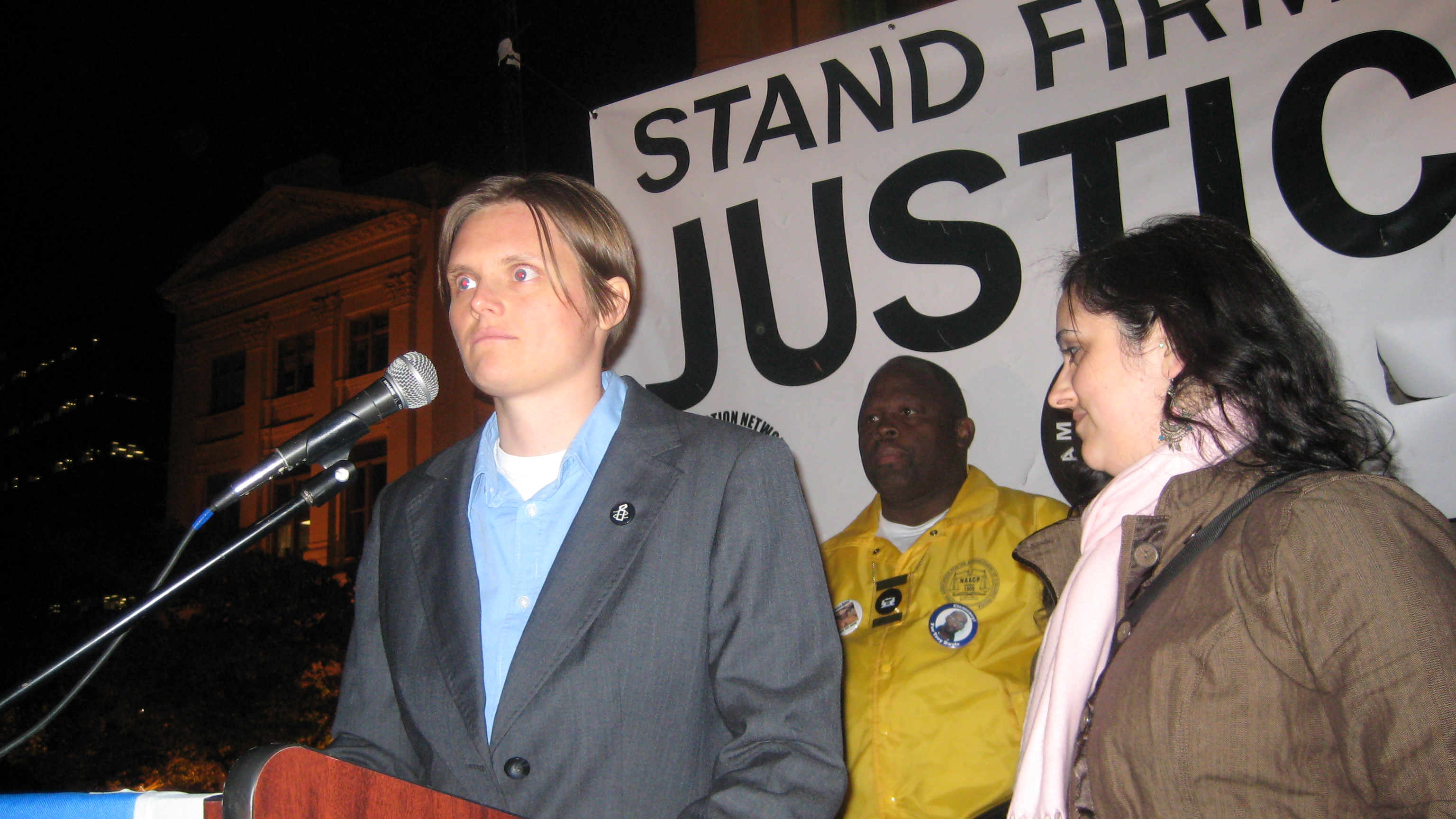
Laura Moye of Amnesty International and Kathryn Hamoudah of Georgians For Alternatives to the Death Penalty address a Troy Davis rally in Atlanta

By deciding not to hear further appeals in the Troy Davis case, the Supreme Court of the United States has given Georgia officials a green light to proceed to execution.  But nothing is simple when issues of life and death are on the line.  

Georgia won’t be able to proceed directly with an execution because their supply of sodium thiopental, a powerful anesthetic that is the first of three shots administered during lethal injection in Georgia and dozens of other states, was recently seized by federal authorities.  The producer of sodium thiopental announced that it would no longer be exporting the drug to the United States because their product was intended to cure, not kill.  Georgia is one of several states that appears to have procured quantities of the drug illegally from a sketchy outfit in the United Kingdom. (more…)

Tulia-style drug bust draws suspicion in Wichita Falls

Alleged Tulia kingpin, Joe Welton Moore

The good folks in Wichita Falls, Texas are celebrating the arrest of 44 drug kingpins, with four or five additional arrests waiting in the wings. 

“It’s a good number of arrests, but the reality is there are probably still five-times as many of these types of criminals out there,” Sheriff David Duke told the Wichita Falls Times Record News. “It’s a scary thing to think that this stuff is being sold in our neighborhoods, near our children. A lot of these dealers are armed because of competition with other dealers. And many will steal, rob and commit financial crimes to facilitate their operations.”

No one associated with the infamous Tulia drug sting of 1999 can read these words without recalling the proud pronouncements of Swisher County Sheriff Larry Stewart and his undercover man, Tom Coleman. (more…)