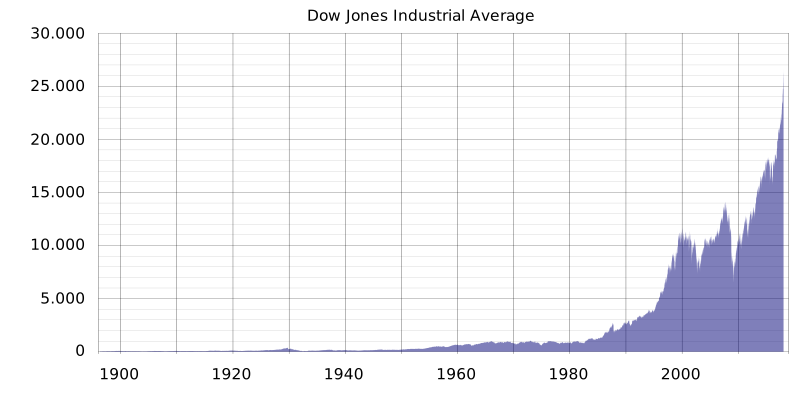
Check out the two graphs below. See any similarities?
Is it just a coincidence that the American incarceration rate and the Dow Jones Average have an identical trajectory between 1960 and 2000? In both cases we see decades of minor dips and blips followed by a rocket launch. (more…)
Retired Supreme Court justice John Paul Stevens was never enthusiastic about the death penalty. Like a lot of Americans, he believed that some violent crimes are so horrific that capital punishment is the only appropriate response. This abstract support for ultimate penalty was rooted in the assumption that the American criminal justice system is capable, first, of restricting capital prosecution to the very worst sort of crime, and, second, that with a man’s life at stake, jurors would hold prosecutors to the highest evidentiary standard: proof beyond a reasonable doubt.
Justice Stevens is still outraged by egregious acts of wanton violence, but he no longer trusts prosecutors to single out the very worst crimes for capital prosecution. Moreover, he realizes that, in far too many cases, the more shocking the details of a crime, the lower the evidentiary standard becomes. The intense desire to see justice done in a particular case easily trumps human reason and the principle of equal justice under law. This is particularly true, Stevens discovered, when the defendant is black and the murder victim is white. (more…)
Thanks to their participation in the nationally televised Bayou Classic, Mychal Bell and Robert Bailey Jr. have now been recognized for something unrelated to the Jena 6 phenomenon. When their names were called, it was because they had made a contribution on the field.
But there is far more at stake here than simple athletic success. Mychal and Robert are making a positive contribution to their teams under the tutelage of seasoned football men who care about their players’ moral and educational advancement more than they care about winning. Mychal and Robert are getting a second chance.
That’s a big deal when you consider that, in the natural order of things, Mychal and Robert would now be institutionalized felons rotting away in obscure Louisiana prisons. By the time the prison doors swung open, the road to higher education would be blocked by dozens of petty regulations designed to keep offenders from reintegrating into society. (more…)
This is the second excerpt from a speech recently delivered at the Campaign to End the Death Penalty conference on the campus of the University of Chicago. The introduction can be found here. AGB
The new Jim Crow comes to Tulia, Texas
By Alan Bean
Sheriff Larry P. Stewart
To understand how radically our society has changed it is helpful to trace the life stories of the folks running the new Jim Crow machinery in small southern towns. The stories you are about to hear are taken from cases investigated by Friends of Justice, but they are symptomatic of a national disease.
I started talking about the new Jim Crow in Tulia, Texas when I realized that a drug bust that swept up half the adult black males in town was standard operating procedure.
There is a picture of Larry Stewart in an old copy of the Tulia Herald. It was Cowboy Day at the Tulia High School, circa 1960, and Larry came dressed as an old-time Texas Sheriff, badge and all. But Larry wasn’t supposed to grow up to be a lawman; like most local boys he wanted to farm like his daddy did before him. (more…)
Wade Goodwyn does his usual impeccable job of bringing an utterly outrageous story to national awareness. If you follow this blog you are already familiar with the basic outline of this story, but Goodwyn inserts the human element that is typically missed by the mainstream media. You can hear the original audio version at the All Things Considered Site.
At the end of the Richardsons’ story you will find brief summaries of three related Texas narcotics cases Wade Goodwyn has covered over the years, stories that provide some of the best New Jim Crow illustrations available anywhere in America. Friends of Justice didn’t just bring the Richardson fiasco to public attention, we were also involved in the other three cases (see my comments below at the end of the NPR piece).
One last word. Without the dogged determination and courage of the defendants (particularly Vergil and Mark Richardson) and attorney Mark Lesher, justice would never have been served in this case.
The comments after this piece, like the comments my post have thus far received, argue that due process protections and normal evidentiary standards should only apply to good people. Consider this quote from Winston Churchill, a champion of criminal justice reform: (more…)
Not that most Americans would care, but it appears that Texas executed another innocent man in 2000. This story from the Fort Worth Star-Telegram relates the sad fate of Claude Jones, a St. Jacinto man convicted of killing a liquor store clerk in the course of an armed robbery in 1989.
Prosecutors showed the jury a single hair that they claimed belonged to Jones. They couldn’t be sure, mind you, and no DNA test was conducted, but they were pretty sure.
But that wasn’t enough for a conviction, corroborating testimony was required. Enter Timothy Jordan. In exchange for a lenient sentence, he testified that he had served as an accomplice and that Jones was the trigger man.
Three years after Jones was executed, Jordan recanted his testimony. Need you ask why? He was threatened with dire consequences if he refused to cooperate with prosecutors. We’ve seen this movie before, haven’t we?
George W. Bush was fixin’ to leave the governor’s mansion for bigger and better things when he gave Jones’ execution the thumbs up. No one on his staff mentioned that the hair that so impressed jurors had not been tested.
Now it has and we know for a fact that the hair did not belong to Jones. (more…)
If Barack Obama can reduce the crack-powder disparity, why hasn’t he issued a single pardon?
Mark Osler, a law professor, former federal prosecutor and Friends of Justice board member, poses this question in an op-ed published Sunday in the Dallas Morning News. I hope I’m wrong, but I think I know the answer. Like most Democrats, our president fears that a show of mercy will make him look weak. So, like Bill Clinton before him, Obama maintains the pious fiction that the criminal justice system never errs or overreaches. Hopefully, the next two years will see more action on the pardon front.
Former federal prosecutor Mark Osler teaches at the University of St. Thomas School of Law in Minnesota. He previously taught law at Baylor University for 10 years.
On Oct. 28, the White House announced that President Barack Obama had earlier in the month denied 71 pardon requests and 605 petitions for commutation of sentence, while granting none. Nearly two years into his term, Obama has issued exactly zero pardons and no commutations, a sorry record that distinguishes him from nearly all of his predecessors. (more…)
Thanks to Doug Berman for alerting me to this hard-hitting critique of the Justice Department’s Office of the Pardon Attorney. Samuel Morison’s comments originally appeared in the Los Angeles Times.
Here’s the heart of his critique: “Having spent more than 10 years as a staff attorney in that office, I can say with some authority that the prevailing view within the Justice Department is that the pardon attorney’s sole institutional function is to defend the department’s prosecutorial prerogatives. There is little, if any, pretense of neutrality, much less liberality. On this parochial view, the institution of a genuinely humane clemency policy would be considered an insult to the good work of line prosecutors.”
President Obama should rely more on his own moral judgment than the Justice Department’s in making clemency and pardon decisions.
By Samuel T. Morison
November 6, 2010
The Times’ well-intentioned Oct. 30 editorial bemoaning that fact that President Obama hasn’t yet granted any pardons or commutations, in which the editorial board correctly notes that the president is “aided in such decisions by the Office of the Pardon Attorney in the Justice Department,” betrays a profound misunderstanding of the role the pardon office plays in the clemency advisory process. In particular, The Times writes, “Ideally, presidents would give great deference to the pardon attorney’s recommendations and take a liberal view of the clemency power, exercising it often and on the basis of clear standards.” (more…)
According to this article in the Washington Post, Republican attempts to demonize House Speaker Nancy Pelosi have been unsuccessful . . . until this election year.
Let me say up front that I have no opinion of Ms. Pelosi one way or the other. I find her nervous smile unconvincing, but I don’t blame her for smiling or for being nervous. What interests me here is the power of oft-repeated talking points in hard financial times. Ms. Pelosi’s job is primarily to negotiate behind the scenes while trying to rally Democrats behind the party line. She isn’t responsible for shaping policy; she’s a cheerleader and a professional compromiser. That’s her role. So why have her “strongly disapprove” numbers risen from a modest 17% to a startling 41%.
Two reasons: one, times are tough and voters are always inclined to blame the folks in power; two, Republicans and Tea Party activists have been telling us that Pelosi is a very bad person. We aren’t told why she is bad; apparently it’s supposed to be self-evident. That’s how the demonization game works. If you argue that Speaker Pelosi is a child of hell because she supports specific legislative initiatives, you shift attention from personality to policy. Republicans realize that, when times are tough, you simply point the finger and scream, “this lady consorts with Satan!” (more…)


 Here’s
 I
I

 Friends of Justice