Category: the politics of race

A mayor and a prophet lock horns in a Southern town

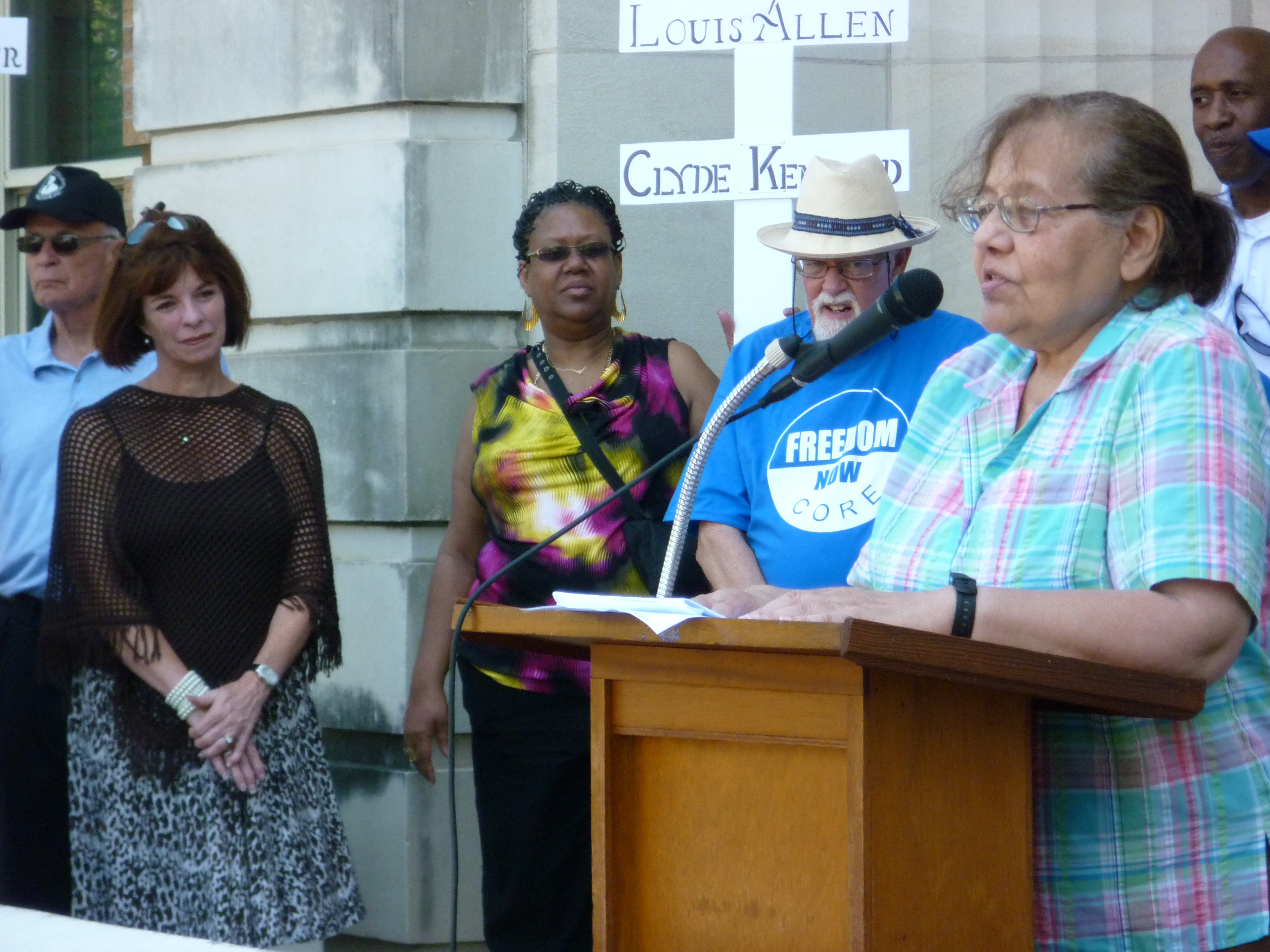
Diane Nash addresses crowd as Mayor Cheri Barry looks on

By Alan Bean

On Saturday, June 18th, Friends of Justice joined dozens of civil rights veterans in honoring the memory of James Earl Chaney, Andrew Goodman, and Michael Schwerner.  For those who worked in Mississippi during the 1960s, the cruel and cowardly murder of three civil rights workers epitomizes a painful period.

The Mississippi phase of the civil rights movement doesn’t get nearly as much attention as corresponding events in nearby Alabama.  There was plenty of terror in Alabama as well; but it was offset by triumph.  Apart from the freedom rides of 1961, Mississippi didn’t produce a lot of victories.  Passionate support for segregation was almost universal among white folks.  In many counties, not a single black voter was registered when the Voting Rights Act was signed into law in 1965.  In Mississippi, two armies, one dedicated to “state’s rights” (full-blown Jim Crow segregation), the other dedicated to Civil Rights (racial equality reinforced by racial justice) fought to a bitter standstill.  (more…)

Truth Crushed to Earth Shall Rise Again: a Mississippi town mirrors the soul of a nation

By Alan Bean

A monument to “The memory of Carroll’s Confederate Soldiers who fought in defense of our constitutional rights from Bethel to Appomattox” stands in front of the Carroll County courthouse in Carrollton Mississippi.  No surprise there; virtually every county courthouse in Mississippi constructed before 1920 sports a civil war memorial.  But few of these monuments are accompanied by the Confederate flag.  We’re not talking about the Mississippi state flag that incorporates the stars and bars–this is the genuine article. (more…)

The slow death of the 14th amendment

Richard Beeman

On May 4, amateur historian David Barton appeared on Jon Stewart’s Daily Show.  Barton’s central argument was that, constitutionally, the first amendment applies to the federal government but not to the states.  Therefore, if individual states and municipalities see fit to make the Bible the sole standard for criminal and civil law, to reinstate chattel slavery or to make Christianity an official and protected religion, the federal government can do nothing about it.

Barton didn’t suggest that non-federal governments should do these things, merely that they can if they want to.

On May 14th, Jon Stewart invited Richard Beeman, an actual constitutional scholar at the University of Pennsylvania, to respond to Barton’s theory. (more…)

“Only a movement built on love”: Michelle Alexander at Riverside Church

“Now I want to be clear that when I’m talking about love, I’m not just talking about love for people who have committed crimes like we may have committed, crimes that we think are not so bad; I’m talking about the kind of care and love that keeps on loving no matter who you are or what you have done. It’s that kind of love that is needed to build this movement.”  (Michelle Alexander)

In the 1920s, with the fundamentalist-modernist controversy raging within his own Northern Baptist Convention, John D. Rockefeller built an architecturally imposing church in the heart of one of New York’s most prestigious neighborhoods, opened it to people of all Christian denominations and called an American Baptist preacher named Harry Emerson Fosdick to be his pastor.  Through the years, Riverside Church has become associated with prophetic preaching, dramatic worship and ecumenical mission.

In 1992, Riverside Church adopted a statement of faith proclaiming:  “the worship of God, known in Jesus, the Christ, through the inspiration of the Holy Spirit … to serve God through word and witness, to treat all human beings as sisters and brothers; and to foster responsible stewardship of God’s creation … The church pledges itself to education, reflection, and action for peace and justice and the realization of the vision of the heavenly banquet where all are loved and blessed.”

This statement of faith nicely captures the conclusion of Michelle Alexander’s address at Riverside this past weekend.  Calling for “A great awakening” Alexander re-stated her firm belief that only a new social movement can end mass incarceration in America.  As her closing remarks make clear, this movement must be built on a solid moral foundation and, for those of us who follow Jesus, that means taking our Savior at his word.  (more…)

US Navy names ship after Cesar Chavez

The US Navy has named a ship after civil rights leader Cesar Chavez.  Self-taught historian, David Barton, may think Chavez is unworthy of emulation and the Arlington School Board may think he doesn’t deserve to have a special day, but the Secretary of the Navy Ray Mabus takes a different view:

Cesar Chavez inspired young Americans to do what is right and what is necessary to protect our freedoms and our country.  The Cesar Chavez will sail hundreds of thousands of miles and will bring support and assistance to thousands upon thousands of people. His example will live on in this great ship.

I’m not sure Cesar and Ray would see eye-to-eye on “what is necessary to protect our freedoms”, but it is nice to see a man of honor and courage getting a little respect after serving several years as the unofficial pinata of Texas conservatives. (more…)

Michelle Alexander: ‘Interest convergence’ won’t end mass incarceration

“Public relations consultants like the FrameWorks Institute — which dedicates itself to ‘changing the public conversation about social problems’ — advise advocates to speak in a ‘practical tone’ and avoid discussions of ‘fairness between groups and the historical legacy of racism.’  Surely the Rev. Dr. Martin Luther King Jr. would have rejected that advice.”

-Michelle Alexander

– “We know through painful experience that freedom is never voluntarily given by the oppressor; it must be demanded by the oppressed.  Frankly, I have yet to engage in a direct-action campaign that was ‘well timed’ in the view of those who have not suffered unduly from the disease of segregation .  For years now I have heard the ‘Wait!’  It rings in the ear of every Negro with piercing familiarity.  This ‘Wait!’ has almost always meant ‘Never!”

-Martin Luther King, Jr., Letter from the Birmingham Jail (more…)

Is anti-white bias on the rise?

By Alan Bean

The title of this Wall Street Journal article is a bit understated.  Not only do white Americans see anti-white bias on the rise, they believe that bias against whites is a greater problem than bias against blacks.  If this study is accurate (and I suspect it is) it is hardly surprising that references to systemic or structural racism hook so much resentment in white audiences–they think they are the ones getting whooped on!

In one sense, this observation is accurate.  White Americans are generally held responsible for past injustice–a catalogue of grievances ranging from the virtual extermination of Native Americans to slavery, Jim Crow and the “Southern Strategy”.  White people keep insisting that neither they nor their parents owned slaves and they have never personally exterminated a Native American.  Therefore, their hands are clean and the fact that these outrages keep coming up for discussion is an indication of anti-white bias.  This justifies the odd belief that white people encounter more social bias in the course of an average day than black people. (more…)

The Future of Southern Politics: Two views

Jamelle Bouie
Chris Kromm

For southern Democrats, the 201o election was utterly devastating.  In states like Texas and Georgia, white Democrats are becoming an endangered species.  Two articles, one in The American Prospect, the other in Facing South address the prospects for southern progressives. 

Jamelle Bouie’s article suggests that since southern whites have permanently abandoned the Democratic Party at every level of politics, the only sensible course is to forget about pandering to conservative whites and become a black and brown party of inclusion.  (more…)

Crucified with Christ: Holy Week through a prisoner’s eyes

Enrique Salazar, Irma and Ramsey Muniz, Alan Bean, Ernesto Fraga

By Alan Bean

Friends of Justice was introduced to Ramiro (Ramsey) Muniz by Ernesto Fraga, a ember of our board who publishes the Tiempo newspaper in Waco, Texas.  Ramsey ran for governor of Texas on two occasions in the early 197os for La Raza Unida party and worked with Mr. Fraga and other members of the Chicano movement.  Ramsey was a standout with the Baylor football team in the late 1960s and graduated from Baylor Law School in 1971.  After his brief sojourn in the world of Texas politics, Muniz returned to south Texas where he worked as an attorney.  You can find more biographical information at FreeRamsey.com.

Ramsey Muniz sees himself as a political prisoner.  The Texas Anglo establishment had no problem with the Latino presence in the 1960s and 70s–somebody had to work the fields and mow the lawns.  But the Texas power structure had no place for a charismatic Latino football hero with a law degree who had the gall to run for governor. 

Texas was firmly in the grip of the Democratic Party in the early 1970s. La Raza Unida was formed because Latino activists believed (correctly) that the Democratic establishment had no interest in running Latino candidates or sharing political power with the Hispanic community.  If the Democrats represented the white population, the reasoning went, Latinos needed to create a separate party to represwent the interest of Chicanos.

It is difficult to exaggerate the sense of outrage and resentment the Chicano movement generated among Texas Democrats.  Ramsey Muniz was commonly viewed as a wild-eyed revolutionary, little more than a terrorist.  Shortly after beginning his post-politics legal career, the federal government charged Muniz with engaging in a narcotics conspiracy with some of the accused drug dealers he was defending.  The only evidence was the uncorroborated testimony of an inmate who agreed to testify for the government in exchange for lenient treatment.  Believing he had no chance before an all-white jury, Muniz accepted a plea agreement and served five years in an Alcatraz-like federal prison off the coast of Washington State. (more…)

Kellogg challenges the colorblind consensus

By Alan Bean

The W.K. Kellogg Foundation recently launched a $75 million grant-making program dedicated to racial healing.  “We believe that all children should have equal access to opportunity,” the foundation’s website reads.  “To make this vision a reality, we direct our grants and resources to support racial healing and to remove systemic barriers that hold some children back. We invest in community and national organizations whose innovative and effective programs foster racial healing. And through action-oriented research and public policy work, we are helping translate insights into new strategies and sustainable solutions.”

In an article written for the National Committee for Responsive Philanthropy, Dr. Gail Christopher, Kellogg’s vice president for program strategy, addressed the issue squarely:

The vision that guides the work of the W.K. Kellogg Foundation is clear: we envision a nation that marshals its resources to assure that all children thrive.  What may be less self-evident to some is the pernicious and self-perpetuating way in which racism impedes many children’s opportunities to do so. (more…)