O what a tangled web we weave, when first we practice to deceive
Sir Walter Scott

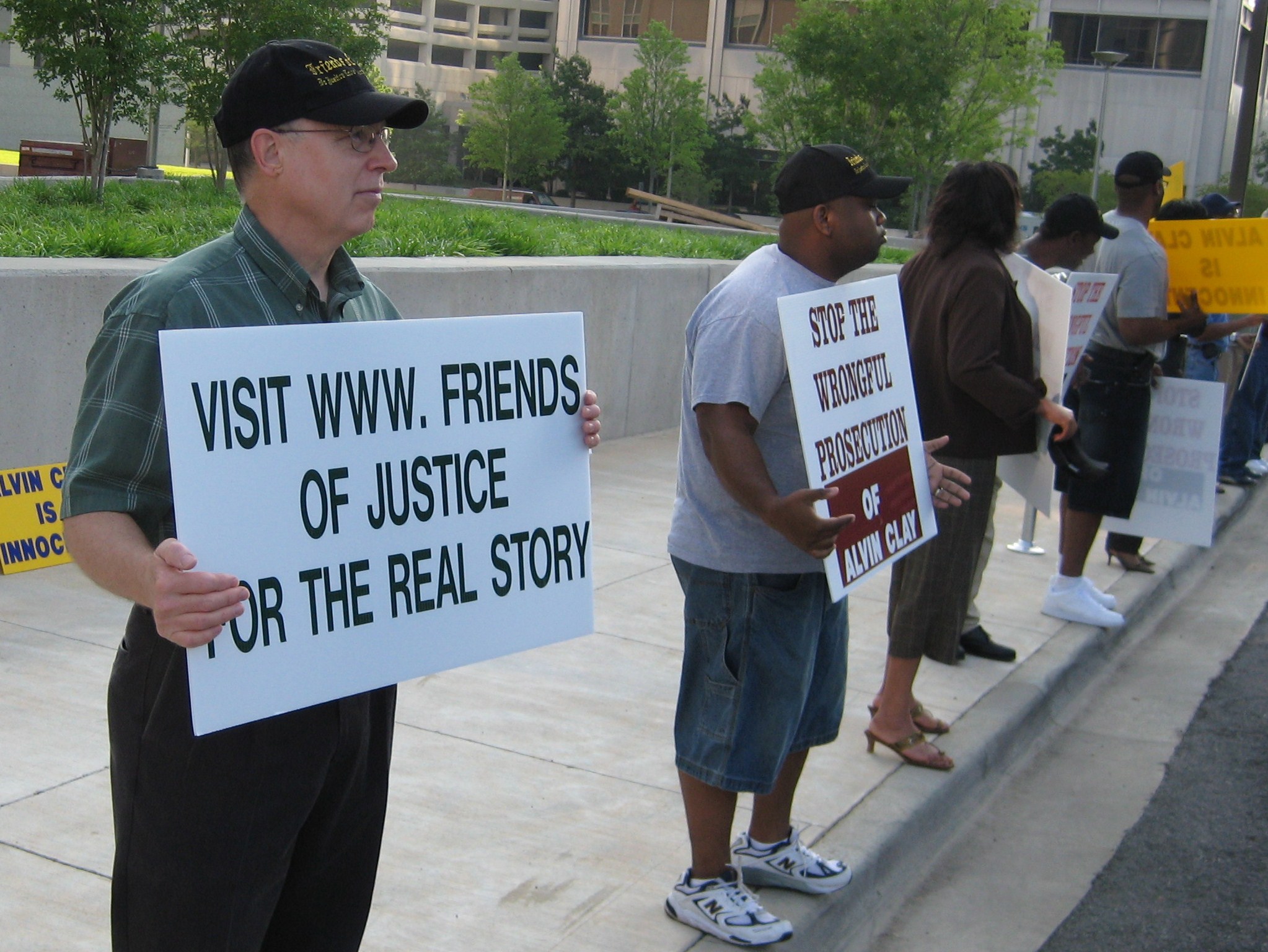
The government’s case against Alvin Clay proceeded at a jackrabbit clip because the government doesn’t have a case against Alvin Clay.
Alvin Clay’s defense has moved ahead with even greater dispatch because the defense can’t accuse federal actors of suborning perjury.
The day began with a motion for acquittal from Mr. Hairston. “It is very, very clear that Alvin Clay had absolutely no part in submitting fraudulent loan applications . . . The buyers, without exception, denied knowing Mr. Clay . . . The only witness to inculpate Mr. Clay was Donny McCuien, and his testimony has been absolutely impeached. . . There was no testimony that Mr. Clay entered into an agreement to commit fraud. There is no evidence that Mr. Clay knew that the money paid to him came from illegal conduct by Mr. Nealy and Mr. McCuien, and Mr. Clay sought to account for the money he received.”
Judge Leon Holmes was unmoved. “It is not my job, nor am I permitted, to judge the credibility of witnesses,” he said. “According to Donny McCuien, Alvin Clay knew no work was done, or intended to be done. If the jury believes that, there is evidence to convict.”
My mind wandered back to the testimony of a woebegone crack addict named Stevie Charlot in the case of Mary Ann Colomb and three of her sons. After twice denying in transcribed and tape recorded affidavits that he had ever bought drugs from the Colombs, Charlot took the stand at trial and spouted a pathetic river of contradictions.
So lamentable was Charlot’s performance that federal judge Tucker Melancon called it “an abomination.”
Yet, like Leon Holmes, Melancon was powerless to intervene. After being convicted by an all-white jury, Ann Colomb and her sons were eventually exonerated and released.
Stevie Charlot and Donny McCuien perjured themselves for the same reason Galileo told the Inquisition that the sun revolves around the earth-they were shown the instruments of torture.

I do not condemn torture victims for their actions, however ignoble. John McCain had his limit, and I know I have mine.
I have a harder time forgiving men like Rodney Hays and Assistant US Attorney Steven Snyder who use the government’s arrows and olive branches to suborn perjury. They do it for the same reason agents of the federal government at Abu Graib and Guantanamo Bay do what they do: the behavior is first tolerated, then accepted and finally expected. It’s all in a day’s work.
Last week, the government’s own witnesses frequently contradicted Donny McCuien’s testimony. Today, with the defense calling the witnesses, it just got worse.
McCuien had testified that he never owned or sold properties.
“I purchased a couple of properties from Donny McCuien [Jr],” Patrice Dean told the jury this morning. To make the homes ready for sale, Dean said, McCuien “fixed a front door, shingles, and a portion of the roof.”
Later, she said, McCuien also did some rehabilitation work on some apartments he sold her.
McCuien has insisted that he never owned construction tools, that he had never used tools, that his father didn’t do carpentry didn’t own any tools.
This morning, Donny McCuien Sr, took the stand. He testified that he owned a wide range of heavy construction tools and that Donny Jr. frequently borrowed them but never gave them back. “He had a key to get access to my storage shed,” Sr. explained. “Donny borrowed some of my tools and I never got them back. I can’t say what he done with them.” These tools included generators, reciprocating saws, hacksaws and circular saws.
Later, a contractor named Roma Isom testified that Donny McCuien Jr. had sold him “Compressors, generators, nail guns, and a couple of other items.” In other words, Donny Jr. stole Donny Sr.’s tools and sold them to the highest bidder. Perhaps it’s not stealing if the victim is your own sweet dad.
The heart of Donny Jr.’s testimony was that Alvin Clay didn’t own a real contracting company, had never done any contracting work, and had no expectation of ever doing so.
A contractor named Roma Isom testified that Clay Construction performed $21,000 of rehab work on one of his properties in September of 2002. The work was subcontracted to another individual and passed two inspections, one from an Arkansas housing inspector.
Isom didn’t recall ever seeing Alvin Clay on the worksite. It wasn’t unusual, he said, for contractors to own no equipment, employ no staff, and to subcontract all of the work to second parties.
Then Graylon McFadden testified that he had performed subcontract work for Clay Construction. “I had several carpenters helping me out,” he said, including his son Darren McFadden, a two-time Heisman runner-up for the Arkansas Razorbacks.
Billie Burnett, a handyman who admits to being a habitual criminal, entered the courtroom between two burly prison guards. Clad in an orange jumpsuit and flip flops, he didn’t immediately inspire confidence, but he proved to be the most convincing witness to take the stand thus far.
Asked if he was a felon, Burnett shook his head in agreement. In fact, he said, he had been convicted of burglarizing businesses on five separate occasions. He wasn’t bragging; it was just who he was.
Burnett told the jury that he had done rehab work on three of the five properties at issue in this trial. At McCuien’s request, he had done yard work, painting, floor finishing and roofing work.
Burnett testified that he met McCuien when “I was working on a house on Elm Street and he stopped me and asked if I did general [contracting] work.” On one of the properties he did “roofing work on a garage and put a ceiling on a garage bedroom. Probably took me about two days.”
McCuien paid Burnett in cash.
Two real estate agents who had worked for Clay Realty talked about his loose management style. “Some offices wanted you to sell a lot,” Kevin Howard testified; “but with Alvin, what you brought in was what you brought in.” Howard called Clay “laid back.” “You basically worked your own deal.”
Geno Tucker told the jury that he worked out of his home while working for Clay Realty, coming to the office only when he had a contract. “It was ideal for me because I had a second job. I could do my thing on my own with little supervision from Mr. Clay.”
Clay’s style was so casual, in fact that “he didn’t even look at the contract; he just took my word for it.”
This hands-off approach would not serve Alvin well when he ran across slick operators like Nealy and McCuien.
When Rodney Hays was called to the stand the faces at the prosecution table went gray.
George Hairston is generally quiet and respectful when questioning witnesses. When dealing with inveterate liars like Hays and McCuien, however, the elderly black attorney goes through a curious transformation. He once broke off a conversation with me because the break was almost over, McCuien was on the stand, and “I need to go off by myself for a minute and get my mean on.”
“All the files you used to prosecute Alvin Clay came from Ray Nealy’s office, right?” Hairston asked.
“Correct,” Agent Hayes said.
“You and McCuien both use the term, ‘correct'” Hairston pointed out. “You two have had a lot of contact, have you not?”
“We have met a couple of times.”
“Just a couple?” Hairston asked, his voice rising.
“We have met multiple times,” Hays admitted.
“Multiple times?” Hairston repeated. “Then why did you say just a couple?”
The FBI man was taken through the history of the prosecution, especially the eleven months stretching from the raid to the eventual indictment. Hairston asked why the original prosecutor, George Vena had been replaced and why his successor, Karen Whately, had been taken off the case?
Steven Snyder was immediately on his feet questioning the relevance of the question. The entire Eastern District of Arkansas had been yanked off the case by the feds in Washington; but the prosecutor didn’t want the jury to know that.
Judge Holmes said he was inclined to agree with Snyder but said he was ready to listen to Hairston’s side of the argument.
“Let me see if I can persuade you,” Hairston said with a wry smile. The two sides met for a sidebar discussion.
The attempt at persuasion having failed, Hairston moved on to Donny McCuien.
Hairston handed Hays a transcript of the notes he had taken after talking to his star witness. Did Donny talk about a deal involving April Flowers that was just like the five real estate deals cited in the indictment.
“Correct,” Hays said.
And wasn’t McCuien upset because Clay, Nealy, Flowers and the loan processor all profited handsomely from the deal while he had to settle for a crummy $1,000.
“I don’t know that there was any Clay Construction involvement in her case,” Hays said.
“Did any of that even occur?” Hairston asked.
“In this incidence, I think Mr. McCuien was confused about some of the details with April Flowers,” Hays said.
“Was he confused, or was he just lying?” Hairston shot back.
When Hays continued to prevaricate, Hairston sharpened the question.
“Did you find that Mr. McCuien’s credibility was somewhat suspect, sir?”
“He made plenty of statements up here and that’s his view of things. Is everything he told me truthful? He is like any other witness; he has his own perspective on things.”
Hairston then asked the witness if he had told the original grand jurors that McCuien wasn’t deeply involved in the fraudulent real estate deals and that he had been “brought in at the end.”
Hays eventually admitted that he had learned soon after that McCuien had lied to him.
“But you didn’t go back and correct the grand jury did you?” Hairston asked.
Judge Leon Holmes rose to Hay’s defense. The defense team had been told that they couldn’t refer to vindictive prosecution and Hairston was getting into that territory.
Hairston changed direction. McCuien had testified that, in the immediate aftermath of the raid, Alvin Clay told him to find some witnesses willing to lie on his behalf. But on Friday, Jeron Marshall testified that McCuien had given her a different version of that conversation a few days after it happened. McCuien told Marshall that Alvin had simply told him to “tell the truth.”
“Did that influence your sense of his credibility?” Hairston asked.
The government objected and Judge Holmes sustained the objection.
Evidentiary rule 608 allows a witness to give his personal estimate of another person’s reputation for honesty; but specific bad acts cannot be referenced unless it resulted in a felony conviction. Since Hays had already given his opinion of McCuien’s credibility, no more specific lies could be mentioned in the hearing of the jurors.
It was this line of reasoning that allowed Terry McEachern to wrongfully convict several dozen defendants in Tulia, Texas eight years ago (before Governor Rick Perry was forced to issue mass pardons).
A strict interpretation of Rule 608 means that Hairston couldn’t accuse Hays of suborning perjury because Hays has yet to be convicted of that crime. The fact that he is clearly guilty is neither here nor there.
Hairston had intended to push Hays much harder, but a glance at the jury made him reconsider. He didn’t want them feeling sorry for the hapless FBI agent.
Only one witness remained, Alvin Clay. Although it was only 3:30, Judge Holmes agreed to call a recess until Tuesday morning.
The jury may have this case as early as tomorrow afternoon. They will be asked to adjudicate a swearing match between Donny McCuien and Alvin Clay. McCuien spelled his name correctly; after that it was all downhill.
Tomorrow, Alvin Clay gets his chance to set the record straight.

Alvin with his mother






 Friends of Justice


