16 There are six things that the Lord hates,
seven that are an abomination to him: 17 haughty eyes, a lying tongue,
and hands that shed innocent blood, 18 a heart that devises wicked plans,
feet that hurry to run to evil, 19 a lying witness who testifies falsely,
and one who sows discord in a family.
Everybody can define “hottie” these days; but the old-school word “haughty” doesn’t come up much in casual conversation. If you’re not familiar with the term, the Merriam-Webster dictionary provides a simple definition:
Having or showing the insulting attitude of people who think that they are better, smarter, or more important than other people.
If you would like to see haughty eyes, look no further than the faces of the men and women protesting the arrival of migrants from Central America. The woman who screamed, “we don’t want you; nobody wants you!” may have believed she was speaking for the entire nation.
She wasn’t.
She was speaking for the slice of America that believes white Anglophones are “real Americans”. A tea party web page in Texas reprinted a virulent screed from a California protest group that summarized the attitude perfectly:
“Americans are not breeding while ‘the bronze master race is.’ … We will die out and they will win.”
Haughty people don’t always look down their noses at the rabble; more often they are fearful, angry and paranoid. (more…)
Heba Said attended the Texas Republican convention dressed in a hijab. She was shocked by the harsh reception she received. But it wasn’t just tea party conservatives who reacted negatively. Liberals, associating the hijab with “patriarchy”, have accused Ms. Said of setting back the cause of feminism. In this piece, written for the Washington Post, Heba reflects on her close encounter with American extremism. AGB
The frustration kept me awake the first time I read the comment. It is difficult to understand how, in a land that each year honors a man who marched for everyone’s equality, people could not want the same for me, a fellow American.
The comment that suggested I was responsible for reversing the work of feminists in this country because I made a decision to wear a hijab, was neither completely negative nor positive. But despite the hundreds of responses that were outright racist or those that suggested that it is okay to hate Muslims, that one kept me wondering for days how someone could say that to me. (more…)
Last week I was in the Mississippi Delta with my wife, Nancy, participating in a couple of civil rights tours. We heard Margaret Block, a retired school teacher from Cleveland, Mississippi who worked with the amazing Fannie Lou Hamer in the early 1960s, address a group of high school students from Albany, New York. Margaret remembered participating in a voter drive in Meridian, Mississippi, less than a year before three civil rights workers were brutally murdered in nearby Neshoba County.
“There was a bunch of Klansman standing around watching us,” Ms. Block remembers, “and they were singing a little song, over and over, ‘Jesus loves me ’cause I’m white; I kill a nigger every night.’ The worst part of it was that none of them could sing a lick.”
We are appropriately horrified by these despicable sentiments and the language in which they were expressed. But don’t we believe, deep in our hearts, that being born in the United States of America gives us a seat in the lifeboat-of-the-elect and gives us the right to knock the undeserving “illegals” back into the shark-infested waters with the precious oar of citizenship?
And don’t we believe that Jesus signs off on our special status?
What do we do with the unaccompanied children, some say as many as 100,000, who have surrendered to American border officials in the last few months? (more…)
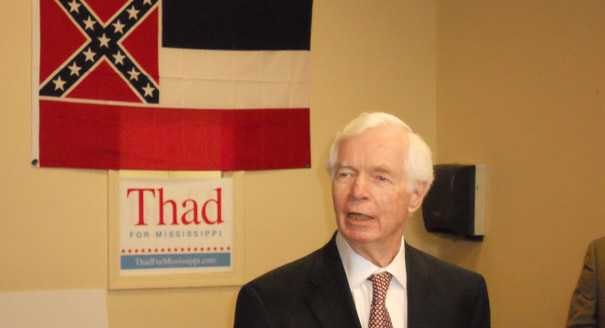
Thad Cochran wasn’t supposed to win this one. Had he played by the normal rules of Mississippi politics he would be working on his golf game. But the senior Senator from the Magnolia State broke the rules.
The calculus leading up to this unlikely electoral victory is complicated. Moderate Republicans, desperate to deprive Tea Party insurgents of a big symbolic win, poured millions of dollars into this primary contest. Chamber of Commerce people backed Cochran to the hilt because, unlike the volatile Chris McDaniel, he was a known quantity.
But there is one simple explanation for a traditional conservative walking away with a narrow victory–he got out the black vote.
Mississippi has open primary elections. That means that if you didn’t vote for a Democrat in the initial primary contest, you can vote in the Republican runoff election. And that’s precisely what tens of thousands of black Mississippians did. According to a Washington Post analyst Philip Bump,
Runoff turnout in the 24 counties with a black population of 50 percent or more was up almost 40 percent from the primary. In all other counties, turnout was up just 16 percent.
“That is an absolutely stunning stat,” The Post’s Chris Cillizza says, “and tells much of the story of the runoff. Cochran’s ability to convince a strongly Democratic constituency to be for him — despite the fact that every Democratic consultant believed McDaniel gave the party a better chance to win the seat in the fall — is simply remarkable.”
Without these crossover voters, Cochran would have gone down to the kind of stunning defeat that most people (myself included) were predicting. Black voters were betting that, although McDaniel would have been more vulnerable to a Democratic challenger in the fall, it was highly unlikely that Mississippi was going to elect a blue senator under any circumstances. In that case, it was best to go with the devil you know.
It is highly significant that Thad Cochran went out of his way to court black Democrats, adopting a distinctly moderate tone in the final weeks of the election. That has McDaniel and his supporters hopping mad. It has been a long time since a white Republican candidate courted the black electorate in the great state of Mississippi. From their perspective (though they can’t say it out loud) Cochran is a race traitor.
The fact that the election results coincided with the American Experience program on Freedom Summer underscored the irony of this development.
Are we witnessing the emergence of a new political coalition comprised of pragmatic black Democrats and moderate Republicans? Probably not. But whenever a traditional conservative faces off against a Tea Party politician like McDaniel, strange political bed fellows will crawl under the sheets once again.
Danny Cortez is the pastor of a small Southern Baptist Church in La Mirada, CA. A few weeks ago, he created a stir in Baptistland by calling for a “third way” on gay marriage.
In a letter to his congregation, Rev. Cortez said
I recently became gay affirming after a 15-year journey of having multiple people in my congregation come out to me every year. I scoured through your whole website and read everything I could. And it was especially the testimony of my gay friends that helped me to see how they have been marginalized that my eyes became open to the injustice that the church has wrought.
In August of 2013, on a sunny day at the beach, I realized I no longer believed in the traditional teachings regarding homosexuality.
Drew Cortez
The real kicker came when the pastor’s fifteen year-old son, Drew, confided that he was gay.
The pastor’s letter was as controversial as you would expect it to be; but rather than calling a hasty vote and sending their preacher down the road, the congregation brought in speakers to address both sides of the issue. Eventually, the church voted to retain Cortez and become a Third Way church that agrees to disagree on the contentious issues raised by the gay rights revolution. They have decided to kick that can down the road and just welcome everyone to church. The church decided to love and minister to LGBT persons without judgment.
Ken Wilson
The Third Way concept was first advocated by Ken Wilson, the pastor of a large Vineyard church in the Midwest, in his book A Letter to my Congregation.
Baptist ethicist David Gushee, once a staunch opponent of marriage equality, expressed his sympathy for Wilson’s approach in his contribution to Wilson’s book.
Al Mohler, president of my alma mater the Southern Baptist Theological Seminary, has led the charge against Cortez his congregation. To Mohler’s frustration and sorrow, convention delegates recently refused to address the issue, a sign of how rapidly the traditional evangelical position on marriage equality is eroding.
Dr. Mohler says that when it comes to homosexuality there is no Third Way. The Southern Baptist Convention has moved to disfellowship gay-friendly congregations in the past (including my home church, Broadway Baptist in Fort Worth), and Mohler sees no reason why the famously conservative denomination should shy away from its disciplinary obligation now. To fail to do so, Mohler says, “will be nothing less than a tragic abdication of responsibility and a violation of theological integrity.”
Al Mohler speaks for the evangelical establishment when he explains why there can be no Third Way:
A church will either believe and teach that same-sex behaviors and relationships are sinful, or it will affirm them. Eventually, every congregation in America will make a public declaration of its position on this issue. It is just a matter of time (and for most churches, not much time) before every congregation in the nation faces this test.
It’s hard to argue with that logic. But logic isn’t driving the debate over homosexuality in American Christianity. Logically, the churches of the segregated South had to decide whether to accept or reject the civil rights movement. Instead, denominational officials crafted tepid resolutions affirming Brown v. Board of Education or the Voting Rights Act and calling for racial harmony. Contrary-minded congregations (and they were legion) were not drummed out of the denomination for refusing to open their churches to African American Christians. SBC pastors weren’t forced to sign off on racial equality to remain in good standing.
Instead, the SBC, with other evangelical denominations in the South, adopted a Third Way approach in which the subject of race was avoided whenever possible, ostensibly in the interest of keeping the focus where it belonged–on saving souls.
We have handled issues like the death penalty in a similar manner. Denominations may endorse or reject capital punishment, but no one has ever been expelled from a congregation, Baptist or otherwise, for being out of step with the majority on this issue.
Initially, most Southern Baptist leaders made their peace with Roe v. Wade, but when pro-life orthodoxy came into vogue the denomination didn’t divide into pro-life and pro-choice segments; instead we had a proxy battle over the Bible. Conservative insurgents knew they could count on the rank and file to fight for the Good Book, but few were willing to go to the wall on the issue of abortion.
When moral issues are hotly contested there will always be three ways (at the very least): traditional, progressive and uncomfortable.
President Obama isn’t the only person who’s opinions on gay marriage are evolving; more than half the nation is evolving right along with him. If we weren’t, the president would have kept his evolving opinions to himself.
The slavery debate in the 19th century spawned three distinct positions: pro-slavery, anti-slavery and uncommitted. Now it would be hard to find anyone willing to publicly embrace the pro-slavery position, but it took generations for the nation to turn its back on the peculiar institution.
That’s the way social change happens, slowly, awkwardly, and by degrees.
So why should it be any different with the debate over gay rights and marriage equality?
Church’s agree to disagree whenever the consequences of disagreement are perceived to be deadly. Most of pastor Cortez’s parishioners will eventually embrace marriage equality, and they know it; but they aren’t quite there yet and they don’t want anyone pushing from behind.
Compromise is neither elegant nor inspiring, but sometimes it’s the best we can do, as individuals and as congregations. Had they really wanted to, the messengers (delegates) at the most recent Southern Baptist Convention would have drummed pastor Cortez and his congregation out of the denomination, but they didn’t. If asked, a solid majority of SBC messengers would have come down on the traditional side of the gay rights debate, but that doesn’t mean they were as comfortable with their position as Dr. Mohler would like.
It took a lot more courage for Danny Cortez to embrace a third way stance than it took for Al Mohler to reinforce the traditional view. Dr. Mohler ascendancy to the presidency of Southern Seminary in Louisville came with the proviso that he would uphold the party line on every conceivable subject. He is very good at drawing lines in the theological sand because he never has to worry about blow-back.
But the vast majority of Southern Baptists are neither paid nor applauded for holding conservative views. They are Christians first and conservatives second, and many are beginning to fear that, on this issue at least, their conservatism and their Christianity are in logical tension. They want to believe the Bible, but, as true disciples of Jesus, they don’t want to be be unloving or cruel.
Forced into a vote, the vast majority would side with Dr. Mohler; but if they can sidestep a vote they will . . . and they did.
Christians on the conservative side of the gay rights debate see homosexuality as a species of sin, a chosen “lifestyle” that can be tamed by repentance and “reparative therapy”.
Alan Chambers
But this view is no longer tenable. Alan Chambers, the former leader of Exodus International, once believed that reparative therapy could “cure” same-sex attraction. But Chambers was forced to admit that his organization’s methods were ineffective and frequently damaging. After apologizing to the gay community, Chambers created an organization called Speak.Love with a mission to “serve in our pluralistic culture by hosting thoughtful and safe conversations about faith, gender, and sexuality; and partnering with others to establish trust, reduce fear, and inspire hope.”
Chambers is now a Third Way Christian. He isn’t ready to say that homosexuality is an expression of God creative intention; but he is no longer willing to offer a robust defense of the old consensus. Like Rev. Cortez, Chambers prefers loving conversation to culture war demagoguery.
The gay rights debate has been co-opted by the culture war. As a consequence, only congregations solidly entrenched on one side of the ideological divide have the luxury to pick a side and staunchly defend it. But culture war boundaries run straight through the heart of most American congregations. It doesn’t matter if 70% or 30% of the people in the pews are ready to welcome the LGBTQ community into fellowship; so long as the congregation is divided on the issue most pastors will refuse to address it.
The upside of our silence is institutional harmony; the downside is that we relinquish our prophetic voice. Moderate Christians can rarely be found in the vanguard of social change. When the shooting starts, we head for the bunkers and wait to see which side will prevail. If no winner emerges, we stay in the bunker. Many pastors can’t imagine life outside the bunker. They are people without opinions, skilled at navigating around the elephants in the room.
Tragically, our world is now so full of elephants that avoidance is no longer an option. So we adopt a Third Way stance that allows the church to move beyond stalemate.
Eventually, we will confront the obvious. God isn’t going to condemn people for being the way he made them. Therefore, whether you are gay or straight, the sexual rules are the same. We believe that committed relationships grounded in covenant love are superior to a life of random promiscuity driven by a need to make it through the night. When people find a loving partner, we celebrate.
Most congregations aren’t there yet. Some are pretty close, but fear keeps us from giving voice to new commitments. Some churches will remain stuck in the traditional perspective, but, unable to use opposition to gay rights as a effective wedge issue, will gradually drop the subject.
Some day we will all declare ourselves, just as Al Mohler insists we must. It will probably happen in my lifetime (I am sixty-one). But we’re not there yet; so we need a Third Way.
Carolyn Dupont realizes that all southern states are not created equal. Life in the Jim Crow South was hard everywhere, but Mississippi was frighteningly unique. As Bob Moses likes to say, “When you’re in Mississippi, the rest of America doesn’t seem real. And when you’re in the rest of America, Mississippi doesn’t seem real.”
Across the South, white evangelicals were serious about defending segregation, but there was always a veneer of moderate opinion to counterbalance the bigotry. In Mississippi, only a handful of white people stood against segregation, and they paid dearly for that stand.
But Carolyn Dupont isn’t thumbing her nose at the Magnolia State, she honestly wonders what folks had to do to the religion of Jesus to justify such a damaging institution. AGB
Fifty years ago this month, Americans gazed with horror as Mississippi morphed into an eerie caricature of itself. The three civil rights workers famously killed in Neshoba County in June 1964 constituted but one episode in a larger orgy of white-supremacist violence. Four other civil rights volunteers lost their lives, while thugs beat others, bombed movement headquarters, shot into the windows of activists’ homes, and burned 54 black churches by summer’s end. Even for those without personal memories of these events, Mississippi’s “Long, Hot Summer” lies branded in the national consciousness both as a moment of shame and a catalyst to action.
Yet rarely do recollections of this high civil rights drama consider the religious backdrop for these grisly events. Paradoxically, it would seem, Mississippi boasted among the highest degrees of religious adherence in the nation; more than 60 percent of the state’s whites identified as either Southern Baptist or Methodist, and membership in other denominations pushed rates of observance over 90 percent. Importantly, by the summer of 1964, the state’s white religious bodies had repeatedly and decisively rejected the quest for black equality. While national representatives of the Southern Baptist Convention, the Methodist Church, and the Southern Presbyterian Church all endorsed the Supreme Court’s Brown vs. Board of Educationruling on school desegregation, Mississippi spokesmen for these groups denied its applicability to their state. While black Americans waged a death-defying struggle for their full humanity, leading religious figures in Mississippi lent their pens to the cause of white supremacy and white congregations affirmed the virtues of segregation. When 28 young Methodist ministers authored a manifesto suggesting that “our Lord Jesus Christ… permits no discrimination because of race, color, or creed,” their Mississippi coreligionists responded with swift and decisive censure. Perhaps most ingloriously, beginning in June 1963, white congregations in Jackson rejected black activists who came to Sunday worship. For the next nine months, the city’s once-serene Sabbaths turned tumultuous, as police with clubs, dogs, and wagons protected the white churches from “disturbances to divine worship.” This ordeal culminated on Easter Sunday 1964, when a downtown Methodist Church refused two bishops of its own denomination.
If by June of 1964 Mississippi’s white Christians had not adequately disavowed racial integration, a final opportunity arose when Southern Baptists from across the country streamed to Atlantic City, NJ for their annual convention — just weeks before the three civil rights workers disappeared. Progressives at this meeting offered up a statement that condemned segregation, endorsed civil rights activity, and urged support of the Civil Rights Bill then before Congress. Yet Baptist leaders from Louisiana, Mississippi, and Alabama substituted a much watered-down version that excised all such endorsements and offered only the rather innocuous recommendation that “Christians and churches [act] under the direction of the Holy Spirit and in the spirit of our Lord Jesus Christ.” The Convention narrowly approved the eviscerated statement, relegating the progressive report to the trash heap. And even as Mississippi Baptists returned home to the summer’s escalating violence, they castigated the socially conscious arm of their denomination for its “liberalism” and its attention to the “distraction” of race relations, arguing that the “cause of Christianity is being undermined by leaders who are more interested in social reforms than the Gospel of Jesus Christ.”
Indeed, the religion woven so deeply into the fabric of southern society proved empty and impotent at this moment of stunning crisis. Speaking historically, little should surprise here. Devout Christians had sanctioned slavery’s ascension as the backbone of the American economy, rushed to champion the Confederacy, and later presided over the rise of Jim Crow. Yet, simply casting stones at a faith many find profoundly meaningful misses the point entirely and yields little in the way of helpful understanding. A far more useful approach will ask: What particular kind of Christianity enables the faithful to repeatedly enact such horrific costs from other human beings? To be sure, in America, a hyper-individualistic version of Christianity has often stripped the Gospel of all social implications, insisting that individual salvation provides the answers to all social ills. In the civil rights era, white evangelicals claimed that race relations would improve “one heart at a time,” citing an American-made faith that renders illegitimate any critique of the systems that enslaved and oppressed millions.
Indeed, many today who do not embrace evangelical religion yet display its legacy. Like Mississippi evangelicals who fiddled “Just as I Am” while their state burned, they prefer to believe that personal responsibility and individual effort alone determine every life path. Such worshipers of hyper-individualism ignore to the point of absurdity the larger structures that constrain our choices and shape our destinies. For them, America’s gross inequities — in education, housing, criminal justice, and employment — remain invisible. And like white supremacists at mid-century, they strive mightily to keep these systems intact.
Carolyn Dupont is the author of Mississippi Praying: Southern White Evangelicals and the Civil Rights Movement, 1945-1975 and Assistant Professor of History, Eastern Kentucky University.
Friends of Justice plans to travel to Mississippi June 22-26 and you canhelp make it happen.
First, a word about the trip.
We will be meeting with some film makers in Winona, MS who want to do a documentary about the Curtis Flowers case. I also hope to visit Curtis on death row at the notorious Parchman penitentiary.
Secondly, we will be touring the Mississippi Delta at the invitation of Dr. Paul Ortiz and the University of Florida’s Samuel Proctor Oral History Program, working with veterans of the fight for civil rights in Mississippi, like our good friend Margaret Block.
(By the way, oral arguments in support of Mr. Flowers’ appeal are set for July 21 and can be viewed online.)
We have already raised half the money we need for this trip and are depending on our supporters to do the rest. Your gift of $100, $50 or $25 will play a big role in getting Friends of Justice to Mississippi for these exciting and important events.
Alan Bean frequently blogs about the messy middle, a term he uses to describe ministers and congregations inhibited from seriously proclaiming the good news of the kingdom by their captivity to the prevailing culture.
The messy middle—I might call it the messy muddle—came up most recently in Alan’s blog regarding the Rev. Frank Schaeffer, the Pennsylvania United Methodist minister who was recently defrocked for officiating at his gay son’s gay wedding.
Most United Methodist churches are messy middle churches, where, as Alan describes it, pastor and congregation alike wait for a clear cultural consensus to emerge before speaking out on any cultural issue. And this probably would describe the church Schaeffer served.
But a funny thing happened to Schaeffer on his way to whatever it was he was on his way to. He discovered his children were gay. Schaeffer had been pretty conventional in his views regarding homosexuality and same sex marriage. But when the issue intruded itself into his family, he began to rethink his views. But he was still silent. After all, there could be serious repercussions. But when his son wanted to marry his male partner, he took the plunge and performed the ceremony. The United Methodist Book of Discipline strictly forbids Methodist ministers to officiate at same sex weddings, so, at a church trial, Schaeffer was defrocked. Schaeffer expresses no remorse for his action, and vows “never to be silent again” on this issue.
The Guardian continues its series on the American mental health system with a practical article by Paul Appelbaum, Professor of Psychiatry, Medicine and Law at Columbia University. It seems the last rethinking of the American mental health system took place in 1955. Can we improve our mental health system without investing billions of dollars? No, we can’t. Therein lies the problem.
We have pretty good mental health services for those who can afford to pay. For those who can’t . . . well, just thinking about it can make you crazy.
No genuine system of mental health care exists in the United States. This country’s diagnosis and treatment of mental health problems are fragmented across a variety of providers and payers – and they are all too often unaffordable. If you think about it, the list of complications is almost endless:
Patients transitioning from inpatient to outpatient treatment often fall between the cracks.
Mental health and general medical treatment are rarely coordinated.
Substance abuse treatment usually takes place in an entirely different system altogether, with little coordination.
Auxiliary interventions that are so essential to so many people with serious mental illnesses – supported housing, employment training, social skills training – are offered through a different set of agencies altogether … if they are available at all.
Our mental health system is a non-system – and a dysfunctional non-system at that.
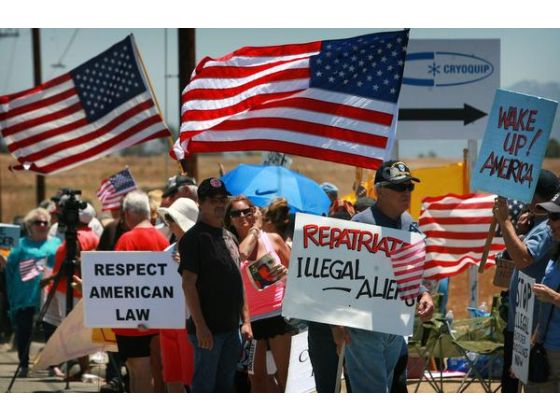
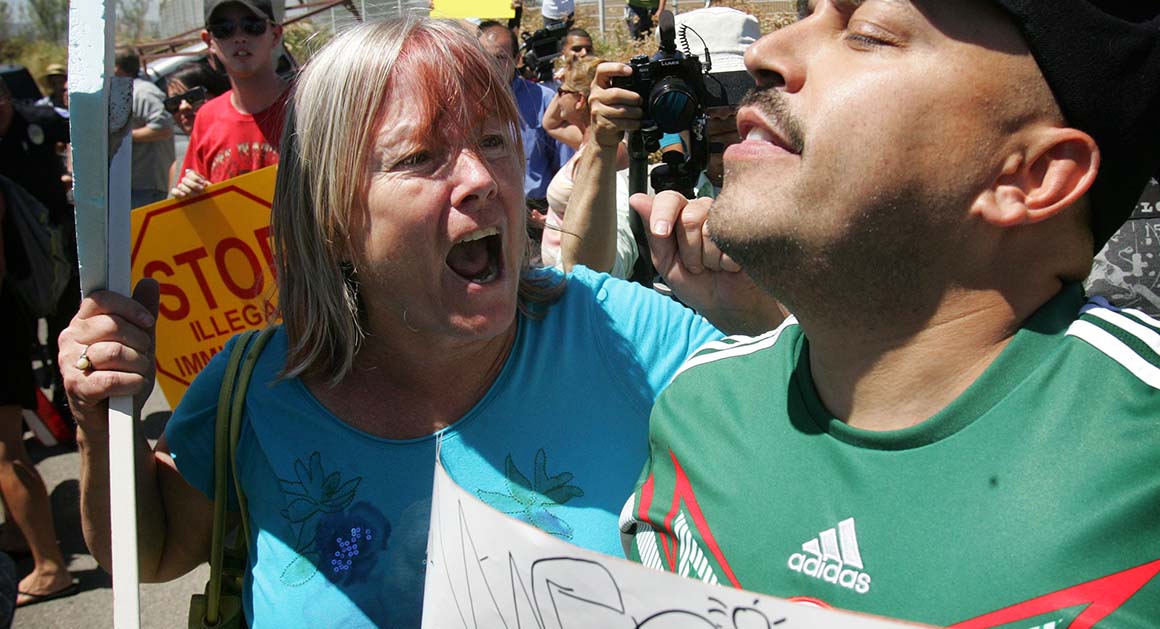 If you would like to see haughty eyes, look no further than the faces of the men and women protesting the arrival of migrants from Central America. The woman who screamed, “we don’t want you; nobody wants you!” may have believed she was speaking for the entire nation.
 Haughty people don’t always look down their noses at the rabble; more often they are fearful, angry and paranoid. (more…)




 It’s hard to argue with that logic. But logic isn’t driving the debate over homosexuality in American Christianity. Logically, the churches of the segregated South had to decide whether to accept or reject the civil rights movement. Instead, denominational officials crafted tepid resolutions affirming Brown v. Board of Education or the Voting Rights Act and calling for racial harmony. Contrary-minded congregations (and they were legion) were not drummed out of the denomination for refusing to open their churches to African American Christians. SBC pastors weren’t forced to sign off on racial equality to remain in good standing.



 Friends of Justice