Category: Uncategorized

Two conflicting explanations for the decline of the liberal Church

David Hollinger

By Alan Bean

The Christian Century has a fascinating interview with Berkeley Professor David Hollinger who argues that “ecumenical Protestants” (he intentionally avoids the word “liberal”) shifted American culture in positive directions because they were willing to go to the wall on issues like civil rights.

This view conflicts with Ross Douthat’s critique of liberal Christianity, expressed most recently in the New York Times’ Sunday Review that liberal denominations have declined numerically because they are “flexible to the point of indifference on dogma, friendly to sexual liberation in almost every form, willing to blend Christianity with other faiths, and eager to downplay theology entirely in favor of secular political causes.”

Hollinger disagrees.  Ecumenical churches have suffered drastic numerical declines, to be sure, but for all the right reasons:

Ecumenical Protestants were way ahead of the evangelicals in accepting a role for sex beyond procreation and in supporting an expanded role for women in society. The ecumenical Protestants understood full well that the Jim Crow system could not be overturned without the application of state power, rejecting the standard line of Billy Graham and many other evangelicals that racism was an individual sin rather than a civil evil. The ecumenical Protestants developed a capacity for empathic identification with foreign peoples that led them to revise their foreign missionary project, diminishing its culturally imperialist aspects—and that led them, further, to the forefront of ethnoracially pluralist and egalitarian initiatives as carried out by white Americans. The ecumenical Protestants resoundingly renounced the idea that the United States is a Christian nation, while countless evangelical leaders continue to espouse this deeply parochial idea.

It could be that Douthat chooses to focus on the lame aspects of liberal Protestantism while Hollinger celebrates the heroic side of that tradition.  Both are certainly part of the mix.  The big difference is that Douthat describes Protestant Christians desperately trying to adapt to secular liberalism; Hollinger sees the ecumenical Protestant tradition establishing the foundations for secular liberalism on issues like civil rights, feminism, gay rights and a non-aggressive foreign policy.

Please read both articles and tell us what you think.

Red River Justice

Until today, the only coverage of the strange doin’s down in Clarksville, Texas story was Friends of Justice blogging and a couple of radio pieces by NPR’s Wade Goodwyn.  Now Texas Observer journalist Patrick Michels has produced a thorough and engaging account of a scarcely believable story.  It should be noted that the Texas Observer was the first publication to take our concerns in Tulia, Texas seriously.  Thank God for genuinely independent media!  AGB

Red River Justice

In an East Texas county known for corrupt law enforcement, Mark Lesher fought the justice system—until it came for him too.

Published on: Wednesday, July 11, 2012

East Texas lawyer Mark Lesher says he and his wife were targeted by law enforcement for stirring up trouble in Red River County.East Texas lawyer Mark Lesher says he and his wife were targeted by law enforcement for stirring up trouble in Red River County.

THE LAW CAUGHT UP WITH Rhonda Lesher on a quiet Monday afternoon in April 2008. She was doing the books at Unique Touch, the hair salon and day spa she owned in the small northeast Texas town of Clarksville. She didn’t take appointments on Mondays, so the cutting stations, blow dryers and massage tables were empty when the deputies walked in.

The officers had a warrant for her arrest, but wouldn’t explain the charges. They promised more details at the sheriff’s office, and Rhonda wondered why they hadn’t just asked her to drop by. She would have walked the five blocks. They let Rhonda make a call, so she picked up a phone on the back wall and dialed her husband’s Clarksville law office. Mark wasn’t always good about answering his phone, but she knew his assistant Kenny Mitchell would be there.

“Kenny, I’m here at the shop, and I’m getting arrested.”

“For what?”

“Hell, I don’t know,” she said. “I guess it’s that crap on the Internet.” Call Mark, she told him, and hung up.

Rhonda followed the deputies out to the street fronting the town square. She knew her arrest would soon be big gossip. She’d been a pretty teenager in the late 1970s at Clarksville High, and some folks still whispered about her like they had in the high school halls. Rhonda, like many who grew up in town, remained an object of fascination into adulthood. Gossip is a popular way to fill time in Red River County, especially for those who can’t find jobs. Some county residents work at the Campbell Soup factory in Paris, 40 minutes to the west, in the neighboring county. There is a hospital in Red River, ranch land, and not much else. (more…)

An Innocent Question

Federal courthouse, McAllen, Texas

By Alan Bean

“Is there any way that I could get a permit that would let me stay in this country?”

The question came from a young man who, the day before, had been nabbed by Border Patrol officers as he waded the Rio Grande River.  Like most of the men in the courtroom, the questioner was short, thin and young.  I guessed his weight at 120 pounds, but it could have been less.

Like the thirty-five men and women standing with him in the magistrate court on the fourth floor of the federal courthouse in McAllen, Texas, the man asking the question was pleading guilty to a charge of entering the United States illegally.  Most of the defendants had been deported on multiple occasions, but this young man was apprehended by Border Patrol on his first attempt to enter the country illegally.

And yet he asked an innocent question; innocent in the sense that children are innocent.  He meant no one any harm.  He was just looking for a chance to earn a decent living.  He was ready to work long and hard.  He was eager to contribute to the greater good.  He entered the United States for the purest of motives, and yet he was being prosecuted as a criminal. (more…)

“You never know what’s behind the door”

By Alan Bean

An Arlington, Texas family has filed a wrongful death suit after officers with the Bureau of Alcohol, Tobacco, Firearms and Explosives, the FBI and other law enforcement agencies broke down a door and killed an innocent, unarmed man.

This is an old, old story.  As an ATF agent quoted in the story says, officers never know what might be waiting for them behind a locked door.  For all they know, a gang of desperadoes, AK 47s at the ready, might be lying in wait.  You have to be prepared for every eventuality, right?

The chances of things ending badly increase with every additional officer involved in the raid.  All it takes is one paranoid kid or a budding sociopath eager for a little gun play and bad things are bound to happen.  A small, experienced unit with high standards of professionalism is much less likely to gun down innocent people than a ragtag assortment of officers who aren’t used to working together.

In this case, at least the ATF had the right house and they appear to have been looking for a genuinely dangerous individual.  But kicking down doors and storming into a room is an intrinsically dangerous undertaking.  The inevitable excuse when the innocent die is the old “I thought he had a gun” canard.  When you enter a room, it can take several seconds to evaluate whether the folks behind the door constitute a threat.  Since dead people can’t kill you, the chances that some undisciplined cowboy will shoot first and ask questions later are unacceptably high.  Anyone, even a child, could be armed.

The high degree of risk inherent in no-knock raids makes the occasional tragedy inevitable.  The officers should have known that the guy they were looking for didn’t own the home they were entering, and that they would likely encounter a family member with no connection to organized crime.  Much better to approach a suspect in such a way that the chances of collateral damage can be reduced.

Overwhelming force is great for officer safety, but it places the public at risk.  No-knock raids should be reserved for truly exceptional situations and I doubt the case described below qualifies.

Arlington family files wrongful death suit after ATF raid

By Darren Barbee

dbarbee@star-telegram.com

The morning he was killed, Harry Wilson Aguilar Sr. stood in the kitchen of an Arlington apartment making school lunches for his grandchildren.

(more…)

Dallas County sued for $60 million for racial discrimination and harassment

By Pierre R. Berastain

David Womble, courtesy of Dallas Voice

David Womble, a supervisor of facilities management in Dallas County, received a pay raise after R.L. Lawson filed a complaint indicating Womble had made racial and anti-gay remarks.  Now, Dallas County is being sued for sixty million dollars.

According to the lawsuit, plaintiffs were subjected to a racist and discriminatory work environment that included graffiti with the words “white power”, a “black Coke can found hanging with a “noose” from a box in the North Tower engine room,” and better tools for white workers.  Womble is also said to have worn a fake gold tooth while mocking his black subordinates.

Dallas County maintenance workers allege racial discrimination in federal lawsuit

By Kevin Krause 
kkrause@dallasnews.com

Published: 27 June 2012 10:55 PM

Dallas County has a history of racial discrimination in its jail maintenance department and officials have done little about numerous complaints in recent years, even boosting the pay of one white supervisor at the center of the allegations, a $60 million federal lawsuit claims.

County officials have said they are investigating allegations in that department after several black employees complained about racist graffiti and mistreatment. But an attorney for Dennis Jones, R.L. Lawson and Clarence Jones said it’s too little, too late.

“If Dallas County was serious in addressing the problems, this action would have been taken long before now,” said the attorney, Larry E. Jarrett.

County officials declined to comment about the investigation or the allegations because of the pending lawsuit. Dallas County Judge Clay Jenkins said he couldn’t comment but said the county is “committed to providing a nondiscriminatory workplace for all of its employees.”

The problems allegedly began in 2010 when black maintenance employees first complained. Grievances tell of “white power” epithets spray-painted on jail walls, anti-gay jokes, a noose and racially insensitive remarks made by white supervisors.

One supervisor allegedly put false gold teeth in his mouth to mock a black subordinate.

Jarrett said he has photographs of the graffiti and what he says was a noose, as well as witnesses to the hostile work environment.

Dennis Jones, 51, who initiated the lawsuit, claims he was fired along with two other black employees — LaParker Smith and Darian Fisher — for having felony records even though they disclosed their records when they were hired. They were the only ones fired. The lawsuit said whites and Hispanics with similar backgrounds were allowed to keep working.

All three men were later rehired.

The lawsuit was originally filed last year and amended to include Lawson and Clarence Jones this month.

Clarence Jones, 27, who is not related to Dennis Jones, filed a grievance through the county in February, saying he went to the depopulated Bill Decker jail on his normal rounds and saw the words “white power” sprayed on the walls in the maintenance shop. He said in the grievance that management “does not do enough to inform employees of what harassment is nor admonish or warn individuals to abstain from such behaviors.”

Read full article here

Walker: A Cocaine Conspiracy Untangles a Web of Lies

Attorney David Moffitt

By Clarence Walker

Assistant District Attorney Karen Plants was head of the narcotics unit of the Wayne County District Attorney Office in Detroit Michigan when the Inkster Police Department scored a major narcotic bust in 2005. Acting on a reliable tip, officers collected 47 kilos of cocaine, the largest haul the Inkster authorities ever had in its history.

This was the epitome of the American way to carry out “the war on drugs”: A swift take down of Alexander Aceval, Ricardo “Richard” Pena, Chad Povish and Brian Hill along with the seizure of the cocaine worth millions of dollars.

While the community celebrated the bust, the subsequent investigation blew the lid off an egregious case of corruption in Michigan’s Jurisprudence.  The drug bust included lies orchestrated by the prosecutor, the judge, the informant and the police.  The string of charges ranged from “obstruction of justice” to perjury.

Circuit Judge Mary Waterstone, in charge of the trials against Aceval and Pena, was complicit in the perjury scheme. She told a Michigan Attorney General investigator that prosecutor Plants expressed concern for the safety of Chad Povish who set up the men to be arrested. (more…)

The Cooperative Baptist Fellowship: a candle in search of darkness

By Alan Bean

Leaders insist that the Cooperative Baptist Fellowship is not a denomination, and there is some truth to the claim.  The CBF doesn’t pass resolutions, has no statement of faith, and delegates to this week’s convention in Fort Worth weren’t delegates selected by individual churches.  If you wanted to attend, you could register for free on the CBF website, and over 1500 people did.

On the other hand, if you attend a church like Broadway Baptist in Fort Worth, the Cooperative Baptist Fellowship clearly fills the role of a denomination.  Broadway, largely due to its stance (or lack of stance) on the gay rights issue, is no longer affiliated with the Southern Baptist Convention or the Baptist General Convention of Texas.  For us, the CBF serves as a denomination.

I attended as much of this weeks CBF gathering in Fort Worth as time would allow, serving as a greeter, attending work shops, chatting with the folks hawking wares and services at the Gathering Place and participating in evening worship.  Still, I missed all of the business sessions and most of the workshops and my conversations were largely limited to  the scattered handful of leaders and participants I know from the distant past.  This was the first CBF event I have ever attended, so I don’t have a large fund of actual experience to draw from.

I was a graduate student at the Southern Baptist Theological Seminary in Louisville when the CBF was founded in 1991.  I was vaguely aware that Daniel Vestal, a conservative but not fundamentalist pastor, lost a close fight for the presidency of the Southern Baptist Convention in 1989.  In those days, as many as 45,000 “messengers” from across the nation would flock to the annual conventions as both moderates and fundamentalist factions tried to turn out the vote.  By contrast, this year’s SBC gathering was attended by fewer that 8,000 people.  Vestal lost that fight and it soon became obvious that the conservative faction had taken control of the denominational apparatus.

Although SBC presidents have little formal control, they do make critical nominations to the all-powerful “Committee on Committees” (a tribute to “organization man” bureaucracy if ever there was one).  Since the Committee on Committees nominates people (usually male people) to the boards of various powerful institutions throughout the denomination, including six theological seminaries, ten years of fundamentalist presidents starting in 1980 represented a complete transfer of power.

The Cooperative Baptist Fellowship came to existence as a protest movement within the SBC that functioned primarily at the state level.  The fundamentalists held sway at the denominational level, but most of the money on which the denomination depended flowed through powerful state conventions.  In influential states like Texas and Virginia, CBF influence was so strong at the state level that pro-SBC conventions were formed so the denomination could relate directly to the more conservative churches.

As a moderate SBC leader told me back in the day, the power struggle in Baptist land was about sociology more than anything else.  The men and women of the CBF are high culture Baptists.  That may sound like a contradiction in terms, and in a sense it is.  How high culture can you be and still call yourself a Baptist?  CBF folks like beautiful art, semi-classical music and a well-turned phrase.  Well, some CBF churches use vestments, pipe organs and are slowly falling in love with the liturgical traditions of historic Christianity.  The quasi-denomination is built on the institutional foundation of churches, Baptist universities like Mercer and Baylor, and the long list of seminaries and theological schools spawned by the exodus of moderates from the SBC.  CBF people may be the most theologically and biblically literate Christians in America.  For all that, they retain a fondness for “the old songs” like Just as I am, and I Love to Tell the Story, they talk about missions, missionaries and “the mission field” a lot, and they take the Bible very seriously.

It’s complicated.

Gradually, the CBF has surrendered the dream of retaking control of the mother ship and has developed a separate identity.  The initial generation of CBF leaders is now old enough for retirement.  Last night, Daniel Vestal was feted and celebrated in a two-and-a-half-hour worship service that, though deeply meaningful to old timers, seemed a tad excessive to first-timers like me.

Old guard CBF leaders like Vestal came of age in the old Southern Baptist Convention and it shows.  Even during the strife of the 1980s, men like Vestal presented themselves as the true defenders of Baptist “distinctives” like world missions and evangelism. “We first lost our focus on evangelism,” Vestal lamented in 1989. “Then we lost our trust for each other. Now, we’re losing our viability as a denomination for world evangelization.”

I doubt this kind of rhetoric resonates with the scores of seminary and college students who attended the CBF gathering in Fort Worth, especially if evangelism means “saving souls” and “world evangelization” means disparaging other religions.  As the CBF and the SBC have drifted apart, both groups have redefined themselves.  The SBC has embraced the old “heaven and hell” Christianity so characteristic of frontier revivalism.  The evangelistic mission of the SBC may have been interpreted in softer terms by moderate SBC leaders between 1950 and 1975,  but the kinder, gentler evangelism had been thoroughly eradicated by 1990.  Since then, preachers who believe in a literal hell, a real heaven, and a sure-’nuff Satan have had the stage to themselves.

“The light shines in the darkness,” John’s Gospel tells us, and confident Christians have always been clear about their darkness and their light.  In the SBC, sinners are lost, they are going to hell, and nothing short of faith in the saving blood of Jesus will save them.  That message has always been popular in the South, especially in Bible Belt states like Texas, Mississippi and Alabama.

I left Southern Baptist life in 1994, shortly after the formation of the CBF, and this week’s conference was my first opportunity to witness the semi-denomination up close and personal.

If the sermon on the glory of God Vestal preached last night is anything to go by, the CBF loves the light but would rather not talk about the darkness.  Using every rhetorical tool in the preacher’s tool kit, Vestal tried to get his audience fired up about the glory of God.  He was only partially successful.

The CBF has always been unsure about the darkness.  Do they believe in a real Satan and a real hell? Some may and some may not; but it hardly matters since hardly anyone affiliated with the group is comfortable with these dark concepts.  Every good story needs an antagonist, a villain, and the CBF story doesn’t have one.  The Light of the world will be swallowed by the neon glitter of secular America unless we splash some tangible darkness onto the canvas, and I didn’t see much of that.

For too long, the unacknowledged Satan of the CBF has been the Grand Inquisitor fundamentalists who sent a generation of SBC moderates into exile (not quite an auto-da-fe, but close enough).  The CBF needs to do better than that.  The glory of God will have an ersatz feel until it is juxtaposed with truly dark evils like poverty, mass incarceration, global warming, anti-immigrant bigotry and the demonization of the gay rights movement.  There’s lots of material out there, but a sort-of-denomination spawned in conflict and controversy naturally wants to keep the lid on Pandora’s box.  Until recently, issues with any potential for controversy have been studiously avoided.

The younger generation of CBF people hunger and thirst for deep theological conversation about things like sex, the ecological crisis, justice, crime and punishment, immigration and all the other broken pieces of America.  Plenty of CBF people want the light to shine into genuine darkness.  Darkness-light issues found their way into some of the workshops I attended, but were addressed in the most general of terms and seldom mentioned in worship nor, I suspect, in business meetings.

This will need to change.  The trauma of being rejected by Mother Church takes a decade or two to get past, but the CBF is divided into folks older than me (who have a hard time letting go of past indignities), and people younger than me (who have little living memory of these events and long to move on).  Who will lead the CBF now that the beloved Rev. Vestal has retired?  That is the question of the hour.  For better or worse, they don’t make preachers like Vestal any more.

During a meeting of Texas Baptists, Bill Leonard, the dean of liberal Baptist historians, took us on a whirlwind tour of the state of Christian America.  In a day in which denominationalism is losing its meaning, he said, Baptists need to be tell the world who we are and who we are not.  I asked old church history prof if a generation of seminary students with no living memory of our Baptist holocaust might open the door to new things.

The Wake Forest professor didn’t give the yes-or-no answer I had expected.  It is a great blessing, he admitted, to live without the burden of history.  But the churches these students will enter are still living with these painful memories and pastors who don’t understand the historical context of their churches don’t always anticipate the trauma they can evoke with a single misplaced sentence.

I see his point.  And yet I long for leaders who are free to apply the light of God to the all-too-real darkness of current events.  The day is coming.  The younger generation of denominational leaders longs for social justice, isn’t the least bit hung up on social evils like cussing, drinking and gambling, and takes a compassionate view of issues like gay rights, immigration rights and the criminal justice system.  In time, these young women and men will be at the helm of the Cooperative Baptist Fellowship and the self-definition Leonard calls for will begin.

Judge tosses record jury award in libel case

Judge Dana Womack

By Alan Bean

Judges are generally hesitant to take matters out of the hands of a jury, but Tarrant County District Judge Dana Womack seems downright eager.   The record award of $13.7 million is gone like smoke and now it is the plaintiffs who must fork over court costs.

In other words, Womack didn’t just call for a do over; she arbitrarily inserted her personal judgment for that of the jury.

If the article below is anything to go by, the case seems to turn on the judge’s doubt that statement’s allegedly made by the defendants, Shannon Coyel, Gerald Coyel, Charlie Doescher and Pat Doescher, could actually be traced to these individuals.  I doubt we have heard the last of this story.

Judge throws out $14 million jury award in online libel case

BY DARREN BARBEE

dbarbee@star-telegram.com

A Tarrant County judge has thrown out a jury’s nearly $14 million Internet libel verdict in a case that garnered national attention and was called the largest such award involving online defamation.

With her ruling, state District Judge Dana Womack sided with the defendants who argued that the jury’s verdict was not supported by the evidence. The judgment, signed late last week, does not explain her reasoning. Womack declined through a court official to comment.

One of the defendants said he understood that the jury had wanted to send a message with its decision.

“But if you’re going to penalize somebody for doing it, make sure you get the people who did it,” said the defendant, Charlie Doescher, who lives in Kennedale.

The case originated after a woman employed by Mark and Rhonda Lesher accused them of sexually assaulting her. They were indicted but acquitted at trial.

The Leshers later sued, saying the woman and her husband, along with their employees, smeared them in blog postings to ruin the Leshers’ reputations. The case took years to get to the jury. In April, a Tarrant County jury voted 10-2 to award the couple $13.78 million. Defendants Shannon and Gerald Coyel and Doescher, who worked for the Coyels, were ordered to pay varying amounts of the award.

In a motion filed last month, the defendants’ attorneys argued that no evidence presented to the court tied them to the posts. A review “will show the IP address allegedly tied to Gerald and Shannon Coyel’s home is nowhere to be found,” the court document said. The motion also argued that no evidence supported an award of mental anguish for the Leshers, nor was there evidence that their reputations were injured and Rhonda Lesher’s beauty salon lost profits.

Rhonda Lesher, who said she moved after the online posts wrecked her business, said Tuesday that the verdict’s reversal was a “slap in the face.” She said the couple plan to appeal.

Many of the blog posts were vile — Lesher said there were more than 25,000 entries — including that her customers engaged in sexual perversions and molestations, drug dealing and other criminal activity. Among the posts, one stated “…they got ‘HERPIES’ and ‘AIDS’!” Another read, “These are the ‘SLIMEST’ ‘LYING’ ‘PERVERTED’ ‘CHILD MOLESTING’ ‘HELPLESS WOMAN RAPING’ ‘SCUM’ I have ever heard of!”

Lesher said she and her husband had asked for $5 million in damages, but the jury went far beyond that. Though she still feels she has been vindicated, the judge’s ruling “took my breath way.”

“I just felt gut shot,” she said. “Don’t get me wrong, I had not spent any [of the award] money in my mind. I wasn’t counting my chickens before the eggs hatched. … We have worked for four years and have spent as much as we’ve spent to get to bottom of it to get some vindication.”

Lesher said the couple sold their ranch to pay for attorneys and have paid civil and criminal trial costs of more than $1 million. The couple still have a suit pending in Collin County against district attorney prosecutors for malicious prosecution, she said.

“The amount of torment and pain we have endured it’s really hard to put into words,” she said.

According to the lawsuit, Shannon Coyel, a former client of Mark Lesher, an attorney, accused the Leshers and one of their employees of sexually assaulting her. The criminal trial was moved to Collin County because of pre-trial publicity, and the jury acquitted all three in January 2009.

Coyel said the trial was “humiliating” and that she saw a counselor for more than two years to deal with her experiences, including the ordeal with the blog posts.

She said she copes through “My faith in God. I go to bed every night and I pray God takes my worries away,” she said.

Media reports about the jury’s verdict angered her, she said, because they came before the case was closed. Coyel said she was never worried about the money that she was supposed to pay — roughly $2 million.

“They would never get a dime from me because I don’t have a dime to give them,” she said.

She also said that the blog posts disgusted her and that her husband barely uses a computer. “Just to even read [the posts], there’s got to be something mentally wrong with you,” she said.

The judge, she said, did an excellent job and followed the law in her ruling.

“This is how the judicial system is supposed to work,” she said. “The judge … could see through all the smoke and mirrors.”

Doescher, who also had been ordered to pay money, said he did not know the Leshers and had never seen them until he walked into the courtroom.

“They were out for revenge,” he said.

Being dragged into the lawsuit was an ordeal for him, he said. “It hurt my life so much.”

In her ruling, Womack orders the Leschers to pay the defendants’ court costs.

Judge Joe Spurlock II, a law professor at Texas Wesleyan University School of Law, said judges have the ability to disregard jury verdicts, dismiss the case and have it retried or allow a person who wins to agree to reduce the award.

Judges in U.S. courts can set aside a verdict when they believe that it was somehow unjust, biased, prejudiced or otherwise compromised, said Spurlock, formerly a district judge in Fort Worth who also served on the appellate court.

“Judges hate to do this,” Spurlock said, noting that jury decisions are held in high regard as a foundational institution. “We only do it on those rare occasions that it’s not proper justice, it was just not properly served.”

Darren Barbee, 817-390-7126

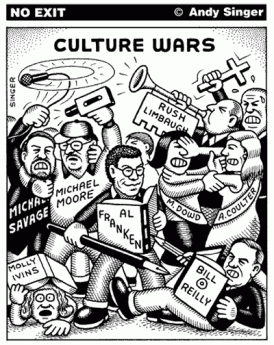
At war over the culture war: Dionne and Gerson go toe-to-toe

By Alan Bean

When two columnists working for the same newspaper address the same subject (the culture war and the contraception debate) you can learn a lot.  Michael Gerson accuses Barack Obama of sustaining our endless American culture war by forcing a conservative Roman Catholic Church to conform to “the liberal values of equality and choice.”  In Gerson’s view, the Catholic Church is an inherently conservative, indeed ‘illiberal’, institution.  Gerson endorses a pluralistic view of America in which a variety of civic organizations, some liberal and progressive, others illiberal and traditional, co-exist in a free society.  But this dream of a pluralistic America is being thwarted by an inherently intolerant “liberal” view of American life in which every individual and institution is expected to conform to the liberal values of equality and choice.  By forcing illiberal Catholic medical providers to provide free contraceptive services to their clients, Gerson alleges, the Obama administration is rejecting the pluralistic vision of America and stoking the fires of culture war.

Gerson believes it is a mistake to antagonize conservative institutions because, unlike their liberal counterparts, they encourage 

The habits of good citizens — attributes such as self-control, cooperation and respect for the law — don’t emerge spontaneously. They are cultivated in families and religious congregations. The health of liberal political institutions is strengthened by the success of traditional institutions, which often teach values that prepare individuals for the responsible exercise of freedom.

In Gerson’s view, Obama moved to the left on immigration and gay rights because he is an ardent culture warrior who disrespects the views of American conservatives.

Then comes E J Dionne, a progressive columnist who, unlike the evangelical Gerson, happens to be a living, breathing Roman Catholic in good standing.  Dionne agrees that Obama’s initial handling of the contraception issue was ham-handed and out of character.  Dionne’s Obama is no champion of the liberal view of America.  At his core, the president is an even-handed pragmatist who is generally eager to negotiate with his ideological opponents.

In fact, Dionne reminds us, six years ago Obama complained that

There are some liberals who dismiss religion in the public square as inherently irrational or intolerant, insisting on a caricature of religious Americans that paints them as fanatical, or thinking that the very word ‘Christian’ describes one’s political opponents, not people of faith.

Sounds a lot like Michael Gerson, doesn’t it.  Obama dropped the ball on the contraception issue, Dionne admits, but was able to self-correct by offering a compromise that was joyfully embraced by Catholic medical care providers.   

Unlike Gerson, Dionne refuses to define the Roman Catholic Church as an inherently traditional or illiberal institution.  The Catholic Church is a pragmatic and pluralistic blending of conservative and progressive impulses.  Dionne says he remains in the fold largely because

When it comes to lifting up the poor, healing the sick, assisting immigrants and refugees, educating the young (especially in inner cities), comforting orphaned and abandoned children, and organizing the needy to act in their own interest, the church has been there with resources and an astoundingly committed band of sisters, priests, brothers and lay people. Organizations such as Catholic Charities, the Catholic Health Association, the Catholic Campaign for Human Development and Catholic Relief Services make the words of Jesus come alive every day.

Moderate Catholics appreciate the president’s willingness to meet the Church half way on contraception and Dionne hopes the conservative wing will tone down its opposition to abortion rights and gay marriage because the American Catholic community is as divided on these issues as the rest of society.

Two views of the Roman Catholic Church; two views of the sitting president.  Who wins?

Dionne gets the best of this dust-up.  The culture war doesn’t separate illiberal traditionalists like a monolithic Catholicism from liberal, pluralism denying, culture warriors like Obama.  Obama has been deeply influenced by both secular liberalism and the traditional values sustained by the Christian Church.  Roman Catholics, like most Christian denominations, are split down the middle over culture war issues like gay marriage, abortion and, now, contraception.  Gerson’s neat divisions don’t fit either Obama or American Catholicism.

If the president has moved off the fence on gay marriage and immigration it’s because he sees no point in placating ideological opponents for whom the word ‘compromise’ has become the vilest of profanities.  Any politician on the right willing to meet the president half way on any contentious issue gets his or her (usually his) mouth washed out with soap in full view of the cameras.

Nice try, Michael, but you didn’t nail it this time.

When God changes the rules

By Alan Bean

In a recent post, I responded to a Curtis Knapp, a Baptist pastor in Kansas who believes the federal government ought to be executing homosexuals in accordance with the twentieth chapter of Leviticus.  I suggested that when the Bible is read through a Christological lens, the admonitions of Leviticus can be taken seriously, but not literally.  They are still in the Bible, but they are trumped by the higher vision of God revealed in Jesus (and in many parts of the Hebrew scriptures as well).

I gave a single example from the Sermon on the Mount in which Jesus clearly distinguishes his message from the “eye-for-an-eye” demands of the Mosaic law.  But there are plenty of other examples.

In a captivating post called “When the atheists are right” law professor (and Friends of Justice board member) Mark Osler, points to the story of the Prodigal Son.  Responding to a Christian father who thought it was his duty to consign his dead son to hell, Osler introduces an alternative take on grace and the character of God.

And there, in the Book of Luke, is the story of the prodigal son — the younger of two, who demanded his inheritance and then squandered it through “dissolute living.” He hits bottom, having run through the money, and resolves to return to his father and repent. However, before he has a chance to say anything, his father runs to him, puts his arms around him and kisses him. There is love there, before repentance, even in the apparent absence of repentance. There is love before all; that is what Christ directs us to do.

The Elder Brother’s rejection of the Prodigal was solidly rooted in precept and principal, but it couldn’t be squared with the gracious heart of God.

Fred Clark’s Slacktivist blog uses Peter’s vision in Acts 10 in which a sheet containing animals which were “unclean” according to Levitical law accompanied by the spoken command: “arise, Peter, kill and eat.”

And what he understood was that his vision was not about dietary laws regarding “all kinds of four-footed creatures and reptiles and birds of the air.” What Peter understood about Peter’s vision was that it was about Gentiles — about outsiders, about those people whom the laws of Moses said were law-breakers, unclean, an abomination.

Here is what Peter himself said about his own vision:

You yourselves know that it is unlawful for a Jew to associate with or to visit a Gentile; but God has shown me that I should not call anyone profane or unclean.

In Acts 10, God changed the rules.  Peter wasn’t informed that his interpretation of the dietary rules was wrong or that the ancient wall between Jew and Gentile was based on a misunderstanding; he was informed that a new vision of faith in action had burst upon the world.  If Peter interpreted his vision in light of the Jew-Gentile divide, we should apply it to the current antagonism between gay and straight Christians.

The Sunday after Barack Obama came out for marriage equality, Dallas pastor Freddie Haynes made a bold stand in the pulpit of Friendship-West Baptist Church in which he asked why Christians are so eager to major in areas that Jesus minored in.  Jesus majored in deliverance and compassion; judgment was a minor issue (unless he was talking about preachers).

This morning, my wife and I encountered these familiar words from Luke 13.  The setting is the healing of a woman who had been crippled for eighteen years.  Jesus’ religious critics are appalled that a Rabbi would heal on the sabbath, a clear violation of biblical teaching and rabbinic tradition.

Jesus replies,

You hypocrites!  Does not each of you on the sabbath untie his ox or his donkey from the manger, and lead it away to give it water?  And ought not this woman, a daughter of Abraham whom Satan bound for eighteen long years, be set free from this bondage on the sabbath day?

In other words, the cold word of the law melts when brought into contact with the compassionate heart of God.  The lesson: whenever we find a disconnect between the clear word of scripture and the grace of God revealed in Jesus; we go with Jesus.  Every time.  All the way.