Category: Uncategorized

David Barton’s therapeutic history

This isn’t really about Thomas Jefferson

Faux historian David Barton has written a book about Thomas Jefferson that portrays the deist slave holder as a Christian patriot who espoused enlightened views on slavery and race.  But Barton’s primary aim is to expose a cynical liberal academy that lies to the American people.  This quote from the book’s blurb is typical:

America, in so many ways, has forgotten. Its roots, its purpose, its identity―all have become shrouded behind a veil of political correctness bent on twisting the nation’s founding, and its founders, to fit within a misshapen modern world.

The time has come to remember again.

Evangelical historians Warren Throckmorton and Michael Coulter learned about David Barton’s book from their students at Grove City College.  What they were hearing sounded strange enough to warrant a careful reading of Barton’s book.  (more…)

Southern Baptist Leader Loses Radio Show following Tirade

This story was originally published by the Associated Baptist Press and requires no editorial comment.  AGB

Richard Land Signs Off Radio Show

Richard Land

By Bob Allen
Associated Baptist Press

Southern Baptists top moral-concerns spokesman told listeners June 2 was his final appearance on the weekly call-in show that sparked recent controversy.

The head of the Southern Baptist Convention’s Ethics and Religious Liberty Commission signed off without fanfare for the last time on the Richard Land Live! weekly radio show June 2.

Land, Southern Baptists’ top spokesman for moral and religious-liberty concerns since 1988, didn’t go into detail about the controversy over recent comments about Trayvon Martin and a plagiarism investigation that brought rebuke and a decision to cancel the program by the executive committee of his trustee board. (more…)

Zimmerman’s bond revoked

George Zimmerman, the man accused of murdering Trayvon Martin, is likely on his way back to the slammer after a judge concluded that he and his family lied about the family finances.  Your can read the New York Times story here.

Tulia story featured in Fort Worth Weekly article

Joe Moore feeds his cattle before being arrested in Tulia

This story in the Fort Worth Weekly uses my take on the tragedy of Tulia, Texas as a metaphor for a failed war on drugs.

Jim Crow Redux:
War on drugs or on minority communities

Matthew McGowan

Fort Worth Weekly

Alan Bean couldn’t miss the headline splashed across the top of his hometown paper one summer morning in 1999. It spoke of big news for the 5,000-person burg in West Texas: a big drug bust that landed a sizable portion of the town’s black community behind bars.

“Tulia streets cleared of garbage,” the banner headline read. Like many aspects of the American war on drugs, the wording smacked of insidious racism.

Bean recalled his reactions to that news story a few days ago, to a roomful of people at a Fort Worth hotel. The event, examining the 40-year-old war on drugs and its disproportionate impact on minority communities, was hosted by the Tarrant County Libertarian Party but drew speakers from several parts of the political spectrum.

At the podium, Bean acknowledged that he’d known nothing of the lopsided statistics when he picked up the paper that morning. The drug bust in his small town would change all that, though, and suddenly push him to the front lines of a war that locks up seven black men for every white man incarcerated in the United States, devastating minority neighborhoods while white enclaves, where drugs are every bit as prevalent, are left mostly unscathed. The more Bean read and researched, the clearer the drug war’s racism became to him. (more…)

Osler: The Five Cardinal Sins of Progressive Activists

 In traditional organizing, advocates work to empower one group of people prevail over another group of people.  You might be trying to help labor wrest concessions from management; or you might be trying to fire up the base so a blue candidate can defeat the red team.  Inevitably, the organizing game is conceived in adversarial, us-against-them terms.  Once you understand the realities of power, it is argued, simple persuasion doesn’t work.

I can think of instances in which entrenched power will only stand aside in the face of a still greater power.  The civil rights movement in Mississippi was like that.  On the other hand, without changed hearts and minds across white America, the civil rights movement could not have succeeded.

Mark Osler is about  changing hearts and minds; he’s not into forcing people to accept your agenda whether they want to or not.  There is much to be said for this approach.  Progressives lose public policy fights when the public is swayed by fear-based arguments.  Unless we address the fear, we can’t shift the debate in our direction.  When you live between Fort Worth and Dallas, Texas, you understand this instinctively.

We must empower the powerless, but must this involve pissing off the powerful?  And if the powerful are really pissed off, how long will our victory persist?

These questions lie at the heart of professor Osler’s “The Five Cardinal Sins of Progressive Activists”.  Highly recommended AGB

The Five Cardinal Sins of Progressive Activists

By Mark Osler

I’m a sinner. At one time or another, in the course of my own advocacy (on the death penalty and other issues), I have committed each of the five sins I am about to describe. In fact, so have most who work in advocacy, whether they are progressive, conservative, or located somewhere else along the political spectrum.

We live in a world that too often values conflict over solutions, and loud voices over wise ones. Avoiding the mistakes described below may not only make you more effective, but help make our public discourse more civil and productive.

1) Speaking mostly to those who agree with you
Over and over, I have seen the same pattern: an advocacy group gets some funding, and then uses the money to host a conference which gathers together large numbers of people who agree with the position of that advocacy group. It’s rewarding, of course, and reaffirming, but what a waste of resources! If the point of advocacy is to change minds, it is almost always a mistake to direct our arguments to those who already agree with us. If you aren’t talking to people who either disagree with you or haven’t made up their mind, you aren’t really doing advocacy work. (more…)

Did Kenneth Chamberlain have to die?

By Alan Bean

While the Trayvon Martin case dominates the headlines, this story hasn’t received the attention it deserves.  As usual, the facts are messy.  Police officers, accompanying a medical team responding to a medical alert, end up shooting a 68 year-old ex-marine to death.  The New York Times story below is over a month old.  More recently, Democracy Now devoted a segment to the tragedy.  Apart from that, the mainstream and alternative media have shown little interest.

The similarities between the Kenneth Chamberlain and Trayvon Martin stories are striking.  In both cases, men with guns manufactured crisis conditions that could have been easily avoided.  In both cases, an innocent man died.

It is difficult to assess how race played into either narrative.  George Zimmerman thought Trayvon Martin was suspicious.  Maybe it was the way he was walking or the way it was dressed.  It now appears that the 9-1-1 operator introduced the race issue, but Zimmerman was responding to visual cues of some kind.  I’m not sure how suspicious a skinny kid with iced tea and skittles can look.  But Zimmerman wasn’t seeing a kid with iced tea and skittles; he saw someone who didn’t belong in his neighborhood–an alien element.

One obvious difference between these tragic tales is that one involved police officers while the other involved an armed civilian.  The difference is more apparent than real.  Zimmerman, for reasons that are not yet clear, saw himself as a kind of reserve police officer.  If officers can pull over and question suspicious people, George thought he ought to be able to do it too.  Legally, he might have been on solid ground–that’s the scary thing about the Trayvon Martin case.

When it becomes necessary to question suspects, there are good reasons why we call police officers.  They have the training, experience, and procedures to handle potentially volatile confrontations with disciplined grace and professionalism.

At least that’s the theory.  Although the facts remain a bit unclear, it appears that the police officers responsible for Kenneth Chamberlain’s shooting intentionally and foolishly escalated the tension in the room.  This happens all too often.  Sometimes its an innocent civilian who takes the bullet; sometimes its the police officer.  But when fear overrides common sense, bad decisions are made. (more…)

A near miss . . . but we’re okay!

By Alan Bean

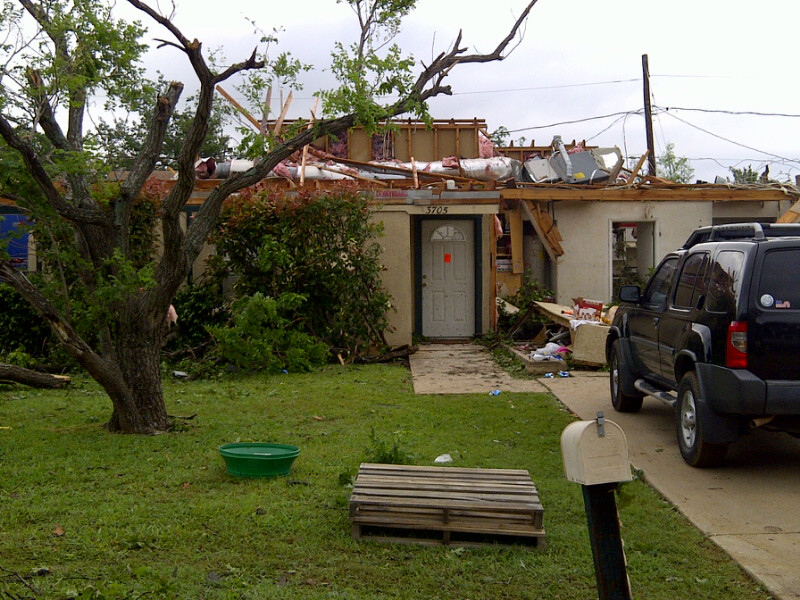
So many people have contacted Friends of Justice asking if we’re okay, that I thought I’d let you know that we are.  The picture to the left was taken about four blocks from the Bean home, so it was a close call.  This is the second time in five years that we have been three blocks from a devastating tornado (the other one was in Tulia, Texas).

Melanie Wilmoth Navarro, our Director of Outreach, got a good shot of the twister that hovered nearby for over an hour as large hunks of tar paper and insulation mixed with tree limbs rained from the sky  All the damage portrayed in this post was caused by this single tornado.

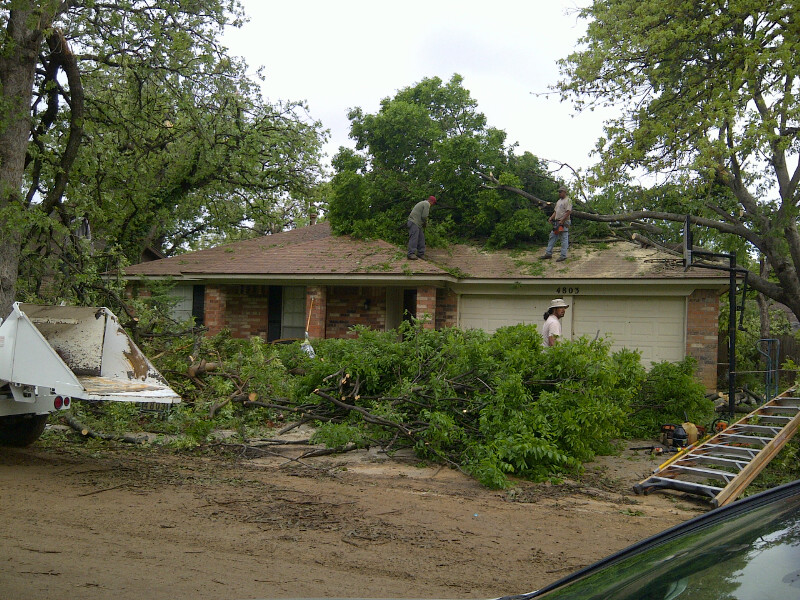
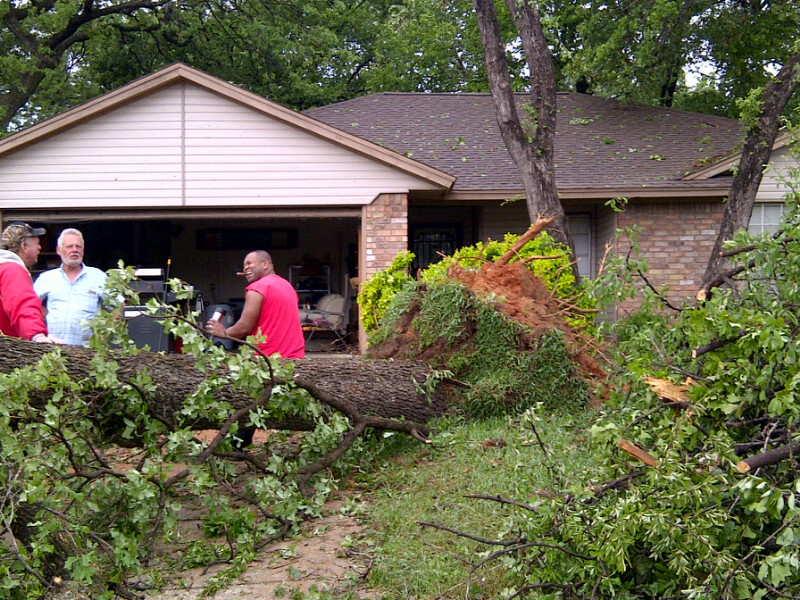
Several homes in a neighborhood located just north of the Friends of Justice office (and a bit south of the Bean home) were destroyed, and dozens of others sustained major damage.  A wing of a nursing home just up the road was completely destroyed.  A good report on the storm damage can be found here.

Friends of Justice staff took refuge in the meat locker of a Braum’s restaurant across the street from our office.  The chances of any particular property getting hit by a tornado are generally remote, but this one was far too close for comfort.  Power was restored at 2:00 am this morning and life is returning to normal.  Here are a few more pictures I took on the way to work this morning.


Bibas: A second chance for ex-offenders

As Michelle Alexander argues in chilling detail, inmates returning to the free world encounter a harsh reality.  Once you leave the free world you never really return.  Pragmatic law professor Stephanos Bibas believes these harsh policies encourage a return to criminal activity and points us in a more hopeful direction.  If you have deep pockets and are curious about Bibas’s ideas you might take a look at his book, The Machinery of Criminal Justice.

Collateral Consequences and Reentry

Stephanos Bibas

Making inmates quit drugs, learn, and work can better prepare them to reenter society. But even after they have supposedly paid their debts to society and victims, our laws are remarkably unwilling to give them a second chance. Ex-cons face a web of laws and prejudices. Some exclude them from the polity symbolically, by forbidding them to vote, serve on juries, or hold public office.

Other laws harm them more tangibly by limiting where they can live and how they can work. After conviction, inmates are often shipped to distant prisons at the other end of the state, impeding family visits and straining or breaking family bonds. Even after they are released from prison, sex offenders and others are often forbidden to live within a thousand feet or so of schools, day-care centers, playgrounds, churches, and hospitals. In many urban areas, these residency restrictions rule out most of the city, in effect exiling or banishing ex-cons entirely. Likewise, licensing laws limit felons’ employment not only as police or schoolteachers, but also as embalmers or septic-tank cleaners.

The net is quite broad: sex offenders include not only child molesters, but also flashers, public urinators, or teenage lovers. And the effects are often perverse: Ex-cons may not be able to live with their families and neighbors, who might keep an eye on them. Instead, they may have to crowd into the same motels on the wrong side of the tracks and build new criminal networks. Likewise, when we deny felons the right to work in the profession for which they have trained, we may be consigning them to unemployment or crime. (more…)

Learning from messy narratives

By Alan Bean

The Trayvon Martin case is following a predictable trajectory.  Calls for the arrest of George Zimmerman centered on the self-appointed neighborhood watch captain’s unprovoked vigilante pursuit of an unarmed citizen.  Now comes the inevitable backlash as the Sanford, Florida police department leaks reports that Martin had been suspended from school after being connected to an empty marijuana baggie.  The unspoken message is that Trayvon Martin really was the flipped-out druggie Zimmerman initially reported in a 911 call.

In addition, Zimmerman’s attorney is suggesting that Martin initiated the physical altercation that lead to his own death.

A certain amount of speculation is unavoidable in this case.  We know that Zimmerman decided to leave his vehicle, against the advice of the 911 operator, with the clear intention of confronting Martin.   We know that Martin was aware that he was being followed because he was on the phone to his girlfriend at the time.  We know a physical altercation preceded the shooting because of the grass stains on the back of Zimmerman’s shirt and his bloody nose.  We know that Zimmerman used deadly force to resolve the situation.

Frankly, I was surprised that it took so long for the champions of the status quo to start spinning the story to their own advantage.  For two weeks, black civil rights groups and bloggers have had the mainstream media all to themselves.  That couldn’t last.  It never does. (more…)

We’re Still Talking about Trayvon Martin and George Zimmerman, and That’s a Good Thing

By Lisa D’Souza

News reports and discussions about the shooting death of Trayvon Martin continue.   The Sanford police have provided information about George Zimmerman’s statement to themZimmerman’s friend has spoken out on his behalf.  This week, both The Diane Rehm Show and Talk of the Nation aired shows discussing the tragedy with experts and callers.  With a federal investigation underway and the autopsy results still sealed, we will learn more as the days and weeks unfold.

Why was George Zimmerman suspicious of Trayvon Martin?  What happened in the 20 minutes that elapsed between Zimmerman’s first seeing Martin and the shooting?  How do Florida’s self defense and gun laws affect police decisions?

And the big question: what about race?  Some have remembered the similarities between Emmett Till and Trayvon Martin’s deaths.  President Obama encouraged us all to do some “soul searching” about not just this incident but the history and context in which it happened.  In response, Newt Gingrich decried the insertion of race into the discussion of this case.  When we can admit that black males are just over 6% of our nation’s population, and yet they are more than 40% of our murder victims (and this data likely doesn’t include the deaths of black men that are not prosecuted due to self-defense claims made by the killer), then we must acknowledge that a discussion of race, violence and criminal justice is long overdue.

It is good that one month after his death, we are still talking about Trayvon Martin.  Let us hope that we remember him for a long time, and that his memory moves us to act so that his tragic and untimely death is the last one of its kind.