The Frontline treatment of the Cameron Todd Willingham saga is gripping, balanced and provocative. Don’t worry if you missed it; you can watch the entire program online.
Hour-long documentaries are frequently crammed with fluff and filler, but the Willingham case demands in-depth treatment to be understood and “Death by Fire” delivers. Here are some of the conclusions: (more…)
The policies of the drug war failed, but ignoring the problem certainly won’t make it go away. Here are four steps we need to take:
By MARK OSLER
October 11, 2010
Mark Osler
Though it is out of the spotlight in a bad economy, the United States still has a drug problem, and it may be getting worse. The use of methamphetamine, a particularly pernicious narcotic, is increasing again. Few things can harm a family or community like meth.
It shouldn’t be surprising that drug use is on the rise. The federal government, in particular, has turned its attention to something else: immigration. Just 14 years ago, about 40 percent of federal defendants who received a sentence were charged with drug crimes, while just 12 percent were up on immigration charges. For the 2009 fiscal year, 32 percent of federal defendants faced immigration charges, while only 30 percent were narcotics violators.
In highlighting this shift, I am not arguing that we go back to what we did at the height of the drug war. Those policies largely failed. If we choose to take drug interdiction seriously, we must try new approaches and take real-world facts into account, including four hard truths: (more…)
This is something of a response to and expansion of Alan Bean’s recent post, “Marcus Borg’s radical Christianity.” In this post Dr. Bean mentioned Walter Brueggemann and John Dominic Crossan in passing. I respond by expanding on the thought of those two scholars, and relate their perspectives to the issue of mass incarceration.
Walter Brueggemann
Walter Brueggemann is the author of The Prophetic Imagination. The second edition was copyrighted in 2001, so it does not qualify as a recent contribution. But it only recently came to my attention.
Brueggemann presents the Hebrew culture as represented by Moses as an alternative community to the royal, person negating culture of Egypt. The culture of Egypt was anti-freedom not only for humanity, but also for God. This counterculture to royalty and the perks of royalty persisted in Hebrew life for a couple of centuries or so before a new royalty, a counter-counterculture, took root under David and thrived under Solomon and his successors in both Hebrew kingdoms. The prophets beginning in the 8th century BCE, some of them at least, broke free from tradition to provide a new counter voice to the royal consciousness of privilege and power that had arisen in the Hebrew kingdoms.
Jeremiah was the prophet of pain; Deutero-Isaiah the prophet of hope. Pain is a necessary predecessor to hope, lament a predecessor to praise in the confrontation between the royal consciousness of privilege and power and the radical freedom of and in God. I have this quote from Brueggemann written in the margin of my Bible at Psalm 23, “It is precisely those who know death most painfully who can speak hope most vigorously” (The Prophetic Imagination, p. 67). Brueggemann cautions that social policy is not necessarily in the purview of the prophet, and that anguish is more fitting than anger as prophetic attitude. (more…)
Montana’s Governor must decide whether Ronald Smith will live or die.
Smith is from Red Deer, Alberta, a midsize city located midway between Calgary and Edmonton. He was drunk and high at the time of the murders and, the evidence would suggest, also mentally unbalanced. Initially, he turned down a plea deal that would have taken the death penalty off the table. Then he pled guilty and asked for the death penalty, telling a jury that he committed the crime because he wanted to know how it felt to kill. Ultimately, he decided he didn’t want to die after all. The case has been bouncing around in the legal system for a quarter century.
Stephen Harper, Canada’s conservative Prime Minister, had no intention of interceding on Ronald Smith’s behalf, but the Canadian courts forced his hand. Canada, like virtually every other western democracy, abolished capital punishment long ago. As in the United Kingdom, the death penalty died in Canada without much public clamor. Most Canadians supported capital punishment in 1976 (as they still do), but leading public figures didn’t think public support made the ultimate punishment moral or even an effective deterrent. (more…)
(This post is part of a series concerning Curtis Flowers, an innocent man convicted of a horrific crime that has divided a small Mississippi town. Information on the Flowers case can be found here.)
Here’s the big news: Patricia Hallmon’s fraudulent behavior is perfectly consistent with the theory that she and her brother Odell perjured themselves in 1996 so they could get their hands on the $30,000 reward on offer from DA Doug Evans and his investigator, John Johnson.
Initially, brother Odell admitted to the scam, testifying to that effect at Mr. Flowers’ second trial. Released from prison, Odell had to live with his irate sister, Patricia. After a month of free-world misery he went to Doug Evans and told him he was recanting his recantation.
And this guy is being sponsored as a credible witness by the State of Mississippi. (more…)
Jeffrey Miron’s op-ed in the Los Angeles Times argues that the drug war is just another big government boondoggle. If you aren’t familiar with the libertarian critique of the war on drugs, Miron’s column will give you the basic outline of the argument.
Libertarians are consistent conservatives. They aren’t fussy about wars of any kind (domestic or foreign) because they are obscenely expensive and never produce the desired results.
American conservatives are successful because they don’t worry about consistentency. Conservatives are a fearless lot. They aren’t afraid of poverty or unemployment because they have secure jobs; they aren’t afraid of sickness because they have great health care; they aren’t afraid of bigotry or discrimination because they are normal (white) Americans; they aren’t afraid of civil rights violations because their civil rights are rarely infringed. (more…)
The Cameron Todd Willingham case is an embarrassment to Texas governor Rick Perry and to death penalty proponents everywhere.
Willingham was convicted of intentionally setting the fire that killed his three young daughters in 1991. Willingham was convicted on the strength of forensic expert testimony that the fire was intentionally set. He was executed in 2004 still professing his innocence.
The Texas Forensic Science Commission has been conducting an inquiry into the Willingham case since 2006. When Craig Beyler, a leading fire expert engaged by the Commission, released a report highly critical of the forensic methodology used by Corsicana officials, the Willingham case became a national phenomenon. Beyler concluded his 64-page report with a slashing indictment of the “junk science” on display in Willingham’s trial:
The investigations of the Willis and Willingham fires did not comport with either the modern standard of care expressed by NFPA 921, or the standard of care expressed by fire investigation texts and papers in the period 1980–1992. The investigators had poor understandings of fire science and failed to acknowledge or apply the contemporaneous understanding of the limitations of fire indicators. Their methodologies did not comport with the scientific method or the process of elimination. (more…)
I write this from Lola Flowers’ dining room table. Yesterday I travelled to the Mississippi State prison in Parchman, Mississippi to visit Curtis Flowers. The last time I saw Curtis he was pronounced guilty of murder and sentenced to death by lethal injection. Then they ushered the defendant out of the courtroom.
Curtis didn’t react to the verdict–it was the fourth time it had been pronounced over the past fourteen years. Two other trials ended in juries divided along racial lines.
Lola and Archie Flowers didn’t show much emotion either. They quietly went to the car to unload the special transparent television Curtis used the last time he was a Parchman resident.
But just beneath the surface, the emotion runs deep. I have been corresponding with Curtis since the June, 2010 trial. His faith is strong. Sooner or later, he fully expects to be exonerated. But life on Mississippi’s death row is a struggle at the best of times.
I didn’t see Curtis yesterday. After driving nine hours from Arlington, Texas, I was informed that my name had not been placed on his visiting list. Curtis had been told to send out visitation forms to everyone he wanted to be on his list. I got my form and returned it. But someone at Parchman decided to leave me off the visitation list. So, while Lola Flowers hopped on the visitation bus, I remained in the waiting room. (more…)
Sheriff Greg Champagne of St. Charles Parish reported yesterday that 70 narcotics cases made by a single undercover officer are being dismissed. Elijah Gary, the officer responsible for making almost 100 cases in the Parish, was on loan from a neighboring Parish (see Times-Picayune article below for the details). When it was discovered that Mr. Gary had been convicted of domestic abuse and violating a restraining order, he was taken in for questioning. Beating up a girlfriend and violating a restraining order doesn’t disqualify an undercover cop–lying about it does.
Several attorney friends sent me this story yesterday because of the obvious parallels between Elijah Gary and Tom Coleman, the Texas “officer of the year” who implicated 47 residents of Tulia, Texas in 1999. According to the Times-Picayune story, “[Sheriff] Champagne’s office received the Crimestoppers Law Enforcement Award at the 25th annual Crimestoppers luncheon in March in New Orleans” on the strength of Elijah Gary’s work. (more…)
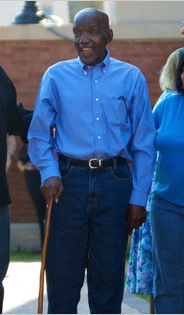
Bobby Ray Dixon (pictured to the left) and Phillip Bivens are free. Thirty years ago, the two men confessed to the brutal rape and murder of Eva Gail Patterson in Mississippi. A third man, Larry Ruffin, was also wrongfully convicted in this case, but died in prison eight years ago.
Sophisticated DNA tests, unavailable when Dixon, Bivens and Ruffin were arrested three decades ago, prove conclusively that these three men are innocent of wrongdoing.
At trial, prosecutors had little evidence to offer apart from the confessions the three men made to investigators. The confessions were later recanted. But jurors found it impossible to believe that innocent suspects would cop to a crime they didn’t commit–even for a brief moment.
Why did the three men implicate themselves? (more…)



.jpg&t=1) Jeffrey Miron’s op-ed in the Los Angeles Times
Jeffrey Miron’s op-ed in the Los Angeles Times


 Friends of Justice