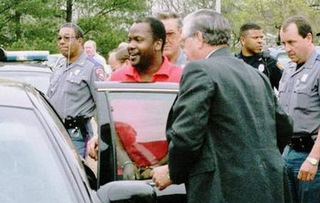
Liz Cheney (yes, she’s the daughter of that Cheney) appears to believe that Guantanamo detainees with alleged ties to Al Qaeda have relinquished the right to competent and aggressive legal counsel. Why else would she release a video suggesting that attorneys who have represented detainees should not be hired by the Justice Department?
FOX News appears to share Ms. Cheney’s views. She wanted to know the identity of “the Al Qaeda Seven”; FOX did the research and named names.
Is Cheney arguing that detainees should be forced to represent themselves, that they should not be defended at all, or merely that attorneys who represent detainees are like porn stars–their work may be constitutionally protected, but you wouldn’t want your boy to marry one?
The last option appears the most likely. Cheney seems to be suggesting that while these people may have the right to minimal representation, no patriotic attorney would agree to sit beside them in a court of law. That work should be left to desperate hacks who will take whatever work they can get. The mere suggestion that detainees have any legal rights worth defending, in Cheney’s view, is an insult to the men and women of the armed forces.
Fortunately, not everyone in the conservative legal establishment endorses Liz Cheney’s views. According to the New York Times, “Many conservatives, including members of the Federalist Society, the quarter-century-old policy group devoted to conservative and libertarian legal ideals, have vehemently criticized Ms. Cheney’s video, and say it violates the American legal principle that even unpopular defendants deserve a lawyer.”
One of the voices raised in protest is that of Kenneth Starr (yes, that Kenneth Starr). I mention this only because Mr. Starr was recently named president of Baylor University. Since Friends of Justice has two Baylor professors on its board (law professor, Mark Osler, and sociology professor, Lydia Bean), and since four Baylor law students are currently working as Friends of Justice interns, we have more than a passing interest in the institution. Although Starr has been a pariah to those on the ideological Left, he has a reputation, among those who know him well, as a charming individual and an irenic conservative.
It is nice to know that liberals and most conservatives can agree on the fundamental tenets of the American criminal justice system: including the idea that all defendants, be they ever so nasty, must be defended competently and aggressively. They may not “deserve” a quality defense; but justice demands that they receive it.
Two more men, Chris Scott and Claude Simmons, have been declared innocent by the Texas Court of Criminal Appeals.
This time, no DNA evidence was involved; the real culprit, Alonzo Hardy, confessed to the crime and also pointed the finger at his buddy, Don Michael Anderson.
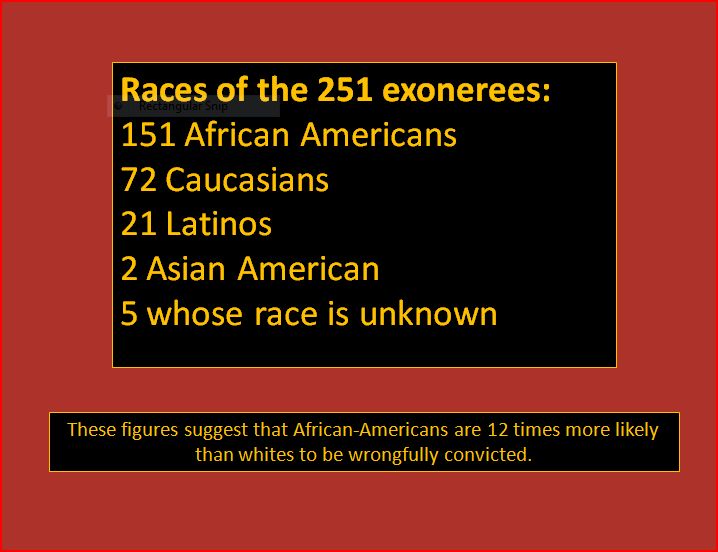
Sixty percent of the 251 men exonerated on the basis of DNA evidence in recent years have been African-American. This suggests that, adjusting for the fact that African-Americans comprise only 12% of the population, black people are twelve times as likely to be wrongfully convicted as white people.
What if Alonzo Hardy had kept his mouth shut? The state of Texas would remain convinced that Scott and Simmonds were guilty.
Few people grasp how easy it is to convict black males of violent or drug-related crime. No real evidence is required; just some person pointing the finger. Does the man behind the finger have zero credibility? Will he benefit from his testimony? No problem! So long as the person in authority says the calls the defendant plenty of nasty names the jury will convict 95% of the time.
This is particularly true when, as in the Curtis Flowers case, the defendant is a low-status African-American and the victim is a high-status white person. Evidence that would never convict a white-man-in-good-standing will sell a low-status black man down the river almost every time. If you can keep black folks off the jury a conviction is virtually assured. Evidence is nice but not necessary.
Congratulations to the innocence projects at at the University of Texas at Arlington and the University of Texas at Austin for bringing this case to light. Without their advocacy a mere confession by another individual wouldn’t matter. An inmate was willing to take the rap for the rape that sent Timothy Cole to prison. Nobody cared. Cole died in prison before he could be exonerated.
I have been highly critical of Mississippi Senator Lydia Chassaniol. Or, more accurately, I have been critical of the Mississippi political and journalistic establishments for not caring about Chassaniol’s intimate ties to a racist organization. Nonetheless, Ms. Chassaniol is a savvy politician with a better-than-average grasp of criminal justice issues.
At the moment, the state of Mississippi is in a neck-and-neck race with Louisiana and Texas for the dubious distinction of having the highest incarceration rate in the union. Unfortunately (or fortunately, depending on your viewpoint), Mississippi and Louisiana are two of the poorest states in the nation and they have been paying a dreadful price for their lock-em-up mania. Senator Chassaniol asks why we can’t place folks we don’t want to parole but can’t afford to incarcerate on house arrest.
I’m not sure its a workable solution, but it would certainly save the state a lot of money.
The Southern Poverty Law Center has issued a frightening report on the explosive growth of extremist organizations on the radical right. It is hard to know how to account for this phenomenon. How do we distinguish, for instance, between mainstream conservatism and right wing fanaticism. As Mark Potok of the SPLC writes, “The ‘tea parties’ and similar groups that have sprung up in recent months cannot fairly be considered extremist groups, but they are shot through with rich veins of radical ideas, conspiracy theories and racism.”
Suspicion of the federal government appears to be at an all-time high. A recent CNN poll showed that a majority of Americans (including “37 percent of Democrats, 63 percent of Independents and nearly 7 in 10 Republicans”) believe that “the federal government poses a threat to the rights of Americans”.
You have to be careful with numbers. Anyone conversant with the subversive work perpetrated by federal entities like the CIA and the FBI over the years understands instinctively that federal power has always had its dark side. This likely explains why over a third of Democrats are concerned about the feds.
But much of the rage and resentment we have witnessed in recent months is rooted in dark political fantasy with very little basis in fact. Notice, for instance, that the Tea Party folk, although they have no particular love for Wall Street, are inclined to blame Congress instead of the banks. The unswerving assumption is that free enterprise is good and government is bad. This dogma makes it impossible for the Tea Party zealots to understand what’s going on. It wasn’t the government that created the current economic meltdown. Government failed us by doing too little to regulate Wall Street and the financial industry, too much regulation was the least of our worries.
Please give the SPLC report your careful attention and let us know what you make of all this.
On Saturday, February 20th, I participated in a lively event at the University of Texas in Austin sponsored by the Campaign to End the Death Penalty. I thought you would be interested in this review from the CEDP website. I didn’t have time to deliver the last few paragraphs of my talk in Austin, so here they are:
Most Americans don’t understand how the integrity of the criminal justice system is undermined by these abuses. Furthermore, they don’t want to learn. The recitation of statistics, while valuable for those already convinced, won’t change the folks on the other end of the ideological spectrum.
The new civil rights movement will be fueled by true stories rooted in actual cases as they unfold. We can no longer restrict our focus to judges and appeals courts; our target audience must be mainstream white America. Like it or not, these folks control public policy. If you can’t win over a sizable chunk of this group you cannot succeed.
We can raise money and motivate the faithful by pimping the culture war and repeating the usual talking points; but those who change America in the next decade will be the people who tell the best stories.
To tell stories you have to hit the streets and live with the hurt. It’s hard work. It calls for a high degree of social flexibility. It means living a heartbeat away from despair. It means making common cause with people who don’t think, believe or behave like we do. But if we’re looking for stories that can fundamentally alter the American debate, there is no other way.
The Lynching Then, Lynching Now Tour came to Austin, Texas on February 20th. The event featured Alan Bean from Friends of Justice, a civil rights organization active in Texas, Louisiana and Mississippi. University of Texas Associate Professor Edmund Gordon participated as well. Dr. Gordon has been active in getting a new Department for African and African Diaspora Studies at UT. We also had Sandra Reed, mother of Texas death row prisoner Rodney Reed. And the event was rounded out by a live call in from Stanley Howard, a member of the Death Row 10 in Illinois, who is still in prison, despite his death sentence having been commuted.
Our event began with a workshop in the late afternoon, featuring Alan Bean and Lily Hughes of the CEDP. Over 40 people attended this workshop, which laid out in depth the history of racism, lynching and the death penalty in the US, and talked about the role racism still plays in the (in)justice system today. This session had a good amount of time for question and answer from the audience.
The evening panel featured all the speakers mentioned above. The speakers were very moving, especially Stanley Howard, who mesmerized the crowd during his live phone call. Dr. Bean also has many incredible stories of injustice to share. For anyone looking for a tour speaker, consider Alan Bean, because the work he is doing speaks directly to this issue and his way of sharing these stories and giving a call to action is powerful and persuasive.
After the event, many people commented that it was really different to hear race discussed so in depth and tied so concretely to the justice system – as one attendee said “you never hear frank discussions of racism these days”. Both Dr. Bean and Dr. Gordon commented on how President Obama has had to avoid overt discussion of racial problems, especially with the use of the death penalty and in the justice system. So folks really appreciated being able to talk at length about this issue.
Especially now, with the death penalty in Texas under constant fire, it is important for abolitionists to take on all aspects of what is wrong with our system and expose politicians, like our current governor Rick Perry, for their role in the continued shameful practice of death penalty, and in hiding the truth about who the justice system is targeting and why.
A great success in the “belly of the beast”, and we thank Alan Bean and all the speakers for participating in this important event.
In 1963 (about the year my father snapped this picture) Canada entered a long period of decline as a hockey power. You can’t appreciate the chauvinistic excesses on display in Vancouver yesterday unless you grew up playing hockey on a frozen backyard rink. The picture was taken in Yellowknife in the Canadian Northwest Territories. It’s twenty below zero, my toes have turned to ice, snot is running down my face, the wind is in my teeth, and I’m in heaven. Like I say, you had to be there.
In 1963, I was listening to radio (we didn’t have television in Yellowknife) when the Trail Smoke Eaters lost to the Soviet Union. Canada used to send real amateurs to international hockey competitions and the Soviets were virtual professionals who played for the Red Army.
It wasn’t supposed to happen. Hockey was our game, it defined us. We weren’t just a sparsely populated British colony or a mouse sleeping next to the American elephant (as Prime Minister Pierre Trudeau once described our national plight); we were the greatest hockey players on earth. We invented the game and we owned it.
I cried when the Smoke Eaters went down to defeat. I cried because the kid in the picture is lost in fantasy. It’s game 7 of the Stanley Cup final or the gold medal game at the Olympics and Bean breaks in on goal. He shoots . . . he scores (as Foster Hewitt, the voice of Hockey Night in Canada, used to say). And when Canada (or the Maple Leafs) won the big game, every Canadian kid who ever laced up a pair of skates imagined himself right there in the mad scrum with all the toothless heroes. When Canadian teams started losing in international competition it was a blow to our national psyche.
Sidney Crosby exults
Then Sidney Crosby took a poke pass and fired the puck into the net to give Canada an overtime victory over the United States. Every true Canadian shared his elation. Hockey was our game again. We had our identity back.
I watched the game yesterday with my sons, Adam and Amos. They were both born in Canada but grew up in the United States. Like every good Canadian, I was behaving like a total idiot; moaning, gasping, wriggling and twitching. When the Americans tied the game with 24 seconds on the clock I was devastated. I prepared myself for the worst. Then Crosby put the game on ice and I went dancing around the room (something Canadians rarely do).
None of this makes a lot of sense, of course. I knew it was foolish to invest my happiness in a bouncing puck I could not control. Team USA could have won the game just as easily as Team Canada. But there is nothing rational about Canadians and the game of hockey. You inherit this national madness as a toddler and, for better or worse, it never lets you go.
This morning I read a high-minded column by an American journalist lamenting the flag-waving chauvinism on display in Vancouver (he compared it to the 1936 Olympics in Berlin). “The first Olympics I ever attended were also in Canada,” Gil Lebreton wrote, “the 1976 Summer Games in Montreal. For a kid not long out of college, it was a profound experience . . . one of the speakers at that Olympics used a phrase that lingers with me still: the family of man. There is no earthly event that reinforces that notion as well as an Olympic Games . . . It persists, despite the overwhelming chauvinism of the past two weeks. They showed us Canadian Games, all right. And in most cases, nothing but Canadian Games.”
How ironic to hear an American lecturing Canadians on the sin of national pride!
Of course, he’s right; but there is nothing specifically Canadian about pride of place. The brotherhood of man is a grand notion. It originated as the second clause of an ideal framed by social gospel theologians around the turn of the 20th century: “The fatherhood of God and the brotherhood of man.” A marvellous concept. In fact, for Americans, the brotherhood of man (or a less masculine equivalent) remains the only alternative to the dogma of American exceptionalism currently embodied by the Tea Party movement.
The better angels of our nature dream of the brotherhood of man, but our deep emotional place (what Freud called the “id”) is controlled by us-against-them visions of conquest and glory. When these visions capture the rational and the emotional mind we’re in real trouble. The 20th century was dominated by such demonic visions. Martin Luther King and the Kennedy Brothers were martyrs to this ghastly vision, as were the untold millions slaughtered on the battlefields of Europe, Africa, Latin America and Asia. Adolf Hitler was the walking embodiment of the “we’re number one” mentality.
Yesterday, I listened to a splendid sermon on loving our enemies. Here’s Luke’s version of Jesus’ message:
If you love those who love you, what credit is that to you? For even sinners love those who love them. If you do good to those who do good to you, what credit is that to you? For even sinners do the same. If you lend to those from whom you hope to receive, what credit is that to you? Even sinners lend to sinners, to receive as much again. But love your enemies, do good, and lend, expecting nothing in return. Your reward will be great, and you will be children of the Most High; for he is kind to the ungrateful and the wicked. Be merciful, just as your Father is merciful.
What would the Olympics look like if all the athletes followed the advice of Jesus? How would American foreign policy be altered if Barack Obama adopted a love-your-enemies mindset? And, most importantly for this blog, how would our criminal justice system change if we took our lead from a merciful God who is kind to the ungrateful and the wicked?
We are not supposed to ask these questions, of course. You can’t apply the radical values of Jesus to the world of real politic. You can’t apply them to the business world, the political arena or even the push and shove of parish politics. In fact, the non-violent, enemy-loving teaching of Jesus can’t be applied in a meaningful way to any human endeavor. Human nature being what it is, you’d be crazy to expose the jugular like that.
That’s the whole idea. Jesus wasn’t dishing out helpful hints for living life in the real world; he was introducing an entirely different mode of life rooted in the nature of God. Jesus makes no sense unless we shift our attention away from the demon-haunted world of human nature to the pure heart of a loving and merciful God. When Christians talk about being converted or born again, that’s what we have in mind. At least, that’s what Jesus wanted us to have in mind.
In reality, we incorporate Jesus and his God into our us-against-them fantasies. God is on the side of the good and opposed to the bad. We are good; they are bad. Therefore, God is on our side.
The criminal justice system is rooted in precisely this Manichean vision. Love and mercy have nothing to do with what happens in our courts and prisons.
Does God give a damn who scored the winning goal yesterday? Of course not. Did God share my joy and relief when Sidney Crosby broke free from his check for a split second and fired a rubber disc into hockey immortality? Maybe just a little bit. In fact, I think God was celebrating right alongside Mr. Crosby, just as God would have been exulting with the American kid who could just as easily etched his name in the annals of sports legend, just as God was on the streets of New Orleans a few weeks back celebrating with the Saints fans.
God knows our irrational and emotional sides. God knows how badly we need to belong to something bigger than ourselves. God knows that, at heart, we are all incurably selfish and that identifying with a regional entity can be a step in the right direction. In a world crowded with outrageous fortune we need our little victories. If a rubber puck crossing a red line in the ice can meld an entire nation into one glorious unit for a split second, God has no problem with that. God made us this way, after all.
But God also knows how dangerous these can be. So long as we admit the silliness of our celebrations–even as we are celebrating–we’re okay. But how easily we slip inside the jaws of death and hell. chauvinism can be fun; but it is always dangerous. Canada, like the Katrina survivors in New Orleans, needed a confidence booster. Don’t we all. But our feeble attempts at self-glorification always look embarrassing, and more than a little scary, when viewed from the outside. And God, let us remember, stands on the outside looking in. God is the Other. God will have no part of our domination fantasies or purity delusions. In God’s eyes, we’re all just silly kids skating around the backyard ice rink dreaming of glory.
Nothing wrong with that, but we were created for so much more.
“If the freedom Democratic Party is not seated now, I question America. Is this America, the land of the free and the home of the brave, where we have to sleep with our telephones off of the hooks because our lives be threatened daily because we want to live as decent human beings, in America?” Fannie Lou Hamer
The summer of 1964 was a watershed moment for the civil right movement and for America. Never before had black and white Americans worked together with such common purpose. And yet, by the end of August, black civil rights leaders were vowing never to work with white people again. Meanwhile, white civil rights activists realized they didn’t have a home in either of the major political parties.
The voting rights movement had been building momentum in Mississippi since the Freedom Rides of 1961. The work was dangerous, beatings were commonplace and martyrs were plentiful. What better way to win protection and attention than to issue a call to idealistic young white people from across America to come to Mississippi for the summer of 1964? John Kennedy had been assassinated half a year earlier and a still-grieving nation was desperate for healing.
Across the southern states, only 40% of eligible African Americans were registered to vote; in Mississippi it was 6.4%. As we have seen, civic leaders in the Magnolia State were determined to keep Negroes out of the courthouse. For the most part, they were successful. To outsiders this looked like blatant injustice, but the good people of Mississippi felt they were simply preserving a cherished way of life. Throughout the spring and early summer the young people kept coming, just as they had at the high water mark of the Freedom Ride movement. They were young, idealistic, dedicated and often remarkably naive. Fannie Lou Hamer had to take the white girls aside and explain why it was a bad idea to be seen in public with a young black male–no matter how good looking and entertaining he might be.
The big idea was a mock election for the purpose of choosing delegates to the 1964 Democratic Convention in Atlantic City. Since African Americans were excluded from participating in the formal election process, they formed their own party, the Mississippi Freedom Democratic Party (MFDP) and conducted parallel elections that were open to all. The MFDP was prepared to argue that they should be seated in Atlantic City in preference to Mississippi’s all white “regular” democratic contingent. The official election was unconstitutional and undemocratic, it was argued, because black voters had been excluded. Furthermore, it was common knowledge that the Mississippi delegation to the Democratic Convention would be supporting the Republican Barry Goldwater in the fall election.
Throughout the summer, Freedom Schools designed to introduce children to the civil rights movement and the American Constitution popped up across Mississippi. White Mississippians correctly interpreted the Freedom Schools as the threat to the established order. In early June a church in the Neshoba County town of Philadelphia was burned to the ground for opening its doors to a Freedom School. Two young white civil rights workers from New York City, Andrew Goodman and Michael Schwerner, traveled to Philadelphia with James Earl Chaney, a black activist from Meridian Mississippi to investigate. Arriving in town, they were arrested, held for several hours, then released, re-arrested and delivered into the custody of the local Ku Klux Klan. While search teams were still scouring the area for the missing men, Mississippi Senator, James Eastland, speculated that the entire affair was a publicity stunt designed to make his beloved Mississippi look bad.
When the bodies were finally found buried in a Neshoba County dam, the bodies of all three men were riddled with bullets and Chaney’s body had been horribly mutilated. During that summer, 35 shooting incidents were reported, six activists were murders, 80 were beaten and 65 houses or churches were burned.
On August 21, 1964, short days before the beginning of the Democratic Convention, seven buses carrying Freedom Democrats from Mississippi rolled up to a modest motel in Atlantic City. President Lyndon Johnson had been hoping the MDFP would back down; he now realized that wasn’t going to happen. Everyone knew Johnson was on the verge of naming Minnisota Senator Hubert Humphrey as his running mate, but the formal announcement hadn’t been made. Humphrey was told that if the credentials of the MDFP deligates were recognized he could forget about being VP.
Lyndon Johnson famously predicted that the 1964 Civil Rights Act would lose him a sizable slice of the South, but his lead in the polls over Goldwater was large and growing. Still, he was worried. What if the sight of white delegates storming out of the convention while black delegates took their places sparked an anti-civil rights backlash across the nation. Besides, Johnson had a good working relationship with Mississippi Senators Jim Eastland and John Stennis and didn’t want to lose their behind-the-scenes support.
Photographers approached the MFDP delegation with a mix of trepidation and curiosity. One reporter said they had the look of prison escapees who feared they would be re-arrested the minute they re-crossed the Mississippi line. At the heart of the group stood the indefatigable Fannie Lou Hamer of Ruleville. Short and squat in her store-bought dress she was leading the group through a medley of spirituals and freedom songs.
Ed King at the Jackson Woolworth sit-in
The MFDP contingent also had a smattering of white delegates like Ed King, the chaplain of Tougaloo College in Jackson. King, a veteran of the sit-in movement, had nearly lost his life in a non-accidental highway accident. The family of slain activist Micheal Schwerner could frequently be seen with the MFDP delegates. Despite the disapproval of the Democratic hierarchy, MFDP attorney, Joseph Rauh, was able to arrange for a hearing in front of the credentials committee. Ed King, Martin Luther King, Rita Schwerner (the widow of the slain activist) and Fannie Lou Hamer were selected to address the committee.
While Lyndon Johnson watched in amazement, Fannie Lou Hamer sat down before a jam-packed auditorium and peered, unblinking, into the camera. “Mr. Chairman and the Credentials Committee,” she said, “my name is Mrs. Fanny Lou Hamer, and I live at 626 East Lafayette Street, Ruleville, Mississippi, Sunflower County, the home of Senator James O. Eastland, and Senator Stennis.”
The president was livid. This ignorant woman (as Johnson called her) was about to set the world on fire. Hurriedly, Johnson called a press conference to tell reporters nothing they didn’t already know. It worked. Network coverage shifted away from the ignorant woman from Ruleville to the most powerful man in the world.
Fannie Lou Hamer talks about Winona justice
Johnson’s reprieve was only temporary. Hamer’s testimony was so rivetting that the networks replayed her remarks in their entirety later that evening. Fannie Lou talked about losing her job on the plantation because she had registered to vote in Indianola. Then she talked about her encounter with Mississippi Justice in the little town of Winona.
“And in June the 9th, 1963, I had attended a voter registration workshop, was returning back to Mississippi. Ten of us was traveling by the Continental Trailway bus. When we got to Winona, Mississippi, which is in Montgomery County, four of the people got off to use the washroom, and two of the people—to use the restaurant—two of the people wanted to use the washroom.
“The four people that had gone in to use the restaurant was ordered out. During this time I was on the bus. But when I looked through the window and saw they had rushed out I got off of the bus to see what had happened, and one of the ladies said, “It was a State Highway Patrolman and a Chief of Police ordered us out.”
“I got back on the bus and one of the persons had used the washroom got back on the bus, too.
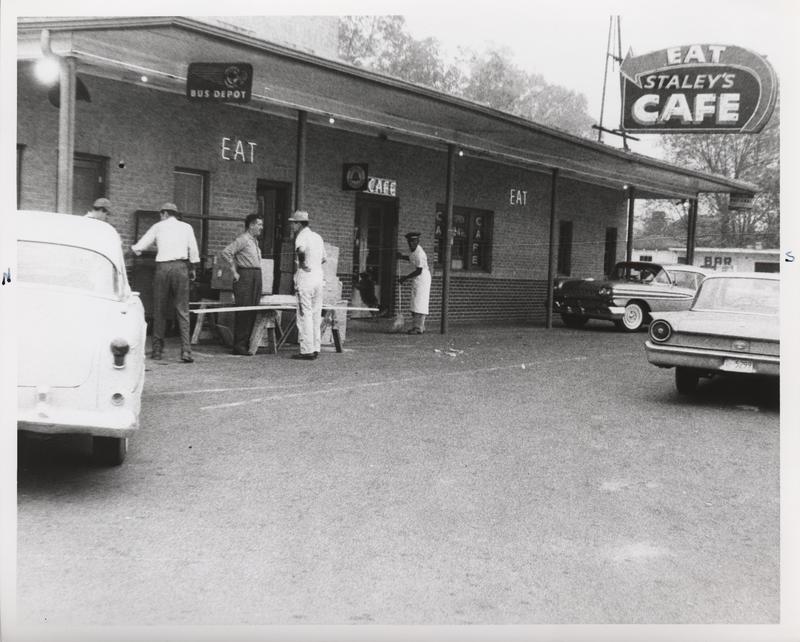
Trailways Depot in Winona
“As soon as I was seated on the bus, I saw when they began to get the four people in a highway patrolman’s car, I stepped off of the bus to see what was happening and somebody screamed from the car that the four workers was in and said, “Get that one there,” and when I went to get in the car, when the man told me I was under arrest, he kicked me.
“I was carried to the county jail, and put in the booking room. They left some of the people in the booking room and began to place us in cells. I was placed in a cell with a young woman called Miss Ivesta Simpson. After I was placed in the cell I began to hear the sound of kicks and horrible screams, and I could hear somebody say, “Can you say, yes, sir, nigger? Can you say yes, sir?”
“And they would say other horrible names.
“She would say, “Yes, I can say yes, sir.”
“So say it.”
“She says, “I don’t know you well enough.”
“They beat her, I don’t know how long, and after a while she began to pray, and asked God to have mercy on those people.
“And it wasn’t too long before three white men came to my cell. One of these men was a State Highway Patrolman and he asked me where I was from, and I told him Ruleville, he said, “We are going to check this.”
“And they left my cell and it wasn’t too long before they came back. He said, “You are from Ruleville all right,” and he used a curse work, and he said, “We are going to make you wish you was dead.”
“I was carried out of that cell into another cell where they had two Negro prisoners. The State Highway Patrolmen ordered the first Negro to take the blackjack.
“The first Negro prisoner ordered me, by orders from the State Highway Patrolman for me, to lay down on a bunk bed on my face, and I laid on my face.
“The first Negro began to beat, and I was beat by the first Negro until he was exhausted, and I was holding my hands behind me at that time on my left side because I suffered from polio when I was six years old.
“After the first Negro had beat until he was exhausted the State Highway Patrolman ordered the second Negro to take the blackjack.
“The second Negro began to beat and I began to work my feet, and the State Highway Patrolman ordered the first Negro who had beat me to sit upon my feet to keep me from working my feet. I began to scream and one white man got up and began to beat me my head and told me to hush.
“One white man—since my dress had worked up high, walked over and pulled my dress down and he pulled my dress back, back up.
“I was in jail when Medgar Evers was murdered.
“All of this is on account of us wanting to register, to become first-class citizens, and if the freedom Democratic Party is not seated now, I question America, is this America, the land of the free and the home of the brave where we have to sleep with our telephones off of the hooks because our lives be threatened daily because we want to live as decent human beings, in America?
“Thank you.”
In moments, Democratic Party officials were deluged with phone calls and telegrams from outraged Americans demanding that the MFDP be seated immediately.
Lyndon Johnson was adamant that this must not happen. A compromise was proposed. Ed King and Aaron Henry would be seated as representatives of the MFDP and the white Mississippi delegation would be seated in its entirety. Fannie Lou Hamer decided the issue when she informed her contingent that she didn’t come all the way to Atlantic City “for no two votes.”
The issue was decided by a rushed vote–the white Mississippi regulars would be seated along with King and Henry. It was too late. Most of the regulars walked out of the convention in protest. When MFDP delegates took their places they were ushered out of the building by security personnel. The second night, every seat in the building was taken so the MFDP contingent marched to the convention floor where Fannie Lou Hamer led them in spirited song.
Stokely Charmichael
The white Mississippi regulars, as expected, abandoned the Democrats for the Republican Goldwater. They have controlled American politics ever since. It was no accident that Ronald Reagan launched his 1980 presidential campaign at the Neshoba County Fair.
Fannie Lou Hamer was disillusioned but undaunted. When a reporter asked her if she was seeking equality with the white man she peered at him imperiously. “No,” she said. “What would I look like fighting for equality with the white man? I don’t want to go down that low. I want the true democracy that’ll raise me and that white man up . . . raise America up.”
Are we there yet? Forty-six years after Ms. Hamer told America the truth about Winona, Mississippi the town remains deeply divided. The wrongful prosecution of Curtis Flowers has revealed a deep perception gap between Winona’s black and white residents. In the fourth of five trials, all five black jurors saw through the state’s paper thin evidence while all seven white jurors voted to convict. When legislation was introduced in a desperate attempt to expand the jury pool only one black senator supported the bill. It passed anyway thanks to overwhelming support from white senators.
The fact that Mississippi has a handful of black senators shows how much has changed. But the inability of white residents to call a wrongful prosecution by its proper name demonstrates just how far we have to go.
This talk was given by Friends of Justice Director Alan Bean at a Restorative Justice Conference held at St. John the Apostle United Methodist Church, February 24th 2010.
The headline in the local paper nearly knocked me off my chair: “Tulia’s streets cleared of garbage.” Forty-seven local “scumbags” had been arrested by dozens of Panhandle police officers. These “known drug dealers”, the article said, were a “cancer on the community” and it was time for local juries to give them a little “chemotherapy behind bars.”
I didn’t know much about the “scumbags” in question and I suspected the newspaper editor didn’t either. But they were children of God. They were American citizens.
My wife and I were attending a Sunday school class dominated by retired farmers and agribusiness managers and when it was “prayer and share” time I shared my outrage about the “scumbag editorial” in the paper.
“They are scumbags!” the man across the table from me roared, molten rectitude smoldering in his eyes, “and they’re all going to jail.”
When a hog farmer named Joe Moore went to trial in December of 1999, we learned that all 132 indictments on 47 people rested on the uncorroborated word of a single police officer, Tom Coleman. A few weeks later, we learned that Coleman had been arrested on theft charges in the middle of the 18-month operation, that he had been fired from every law enforcement job he ever held, that he had a reputation for racism, had once kidnapped his own children, and had left every town he ever worked in owing local merchants thousands of dollars.
Those of us who didn’t like what was happening had a tough decision to make. Either we ignored what was happening around me or we dedicated our lives to fighting it—there was no middle ground.
Several months after we started our struggle for justice, my wife Nancy and I took three children into our home: Kayla, La Kendra and Laramie. Their mother and step-father were both in Texas prisons for selling drugs to Tom Coleman. One evening, I saw six-year-old Kayla hurling little Lego people into a windowless Lego-room. “What are you doing?” I asked.
“They’s all goin’ to jail,” Kayla replied.
“And why is that?” I queried.
“Cause they’s bad.”
“What did they do?” I asked.
Kayla tossed another Lego person into her Lego-box as if to make a point. “They’s just bad,” she said.
Imagine that you are seven years old and half the people in your social world suddenly disappear behind bars. You either conclude that folks are getting what they deserve, or you abandon hope. You can’t deal with the thought that the authorities aren’t there to protect you and people like you. That’s too threatening for a six year-old.
If you lived in Tulia it was impossible to think and speak clearly without committing social suicide. Tulia was typical. People of faith are called to live outside the parameters of the possible, but it takes a kind of miracle to make it happen.
Eventually, we were able to attract media attention and world class legal talent to the cause, Tom Coleman was convicted of aggravated perjury, Governor Perry pardoned the defendants and the city of Amarillo paid them $6 million.
I am currently working on the case of Curtis Flowers, a black resident of Winona Mississippi accused of killing four people in a local furniture store in 1996. In June of this year, Curtis will go to trial for an unprecedented sixth time. The first three trials were overturned by sustained charges of prosecutorial misconduct or ended in hung juries.
Now state Senator Lydia Chassaniol, a resident of Winona, is pushing a bill that will allow prosecutors to expand the jury pool into neighboring counties. Her bill sailed through the Senate with the vast majority of white senators voting yea and all but one black senator voting nay.
What created this profound perception gap between black and white citizens of Mississippi?
A short history lesson. In 1963, Fannie Lou Hamer and several other civil rights activists were arrested at the Trailways depot in Winona when they tried to eat at an all-white diner. A few hours later, Hamer was beaten half to death by two black inmates working under the supervision of Sheriff Earl Wayne Patridge and his deputies. When Bobby Kennedy’s Department of Justice tried to prosecute the officers responsible for assaulting Ms. Hamer and her friends, not a single district attorney in the state of Mississippi would take the case.
In 1963, when the Mississippi criminal justice system was for whites only, Senator Lydia Chassaniol was attending Winona’s all-white public schools. Like little Kayla in Tulia, she was too young to discern right from wrong so she took her cues from her elders. By the time Ms. Chassaniol graduated from Ole Miss with a degree in education, little segregation academies were popping up all over the state. She spent several decades teaching in Winona’s all-white private school (now called a “Christian” school) then went into politics.
When Trent Lott was associated with an overtly racist organization called the Council of Conservative Citizens, his political career was over. This summer, when Lydia Chassaniol admitted that she belonged to the same ardently racist organization no one in Mississippi was surprised or seemed to care.
Lydia Chassaniol was born into a culture committed to the principle of white supremacy, a commitment that has never been rescinded. Like most of us, she lives and works within social parameters she did not create and for which she is not personally responsible.
A few years ago, Mark Peffley with the University of Kentucky and Jon Hurwitz of the University of Pittsburgh asked 600 white adults and 600 black adults if they believed the death penalty should be an option for people convicted of premeditated murder. 65% of the white folks thought it should be compared to 50% of the black participants.
Then each participant was read a statement: “Some people say that the death penalty is unfair because most of the people who are executed are African Americans.” Black support for the death penalty fell by 12 percentage points, but this argument increased white support by 12 percentage points, from 65% to 77%.
The researchers concluded that “Many whites begin with the belief that the reason blacks are punished is because they deserve it, not because the system is racially biased against them. So when these whites are confronted with an argument against the death penalty that is based on race, they reject these arguments with such force that they end up expressing more support for the death penalty than when no argument is presented at all.”
There is a strong relationship between support for the death penalty and civil rights resentment.
During the glory days of the civil rights movement, support for the death penalty plunged from 68% in 1953 to a record low of 42% in 1966. Then widespread rioting, the rise of the black power movement and agitation over the war in Vietnam created a powerful backlash against the civil rights movement. By 1994, support for the death penalty had soared to an unprecedented 80%.
There was more involved than resurgent racism, however. During this period, bipartisan support for neo-liberal economics created an ever-expanding gulf between the wealthy (who were doing better all the time) and the poor (who were being negatively impacted by globalization, and the shift of manufacturing from inner cities to the suburbs).
Between 1983 and 1998, average household net worth increased by 25% for families in the upper 40% of income. For families in the bottom 40%, household net worth dropped by 76%.
This widening disparity created a crisis of conscience for those at the positive end of the continuum. It was in this context that British Prime Minister Margaret Thatcher made an amazing claim. “There is no such thing as society,” she said. “There are individual men and women, and there are families. And no government can do anything except through people, and people must look to themselves first.”
Skyrocketing crime rates in the eighties and early nineties encouraged this fixation on personal responsibility. The crack epidemic hit America’s poorest neighborhoods like a sledgehammer. Competition among street dealers for market share sent the homicide rate into the stratosphere and property crime perpetrated by desperate addicts swelled the overall crime rate.
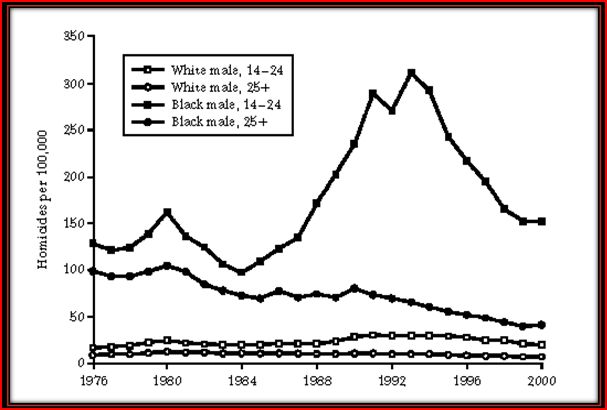
Murder rates for white males showed little fluctuation during this period, and rates for black males over 25 fell dramatically. But for black males 24 and younger, the homicide rate almost tripled. Anyone who seemed to be making excuses for “the thugs” was shouted down.
These conditions created a perfect storm for tough on crime politicians. The Texas prison population soared from 39,000 in 1988 to 151,000 in 1998—an increase of 387%. Mass incarceration became the order of the day and every little rural community in Texas had its own prison.
But there were problems. Mass incarceration encouraged prosecutors and judges to avoid the time and expense of jury trials. Asked to choose between a virtual life sentence if convicted at trial and a plea offer of five or ten years, most defendants took the plea.
Unfortunately, these tough bargaining techniques worked just as well with the innocent as with the guilty. In recent years, improvements in DNA testing have reversed over 250 felony convictions. If these cases are representative, African-American defendants are more than 12 times as likely to be wrongfully convicted as white defendants.
As rehab centers and mental hospitals downsized or closed their doors, prisons were flooded with folks whose major problem was a chemical dependency, mental illness, or a severe learning disability. Eventually, the crack epidemic ended and crime rates returned to normal levels, but the mills of mass incarceration continue to grind.
What we see, what we think and what we say is usually defined by the parameters of the possible. Too often, the price of peace is silence. When Jesus considered his social world, God’s words to Isaiah came to mind:
This people’s heart has grown dull,
and their ears are hard of hearing,
and they have shut their eyes;
so that they might not look with their eyes,
and listen with their ears,
and understand with their heart and turn—so I could heal them.
I am not asking you to accept my analysis of our shared history, nor am I challenging you to see things as I see them. But if you are a person of faith, I ask you to pray for the grace to see what only Jesus can see, to think the unsearchable thoughts of the Spirit and to echo the unspeakable words of a just and loving God.
This compelling story in the New York Times slipped past me. I was on the road in Louisiana for eight days and didn’t have the luxury of surfing the net. Non-DNA exoneration is becoming the primary focus of the criminal justice reform movement. For one thing, we are rapidly running out of testable DNA. Jeff Blackburn with the Innocence Project of Texas believes that good DNA cases will be difficult to find within a year. Barry Scheck, director of a national Innocence Project, thinks good cases will be available for another decade if advocates are willing to move beyond their own backyards.
The truth, I suspect, lies somewhere in between these perspectives. The DNA-exoneration phenomenon will slow from a torrent to a trickle over the next five years, then fade from view altogether.
The Times article focuses on Plan B, non-DNA exoneration projects that build on the foundation established by DNA exonerations. “Criminal justice experts say exonerations have shed light on two circumstances once thought to be extremely rare or even inconceivable: Witnesses are sometimes wrong, and people sometimes confess to crimes they did not commit.”
But why do witnesses get it wrong, and why do people sign false confessions? The article doesn’t get into that, so I’ll give you a quick run-down. More often than not, it is because witnesses feel pressured by investigators and prosecutors. Weak-minded people who have been badgered for hours will often sign whatever is placed in front of them just to make the ordeal stop.
As we have seen, inmates facing virtual life sentences will admit to almost anything if there is a dramatic time cut on the table.
Tragically, even well-intentioned witnesses get it wrong. An excessive eagerness to help the prosecution, especially in cases involving horrifying violence, prompts witnesses to remember whatever the authorities need them to remember.
Memory isn’t like a snap shot or a video reconstruction of an actual event. We remember scattered impressions which the mind weaves into a coherent narrative. Memories are thus subject to suggestion and manipulation. Let a witness know the right answer and the mind works overtime to produce a memory consistent with that answer. As the face of the perp du jour becomes firmly imbedded in the mind witness confidence grows. Witnesses no longer remember the actual event; they remember an artificial reconstruction of the event shaped by suggestion.
The Times article notes that non-DNA exoneration projects are rare. In New York State, for example, not a single innocence project focuses on non-DNA cases. The reason is obvious. “Cases that lack what many call the “magic bullet” of DNA often require cumbersome investigations, including finding and re-interviewing witnesses or poring over thick files to find anything vital that a trial lawyer might have missed. Even when crucial evidence is uncovered — witness recantations or exculpatory statements that were ignored by prosecutors — judges, juries and prosecutors often treat it with skepticism.”
One compelling case of non-DNA exoneration, the article notes, “came six years after a panel of federal judges, having considered much of the same evidence, ruled that though it had ‘a nagging suspicion that the wrong man may have been convicted of capital murder,’ it could not overturn the conviction of the man, Darryl Burton, because of numerous procedural impediments.
Those working for non-DNA exonerations work to change the judicial culture. The Times article highlights the work of Dallas County DA, Craig Watkins. Unlike his infamous predecessor, Henry Wade, Watkins believes that “The duty of the district attorney is to seek justice. Justice means we right the wrongs of the past.”
If every DA operated out of that philosophy there would be no need for groups like Friends of Justice. We focus on jurisdictions where a very different prosecutorial mindset prevails. Our challenge is to alert the public to what is happening, and we do that by allowing normal folks to peer behind the smoke and mirror show presented at trial to the process of manipulation and intentional distortion that all too often passes for an investigation.
Investigation is part of that process–that’s why I spend so much time on the road. But getting the facts straight is only part of the process. Locating the wrongfully accused and wrongfully convicted in space and time is also part of the story. Who are these people, we ask, and how did they get caught up in the machinery of wrongful conviction? We introduce you to the family and friends of the wrongfully accused. We talk about the history of a particular jurisdiction and the unique culture at work in the courtroom. We try to get the mainstream and alternative media to ask the right questions and pursue the right answers.
Work this narrative strategy long and hard enough and the truth breaks free.
The Times article ends with a disturbing quote from Daniel S. Medwed, a professor at the University of Utah who studies wrongful convictions: “One thing we’ve learned by studying these cases and litigating these cases is it could really happen to anybody. Nobody is immune.”
That’s kind of true and kind of misleading. DNA exonerations suggest that wrongful conviction impacts people of color to a grossly disproportionate degree. According to the Innocence Project, the 249 people exonerated on the basis of DNA included 150 African Americans,71 Caucasians, 21 Latinos, 2 Asian American and 5 whose race is unknown. Poor people, the unemployed and underemployed, and folks with a history of drug dependency are also at heightened risk.
Hopefully, future articles on the exoneration issue will pay more attention to the racial dynamics at work in these cases.
This in-depth report in the New York Times Magazine asks just how Christian America’s founding fathers really were. It’s an important question in the Lone Star State where the religious right is pushing the idea that America is a Christian nation founded by evangelical Christians for evangelical Christians. Below, I have pasted a few quotations that recreate the gist of Russell Shorto’s ten-page article, but I encourage you to read the entire piece. My own (highly unorthodox) take on the debate follows.
Christian conservatives contend that Christianity has been written out of the public school curriculum:
Some conservatives claim that earlier generations of textbooks were frank in promoting America as a Christian nation. It might be more accurate to say that textbooks of previous eras portrayed leaders as generally noble, with strong personal narratives, undergirded by faith and patriotism. As Frances FitzGerald showed in her groundbreaking 1979 book “America Revised,” if there is one thing to be said about American-history textbooks through the ages it is that the narrative of the past is consistently reshaped by present-day forces. Maybe the most striking thing about current history textbooks is that they have lost a controlling narrative. America is no longer portrayed as one thing, one people, but rather a hodgepodge of issues and minorities, forces and struggles. If it were possible to cast the concerns of the Christian conservatives into secular terms, it might be said that they find this lack of a through line and purpose to be disturbing and dangerous.
Folks like Texas State Board of Education member Mark McLeroy place great emphasis on the founding documents of states like Connecticut and Massachusetts which were founded as unabashed Christian utopias.
Merely weaving important religious trends and events into the narrative of American history is not what the Christian bloc on the Texas board has pushed for in revising its guidelines. Many of the points that have been incorporated into the guidelines or that have been advanced by board members and their expert advisers slant toward portraying America as having a divinely preordained mission. In the guidelines — which will be subjected to further amendments in March and then in May — eighth-grade history students are asked to “analyze the importance of the Mayflower Compact, the Fundamental Orders of Connecticut and the Virginia House of Burgesses to the growth of representative government.” Such early colonial texts have long been included in survey courses, but why focus on these in particular? The Fundamental Orders of Connecticut declare that the state was founded “to maintain and preserve the liberty and purity of the Gospel of our Lord Jesus.” The language in the Mayflower Compact — a document that McLeroy and several others involved in the Texas process are especially fond of — describes the Pilgrims’ journey as being “for the Glory of God and advancement of the Christian Faith” and thus instills the idea that America was founded as a project for the spread of Christianity. In a book she wrote two years ago, Cynthia Dunbar, a board member, could not have been more explicit about this being the reason for the Mayflower Compact’s inclusion in textbooks; she quoted the document and then said, “This is undeniably our past, and it clearly delineates us as a nation intended to be emphatically Christian.”
The religious right wants American school children to see themselves as God’s chosen instument, a city set upon a hill.
One recurring theme during the process of revising the social-studies guidelines was the desire of the board to stress the concept of American exceptionalism, and the Christian bloc has repeatedly emphasized that Christianity should be portrayed as the driving force behind what makes America great. Peter Marshall is himself the author of a series of books that recount American history with a strong Christian focus and that have been staples in Christian schools since the first one was published in 1977. (He told me that they have sold more than a million copies.) In these history books, he employs a decidedly unhistorical tone in which the guiding hand of Providence shapes America’s story, starting with the voyage of Christopher Columbus. “Columbus’s heart belonged to God,” he assures his readers, and he notes that a particular event in the explorer’s life “marked the turning point of God’s plan to use Columbus to raise the curtain on His new Promised Land.”
The concept of the “separation of church and state” lies at the heart of the current debate. Christian conservatives reject the idea as a dangerous heresy.
If the fight between the “Christian nation” advocates and mainstream thinkers could be focused onto a single element, it would be the “wall of separation” phrase. Christian thinkers like to point out that it does not appear in the Constitution, nor in any other legal document — letters that presidents write to their supporters are not legal decrees. Besides which, after the phrase left Jefferson’s pen it more or less disappeared for a century and a half — until Justice Hugo Black of the Supreme Court dug it out of history’s dustbin in 1947. It then slowly worked its way into the American lexicon and American life, helping to subtly mold the way we think about religion in society. To conservative Christians, there is no separation of church and state, and there never was. The concept, they say, is a modern secular fiction. There is no legal justification, therefore, for disallowing crucifixes in government buildings or school prayer.
Mainstream scholars disagree, sometimes vehemently. Randall Balmer, a professor of American religious history at Barnard College and writer of the documentary “Crusade: The Life of Billy Graham,” told me: “David Barton has been out there spreading this lie, frankly, that the founders intended America to be a Christian nation. He’s been very effective. But the logic is utterly screwy. He says the phrase ‘separation of church and state’ is not in the Constitution. He’s right about that. But to make that argument work you would have to argue that the phrase is not an accurate summation of the First Amendment. And Thomas Jefferson, who penned it, thought it was.”
Historians argue that the founding fathers were intellectual hybrids who had been influenced by both traditional Christianity and a rational worldview called “Deism”, then popular in Europe, that rejected most of the claims of “revealed” religion. The Deist God created the world and set it in motion, but has little interest in political affairs and no master plan for individual humans or the human race.
In fact, the founders were rooted in Christianity — they were inheritors of the entire European Christian tradition — and at the same time they were steeped in an Enlightenment rationalism that was, if not opposed to religion, determined to establish separate spheres for faith and reason. “I don’t think the founders would have said they were applying Christian principles to government,” says Richard Brookhiser, the conservative columnist and author of books on Alexander Hamilton, Gouverneur Morris and George Washington. “What they said was ‘the laws of nature and nature’s God.’ They didn’t say, ‘We put our faith in Jesus Christ.’ ” Martin Marty says: “They had to invent a new, broad way. Washington, in his writings, makes scores of different references to God, but not one is biblical. He talks instead about a ‘Grand Architect,’ deliberately avoiding the Christian terms, because it had to be a religious language that was accessible to all people.”
The curious thing is that in trying to bring God into the Constitution, the activists — who say their goal is to follow the original intent of the founders — are ignoring the fact that the founders explicitly avoided religious language in that document.
The folks who are injecting a religious vision into Texan textbooks know they enjoy widespread public support.
Americans tell pollsters they support separation of church and state, but then again 65 percent of respondents to a 2007 survey by the First Amendment Center agreed with the statement that “the nation’s founders intended the United States to be a Christian nation,” and 55 percent said they believed the Constitution actually established the country as a Christian nation. The Christian activists are aware of such statistics and want to build on them . . .
The article hints that religion, per se, may not be the controlling issue in this debate. Consider this:
“BROWN BEAR, BROWN BEAR, What Do You See?” It’s not an especially subversive-sounding title, but the author of this 1967 children’s picture book, Bill Martin Jr., lost his place in the Texas social-studies guidelines at last month’s board meeting due to what was thought to be un-American activity — to be precise, “very strong critiques of capitalism and the American system.” Martin, the creator of 300 children’s books, was removed from the list of cultural figures approved for study by third graders in the blizzard of amendments offered by board members.
I wish Shorto had chosen to elaborate on this theme. Conservative revisionists embrace a worldview organized around the semi-divine status of the free market. America, to this way of thinking, was created and commissioned to share the gospel of free market capitalism to a lost and benighted world. America is a chosen and exceptional nation because she keeps the corrupting hands of government off the free market. Americans are blessed when they adhere to free market orthodoxy and punished when they stray into the thickets of socialistic reform.
It is very difficult to find a place for the Jesus of the New Testament in free market fundamentalism, of course. The itinerant preacher and healer who had nowhere to lay his head has his adherents in the great state of Texas, but they aren’t the folks calling the shots in Austin. The true religion of America is the power of positive thinking, a doctrine deeply rooted in the tenets of free market fundamentalism. Here’s how it works. If you conform to the dictates of the market (get a marketable college degree, enter a hot field and work hard) you will be blessed. Sure, there will be a little turbulence along the way (such as the current turmoil on Wall Street), but the free market will bless you in the long run. This is God’s way in the world.
The downside to this doctrine is troubling. If you refuse to conform to the dictates of the free market (you fail to obtain a marketable degree, you can’t find a place in the job market, and you don’t work hard) the markets will punish you. You may get by okay for a short while, but the wheels will inevitably come off. This reality check is designed to teach you the error of your ways and call you back to the dictates of the free market.
Socialist reformers (and in this view, all reformers are socialists) damage the po0r by softening the market’s proper punishment. When we help the poor, the reasoning goes, they will never learn the error of their ways.
How does free market fundamentalism impact the criminal justice system? It’s simple. Positive thinkers who live in accordance with free market principles are true Americans (also known as “Real Americans”); losers who skirt the harsh realities of the free market have rejected their birthright as free Americans and forfeit the constitutional protections that citizenship confers. Poverty is unAmerican. When a poor man is arrested he is guilty by definition. He may be innocent of the alleged crime, but he is guilty of flouting the God-ordained principles on which this great nation was founded. Otherwise he wouldn’t be poor. If he can’t afford to hire a lawyer, that’s as it should be. When he dies, the fires of hell will provide a fitting postscript to a ruined life.
Free market fundamentalism is the sworn enemy of grace. Grace is for Americans only. The statement “God is love” cannot be squared with this religious vision. God is love if you are a Real American who shows his faith in Jesus by trusting in the free market system. No one else need apply.
I am giving you the blunt, uncut version of free market fundamentalism, something you rarely see in print. I am intimately acquainted with this religion because I have spent thousands of hours in evangelical Sunday school classes (where the dictates of free market fundamentalism were cobbled together free from biblical constraint) and because I have spent the past ten years immersed in the ruthless rhythms of the criminal justice system.
The American justice system, in theory, is a marvel. The gap between theory and reality is created by the heartless doctrine described above.
I was a bit annoyed by Russell Shorto’s tendency to describe the Christian Right as representatives of the “Christian” position. Shorto knows that mainstream church historians are harsh critics of the Texan campaign to inject a peculiar version of “Christianity” into the textbooks of Texas (and the 46 other states that follow the Lone Star state’s lead when purchasing textbooks). The Religious Right may speak for Texas (that remains to be seen); but they don’t speak for Jesus and they don’t speak for me.
 Liz Cheney (yes, she’s the daughter of that Cheney) appears to believe that Guantanamo detainees with alleged ties to Al Qaeda have relinquished the right to competent and aggressive legal counsel. Why else would she release a video suggesting that attorneys who have represented detainees should not be hired by the Justice Department?
 One of the voices raised in protest is that of Kenneth Starr (yes, that Kenneth Starr). I mention this only because Mr. Starr was recently named president of Baylor University. Since Friends of Justice has two Baylor professors on its board (law professor, Mark Osler, and sociology professor, Lydia Bean), and since four Baylor law students are currently working as Friends of Justice interns, we have more than a passing interest in the institution. Although Starr has been a pariah to those on the ideological Left, he has a reputation, among those who know him well, as a charming individual and an irenic conservative.




 The summer of 1964 was a watershed moment for the civil right movement and for America. Never before had black and white Americans worked together with such common purpose. And yet, by the end of August, black civil rights leaders were vowing never to work with white people again. Meanwhile, white civil rights activists realized they didn’t have a home in either of the major political parties.



 Several months after we started our struggle for justice, my wife Nancy and I took three children into our home: Kayla, La Kendra and Laramie. Their mother and step-father were both in Texas prisons for selling drugs to Tom Coleman. One evening, I saw six-year-old Kayla hurling little Lego people into a windowless Lego-room. “What are you doing?” I asked.



 This compelling story in the New York Times
 Friends of Justice