Category: Uncategorized

Sheriff’s fall symptomatic of a broken system

At first, Luke Bolton’s story was too bad to be true.  But in the end every lurid detail checked out: prisoner-guard sexual trysts, free-flowing drugs inside the Montague County jail, prisoners paid in Marlboros for beating up cellmates.  And then there was Bill Keating, the former Fort Worth police officer and investigator who presided over the chaos in his jail, raking off his 10% from the drug trade and making female inmates offers they couldn’t refuse.  

A number of short pieces about Keating and his infamous jail have appeared in North Texas papers over the past few months, but Tim Madigan’s feature length story in this morning’s Fort Worth Star Telegram digs beneath the shocking details to place this tragic tale in proper context. 

The Keating story is an egregious case of normal.  The American Gulag generates an enormous power differential between inmates and their overlords.  It is often easier to get drugs in prison than on the street.  Female prisoners are frequently raped by prison guards and it has been estimated that between 200 and 300,000 male inmates are raped every year.  Sometimes the sexual stuff is considered “consensual”; but the brutal realities of prison life drain all meaning from the word “consent”. 

These dreadful conditions occur even in well-run prisons under the watchful eye of by-the-book wardens.  But it is not unusual for prison authorities to use rape, brutality and gang violence as instruments of social control.  It is virtually impossible to quanify prisoner abuse (most of it subbed out to the inmates themselves); the consequences of blowing the whistle are too severe. 

Many of America’s larger prisons use racial strife to keep the inmate population divided and distracted.  White, black and Latino inmates are often afraid to engage socially across racial lines for fear of reprisal from fellow inamtes.  Inter-racial hatred is promoted by prison guards in many prisons.  When inmates are beefing with each other they are less likely to turn their hostility on the guards.  Outside California (which has an incredibly strong prison guard union) prison personnel are usually poorly paid, undertrained and often demoralized.

Do all prisons fit this apocalyptic profile?  Certainly not.  Much depends on the attitude of administrators.  Some wardens and sheriffs maintain a vigilant watch for inappropriate, unprofessional, unsafe and illegal behavior; some, like Montague County Sheriff Bill Keating, actively encourage the choas; most prison administrators fall somewhere in between.  A certain amount of rule-bending is considered good for business.

Probably the best book on prisons and the criminal justice system (though now a bit dated) is Christian Parenti’s “Lockdown Nation: Police and Prisons in the Age of  Crisis.”  Parenti argues that the sadism and rampant abuse within America’s prisons and jails is symptomatic of misguided criminal justice p0licies.  (Here’s a brief synopsis of his perspective.)  I’ll have more to say about Parenti later.

As you peruse the jaw-dropping contours of Bill Keating’s North Texas hell hole ask yourself how so much outrage eluded public awareness.

On sheriff’s watch, rural North Texas jail became den of drugs and debauchery

By TIM MADIGAN

tmadigan@star-telegram.com

In a career spanning five decades, Bill Keating had been a Fort Worth cop, a district attorney’s investigator, police chief in Watauga, then city manager there. He picked up plenty of enemies along the way, but many others swore by him, too, remembering a hard-drinking guy who had finally taken the cure and gotten sober, a smart, fearless lawman and competent city administrator. (more…)

Civil rights stalwarts decry gay marriage

Consider this picture carefully.  In the background, a woman weeps.  In the foreground, a solemn-faced woman holds up the Holy Bible.  Are these people standing up for civil rights?  Quite the contrary; they are protesting gay marriage.

The issues of  gay rights and gay marriage have polarized the old civil rights coalition.  Many of the white progressives who marched for racial equality as young people have recently diverted their energies into the fight for sexual justice.

Meanwhile, many of the black pastors who once issued a prophetic call for racial righteousness are making opposition to gay marriage the central focus of their preaching.

The rest of us are trying to change the subject.

Most Americans are deeply conflicted by gay marriage.  Most of us were raised to think of same sex intimacy as something too shameful to mention in polite company.  But in recent years we have been hearing from gay men and women who tell us they didn’t choose their sexual orientation, they can’t change it, and they want their humanity respected.

The strong opposition to gay marriage is much like support for the war on drugs or resistanced to criminal justice reform.  We want to live like the angels.  We want America to be a city set upon a hill, a holy nation in which people grow up, get married, and get a steady job so they can support their families.  Therefore, we are against gay sex, extra marital sex, intoxication, drug abuse, divorce, abortion, welfare, and all that falls short of what we consider the ideal.  To settle for anything less is to give up on the dream–a deal with the devil.  When people depart from our ideal vision we tell them to stop it.  Just say no.

This explains why the woman in the picture is holding up the Bible, a symbol of everything good and true and wholesome.

The champions of a holy America are currently depending on the widespread popularity of their viewpoint.  So long as a strong majority agrees with the traditional position you don’t have to argue for your position.  But when issues like gay marriage, the war on drugs and mass incarceration are debated openly the city-on-a-hill folk get clobbered every time.  The war on drugs is an attempt to repeal the law of supply and demand.  No matter how much money you invest in the project you are going to fail.  Mass incarceration makes us all less safe.  And you can’t argue with biology.  No matter what the Bible says or what we believe to be “the better way” a certain percentage of the population doesn’t fit the heterosexual mold.  Some men are drawn to men; some women are attracted to women.  It’s a fundamental law of nature.

Gay men and women are American citizens and must therefore benefit from all the constitutional protections enshrined in the Constitution and the Bill of Rights.  If two women want to get married and form a family with two mommies and no daddy they are going to do it.  The only way to stop them is to deny the principles on which our nation was founded.

Folks opposed to “the gay lifestyle” should be free to believe and preach whatever they want, but the separation of church and state means, among other things, that public policy should not be shaped by biblical mandate.  Some make convincing arguments for gay marriage on the basis of Scripture.  Politically, these arguments are equally beside the point.  Churches shouldn’t be forced to marry gay people if they don’t want to; but the state must grant to gay Americans all the rights and priviliges granted to straight Americans.  It’s the only way we can continue to be who we are.

Once the issues are on the table it’s all over. 

In 1962, southerners were still standing foursquare for segregation; a short decade later few politicians would dare to take a public stand for state-sanctioned inequality.  Policies could still be racist in intention and effect but no one could admit as much.

So it is with the gay marriage debate.  The moment it begins in earnest it will be over.  It is very close to beginning in earnest.

This explains why it is so difficult to arrange a public conversation on issues like gay marriage, the war on drugs, or mass incarceration: everybody knows who the winners would be so we stifle debate in the interest of social stability.

Bring up any of these hot potatoes in a mainstream organization like a church or the Rotary and all hell breaks loose.  When I tell mainstream pastors that I would like to speak to their parishioners about criminal justice reform I can see the fear in their eyes.  They don’t want to debate the issue with me; they just want me to go away.  They may even agree with me, or fear that they would if they give the matter much thought.  So they choose to forecloswe on open debate.  If the can appears to contain worms it will not be opened.

It is sad to see people who have sacrificed so much to the cause of civil rights denying civil rights to others.  The irony is obvious to everyone but the folks holding the Bibles.

Why are black Americans so opposed to gay rights?  Because it’s a subject that, until recently, was considered off limits.  But simply by protesting gay rights, black Christians elevate the issue and open themselves to contrary voices.  The righteousness of segregation was obvious to white southerners until somebody called it sin. 

So it will be with the gay rights debate.  As soon as the back-and-forth begins the outcome is foreordained.  Unless, that is, we decide to toss the principle of equality overboard.

This Washington Post article article talks about the recent decision of the Washington DC Council to recognize gay marriages solemnized in other states.  Only one person on the council opposed the measure: Marion Barry.  He has no personal beef with gay marriage–but his constituents do.  Barry, like most Americans, wants to go slow on this one.  But once the issue is raised to the level of open public debate you can’t go slow; you turn thumbs-up or thumbs-down.  That’s why so many churches and denominations are currently being rent assunder by the gay rights issue.

Uproar in D.C. as Same-Sex Marriage Gains

By Tim Craig

Washington Post Staff Writer

Wednesday, May 6, 2009

The D.C. Council overwhelmingly approved a bill yesterday to recognize same-sex marriages performed elsewhere, in a vote that followed a sharp exchange between an openly gay member and a civil rights champion and set off shouts of reproach from local ministers.

The council passed the measure by a vote of 12 to 1. During the debate, council member David A. Catania (I-At Large) accused Marion Barry (D-Ward 8), who cast the dissenting vote, of having taken a “bigoted” position.

After the vote, enraged African American ministers stormed the hallway outside the council chambers and vowed that they will work to oust the members who supported the bill, which was sponsored by Phil Mendelson (D-At Large). They caused such an uproar that security officers and D.C. police were called in to clear the hallway.

Yesterday’s action could be a precursor to a debate later this year over whether to legalize same-sex marriage in the city. “There is no turning back,” said Catania, who plans to introduce a broader gay marriage bill in a few months.

Barry, who said he supports gay rights and civil unions, warned after the vote that the District could erupt if the council does not proceed slowly on same-sex marriage.

“All hell is going to break lose,” Barry said. “We may have a civil war. The black community is just adamant against this.”

Mayor Adrian M. Fenty (D) has said he will sign the bill recognizing same-sex marriages performed elsewhere. The council’s action puts the matter before Congress, which under the Home Rule Charter has 30 days to review District legislation. The bill could present the House and Senate with their biggest test on the same-sex marriage issue since Congress approved the Defense of Marriage Act in 1996.

At least one GOP member said yesterday that he will try to block the bill from becoming law.

“Some things are worth fighting for, and this is one of them,” said Rep. Jason Chaffetz (Utah), the ranking Republican on a House Oversight and Government Reform subcommittee that oversees the District. “It’s not something I can let go softly into the night. . . . I recognize the Democrats are in the majority, but I represent the majority of Americans on this issue.”

Several council members and gay rights advocates are hopeful that the Democratic majorities in the House and Senate will be able to stop congressional intervention.

“I do not believe that a serious attempt to overturn the council bill will be made or will be successful,” said Del. Eleanor Holmes Norton (D-D.C.), who praised the council’s decision.

But the emotional debate that took place yesterday at the Wilson Building suggests that the issue could be divisive in a city with a long history of racial tension in politics.

Barry, a prominent figure during the civil rights movement, said that he “agonized” over whether to oppose the bill but that he decided to stand with the “ministers who stand on the moral compass of God.”

“I am representing my constituents,” said Barry, who later told reporters that “98 percent of my constituents are black, and we don’t have but a handful of openly gay residents.”

Civic activist Philip Pannell, who is openly gay and lives in Ward 8, called Barry’s remarks offensive. “He of all people, coming out of the civil rights movement, should understand the need to fight for the rights of all minorities to be protected,” Pannell said.

Catania and Jim Graham (D-Ward 1) are the two openly gay members of the council, and Catania made it clear that he took offense at Barry’s stance.

“This issue is whether or not our colleagues, on a personal level, view me and Jim Graham as your equals,” Catania said, “if we are permitted the same rights and responsibilities and obligations as our colleagues. So this is personal. This is acknowledging our families as much as we acknowledge yours.”

Barry, visibly upset, fired back that he has been a supporter of gay rights since the 1970s.

“I understand this is personal to you and Mr. Graham. I understand because I have been discriminated against,” Barry said. “. . . I resent Mr. Catania saying either you are a bigot or against bigotry, as though this particular legislation represents all of that.”

Catania replied: “Your position is bigoted. I don’t think you are.”

The tenor of the debate was equally heated outside the council chamber.

“We need a new council. They are destroying our youth,” a same-sex marriage opponent, Paul Trantham of Southeast Washington, shouted in the hallway during the ruckus. “Every minister who fears God should be here. This is disrespectful to the nation’s capital. There is nothing equal about same-sex marriage.”

This week, more than 100 black ministers signed a letter to Fenty opposing the measure.

Council member Yvette M. Alexander (D-Ward 7) accused some of the black ministers of questioning her religious commitment and threatening to unseat council members who supported the bill. “The ministers have really upset me to a point they have questioned my Christianity, they have questioned my morality,” Alexander said.

The Archdiocese of Washington issued a statement criticizing yesterday’s vote as showing “a lack of understanding of the true meaning of marriage.”

Outside the Wilson Building, Steven Gorman of Crestwood in Northwest Washington stood quietly holding a “marriage equality” sign. “I’ve been out for 25 years, and I’ve been battling for 25 years,” said Gorman, who married his partner last summer in California. “This is not over, but we are winning.”

Staff writers Hamil R. Harris and Paul Kane contributed to this report.

Religion, reason and justice

Stanley Fish, a seasoned academic, writes complicated essays for the New York Times that invariably end up in the Gray Lady’s top-ten.   This weeks offering (currently number 2 on the NYT hit parade) is an erudite discussion of Terry Eagleton’s Reason, Faith and Revolution
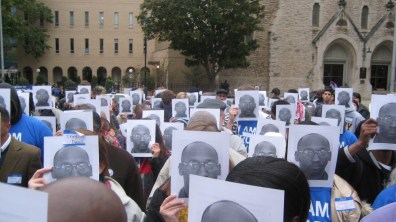
Eagleton, a professor of english literature and cultural history who teaches in Ireland and England, is unimpressed with the current crop of fighting-atheist books from folks like Christopher Hitchens and Richard Dawkins.  That doesn’t mean the professor disagrees with these writers at every point.  Consider this excerpt from the introduction to his book:

Religion has wrought untold misery in human affairs. For the most part, it has been a squalid tale of bigotry, superstition, wishful thinking, and oppressive ideology. I therefore have a good deal of sympathy with its rationalist and humanist critics. But it is also the case, as this book argues, that most such critics buy their rejection of religion on the cheap. When it comes to the New Testament, at least, what they usually write off is a worthless caricature of the real thing, rooted in a degree of ignorance and prejudice to match religion’s own. It is as though one were to dismiss feminism on the basis of Clint Eastwood’s opinions of it.

Eagleton doesn’t tell us much about his personal faith, although you get the impression that he values the Jewish and Christian Scriptures.   He appears to believe that religion, at its highest and best, isn’t about papal infallibility or messianic water-walking; its about the ideal we can dream but attain: love, mercy, beauty and justice.  

True religion aspires to the Kingdom of God.

Stanley Fish likes Eagleton’s distinction between the true business of reason and the true business of religion.  Religion is about first principles.  Reason comes into play only after we have laid a foundation of a priori core belief.  If everything is in flux and one proposition is valued as much as the next, reason doesn’t know where to start.  Once the rules of the game have been established (core convictions about “the good”) reason helps us sort things out.  Religion establishes the destination and reason helps with the journey. 

If all we have is naked reason, there can be no destination.

Rationalists, as individuals, may value mercy, beauty and justice, but, apart from some religious vision, there is no compelling justification for valuing these things.  One might just as easily value the culture of the Old Confederacy or the ethos of the Third Reich (and lots of people do).

On the other hand, if you want to know the way the physical world works don’t ask a theologian or a preacher–that’s not her area of expertise.  Some theologians may know a lot about science–but religious revelation had nothing to do with acquiring this knowledge.

In brief, reason and religion work well together and lose their way when left to their own devices.

Justice means little apart from a vision of the kingdom of God.  Leave religion out of the equation and we can keep blathering on about “justice”; but we have no earthly idea what we mean by the term.  Or, to be more precise, we have no heavenly idea of what we mean, no sense of the transcendent.

He has shown you, O man, what is good.  And what does the Lord require of you but to do justice and to love mercy and to walk humbly with your God.  (Micah 6:8)

This is why I am disturbed when religionists celebrate their rejection of justice, mercy and humility.  Are these religious people who have lost their way; or are they unwitting rationalists arguing from a non-biblical set of core values: power, retribution and domination.

Sure, you can find remnants of this power religion in the Bible.  But the moral heart of the Old Testament is in the prophets and the moral heart of the New Testament resides in the words of Jesus.  Here we find a consistent, self-referential moral vision that has kept western civilization from running off the rails.  Other civilizations are rooted in different religious visions but the process works the same way.

When the most conspicuous religionists show the least appreciation for transcendent values like justice, mercy and humility they lay themselves open to the critique of religions cultured despisers. 

Friends of Justice is a faith-based organization.  We aren’t obsessed with the minutiae of doctrine and we aren’t sticklers for strict orthodoxy.  But our moral vision comes from the Hebrew and Christian Scriptures straight and uncut.  You may reject that foundation if you wish, but it’s what keeps us moving forward.

Troy Davis loses another round

I have been waiting for some indication from the federal Supreme Court before blogging on the Troy Davis case.  So far nothing. 

Two weeks ago, a federal panel of judges refused to grant Mr. Davis a hearing to present evidence of innocence that has never seen the inside of a courtroom.

This commentary from Jill Peterson of Augusta, calls upon Georgia Governor Sonny Perdue to intervene on Troy’s behalf. 

That’s a long shot.  Perdue rode to victory on a promise to restore the old Georgia state flag–a banner proudly dominated by the stars and bars.  Since then, Perdue has lacked the political will to follow through on his promise.  This suggests that he was just playing demagogue for political gain.  Can you expect political courage from a man indebted to the “back to Dixie” crowd? 

The Davis case proves that the legal system values finality over fact.  It isn’t hard to see why criminal justice professionals love finality.  With new cases being stacked on their desks every day they have neither the time or the energy to revisit the past.  Once a man is convicted he needs to stay convicted–the appearance of an appeals process notwithstanding, the system isn’t designed for do-overs.

I can’t prove that Troy Davis is innocent and the state of Georgia no longer has the evidence to prove guilt beyond a reasonable doubt (even to the satisfaction of an all-white jury).  But they appeared to have the evidence twenty years ago and that’s all they need.

The Davis case shows how the state can cobble together a superficially convincing case.  By issuing dire threats guilded with promises of leniency, investigators can manipulate vulnerable “witnesses” into signing statements.  Once a statement is signed the person must testify on pain of perjury.  Stack up six or seven of these people and a jury will convict.

When you have a black defendant and a white victim the death penalty is a foregone conclusion.  Conversely, if you have a black victim and a white defendant the chances of an execution are approximately zero.

Troy Davis needs a chance to set the record straight.  Judge Rosemary Barkett, the dissenting judge in last month’s in the three judge panel that denied Davis a hearing last month, wrote, “to execute Davis, in the face of a significant amount of proffered evidence that may establish his actual innocence, is unconscionable and unconstitutional.”

Amen to that.  Now our only hope is that the same Supreme Court that already refused to intervene will change its mind.

You might also be interested in this Alternet piece by Troy Davis’ sister.

Governor has a chance to serve justice in Troy Davis case

by Jill Peterson, April 27th 09:57am

Governor Perdue can allow us a baseball stadium, but can he halt the execution of an innocent man? According to Georgia law, no, but the case of Troy Davis is compelling enough that pressure will likely be put on him to do something.

On April 16, a federal appeals court decided not to grant death row inmate Troy Davis a hearing to present evidence of innocence that has yet to be considered by a court.

Davis was arrested in 1989 for the murder of a police officer in Savannah. The officer was responding to calls for help from a drunken homeless man who was being pistol whipped over his beer when the attacker shot the officer once and then stood over him to shoot again.

The police department was naturally interested when Sylvester “Red” Colesmade a visit to the station the next day (withhis attorney) with not only a tip, but a name- Troy Anthony Davis.

Morris Publishing’s Savannah Morning News ran Davis’s photo withthe words “cop killer” before the police had even had a chance to question Davis. Davis went in voluntarily to talk to the police and never came back out. He has been on death row for nearly twenty years. In fact, he’s been scheduled for execution three times now, coming within hours of the needle- close enough to have gotten a pre-execution enema.

The postponements are not exactly fancy legal wrangling by Davis. He should be so lucky. Public defense is horribly overloaded in Georgia to the point that Davis was without proper representation as crucial deadlines for appeals came and went, and courts have consistently denied him new trials on procedural grounds. Davis’s executions have been resisted by huge public protest and not only from anti-death penalty advocates. This execution is also denounced by such toughies as Libertarian Presidential Candidate Bob Barr and former FBI Director William F. Sessions. The dissenting judge in the panel of three last week, Judge Rosemary Barkett, wrote, “to execute Davis, in the face of a significant amount of proffered evidence that may establish his actual innocence, is unconscionable and unconstitutional.”

What is it about this case that gets so much attention from around the world?

It’s a long story, but in short, the case against Troy Davis leaves a heavy shadow of doubt. No physical evidence links Davis to the murder; he was convicted on the testimony of nine witnesses’ accounts. New evidence that Davis would like to have heard includes recantations (at the risk of being found guilty of perjury) from seven of those nine witnesses, some citing police coercion. Some of the recantations and additional testimony from new witnesses implicate Red Coles. There are also letters from some of the very jurors who had called for Davis’s death saying they would have found differently if they’d had access to all the information.

Two witnesses have not recanted their testimony. One is a man who told police just hours after the incident that he wouldn’t be able to recognize the killer’s face, but he was sure that the shooter used a shiny gun.

(Interestingly, Red Coles was known to carry a chrome plated .38- the same caliber as the gun that was used in the murder.) The first time this man ever identified Troy Davis was at trial after having seen Davis’s photo in the newspaper.

The other witness sticking to his story is Red Coles.

The court has granted Davis thirty days to try for the U.S. Supreme Court which has already turned down the chance to consider his case once earlier this session. If the Court doesn’t decide to hear his case, Georgia may execute as early as June.

Teaching our racial history

Leonard Pitts uses a tragic story from Sarasota, FL to decry the growing influence of Neo-Confederate propaganda.  With commendable sensitivity, Pitts sifts through a story reminiscent of Jena.  There are no heroes and villains in this story, just victims.

Here’s the key insight: “If we were a people with the courage to teach our racial history fearlessly, and the foresight to inculcate in our children a reverence for civil liberties, this tragedy might never have happened.”

Grievance and rage combustible

By LEONARD PITTS JR.

lpitts@miamiherald.com

A few days ago, a high school student in Sarasota failed history and another failed civics. As a result, the one wound up shot in the chest and the other jailed on a charge of aggravated battery with a deadly weapon.

Here’s the story, as reported by The Sarasota Herald Tribune: On the last Friday in April, an 18-year-old white kid named Daniel Azeff and a friend went riding downtown in a pickup truck, yelling racially disparaging remarks and waving a Confederate battle flag. Azeff’s grandfather, Joseph Fischer, told the paper he has cautioned his grandson repeatedly about his fascination with that dirty banner. Azeff, he said, does not really understand what the flag means.

If so, he’s hardly alone in his ignorance. A generation of apologists for the wannabe nation symbolized by that flag has done an effective job of convincing the gullible and the willfully ignorant that neither the nation, the flag, nor the Civil War in which both were bloodily repudiated, has anything to do with slavery. It’s just ”heritage,” they say, as though heritage were a synonym for ”good.” As though Nazis, white South Africans and Rwandans did not have heritage, too.

For the record: In explaining its decision to secede, South Carolina cited ”an increasing hostility on the part of the non-slaveholding States to the institution of slavery.” Georgia noted its grievances against the North ”with reference to the subject of African slavery.” Mississippi said, ”Our position is thoroughly identified with the institution of slavery.” To which Confederate ”vice president” Alexander Stephens added: “Our new government is founded upon . . . the great truth that the Negro is not equal to the white man, that slavery, subordination to the superior race, is his natural and moral condition.”

So the notion that the Confederacy and its symbols have nothing to with slavery is tiresome, silly and delusional. In choosing to adopt one of those symbols that night, David Azeff took a history test of sorts — and failed.

As noted, Michael Mitchell’s test was in civics. Police say Mitchell, who is 18, black and a student at Sarasota Military Academy, saw Azeff’s flag, took offense and, when the white kid parked and walked down the street, confronted him. Azeff denied being a racist; he was, he said, just exercising his First Amendment rights. Police say the argument escalated, until Mitchell pulled a gun and shot Azeff in the chest.

Thus did Mitchell fail his own test. This is America. Daniel Azeff has a perfect right to express virtually any opinion he chooses, no matter how asinine or provocative, without being shot for it.

Thankfully, Azeff is expected to make a full recovery. Meantime, Mitchell, said to be a good kid who has never been in trouble before, remains jailed in lieu of $50,000 bail. It is difficult not to see a certain symmetry.

That’s not an argument of moral equivalence: Mitchell allegedly pulled a gun, so the moral weight for what happened rests squarely upon his shoulders.

And yet it’s also true that each teenager had what the other lacked. One knew his rights, the other, his history. But neither realized that you cannot fully appreciate the one without understanding the other. So each young man fell into the other’s blind spot.

If we were a people with the courage to teach our racial history fearlessly, and the foresight to inculcate in our children a reverence for civil liberties, this tragedy might never have happened. We are not those people. And because we aren’t, these two boys hurtled toward collision, hopped up on grievances and rage they were ill-equipped to speak — or hear. They took a test that night in Sarasota, and let no one be surprised they failed.

They never had a chance.

David Simon understands mass incarceration


If you want to understand why America has become the incarceration nation watch this penetrating exchange between Bill Moyers and David Simon, co-producer of HBO’s The Wire.  Simon gets to the guts of the matter:

“There are about 749 different shows, dramas and comedies on television right now that you can watch. You know, 748 of them are about the America that I inhabit, that you inhabit, that most of the viewing public, I guess, inhabits. There was one about the other America. And it was arguing passionately about a place where, let’s face it, the economic rules don’t apply in the same way. Half of the adult black males in my city are unemployed. That’s not an economic model that actually works.

These really are the excess people in America, we– our economy doesn’t need them. We don’t need ten or 15 percent of our population. And certainly the ones that are undereducated, that have been ill served by the inner city school system, that have been unprepared for the technocracy of the modern economy. We pretend to need them. We pretend to educate the kids. We pretend that we’re actually including them in the American ideal, but we’re not. And they’re not foolish. They get it.”

You can find the entire transcript or watch the video here.  I’ve seen it twice and was mesmerized both times.  Better still, rent the entire five seasons of The Wire.  It’s strong medicine, but it works.

Southern Change

Gov. Sonny Perdue wrote a brief that details Georgia's progress, in both voter participation by blacks and the election of African Americans.

Southern man
better keep your head
Don’t forget
what your good book said
Southern change
gonna come at last
Now your crosses
are burning fast (Neil Young)
.

As I write, the Supreme Court is considering a case predicated on a simple assumption: racial bias in the Deep South has declined so drastically that federal oversight of state elections and changes to election law is no longer required.

Strangely, the case has little support among Southern legislators.  Georgia Governor Sonny Perdue (pictured at the left) wants to be free of federal oversight, but few Southern Republicans have rallied to the cause.

Partially, that’s because both parties, with the full approval of the feds, use racial gerrymandering to shore up safe seats.  The same process that ensures the election of a handful of black candidates produces overwhelmingly white jurisdictions friendly to Republicans.

But let’s not be too cynical here.  Southern support federal oversight just might be sincere.

The Washington Post’s coverage of the Supreme Court case notes that Alabama’s statement of support for dropping federal oversight had to be filed by a private lawyer because the state’s attorney general refused to endorse it.

The issue turns on a question that pops up a lot on the Friends of Justice blog: how much has really changed in the Deep South?

Obviously, a lot has changed.  When Brown vs. Board of Education shot down the legitimacy of “separate but equal” public schools in 1954, national attention was rivetted on southern states like Alabama, Georgia, Louisiana and Mississippi.  The violent rejection of “Brown” across the Solid South exposed a society in which non-whites enjoyed few of the legal and political rights commonly associated with American citizenship.  The electoral system in states like Mississippi was rigged to prevent significant numbers of black residents from voting or registering to vote.  The legal system was unapologetically partisan.  There was one standard of justice for white people and another for non-whites and if you didn’t like it that way you learned to keep your mouth shut.

By the end of the 1960s, however, both the civil rights movement and the white backlash it inspired were running on empty.  Both civil rights groups and the white citizens’ councils were disbanding and reorganizing in reponse to steadily declining support. 

In general, white southerners gave up the fight for segregated education, turning their attention to the creation of private segregation academies outside the public system.  Gradually, racial attitudes softened across the South, especially among educated urbanites.

Canadian singer Neil Young created an outcry in the early 70s with songs like “Alabama” and “Southern Man”: “Southern change gonna come at last; now your crosses are burning fast.” 

Change has come, to be sure; but it is maddeningly difficult to measure. 

In my last post, I suggested that most Americans subscribe to some form of white nationalism–that is, we think of America as a nation founded by white people for white people.  In most of America, a banal form of white nationalism prevails.  Non-whites are welcomed into the political process and the legitimacy of the civil rights movement is widely acknowledged, but white remains the color of normal.

In states like Louisiana, Alabama and Mississippi, folks are more inclined to take their white nationalism straight.  Ask good Baptists and Methodists in little southern towns for their opinion of Martin Luther King and you won’t hear a lot of superlatives.  Southerners over the age of thirty generally resent a civil rights movement that made their region synonymous with bigotry. 

A few years ago, Paul Hendrickson visited the former Mississippi Sheriffs featured in a 1962 Life photograph taken on the campus of the University of Mississippi.   He kept hearing references to “that civil rights crap”.  The same words were repeated verbatim, like a mantra. 

The children and grandchildren of these former race warriors were less forthcoming, but they rarely disavowed their elders’ perspective.  It was no longer as personal.  The taste of humiliation had diminished over the years.  But there was little sign that a profound and intentional shift in perspective had taken place.

My experience (which is admittedly limited and subjective) suggests that the average middle-aged white person in the Deep South occupies a shadowy nomansland between the full-throated and banal forms of white nationalism.  The membership of overtly racist groups like the Council of Conservative Citizens has never been high and their views are probably atypical.  But there is little celebration of diversity and racial understanding in the small town South.  A scab has formed on the wounds of historym but it is exceedingly thin.

Voting patterns are difficult to interpret with precision, but they provide the best empirical measure of racial attitudes.  The fact that a southerner voted for John McCain, doesn’t mean that she is biased against black people in general or Barack Obama in particular.  She may simply have a preference for Republican policies. 

You learn more from voting  trends. 

The data below isn’t as complicated as it first appears.  In states with a black population below 25%, Barack Obama outperformed John Kerry among white voters.  That’s the good news.  But in states with a black population above 25%, Obama did worse (in some cases, considerably worse) than the 2004 Democratic candidate.

Support for Democratic presidential candidates has been low in Mississippi ever since the federal government forced Ole Miss to integrate in 1962 and passed voting and civil rights legislation in 1964 and 65.  But notice the weak and declining support for Obama in most sections of the Deep South. 

StateVotebyRace2.png

Charles Franklin, the creator of this chart, provides a helpful summary of the results:

Three of the four deep south states dropped clearly below their 2004 white support for Kerry. Georgia did not, matching it’s 23% white support for the Democrat in both years. Mississippi, the lowest state in 2004, shifted from 14% to 11%, while my home state of Alabama dropped from 19% to 10%, claiming the prize for lowest white support for Obama of any state in the Union. Louisiana went from 24% to 14%, the largest point drop of all. One other southern state registered a notable drop, Arkansas fell from 36% white support for Kerry to 30% for Obama.

This dramatic decline in support is particularly significant when compared with national trends:

 There were a number of states with considerable increases (labeled in the chart for a five point or greater gain.) The most interesting are North Carolina (up from 27% to 35%) and Virginia (up from 32% to 39%.) Clearly Obama could not have won those states on the white vote alone, but those shifts amount to roughly a 5-6 point boost in statewide vote share, certainly enough to matter.

Also interesting are traditional red states Indiana and Kansas, with gains from 34% to 45% and from 34% to 40% respectively. Also Montana and North Dakota are notable, with gains from 39% to 45% and from 35% to 42%. While the Democrat didn’t win three of these four states, these shifts demonstrate that they are no longer as out of reach for Dems as recent past elections might have suggested.

 Barack Obama’s lack of popularity among Deep South whites would be particularly striking if urban centers were removed from the mix.  County-by-county voting results consistently showed virtually non-existent white support for Obama in rural sectors of the South.

What does all of this say about bias in the legal system? 

I’m not suggesting that the criminal justice regime in states like Mississippi is as partisan as it was in the middle decades of the 20th century; but a shift from cataclysmic to really bad doesn’t mean that black defendants facing all-white juries in isolated Deep South towns have nothing to worry about.  White resentment in these communities ran far deeper than most non-Southerners ever comprehended; and it didn’t wither up and blow away just because folks stopped wearing their bigotry like a badge of honor. 

Most tragically, the Christian faith is still associated with views anthithetical to the teachings of Jesus.  The public face of evangelical Christianity is of southern manufacture: the kind of Christianity encountered on television was honed and perfected by the same people who ran the White Citizen’s Councils.   Respectable southern segregationists fell into the habit of baptising southern segregation associating the opposition with communism and the very devil.  Consider this quote from Francis P. Mims from a 1959 edition of  The Citizen:

The membership of the Councils is made up of God-fearing, freedom-loving Americans who hate no one, however misguided he may be. Our struggle is to preserve for our children the wonderful faith in God and Country which has been taught us, and which is outlined for us in unmistakable language in the Constitution of the United States. They hate us. But an aroused band of Christian people will not be deterred. We march together under the banner of Faith, Hope and Charity–and we’re not afraid of what the ultimate outcome will be!


Southern men might not have wanted him around, but Neil Young was right about the Good Book.  Jesus lived and died by the principle of non-violence.  The arms of the historical Jesus were open to all.  Jesus was biased, to be sure, but his bias always ran in favor of the poor, the outcast and the disaffected.  Always! 

Jesus was the sworn enemy of the religion of respectability and he paid for it with his life.  Notice, Jesus was betrayed by a paid snitch and convicted on the basis of coerced and uncorroborated testimony. 

Followers of Jesus–the real Jesus–embrace the plight of the poor, the disconnected, the disheveled, the uneducated, the addicted and the insane.  Jesus may not have been a liberal, but he was definitely a bleeding heart.  We don’t wear our religion on our sleeves, but Christian discipleship has driven the mission of Friends of Justice from the beginning.  

Jesus goes on trial every day in little courtrooms across the South.  Every one in a while, Friends of Justice is there “to stand with Jesus in his hour of need” (Deitrich Bonhoeffer).  It’s in the Book:

Then shall the righteous answer him, saying, Lord, when saw we thee an hungered, and fed thee? or athirst, and gave thee drink?  When saw we thee a stranger, and took thee in?  or naked, and clothed thee?  Or when saw we thee sick, or in prison, and came unto thee?  And the King shall answer and say unto them, Verily I say unto you, Inasmuch as ye have done it unto one of the least of these my brethrn, ye have done it unto me. (Matthew 25:37-40)

Black Judge discontinues column

This story in the Friday Dallas Morning News requires little commentary from me–just read the comments that follows the brief article and you will get a feel for what black officials like Victor Lander are up against. 

Black officials are not allowed to remind us that white Americans once regarded non-whites as non-citizens and behaved accordingly.  Judge Lander surrendered his column but he kept his job. 

If Mayor Leppert possessed real political courage he would have stood behind Lander. 

But the mayor is surrounded by people like John G. Browning, a Dallas attorney who is shocked . . . shocked by Lander’s commentary.  Browning makes much of the fact that Lander stood up for the Jena 6 and the infamous Jeremiah Wright.  From Browning’s perspective, these opinions qualify Judge Lander as a whack-job. 

Since I introduced Judge Lander and his congregation (Friendship West Baptist Church) to the Jena story I take attacks on the Judge personally.  Unfortunately, attacks of this kind are routine.  White Americans wants to believe that the criminal justice system provides equal justice for all and we break into loud lamentation when a black Judge like Victor Lander or a black DA like Craig Watkins suggests otherwise. 

Dallas Administrative Judge C. Victor Lander to stop writing opinion column

C. Victor Lander, administrative judge of Dallas’ municipal courts, has agreed to stop writing an opinion column for the Dallas Weekly after coming under fire for references to race in a recent piece.

In a meeting with Mayor Tom Leppert this week, Lander agreed to stop writing the column, confirmed Leppert’s Deputy Chief of Staff Paula Blackmon.

Lander also told the entire City Council that he would stop writing for the Dallas Weekly in an executive session meeting Wednesday, several sources confirmed.

In a March 4 column about Dallas County District Attorney Craig Watkins, Lander wrote that “black folks have been cleaning up white folks messes for hundreds of years, so why should we expect any different now?”

The comment led to one call for his resignation from council member Mitchell Rasansky. Other council members were more understanding and accepted Lander’s apology and retraction of the statement.

Lander did not immediately return a call for comment Friday.

UPDATE: Lander called to say that he told the mayor he would not write the column anymore.

“I just want to make sure the things I say are not misconstrued again, therefore, I’m going to suspend with my column,” he said. “That does not mean I’m going to be silent. But I believe it is in the best interests of all concerned if I communicate on issues dealing with the municipal courts and improvement of the processes there.”

American Violet: A Nice Clean Story


For years now, Hollywood has been gearing up for a feature film about Tulia, Texas starring Halle Berry.  It is a bit ironic that the Hearne story is now gracingthe silver screen when Tulia (a much bigger media story) has never reached the production stage.  Alfre Woodard, who plays the mother in American Violet, was initially slated to star in one of several contemplated Tulia movie projects.

The apparent anomaly is easily explained.  The Hearne story (the subject of the new film, American Violet)  is much cleaner than the Tulia saga.  Although you’d never know it from Bob Herbert’s savage columns in the New York Times, the guilt-innocence issues in Tulia were always ambiguous.  Friends of Justice argued that no one should be convicted on the uncorroborated word of a gypsy cop with a reputation for dishonesty and racism.  We never suggested that no one in Tulia ever sold dope to undercover agent Tom Coleman.  The truth was known only to Coleman, the defendants and Almighty God.

The Hearne story is much simpler.  Derrick Megress, the confidential informant who made dozens of uncorroborated cases, admitted without reservation that he set up every single defendant.  The fact that a number of his marks pled guilty in exchange for lenient plea bargains didn’t alter their actual innocence.

In addition, Regina Kelly is a very sympathetic figure (the picture above isn’t that far off).  In Tulia, media attention centered on Freddie Brookins Jr., an engaging young man with an articulate and supportive family, and Joe Welton Moore, an aging hog farmer with numerous health issues.  I firmly believe that both men were innocent, but nobody could prove it.  All we could prove was that the man pointing the finger wasn’t credible under oath.

Americans hate to think that an innocent person might be convicted.  Nonetheless, when the guilt-innocence issue is fuzzy it’s hard to get much interest–no matter how shoddy the state’s case.  Nobody will take a chance.

That’s why Friends of Justice focuses on cases with a high potential for wrongful conviction.  While others keep their distance until clear evidence of actual innocence is on the table, we consider getting involved so long as there is a strong defendant and weak evidence.  When people of color are arrested and investigated by white police officers and prosecuted by a white DA in front of a white judge and an all-white jury you can count on a conviction no matter how threadbare the case may be. 

When the victim of the alleged crime is white a black defendant is in deep trouble.  This simple fact gives American Violet its sizzle.

We can’t blame other organizations for shying away from the ambiguous cases, but there needs to be at least one organization willing to help vulnerable defendants who can’t prove their innocence any more than the state can prove their guilt.    When a case devolves into a guessing game Friends of Justice is willing to get involved.

The Kunstler Fund for Racial Justice is also willing to get involved at the pre-conviction stage, and there must be other organizations out there ready to aid those in danger of wrongful conviction, but I am not aware of any name brand non-profits willing to take that kind of gamble.  Amnesty International deserves credit for rising to the defense of Troy Davis.  If you know of any other organizations who intervene at the pre-conviction stage please let me know.

This morning I received Google alerts for two American Violet stories.  Both mention Tulia.  This movie review makes the erroneous assumption that American Violet is based on the Tulia story.  This article from Legal Affairs accurately describes Hearne and Tulia as twin posterboys for the federal Byrne Grant program.  Both are worth a quick look.

You should also check out Scott Henson’s take on the movie.   In a related post, Scott bears glad tidings of great joy: the Texas Senate just turned thumbs up to a proposal requiring corroboration for inmate snitch testimony.  An incremental step, to be sure, but it will make a big difference.  The Senate also passed a bill requiring that law enforcement adopt written standards for eyewitness identification.  Hopefully, both bills will be passed by both houses before the 2009 session ends.

American Violet: the law as criminal

Wade Goodwyn has been working on this storyever since he attended the premier of “American Violet” at St. Mary’s Catholic Church in Hearne, Texas three weeks ago.  (I know because he’s been calling me for background every other day.)  The NPR reporter’s interest in the Hearne story isn’t surprising; as the introduction to this morning’s story indicates, American Violet was inspired by Goodwyn’s reporting.  When producer Bill Haney heard the Hearne story on NPR he had to pull off the road to get his emotions under control. 

Those emotions sparked the movie project.

As I suggested in an earlier post, the Hearne story is largely dependent on the early publicity the Tulia drug sting received.  Tulia and Hearne were parallel stories: one featuring a racist white cop, the other a hapless black informant. 

There is one difference: Terry McEachern, the DA who prosecuted the Tulia cases, was voted out of office; John Paschall, the architect of the Hearne fiasco, is still in power.

Paschall’s control over Hearne and Robertson County provides a backdrop for Goodwyn’s story.  The priest who offered his church for the preview screening of American Violet was amazed to see handbill’s advertising the event disappearing from shop windows after a bizarre and shadowy emissary from the DA’s office paid a visit to local business owners.

Regina Kelly watches the Preview

DA John Paschall recently told the Dallas Morning News: “The only way I’d watch it, I’d have to be handcuffed, tied to a chair and you’d have to tape my eyes open.”

Not everyone in Hearne’s white community agrees: the audience at St. Mary’s was only two-thirds African American.

Goodwyn’s piece nicely captures the sense of threat and oppression hanging over little southern towns like Hearne (Deep East Texas is on the Western tip of the Old South).  Prominent white folk don’t feel it, of course; but sit down with residents on the black side of town and you learn the meaing of fear.  

With men like John Paschall in power the law sinks far below the grand ideal emblazoned across the fascade of the Supreme Court building in Washington: “Equal Justice Under Law.”

University of Virginia sociologist Donald Black has argued that, in the real world, the law often behaves like a criminal.

Conventional legal thinkers regard law as inherently legitimate and worthy of respect.  Otherwise it is not law at all.  Illegality is the antithesis of law, and law that is criminal is seemingly a contradiction in terms.  But from a sociological standpoint this conventional view of law is untenable.  It is even worse than wrong: It is factually meaningless.  It is factually meaningless because conventional legal thinkers such as lawyers and law professors confuse factual statements and value statements about law–what law is and what it should be.  For this reason it is difficult to know whether they are speaking of something that actually happens or something that should be happening.  (The Geometry of Law, 2002)

 I never apologize for my lack of legal training.  If I was doing the work of a lawyer my lack of precise legal knowledge would be a major problem.  But since my mission is to effect justice by changing the narrative of racially charged cases in the American South, a certain distance from the legal trade is a distinct advantage.

Don’t get me wrong, I lean heavily on the expertise of trained lawyers.  There are several attorneys on the Friends of Justice board of directors and that is no accident; I need their assistance at every turn.

But Donald Black points to a fundamental problem all legal professionals face:

Their closeness to the subject makes it difficult for them to be scientific.  Instead, they continually embrace the existence and operation of law.  They romanticize it.  They revere it as a sacred process.  They worship it.  They are no more likely to be scientific about law than is a priest to be scientific about God.

Or, as legal amateur  (and devout Catholic layman) GK Chesterton put it exactly 100 years ago:

Now it is a terrible business to mark a man out for the vengeance of men. But it is a thing to which a man can grow accustomed, as he can to other terrible things; he can even grow accustomed to the sun. And the horrible thing about all legal officials, even the best, about all judges, magistrates, barristers, detectives, and policemen, is not that they are wicked (some of them are good), not that they are stupid (several of them are quite intelligent), it is simply that they have got used to it.   Strictly they do not see the prisoner in the dock; all they see is the usual man in the usual place. They do not see the awful court of judgment; they only see their own workshop.

 Hearne demonstrates the dangers of accepting the legal fiction that prosecutors, judges and juries are fair and nonpartisan.  They may aspire to these high virtues, but rarely do they come close.   Human beings are inherently biased and the tortured history of the American Southland magnifies this tendency. 

Regina Kelly would have been tried, convicted and incarcerated if her accuser hadn’t recanted his testimony and prominent allies like the ACLU hadn’t latched on to her case.  Both were required: a recanting accuser and high-status allies.   As we celebrate Regina Kelly’s courage may we remember that most innocent defendants aren’t so fortunate.

Alan Bean

Friends of Justice