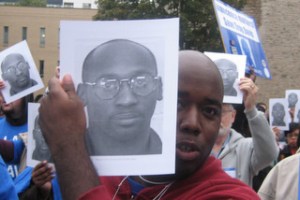
Chances that the Supreme Court will address the Troy Davis case improved markedly when the court took its summer break without making a decision on the vexing case.
The Davis case demonstrates the weakness of circumstantial murder prosecutions based largely on eyewitness testimony. A series of crucial eye witnesses have recanted earlier testimony, often complaining that they were pressured by the authorities.
What do we make of a juror who swears to one thing on the witness stand then, years later, reverses course? Spencer Lawton, the prosecutor who convicted Troy Davis eighteen years ago, called the recanted testimony “suspicious”. But will Larry Chisolm, the new Chatham County DA take the same view?
Common sense suggests that witnesses were more likely to get it right eighteen years ago because memory fades over time. On the other hand, investigators desperate for a conviction in a high-profile case can shape testimony by abusing the power of suggestion. Memory isn’t like photography; you don’t capture a pristine and timeless image that can be taken out and re-examined at a later date. Initial impressions fade with remarkable rapidity. At best, memory is a jigsaw puzzle with most of the pieces missing. The mind creates a coherent memory by filling in the missing pieces, often drawing on fragments of unrelated memory and personal prejudice (wishful thinking) to connect the dots.
When an investigator emphasizes a certain suspect by repeating his name, subtly drawing attention to a particular photograph in a photo spread, or including a photo of the prime suspect noticably different from the other pictures in an array, eyewitnesses are being encouraged to incorporate this new piece of information into their memory of the event. “Yes, now I remember, that’s exactly what the guy looked like.” Witnesses who initially claim they can’t remember much about the bad guy often find their memory sharpens considerably once they embrace an investigator’s theory of the crime. A comparison between initial statements and courtroom testimony often reveals the evolution of a false sense of certainty.
Now, when the eye witness remembers the event, the perp really does wear the face of the prime suspect and this impression intensifies over time. This is why the witnesses who have been proved wrong in DNA cases often insist that they were absolutely positive they had the right guy.
Competent investigators don’t want to nail the first guy who lacks a good alibi; they want to find the truth. They are fully aware of the power of persuasion, manipulation and suggestion and therefore leave witnesses free to tell their own stories in their own way. But under the pressure of public expectation and institutional group-think it is frightfully easy for an officer or a prosecutor to prematurely lock onto a certain suspect and shape the facts to fit the orthodox theory of the crime.
Wrongful convictions are particularly common in heinous cases with spotty and ambiguous evidence. The public clamors for closure and legal professionals feel pressured to produce a suspect. Witnesses willing to tell the story “right” are considered credible while witnesses whose recollections clash with the state’s narrative are ignored and sometimes belittled and denigrated.
In time, however, victims of memory manipulation can come to doubt their “recollections”, especially when fellow witnesses are questioning the accuracy of their own trial testimony. Since recantation comes with a considerable price tag (no one wants to admit a mistake and perjury charges are always possible) witnesses who change their stories after trial should be taken seriously. On the other hand, witnesses who had it right at trial can be manipulated to question earlier statements–the power of suggestion works both ways. Unfortunately, most people have a hard time maintaining an independent point of view in the face of adamant opposition.
As a practical matter, the judicial system would devolve into chaos if witnesses were allowed to change their stories after the fact. The system places a high premium on finality. Once a jury hands down a guilty verdict it is frightfully difficult to challenge the result. Jurors are heavily invested in their decisions and legal professionals tend to be forward looking because they face perenially overflowing dockets.
You can’t stand up for Troy Davis without questioning the objectivity, fairness and basic adequacy of our current legal system. That’s why every court thus far has decided to pass on this troubling set of facts. The Supreme Court’s willingness to leave the issue open is thus a very positive sign.
Supreme Court delays Troy Davis decision
Tuesday, June 30, 2009
SAVANNAH — Death row inmate Troy Anthony Davis got another legal break Monday when the U.S. Supreme Court recessed for summer without acting on his latest appeal, likely delaying any developments in his case until fall. Earlier, his supporters presented Savannah’s district attorney with 60,000 petition signatures urging him to reopen the case.
Davis has spent nearly 18 years on deathrow after his conviction for killing an off-duty police officer, and his case has become a rallying point for death penalty opponents worldwide. His attorneys say Davis is innocent of killing officer Mark MacPhail and deserves a new trial after several prosecution witnesses reconsidered testimony given at his 1991 trial.
Davis has been spared from execution three times since he was first scheduled to die by lethal injection in 2007, as various courts have weighed and ultimately rejected his appeals.
Davis’ attorneys filed his latest appeal with the U.S. Supreme Court after the 11th Circuit Court of Appeals rejected their request for a new trial in April. The Supreme Court had not decided whether it would hear Davis’ appeal when justices recessed for the summer Monday. They won’t reconvene until September.
“It’s definitely good news,” said Jason Ewart, Davis’ attorney, who interpreted the court’s inaction as a sign it wants to take a closer look at the case. “It’s not just a move buying more time.”
While the Supreme Court’s in recess, the next move would be up to Chatham County District Attorney Larry Chisolm.
There’s no stay of execution preventing Chisolmfrom seeking a judge’s order to move forward withDavis’ death sentence. The prosecutor released a brief statement Monday that stopped short of saying he would wait for the Supreme Court before acting.
“As previously stated, the Chatham County District Attorney’s office has no comment on the substance of this case until all appeals are exhausted,” Chisolm said.
Chisolm’s spokeswoman, Lydia Sermons, declined to comment further.
Davis’ supporters say Chisolm has another option. They’re working to pressure Chisolm to reopen Davis’ case without waiting for the courts.
“He doesn’t have to wait for them,” said Martina Correia, Davis’ sister. “He could still open this case at any time.”
About 25 people from the NAACP, Amnesty International and other groups supporting Davis held a news conference Monday outside the Savannah courthouse to present Chisolm’s office with 60,000 petition signatures urging the prosecutor to seek a new trial for Davis.
They said about 11,000 signatures came from Savannah and surrounding Chatham County, where black voters were key to Chisolm’s election as the county’s first African-American district attorney last fall. Davis is also black.
“We have sufficient evidence, we believe, to show that Troy Anthony Davis is innocent,” said Prince Jackson, president of the NAACP’s Savannah branch. “We are asking that he be given a chance. After all, his life is at stake.”
Sermons, who accepted the petitions on Chisolm’s behalf, has previously said the district attorney wasn’t sure he has the legal authority to halt Davis’ execution. She declined to elaborate Monday.
Chisolm’s predecessor, Spencer Lawton, was district attorney when Davis was convicted. Prosecutors under Lawton, who retired last year, rejected Davis’ claims of innocence and labeled statements by recanting witnesses as “suspect.”
MacPhail was slain 20 years ago while working off-duty as a security guard at a bus station. He had rushed to help a homeless man who had been pistol-whipped at a nearby parking lot, and was shot twice when he approached Davis and two other men. Witnesses identified Davis as the shooter at his 1991 trial.
But Davis’ lawyers say new evidence proves their client was a victim of mistaken identity. They say three people who did not testify at Davis’ trial have said another man confessed to the killing. But in an interview with the Associated Press, the jury foreman at the trial said he had no doubts about Davis’ guilt.
The case has attracted worldwide attention, with calls to stop Davis’ execution from former President Jimmy Carter, Pope Benedict XVI and Nobel Peace Prize-winner Desmond Tutu. Rallies have been held as far away as Paris.
 Friends of Justice
Thank you for your coverage of the Davis case.
Troy Davis: Both sides need to be told
Dudley Sharp, contact info below
Anyone interested in justice will demand a fair, thorough look at both sides of this or any case. Here is the side that the pro Troy Davis faction is, intentionally, not presenting.
(1) Davis v Georgia, Georgia Supreme Court, 3/17/08
Full ruling http://www.gasupreme.us/pdf/s07a1758.pdf
Summary http://www.gasupreme.us/op_summaries/mar_17.pdf
” . . . the majority finds that ‘most of the witnesses to the crime who have allegedly recanted have merely stated that they now do not feel able to identify the shooter.’ “One of the affidavits ‘might actually be read so as to confirm trial testimony that Davis was the shooter.’ ”
The murder occurred in 1989.
(2) “THE PAROLE BOARD’S CONSIDERATION OF THE TROY ANTHONY DAVIS CASE” , 9/22/08, http://www.pap.state.ga.us/opencms/opencms/
“After an exhaustive review of all available information regarding the Troy Davis case and after considering all possible reasons for granting clemency, the Board has determined that clemency is not warranted.”
“The Board has now spent more than a year studying and considering this case. As a part of its proceedings, the Board gave Davis’ attorneys an opportunity to present every witness they desired to support their allegation that there is doubt as to Davis’ guilt. The Board heard each of these witnesses and questioned them closely. In addition, the Board has studied the voluminous trial transcript, the police investigation report and the initial statements of all witnesses. The Board has also had certain physical evidence retested and Davis interviewed.”
(3) A detailed review of the extraordinary consideration that Davis was given for all of his claims, by Chatham County District Attorney Spencer Lawton http://tinyurl.com/46c73l
Troy Davis’ claims are undermined, revealing the dishonesty of the Davis advocates . Look, particularly, at pages 4-7, which show the reasoned, thoughtful and generous reviews of Davis’ claims, as well a how despicable the one sided cynical pro Troy Davis effort is.
(4) Officer Mark Allen MacPhail: The family of murdered Officer MacPhail fully believes that Troy Davis murdered their loved one and that the evidence is supportive of that opinion. http://www.markallenmacphail.com/
Not simply an emotional and understandable plea for justice, but a detailed factual review of the case.
The Supreme Court this morning (8/17/09) has ordered a new hearing in the Troy Davis case. Thomas and Scalia dissented; Sotomayor did not participate. This is big!