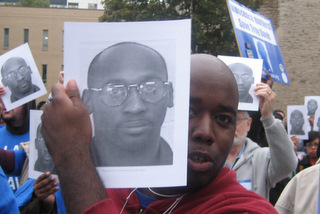
 Since a federal judge in Georgia characterized Troy Davis’s innocence claims as “smoke and mirrors” the mainstream media have given only passing attention to the case. Jen Marlowe’s well-researched piece in The Nation is a welcome exception to the general rule. Marlowe moves through the evidence witness-by-witness displaying a thorough familiarity with the case. I have pasted an excerpt below. After describing the scene at the June 23 hearing in Savannah, Marlowe lays out the evidence:
Davis sits on death row for the murder of Savannah police officer Mark MacPhail, who was gunned down with a .38 caliber weapon in the early morning hours of August 19, 1989, as MacPhail ran to assist a homeless man named Larry Young, who was being pistol-whipped in a parking lot. Davis was convicted based solely on eyewitness testimony, a fact that has given rise to many of the “crucial, unanswered questions” in his case: seven of the nine eyewitnesses later recanted. One who did not was Sylvester “Redd” Coles, who had been seen arguing with Young that night and who implicated Davis the day after the murder. After Davis was arrested, it emerged that Coles had a .38 caliber pistol the night of the murder.
Davis has maintained his innocence, and his case has inspired a global movement to save his life, with such figures as President Jimmy Carter, Pope Benedict XVI and Archbishop Desmond Tutu making statements on his behalf. But authorities in Georgia seem determined to execute him; Davis has already faced three execution dates. On September 23, 2008, he came within less than two hours of lethal injection before the Supreme Court granted a stay, in order to consider an appeal by his attorneys.
Inside the packed courtroom, the Davis and MacPhail families sat in the front row, on wooden benches on opposite sides of the aisle. US District Judge William Moore heard compelling evidence that had never before made it inside a court, including the recantations of four witnesses. Three other witnesses testified that Coles had confessed to them that he was the killer. One witness, Benjamin Gordon, even described watching Coles pull the trigger.
Yet two months later, on August 24, Judge Moore turned down Davis’s innocence claim, simultaneously acknowledging that executing an innocent person would violate the Constitution, while flippantly dismissing the possibility that Davis is innocent. “While Mr. Davis’s new evidence casts some additional, minimal doubt on his conviction,” Judge Moore concluded in a 174-page order, “it is largely smoke and mirrors.”
Now Davis faces the prospect of a new execution date, when in reality “smoke and mirrors” more appropriately describes the evidence used to sentence him to die in the first place.
Davis’s image was already splashed all over the media and on “Wanted” posters before eyewitnesses were asked to identify MacPhail’s killer in a photo spread that included him but did not include anyone else who had been at the scene of the crime, including Coles. In fact, after he implicated Davis, Coles was included in a re-enactment of the crime as a witness rather than a suspect. If this was not “smoke and mirrors,” it was, at the very least, inexcusably suggestive, tainting the identification of Davis.
Eyewitness testimony is notoriously unreliable. Recantation testimony is thought to be even less reliable. But one must consider the possible motivations for the witnesses’ testimonies at trial, and for their later recantations. Many of them would go on to say that their original affidavits were coerced by the police. Daryl Collins, who was 16 at the time, said he was threatened with being charged as an accomplice to murder. Kevin McQueen, who did time with Davis in Chatham County Prison and claimed that Davis had confessed to him, later said that he had been motivated by his anger at Davis over a prison-yard argument. Furthermore, McQueen stated, he received a reduced sentence in exchange for his testimony. The state’s attorneys tried multiple tacks to poke holes in McQueen’s recantation at the hearing, but McQueen stood firm. “No matter how many times you come at me, the man did not tell me anything about shooting anyone. Period.”
Attorneys for Davis asked McQueen whether he expected to gain anything from his recantation now. “Peace of mind, I guess.” McQueen answered.
Thirty-eight-year-old April Hutchinson is a new witness who testified at the June evidentiary hearing that Coles had used her as a decoy after the murder. “Redd asked me to walk with him so it seemed like he didn’t do anything,” she said. “I started walking with him because I was scared because of the reputation he had.… He gave me a look that said, ‘You better not say anything.’ ”
Why did she decide to tell the story now?
“It’s hard to forget. I am older and I have kids and if I want them to do the right thing, then I have to do the right thing.”
Benjamin Gordon, meanwhile, who claims he saw Coles pull the trigger, had good reason to keep quiet: his uncle is married to Coles’s sister. Yet “I’ve been carrying this burden for a long time,” Gordon testified. “I came today so that the truth will be known.”
The witnesses are trying to do the right thing. Why has the state of Georgia not followed that lead?
Though Davis will appeal, either to the Supreme Court or the Court of Appeals for the Eleventh Circuit, Moore’s decision was a critical blow. Yet the unanswered questions surrounding Davis’s case are as troubling today as they were before the evidentiary hearing, if not more so. The Georgia Board of Pardon and Paroles should do the right thing, before another execution date is set. Troy Davis should be granted clemency.


This is one of those “not Rosa Parks” cases. From what I’ve seen (in print) Troy Davis is/was no choir boy. He was present at the murder, and probably involved in the beating of the homeless guy. So supporters of the death penalty for Davis can say, with some justification, “Well, even if he didn’t do this, he’s still a bad guy.” And that in their minds is justification for going ahead with the needle. In spite of reasonable doubt that he’s the killer. Not hard to see why Benjamin Gordon is not among the eyewitnesses recanting their testimony. Nor is it hard to see why the jailhouse snitches in the Colomb case issued perjured testimony.
One of the incremental reforms that should be pushed on the way toward the new consensus Michelle Alexander and FOJ are seeking is the recording of all LE interviews leading to testimony, and making those recordings available to defense. Who knows how much browbeating took place to get the testimony re Troy Davis and Curtis Flowers?