Month: October 2011

The growing campaign to end the New Jim Crow

Alan Bean and Melanie Wilmoth

Just a few nights ago, activists, former prisoners, and concerned citizens gathered at Riverside Church in New York to discuss mass incarceration and the criminal justice system. These individuals are launching a campaign built around the ideas expressed by Michelle Alexander in her book “The New Jim Crow: Mass Incarceration in the Age of Colorblindness.” Especially concerned with the effect our broken justice system has on people of color, these organizers are advocating for a complete transformation of our system of mass incarceration. MW

I met Jazz Hayden at a conference in Chicago a while back and have been following his work ever since.  Pockets of resistance to the New Jim Crow are popping up across the country and Jazz is at the forefront of this movement.  AGB

Prison Activists Work to End Racial Bias in Justice System

By Nat Rudarakanchana

On a quiet Friday evening, a band of grizzled but passionate prison activists wound its way through the corridors of Riverside Church, into a bright business-like meeting room. On the agenda this night: the launching of a campaign to end what they call the “New Jim Crow.”

The phrase refers to academic Michelle Alexander’s book “The New Jim Crow: Mass Incarceration in the Age of Colorblindness,” which argues that the American criminal justice system is both unjust and racist. Several city-based activists dealing with the rights of prisoners have heard of the book: more than a few highly recommend it, too.

Among those present at this private meeting were two Harlem residents who have endured the prison system for decades and survived to tell the tale. (more…)

For God’s sake, test the DNA!

Hank Skinner

By Alan Bean

Before the State of Georgia killed Troy Davis, I would have bet good money that Texas wouldn’t execute Hank Skinner without bothering to test the DNA evidence.  But now all bets are off.

Common sense suggests that a simple DNA test should be performed in the interest of justice.  What have we got to lose (other than our reputation as a nation that guarantees liberty and justice)?

The State of Texas argues that Skinner had a chance to ask for DNA testing and he failed to take advantage. 

This may strike you as a peculiar argument, but in the Alice and Wonderland world of modern jurisprudence, procedure is everything and common sense counts for nothing.  It doesn’t matter what the DNA might tell us; the constitutionally guaranteed window of opportunity is now closed.

Killing Hank Skinner is a bad idea, practically and on principle.  But if we’re in the people-killing business, shouldn’t we at least make sure they are guilty of something really bad?  If you think so, please keep reading.  

Will Texas Kill an Innocent Man Next Week?

Hank Skinner is scheduled to die on November 9. But the state of Texas may execute him without even conducting DNA tests on all of the evidence from his trial, despite a decade of requests from Hank and his lawyers. (more…)

Bigger than the Beatles?

By Alan Bean

In March of 1966, John Lennon made an offhand comment to a reporter with the London Evening Standard:

“Christianity will go. It will vanish and shrink. I needn’t argue with that; I’m right and I will be proved right. We’re more popular than Jesus now; I don’t know which will go first – rock ‘n’ roll or Christianity. Jesus was all right but his disciples were thick and ordinary. It’s them twisting it that ruins it for me.”

In England nobody noticed, but when the statement hit the American press, Beatle records were ceremonially crushed and burned all over this God-fearing nation.  Eventually, Lennon was forced to issue an apology:

“Well, originally I pointed out that fact in reference to England. That we meant more to kids than Jesus did, or religion at that time. I wasn’t knocking it or putting it down. I was just saying it as a fact and it’s true more for England than here. I’m not saying that we’re better or greater, or comparing us with Jesus Christ as a person or God as a thing or whatever it is. I just said what I said and it was wrong. Or it was taken wrong. And now it’s all this.”

Were the Beatles bigger than Jesus?  Does it matter? (more…)

Pat Buchanan appears on white supremacist radio show

MSNBC commentator, Pat Buchanan, recently appeared on a white supremacist radio show to promote his new book, “Suicide of a Superpower.” In protest, the advocacy group ColorOfChange.org organized a petition, calling on MSNBC to fire Mr. Buchanan for his “long record of bigotry.”  For more details and to sign the petition, see the below message from ColorOfChange.org. MW

Did you hear about MSNBC’s white supremacist commentator?

For years, Pat Buchanan has passed off white supremacist ideology as legitimate mainstream political commentary. And MSNBC continues to pay him and give him a platform on national TV to do it.

Buchanan has just published a book which says that increasing racial diversity is a threat to this country and will mean the “End of White America.”1  This weekend, to promote his book, he went on a white supremacist radio show whose host has said things like “MLK’s dream is our nightmare,” and “interracial sex is white genocide.”2

Buchanan has the right to express his views, but he’s not entitled to a platform that lets him broadcast bigotry and hate to millions. If MSNBC wants to be seen as a trusted, mainstream source of news and commentary, it needs to fire Buchanan now.

Please join us in calling on MSNBC to fire Pat Buchanan:

http://act.colorofchange.org/sign/buchanan/

Here are a few examples of what Buchanan has said in the past: (more…)

The day Elizabeth and Hazel were dissed by Oprah

By Alan Bean

I have been inspired by the story about how Elizabeth Eckford (the black woman walking stoically into Little Rock’s Central High School in 1959) and Hazel Bryan (the white woman in the rear screaming, “Go home to Africa, nigger!”) had bridged the racial divide and become best friends.

Not surprisingly, it isn’t that simple.

Racial reconciliation comes hard.  Everybody needs to feel good about their people, their heritage, their roots.  At least Sir Walter Scott thought so:

Breathes there there the man with soul so dead

Who never to himself hath said,

This is my own, my native land!

Whose heart hath ne’er within him burned,

As home his footsteps he hath turned

From wandering on a foreign strand!

If such there breathe, go, mark him well;

For him no minstrel raptures swell . . .

African Americans and American whites, particularly in the South, have a hard time feeling good about their ethnic heritage.  Few Black Americans chose to come to this country.  In most cases, their ancestors were hunted down like dogs, manacled, separated from family, culture and religion, stowed into the hulls of slave ships, transported across the Atlantic ocean, and put to work under the lash beneath a blazing son.  The Emancipation Proclamation hardly improved their lot.  In its own strange way, Jim Crow was every bit as degrading as slavery.  (more…)

“People wasn’t made to burn”: Joe Allen resurrects a lost story

By Alan Bean

In a three-month period shortly after World War II, 751 home fires killed fo urteen people in the city of Chicago.  The deadliest of these fires broke out in filthy, overcrowded tenement buildings in the city’s black district.  Joe Allen’s People Wasn’t Made to Burn tells the story of a fire on 1733 West Washburne Street that claimed the lives of four children and eventually placed the victim’s father on trial for murder.

Like scores of other Mississippi sharecroppers, James and Annie Hickman had migrated north in search of a better life.  In segregated Chicago, housing options were strictly limited for Black families like the Hickmans.  They were “forced to live in ‘kitchenettes’: dilapidated one-room apartments that in many cases had no heat, electricity, or running water.”  The kitchenette the Hickman family moved into was owned by Mary Porter Adams, a Black woman desperate to maximize her monthly profit, and managed by David Coleman, a white man determined to spend as little as possible on maintenance and repair work.

James Hickman paid Coleman a $100 deposit and moved into a 25 by 15 foot attic apartment on the understanding that more suitable accommodations on the second floor would soon be available.  “The Hickmans had to go down to the floor below them to get water from a neighbor to cook and clean with” Joe Allen tells us.  “They cooked on a Kenmore two-burner stove a few footsteps from their beds.  At a local store James bought two lamps to light the room, both fueled by kerosene.”

When James Hickman asked Coleman when the second-floor apartment would be ready, the manager initially put him off.  Hickman kept pressing the issue.  Finally, Coleman told Hickman he wasn’t going to rent him the better apartment and wouldn’t return the deposit money.  Moreover, Coleman said “he had a man on the East Side ready to burn the place up” if Hickman took him to court.    (more…)

Behind bars without proof of guilt: The case of Everton Wagstaffe

Everton Wagstaffe

by Melanie Wilmoth

You can find a NYT update on this story here.

Everton Wagstaffe has been in prison for over 18 years.

Since his arrest, Wagstaffe has unyieldingly claimed his innocence and fought for his release, yet he remains behind bars serving out a 25-year sentence for second degree kidnapping.

Although Wagstaffe completed his minimum sentence several years ago, he remains in prison, refusing to go before the parole board and admit guilt for a crime he did not commit. Several years ago, he qualified for a “conditional release” which would have set him free as long as he followed a strict set of rules and guidelines. Claiming his innocence, Wagstaffe refused to sign the release, not wanting to comply with the guideline requiring him to register as a sex offender.

The case against Wagstaffe began on New Years Day 1992. On this day, 16-year-old Jennifer Negron was kidnapped in Brooklyn, New York. Hours after the kidnapping, her body was discovered dead in the street. (more…)

Are we the 99%?

By Alan Bean

Bloggers quickly learn that most readers snap up posts on the hot stories of the day, so by now I should have written something on the Occupy Wall Street movement.  Thus far, the OWS people haven’t addressed the issue of mass incarceration, and I don’t expect that to change.  The big issue that has drawn thousands of people into the streets is economic inequality.  Some OWS protesters want to do away with free market capitalism; others simply resent living in a plutocracy where the politicians function as lap dogs for the wealthy and only well-financed opinions receive a public airing.

This resentment has been hanging in the air for decades, of course, but the economic meltdown of 2008 built a roaring fire under the winter of our discontent.  Everything is melting.  We see the very people responsible for the current fiasco assigned to key positions in Barack Obama’s cabinet and we are outraged.  These people signed off on the housing bubble and turned a blind eye to the massive fraud in the economic sector that kept the bubble afloat for so long.  They have been tainted by ubiquitous iniquity and they have demonstrated their incompetence, so why are they still calling the shots?  Why are they shaping public policy?  Why is the Tea Party intent on cutting their taxes and catering to their every whim? (more…)

Scot McKnight gets the kingdom all wrong

By Alan Bean

IVP Author Scot McKnight“Social justice outside the church is not biblical justice or kingdom work. It is social work. Fine, that’s a good thing. But let’s not call this kingdom work.”
So says Scot McKnight, author of “The Jesus Creed: Loving God and Loving Others“.  McKnight has no beef with works of justice performed outside the church, it just doesn’t qualify as kingdom work.  (You can find an extended treatment of his remarks in this Associated Baptist Press article.)

McKnight believes in justice, especially the kind of justice that mattered to Jesus.  But that’s just the problem, few churches share his passion.  Take the issue of mass incarceration, for instance.  Over the past four decades, churches have adopted a law-n-order, lock-’em-up stance.  We wanted to be on the side of the angels, and that meant supporting law enforcement force the bad people (particularly drug dealers) off the streets. (more…)

As one having authority

By Alan Bean

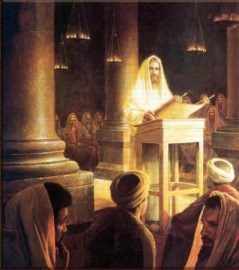
This week the Mustard Seed Conspiracy study is examining Jesus’ brief ministry in Capernaum as described in the Gospels of Mark and Luke.  In Luke, this material follows immediately on the heels of Jesus’ rejection in his hometown of Nazareth.  This is important for two reasons.  In Nazareth Jesus announced his agenda using the ancient words of Isaiah 61: “The Spirit of the Lord is upon me, because he has anointed me to preach good news to the poor; he has sent me to proclaim release to the captives.”  Now, in Capernaum, he makes good on his promise. 

Luke also uses the Nazareth-Capernaum contrast to make a second point: a prophet may be without honor in his own town, but the strangers down the road get it immediately.

The recurring theme of the Capernaum passages is authority.  Jesus takes authority over Shakespeare’s “slings and arrows of outrageous fortune”: the “unclean spirits of disease and disability (physical and mental). 

And Jesus takes authority over his audience–he has no interest in keeping the customers satisfied.

Let’s start with the unclean spirits.  On 23 occasions in the Synoptic Gospels, Jesus casts out unclean spirits (also referred to as demons).  There is something unseemly about these unclean spirits.  They twist their victims into grotesque shapes and exit the body with horrifying shrieks.  Why, we ask, couldn’t Jesus quietly heal people?  (more…)