Month: October 2011

“Lost in detention”: The criminalization of immigration

by Melanie Wilmoth

Earlier this week, PBS Frontline aired its documentary “Lost in Detention.” The documentary takes a hard look at the broken U.S. immigration system and the resulting increase in the number of detained and deported immigrants.

Under the Obama Administration, over 400,000 immigrants were detained and deported this year alone (which is a significantly higher number of deportations than in previous administrations). As Frontline suggests, much of this increase in detention and deportation is a result of Secure Communities, a partnership between U.S. Immigration and Customs Enforcement (ICE) and the FBI that uses fingerprint data to track criminal immigrants. Secure Communities allegedly aids in the deportation of immigrants who have committed serious crimes and, thus, pose a threat to public safety. According to ICE, Secure Communities prioritizes “the removal of individuals who present the most significant threats to public safety as determined by the severity of their crime, their criminal history, and other factors.”

However, the Secure Communities program has reached far beyond its stated purpose. Since its implementation in 2008, Secure Communities has successfully broken up families and incited fear in immigrant communities. Thousands of individuals, many of whom are non-criminals, U.S. citizens, and parents of children who are U.S. citizens, have been arrested. In addition, Latinos have been disproportionately affected by Secure Communities, making up 93% of those arrested through the program.

After arrest, 83% of individuals are placed in detention centers. Punitive in nature, the 250 detention centers in the country warehouse immigrants in prison-like settings until deportation. Reports of abuse in these centers run rampant.  (more…)

U.S. support for death penalty dips to 39-year low

by Melanie Wilmoth

A Gallup poll conducted last week reveals that support for the death penalty in the U.S. has dropped to a 39-year low. According to the poll:

“Sixty-one percent of Americans approve of using the death penalty for persons convicted of murder, down from 64% last year. This is the lowest level of support since 1972, the year the Supreme Court voided all existing state death penalty laws in Furman v. Georgia.”

The poll, conducted October 6-9, 2011, came in the wake of Troy Davis’ execution, which could explain some of the decrease in support for the death penalty. However, Gallup points out that “there have been high-profile executions in the news in previous years without concomitant drops in death penalty support, making it less clear that such events have a direct impact on attitudes.”

See the results of the poll below:


NYPD detective admits to fabricating drug buys to meet arrest quotas

Already in the spotlight for its racially biased “stop and frisk” tactics, the NYPD took another hit when Stephen Anderson, a former narcotics detective, admitted to falsifying drug buys and planting drugs on innocent people to meet arrest quotas. Based on Anderson’s testimony, NYPD supervisors put significant pressure on narcotics officers to meet buy-and-bust quotas. Check out the New York Daily News’ report on the issue below. MW

We fabricated drug charges against innocent people to meet arrest quotas, former detective testifies

by John Marzulli

A former NYPD narcotics detective snared in a corruption scandal testified it was common practice to fabricate drug charges against innocent people to meet arrest quotas.

The bombshell testimony from Stephen Anderson is the first public account of the twisted culture behind the false arrests in the Brooklyn South and Queens narc squads, which led to the arrests of eight cops and a massive shakeup.

Anderson, testifying under a cooperation agreement with prosecutors, was busted for planting cocaine, a practice known as “flaking,” on four men in a Queens bar in 2008 to help out fellow cop Henry Tavarez, whose buy-and-bust activity had been low.  (more…)

Canadian government toys with mass incarceration

By Alan Bean

I just returned from a nine-day trip to Edmonton, Alberta.  Whether I was attending my 40th high school reunion or visiting with friends and relatives, the nature of my work brought the conversation around to Bill C-10, “The Safer Streets, Safer Communities Act,” sponsored by the reigning conservative government.  In essence, the plan calls for lots and lots of prison construction

Consider the facts.  The United States currently incarcerates 743 people per 100,000 population; Canada incarcerates 117 per 100,000.  If the Canadian crime rate was on the rise there might be some rationale for prison construction but, as in America, the crime rate north of the 49th parallel has been dropping like the anvil in a road runner cartoon for years.

Is Prime Minister Steven Harper trying to shore up his political dynasty by playing the tough-on-crime card that worked so well for so long in the US of A?  Should we be talking about a “Northern strategy”?

This morning the Grits for Breakfast blog referenced an august gathering in which a number of guests from the lock-’em-up state of Texas explained to Canadian officials why massive spending on prisons is an economic and public safety disaster.  You can find the full article from the Canadian Broadcasting Corporation site here. 

Also, over at the Canadian version of the Huffington Post, Liberal MP Carolyn Bennett provides her own critique of Bill C-10.

I am rarely embarrassed by the country of my birth, but Bill C-10 is downright embarrassing.

Have we domesticated discipleship?

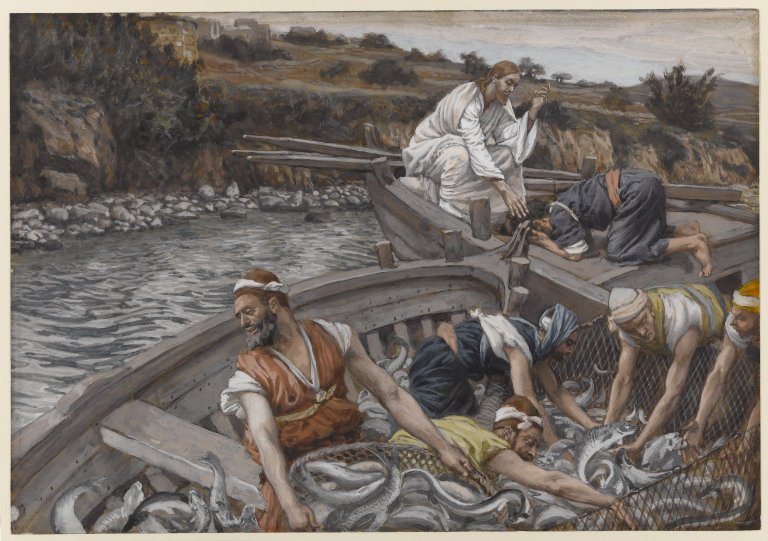
File:Brooklyn Museum - The Miraculous Draught of Fishes (La pêche miraculeuse) - James Tissot - overall.jpg

Then Jesus said to Simon, “Do not be afraid; from now on you will be catching people.” (Luke 5:10)

By Alan Bean

This week we consider Jesus’ calling of the first disciples. In Mark’s gospel, the subject is covered in five short verses; Luke’s account is twice as long and doubly detailed. The evangelists (a fancy word for the men who write the four gospels) inherited scores of traditional stories about the life and work of Jesus and used this material with great freedom.

In Mark’s gospel, Jesus appears to two groups of fisherman busy casting their nets into the sea. “Follow me,” he says, “and I will make you fish for people.” Without a word, the men drop their nets and follow.

In Luke, the action if far more complex. Right at the end of John’s gospel, we find a story about a miraculous catch of fish. Luke gives us the same story, but he places it in a very different setting. In John, the risen Christ appears to his disheartened disciples and asks them to let down their nets for a catch. In Luke, this request is extended right at the beginning of Jesus’ teaching ministry.

As a teenager growing up in McLaurin Baptist Church in Edmonton, Canada, I discussed Mark’s story with Sadie Beggs, an Irish Baptist. “Jesus just walks up and tells these guys to follow, and they do,” I said. “I wonder what was going through their heads.”

Sadie told me she had always been mystified by the disciples’ willingness to follow a perfect stranger. “It must have been a miracle,” she said.

In Luke, the decision to follow Jesus is more understandable. Jesus heals the mother-in-law of a soon-to-be disciple named Simon just shortly before the two men meet by the sea of Galilee. The call to discipleship doesn’t come from a complete stranger, in other words, Simon has already seen Jesus at work. (more…)

Racial gap in school suspensions widens

A report released by the National Education Policy Center, sheds light on the growing racial gap in school discipline. The report indicates that black students are far more likely to be suspended or expelled from school for minor infractions. As research suggests, students who are removed from school are much more likely to become involved in the juvenile justice system. In turn, kids who are locked up as juveniles are more likely to be incarcerated as adults. In essence, discipline policies and the disproportionality in school suspensions serve to effectively funnel kids of color through the school-to-prison pipeline. MW

Racial Gap in School Suspensions Widens

Black students are often removed from school for minor infractions, says a new report.

by Joshua R. Weaver

In Mississippi, Wanda Parker’s son was suspended from school after being caught with an iPod Touch, which, she says, administrators mistook for a cellphone. She unsuccessfully pleaded for weeks to get her son admitted back into school. But because of the school district’s zero-tolerance cellphone policy, Parker’s son, who is African American, missed seven weeks of normal instruction and spent 45 days at an alternative school.

School suspensions for nonwhite students in kindergarten through 12th grade have increased by more than 100 percent since 1970, according to a new report. Suspension rates for blacks outgrew those for whites during the same time period, increasing by more than 10 percentage points by 2006, a year in which about a quarter of black students were suspended at least once.

Parker was among a group of parents, administrators, policymakers, judges and academics who convened last week at a press conference at the National Press Club in Washington, D.C., to discuss the report’s findings, its implications and the ongoing problem of school-discipline disparity.

“These zero-tolerance policies dehumanize schools and make them feel more like a prison than a second home,” Parker says. “My son was shamed and deprived of his education.” (more…)

Arizona holds record for some of the longest, harshest sentences in country

In a recent article, Bob Ortega of the Tucsan Citizen discusses Arizona’s tough sentencing laws and the state’s over-reliance on incarceration. Arizona is known to have some of the longest, harshest sentences. With over $1 billion spent on prisons this year alone and a plan to create 6500 new prison beds over the next 5 years, there is no sign that Arizona plans to change its ways in the near future. Read about Arizona’s prison spending, tough sentencing, high crime rates, and more below. MW

Arizona prison sentences among toughest for many crimes

by Bob Ortega

Whether it’s putting a shoplifter behind bars for three years or a child-porn user away for 200 years, Arizona imposes among the longest, harshest sentences of any state in the country for a wide variety of crimes.

Politically, that has been popular, but the practice carries a hefty price tag. This year, the state will spend more than $1 billion to keep prisoners behind bars, and that figure will balloon if Arizona carries out plans to build or contract for as many as 6,500 new prison beds over the next five years.

Many other states, to cut costs as budget deficits have soared, have adopted sentencing alternatives over the past decade that have slashed their prison populations.

They diverted non-violent offenders into drug- or alcohol-treatment programs, increased tightly supervised probation, and took other steps that experts say save money while helping cut the likelihood that convicts will reoffend.

Nationally, crime rates have been falling for decades. Even with more convicted criminals on the street, many of these states have seen their crime rates fall as far or farther than in Arizona, where the prison population has climbed 50 percent over the past decade. (more…)

Michael Morton and the case for Texas criminal justice reforms

Michael Morton

By Melanie Wilmoth

Michael Morton spent 25 years behind bars for the murder of his wife, Christine, before he was released based on DNA evidence that pointed to another suspect.

In Morton’s case, there was a wealth of evidence suggesting Morton was not the murderer, but prosecutors never pursued another suspect. Prosecutors were convinced, despite no clear evidence, that Morton was guilty.

It is a classic case of prosecutorial tunnel vision.

As Texas Sen. Rodney Ellis so aptly points out, “The role of the prosecutor is to discover the truth, but oftentimes there’s more interest in getting a conviction.”

Morton’s case is one of hundreds that highlights flaws within the Texas criminal justice system. However, the question remains: Will Texas actually see this case as a sign that serious criminal justice reforms are necessary to prevent prosecutorial misconduct and the continuance of wrongful convictions?

(Check out a related post over at Grits for Breakfast.)

Morton Case Sparks Calls for Texas Evidence Law Reform

by Brandi Grissom

Not long after his mother was murdered, 3-and-a-half-year-old Eric Morton began to tell his grandmother what he had seen that terrible day.

“Mommy’s crying. She’s — Stop it. Go away,” his grandmother said he told her. She asked why his mother was crying.

“’Cause the monster’s there,” Eric said.

Gingerly, she pressed for more details.

“He hit Mommy. He broke the bed,” her grandson said.

“Is Mommy still crying?”

“No, Mommy stopped.” (more…)

Girl Scouts, civil rights, and white racial resentment

Below is an interesting article detailing a lawsuit filed against a Georgia Girl Scouts organization. The lawsuit, filed last week, was a result of the expulsion of two sisters from their Girl Scout troop after they gave a presentation on the civil rights movement. 

The audience and other troop leaders did not respond well to the civil rights presentation. According to the suit, “The only applause [the presenters] received was from the other two African American girls and one Indian girl in attendance.”

The response to the young girls’ presentation is not surprising coming from a largely white audience. In fact, this reaction is all too common. The civil rights movement does not reflect favorably on most Southern whites and, therefore, discussion of the movement is often met with resistance and resentment from white audiences. It will be interesting to watch the suit unfold and hear the response (if any) from the Girls Scouts of America . MW

Ga. mom sues Girl Scouts claiming daughters were expelled after civil rights presentation 

By Associated Press

ATLANTA — An Atlanta-area mother has filed a lawsuit against a Girl Scouts organization alleging that her twin daughters were expelled from their troop after they gave a presentation on their family’s involvement in the civil rights movement.Angela Johnson filed the suit last week in Gwinnett County State Court, claiming intentional infliction of emotional distress and negligence. The suit says the troop leaders knew an expulsion would cause the girls harm and that the organization had a responsibility to repair the situation.

In a statement, the Girl Scouts of Greater Atlanta says the girls weren’t expelled and calls the incident a “disagreement between well-intentioned moms,” referring to Johnson and the troop leaders. (more…)

“A culture of cruelty:” Anti-immigrant sentiment and the war on immigration

By Melanie Wilmoth

A recent report published by No More Deaths/No Más Muertes, documents in detail the abuses perpetrated by U.S. Border Patrol against immigrant detainees. No More Deaths is an Arizona-based organization that fights for immigrant rights and immigration reform. Through their research over the last 3 years, they have documented over 30,000 incidents of immigrant abuse.

Their report, “A Culture of Cruelty,” tells the stories of a sampling of the individuals who suffered from these abuses. The abuses documented include deprivation of food and water, failure to treat serious medical conditions, physical and psychological abuse, death threats, and inhumane conditions within detention centers.

During the course of their investigation, No More Deaths also uncovered thousands of instances in which due process was denied to immigrant detainees:

“We recorded 1,063 incidents of detainees not receiving due process. Common ways in which due process were violated were:

  • Forms not being provided in a language that the person can read
  • Failure to inform people of their rights to legal counsel and the Mexican Consulate
  • Failure to provide access to the Mexican Consulate when requested
  • Failure to follow protocol for detainees requesting asylum
  • Coercion into signing voluntary repatriation documents under threat of violence, criminal charges, or lengthy detention times
  • Forced fingerprinting on voluntary deportation documents”

As No More Deaths rightly suggests, the “culture of abuse” among U.S. Border Patrol did not arise in isolation. The documented abuses and maltreatment are a reflection of an increasing anti-immigrant sentiment and a punitive consensus that has resulted in the criminalization of immigration.

“In the first half of Fiscal Year 2011, illegal entry and reentry were the most common federal criminal charges prosecuted nationwide,” No More Deaths reports. In Alabama alone, the recent immigration laws have caused thousands of individuals to flee for fear of being detained.

In addition to the anti-immigrant policies that contribute to the war on immigration, there is also an economic aspect that cannot be ignored. Private prison industries, in particular, profit from the increasing numbers of immigrant detainees:

“In the last five years, the annual number of immigrants detained and the cost of detaining them have doubled: in 2009, 383,524 immigrants were detained, costing taxpayers $1.7 billion at an average of $122 a day per bed. Private industry, thus, has strong economic incentives to push for ever more extreme anti-immigrant policies, regardless of the cost to government or the human toll involved…The nation’s largest private prison company, the Corrections Corporation of America, not only lobbied for but actually helped to draft Arizona’s SB 1070.”

The narratives of the immigrants that unfold throughout No More Deaths’ report are tragic and heart-wrenching, but their stories must be told if anything is to be done to change immigration policy and the current anti-immigrant sentiment in the U.S.

Three Years, 30,000 Incidents of Human Rights Abuse: Are Border Patrol Agents the Real Criminals?

by Valeria Fernandez

Allegations range from Border Patrol agents denying food and water to adults and children in detention for several days, to purposely separating families during deportation.

Those are the findings of a new report released by the Arizona humanitarian aid organization No More Deaths. (more…)