Month: August 2013

Brumley: Moderates seek exit from ‘messy middle’

By Alan Bean

I stole the term “messy middle” from my daughter, Dr. Lydia Bean, who coined the phrase for a recent study of evangelicals and same sex marriage.  Since I am briefly quoted in the article below, I thought I should elaborate a bit.  The messy middle churches I describe aren’t moderate in the sense of being poised midway between liberals and conservatives.  Unlike homogeneous congregations in which the majority of congregants hold similar views on theological, political and economic issues, messy middle churches minister to people who are all over the ideological map.

Some are economic conservatives but quite liberal theologically and progressive on social issues.  Others are theological and social conservatives but skew to the left on economic issues (you see this a lot in African American and Latino churches).

Because the culture war fault line runs right down the middle of messy middle congregations, pastors and other opinion leaders within the church are reluctant to tackle issues that highlight the lack of message unity within the congregation or, worse yet, spark controversy within the body.

This explains the strange silence in most messy middle congregations on issues that affect poor people: employment policy, mass incarceration, immigration and homelessness.  Generally, we just don’t talk about this stuff.

That makes sense if the goal is maintaining institutional stability.

But if we’re trying to follow a Christ who preached good news to the poor, we’ve got a problem.

And recent studies suggest that millennials (roughly folks between 18 and 32 as of this writing) are looking for a faith that makes sense of the real world while transcending the weary divisions promoted by the culture war.  Millennials tend to be much more socially progressive than their parents, particularly on the issue of same sex marriage.

Below, a number of Christian leaders, including author Brian McLaren, Suziee Paynter of the Cooperative Baptist Fellowship, and Curtis Freeman of Duke Divinity School, share their views.

Moderates seek exit from ‘messy middle’

Individuals and institutions are beginning to seek ways to help moderate churches find their prophetic voice in an age when Millennials demand social-action churches.

By Jeff Brumley

Many are convinced that beyond addressing material and spiritual needs, moderate Baptist churches must become more vocal advocates for “the least of these” in society.

Some are forming congregational programs, while institutions like the Cooperative Baptist Fellowship are studying initiatives to help churches find their prophetic voices as Millennials moving into leadership voice dissatisfaction with congregations that remain silent on the burning social issues of the day.

In Texas, Alan Bean recently launched the Common Peace Community, a congregational initiative he hopes will inspire Baptist and other churches to move out of what he calls the “messy middle.” (more…)

Kiker: Random Reflections on War and Peace

By Charles Kiker

I’m writing this on the 85th anniversary of the signing of the Kellogg-Briand pact on August 27, 1928. Kellogg-Briand made war on war, declaring that the only legal war in international relations was a war of self-defense. The United States Senate, by a vote of 85-1, ratified that treaty, entered into and agreed upon by the world’s major powers. The United States has never officially abrogated that treaty.

In at least 50 of the 85 years since that pact was signed there have been major conflicts involving one or more of the world’s major powers. In a very, very few of those years could one say the world was without some sort of armed conflict.

So much for international law!

The President has promised that the United States will withdraw from Afghanistan in 2014, bringing to a close this country’s longest war.

But it seems likely that before that war ends, our country will be involved in another, a very messy situation in Syria. (more…)

Why is Black America still fixated on Trayvon Martin?

George Zimmerman and his lawyer Mark O'MaraBy Alan Bean

If you were hoping the big fuss over Trayvon Martin was going away, this weekend’s March on Washington 2 was a rude wake-up call.  Speaker after speaker pointed to the Zimmerman-Martin saga as an example of why Dr. King’s dream is yet unfulfilled.

A host of white opinion leaders have argued, with some justification, that the Zimmerman trial devolved into an unsightly media circus.  Sure, the media exploited this story, the way they exploited  the carefully orchestrated outrage perpetrated by Miley Cyrus a couple of days ago, but they didn’t create it.

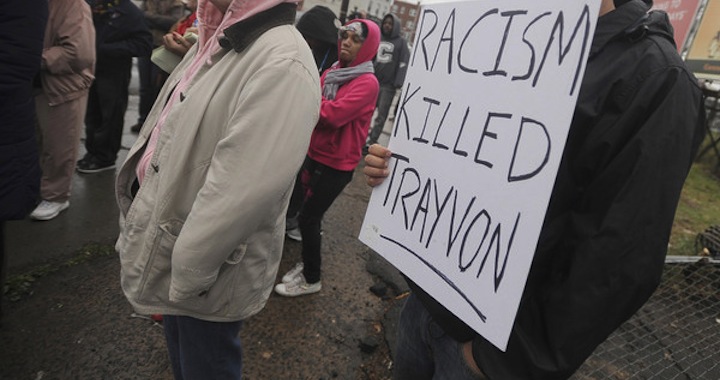
The media flocked to this story because millions of African Americans see Trayvon Martin as the new Emmett Till.

In 1955 the issue was lynching; in 2013 it’s racial profiling and stand your ground laws.

If you’re thinking the issue would be settled by a jury verdict, remember that Till’s murderers were also acquitted by a jury of their peers.

But wasn’t Trayvon Martin a little thug?  Didn’t he initiate the fight?  Didn’t he have the well-intentioned Zimmerman fearing for his life?  Didn’t Trayvon’s pot-smoking past justify Zimmerman’s profiling?  Isn’t this whole story a saga invented by race-baiters like Al Sharpton and Barack Obama?  Haven’t there been a series of black-on-white crimes much worse than anything Zimmerman did that have been ignored by the race-baiters?  Aren’t black people just trying to change the subject from their high drop out rates and single-parent family problem?

If you are asking these questions (and, Lord knows, some of you are) please read this post from Craig Watts that recently appeared on the excellent RedLetter Christians blog.

Beyond Trayvon Martin and Racism

Posted AUG 14 2013

by CRAIG M. WATTS 

Racism Killed Trayvon Martin
It continues even now. The group emails and facebook posts spotlighting incidents of black on white violence and the cries, “Where’s the outrage now like there was over Trayvon Martin’s death at the hands of George Zimmerman! Why isn’t the President speaking out now?” And each time the comparison offered shows a total lack of understanding about why Martin’s killing was different.

No doubt there have been acts of violence more horrible than Trayvon Martin’s case. And no doubt there is black on white violence as well as white on black violence, though most killings by far involve people of the same race. And certainly innocent people of all races have been killed.

Still there are differences in Zimmerman’s killing of Martin, differences that rightly led to the national attention.

The day after the court decision I was in Orlando, Florida where I was visiting with two men –one of them a minister- who were attending the NAACP national meeting. “It wouldn’t have gone down this way if Zimmerman was black and Trayvon was white,” remarked one of them.  “The police wouldn’t have failed to arrest an armed black man who tracked down an innocent white kid, caused a fight with him and then pulled out a gun and killed him. The police would likely shot the black man right there.”

No one can know for sure what the police would have done. But the scenario the man described is not at all farfetched. And it wouldn’t have made national news. Unfortunately, many white people –like those who make the questionable comparisons- have not even considered the matter from the perspective of a black man. (1) A young black man had done nothing wrong. (2) He was tracked down by an armed man of another race for no other reason than that the young man was black and therefore viewed with suspicion as a white young man would not normally have been. (3) The armed man provoked an unnecessary confrontation. (4) In the midst of a fight the armed man pulled out his weapon and killed the innocent black young man. (5) Police did not arrest the killer until there was a public outcry. (6) When the killer when to trial, he was declared “Not Guilty.”

Those who object to the attention given to the killing of Trayvon Martin and who continue to post stories of doubtful similarity to Martin’s case on Facebook or send them in emails fail to see that those six characteristics are essential to the whole issue.  Too many people the attention given to Zimmerman’s killing are simply in denial about enduring and still pervasive problem woven into the nation’s social fabric: racism.

I’m hesitant to simply label all these people as racists who point to other incidents of violence and make questionable comparisons. But I do believe a certain kind of moral myopia is at work, hindering their ability to see what’s going on. What appears as racism is often an expression of a broader problem: the failure to have sufficient empathy and compassion for people outside of one’s own circle, not only of race, but of class, nationality, sexual orientation and others crucial aspects of identity. This failure accounts for the apparent inability of some to even begin grasp the real issues at stake when discrimination and inequality come into play and even to blame the victims who are not like him or herself.

Sadly, this failure is far too prevalent among American Christians. Love, kindness, and compassionate understanding are present in them. But they don’t extend it in fullness to those who are not like them. Jesus sought to address this problem in the parable of the Good Samaritan (Luke 10:25-37). Loving our neighbors involves more than care for people who are like us. The circle of care and understanding must extend even to people who have been perceived as at odds with “our kind” of people. Suspicion must be put aside.

This matter is beyond racism. The failure to have sufficient empathy and compassion for people outside of one’s own circle, not only of race, but of class, nationality, and sexual orientation is a failure of moral imagination. We can’t “weep with those who weep and rejoice with those who rejoice” (Romans 12:15 ) if we can’t or won’t get out of our own shoes and imagine ourselves in their place. More likely we will minimize their suffering and troubles or attribute the misfortune to the people’s own personal flaws. We will insensitively judge and tend to be self-righteous.

Attitudes toward the poor among many people in the United States display this same lack of empathy and compassion. Too many blame the poor for their plight and assume their problems are the result of laziness or moral failings. In other words, they blame the victims rather than seek to sympathetically understand the struggles and suffering of those who are disadvantaged.  Self-righteous judgmentalism overshadows merciful traits found in the way Jesus dealt with the poor.

Christians will not be agents of reconciliation and healing as long as they see the world from the perspective of the privileged or fail to even attempt to see from the viewpoints for those who are unlike themselves in important ways.  We have a higher calling than simply to be representative of our race, class, nationality or whatever else defines us in this world. “As God’s chosen ones, holy and beloved, clothe yourselves with compassion, kindness, humility, meekness, and patience” (Colossians 3:12).

Was the Apostle Paul a woman-hater, or what?

evans_projectmatzoh_post.jpg
Rachel Held Evans having a bit of fun

By Alan Bean

The title of this blog post from Rachel Held Evans reads like a dusty treatise cribbed from a little-read theological journal, but it is well worth reading.  Before long there will be four posts in this series on the domestic codes of the New Testament and I urge you to read them all. (For more on the author, check out this piece from the Atlantic.)

At issue here are all those passages where Paul and a few other New Testament luminaries, make disparaging remarks about women; or at least that is how these passages are commonly read.  Rachel Held Evans doesn’t mind sharing her problems with the Bible, but she believes the domestic codes are only problematic when we rip them from their original context.  Fully contextualized, these passages are alive with life and blessing.

Four Interpretive Pitfalls Around the New Testament Household Codes

Rachel Held Evans

This is the first post in a weeklong series entitled  “Submit One To Another: Christ and the Household Codes,” which will focus on those frequently-cited passages of Scripture that instruct wives to submit to their husbands, slaves to obey their masters, children to obey their parents, and Christians to submit to one another (Ephesians 5:21-6:9, Colossians 3:12-4:6; 1 Peter 2:11-3:22). You are welcome to join in the conversation via the comment section or by contributing to our Synchroblog. Use #onetoanother on Twitter. 

***

Ever heard this before? 

“The Bible says wives are to submit to their husbands, so clearly, Christian men are supposed to be the heard of the household and Christian wives are supposed to defer to the wishes of their husbands when making family decisions.” 

Or this? 

“The Bible teaches husbands to love their wives and wives to respect their husbands because men need respect more than they need love and women need love more than they need respect.”  (more…)

What would King make of Obama?

By Alan Bean

Casey Sigal is an unsentimental Englishman who worked the civil rights beat in the early 1960s.  This piece in The Guardian touches on themes often ignored in mainstream reporting of this  week’s commemoration of the March on Washington.

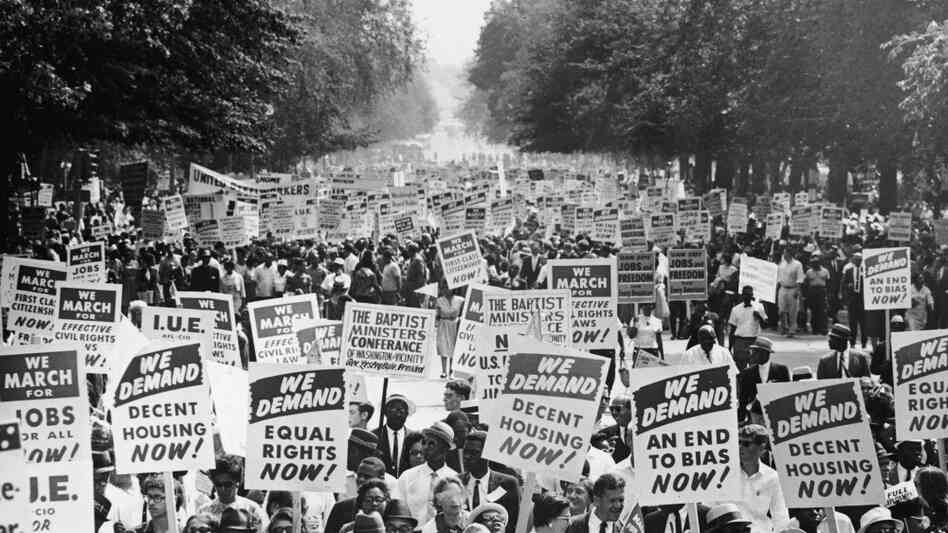
The march, Sigal reminds us, unfolded against a backdrop of fear bordering on dread.   Prisons had been emptied to make room for the scores of people sure to be arrested.  This is the way official Washington still looked at Negroes in the summer of 1963.

Moreover, the movement itself was sadly divided over tactics.  If Martin Luther King Jr. is the man most of us associate with the March on Washington it was probably because of his unique ability to maintain dialogue with the old civil rights establishment, the young firebrands associated with SNCC, and the incendiary leadership of Malcolm X.  All sides grudgingly agreed to let King take center stage because they knew he understood where they were coming from even if he couldn’t always agree with their conclusions.

King was a feared man in 1963.  He came preaching peace and forgiveness, but John and Bobby Kennedy knew they couldn’t embrace King’s message without kissing the Dixiecrat South goodbye.  John Kennedy died a few weeks later because his heart, if not his head, was with the civil rights movement and everyone in the South knew it.   King was willing to whittle down white fear to a manageable size, but he made no attempt to placate it altogether.  White racism was, and remains, an irrational, some would say demonic reality that must be rejected without reservation.

It is the question that introduces and concludes this piece that really intrigues me: what would MLK make of president Barack Obama?  Sigal doesn’t think the civil rights giant would be too impressed.  What do you think?

Remembering my time at the 1963 March on Washington

As we celebrate the 50th anniversary, we must ask: what would the Rev Martin Luther King think of Obama’s presidency?

By Casey Sigal

Saturday 24 August 2013 07.00 EDT

March on Washington

Crowds in front of the Washington Monument at the March on Washington. Photograph: Bruce Davidson/Magnum Photos

In 1963, a teenage woman civil rights worker in Albany, Georgia, said, “If you’re not prepared to die here then you’re not facing reality”.

Any of us who participated in the 1963 March on Washington for Jobs and Freedom will celebrate its 50th anniversary with a combination of sweet nostalgia and mixed feelings about its “legacy”. For me, and so many others, the event itself was redemptive and personally transforming. It had been a terrible year for African Americans and civil rights activists, a blood-drenched inventory of violence that included the jail beating of Fannie Lou Hamer and assassination of Medgar Evers. So on that Wednesday, 28 August, when 300,000 Americans from right across what I call the “decency spectrum” descended on an almost deserted Washington, it was as if a Norman Rockwell painting had come alive. (more…)

Is a war on the undocumented replacing the war on drugs?

By Alan Bean

It was refreshing to hear AG Eric Holder (and a swelling chorus of conservative critics) denouncing the folly of the war on drugs and the bloated prison population that followed in its wake.  Hopefully, the president’s use of the pardon will reflect this perspective.  But while the ranks of narcotics defendants have begun a slow but steady decline, America’s war on immigrants is quickly filling the void.

In uncluttered and accessible prose, Chris Kirkham reveals a disturbing world that is unfamiliar to most Americans.  It is just as foolhardy and counterproductive as the war on drugs, but the military-industrial complex (desperate for new sources of revenue) and the private prison industry (which would be ruined by a full-scale retreat from the war on drugs) are thrilled by recent federal policy decisions.  If the Senate immigration bill is adopted without major alteration, these folks will experience a windfall beyond their wildest imaginings.

War On Undocumented Immigrants Threatens To Swell U.S. Prison Population


kirkham@huffingtonpost.com

Posted: 08/23/2013

undocumented immigrants prison
For decades, drug crimes contributed to an explosion in the size of the federal prison system, far outpacing any other charges brought by prosecutors.

Now, just as the federal government has pulled back the throttle on the drug war, it is embarking on an unprecedented campaign to criminally prosecute undocumented immigrants crossing the border. The result: A new wave of non-violent offenders are flooding the nation’s prisons.

“This is the crime du jour,” said Judith Greene, director of the nonprofit Justice Strategies, which has focused on the private prison industry’s growing reliance on incarcerating undocumented immigrants. “It’s the drug war all over again. It’s what’s driving the market in federal prisons.”

Immigration offenders represent one of the fastest-growing segments of the federal prison population, providing a lucrative market for private prison corporations that largely control these inmates in the system. Over the last decade, revenue from the federal prison system has more than tripled for the GEO Group and nearly doubled for Corrections Corp. of America — the two companies that dominate the private prison industry. (more…)

A study in civic priorities, by state

By Alan Bean

This map gives us the highest paid public employees by state.  I would have thought social workers or school teachers would win the prize in at least one state.  Sadly, no.

On first glance, it appears that Blue states tend to favor basketball coaches while Red states lean toward football coaches.  But that theory breaks down under close examination.  Northern states, Blue and Red, are more likely to pay academics more than coaches.  Must be the influence of that cool Canadian air.  Vermont pays the big bucks to hockey coaches (another Canadian influence, obviously) but I bet they don’t get paid as well as the football and basketball gods.

Fred Clark: Victor Hugo’s theory for why the rich resent the poor

Victor Hugo’s theory for why the rich resent the poor

Posted: 17 Aug 2013 11:17 PM PDT

Chris Hedges sent me looking for this, from Victor Hugo in Les Miserables:

On the part of the selfish, the prejudices, shadows of costly education, appetite increasing through intoxication, a giddiness of prosperity which dulls, a fear of suffering which, in some, goes as far as an aversion for the suffering, an implacable satisfaction, the I so swollen that it bars the soul . . .

That’s harsh. It’s particularly harsh because it’s so precisely accurate.

“A fear of suffering which, in some, goes as far as an aversion for the suffering” diagnoses the disease now afflicting American politics. Whether it’s food stamps or gun safety, lead and mercury poisoning or substandard schools, access to health care or the dual mandate of the Fed, this is what shapes our discourse.

This accounts for the great mystery at the heart of American politics — the backwards flow of resentment. In America, the wealthy resent the poor, the powerful resent the powerless, the well-fed resent the hungry, leaders of the dominant religion resent religious minorities, privileged whites resent people of color, privileged men resent women.

This is an enigma. It seems impossible. The poor do not deprive the rich, so how is it even possible for the rich to resent them? We can understand how the downtrodden might resent those who have beaten them down, but what possible reason could there be for those at the top to resent those they grind beneath them? There is no rational basis for this resentment — no way of explaining it.

Hugo offers a theory: The fear of suffering can fester into an aversion for all who suffer. Those who suffer are a reminder of the thing we fear. And so we come to resent those who suffer, and therefore we seek to punish them.

That fits the confounding facts. It helps us to understand the disgraceful, gravity-defying miracle of reverse resentment.

Concern over NSA violations is growing

By Alan Bean

Are Bradley Manning and Edward Snowden heroes or traitors?  Your answer to that question likely depends on whether you think it is more important for the federal government to investigate terrorism or to respect the civil rights of Americans.

I have always inclined toward the latter view priority.  This is partly because I’m convinced the Bean family phone was tapped in the midst of our advocacy on behalf of 47 wrongfully convicted drug defendants in Tulia, Texas between 1999 and 2003.  Shortly thereafter, I applied for American citizenship, a process that was repeatedly stalled because of security concerns.

Experiences like that make you suspicious of government eavesdropping.  We weren’t breaking any laws.  In fact, we were standing up for the constitutional rights of America citizens–which is supposed to be a good thing, right.  And yet the federal government found our advocacy work suspicious, even threatening.

I could be wrong about all of this, of course.  But I’m convinced that my concerns are legitimate and it is that conviction that drives my emotional reaction to the Manning-Snowden disclosures.  Nothing against Barack Obama personally, but I object to his feverish, slightly paranoid response to the Snowden leaks.

Whenever national security is at issue the stakes are high.  I realize that.  But, like all human beings, I am biased, and my biases are rooted in personal experience.

It appears that I am in the minority on this one.  Two-thirds of the American population thinks investigating terrorism trumps security concerns.

I am not anti-government, but I am a Christian who takes the doctrine of human depravity seriously.  The idea isn’t that we’re all bad to the core (although some of us may be).  Human depravity means that everything we do, think and believe is tainted, at best a mix of truth and falsehood, right and wrong, good and bad.  Public officials, even those who appear in uniform on Meet the Press, are no exception to that rule.  Human beings get things really wrong all the time.

I love us, but I don’t trust us.

As President Reagan put it, “Trust and verify”.  I trust the government; but I want a watch dog looking over the shoulder of every public official in America, making sure they are performing their duties in the public interest.

Thanks to Edward Snowden we now know that the NSA has exceeded the limits established by Congress on thousands of occasions since Barack Obama took office.  This troubles me and I think it ought to trouble you too.

The Washington Post-ABC News poll cited below suggests that concern over the official invasion of privacy is growing along bi-partisan lines.  This isn’t primarily a culture war issue.

Not surprisingly, Democrats were far more concerned about privacy and civil rights issues when George W. Bush was president.  But recent revelations have forced a re-evaluation.  Three-quarters of the population agrees that our civil rights have been abused by federal agencies, but most folks think that’s just the price tag that comes with security.

For a free people, that price is too high.

Read the study and tell us what you think.

Concern over NSA privacy violations unites Democrats and Republicans, poll finds

By Scott Clement, Published: August 16 at 11:31 amE-mail the writer

Fresh disclosures that the National Security Agency broke privacy rules threatens to  fuel Americans fast-growing concerns about civil liberties. But the surprising partisan consensus that programs trample on privacy marks a key feature of public assessments, representing a break from similar debates during George W. Bush’s presidency.

A July Washington Post-ABC News poll — before the latest disclosures reported by The Post — found fully 70 percent of Democrats and 77 percent of Republicans said the NSA’s phone and Internet surveillance program intrudes on some Americans’ privacy rights. What’s more, Democrats and Republicans who did see intrusions were about equally likely to say they were “not justified:” 51 and 52 percent respectively. Nearly six in 10 political independents who saw intrusions said they are unjustified. 

There was less partisan agreement in 2006, when news about the George W. Bush administration’s warrantless wiretapping program broke. That January, a Post-ABC poll found 73 percent of Democrats — but only 50 percent of Republicans — said federal agencies were intruding on some Americans’ privacy rights.

Intrudes on some americans privacy

The current agreement is striking given how far apart Democrats and Republicans stand on views of President Obama and virtually all other political issues,  but it also marks a return to the year following the Sept. 11, 200, terrorist attacks, when overwhelming majorities in both camps prioritized terrorism investigations over invasions of personal privacy.

The agreement did not last long, as Democrats’ privacy concerns rose sharply in 2006 while Republicans maintained focus on investigations. But that commitment has waned in the past two years to nearly match Democrats: In the July Post-ABC poll, 32 percent of Democrats and 33 percent of Republicans said it’s more important to avoid privacy intrusions.

Post-ABC polls

See interactive results and complete trends over time from the latest Post-ABC poll.

Defense lawyers will put federal government on trial

A slide from a presentation is seen about a secretive information-sharing program run by the U.S. Drug Enforcement Administration's Special Operations Division
A slide from a DEA presentation

Suppose the Drug Enforcement Agency gets some information about illegal drug activity from a confidential informant of dubious reputation and they don’t want defense attorneys grilling the poor sap on the stand.  What to do?

A series of articles recently published by Reuters reveals that since the early 1990s the DEA has employed a clever work-around.

Instead of using the actual source of the information, the DEA alerts law enforcement to pull over a particular car at a specified time and place and, sure enough, the trunk is full of powdered cocaine.

Here’s the kicker: the DEA doesn’t have to tell defense counsel how they knew to stop that particular vehicle.  In fact, they don’t even have to reveal this information to local law enforcement, the prosecutor or the judge.  Everyone is left in the dark and somehow that’s okay. (more…)