Author: Alan Bean

East Texas Case Highlights the Abuse of Texas Forfeiture Law

[Lynda+Russell.jpg]
Shelby County DA Lynda Russell

This is one of those stories that slipped past me.  Thanks to Friend of Justice, James Canup for bringing it to my attention.  AGB

Authorities in the Deep East Texas town of Tenaha have been making the most of Texas forfeiture law.  According to a CNN report,  law enforcement in this town of 1,000 on the Louisiana border raked in $3 million between 2006 and 2008.  Most of the money, you will be surprised to learn, was seized from black and Latino motorists.

Forfeiture law sounds like a good idea.  Law enforcement seizes assets from drug dealers and funnels the filthy lucre into the war on drugs.  The good guys enrich themselves at the expense of the bad guys–who could ask for anything more?

Unfortunately, if you focus your attention on low-status minority drivers, you can forget about probable cause.  Why else would a black or brown individual have more than $20 in his pocket?  Amounts larger than that are clearly drug assets, right?

So you make the guy an offer he can’t refuse.  A Tennessee man was cruising through the Shelby County town a few years ago when the local cops pulled him over–he was doing 37 in a 35 zone (irrefutable evidence of drug dealing in itself).  Roderick Daniels was told that if he forfeited the $8500 they found in his wallet, money laundering charges wouldn’t be pressed. 

Daniels cooperated with the officers, then quietly sued the county.

File:Map of Texas highlighting Shelby County.svg
Shelby County, TX

 Daniels claims he intended to spend the $8500 on a car.  Who would pay cash for a used car, you ask?  Working class folks, that’s who.  I know people  who cash their pay check and then drive around to all the utility companies to pay their bills in cash.  Bank accounts are largely a middle class phenomenon; hard living folk prefer to deal in cash money.

Who knows, maybe Daniels was fresh from a big drug deal; but he doesn’t have to prove his innocence.  (If the picture above is anything to go by, Shelby County DA, Lynda Russell looks pretty suspect herself.)

Here’s the practical result of giving law enforcement a license to print money–motorists from out-of-town are considered guilty until they prove their innocence . . . or kiss the cash in their pockets good-bye.

In March of this year (just before joining staff of The Stars and Stripes) Howard Witt of the Chicago Tribune wrote a feature story on Tenaha’s forfeiture frenzy.  “If used properly, it’s a good law-enforcement tool to see that crime doesn’t pay,” John Whitmire, chairman of the Senate’s Criminal Justice Committee, told Witt. “But in this instance, where people are being pulled over and their property is taken with no charges filed and no convictions, I think that’s theft.”

Can we safely assume that law enforcement will make “proper use” of forfeiture laws that can put $3 million in the pockets of a little town like Tenaha?  Whitmire clearly doesn’t think so–he and other Texas politicians have been working to rewrite the law to prevent further abuses.

Tenaha, TexasWitt’s story in the Tribune highlights the work of the Nacogdoches attorney who filed a federal lawsuit on Daniel’s behalf.  David Guillory “combed through Shelby County court records from 2006 to 2008 and discovered nearly 200 cases in which Tenaha police seized cash and property from motorists. In about 50 of the cases,” Witt reports “suspects were charged with drug possession.  But in 147 others, Guillory said the court records showed, police seized cash, jewelry, cell phones and sometimes even automobiles from motorists but never found any contraband or charged them with any crime.”

Guillory was able to contact 40 of the motorists directly.  All but one of them were black. 

Here’s Guillory’s conclusion:

The whole thing is disproportionately targeted toward minorities, particularly African-Americans.  None of these people have been charged with a crime, none were engaged in anything that looked criminal. The sole factor is that they had something that looked valuable.

Tenaha may be the more aggressive at going after forfeiture money than most Texas towns, but the problem on display in this little town are ubiquitous.

Judges judging judges

This Houston Chronicle piece reveals that “only seven judges in the last decade have faced formal disciplinary action as a result of the nation’s secretive misconduct review process. In that same period,” the article reports, “citizens filed more than 6,000 formal misconduct complaints.”

True, most of these complaints come from irate defendants who didn’t like the customer service they received in the courtroom.  I get letters complaining about judges all the time and few of them involve meaningful allegations. 

Still, are we to believe that only seven complaints over a ten-year period were worthy of review?

The problem, Lise Olsen suggests, is that judges are judging the judges.  Poor black defendants rarely get a jury of their peers but judges always do.  This isn’t exactly like having the fox guard the henhouse; but when Foxy-Loxy has a mouthful of feathers, you want a few chicken’s on the jury. 

Judges are generally good, disciplined, well-intentioned people who take their jobs seriously.  But there are plenty of judges who function as an extension of the prosecutorial arm.  To employ a pro wrestling analogy, some judges work as tag team partners for the US Attorneys Office. 

The Houston Chronicle article is primarily concerned with out-of-the-courtroom behavior like sexual harassment.  A serious matter, no doubt, but I am more concerned with what goes down inside the courtroom.

In fairness, the judges I have observed in the federal system (conservative, liberal, and somewhere in between) have generally been fair.  The tag team phenomenon is most commonly on display in thinly populated counties where due process concerns carry little weight.  When the same judges and prosecutors work together on a daily basis the independence of the judiciary is in jeopardy.

Judge Ed Self, the man who presided over the majority of the trials related to the Tom Coleman operation, once ran a campaign ad promising to work closely with law enforcement to put drug dealers behind bars.  That’s not supposed to be a judge’s job; but when you’re up for election in a rural county it’s best to talk tough.

Federal judges don’t have to worry about the electorate because they enjoy lifetime appointments.  On the whole, that’s a good thing.  William Wayne Justice, a federal judge in the Eastern District of Texas, received death threats when he ordered the public schools under his jurisdiction to integrate in 1970.  Justice had little choice in the matter since, a year earlier, the Supreme Court had settled the matter in the high-profile Alexander vs. Holmes County case.  It is questionable whether any state court in the South would have done the right thing in the face of massive resistance.

But the power conferred with lifetime appointments can give federal judges a much too high opinion of themselves.  We should hold the role of judge in high esteem while remembering that individual jurists are flesh and blood humans subject to the full range of temptation.  When federal judges are accused of misconduct there must be an independent evaluation process.  Because every judge is vulnerable to complaints from the public there is a natural bias in the direction of leniency.  When judges go bad (inside or outside the courtroom) our system of justice is in peril.

Narrative strategy 101: a word to our readers

Did you read my recent post about Fannie Lou Hamer’s religion, or the one I sent out yesterday about the vicious beating Hamer and her friends sustained in 1963?  If you didn’t read either piece it may have been because you didn’t see the point.  “Who the hell is Fannie Lou Hamer,” you may have asked, “and why should I care?”

As most of you have gathered by now, all the posts about the history of the Mississippi civil rights movement have some connection with the case of Curtis Flowers, the thirty-nine year-old Winona native who will soon stand trial for an unprecedented sixth time on the same murder charges.  Perhaps you are waiting patiently for me to connect the dots between 1963 and 2009 and are beginning to wonder where I’m going with all of this.  If so, this blog is for you.

My inquiry into the Flowers case began with a couple of visits to Winona.  I met with the Flowers’ family, talked to his extended social network and visited with his attorneys in Jackson.  They handed me a CD containing the transcripts of the five trials that have taken place thus far.  It was while plowing through thousands of pages of trial testimony that the historical questions began to emerge.

The case against Flowers was exceedingly weak.  I saw that immediately.  The physical evidence was largely junk science.  The eye witnesses either lacked credibility or failed to support the state’s theory of the case.  Furthermore, the crime itself had all the earmarks of an organized hit.  There are some people in our sorry world who would kill four people in cold blood over $82, but Curtis Flowers didn’t fit the profile. 

Nonetheless, Doug Evans, the man who has prosecuted Curtis Flowers five times, thought he had a solid case.  He didn’t just think it; he knew it.  Otherwise, he would have deep-sixed this case years ago (can you imagine how weary of the details he must be by now).  But four innocent people were killed in Winona on July 16, 1996, Mr. Evans thinks he knows who did it, and it is his job to make that man pay.

In the mind of DA Doug Evans it’s just that simple.

So why, I asked myself, did a case this weak seem strong to DA Evans?

While I was pondering that question I stumbled upon State Senator Lydia Chassaniol, the former Winona school teacher who raised eyebrows by addressing the annual meeting of the Council of Conservative Citizens last summer.  Her picture looked so friendly; she looked like everybody’s auntie.  I imagined I would enjoy her company if we were ever introduced.  Yet Miss Lyida was a proud, card-carrying member of an organization proudly rooted in the old citizens’ council movement. 

History has always been important to the Friends of Justice.  I didn’t understand what was going on around me in Tulia until I researched the history of the town.  But with the Flowers case history is everything.

I knew I would find the mindset driving this case buried in the ashes of history.  I didn’t know what I would find.  I’m still not sure how all of this ties together, but I’m certain it does.  So I started reading through the files of the Mississippi Sovereignty Commission, I leafed through several books and dozens of articles.  The piece I wrote on Hamer’s beating in Winona, for instance, was culled from twenty different sources.  At Friends of Justice we do our homework.

Lawyers rarely ask why a prosecutor is bound and determined to prosecute a weak case.  Legally, it doesn’t much matter.  Prosecutors are only accountable to the public at election time and are free to prosecute any case they wish for any reason.  Similarly, attorneys don’t generally delve into the historical nexus of a case.  In the courtroom, history is irrelevant.  The law assumes that prosecutors, judges and defense attorneys are fair-minded, unbiased individuals who have the best interest of the public at heart. 

Therefore, when Friends of Justice says we are fighting for Curtis Flowers we aren’t usurping the role of the attorneys assigned to the case.  Curtis Flowers is being defended by a team of attorneys with the Office of Capital Defense Counsel in Jackson, Mississippi.  Ray Charles Carter, Mr. Flowers’ lead attorney, serves on the board of the National Association of Criminal Defense Lawyers.  The man is an excellent attorney who has represented Curtis three times and will soon represent him a fourth time.  Friends of Justice doesn’t do legal work–that’s Mr. Carter’s job.  Everybody clear on that.

Furthermore, Mr. Carter and the Office of Capital Defense Counsel can’t be held responsible for what Friends of Justice says and does.  We honor attorney’s wishes whenever possible, but we our work is entirely autonomous. 

The narratives Friends of Justice creates are intended to impact the courtroom indirectly by bringing scrutiny and historical perspective to a case.  Attorneys rarely appreciate the potential impact of our strategy until they see it in operation.  Once journalists and advocacy groups take an interest in a case the Doug Evans’s of this world are forced to answer the hard questions that can’t be asked inside the courtroom.  The BBC story on the Flowers case is only the beginning.  Thus far, just over 1,550 people have checked out the blog version of the Curtis Flowers story–but interest is growing rapidly.

In the meantime, I will keep bringing you the story, episode-by-episode.  My conclusions will be shaped by facts not ideology.  Next, you will learn what became of Fannie Lou Hamer after she was assaulted by the State of Mississippi in the summer of 1963.  Prepare to be amazed.

Doing well by doing good

Jeff Blackburn

Steven Phillips, one of the several dozen men exonerated through the efforts of  the Texas Innocence, is suing two Texas attorneys.  According to Phillips’, Amarillo attorney Jeff Blackburn and Lubbock attorney Kevin Glasheen are claiming $1 million in legal fees from Phillips.

Blackburn says its all a misunderstanding because, regardless of what the paperwork says, he has no financial interest in the case.  It appears evident, however, that Blackburn and Glasheen stand to collect a combined $8 million from representing Texas exonerees.

Jennifer Emily’s story in this morning’s Dallas Morning News is by far the most critical piece published thus far.  Emily quotes State Representative Raphael Anchia thusly:

“When I hear about folks potentially abusing and taking the money of the exonerees, it really breaks my heart. They should be helping the exonerees on a pro bono basis. The exonerees have suffered enough.”

The DMN article also quotes Michelle Moore, who once worked with Blackburn at the Innocence Project of Texas.  “It was bad enough to see private attorneys do it, taking 30 to 40 percent” Moore told the DMN, “but to see people who are supposed to be helping … I have no problem with someone who does attorney’s work receiving a fee. But when it’s a one-page document the guy could fill out himself …”

Finally, Texans for Public Justice, identified in the article as “a watchdog group”, has made statements critical of Blackburn and Glasheen.  “”The Texas Innocence Project will suffer a huge loss of innocence,” the group says “if its top attorney worked by day as a pro bono attorney for the falsely accused while secretly angling by night for a cut of those exonerees’ monetary settlements.”

Meanwhile, the blogosphere is picking up on the story.  “Frankly, I find this whole thing disgusting,” one blogger writes.  “The compensation paid by the state was to help make up for a huge injustice done to these exonerees. It was not meant to make attorneys rich.”

But that appears to be the real issue here: should attorneys be expected to invest thousands of unreimbursed hours working for their clients? 

Scott Henson at Grits for Breakfast doesn’t think so.  Grits calls State Rep. Achaia naive for expecting attorneys to work pro bono–how are they supposed to pay the mortgage?  Until recently, Henson worked with Blackburn and Glasheen for the Innocence Project of Texas.  He takes issue with Michelle Moore’s comment about lawyers charging the big bucks to help fill out a one-page form.  Scott’s argument here requires an extensive quotation:

The fact is that Texas already had a compensation statute when Steven Phillips got out of prison, but at a much lower compensation rate. All of the fellows who hired Glasheen (some of whom, but not Phillips, for which Blackburn receives a referral fee) could have filed that same one-page document already and received compensation at a lower rate. They each had a choice under the law: Sue or accept compensation. Some did accept the compensation and didn’t pay lawyers anything. Bully for them. That was their decision, but they’ll receive less money overall than Mr. Philips. The only ones on the hook for attorneys fees are the ones who made a conscious choice that the previous compensation package was not enough.

Under the law for exonerees who reject the state compensation package, their other option for compensation was and is to hire a lawyer and sue . . . Those lawsuits were settled this spring in light of Texas’ new compensation bill and a portion of the bill’s success may be attributed directly to leverage from Glasheen’s litigation – particularly among Dallas-area reps like Anchia whose local governments could otherwise be on the hook for big civil judgments. If the bill had failed, the litigation would have gone forward, including Mr. Phillips’, of that I have little doubt.

Bottom line: these exonerees are in a unique position because of a) choices they made and b) the point in history they made them. Nobody going forward will find themselves similarly situated because the law has changed.

This issue reveals a common assumption: those who work on behalf of indigent defendants are self-serving if they are reimbursed for their services.  It is generally believed that attorneys like Blackburn and Glasheen are on salary to the Innocence Project of Texas.  I’m not sure if that’s true and would like to be enlightened.

There is also the issue of proportionality.  If Blackburn and Glasheen rake in $8 million for their services on behalf of exonerated defendants they will be earning more in a single year than the combined incomes of several dozen full-time Texas criminal justice reform advocates.  The natural response, Scott Henson suggests, is that the attorneys in question lobbied extensively for legislation that, when passed, greatly expanded the pool of money available to the exonerated. 

I am willing to buy that argument, but an immense compensation gap remains between high profile attorneys like Jeff Blackburn and the hundreds of people across the county who have given up the criminal justice reform game in recent years because they couldn’t make a living at it.  The same issues arose in the wake of the Tulia drug sting.  Jeff Blackburn was reimbursed handsomely (albeit for several years of hard work) while the rest of the advocacy network assembled around the case was recompensed at much lower levels, or not at all. 

Friends of Justice and the Kunstler Fund for Racial Justice, the organizations that brought the case to national attention, received not a nickel.  The Texas ACLU was the first established Texas-based organization (eight months after Friends of Justice first blew the whistle) to enter the Tulia fight and they didn’t have a financial stake in the game when the winnings were divided.    It was just the way things worked.

True, there are many services that only attorneys can perform, and they certainly deserve to be reimbursed, but if the Tulia defendants had relied on Panhandle attorneys to go to the wall on their behalf (before 20/20 and the New York Times were involved, that is) they would have been sorely disappointed.  The first steps must be taken by plucky, small-budget organizations who assume all the risk and reap none of the profit.

The same scenario played out in Jena, Louisiana.  A few attorneys involved in the Jena fight were paid reasonable fees for their services but nothing approaching Blackburn-Glasheen levels.  As in Tulia, most of the legal work was on a pro bono basis.

Of course, in Tulia and Jena, pro bono attorneys were working fordeep-pocket law firms who could afford to make a few attorneys available.

There is little consistency, proportionality or fairness to all of this.  But if attorneys representing the Innocence Project of Texas are getting rich (and yes, $4 million in fees qualifies as rich in my book) the public should be aware of it.  This story illustrates just how little the mainstream media understands about the legal business.  Attorneys like Jeff Blackburn take big risks and incur big losses.  Sometimes they hit the jackpot.  That’s the way the game is played.  One thing is clear, none of the attorneys associated with the Innocence Project were working out of the goodness of their hearts. 

My guess is that more light is yet to be revealed.  I’ll keep you apprised.

“Songs got us through”: Fannie Lou Hamer in Winona

Fannie Lou Hamer never recovered from the beating she suffered in the county jail in Winona, Mississippi.  A blood clot eliminated vision in one eye.  Severe damage to her kidneys shaved decades off her life.

The sadistic brutality Hamer and her friends endured in Winona beggars comprehension unless you understand the times.  In 1963, only 6.4% of Mississippi’s eligible black voters were registered.  In Montgomery County it had been years since the last African-American had voted.  It took men like Sheriff Earl Wayne Patridge to maintain this unnatural state of affairs.

Patridge took office in a violent time.  His predecessor, Lawrence King, had paid two black men to kill one of his deputies, William L. Kelly.  King had been sleeping with Kelly’s wife and wanted to eliminate the competition.

By the time Fannie Lou Hamer arrived in Winona on June 11, 1963, Patridge was skilled at bending violence to his purpose.  A young black man named Jake Daniels was savagely beaten by police officers on at least two occasions, most recently just months before Hamer came to town.  A year earlier, Patridge and his officers beat up a young black man named Johnnie Frazier shortly after the Interstate Commerce Commission (in theory) integrated bus stations across the South.  Frazier figured that federal law applied in the State of Mississippi so he tried to eat at Staley’s Cafe, a whites-only establishment serving patrons at Winona’s Trailways depot.  These are the acts of violence that drew the attention of the Federal Justice Department–there were almost certainly other beatings that went unreported.

Sheriff Earl Wayne Patridge had a rule: Any nigger dumb enough to challenge Jim Crow in Montgomery County got a whipping–no exceptions.

On June 9, 1963, Fannie Lou Hamer and several other civil rights workers were returning from a trip to Septima Clark’s citizenship school in Charleston, South Carolina.  When they changed buses just over the Mississippi line, the group, still brimming with righteous fervor, insisted on sitting at the front of the bus.  The driver forcibly drove the group to their proper place at the rear, then phoned ahead to Winona.  When the troop arrived in Montgomery County, Earl Wayne Patridge, several of his deputies and a state trooper were waiting for them.

Hamer stayed on the bus while her companions attempted to get service in Stacey’s Cafe.  When the group was driven from the diner by force, Annelle Ponder, a stately school teacher from Atlanta, started taking down the license plate numbers of the police cars parked outside the depot.

Looking out the bus window, Hamer could see her friends being herded into police cars.  Rushing to the rescue, Fannie Lou was kicked in the shins by a sheriff’s deputy and taken into custody.

Six travelers were arrested on June 9. 1963: Annelle Ponder, Fannie Lou Hamer, 15-year-old June Johnson of Greenwood, young SNCC activist Euvester Simpson from Ita Bena, James West, and Rosemary Freeman.  June Johnson was the first to experience the wrath of Sheriff Patridge and his boys.  Stripped naked, she was smacked around the interrogation room until her face was a mask of blood.  There was an element of sexual sadism at work; a celebration of power and dominance that trumped simple lust.

Next, the men in uniform dragged in Annelle Ponder, the woman who intended to report them to the authorities.  They wanted Ponder to call them “sir”.  She told them she didn’t know them well enough to know whether they deserved that courtesy.  Smacked hard across the face, Ponder collapsed to the floor.  The men dragged her back to her feet and once again she was told to call her tormentors “sir”.  When she refused outright, a hail of blows drove her back to the floor.

Hovering on the margins of consciousness, Ponder called out to God to forgive her tormentors.  There were enough Baptists in the room to catch the biblical reference: “Forgive them, Father, for they know not what they do.”

Outraged by such uppity blasphemy, Patridge and his boys beat Ms. Ponder senseless and dragged her back to her cell.

Next they came for Fannie Lou Hamer.

“Where you from?” an officer asked.

“I’m from Ruleville,” she answered quietly.

“We’ll see about that,” the man replied with a sneer.  A call to Sunflower County revealed that Hamer was a seasoned agitator famous for singings gospel songs at civil rights rallies.
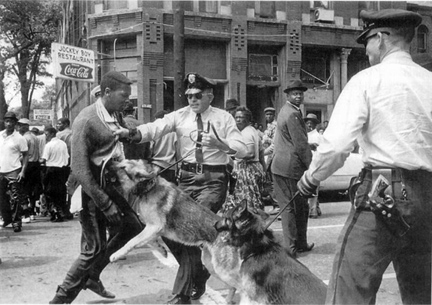
You can’t understand the species of rage on display in the Montgomery County Jail unless you remember what was happening in America in the spring and summer of 1963.  A month earlier, student protesters in Birmingham, Alabama (just a few hours from Winona) had been attacked by police dogs.  The home of Mississippi NAACP field secretary Medgar Evers had been fire bombed around the same time, and at the University of Alabama, Governor George Wallace was shouting, “Segregation forever” to cheering crowds as he threatened to bar a black student from enrolling at the state university.

Men like Earl Wayne Patridge were under seige; winning every battle,yet losing the war.

The deputy returned from running the identity check on Fannie Lou Hamer and flashed a malicious grin.  “You’re from Ruleville, all right,” he said, “and now we’re gonna make you wish you was dead.”

This was no idle threat.  After dishing out two vicious beatintgs the men in the interrogation room were growing weary.  Two black inmates were brought into the room, handed weapons and told that they better do what they had been told or there would be hell to pay.  Using black men to do the dirty work was an old Mississippi standby.  Black men were sometimes used to light the pire at lynchings and, as we have seen, ex-sheriff Lawrence King had hired two black men to do in his deputy.

The first inmate was handed a cosh, a lead pipe encased in leather with a flexible handle.  Instinctively, Fannie Lou Hamer rolled onto her belly.  She had suffered from polio as a child and hoped to protect her weak side from what was coming.

As the blows rained down, Hamer started moving her feet and the second inmate sat on her legs to keep her still.  Her dress had started working up her leg and Hamer tried valiantly to pull it down.  A deputy stepped forward and pulled the dress all the way up.  When Hamer told her Winona story she always included this humiliating detail.  She didn’t use fancy words like “sexual sadism”.  She didn’t have to.

When the inmate with the cosh grew tired, the two men switched places.  The beating went on and on until Hamer’s flesh had grown hard and grotesque cuts and gashes covered her body.  Hamer was ordered to get up.  She couldn’t move and had to be dragged back to her cell.

Through a hellish night, young Euvester Simpson did everything in her power to keep her cellmate alive.  Years later, Simpson shared this account with an interviewer:

I sat up all night with her applying cold towels and things to her face and hands trying to get her fever down and to help some of the pain go away. And the only thing that got us through that was that … we sang. We sang all night. I mean songs got us through so many things, and without that music I think many of us would have just lost our minds or lost our way completely.

In the early sixties, jailers in small towns generally lived in the jail with the inmates. I have often wondered what the jailer felt when they heard muted songs of praise drifting through the cell block.    A day or two after the beating, Hamer told the jailer’s wife to read Proverbs 26:26: “Whose hatred is covered by deceit, his wickedness shall be showed before the whole congregation.”  She also suggested Acts 17:26, the verse declaring that God “hath made of one blood all nations of men for to dwell on the face of the earth.”

The woman dutifully jotted down the biblical references, but the two women never met again.

Meanwhile, Martin Luther King and the rest of the Southern Christian Leadership Conference staff in Atlanta were learning that five of their people had disappeared in Winona.  Hours later, news of the arrests arrived in the White House.  Dogs and bombings in Birmingham, Governor Wallace’s stand for segregation and the disappearance of civil rights workers in Mississippi made it impossible for President John Kennedy to maintain his neutrality.  While Fannie Lou Hamer and Euvester Simpson subsisted on a diet of gospel songs, Kennedy told his aids he was going on national television.  The speech, written almost entirely by Kennedy himself, was the most candid engagement with American racism any US president had ever made.

We preach freedom around the world, and we mean it, and we cherish our freedom here at home, but are we to say to the world, and much more importantly, to each other that this is the land of the free except for the Negroes; that we have no second-class citizens except Negroes; that we have no class or caste system, no ghettoes, no master race except with respect to Negroes?

Now the time has come for this Nation to fulfill its promise. The events in Birmingham and elsewhere have so increased the cries for equality that no city or State or legislative body can prudently choose to ignore them. The fires of frustration and discord are burning in every city, North and South, where legal remedies are not at hand. Redress is sought in the streets, in demonstrations, parades, and protests which create tensions and threaten violence and threaten lives.

We face, therefore, a moral crisis as a country and a people. It cannot be met by repressive police action. It cannot be left to increased demonstrations in the streets. It cannot be quieted by token moves or talk. It is a time to act in the Congress, in your State and local legislative body and, above all, in all of our daily lives. It is not enough to pin the blame on others, to say this a problem of one section of the country or another, or deplore the facts that we face. A great change is at hand, and our task, our obligation, is to make that revolution, that change, peaceful and constructive for all. Those who do nothing are inviting shame, as well as violence. Those who act boldly are recognizing right, as well as reality.

America would never be the same.

Is Mississippi ready for the truth?

In the fall of 2010, Mississippi will introduce its school children to the civil rights movement.  When the new curriculum received its first round of  media attention in August, anxiety in the white community was palpable.  The comments section at the end of an article in the Jackson Free Press evolved into a lively debate between readers on both sides of the ideological divide.  Many white readers talked about “revisionist history” and feared the new curriculum was a thinly veiled attempt to get black children to hate whitey.  Others, white and black, disagreed vigorously.  You can’t promote healthy race relations, they argued, by burying the truth. 

This perception gap is also evident in a recent article in the Greenwood Commonwealth which I have pasted below (Commonwealth articles disappear from the web after a couple of weeks).   It’s hard to say what percentage of white Greenwood residents resist the simple lessons of history but the comments below aren’t encouraging. 

One reader questioned the wisdom of teaching civil rights history to students who can’t read properly:

There is nothing wrong with learning about your history, but you should also be taught to live in the present, and not forever dwell on the past. The students leaving school today can’t speak the english language. People need to give civil rights a rest and move on with their lives.There is more to life than something that happened fifty years ago. It’s almost 2010. Whats the point of learning something if you don’t have the intelligence to talk about it ?

You hear a variant of this complaint in some portions of the black community as well; it goes something like this: “We didn’t put our lives on the line for justice so our grandkids could hang around on the corners and ask their parents and grandparents to raise their illegitimate children.”

The full truth needs to be spoken.  Too many white Americans, especially in southern states like Mississippi, have never reckoned with the sins of their fathers or considered how the past impacts the present.  Too many young black Americans know virtually nothing about the horrors of segregation or the heroic struggle required to break the back of Jim Crow.  True, when black students learn the full truth they will be angry; but they will also feel their debt to generations past and their obligation to take up the struggle.  White America needs to be called to account; but accountability begins at home.  Black students, in Mississippi and throughout the nation, cheat themselves if they use the horrors of history to justify indifference and fatalism. 

Showing students civil rights history

By TAYLOR KUYKENDALL

Staff Writer

Published: Saturday, December 5, 2009 10:13 PM CST

Greenwood High School is adding a civil and human rights element to its curriculum as part of a statewide pilot program.

Under a 2007 law, the state Board of Education must provide school districts with more opportunities for such education. This year, 28 districts statewide, including Greenwood, are implementing the pilot program.

Next year, it will be a mandatory part of the U.S. history curriculum for all public schools.

“It’s important that all of our students have a greater awareness of civil rights,” said Jennifer Wilson, Greenwood’s assistant superintendent. “This program will put a greater emphasis on that.”

Two Greenwood High history instructors, Thomas Young and Larry McCluney, have been trained at workshops on teaching the new curriculum.

“One of the things they did was give us a list of people in different areas we could contact to speak to the class,” Young said. “A lot of people who were active in the civil rights movement are here in this area.”

McCluney said many children today know little about the civil rights movement. He said it was important to be able to do more than identify key historical figures such as Dr. Martin Luther King Jr., Rosa Parks and Harriet Tubman.

“Today’s children really don’t thoroughly appreciate nor understand what others went through to get where we are today,” McCluney said. “It would be a good thing to get them back into it.”

McCluney and Young said the new curriculum extends beyond blacks’ struggles in the 1960s. The program explores the pursuit for equal rights of all people, including women’s suffrage, Native American suffrage, immigration and more.

“The true purpose of a public school is to produce a citizen,” McCluney said. “This curriculum emphasizes the nation as a community and the direction that it is going.”

The material will be tested as a part of the U.S. History section of the statewide assessment. In addition to training teachers how to deliver the coursework, those participating in the pilot program are given resources to help them deliver the material to students.

“The training has been more about integrating the material into the rest of the classwork,” McCluney said.

He said he was excited about the new curriculum.

“It’s just important that we don’t lose sight of teaching American history in general,” he said.

Some of the things Greenwood Schools outlined as possible extensions of the history curriculum include:

  • Creating a student-led documentary with interviews with civil rights pioneers.
  • Using program resources such as DVDs, guest speakers and other teaching aids.

Comments

Be sure to teach this too wrote on Dec 7, 2009 11:26 AM:

” Instead of just teaching black children how bad their ancestors were treated, you absolutely have to teach them that hating white people causes even more problems. I’m a white male, age 35. I have never owned a slave and I have never owned a business that didn’t allow blacks inside my building. I have done nothing to the black people. Therefore, if a black person is racist against me (or any other person like me), I’d like to know WHY. So, if you’re going to teach them how bad they were treated, how are you going to keep them from growing up, hating white people? ”

Truth wrote on Dec 6, 2009 1:05 PM:

” Just be sure the truth is taught in regard to this subject. I am a white female who was a young adult in the 60’s. I assure you it was not a good or pleasant time for anybody. I also am a true southerner and have many, many black friends whom I love dearly. Please don’t teach hate to our children. Make them understand the nature of love and growth, understanding, and acceptance. ”

Great Idea wrote on Dec 6, 2009 10:50 AM:

” Students from this area definitely need to be educated on how much sacrifice was made in order for them to receive basic freedoms such as a right to an equal education, especially here in the Delta. I also think it’s important to recognize those civil rights legends from the Delta area to drive the point home. They need to be recognized and their stories need to be heard by those they affected the most and that’s the children of this community today. Finally, I can say a another great step forward to rectify the wrongs of the past that this state help perpetrate. Maybe our children will appreciate what they have more, at least that’s my hope and should be everyone’s hope. ”

Rev. CivilWrongs burnett blackmon wrote on Dec 6, 2009 9:38 AM:

” HateWhitey 101. Whatta deal. Next. ”

Lee wrote on Dec 6, 2009 8:00 AM:

” It’s important for our students to gain intelligence, first and foremost, before teaching them to hate other races, and blame other people for all thats wrong in their lives. there will be plenty of time later in life for that. Teaching people to live in the past is whats wrong with Greenwood today. There is nothing wrong with learning about your history, but you should also be taught to live in the present, and not forever dwell on the past. The students leaving school today can’t speak the english language. People need to give civil rights a rest and move on with their lives.There is more to life than something that happened fifty years ago. It’s almost 2010. Whats the point of learning something if you don’t have the intelligence to talk about it ? “

Huckabee Got it Right!

Mike Huckabee is done as a presidential contender.  That’s the word on the street.  When you commute a burglary sentence in 2000 and the guy shoots four police officers to death nine years later, you’re political toast. 

But ex-Governor Huckabee refuses to back down.  Fact is, he says, Maurice Clemmons didn’t go to prison for rape and murder back in 1989; he was in for burglary.  For that he was given a virtual life sentence.   That didn’t make a lot of sense to the Huckabee.  Would a stupid white kid from a good family get a sentence like that for a crime like that? 

So the governor commuted the sentence.  This gave Clemmons an opportunity to make his case to the Arkansas parole board.  The board looked at Huckabee’s reasoning and thought it made a lot of sense.

Objectively, it was the wrong decision.  Maurice Clemmons turned out to be a heartless psychopath–the kind of guy that guns down police officers for sport. 

Did Mike Huckabee know that back in 2000?  Was there any way of knowing?

Here’s how the presidential hopeful put the case when he appeared on The View:

The easy thing to do, and frankly the politically expedient thing to do, is to say no to every last one of them. That’s the easy thing. And you’ll always cover your rear end if you do that. Because nobody will ever say, ‘Oh you should have let these people out.’

But the reason we have executive clemency in our system of justice is because there are sentences that are disproportionate, there are times when the justice system failed. And our Founding Fathers were smart enough to create checks and balances, so that no one branch of government was able to act independently of the other two.

Conservative pundits and politicians aren’t buying this argument.  Americans, the reasoning goes, feel comfortable with politicians who never pardon anyone or commute any sentence for any reason. 

The sad case of Michael Dukakis keeps coming up.  Dukakis granted a furlough to Willie Horton and the man found a strange way to show his appreciation.  But the knockout punch came during the 1988 presidential debates when the Massachusetts governor was asked what he would do if his wife was raped and murdered.  Dukakis said he was opposed to the death penalty under any circumstances.  That answer, viewed in the context of the Horton furlough, killed the Dukakis candidacy.

At least that’s the prevailing wisdom.  But what if political ineptitude cost Dukakis lost the 1988 election?

For instance, what if the governor had prefaced his answer with this: “If my wife was raped and murdered, I would want to tear the killer’s heart out with my bare hands.  That’s the natural human response and I suspect you would feel the same way.  But our system of justice wouldn’t allow me to decide the fate of the man who killed my wife.  Our legal system is driven by justice, not personal vengeance.”

Vengeance can be good politics, no doubt about that.  But so can justice.  Mike Huckabee thought a life sentence for a single burglary was a vengeful sentence and thus inconsistent with the foundational principles of American judicial system.  Eleven years of prison time for a single criminal act in which no one was injured was a just and sensible sentence.

Those calling for Huckabee’s head on a platter argue that no sentence should ever be commuted because every prisoner might turn out to be a bloodthirsty psychopath.  Follow that logic to its natural conclusion and every sentence would be a life sentence.  Suppose you get pulled over by a traffic cop when you’ve had one too many.  How do we know you won’t drive drunk again?  And next time you might take an innocent life.  So, just to be on the safe side, you spend the rest of your natural life in prison.

That would be a safe penalty, but it would turn America into a bizarre police state where half of us are locked up and the other half are in the corrections field.

Liberals don’t like Huckabee because he is a person of faith who would erase the line between church and state; conservatives think the ex-governor takes the Jesus-thing a bit too far.  Me, I like the Baptist preacher from Arkansas because he’s a Christian disciple and tries to live accordingly. 

That isn’t a political endorsement; I disagree with the Huckster on a myriad of issues.  But he did the right thing back in 2000.   When the folks in Washington state put Maurice Clemmons back on the street the man had already revealed his violent nature.  That’s what you call a bad decision.

It will be interesting to see how the Clemmons affair impacts the nation’s political future.  But I doubt the people grieving the senseless deaths of four good officers in Tacoma, Washington are giving the matter a lot of thought.

Mangold brings the Flowers case to a British audience

BBC correspondent, Tardy Furniture store, Winona MississippiTom Mangold was the first reporter to build an in-depth television story around Jena, Louisiana.  Now the British journalist has the distinction of being the first reporter in any medium to address the social currents swirling around the case of Curtis Flowers.  I have pasted the brief article that appears on the BBC website below, but  the twenty-eight minute audio version of the story that played on BBC Radio goes into much greater depth.

Tom Mangold first contacted me seven years ago when he developed an interest in the Tulia drug bust.  At the time, the credibility of undercover agent Tom Coleman’s was still more or less intact, but that didn’t seem to bother Mangold.  He was more interested in the social context of the story and what it said about George W. Bush’s America.  The guilt-innocence issue was of strictly secondary importance.

You can see the same broad focus in Mangold’s treatment of the Flowers story.  As with Tulia and Jena, the sheer ambiguity of the facts elicit strongly divergent reactions that break along racial and ideological lines. 

In my blogging thus far, I have had little to say about the legal case against Flowers (that will change as the June 2010 trial approaches).   I provided some background assistance in the production of the BBC story but I made no attempt to affect the content and had no idea what Mr. Mangold would do with the Flowers case.  Friends of Justice doesn’t tell reporters how to do their job; we simply make obscure stories accessible to journalists and advocacy groups by placing the facts in their historical and social context.

If you listen to the extended audio version of this story you will hear Mangold ask Curtis Flowers if he killed Bertha Tardy and three of her employees.  “No, sir,” Flowers replies, “I did not.” 

The BBC correspondent asks Flowers if he believes he will one day be exonerated.  “Yes, sir, I do” Flowers says.

Mangold asks if Flowers believes this because he has confidence in “the Lord” or because he has confidence in the fairness of the criminal justice system.  Flowers says his conviction is religious.  Asked if he believes in the criminal justice system, Flowers answers without hesitation: “No, sir, I do not.”

Roxanne Ballard, Bertha Tardy’s daughter, isn’t sure that justice will be served in this case.  She is convinced that Flowers is 100% guilty, but she has no idea how the legal process will play out and wonders what will happen if Mississippi is unable to secure a final conviction.

Mangold’s interview with members of the Council of Conservative Citizens on the audio version is a real eye-opener.  The CCC folks come off as pleasant and polite, but they would clearly return to the social mores of 1960 if they had the option.

You can find a link to the audio version of this story at the conclusion of the text version.  Read, listen, and tell us what you think.

Facing a sixth trial for the same crime

By Tom Mangold

Radio 4, Crossing Continents

Curtis Flowers, a 39-year-old African American is to stand trial for an unprecedented sixth time for murder of four people in Mississippi in 1996. So far, two of his trials have resulted in mistrials and three in convictions that were later overturned.

James Bibbs, also an African American, was a juror in Mr Flowers’ 2008 trial, which ended in a mistrial. He was the only one of the 12 to vote against a conviction.

At the end of the trial, Mr Bibbs was hauled in front of the judge, harangued, threatened, arrested in court, led away in handcuffs, charged with perjury and spent the night in prison.

Mr Bibbs is in his early 60s. He’s a retired school teacher, a Vietnam veteran, a local football referee – a patently decent man who was shocked by what had happened.

“The judge got real loud, and he said ‘you are lying, you committed perjury’. I was disappointed, all these years you do all these things for the community, then you are called a liar like that out in the public, it was degrading.”

The judge’s outburst (the perjury charge has since been quietly dropped) came in a case that is extraordinary for many reasons.

Unprecedented

The prosecution of Curtis Flowers casts a sharp light on racial attitudes in America’s South one year after the election of the nation’s first black President.

He has been sentenced to death three times, only for each trial to be overturned on appeal because of what the Mississippi Supreme Court described as prosecutorial misconduct. In one further trial, the jury failed to agree after dividing broadly on racial lines.

In the fifth trial, James Bibbs voted for acquittal, and a unanimous verdict was required.

Mr Flowers has spent 13 years on remand in prison.

The local district attorney, desperate to score a conviction in such a high-profile case, has played it dirty to win.

One of his tricks, exposed by a refreshingly impartial Mississippi Supreme Court, was to fiddle the jury selection to exclude black jurors.

Paradoxically, the DA is not generally held to be a racist himself.

Just to complicate matters even further, Curtis Flowers does have a strong case to answer.

He had a motive.

Mr Flowers had been employed by the owner of a furniture store who sacked him. There was a dispute about money owing.

Subsequently someone walked into the store, shot the owner and then coldly massacred three other employees. Mr Flowers has never produced an alibi for that terrible morning.

For his defence, the scientific forensic evidence against him is wafer thin, and some witness evidence is contentious.

Post-racial society

The murders took place in the small town of Winona, in the heart of a state with the worst civil rights record in the US.

Winona is not far from Philadelphia, MS, where three white civil rights workers were infamously murdered in the early 60s – a story captured in the film Mississippi Burning.

The lynchings, the cross burnings, the overt violence and discrimination have long since disappeared.

But even one year after Obama and the dream of a post-racial society, the Flowers case shows how short the march away from old attitudes has been.

The local state senator, Lydia Chassaniol has won few African-American hearts by introducing a bill that would widen the jury pool in such a way that critics say would make it easier to select an all-white jury.

She has joined a local chapter of the right-wing Council for Conservative Citizens and addressed their annual conference.

“I’ll talk to anyone who wants me to talk to them,” the senator told me, stressing her role as official tourist booster for the state.

But meet members of the council, as I did, in a modest motel outside Winona, and the nature of this rump of the red-neck, good ‘ole white boys, confederate-flag-wavers is striking.

Their hatred of inter-racial marriage, homosexuals, liberals (aka communists) identifies an atavistic streak that still remains 150 years after slavery.

As one of them told me: “It’s alright for them (non-whites) to practise their culture but they should not take ours away from us. We are probably the most discriminated race in the country.”

Mr Flowers faces a sixth trial next June. In Britain, natural justice would have made it likely that the prosecution would be dropped after the second mistrial.

But this is Winona Mississippi and a black man accused of a quadruple murder will not be allowed to walk away.

Black president or not, the state and its judicial servants are not ready for that yet.

Crossing Continents: Mississippi Smouldering is broadcast on BBC Radio 4 on Thursday, 26 November 2009 at 1100 GMT and repeated on Monday, at 2030 GMT.


Rethinking Mass Incarceration?

If Adam Liptak is right, liberals, conservatives and libertarians have come to distrust our criminal justice system.  Liberals think it’s unfair; conservatives think it’s too expensive; libertarians think it’s too intrusive. 

Liptak was in Tulia, Texas for the evendentiary hearings that exposed Tom Coleman’s racist brand of idiocy back in 2003.  Does the meeting of the minds Liptak describes in the New York Times portend an end to the drug war?  Will the Tom Coleman’s of this world soon be looking for legitimate employment?

Don’t hold your breath.  True, we didn’t hear much tough-on-crime rhetoric during the last general election.  And mass incarceration certainly carries a stiff price tag.  According to Dr. Glen Loury of Brown University and Dr. Bruce Western of Harvard, “Spending on law enforcement and corrections at all levels of government now totals roughly a fifth of a trillion dollars per year. In constant dollars, this spending has more than quadrupled over the last quarter century.”  Spending has quadrupled because the prison population has quadrupled.  And perhaps, as Liptak’s piece suggests, even Republican incarceration buffs like former AG Edwin Meese are undergoing a change of heart.

But there are two problems with this argument.  For one thing, conservative hand-wringing over the justice system has been prompted primarily by federal laws impinging on white collar criminals.  As Liptak acknowledges, “So-called overcriminalization is at the heart of the conservative critique of crime policy. The U.S. Chamber of Commerce made the point in a recent friend-of-the-court brief about a federal law often used to prosecute corporate executives and politicians. The law, which makes it a crime for officials to defraud their employers of ‘honest services,’ is, the brief said, both ‘unintelligible’ and “used to target a staggeringly broad swath of behavior.”

That’s not going to help Tulia victims like Joe Moore and Freddie Brookins Jr. 

Secondly, as I have noted elsewhere, mass incarceration is far more than the consequence of tough-on-crime demagoguery; it was America’s response to a surplus population created by the neo-liberal economic policies of the late 1970s.  Sure, politicians demagogued the crime issue to win election; but the real issue was economic.  When you put the squeeze on the middle and working classes, the folks in the hood don’t stand a chance.  The war on drugs and mass incarceration should be understood as a policy response to the disappearance of meaningful work in poor, economically isolated neighborhoods. 

Until we create decent jobs for poor people, mass incarceration will remain a fact of American life.  If we back away from the war on drugs we will have to find other ways to transfer poor folks from the hood to the prison and back again.  We simply don’t have enough good jobs to go around, and that means that between 15% of the population (in good times) and 30% (in bad times) will find it painfully difficult to (a) find a job, (b) maintain a marriage or (c) finance a college education.  The standard of life in poor, economically isolated neighborhoods will continue to deteriorate, law enforcement will clamp down on the resulting chaos and the prisons will remain full-to-overflowing.

Can America afford to shut down half its prisons?  Only if we are serious about creating jobs.  The free market cannot produce enough work to employ every able-bodied American and give every family a decent standard of living.  Therefore, the government must pay people to rebuild their own blighted neighborhoods.  A crazy idea, you say.  No crazier (and far less expensive)  than incarcerating over two million Americans.

A tough time to be young, male and black

  We don’t like whiners, do we?  And with good reason.  The belief that the cards are intentionally stacked against you can be a one-way ticket to professional disaster . . . even if it’s true.  The Washington Post recently looked at unemployment statistics and, if you’re young, black and male, it ain’t a pretty picture.  The unemployment rate for this group is currently worse than it was for American workers at the heart of the Great Depression. 

Consider this excerpt:

“Increased involvement in the underground economy, criminal activity, increased poverty, homelessness and teen pregnancy are the things I worry about if we continue to see more years of high unemployment,” said Algernon Austin, a sociologist and director of the race, ethnicity and economy program at the Economic Policy Institute, which studies issues involving low- and middle-income wage earners.

Earlier this month, District officials said they will use $3.9 million in federal stimulus funds to provide 19 weeks of on-the-job training to 500 18-to-24-year-olds. But even those who receive training often don’t get jobs.

The problem, I contend, is that the US economy, by design, has little to offer the 20% of the population at the bottom of the economic and educational ladder.  In the late 1970s, the captains of interest, with ungrudging approval from the political establishment (Democrat and Republican) intentionally created a surplus population as a way of placing downward pressure on wages.  Globalization is best understood as part of this process.  Between 1930 and 1980 wages for the folks at the bottom rose faster than any other income group; since 1980 the rich have been getting richer and . . .

This being the case, the employment prospects of high school dropouts is bound to be tough at the best of times.  In the midst of a brutal recession you get 30% unemployment. 

But there is more to it than an economy with few jobs for the unskilled.  “Some studies examining how employers review black and white job applicants,” the Post article points out, “suggest that discrimination may be at play.”

“Black men were less likely to receive a call back or job offer than equally qualified white men,” said Devah Pager, a sociology professor at Princeton University, referring to her studies a few years ago of white and black male job applicants in their 20s in Milwaukee and New York. “Black men with a clean record fare no better than white men just released from prison.”

Delonta Spriggs, a 24 year-old reformed drug dealer looking for legitimate employment enrolled in a jobs training program but it wasn’t enough:

“I thought after I finished the [training] program, I’d be working. I only had three jobs with the union and only one of them was longer than a week,” Spriggs, a tall slender man wearing a black Nationals cap, said one afternoon while sitting at the table in the living room/dining room in his mother’s apartment. “It has you wanting to go out and find other ways to make money. . . . [Lack of jobs is why] people go out hustling and doing what they can to get by.”

Does that sound like whining?  It’s certainly a message Middle America doesn’t want to hear.  We like to believe that anyone who wants a decent job can get one if they try hard enough.  For most job hunters this is true (although in the present economy it can take half or year or longer to snag a job).  But for young uneducated black males living in bad neighborhoods, work is desperately hard to find.  After a year-or-so of fruitless job hunting, the lure of the streets takes over.  America has a place for young men in this predicament . . . it’s called prison.