Author: Alan Bean

Hard Times in Bunkie, Louisiana

p2203966-1.jpg

An update to this post can be found here.

At a glance, Bunkie looks like any other cash-strapped central Louisiana town.  It’s a jumble of crumbling shacks, modest bungalos and a clutch of picturesque mansions straight out of Gone with the Wind.   Bunkie used to be a predominantly white community, but as one old timer told me, “the old whites are dying and the young whites are movin’ out–pretty soon you got yourself a black majority.  Used to be the east side was black and the west side was white, with Highway 71 as the divider.  But now a lot of black folks are buying homes on the west side.  That causes conflict; a lot of whites don’t want to live around blacks.”

I first visited Bunkie on February 22, 2007; exactly one year ago.  I had been organizing the families of the Jena 6 and Tony Brown, a radio personality in nearby Alexandria, had interviewed me on his morning talk show. 

“You’ve got to come down to Bunkie,” Denise Atkins told me, “we got it real bad down here.”

Denise arranged a public meeting in an old restaurant that was in the process of renovation.  A crowd of thirty showed up for fried chicken and conversation.  Everyone wanted to talk about Chad Jeansonne, a detective with the Bunkie Police Department who had learned every trick in the drug war manual. 

Moments into the meeting, several participants noticed a shadowy figure lurking in a darkened corner of the room.  A middle aged black woman in the uniform of the Bunkie Police Department emerged from her hiding spot and confronted her accusers.

“What you doin’ spying on us?” somebody asked.  “I’ve seen you on those raids where the cops come busting in without no warrant.  You know how they do us!”

The officer was unrepentant.  “If ya’ll would quit doing drugs and hanging out on the street corner you wouldn’t have nothing to worry about!”

 “We all work hard for our money,” a young woman shot back.  It was a familiar conversation: Mos Def meets Bill Cosby.  The disgruntled officer sauntered out of the room.

A few days later, I got a phone call from an officer with the Louisiana State Police.  “Hello Dr. Bean,” a pleasant voice said.  “I hear you’ve been down to Bunkie talking to some folks and I was just curious about your business.”

“I was invited to Bunkie by some concerned citizens,” I replied.

“What were they concerned about?”

“Oh, the usual,” I replied.  “Racial profiling, warrantless searches, and coerced testimony and plea agreements.  But the conversation kept coming around to one officer in particular: a fellow named Jeansonne; Chad Jeansonne.”

“Well, I’m sure your investigation will lead you to the conclusion that Mr. Jeansonne is a fine officer doing really good work for us down there in Bunkie.”

This prophecy has gone unfulfilled.  After chatting with four ex-Bunkie police officers who had worked with Jeansonne I started taking the complaints emerging from Bunkie’s poor black community much more seriously.  Unsubstantiated rumors make the rounds in little towns and I have learned to suspend judgment.  But as one attorney who has defended dozens of clients in Avoyelles Parish recently told me: “When you got one defendant saying the cops are planting evidence and faking drug cases, you brush it off.  But when every guy you represent has the same story, you start to see a pattern.  All these little towns have bad cops; but this Jeansonne fellow is totally out of control.”

I haven’t been able to do much with the horror stories emerging from Bunkie, Louisiana.  The allegations are serious, but most of it ends in a he-said-she-said standoff.  The story of Larry Bazile is different.

Larry Bazilep2183956-1.jpg

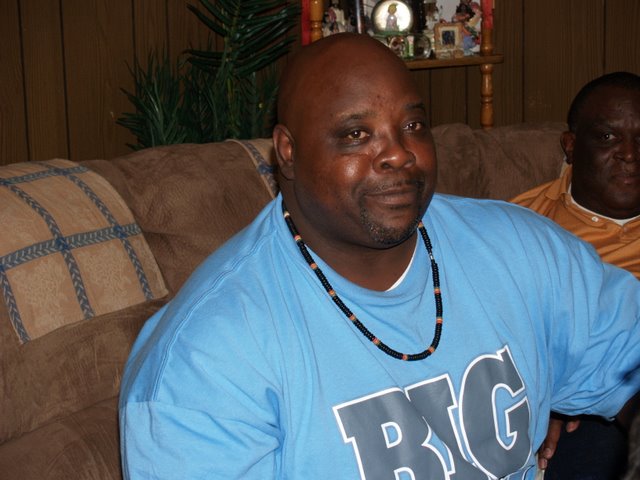
Larry Bazile is a big man with a drug conviction on his record–par for the course for black males in towns like Bunkie.  Bazile took a plea offer for a probated sentence when the prosecutor told him he didn’t stand a chance in court.  The evidence against him was sketchy at best; but Larry knew what happened when black males roll the dice with a jury in Avoyelles Parish.  Now, twenty years later, he spends most of his time caring for Pearly Bazile, his seventy-six year-old mother.  

On December 1, 2006, at six in the morning, officers from the Bunkie Police Department, assisted by two FBI agents, knocked on Larry Bazile’s door.  When Bazile didn’t open immediately, an officer began kicking the door impatiently.  “Hold on,” Larry called out as he opened the door.

In seconds, Bazile had been knocked to the floor.  He was asking to see a search warrant while they handcuffed his hands behind his back.  He asked for a warrant three more times during the raid, but the papers were never produced.

Officers rousted Pearly Bazile out of bed even after being informed that she was an invalid.  Young children were crying (over a year later, they are still afraid of the police).  Several relatives from out of town, in their early-to-mid twenties, had been staying the night.  They too were handcuffed.  

An officer called one of the young men into the bathroom.  He was holding a bottle of prescription pain medication in his hand.  “I’m gonna charge you with this,” the officer said, “unless you tell me what the big guy’s been doing.”  The big guy in question was Larry Bazile.

Larry and his young friends were hauled down to the Police Department shed, then transported to the lock-up in neaby Marksville.  Larry was charged with conspiracy.  A relative visiting from Dallas was charged with possession of drug paraphernalia (the pill bottle). 

Over a year later, Larry Bazile is still awaiting his day in court.  When I first talked to him he had no idea where the conspiracy charge came from.        

p2183957-1.jpg            

  p3081550-1.jpg

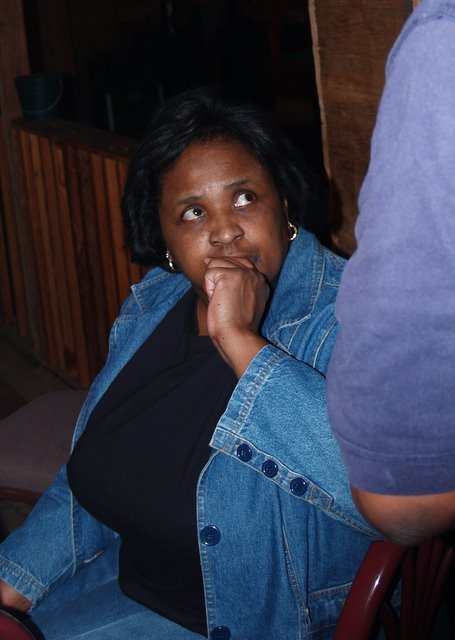
Unlike most poor black defendants, Larry Bazile isn’t alone.  Jerriel Bazile, a Dallas real estate man, and Gaythell Smith, a Dallas police officer (pictured above) have taken a passionate interest in their brother’s case.  For months, their persistant questions went unanswered.  Finally, Jerriel filed a freedom of information request for the complete records surrounding the case and prosecutor Charles Riddle turned over the pertinent materials.

The changes against Larry Bazile can be traced back to November 16, 2006, the day an FBI officer allegedly purchased $40 of crack cocaine from the defendant.  Detective Chad Jeansonne filed several different reports over a period of three months, all supposedly based on the testimony of an unnamed FBI agent. 

But there’s a problem: three irreconcilable accounts of the alleged drug buy emerge from these documents.  In one version, the FBI agent came to Bazile’s residence alone.  In version two, the agent is accompanied by an unnamed confidential informant.  In yet a third version, the agent came to Bazile’s home with a second defendant, Lloyd Robinson.

Is Jeansonne a busy cop with a faulty memory, or is there some method in this madness?  To understand the glaring inconsistencies in Jeansonne’s reports you have to understand that less than 5% of narcotics cases ever go to trial.  Generally, the government drops the charges or, more frequently, the case is settled by a plea bargain.  Jeansonne wrote three irreconcilable versions of the alleged drug buy to fit three separate prosecutorial strategies.

Bazile could be charged with participating in a conspiracy with Lloyed Robinson-hence, it would be convenient if Robinson participated in the buy.  If Robinson refused to cooperate, the state could produce a confidential informant to testify that he had accompanied the FBI agent to Bazile’s home.  Failing that, the case could be made simply on the uncorroborated word of the FBI agent (the least appealing of the three options since there was no marked money and no video, audio or photographic evidence). 

The legal mystery was partially solved a few weeks ago when the prosecution placed Lloyd Robinson on the stand in the course of a short-lived pre-trial hearing.  Robinson admitted that he had called Larry Bazile on the day in question, but adamantly denied accompanying the FBI agent to Bazile’s home.  When Robinson started talking about going with the agent to the home of a third party (who was never charged) he was silenced. 

“The deal is off,” an enraged prosecutor bellowed.  “It’s off.”

The prosecution knows the Bazile family is in possession of Chad Jeansonne’s creative writing assignments, but they don’t appear to be worried.  If the judge rules the reports inadmissible in court it’s as if they didn’t exist.

With the conspiracy strategy off the table, how will the state proceed? 

They could produce a confidential informant willing to verify the alleged transaction.  This would be relatively easy.  Jeansonne, my sources tell me, has a covey of troubled young men in the drug underworld willing to offer assistance when necessary.  Jeansonne, they say, believes his informants implicitly.  You offer an informant a sum of money to tell the story your way, or you threaten to send him off to prison if he gets his testimony wrong, or perhaps you work it both ways.  It’s easy to produce witnesses in narcotics cases and, so long as they are singing in harmony with police officers, juries believe every word that falls from their lying lips.

Or maybe the State of Louisiana will produce an FBI agent willing to testify under oath that he purchased drugs from Larry Bazile unaccompanied by either Lloyd Robinson or an informant.  But how would our hypothetical agent feel about being associated with so many discrepant versions of a simple story?

Normally, he wouldn’t have to worry because no one but the prosecutor would be aware of the discrepancies.  But now, thanks to the tenacious detective work of Jerriel Bazile, the truth is out.

The government wants this thing to go away.  If Larry will admit to selling drugs the state would be happy to give him five years probation.  But Larry doesn’t want to be “on paper” for a crime he didn’t commit.  He’s been down that road and has no appetite for a repeat performance.

You may be wondering how Chad Jeansonne has been able to hide his low down ways from his superiors in Avoyelles Parish. 

He hasn’t. 

Over the past year I have made six separate trips to Bunkie and have spoken to dozens of residents, including four former colleagues of Mr. Jeansonne.  I have spoken with defense attorneys who have tried cases based on Jeansonne’s handiwork.  Everyone knows that Mr. Jeansonne isn’t what they call “real police”.  He’s the kind of officer that gives the profession a bad name.

 So why doesn’t anybody deal with this guy?

There are so many reasons why Chad Jeansonne remains free to work his dreadful magic.  First of all, he restricts his malice to the poor end of the black side of town.  Secondly, he produces results that make his superiors look good–lots of drug convictions.  Third, I am told that he is always professional when in the company of state police officers. 

But there is a fourth reason: it is in no one’s best interest to take Mr. Jeansonne down.

Suppose you take a public stand against a dirty cop and nobody backs you up?  The mayor and the DA and the judge all stand by their man.  Suppose you are a defense attorney.  If you anger the local constabulary (or the prosecutor, or the judge) you will suddenly be out of work in that Parish. 

So everybody yields to the status quo and hundreds of poor people on the black end of town remain locked in a nightmare.  This scenario is playing out in hundreds of little towns across America.  Bunkie is a particularly egregious case of normal.

We had another community meeting in Bunkie this past Monday.  About 40 concerned residents crowded a tiny livingroom, each one desperate to tell their story.  People spoke of sleepless nights, ulcers, high blood pressure and deep depression.  Looking into those faces I decided the time for silence was over.  The world needs to learn about Chad Jeansonne and the public officials who cover for him.

An update to this post can be found here.

Telling Claudette’s Story

Rosa and Claudette
Rosa Parks and Claudette Colvin

“I don’t like to talk about ‘at-risk’ kids,” the man was saying.  “We need to start holding people responsible for their actions.  It’s time to stop making excuses.”

The remark was made in the fellowship hall of a Dallas church during a well-attended presentation by the Children’s Defense Fund on ”dismantling the cradle to prison pipeline.

“A lot of us rode the buses down to Jena, Louisiana a few months ago,” the man continued, “to speak up for the Jena 6.  And then we read that one of these kids just got picked up for attacking a fellow student right here in Dallas.  Imagine that, after thousands of people sacrifice so much to stand up for him, he goes and lets us down.”

As Charlotte Allen would say, the remark was “irresistable”.  It was the elephant in the room; somebody had to say it.

I am often asked if, given the manifest imperfections of the Jena 6, I regret bringing their story to the attention of the world.  What about the money-in-the-mouth stunt on YouTube, or the “thuggin’ for the cameras” episode in Atlanta?  What about the disclosure of Mychal Bell’s juvenile record?  And now Bryant Purvis slams the head of a fellow student into a desk for allegedly deflating the tires of his car.  If we’re going to defend victims of injustice, people ask, shouldn’t we be looking for a latter day Rosa Parks?

No, we shouldn’t.  There may be instances in which paragons like sister Rosa are railroaded by the system, but they are aberrations.  A good justice narrative captures a localized and specific example of a national phenomenon–we focus on the rule, not the exception.

Rosa Parks wasn’t the first African American to go to jail in Montgomery, Alabama for refusing to yield her seat to a white person.  Months earlier, a young woman named Claudette Colvin had experienced precisely the same indignity.  But Claudette had issues.  She didn’t leave the bus with quiet dignity and she was carrying a child conceived outside of marriage.  Civil rights leaders (wisely) decided to pass on Ms. Colvin.

But that was 1955.  The spiritual heirs of Rosa Parks aren’t going to jail; these days, prison space is reserved for kids like Claudette Colvin.

Claudette Colvin possessed many redeeming qualities.  So does Bryant Purvis.  Bryant is a big kid; six-foot-six and still growing.  He’s intelligent.  He’s unusually good looking.  The kid has potential.  Although he stands accused of assaulting Justin Barker, eye witness statements suggest he wasn’t present at the scene.

Reed Walters would eventually have dropped all charges against Bryant Purvis if events had been allowed to play out naturally.  Now, all bets are off.

Friends of Justice is dedicated to the non-violent teaching of Jesus; the philosophy that inspired Gandhi and King.  But we also stand with little kids and adolescents victimized by the foolish and short-sighted decisions of adults.  In her address to the New Baptist Covenant gathering in Atlanta, Marian Wright Edelman told us that she is often asked “what’s wrong with the children.”  “There’s nothing wrong with the children,” she replies; “the problem is with the grown-ups”.

By “grown-ups,” Ms. Wright Edelman isn’t just talking about out-of-control mothers and fathers who abnegate their parental responsibilities (although they are part of the picture).  The grown-ups most responsible for the plight of our children are policy makers whose callous decisions have placed innocent children in harm’s way.

To employ a biblical image, Jena is about the sins of the fathers being visited upon the children.  A year ago, I spoke to over 100 members of Jena’s black community at a public meeting at a local Baptist church.

“Our children have tried to work things out the way things are worked out in the schoolyard,” I said, ”through intimidation, violence and revenge.  But it was not their job to work things out—it was not their job to say yes and no—that is a job for adults.  Had the adults said no in September, had they said it loud, and had they said it proud, had they said it like they meant it, there would have been no fight at the Fair Barn because there would have been nothing to fight about.  And without a fight at the Fair Barn there would have been no need for retaliation in the school yard.”

The events of the past year have done nothing to alter my perspective.

Shortly after speaking in Jena last year, I flew to Atlanta for a summit on the misuse of confidential informants.  During a breakout session I had an informative chat with Ed Burns, co-writer of HBO’s The Wire.  Ed told me he had worked as both a school teacher and a police officer in Baltimore, experiences which allowed him to see the social catastrophe playing out in that city from both sides. The Wire focuses on young, black inner city men caught up in the drug trade.  Some of these guys are cold-blooded killers: the kind of people who need to be in prison.  But most of the characters are normal kids living in the middle of a toxic environment.  They try to break free, but they can’t.  Eventually, they all find their way into the morgue or the criminal justice system.

Ed Burns provides an insider’s different perspective on police work; his officers are more sinner than saint.  Internecine power struggles abound.  Rogue cops beat helpless suspects and pocket money seized in drug raids.  The line between “real police” who go by the book and bad cops on the make is drawn in shades of gray.    No one faults Ed Burns and David Simon, his co-writer, for glorifying the thug life or for demonizing law enforcement–the portrait is too stark and unsentimental to be denied.  Burns and Simon are like the inner city poets celebrated by Bruce Springsteen who “just stand back and let it all be.”

Rosa Parks was the perfect symbol for the civil rights movement of the 50s and 60s; her story drove the Old Jim Crow regime to its knees.  But the New Jim Crow gives Rosa Parks a pass.

In 2008, the heirs of Claudette Colvin are caught in the crosshairs and somebody needs to tell their story.  We can no longer afford to deal in hagiography (stories of the saints); by definition, the children in the cradle to prison pipeline are deeply troubled. Criminal justice reformers have two options: we can eschew the narrative strategy altogether in favor of statistics-laden policy papers, or we can tell real-life, Bruce Springsteen, Ed Burns, Claudette Colvin-type stories that just ”stand back and let it all be.”

Friends of Justice will continue to tell Claudette’s story.  It ain’t always pretty, but it’s the truth.


Charlotte Allen Responds

Rev. Bean has graciously offered me an opportunity to write a critique of his critique of my Jan. 21 article for the Weekly Standard, “Jena: the Amazing Disappearing Hate Crime,” so I am herewith taking him up on his offer.            

First, Rev. Bean accuses me and the Weekly Standard of subscribing to an ideology centered around a “white, Judeo-Christian culture.” It hardly bears pointing out that both Judaism and Christianity are historically rooted in the Middle East, that is, Asia. As the religious historian Philip Jenkins, author of “The Next Christendom” (2002), never tires of pointing out, Christianity is in fact moribund in “white” Western Europe, while it is growing exponentially in the Global South—Africa, Asia, and South America, where they actually believe what the Bible says, including all that stuff about Christ sitting “at the right hand of God,” in contrast to being eaten by wild dogs after his crucifixion as the Jesus Seminar people claim. Indeed, as Jenkins notes, “Africa may soon be home to the world’s largest Christian populations.” So I don’t get what Rev. Bean means about Christian culture being “white” or anti-“diversity.” Even in America, the vast majority of blacks and Hispanics are Christians.            

Second, Rev. Bean argues that because I am a Roman Catholic (my response: guilty as charged), and I believe in the teaching authority of my church as not only the “human institution” (I’d call it an all-too-human institution) that Rev. Bean describes but also as an institution divinely guided by the Holy Spirit, I take at face value all truth-claims made by secular authority figures, in particular the secular authority figures in Jena, Louisiana.            

This charge, as well as the leap of logic that it entails, is absurd. The “official documents” that I consulted for my story consisted of transcripts made by the court reporter and photocopies of handwritten witness statements made by members of the Jena Six and also by the students, teachers, and school administrators who witnessed the attack on Justin Barker on Dec. 4, 2006. Those documents recorded what people said, not officials’ spin on what they said. I also read the thorough, almost daily, contemporaneous reporting on the noose-hangings and the Barker assault in the Alexandria, La., Town Talk, a non-Jena newspaper whose coverage was criticized by some Jena whites I interviewed for being overly sympathetic to the Jena Six and for supposedly blowing the noose incident out of proportion.            

In none of those sources did I find any corroboration for three assertions made by Rev. Bean in his narrative, presumably on the basis of his interviews with members of the the Jena Six and their relatives: 1) that black students at Jena High School, whether including or excluding Jena Six member Robert Bailey Jr., had staged a protest under the noose tree (I’m not saying they didn’t, but merely that no one, including the black parents outraged by the nooses themselves, mentioned any protest); 2) that LaSalle Parish District Attorney Reed Walters was specifically addressing (and hence threatening) the protesting black students, or any black students at Jena High, when he made his “stroke of the pen” speech at the school assembly; and 3) that Bailey was hit over the head by whites wielding beer bottles—or even by a single white wielding a single beer bottle—during the Fair Barn altercation on Dec. 1, 2006, necessitating a trip by Bailey to a hospital emergency room for stitches. For example, Bailey’s own victim-impact statement, part of the court record in the criminal case brought against his assailant, Justin Sloan, did not mention bottles, other weapons, or medical treatment of any kind.            

The rubber hit the road regarding corroboration for all three incidents at a hearing on June 13, 2007, on an unsuccessful motion by Bailey’s lawyer, Samuel Thomas, to have Walters recused as prosecutor for having a personal interest in the case that hindered the fair and impartial administration of justice. A transcript of that hearing lies on my desk as I write this. That hearing was Thomas’s big chance to offer evidence concerning the alleged protest under the tree, the alleged threat by Walters at the assembly, and Bailey’s alleged  hospitalization, all of which Thomas had made part of the grounds in his motion to get Walters off the case. Thomas in fact presented not a shred of evidence at the hearing supporting the proposition that any of those three incidents had actually occurred: not a word of testimony from Fair Barn partygoers or Jena High students, teachers, or administrators who had been present at the assembly, not a single emergency-room or other medical record. 

Indeed, Thomas did not even ask the then-principal of Jena High, Scott Windham, who had been in the auditorium at the assembly and whom Thomas called as a witness at the hearing, whether he had perceived Walters’s “stroke of the pen” statement as having been addressed only to black students. So for me the question was: Do you believe Rev. Bean’s narrative (and its various permutations as its contents filtered into news reports and blogs) or your own lying eyes reading this transcript? 

Finally, there is the matter of Mychal Bell’s supposedly incompetent respresentation at his adult trial by the black public defender Blane Williams, I’d like to know exactly what else Williams could have done at that trial, beyond what he did do: cross-examine the students who had witnessed the assault on Barker and preserve a number of legal issues for appeal. Had Williams called his client to the stand, he would not only have waived Bell’s Fifth Amendment right against self-incrimination but subjected him to impeachment by his own witness statement and the improbable chain of events it recorded, plus undoubtedly a string of rebuttal witnesses. Whom else could Williams have put on the stand? Other members of the Jena Six? Good luck. Bell’s mother? What could she have said—”My son, he’s a good boy”? The problem Williams faced was that, as Bell’s subsequent guilty plea indicated, his client didn’t have much of a case. I don’t see how Bell’s high-power new team of lawyers from Monroe did any better a job of representing him than Williams had. Arguably they made things worse by exposing Bell’s prior criminal record to public scrutiny. 

I’m not saying that “original sin,” as Rev. Bell so Augustinian-ly puts it, didn’t play a role in the racial black eye that Jena received over the noose and Barker incidents. As I wrote in my article, the LaSalle Parish school board failed to communicate adequately to the black residents of Jena and to the world at large that hanging nooses on a schoolyard tree was intolerable. Public officials and white Jena citizens who could have spoken to the press early and forthrightly about the various incidents chose not to do so. As I also said in my article, Walters’s original charge of attempted second-degree murder against the Jena Six was probably excessive, although it was certainly not improper, given that repeated kicks to the head can be fatal and the attack on Barker ended only after teachers and other students at Jena High pulled his assailants off his unconscious body. But none of the evidence I looked at persuaded me that systemic racial injustice, whether peculiar to Jena or symptomatic of America as a whole, played any role in the prosecution of the Jena Six. 

As an irresistible footnote, I might add that the Jena Six would come off as more sympathetic and credible if they didn’t get involved in incidents like this one. http://www.thesmokinggun.com/archive/years/2008/0207082jena1.html

Charlotte Allen and the Neo-Con Jena

I came across Charlotte Allen’s Jena story in a bookstore in Atlanta’s Peachtree Mall.  I was killing time while my wife, Nancy, tried on shoes at the Naturalizers store.  Glancing at the magazine rack, my attention was captured by the upper lefthand corner of the Weekly Standard: “Jena: the Amazing Disappearing Hate Crime.”

I plopped down $3.95 and gave Ms. Allen’s article a quick read.  Gradually, it all came back to me.  Allen called me up a few months ago, just as the furor over Jena was begining to fade.  At the time, I was getting three or four calls from journalists every day and the conversations blur together.  But Allen stuck out because her tone was unusually combative and . . . I think “dismissive” would be the word. 

The Weekly Standard story is predicated on the now-familiar notion that Alan Bean twisted the facts to create a news story ex nihilo, out of nothing. 

I hesitate to give Ms. Allen’s article more attention than it deserves.  The piece doesn’t turn up readily in a Google search, and it is in my best interest to let it pass unnoticed.  I bring it to your attention because it is makes explicit ideas that are often merely implied.

William Kristol’s Weekly Standard published Ms. Allen’s tortured prose because it reinforces the magazines editorial stance.  Kristol (a newly minted New York Times columnist) is a neoconservative icon, a dreamer of dreams.  The Standard helped create the moral and philosophical environment that gave us the Iraq War.  Create a democratic eden in Iraq, the reasoning went, and corrupt Islamic regimes would topple like dominos all over the Middle East.

Kristol’s Standard sees America as an exceptional and potentially heroic nation.  America is great because she nurtures virtues like integrity, honesty, fidelity, and perseverance.  These admirable qualities are rooted in the Judeo-Christian tradition and would collapse without it.  We cannot afford to embrace diversity too enthusiastically, neo-cons believe, because America’s greatness is a product of western, white, Judeo-Christian culture.  We are all equal, but some of us are more equal than others.

This way of seeing the world necessitates faith in the wisdom and virtue of public institutions and public officials.  These folks aren’t perfect, but in a rough and ready way they reflect the genius of America and are therefore worthy of trust and, yes, reverence. 

Charlotte Allen is a professional debunker, adept at poking holes in liberal baloons.  Her most ambitious efforts to date have been devoted to lampooning members of “the Jesus seminar” and their renewed quest for the historical Jesus.  Allen is an orthodox, traditional Roman Catholic, thoroughly steeped in the wisdom of church fathers like Augustine and the authority of Mother Church. 

Yesterday I introduced you to Paige Patterson, president of Southwestern Theological Seminary in Fort Worth, Texas.  Patterson believes in a flawless Bible; Allen believes in a flawless tradition.  Like Patterson, she has made common cause with traditionalists like Bill Kristol and Patterson’s Southern Baptist Convention . . . any port in a storm.

This explains why my take on Jena is so distasteful to people like Kristol and Allen.  I have presented the public officials of Jena, Louisiana as self-serving, small-minded, dull-witted bureaucrats.  I have repeatedly asserted that Jena is America.  I contend that the American criminal justice system is corrupt, inefficient, unspeakably expensive, cruel, unusual, and counter-productive.  I see the dream of American exceptionalism as an unqualified nightmare.

What is more, I say these things as a Baptist minister.  My wife is also an ordained Baptist Minister, and she agrees with me.  So does my father-in-law, Charles Kiker . . . you guessed it, Charles is also an ordained Baptist with a doctoral degree in Old Testament. 

Ultimately, we are critical of public officials because we are disciples of Jesus Christ.  Charlotte Allen worships the Christ of Church tradition who sitteth at the right hand of God; the Christ who turned over his mission to a human institution which now represents his interests.  The Friends of Justice follow the historical Jesus (the one Allen says we will never find) who preached good news to the poor and who was crucified by religious and political luminaries.

Like Charlotte Allen, I believe in original sin (a good Augustinian doctrine if ever there was one).  For evidence, I point to well-intentioned religionists like Reed Walters, while Allen references troubled black males like Mychal Bell. 

I appreciate the efforts of police officers, prosecutors, judges and juries–they provide an invaluable service and are worthy of our prayers and our respect.  Unfortunately, public officials are flesh and blood mortals who repeatedly fall prey to ignorance, self-delusion, hubris and blind ambition.  These failings are particularly evident when the powerful confront the people Jesus called “the least of these”. 

Allen’s version of the Jena story is copied, almost verbatim, from the annals of the Jena Times.  Documents created by public officials like DA Reed Walters, local law enforcement, Sammy and Craig Franklin at the Times, the Alexandria TownTalk, and US Attorney Don Washington are swallowed whole and trusted implicitly.  Information gleaned from poor black folks in Jena is dismissed out of hand.

My great sin was to accept the word of street punks like Robert Bailey over the word of public officials in good standing like Reed Walters.

I assured Charlotte Allen that I carefully perused every relevant issue of the Alexandria and Jena papers before I released a word about Jena to the national media.  This meant long days in the local library and, at a quarter a page, a hefty photocopying bill. 

In addition, I worshipped with the prominent white congregation Allen references in her article and spent an hour and a half discussing the issues with the town’s most prominent white pastor (who doubles as a reserve police officer).   

Next, I made an appointment with Craig and Sammy Franklin at the Jena Times.   I shared my take on the story with the Franklins and asked them to rebut my central contentions.  Then, as Allen reports, I told them how the national media would handle the story.

Following that, I spent the better part of a day at the courthouse pouring over legal documents and eye witness statements.  I photocopied this material and spent a full day pouring over it.

I talked to members of the local school board and got their side of the story with the proviso that I not mention them by name.

In addition, I talked to the only people who lived close enough to the salient events to know what actually went down–the young men now known as the Jena 6.  I interviewed Robert Bailey for two hours in the lock-up on the second floor of the LaSalle Parish courthouse. 

I didn’t accept the word of anyone involved in this story uncritically–original sin applies to every aspect of every person.  Folks lie; they spin the truth; they pass over inconvenient details.  My job was to learn everything a person could learn and then ask which version of the story made the most sense.

Ms. Allen’s essay has many low points (her faith in public officials is both touching and troubling), but the nadir comes with her treatment of Mychal Bell’s trial.  Could a sentient being really consult the transcript of that unseemly affair and conclude that Blane Williams represented his client to the best of his ability?  Does Ms. Allen have any idea what competent legal counsel looks like?  This helps explain how court appointed attorneys can roll over and play dead in the courtroom and no one (apart from the defendant and his family) appears to notice.  

Toward the end of my conversation with Ms. Allen I suggested that events in Jena unfolded with the inevitability of a Greek tragedy.  The sins of the fathers were visited upon the children (black and white).  If public officials in Jena had taken the noose incident seriously and confronted it boldly, a world of hurt would have been avoided and Jena, at long last, could have transcended her Jim Crow legacy.

Unfortunately, that didn’t happen.  It didn’t happen because it couldn’t happen.  To her credit, Charlotte Allen quotes Eddie Thompson, a Pentecostal pastor who lives close enough to the poor and blue collar folk in Jena to know what’s going on. 

“It’s an unconscious racism,” Thompson told Allen, “something that most white people here aren’t even aware of. You see it in income disparities, the fact that blacks live in a lesser part of town and are a lower socioeconomic group. For the black community, there’s been a lack of ownership, a feeling that they weren’t part of the town.”

And this is why public officials were unable to respond to the message conveyed by the nooses hanging from the tree at the white end of the school courtyard–nobody was willing to bell the cat, to reference to the elephant in the room, to acknowledge that vestiges of Jim Crow segregation clung to the community like moss clings to the trees along Highway 8. 

Unable to confront reality, people like Roy Breithaupt and Reed Walters decided to sweep the incident under the rug.  I didn’t invent the unrest at the high school in the wake of the disciplinary committee’s refusal to attach any racial meaning to the noose hanging.  The Jena Times reported that parents were coming to school to pick up their kids.  White-on-black fights were breaking out all over the campus.  All of this is a matter of public record.

I didn’t make up the incident that sparked a school assembly.  Robert Bailey and his friends stook defiantly under the tree on the white end of the school ground.  Why is there no documentary evidence of this event?  Because it wasn’t in the interest of public officials to mention it.  Instead, they called an unscheduled assembly at which Reed Walters made his infamous “stroke of my pen” comment.

I didn’t make that up either; Walters has admitted in open court that he made the remark.  But what did it mean?  According to Craig Franklin (whose version Walters’ remark departs considerably from the DA’s courtroom testimony), the words meant nothing at all.  Or almost nothing.  He was trying to silence the room.  If the little chatterboxes didn’t shut up, so this version goes, Walters was willing to use the power of his office to make their lives disappear.  Is that what he said?  Is that what he meant?

No, his comments were directed at the black students whose legitimate protest had sparked the campus unrest the assembly was designed to quash.  This is the only version of the facts that makes any sense whatsoever, a point Charlotte Allen would be forced to acknowledge if she gave the matter any thought.

Allen suggests that I invented a series of black-white confrontations involving Robert Bailey et al and the circle of friends surrounding the noose boys.  If these violent altercations took place the way Robert Bailey claims they did, we have clear evidence that the hostility unleashed by the noose incident was alive and well in late November of 2006.

Unfortunately, the fights are not documented.  By the time the police arrived on the scene, the participants had scattered and there was nothing to report. 

Fortunately, private investigators have thoroughly researched my version of events and, on the basis of numerous interviews in Jena’s black and white communities, have confirmed my story.  Should any of these cases proceed to trial, the truth will emerge.

I could walk you through Ms. Allen’s article paragraph-by-paragraph and reduce her claims to rubble, but what’s the point?  The issue here is epistemological: how do we know what we know?  Allen thinks you get at the truth by reading official documents produced by public officials.  That’s a good place to start, but if that’s where you end up the full truth will remain illusive.  Experience has taught me to distrust stories (be they ever so official) that don’t make sense.

Original sin dictates that, in her role as professional debunker, Charlotte Allen will always have plenty of material to work with whether she’s skewering the Jesus Seminar people or civil rights luminaries like Al Sharpton.  When Jena went national an unholy host of saints and fools rushed to the fires of celebrity.  Silly things were said and done.  Am I responsible? 

Did I oversimplify the story as some have alleged?  Actually, I took a simple tale about black thugs beating up an innocent white kid and added several layers of inconvenient complexity–the truth is always more complicated than the newspapers (or the news magazines) would have us believe. 

Alan Bean
Friends of Justice

Doin’ what we gotta do: Reflections on the New Baptist Covenant

The New Baptist Covenant in Atlanta was Jimmy Carter’s baby.  Among Baptists, only the beloved ex-President has the name recognition and the hard-won credability to pull off an event of this magnitude.  For the first time in living memory, Baptists from North and South, and Baptists from Black and White denominations came together in Atlanta.

True, by the time Carter and Bill Clinton spoke on Friday night most of the people in attendance were white refugees from the Southern Baptist Convention.  More than anything else, Carter’s New Baptist Covenant framed with these folks in mind.

On Friday night, Jimmy Carter paid the ultimate tribute to the SBC of his youth.  He told us how Southern Baptist mission trips pulled him out of a crisis of faith he in the mid-1960s as he watched unlettered men share their simple faith with strangers.  These stories ended with a period; there was no semi-colon followed by a diatribe against the current leaders of the SBC.

The best reporting from the New Baptist Covenant appeared in a Los Angeles Times article by Richard Fausset.  The focus is on Carter the man, the meeting he inspired in Atlanta remains in the background, but Fausset addresses all the important issues.

On the opening night, former Southern Baptist President Jimmy Allen asked if the Atlanta gathering would be a movement or simply a moment.  One thing is clear, a movement sparked by an octogenarian can’t remain a cult of the personality.  Carter’s active years are numbered; he knows it, and so do the folks who flocked to Atlanta.  This poignant fact added a sense of urgency to the meeting.

Richard Fausset plucked a telling quote from Bill Leonard, currently dean of the divinity school at Wake Forest.  “The curse and the genius of the Southern Baptist Convention for Carter’s generation is that it inculcated a sense of Baptist identity that is so deep in people that it was hard to give up.  It shaped your spirituality — but also your own sense of who you were.”

Leonard was a newly minted church history professor when I enrolled at the Southern Baptist Theological Seminary in 1975.  He was still there when I returned for doctoral work in 1989.  I served briefly as Leonard’s grader before he yielded to the inevitable and left Southern for a more hospitable academic climate.  Southern boasted one of the best church history faculties in America in 1990; three years later, all four professors had left the fold.

Bill Leonard grew up in Texas, attending Southwestern Theological Seminary in Fort Worth (20 miles west of where I currently live).   For men like Leonard and Carter, the rift in the Southern Baptist Convention meant exile.  It was like being disowned by your own mother.

As a Canadian Baptist ordained by the American (Northern) Baptist Churches, I had a hard time relating to all of this.  I suspect many of the Black and northern white Baptists who attended the Atlanta gathering wearied of all the nostalgic references to what had been. 

From the beginning, Southern Baptist leaders have regarded Mr. Carter’s religious experiment with suspicion.  Paige Patterson, currently President of Southwestern Seminary, said the rift in the ranks boiled down to epistemology: how you know what you know.  “We believe that we know what we know because God has flawlessly revealed to us in the Bible what his will and thought and purpose is; they do not believe that.”

Here we come to “the curse” of Southern Baptist life professor Leonard mentions.   Growing up Baptist in the South created such a strong connection between person, place and piety that most believers would sacrifice anything to hold onto it.  The myth of the perfect Bible proved to be a wonderful debating ploy against “liberal” opponents–no Baptist wants to be defined as anti-Bible.

But there has been a profound and tragic downside.  Almost by definition, a flawless Bible is a “flat Bible” free of internal contradiction.  If a teaching (stone the adulter) appears in any part of Scripture it is God’s own truth.  In fact, since Jesus is the Son of God, all Scripture can be read as the very word of the Savior. 

Unfortunately, Jesus self-consciously set himself against many of the legalistic traditions in the Hebrew Scriptures; other prophetic teachings were radicalized and expanded.  In the fifth chapter of Mathew, Jesus says, “You have heard that it was said to the men of old, ‘You shall not kill; and whoever kills shall be liable to judgment; But I say to you that every one who is angry with his brother shall be liable to judgment . . . You have heard that it was said, “An eye for an eye and a tooth for a tooth.’  But I say to you, Do not resist one who is evil.  But if anyone strikes you on the right cheek, turn to him the other also.”

Jesus’ moral teaching flies in the face of conservative American ideology.  In a desperate attempt to preserve a culture, Baptist leaders in the South allied themselves with cold warriors and free market capitalists (hardly natural allies for followers of Jesus; but you gotta do what you gotta do).

Which brings us to the ultimate irony: Southern Baptists leaders accusing a pious Baptist deacon of embracing “the religion of secular humanism” while they embrace a politician who rarely attended church and his horoscope-consulting wife.  It was neither pretty nor logical, but you gotta do what you gotta do.

The Atlanta event was organized around the incendiary words of Isaiah, amplified by the teaching of Jesus in the fourth chapter of Luke: “The Spirit of the Lord is upon me because he has anointed me to preach good news to the poor.  He has sent me to proclaim release to the captives and recovery of sight to the blind to set at liberty those who are oppressed, to proclaim the acceptable year of the Lord.”

I was drawn to Atlanta because (a) the American Baptists invited me to participate and (b) all this talk about “good news to the poor” squared perfectly with my criminal justice reform work with Friends of Justice.

Southern Baptist leaders have charged that the New Baptist Covenant is a not-so-subtle smokescreen for liberal politics.  The involvement of Bill Clinton and Al Gore did little to counter this impression.

I didn’t attend Gore’s Climate Change luncheon (the $35 fee stuck in my craw), but I did hear Mr. Clinton on Friday evening.  I have been critical of some of Clinton’s racially polarizing remarks during the current election campaign, but I was pleased with the tone of his comments in Atlanta.  He talked about his attempts to find common ground with Southern Baptist leaders.  He urged the audience to be gentle with their co-religionists because, after all, we might all be wrong.

Throughout his address (delivered without notes) Mr. Clinton demonstrated an impressive familiarity with the Scriptures.  He gave particular attention to a phrase from the King James rendering of 1 Corinthians 13: “For now we see as through a glass darkly, but then, face to face.”

Unlike Paige Patterson, who, thanks to his flawless Bible, already sees face-to-face, we must be humble and respectful of diversity because we are all stumbling about it a dimly lit room.

Good thoughts; but can you build a movement on shadows?

In his interview with Richard Fausset, Jimmy Carter worked hard to temper his criticism of the estranged members of his religious family.  “The Southern Baptist Convention has become increasingly narrow in its definition of who is welcome,” Carter began.  “They now have decided that women can’t teach men, and that women can’t be deacons, and women can’t be pastors, and women can’t be missionaries and so forth.”

The ex-president paused.  “Which–I’m not criticizing them.  That’s their prerogative.” 

Richard Fausset was irritated by Carter’s reserve.  “It is the kind of staement that doesn’t help matters,” he observed.

Fausset is right.  The glorious thing about the New Baptist Covenant was the opporunity to bridge the North-South and Black-White divides that have haunted Baptist life for generations.  For ex-Southern Baptists, the grieving process will never end.  We understand that.  We sympathize. 

But a new world of opportunity awaits.  We are now free to take Jesus’ radical teaching at face value without ignoring or explaining away the clear import of his teaching.  To follow the Jesus of the Gospels is to work for the poor.  That means undermining a criminal justice system that preaches bad news to the poor.  It means seeing the defendant and the prisoner not just as American citizens but as the very face of Jesus–Christ in his distressing disguise (to borrow a phrase from Mother Theresa).

The time has come for Mr. Carter, Mr. Clinton and their spiritual kinfolks to let go of the Southern Bapist Convention so their hands can be free to enthusiastically embrace their American Baptist and Black Baptist brothers and sisters.  It’s tough, I know; but we all gotta do what we gotta do.

Alan Bean

Executive Director

Friends of Justice

Nancy Bean Speaks on Hate Crimes

A young man has been charged under hate crime statutes for displaying a noose on the back bumper of his pickup truck.  The incident took place in Alexandria, a few miles down the road from Jena, in the immediate wake of the September 20th march on Jena.  I learned about the incident from a breathless CNN producer who was in town to cover the march.  He wanted my reaction. 

I told him I’d have to think about it.  Four months have passed and I’m still thinking.

Yesterday, while my wife and I walked the dog, I said, “What do you think of charging the guy with the noose on his truck as a hate criminal?”

US Attorney Donald Washington announced the prosecution hours after dozens of lost souls wandered the streets of Jena with nooses dangling from their belts–one protester used a noose as a leash for his dog.  No charges were filed.

Nancy was silent for a moment.  When she started talking, I realized she had more to say on the subject than I did, and that she’d say it a lot better than I could.

Nancy Bean has been the heart and soul of Friends of Justice since our inception in 2000.  She opened our home to the defendants and their families every Sunday night.  She recruited and organized a bus trip of 50 people, mostly children, to march on Austin in the fall of 2000.  She was a teacher at Tulia High School at the height of the drug sting controversy where she was aggressively shunned by other teachers.  She organized a series of camps and college visits for poor students of Tulia who had never dreamed of going to school. “Hello Ms. Bean,” kids of all ages would say as we walked our dog through the poor neighborhoods of Tulia.  Regularly we’d open our door to a band of children inquiring about the next outing. After they graduated, Nancy’s students continued to drop in to her classroom or to our home for help filling out a job application or to play a game of pool. 

After we took in three young children who had been orphaned by Tulia’s drug sting, Nancy received furtive requests from high school students wanting to come home with her.  When her latest orphan graduated high school and left for college after two years with us, Nancy told her parents and God: “I’m not taking anyone else in. Well, not unless they arrive on the doorstep and tell me that God sent them.”

Nancy is now a Special Education Counselor in two Arlington schools.

So, what does Nancy think about charging a white kid in Louisiana with a hate crime?  Read on . . .

Hate sucks. And directed against God’s creatures, hate is shameful and anathema to the law of God which is love.  But making hate a crime is a dangerous thing in a free society. When we give the power of punishing motives to the government, whether in the name of a terrifying war on terror or in the name of protecting the civil rights of minorities, we open up a floodgate assault against free speech and dissent.

I hear and agree with the well-intentioned arguments for hate crime enhancement as disincentive for intimidation of ethnic minorities. But since when can we entrust government with powers over our intentions? Since when can we entrust government with powers over our free speech? Since Salem? Since the Sedition Acts? Since McCarthyism? Since Homeland Security?

A noose is an unmitigated symbol of hatefulness and a reminder of our societal shame. So is a swastica. Such symbols are not allowed in public schools. Items of clothing or drawings boasting such are confiscated and kids in possession are given detention or suspension.  That’s because students are required to be in school and the school is acting in loco parentis. Sorry, but you can’t show your boobs or your butt in school, either. It’s not about freedom of speech; it’s about the training and supervision of our children.

School administrators are known to go overboard in their parental role and do nasty things such as suspicionless drug testing under parental protest. Our family knows that first hand. But no one is going to prison because confederate flag t-shirts are not allowed on campus. And the administrators at Jena High School could have saved everyone a whole load of trouble if they had responded to nooses hanging on school grounds with firm in-school discipline for the perpetrators and in-class education and counseling sessions for students and staff.  

A kid stupid enough to drive through town with a noose on display should be charged with a stupid crime that he is no doubt committing. Like driving dangerously or under the influence. Or somebody should call his mother. Or if she is already in prison, somebody should call his grandmother. We have more than enough laws to prosecute and to send two million people to prison.

We don’t need to make more criminals; we need to make more citizens. We need to teach real history to our kids: the real ugly and courageous stories that make us who we are. We need to teach dissent to our children: how to live respectful, empowered, dissenting lives.

The New Black Panthers joined the September 20th throng in Jena. Dressed in military fatigues and black barets as symbols of racial warfare, they employed physical intimidation to get their message to the crowds. They barred organizers like my husband, Alan, from some proceedings. Should they be charged with hate crimes? As distasteful as I find the symbols of war, I don’t think so.

People go to prison or disappear to torture camps in Syria when the government is given the right to censure our speech and to interpret our motives. I want to live with my freedom of speech and dissent. And that means people I disagree with and people full of hate get to keep theirs, too.

Nancy Bean

John Grisham, criminal justice reform, and the New Baptist Covenant

John Grisham is a writer, not a public speaker.  But when the voice on the phone belongs to Jimmy Carter, you make exceptions.   Bill Moyers had to back out of this week’s New Baptist Covenant celebration in Atlanta and Carter wanted a speaker of equal stature as a replacement.  Friday evening, Grisham was a guest on Bill Moyer’s Journal.

Grisham talked about writing.  He talked about being Baptist in the South.  He talked about the Iraq War.  But the conversation kept coming back to the writer’s fixation with the criminal justice system.  In particular, Grisham wanted to talk about wrongful convictions and small town justice.

Here’s my favorite segment:

JOHN GRISHAM: Wrongful convictions happen every week in every state in this country. And they happen for all the same reasons. Sloppy police work. Eyewitness identification is the most– is the worst type almost. Because it’s wrong about half the time. Think about that.

BILL MOYERS: Eyewitnesses?

JOHN GRISHAM: Eyewitness identification. They get it wrong about half the time. And that’s sent more men to prison than probably anything else. Sloppy police work. Sloppy prosecutions. Junk science. Snitch testimony. What– it happens all the time. You get some snitch in a jail who wants out, and he comes in and says, “Oh, I heard your defendant confess.” And they’ll say, “Well, okay, we’ll reduce your time and we’ll let you out if you’ll testify at trial.”

So there should be rules governing snitch testimony. But there are a lot of reasons.There are five or six primary reasons you have wrongful convictions. All could be addressed. All could be fixed with the right statutes.

Amen, and amen!  Everybody familiar with the criminal justice system knows Grisham is right; but when was the last time you heard someone talk like that in the mainstream media?

There are a lot of Baptists like Grisham in the South; quietly passionate, earnestly honest, haunted by ghosts past and present.  Many of them will be speaking at President Carter’s New Baptist Covenant gathering.  Actually, hundreds of people have labored long to make this dream a reality; but the dream was Carter’s.

The New Baptist Covenant celebration is a modern miracle–the sort of thing that doesn’t happen in the natural world.  Twenty thousand Baptist preachers, lay people and bureaucrats will spend half a week considering the implications of the good news that once danced on the lips of Jesus.  Everything will come back to the passage in the fourth chapter of Luke where Jesus built his work on a foundation laid by the prophet Isaiah:

The Spirit of the Lord is upon me, because he has anointed me to preach good news to the poor.  He has sent me proclaim release to the captives and recovery of sight to the blind; to set at liberty those who are oppressed, to proclaim the acceptable year of the Lord.

Follow those words to their natural conclusion and you don’t end up with the Southern Baptist Convention, or any other Christian denomination.  That’s why I call a massive gathering of Baptist leaders organized around such an incendiary text a miracle.  

What does it mean to preach good news to the poor?  Ask that question and the criminal justice system will soon enter the conversation.

I will be part of a special interest session on racism this coming Friday.  On Saturday morning I will say a few words at the American Baptist breakfast.  My wife, Nancy, and I will be leaving Wednesday and returning to Arlington next Sunday evening.  We changed our flights so we could hear Grisham and President Carter speak this Wednesday evening.  I’ll give you the highlights when I return.

Since a disciplined army of fundamentalists took control of the Southern Baptist Convention in the 1980s, moderate Baptist preachers have been wandering in a wilderness of regret, revisiting the ashes of painful memory, regrouping, establishing new seminaries and places of worship.  Twenty years have now passed and the time for grieving is over.  This week, the focus will not be on the sins of the Southern Baptists.  The New Baptist Covenant is a celebration of future hope not a lamentation over spilled milk.

Bill Moyers talks with John Grisham

BILL MOYERS: My next guest has written twenty one books in all — with titles you’ll recognize. A TIME TO KILL, THE FIRM, THE PELICAN BRIEF, THE CLIENT, THE RAINMAKER, THE TESTAMENT, THE INNOCENT MAN, A PAINTED HOUSE. Believe it or not they have sold nearly a quarter of a billion copies in 29 languages.  Some were made into blockbuster movies  

THE RAIN MAKER: I’m asking you, the jury, just do what you think is right in your hearts.

BILL MOYERS: The writer, of course, is John Grisham, the small town lawyer who never wrote a book until he was 30 years old.  For all his wild success, John Grisham is not a very public man.  He keeps a low profile and makes few speeches.  So I was surprised to read that he is going to make a keynote address next week in Atlanta, Georgia before the first meeting of the “New Baptist Covenant”. It’s a group formed by former President Jimmy Carter to unite Baptists “around an agenda of Christ-centered social ministry.”

JIMMY CARTER: Strengthening God’s kingdom on earth in the name of Jesus Christ our savior.

BILL MOYERS: Former President Bill Clinton and former Vice President Al Gore will speak so will Republican Senators Lindsey Graham and Charles Grassley. John Grisham is a devout Baptist laymen .a member of University Baptist Church in Charlottesville, VA. And a veteran Sunday school teacher, like Jimmy Carter himself. He has some strong feelings about social justice and the state of democracy.  I invited him to the studio for a conversation.  Welcome to the Journal.

BILL MOYERS: You so rarely give speeches that I’m curious as to why you chose this gathering in Atlanta for a forum?

JOHN GRISHAM: I didn’t have much of a choice. The phone rang a couple weeks ago, on Saturday morning, and it was Jimmy Carter. And I’d never talked to him before. And he invited me to come down. And I told him I probably couldn’t do it because my next book comes out that week, January the 29th. And he said, “Well, can I be pushy?” You know, I don’t know how you tell a former president they can’t be pushy. And I said, “Sure.” And he said, “I really want you to come.” I said, “Okay. I’ll be happy to do it.” So I’m looking forward to it.

BILL MOYERS: What is the new one?

JOHN GRISHAM: It’s called THE APPEAL. You’ll love it. It’s got more politics than anything I’ve written. It’s tons of politics, tons of legal intrigue. It’s about — all my books are based, in some degree on something that really happened. There’s an element in truth in all these books. This is about the election of a Supreme Court justice in the state of Mississippi.

Thirty some odd states elect their judges, which is a bad system. Because– if they allow private money. Just like a campaign. Just like the campaign we’re watching now for president. You got corporate people throwing money in. You got big individuals. You got, you know, cash coming in to elect a judge who may hear your case. Think about that. You’ve got a case pending before the court and you want to reshape the structure of the court, well, just to get your guy elected. And that’s happened in several states. Big money comes in, take out a bad judge, or an unsympathetic judge. Replace him with someone who may be more friendly to you. And he gets to rule in your case without a conflict.

BILL MOYERS: Is this the story of the corporation that dumps the toxic poisons into the stream. Ruins the community’s drinking water?

JOHN GRISHAM: It starts off with a verdict. Chapter one is a verdict where this big chemical company has polluted this small town to the point where you can’t even drink the water. It’s become a cancer cluster. A lot of people have died. And so there’s a big lawsuit. And that’s the opening of the book. And then it’s all the intrigue about what that company does. Because the guy who owns that company doesn’t like the composition of the Supreme Court. And he realizes he can change it. And so–

BILL MOYERS: By buying an election. He can buy the judge.

JOHN GRISHAM: Buy your judge. It’s bad at the Supreme Court level, but even at a local level, you know–

BILL MOYERS: You mean at the state Supreme Court level.

JOHN GRISHAM: State Supreme– oh yeah, state Supreme Court. All these are state Supreme Court–

BILL MOYERS: What practical consequences issue from the fact that judges in Mississippi are often determined by the most money that goes into the campaign? What’s the practical consequences for citizens?

JOHN GRISHAM: In a state like Mississippi, where the court has now been realigned in such a way where you have a hard right majority. Six or seven. Two or three dissents. When you’ve got a majority you only need five. Virtually every plaintiff’s verdict is reversed.

BILL MOYERS: Virtually every one?

JOHN GRISHAM: Virtually every one. So if you have a– if your neighbor’s son gets killed in a car wreck, and there’s a big lawsuit, and there’s a big verdict against the, you know, the guilt of the negligent party– or if your friend is injured by a negligent doctor, or a hospital, whatever, you’re pretty much out of luck.

BILL MOYERS: So the court is now decidedly biased, in your judgment, in favor of the powerful.

JOHN GRISHAM: Oh, it’s not in my judgment. It’s a proven fact. You can read the Supreme Court decisions in Mississippi, and Alabama, to those two states are next door to each other. And both states have a hard right majority. And so people with legitimate claims are, not always, but generally out of luck. (more…)

Barack, Hillary and the New Jim Crow

Over the course of the past few months I have been repeatedly stunned by white discomfort with Jena.  The inability to understand why African Americans are outraged by the hanging of nooses; the lack of sensitivity to context; the lack of feel for proportion; the fact that so many white people were intimidated, or even disgusted, by the appearance of 20,000 black people on the streets of Jena–taken together, these factors sketch the contours of a new kind of Jim Crow regime

And then we stumble across Raquel Christie’s rambling and unfocused essay in the American Journalism Review.  Why did Christie give so much credence to bumbling blowhards like Craig Franklin and Jason Whitlock while heaping scorn on established professionals like Howard Witt and Darryl Fears?  Why was she so desperate to believe that “Jena” wasn’t worth the oceans of ink and miles of celuloid that have been devoted to it?

White America wants to believe that, apart from a few weirdos like Richard Barnett, racism is dead.  And if bigotry is dead and buried, why are all these black people (and a few self-loathing African American-lovers like Alan Bean) intent on digging up the corpse? 

Barack Obama has been running away from the race issue from the moment he announced his candidacy.  Obama knows that if he is seen as the champion of black America he is doomed.  So, whenever the race card appears on the table, Mr. Obama quietly slips it back in the deck.  He doesn’t want to share a sentence with Al Sharpton or Jesse Jackson–given the current state of the white electorate, that would be a death sentence.

Remember Dick Morris, the cynical Clinton spinmeister of yesteryear? 

He’s back!  And if he’s right about the dynamics of the Democratic primary my caustic evaluation of white America is seriously understated.

Morris asserts that Hillary and Bill Clinton want to lose in South Carolina.  Why? Because half the voters in tomorrow’s primary will be African American.  If Obama wins in South Carolina due the overwhelming support of the black electorate, he becomes a youthful incarnation of Jesse Jackson.

Is that a bad thing?  Well, if you need the support of white America (even the progressive side of white spectrum), yes, being construed as a black chamption is a very bad thing.  It isn’t that white progressives are uncomfortable with black professionals like Barack Obama.  As an isolated individual, Obama’s blackness isn’t problematic–it might even work to his advantage. 

But when Obama is seen as a black champion he hooks white anxiety.  At least, that’s what Morris suggests

Generally, the New Jim Crow is invisible.  Three things bring it to the surface: religion (our churches are as segregated as they were in 1962), the criminal justice system (black males are incarcerated at seven times the rate of white males), and electoral politics (even white progressives are intimidated by the assertion of unified black purpose

Are Bill and Hillary Clinton responsible for this lamentable state of affairs?  Not really.  Like her major opponent, Hillary Clinton wants to win.  It is in Mr. Obama’s best interest to de-emphasize his blackness and to Ms. Clinton’s advantage to characterize her opponent as a classy incarnation of Al Sharpton

Like Mayor Daley said, politics ain’t beanbag.

How Clinton Will Win The Nomination by Losing South Carolina

A Commentary By Dick Morris

Hillary Clinton will undoubtedly lose the South Carolina primary as African-Americans line up to vote for Barack Obama. And that defeat will power her drive to the nomination.

The Clintons are encouraging the national media to disregard the whites who vote in South Carolina’s Democratic primary and focus on the black turnout, which is expected to be quite large. They have transformed South Carolina into Washington, D.C. — an all-black primary that tells us how the African-American vote is going to go.

By saying he will go door to door in black neighborhoods in South Carolina matching his civil rights record against Obama’s, Bill Clinton emphasizes the pivotal role the black vote will play in the contest. And by openly matching his record on race with that of the black candidate, he invites more and more scrutiny focused on the race issue.

Of course, Clinton is going to lose that battle. Blacks in Nevada overwhelmingly backed Obama and will obviously do so again in South Carolina, no matter how loudly former President Clinton protests. So why is he making such a fuss over a contest he knows he’s going to lose?

Precisely because he is going to lose it. If Hillary loses South Carolina and the defeat serves to demonstrate Obama’s ability to attract a bloc vote among black Democrats, the message will go out loud and clear to white voters that this is a racial fight. It’s one thing for polls to show, as they now do, that Obama beats Hillary among African-Americans by better than 4-to-1 and Hillary carries whites by almost 2-to-1. But most people don’t read the fine print on the polls. But if blacks deliver South Carolina to Obama, everybody will know that they are bloc-voting. That will trigger a massive white backlash against Obama and will drive white voters to Hillary Clinton.

Obama has done everything he possibly could to keep race out of this election. And the Clintons attracted national scorn when they tried to bring it back in by attempting to minimize the role Martin Luther King Jr. played in the civil rights movement. But here they have a way of appearing to seek the black vote, losing it, and getting their white backlash, all without any fingerprints showing. The more President Clinton begs black voters to back his wife, and the more they spurn her, the more the election becomes about race — and Obama ultimately loses.

Because they have such plans for South Carolina, the Clintons were desperate to win in Nevada. They dared not lose two primaries in a row leading up to Florida. But now they can lose South Carolina with impunity, having won in Nevada.

But don’t look for them to walk away from South Carolina. Their love needs to appear to have been unrequited by the black community for their rejection to seem so unfair that it triggers a white backlash. In this kind of ricochet politics, you have to lose openly and publicly in order to win the next round. And since the next round consists of all the important and big states, polarizing the contest into whites versus blacks will work just fine for Hillary.

Of course, this begs the question of how she will be able to attract blacks after beating Obama. Here the South Carolina strategy also serves its purpose. If she loses blacks and wins whites by attacking Obama, it will look dirty and underhanded to blacks. She’ll develop a real problem in the minority community. But if she is seen as being rejected by minority voters in favor of Obama after going hat in hand to them and trying to out-civil rights Obama, blacks will even likely feel guilty about rejecting Hillary and will be more than willing to support her in the general election.

Did the press drop the ball in Jena?

This convoluted article appeared today in the American Journalism Review.  Prepare to be confused.  From Raquel Christie’s perspective there is only one thing you need to know about Alan Bean–he is not a journalist; therefore he should be ignored by objective reporters.  It is also suggested that reporters shouldn’t interview the parents of criminal defendants because, unlike prosecutors, local newspaper editors and school superintendents, family members of the accused are hopelessly biased.

Ms. Christie can’t decide if Jena was a non-story that didn’t deserve the attention it received, or a shocking “race beat” story that was too long ignored.  Since I figure prominently in this slash-and-burn critique of journalists run amok, I must respond. 

If I hadn’t alerted the media to this story, would anyone in America know about the Jena 6, Justin Barker, and the now-infamous nooses?  Would that have been a good thing or a bad thing? 

Christie raises all of the old bugaboos: why did early reports mention three nooses instead of two?  Why was it suggested that the tree was a “white tree” when black students occasionally sat under it?  Why did reporters insist that the noose boys received a three days of in-school suspension when they were actually suspended for a longer period and sent to counseling? Why did journalists report that Mychal Bell was convicted by an all-white jury without mentioning that a few black residents failed to show up for jury duty?  Why did the media fail to report that Mychal Bell had a criminal record?

Christie then allows Howard Witt of the Chicago Tribune and Darryl Fears of the Washington Post to present the convincing answers they have been repeating for months now. 

They mentioned three nooses because their sources mentioned three nooses (and why does it matter anyway?).  

They mentioned that the noose tree was located on the white side of the school courtyard because that’s what every black person they interviewed reported.  Black residents admit that black students were free to wander across the sidewalk that separated white students from black students–so long as they didn’t linger too long.  No one doubts that a black student asked for permission to sit under the tree or that white students responded by hanging nooses–neither action nor reaction makes sense if the school yard was fully integrated. 

Witt and Fears reported the three-day suspension story because that’s what Superintendent Roy Breithaupt told them (why would the super lie?).

They mentioned the all-white jury because . . . the jury was all white.  It should be noted that Blaine Williams, Mychal Bell’s pro-prosecution attorney (yes, that’s the guy who didn’t call a single witness) is the source of the story that all kinds of black people didn’t show up for jury duty.  This didn’t raise suspicions in Ms. Christie’s mind because she didn’t attend the trial and doesn’t realize that Williams is a walking embarrassment.

Reporters failed to mention Mychal Bell’s criminal record because public officials never brought it to their attention.  Mychal’s file in the courthouse didn’t reference his juvenile history because adult files (as public documents) never reflect juvenile records.

Raquel Christie has dutifully printed these explanations but she appears unconvinced–why, I’m not sure.  Instead, she ends the piece by quoting a white guy who thinks Jena was a non-story and that the 20,000 people who road the buses in September were suffering from mass-paranoia.

 Christie didn’t call me (or anyone else) and ask me for a different take?  Does she think Barack Obama is part of the mass-delusion?

Ms. Christie is obviously confused.  She wanted to write a story about the media dropping the ball in Jena but the facts kept getting in her way.  So we are left with a mish-mash of unadjudicated disagreement ending with a racist allegation about black America which Ms. Christie appears to endorse.

According to many black bloggers, white reporting on Jena shows how little most white Americans know about the dynamics of modern racism or the criminal justice system.  Raquel Christie’s confused expose stands as Exhibit A.

How would Howard Witt respond to Christie’s confused meanderings?  This interview with the Maynard Institute for Journalism Education addresses many of the issues raised in the AJR piece.  Witt doesn’t suffer fools gladly.