Author: Alan Bean

David Kennedy: how to stop the killing

David Kennedy

By Alan Bean

I am re-posting this review of David Kennedy’s Don’t Shoot because it addresses the issue of gun violence in realistic, practical and non-ideological terms that make sense to me.  America is obsessed with guns and violence.  The reform movement is right about the need for common sense gun reform.  The NRA is right about the toxic impact of violent movies and video games.  But when you ask why the murder rate in this country is six times as high as most other western democracies, you’re talking about several hundred inner city neighborhoods.

If you want to know how these neighborhoods turned into killing fields, the best place to begin is with William Julius Wilson’s When Work Disappears.  If you want a primer on felon disenfranchisement and the horror of the war on drugs, read Michelle Alexander’s The New Jim Crow.  But if you just want the shooting to stop, David Kennedy’s Don’t Shoot is by far the best advice going.  Here’s my summary of his argument.

David M. Kennedy: Don’t Shoot: The End of Violence in Inner-City America

David Kennedy

David Kennedy directs the Center for Crime Prevention and Control and teaches criminal justice at New York’s John Jay College of Criminal Justice.  He is bright, intense, and haunted by the horrors he has witnessed on the streets of inner-city America. He doesn’t place his hope in the conversion of white suburbanites; his focus is on a perception gap that keeps police officers and residents of high-crime neighborhoods from really seeing one another.

Kennedy isn’t dreaming of a drug-free utopia; he just wants children to be able to walk to school without encountering open air drug markets.  He isn’t trying to build crime-free communities, he just wants the killing to stop.  “The killing’s wrong,” he says.  “The killing’s terrible, it’s got to stop.  Even the street guys, almost all of them, think that.” (more…)

Murder rate soars in Chicago; what can be done?

By Alan Bean

There were 506 homicides in Chicago last year, a 16% increase over 2011.   That amounts to 10.83 homicides per year per 100,000 population.  The rate in New York City is 2.72, which is just over half the national average of 4.8.

Homicide rates fluctuate wildly, historically and regionally.  Chicago’s homicide rate is about one-third as high as New Orleans (America’s true murder capital).  The Crescent City was plagued with 32.65 homicides per 100,000 population last year, and Detroit (27.38) and Baltimore (18.22) weren’t far behind.  These rates make Chicago look downright pacific.

Speaking of the Pacific, the homicide rate in Los Angeles last year was 4.19  but Oakland’s rate was over three times as high (15.89).

Homicide rates also vary radically by nation and continent.  Some Central America countries have rates in the 90s, while European countries hover between 1 and 2 homicides per 100,000.  Canada is 1.6; Mexico is 22.7. (more…)

Six assumptions that keep white churches from applying biblical norms to immigration and criminal justice

Steven M. Teles

By Alan Bean

In The Rise of the Conservative Legal Movement, Steven Teles describes how the conservative movement was able to undermine and largely replace what he calls the Liberal Legal Network (LLN for short). By the late 1960s, liberal ideas inspired by New Deal politics and the civil rights movement were deeply entrenched within the American legal establishment.  To change this picture, Teles says, conservative counter insurgents had to realize that they were dealing with a hegemonic regime.

A regime is most likely to endure when it can make its ideas seem natural, appropriate, and commonsensical, consigning its opponents to the extremes . . . A regime that has achieved hegemony makes its principles seem like ‘good professional practice,’ ‘standard operating procedure,’ ‘the public interest,’ or ‘conventional wisdom.’  Those who fail to affirm these principles are stigmatized, and their arguments are dismissed.

In order to overcome this kind of hegemonic reality, Teles suggests, “intellectual entrepreneurs” must “‘denaturalize’ the existing regime, by exposing the hidden normative assumptions embedded in seemingly neutral professional, scientific, or procedural standards and practices, forcing those assumptions to be justified and alternatives to them entertained.”

This analysis got me thinking.  Friends of Justice is encouraging American churches to embrace a biblical “common peace” perspective on immigration and criminal justice issues.  This agenda makes perfect sense to most Latino and African American Christians, but is greeted with a mixture of bewilderment, suspicion and hostility in Anglo religious circles.  I’m not talking about conservative evangelical congregations or the religious right; the churches I’m describing are a mix of standard issue evangelicalism and big steeple Protestantism.  People in these churches value niceness above all other virtues, but they have a hard time wrapping themselves around the concept of a Common Peace Community.

We are dealing with a hegemonic regime rooted in deeply embedded assumptions that, in Anglo churches at least, have attained the status of the ‘good professional practice,’ ‘standard operating procedure,’ ‘community interest,’ or ‘conventional wisdom’ Steve Teles talks about.  Why does a politically irrelevant religion seem natural, appropriate, and commonsensical to so many white Christians, and why do I so often feel stigmatized and dismissed when I do my thing?

If Friends of Justice is serious about exposing the conventional wisdom at work in white churches these assumptions must be identified.  Here is my first stab at culling out the assumptions that make it hard for people like me to apply biblical norms to immigration and criminal justice.  If you think I’m being unfair, please tell me why in the comment section below.

Six assumptions that keep white churches from applying biblical norms to immigration and criminal justice

  1. The immigration and criminal justice systems should be left to lawyers and politicians. It doesn’t really matter what Christians think about these issues because we lack the expertise and standing to form a credible opinions or impact public policy decisions.
  2. Churches should avoid partisan politics.  Institutional tranquility demands that the political implications of our religion must never be discussed in religious settings.
  3. Crime and illegal immigration threaten my personal security, so I am reassured by political tough talk.
  4. Religion is about saving souls, promoting a sense of personal well-being,  nurturing personal relationships, and sustaining a spiritual family.  Public policy issues conflict with these priorities.
  5. It’s great that racial minorities attend churches and have religious ideas.  But American Christianity has always been a white person’s religion and should be restricted to issues directly affecting white people.
  6. It’s great that racial minorities are taking an interest in politics.  But American politics is designed to maximize the prosperity and personal happiness of white people.

Lawsuit claims private prison uses violent prison gangs to offset insufficient staffing

By Alan Bean 

Attorneys representing a group of inmates at the Idaho Correctional Center are alleging that Corrections Corporation of America (CCA) is attempting to cover up serious deficiencies in staffing by falsifying staff logs.  The lawsuit brought by the plaintiffs also alleges that CCA tries to cut costs by aligning itself with violent prison gangs who, one assumes, have their own ways of maintaining discipline.  Let’s hope the allegations are inaccurate, because, if I was locked up, I wouldn’t want the “the Aryan Knights and the Severely Violent Criminals” running my prison.  I doubt the tax payers of Idaho had that in mind either when politicians decided to privatize the state’s largest prison.

Inmates claim private prison falsifies staff logs

REBECCA BOONE – Associated Press (AP)

Originally published 04:42 p.m., January 22, 2013
Updated 08:05 p.m., January 22, 2013

BOISE, Idaho (AP) — Attorneys for inmates at Idaho’s largest private prison say Corrections Corporation of America is falsifying staff logs to hide chronic understaffing.

The allegation was raised Friday in an amended lawsuit filed in Boise’s U.S. District Court.

Attorneys for the Nashville, Tenn.-based CCA have not yet responded to the amended lawsuit in court, and CCA spokesman Steve Owen said he couldn’t discuss details of the litigation. (more…)

The importance of criminalizing immigrant labor

Christian Parenti

By Alan Bean

If you think the immigration debate will be sane and smooth, consider these paragraphs from Christian Parenti, one of the most thoughtful and responsible authorities on crime and punishment in America.  Lots of big words, but if you want to understand the immigration debate read and re-read these words until you get his drift.

I have been told that the extreme anti-immigrant legislation proposed in the last session of the Texas Legislature was beaten back by a coalition comprised of immigrant rights activists and business owners.  The owners didn’t want their supply of cheap labor drying up.  But how will they react if their workers are no longer subject to deportation?

“What keeps agricultural labor so amazingly inexpensive, unorganized, and efficient, if not a pervasive culture of fear among immigrant laborers?  To the extent that raids ‘reproduce’ a supply of poorly remunerated agricultural labor, then the economic damages suffered by individual employers are simply the diseconomies and political externalities of maintaining the interests of employers in general.

It is axiomatic that owners of capital need labor to be inexpensive relative to the price of labor’s product if profits are to remain healthy, and that impoverished people, driven by desperation, will generally labor for lower wages than people with some degree of social power and wealth.  But sometimes poverty is not enough.  In many dangerous and dirty low-wage labor markets–such as food processing, agriculture, and apparel manufacturing–employers seem to prefer not just poor workers, but criminalized workers.  A labor supply of undocumented, ideologically demonized, and literally hunted immigrants is to American capitalists what drugs are to America’s consumers: an essential import.”

The usefulness, if not necessity, of criminalizing immigrant labor became apparent in the wake of the 1986 Immigration Reform and Control Act (IRCA), which gave green cards to 1.2 million undocumented farm workers.  As soon as these laborers received this slightest of legal protections, the vast majority of them evacuated the fields in search of better employment.  As soon as these migrant laborers were ‘legal’ they had a degree of upward mobility; poverty alone was not enough to ‘keep them down on the farm.’  Only police terror can assure that.  To remain passively trapped at the very bottom run of the labor market, immigrants must be legally and ideologically constructed as criminals.”  (Lockdown America, pp. 153-154)

Back to Dred Scott and Jim Crow?

Rachel Maddow was the first American journalist to draw attention to a story the mainstream media has studiously ignored: a Republican plan to score presidential elections using gerrymandered state district maps.  It is thanks to these electoral maps that Republicans were able to hold on to House in the last election while losing the popular vote.  If six Republican states (including Virginia, Michigan, Pennsylvania and Ohio) had calculated their electoral college tallies using the same maps employed in state elections, Mitt Romney would now be president even though he lost the popular vote.

In Virginia, for instance, Barack Obama would have won only for of the state’s thirteen electoral votes under this plan even though he won the popular vote.   The trick is to make rural and suburban votes worth more than urban (that is minority) votes.  When you do the math, as several bloggers have done, this means that your average urban vote is worth precisely three-fifths as much as your average white vote. (more…)

Michelle Alexander: Why Police Lie Under Oath

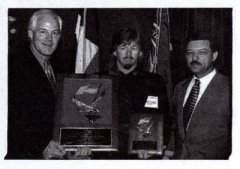
Tom Coleman receives Texas Lawman of the year award from John Cornyn

By Alan Bean

Michelle Alexander says police officers lie under oath because people are desperate to believe them.  There is only one oblique reference to Tulia, Texas in this opinion piece, but I can’t hear the phrase “lying police officer” without thinking about Tom Coleman, the gentleman receiving the Texas Lawman of the year award in the picture to the left.  Everybody was prepared to believe every word that proceeded from the mouth of this man.

Friends of Justice was organized by a ragtag collection of Tulia residents who were convinced Coleman was lying.  We couldn’t prove it to a scientific certainty.  But, as Judge Ron Chapman ruled four years after our fight began, the man was simply not credible under oath.  A close look at the facts made that patently clear.

But nobody wanted to look at the facts.

Why were so many people willing to bet the farm on Coleman’s truthfulness?  In this opinion piece written for the New York Times, Michelle Alexander provides some disturbing answers.

Why Police Lie Under Oath

By MICHELLE ALEXANDER

THOUSANDS of people plead guilty to crimes every year in the United States because they know that the odds of a jury’s believing their word over a police officer’s are slim to none. As a juror, whom are you likely to believe: the alleged criminal in an orange jumpsuit or two well-groomed police officers in uniforms who just swore to God they’re telling the truth, the whole truth and nothing but? As one of my colleagues recently put it, “Everyone knows you have to be crazy to accuse the police of lying.” (more…)

Back to Jesus!

Charles Kiker, February 2013

          First United Methodist Church in Tulia is presenting Adam Hamilton’s videos on world religions at our Wednesday night fellowship meals.  Adam Hamilton is the senior and founding pastor of Church of the Resurrection in Leawood, Kansas—a suburb of Kansas City.

          The video series consists of presentations regarding Hinduism, Buddhism, Islam, Judaism, and Christianity. Hamilton presents the backgrounds and major beliefs of the different religions. He points out common ground and differences with Christianity. He holds to Christian distinctives, but always respectfully and without rancor.

A recent video presentation was on Islam. Hamilton’s ground zero difference with Islam is that it is a religion of a book, the Koran, which Mohammed claimed was dictated to him word for word by the angel Gabriel, in the Arabic language.

But isn’t Christianity a religion of a book, the Holy Bible?

The title of a radio broadcast I often heard in the 60s was, “Back to the Bible.” That was and still is a kind of rallying cry for some Christians. Come back to the Bible. Be a people of the Book.

But ultimately, Hamilton insists, Christians are not a people of the Book, nor is Christianity a religion of the Book. Christianity is faith in a person, Jesus the Messiah, the Son of God.

I agree with Hamilton. And Hamilton agrees with John the Evangelist:

“In the beginning was the Word, and the Word was with God, and the Word was God. All things came into being through him, and without him not one thing came into being. What has come into being in him was life, and the life was the light of all people. The light shines in darkness, and the darkness did not overcome it” (John 1:1-5, NRSV). And John continued in verse 14:

“And the Word became flesh and lived among us. . . .”

Jesus is the Word of God. It is Jesus who shows us what God is like. We know Jesus from the book, but ultimately it is Jesus, not the book, to whom our allegiance is due.

My first Bible was a Christmas gift during World War II. It was an edition designed for members of the armed services. It had a patriotic olive drab cover to honor the men in uniform in World War II. It had the words of Jesus in red. It was a red letter Bible. We need red letter Bibles, but what we really need is red letter Christians. (more…)

Five myths about the immigration ‘line’


By Alan Bean

Daniel Kowalski provides a much needed corrective to much of the political blather surrounding the immigration debate.  The biggest myth about the immigration line is that most people who want to live in the United States have a line to get in.  They don’t.

I was particularly struck by this bold statement:

Our immigration policy runs counter to our national ethos of civil and human rights. Over the past century, we have come to believe that discrimination on the basis of race, gender, faith and sexual orientation — things that cannot be changed or that we cannot demand be changed — is morally wrong. Yet the Immigration and Nationality Act, by setting quotas on how many people can come from certain countries, is another form of discrimination.

Is there a national ethos of civil and human rights?  The anti-immigrant movement, and much of the historical information Kowalski provides in this essay, suggest that two equally powerful ethoses (ethi?) are vying for the upper hand.  This explains why our immigration policy is so radically unfair and why no politician dares tell the truth.

Five myths about the immigration ‘line’

By Daniel M. Kowalski

Daniel M. Kowalski is a senior fellow at the Institute for Justice and Journalism and the editor of Bender’s Immigration Bulletin. He practices citizenship and visa law in Austin at the Fowler Law Firm.

The “line” of people seeking American citizenship or legal status has become an integral part of our immigration debate. In a speech Tuesday, President Obama said that undocumented immigrants should go to “the back of the line” behind those who are going through the process legally. The immigration reform blueprint presented a day earlier by a group of senators contained the same requirement. But misinformation about this line abounds.

1. There is one line.

The federal government has issued more than 1 million green cards per year, on average, for the past five years. But there are several lines — which one immigrants end up in depends on whether they have a job or family in the United States. (more…)

The Lion and the Hyena

By Alan Bean

I received this graphic from a Facebook friend.  I clicked on “like”.  My friend probably wondered why.  I’m not sure.  Something about the image appeals to me.  The “conservative” is literally lionized, an invisible force for good.  The “liberal” is a scavenger, an impostor, a hyena attempting, in this case unsuccessfully, to feast on the carcass when he didn’t make the kill.

I have often felt like the hyena in the picture, a hapless liberal do-gooder confronting  the conservative juggernaut.  Nonetheless, I feel compelled to mouth off several sentences too many.

Some conservatives would reverse the image.  They see themselves as a lion surrounded by a pack of liberal hyenas.

These savanna fantasies obscure more than they illuminate.  “Liberal” and “conservative”, two grand words with a goodly heritage, are now debased currency.  When liberalism is associated with superficiality, debauchery, and profligate sentimentality, who wants to be a liberal?  When conservatism becomes a code word for racial bigotry, intolerance and privilege, who wants to be a conservative? (more…)